The UniTN Discourse Parser in CoNLL 2015 Shared Task:
Token-level Sequence Labeling with Argument-specific Models
Evgeny A. Stepanov Giuseppe Riccardi Ali Orkan Bayer
Signals and Interactive Systems Lab
Department of Information Engineering and Computer Science University of Trento, Trento, TN, Italy
{stepanov,riccardi,bayer}@disi.unitn.it
Abstract
Penn Discourse Treebank style discourse parsing is a composite task of identify-ing discourse relations (explicit or non-explicit), their connective and argument spans, and assigning a sense to these rela-tions from the hierarchy of senses. In this paper we describe University of Trento parser submitted to CoNLL 2015 Shared Task on Shallow Discourse Parsing. The span detection tasks for explicit relations are cast as token-level sequence labeling. The argument span decisions are condi-tioned on relations’ being intra- or inter-sentential. Non-explicit relation detection and sense assignment tasks are cast as classification. In the end-to-end closed-track evaluation, the parser ranked second with a global F-measure of 0.2184
1 Introduction
Discourse parsing is a challenging Natural Lan-guage Processing (NLP) task that has utility for many other NLP tasks such as summarization, opinion mining, etc. (Webber et al., 2011). With the release of Penn Discourse Treebank (PDTB) (Prasad et al., 2008), the researchers have de-veloped discourse parsers for all (e.g. (Lin et al., 2014) or some (e.g. (Ghosh et al., 2011)) discourse relation types in the PDTB definition, or addressed particular discourse parsing subtasks (Pitler and Nenkova, 2009).
PDTB adopts non-hierarchical binary view on discourse relations: a discourse connective and its two arguments –Argument 1andArgument 2, which is syntactically attached to the connective. And, a relation is assigned particular sense from the sense hierarchy. It was identified that pars-ing Explicitdiscourse relations, that are signaled by a presence of a discourse connective (a closed
class), is much easier task than detection and clas-sification of Implicitdiscourse relations, where a discourse connective is implied, rather than lex-ically realized. Since Explicit and Implicit dis-course relations in a document do not differ much in relative frequency, the low performance on one of the relation types limits the utility of discourse parsing for downstream applications.
In this paper we describe the University of Trento discourse parser for both explicit and non-explicit – implicit, alternatively lexicalized (Al-tLex), and entity (EntRel) relations – that was submitted to the CoNLL 2015 Shared Task on Shallow Discourse Parsing (Xue et al., 2015) and ranked 2nd. The parser makes use of token-level sequence labeling with Conditional Random Fields (Lafferty et al., 2001) for identification of connective and argument spans; and classification for identification of relation senses and argument configurations.
The parser architecture is described in Section 2. The features and individual model details are described in Sections 3 and 4, respectively. In Section 5 we describe official evaluation results. Section 6 discusses the lessons learned from the shared task and provides concluding remarks.
2 System Architecture
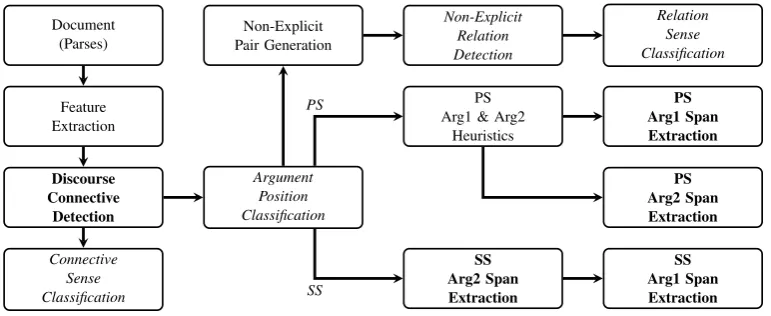
The discourse parser submitted for the CoNLL 2015 Shared Task is the extension of the parser de-scribed in (Stepanov and Riccardi, 2013; Stepanov and Riccardi, 2014). The overall architecture of the parser is depicted in Figure 1. The approach structures discourse parsing into a pipeline of sev-eral subtasks, mimicking the Penn Discourse Tree-bank (PDTB) (Prasad et al., 2008) annotation pro-cedure as in (Lin et al., 2014).
The first step is Discourse Connective Detec-tion (DCD) that identifies explicit discourse con-nectives and their spans. ThenConnective Sense Classification(CSC) is used to classify these
Document (Parses)
Feature Extraction
Non-Explicit Pair Generation
Non-Explicit Relation Detection
Relation Sense Classification
Discourse Connective Detection
Connective Sense Classification
Argument Position Classification
PS Arg1 & Arg2
Heuristics
PS Arg1 Span Extraction
PS Arg2 Span Extraction
SS Arg1 Span Extraction SS
Arg2 Span Extraction
[image:2.595.106.492.61.219.2]SS PS
Figure 1: Discourse parser architecture. CRF modules are inbold; classification modules are initalic.
nectives into the PDTB hierarchy of senses; and
Argument Position Classification (APC) to clas-sify the connectives as requiring their Argument 1in the previous (PS) or the same sentence as Ar-gument 2(i.e. classify relations as inter- and intra-sentential). With respect to the decision of the step anArgument Span Extraction(ASE) model is ap-plied to label the spans of both arguments.
SeparateArgument Span Extractionmodels are trained for each of the arguments of intra- and inter-sentential explicit discourse relations. Iden-tification of Argument 2 is much easier, since it is the argument syntactically attached to the dis-course connective. Thus, for the intra-sentential (SS) relations, models are applied in a cascade such that the output of Argument 2 span extrac-tion in the input for Argument 1span extraction. For the inter-sentential (PS) relations, a sentence containing the connective is selected asArgument 2, and the sentence immediately preceding it as a candidate for Argument 1. Even though in 9% of all inter-sentential relations Argument 1 is lo-cated in non-adjacent previous sentence (Prasad et al., 2008), this heuristic is widely used (Lin et al., 2014; Stepanov and Riccardi, 2013), and is known as Previous Sentence Heuristic.
In PDTB, the Non-Explicit discourse relations – Implicit, AltLex, and EntRel – are annotated for pairs of adjacent sentences except the pairs that were already annotated as explicit discourse re-lations (Prasad et al., 2007). Thus, in the Non-Explicit Pair Generation(NPG) step a list of ad-jacent sentence pairs is generated omitting the inter-sentential explicit relations identified in the APC step. In theNon-Explicit Relation Detection
(NRD) step the candidate pairs are classified as holding a relation or not. The pairs identified as
a relation are then classified into relation senses in theRelation Sense Classification(RSC) step.
Since the goal ofDiscourse Connective Detec-tionandArgument Span Extractiontasks is to la-bel the spans of a connective and its arguments, they are cast as token-level sequence labeling with CRFs using CRF++ (Kudo, 2013). The Non-Explicit Relation Detection andSense and Argu-ment Position classification tasks are cast as su-pervised classification using AdaBoost algorithm (Freund and Schapire, 1997) implemented in icsi-boost(Favre et al., 2007). In Section 3 we describe the features used for token-level sequence labeling and classification tasks; and in Section 4 models for each of the subtasks in more detail.
3 Features
Besides tokens, the PDTB corpus distributed to the participants contains Part-of-Speech tags, con-stituency and dependency parses. These resources are used to extract and generate both token-level and argument/relation-level features. Addition-ally, for argument/relation-level features Brown Clusters (Turian et al., 2010) are used.
3.1 Token-level Features
Discourse Connective Detection and Argument
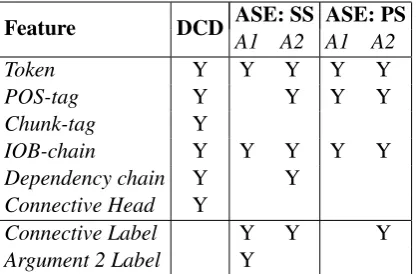
Span Extractiontasks of discourse parsing are cast as token-level sequence labeling with CRFs. The list of features used for the models is given in Ta-ble 1. Besides tokens and POS-tags, the rest of the features is described below.
Feature DCD ASE: SS ASE: PSA1 A2 A1 A2
Token Y Y Y Y Y
POS-tag Y Y Y Y
Chunk-tag Y
IOB-chain Y Y Y Y Y
Dependency chain Y Y
Connective Head Y
Connective Label Y Y Y
[image:3.595.77.286.62.199.2]Argument 2 Label Y
Table 1: Token-level features for Discourse Con-nective Detection (DCD) and Argument Span Ex-traction (ASE) for intra-sentential (SS) and inter-sentential (PS) explicit discourse relations.
chunk). The information is extracted from con-stituency parse trees using chunklink script (Buch-holz, 2000).
IOB-chainis the path string of the syntactic tree nodes from the root node to the token, similar to Chunk-tag, it is prefixed with the IOB informa-tion. For example, the IOB-chain ‘I-S/B-VP’ in-dicates that a token is the first word of the verb phrase (B-VP) of the main clause (I-S).The feature is also extracted using the chunklink script (Buch-holz, 2000).
Dependency chainis a feature inspired by IOB-chainand is the path string of the functions of the parents of a token, starting from root of a depen-dency parse. For example, the dependepen-dency chain ‘root/nsubj/det’ indicates that a token is a deter-miner of the subject of a sentence.
Connective Head is a binary feature that indi-cates whether a token is in the list of 100 PDTB discourse connectives. For example, all ‘and’ to-kens will have this feature value ‘1’.
Connective LabelandArgument 2 Labelare the output labels of theDiscourse Connective Detec-tion andArgument 2 Span Extraction models re-spectively. The outputs are the IOB-tagged strings ‘CONN’ and ‘ARG2’. Using these labels as fea-tures for Argument Span Extraction is useful for constraining the search space, since the Connec-tive, Argument 1 and Argument 2 spans are not supposed to overlap.
Besides the features mentioned above, we have experimented with other token-level features: (1) morphological: lemma and inflection; (2) depen-dency: main verb of a sentence (i.e. root of the dependency parse) as a string and binary feature;
(3) Connective Head as string. Even though previ-ous work on discourse parsing (e.g. (Ghosh et al., 2011; Stepanov and Riccardi, 2013) found these features useful in token-level sequence labeling approach toArgument Span Extractionusing gold parse trees, they were excluded from the submitted models since in greedy hill climbing their contri-butions were negative.
Using templates of CRF++ the token-level fea-tures are enriched with ngrams (2 & 3-grams) in the window of±2tokens. That is, for each token there are 12 features per feature type: 5 unigrams, 4 bigrams and 3 trigrams. All features are condi-tioned on the output label independently of each other. Additionally, CRFs consider the previous token’s output label as a feature.
3.2 Argument & Relation-level Features
In this section we describe features used for de-tecting non-explicit discourse relations and their sense classification. Since in these tasks the unit of classification is a relation rather than token, these features are extracted per argument of a relation and a relation as a whole.
Previous work on the topic makes use of wide range of features ranging from first and last tokens of arguments to a Cartesian product of all tokens in both arguments, which leads to a very sparse feature set. To reduce the sparseness in (Ruther-ford and Xue, 2014) the authors map the tokens to Brown Clusters (Turian et al., 2010) and improve the classification into top-level senses.
Inspired by the previous research, we have perimented with the following features that are ex-tracted from both arguments:
1. Bag-of-Words;
2. Bag-of-Words prefixed with the argument ID (Arg1 or Arg2);
3. Cartesian product of all the tokens from both arguments;
4. Set of unique pairs from Cartesian product of Brown Clusters of all the tokens from both arguments (inspired by (Rutherford and Xue, 2014));
5. First, last, and first 3 words of each argu-ment (from (Pitler et al., 2009; Rutherford and Xue, 2014));
7. Ternary features for pairs from 6 to indicate matches (1, 0) or NULL, if one of the argu-ments misses the feature (extension of ‘sim-ilar subjects or main predicates’ feature of (Rutherford and Xue, 2014)) (16 features); 8. Cartesian product of Brown Clusters of 6 (16
features);
These features are used for Non-Explicit Dis-course Relation Detection and Sense Classifica-tiontasks, which are described in the next section. 4 Discourse Parsing Components
In this section we describe individual discourse parsing subtasks discussing features and models.
4.1 Discourse Connective Detection
Discourse Connective Detectionis the first step in discourse parsing. The CRF model makes use of all the features in Table 3 (except Connective La-bel – its own output – and Argument 2 LaLa-bel – the output of downstream component). Using just cased token features (i.e. 1, 2, 3-grams in the win-dow of ±2 tokens already has F-measure above 0.85. Adding other features gradually increases the performance on the development set to 0.9379. Other than the token itself, the feature that con-tributes the most to the performance is IOB-chain.
4.2 Connective Sense Classification
Connective Sense Classification takes the output of Discourse Connective Detection and classi-fies identified connectives into the hierarchy of PDTB senses. We have experimented with two approaches: (1) flat – directly classifying into full spectrum of senses including class, type and sub-type (Prasad et al., 2008); and (2) hierarchical – first classifying into 4 top level senses (Compar-ison, Contingency, Expansion and Temporal) and then into the rest of the levels. For the purposes of the Shared Task partial senses (e.g. just class) were disallowed; thus, for the flat classification, instances having partial senses were removed from both training and development sets.
The flat classification into 14 senses using just cased token strings as bag-of-words yields the best performance and has accuracy of 0.8968 on the filtered development set using gold connec-tive spans. The 4-way classification into top-level senses on a full development set using just connec-tive tokens has accuracy of 0.9426. Adding POS-tags increases accuracy to 0.9456. Due to the error
propagation, going to the second level of the hi-erarchy drops the performance slightly below the flat classification. None of the other features listed in Table 1 has a positive effect on classification. Adding argument spans lowered the performance as well.
4.3 Argument Position Classification
Argument Position Classificationis an easy task, since explicit discourse connectives have a strong preference on the positions of its arguments, de-pending on whether they appear at the beginning or in the middle of a sentence. In the literature the task was reported as having a very high base-line (e.g. (Stepanov and Riccardi, 2013), 95% for whole PDTB). The features used for classification are cased connective token string (case here carries the information about connective’s position in the sentence), POS-tags and IOB-chains. The accu-racy on the development set given gold connective spans is 0.9868.
4.4 Argument Span Extraction
Argument Span Extraction models that make use of the Connective and Argument 2 Labels are trained on reference annotation. Even though, the performance of the upstream models ( Dis-course Connective DetectionandArgument Posi-tion ClassificaPosi-tion) is relatively high compared to theArgument Span Extractionmodels, there is still error propagation.
For the Argument Span Extraction of explicit relations the search space is limited to a single sentence; thus, all multi sentence arguments are missed. This constraint has a little effect on Argu-ment 2spans. However, since as a candidate for inter-sententialArgument 1 we use only immedi-ately preceding sentence, together with this con-straint we miss 12% of relations. Thus, detection ofArgument 1spans of inter-sentential relations is a hard task, additionally due to the fact that there is no other span (connective or Argument 2) to de-limit it. Even though we have trained CRF models for the task, previous sentence heuristic was per-forming with insignificant difference. Thus, the heuristic was selected for the submitted version, and it was augmented with the removal of sen-tence initial and final punctuation. ForArgument 2of inter-sentential relations performance of CRF models is acceptably high (≈0.80).
syntacti-cally attached to the connective; and performances are high (≈0.89on the development set using the features in Table 1). Thus, its output is used as a feature forArgument 1extraction. Interesting fact is that POS-tags have a negative effect on the Ar-gument 1 Span Extraction.
4.5 Non-Explicit Relation Detection
Based on the output ofArgument Position Classi-fication a set of adjacent sentence pairs is gener-ated as candidates for non-explicit discourse rela-tions: Implicit, AltLex, and EntRel. For training the classification models we have generated No-Relation pairs using reference annotation, exclud-ing all the sentences involved in inter-sentential re-lations (some rere-lations have multiple sentence ar-guments). Additionally, since arguments of non-explicit relations are stripped of leading and trail-ing punctuation, the No-Relation pairs were pre-processed. The task of detecting relations proved to be hard.
Similar to Connective Sense Classification we attempted (1) flat classification into all PDTB senses + No-Relation (i.e. merging the task with
Relation Sense Classificationdescribed in Section 4.6) and (2) hierarchical – first detect the pres-ence of a relation then classify it into the hier-archy of senses. For the hierarchical detection of Non-Explicit relations we tried (1) Relation vs. No-Relation classification and (2) classifica-tion into relaclassifica-tion types (Implicit, AltLex, EntRel) + No-Relation. The model that has the high-est F-measure for actual relations turned out to be binary Relation vs. No-Relation classification (0.6988). However, since in the testing mode we don’t have access to argument span information the performance is expected to drop significantly. The most robust feature combination for the task is Cartesian product of Brown Clusters of all the to-kens from both arguments and Cartesian product of Brown Clusters of predicate, subject and direct and indirect objects (4 and 8 from Section 3.2).
4.6 Relation Sense Classification
After a sentence pair is classified as a relation, it is further classified into the hierarchy of senses. The models are trained on all the features from Section 3.2, excluding prefixed Bag-of-Words and Carte-sian product of all tokens. Relations are classified directly into 14 PDTB senses + EntRel.
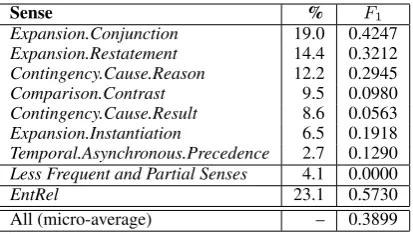
The task is extremely hard, the classification ac-curacy is 0.3899 and the model misses infrequent
Sense % F1
Expansion.Conjunction 19.0 0.4247 Expansion.Restatement 14.4 0.3212 Contingency.Cause.Reason 12.2 0.2945 Comparison.Contrast 9.5 0.0980 Contingency.Cause.Result 8.6 0.0563 Expansion.Instantiation 6.5 0.1918 Temporal.Asynchronous.Precedence 2.7 0.1290 Less Frequent and Partial Senses 4.1 0.0000
EntRel 23.1 0.5730
[image:5.595.312.519.61.178.2]All (micro-average) – 0.3899
Table 2: F-measures of non-explicit relation sense classification per sense, ordered by frequency in the training set.
senses. Table 2 lists the captured senses with their percentages in training data and F-measures on the development set. The distribution of senses has a direct effect on its F-measure.
The performances reported so far are on a spe-cific task without error propagation from the up-stream tasks. In the next section we report official Shared Task evaluation results.
5 Official Evaluation Metrics and Results The official evaluation of CoNLL 2015 Shared Task on Shallow Discourse Parsing is done on a per-discourse relation basis. A relation is con-sidered to be predicted correctly if the parser correctly identifies (1) discourse connective span (head), (2) spans and labels of both arguments, and (3) sense of a relation. The predicted connective and arguments spans have to match the reference spansexactly. Consequently, to get a true positive for a relation the parser has to get true positive on all the subtasks.
The task organizers also provided the evalu-ation script that reported precision, recall and F-measures for Discourse Connective Detection, joint Sense Classification scores for explicit and non-explicit relations, and joint Argument Span Extraction score for explicit and non-explicit lations. For argument spans three scores were re-ported: Argument 1 andArgument 2 individually and jointly. ForSense Classificationthe script re-ported performance on each of the senses and their macro-average. Later, performances for explicit and non-explicit relations were split. The partici-pants had to evaluate their systems on 3 data sets: (1) Development (WSJ Section 22), (2) Test (WSJ Section 23), and the blind test set annotated specif-ically for the Shared Task.
Explicit
Task Dev Test Blind
Connective 0.9219 0.9271 0.8992
Arg1 0.5646 0.5008 0.4903
Arg2 0.7748 0.7616 0.7068
Arg1&2 0.5075 0.4460 0.3959
Sense 0.4573 0.3260 0.2522
Parser 0.4760 0.3956 0.2997
Non-Explicit
Dev Test Blind
– – –
0.4586 0.4437 0.4329 0.4912 0.4744 0.5657 0.4000 0.3730 0.3831 0.0601 0.0678 0.0681 0.1577 0.1330 0.1577
All Relations
Dev Test Blind
[image:6.595.75.522.62.179.2]0.9219 0.9271 0.8992 0.5225 0.4775 0.4654 0.6230 0.6068 0.6260 0.4499 0.4065 0.3886 0.3121 0.2526 0.1887 0.3055 0.2536 0.2184 Table 3: Task-level and parser-level F-measures of the parser on the development, test, and blind test sets for explicit and non-explicit relations individually and jointly. The Sense values are macro-averages.
Team P R F1
lan15 0.2369 0.2432 0.2400
stepanov15 0.2094 0.2283 0.2184
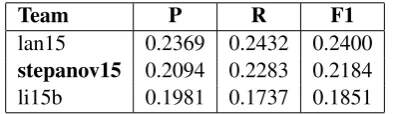
li15b 0.1981 0.1737 0.1851 Table 4: Parser-level precision (P), recall (R), and F-measures (F1) of the submitted system on the blind test set. UniTN system is inbold.
metrics (tasks) per evaluation set is reported indi-vidually and jointly for explicit and non-explicit relations in Table 3. From the results, it is clear that non-explicit Relation Sense Classificationis the hardest task. The next hardest task is inter-sententialArgument 1 Span Extraction. According to the organizers, the development, test and blind test sets are coming from the same domain. How-ever, we observe a gradual decline in performance from development to test and from test to the blind test sets for each of the tasks on explicit relations. For non-explicit relations, on the other hand, per-formances vary and in some cases the performance on the blind test set is the highest (Argument 2
spans).
The parser ranked the second on the test and the blind test sets and the third on the develop-ment set. For the comparison we also report per-formances of the systems ranked the first and the third in Table 4. The global F-measure of our parser on the blind test set is 0.2184, which is 0.0219 points lower than the first ranked system and 0.0333 points higher than the next best sys-tem. Comparing the performance with all the par-ticipants, we have observed that our parser main-tains higher recall across the subtasks.
6 Conclusion
In this paper we have presented University of Trento parser submitted to CoNLL 2015 Shared
Task on Shallow Discourse Parsing. We have described the discourse parsing architecture and models for each of the subtasks. The subtasks are categorized into span detection and classification. The span detection tasks are for explicit relations – Discourse Relation Detection and Argument Span Extraction; they are cast as token-level sequence labeling using Conditional Random Fields and ar-gument span decisions are conditioned on rela-tions’ being intra- or inter-sentential. Classifica-tion tasks – Connective Sense ClassificaClassifica-tion, Ar-gument Position Classification, Non-Explicit Re-lation Detection, and Non-Explicit ReRe-lation Sense Classification – employ AdaBoost algorithm.
Participation in the CoNLL 2015 Shared Task on Shallow Discourse Parsing gave the teams a unique opportunity to compare their discourse parsing approaches on the same training and test-ing splits and the same automatic features. Even though the ranking of submitted systems depends on performances of all the modules, we can con-clude that token-level sequence labeling for Argu-ment Span Extraction of explicit discourse rela-tions is a viable approach.
Participation additionally allowed us to identify potential points of improvement for our parser. For example, even though Discourse Connective Detection as sequence labeling has an F-measure of 0.8992 on the blind test set, it ranks 4th. Since it is the first step in the pipeline, increasing the ro-bustness of the model is essential.
Acknowledgments
[image:6.595.82.279.231.288.2]References
Sabine Buchholz. 2000. chunklink.pl. http://
ilk.uvt.nl/software/.
Benoit Favre, Dilek Hakkani-T¨ur, and Sebastien Cuen-det. 2007. Icsiboost. https://github.com/
benob/icsiboost/.
Yoav Freund and Robert E. Schapire. 1997. A decision-theoretic generalization of on-line learning and an application to boosting. Journal of Computer and System Sciences, 55(1):119–139, August.
Sucheta Ghosh, Richard Johansson, Giuseppe Ric-cardi, and Sara Tonelli. 2011. Shallow discourse parsing with conditional random fields. In Proceed-ings of the 5th International Joint Conference on Natural Language Processing (IJCNLP 2011).
Taku Kudo. 2013. CRF++. http://taku910.
github.io/crfpp/.
John Lafferty, Andrew McCallum, and Fernando C. N. Pereira. 2001. Conditional random fields: Prob-abilistic models for segmenting and labeling se-quence data. In Proceedings of 18th International Conference on Machine Learning, pages 282–289.
Ziheng Lin, Hwee Tou Ng, and Min-Yen Kan. 2014. A PDTB-styled end-to-end discourse parser. Natural Language Engineering, 20:151 – 184.
Emily Pitler and Ani Nenkova. 2009. Using syn-tax to disambiguate explicit discourse connectives in text. In Proceedings of the ACL-IJCNLP Con-ference, pages 13–16.
Emily Pitler, Annie Louis, and Ani Nenkova. 2009. Automatic sense prediction for implicit discourse relations in text. In Proceedings of the 47th An-nual Meeting of the ACL and the 4th IJCNLP of the AFNLP, pages 683–691.
Rashmi Prasad, Eleni Miltsakaki, Nikhil Dinesh, Alan Lee, Aravind Joshi, Livio Robaldo, and Bonnie L Webber. 2007. The Penn Discourse Treebank 2.0 annotation manual.
Rashmi Prasad, Nikhil Dinesh, Alan Lee, Eleni Milt-sakaki, Livio Robaldo, Aravind Joshi, and Bon-nie Webber. 2008. The Penn Discourse Treebank 2.0. InProceedings of the 6th International Confer-ence on Language Resources and Evaluation (LREC 2008).
Attapol T. Rutherford and Nianwen Xue. 2014. Dis-covering implicit discourse relations through Brown Cluster pair representation and coreference patterns. InProceedings of the 14th Conference of the Euro-pean Chapter of the Association for Computational Linguistics (EACL 2014).
Evgeny A. Stepanov and Giuseppe Riccardi. 2013. Comparative evaluation of argument extraction al-gorithms in discourse relation parsing. In Proceed-ings of the 13th International Conference on Pars-ing Technologies (IWPT 2013), pages 36–44, Nara, Japan, November.
Evgeny A. Stepanov and Giuseppe Riccardi. 2014. Towards cross-domain PDTB-style discourse pars-ing. InEACL Workshops - Proceedings of the Louhi 2014: The Fifth International Workshop on Health Text Mining and Information Analysis, pages 30–37, Gothenburg, Sweden, April. ACL.
Joseph Turian, Lev Ratinov, and Yoshua Bengio. 2010. Word representations: A simple and general method for semisupervised learning. InIn ACL, pages 384– 394.
Bonnie L. Webber, Markus Egg, and Valia Kordoni. 2011. Discourse structure and language technology. Natural Language Engineering, pages 1–54. Nianwen Xue, Hwee Tou Ng, Sameer Pradhan, Rashmi