Distributed Approch Using NSGAII Algorithm to
Solve the Dynamic Dial a Ride Problem
A. RADDAOUI, I. ZIDI, K. ZIDI, K. GHEDIRA
Abstract— THE DRP (dial a ride problem) consists on determining and planifiying the operated tours of vehicles in order to satisfy the user’s requests hoping to become origin’s points to destination’s points.
The DRP is bind to NP- difficult problems, in order to solve it, many researchers have been used multi objective approached methods; actually our approach consists on reducing the number of vehicles, reducing the route’s time and increasing the customer’s number.
In this paper, we propose our contribution which is a distributed approach based on a multi-agent system( made to decompose the problem and to model the heterogeneous vehicle), and an instance of the genetic algorithm (NSGAII). The process of the proposed approach is shown through an illustrative example.
Keywords- Distributed GA NSGAII, Mutli-objectve Simulated Annealing Algorithm, DRP, Multi-objective algorithm, DRP, SMA.
I. INTRODUCTION
The DRP (Dial a Ride Problem) consists in determining and planning the tours operated by vehicles in order to satisfy user’s requests wishing to be transported from origin to destination.
In this paper, we propose our contribution of DRP responsive transport with the use of a distribution of the genetic algorithm NSGA II (DNSGAII).
The DRP consists on responding the actual transport’s requests via the vehicles ‘fleet under a number of feasibility and functioning constraints. DRP is a problem belonging to the NP-difficult class [1]. The accurate methods are unable to solve this kind of problem in a reasonable time especially when the problem is so big [2]. In this case, we are obliged to use methods that permit us to find an approached solution in an acceptable time. It is about the heuristics and meta-heuristics, like those which are based on genetic algorithm, simulated annealing and taboo searches.
A.Raddaoui is with the University of Tunis, SOIE-Management Hight Institue, 41, Liberty street Le Bardo 2000, Tunisie (e-mail: [email protected] ).
I.Zidi is with the University of Gafsa, Faculty of Sciences of Gafsa, Zarroug, Gafsa 2112, Tunisie (e-mail: [email protected]).
K.Zidi is with the University of Gafsa, Faculty of Sciences of Gafsa, Zarroug, Gafsa 2112, Tunisie (e-mail: [email protected] ).
K.Ghedira is with the University of Tunis, SOIE-Management Hight Institue, 41, Liberty street Le Bardo 2000, Tunisie (e-mail: khaled.ghedira.isg.rnu.tn ).
II. RELATED WORKS
A DARP (Dial-a-Ride Problem) is an extension of the PDP where the goods are individuals, leading to some additional technical constraints due to transport of persons for example, the fact of having a single point of embarkation by landing point and vice versa, and the obligation to comply with specific deadlines.
Dial a Ride Problem or Demand Responsive Transport (DRT) as defined by common road transport, is a special case of DARP where service quality can be measured in terms of comfort and friendliness, ergonomics, forms of trajectory in relation with origins and destinations, considered the requests in real time, etc… [3].
Generally, a DRP is an extension of the PDP (Pickup & Delivery Problem) in which the freight is replaced by the transport of persons [4]. In the article [5] we find a more detailed of the state of the art of this problem. The DRP has been extensively studied in the literature. We distinguish several variants of the DRP. Indeed, there are DRP with or without time windows and dynamic and static DRP. In the case of dynamic DRP, the problem is usually treated as a succession of static problem [6].
The majority of research works has been focused on the static DRP while for example [7] have solved the dynamic DRP. When the problem is of small size, we tend to use exact methods to solve it. In this context we mention the work of Psaraftis who used an exact algorithm of dynamic programming to solve the problem with a single vehicle [2]. He studied the case where there are windows of time imposed at points of departure and arrival for each demand. Again using the exact methods, we find the work who resolved the DRP with the method of Branch and Bound. With the increasing of requests for transportation in a DRP, the researchers thought the problem with heuristic and meta-heuristic methods. These methods allow reaching an acceptable solution of the problem in the reasonable time. In this context, we cite the main work such as Mauri et al, where the authors solved a multi-objective DRP [8]. They applied their approach on data derived from the benchmark presented in [9]. Indeed, they developed a simulated algorithm based on three local search methods. Cordeau et al, have applied the tabu search algorithm to solve the problem.
III. MATHEMATICALFORMULATIONOFDRP The DRP has been modeled mathematically in several research works. It is general modeled by a multi-objective mathematical program. In this section, we present the mathematical modeling of our DRP, our model is based on Zidi et al. This model is characterized by two main objectives. The first one is economic, and the second models the quality of service rendered to travelers [11].
A. Variables ODRP
n : Number of transport requests.
D = {1,..n} : Pickup locations.
A = {n +1,..2n} : Delivery locations.
M = {0,..m} : set of depots.
N = D A M : The set of all nodes in the graph.
V = {0,...v} : Set of vehicles.
Qv: Capacity of a vehicle.
q : Amount loaded onto vehicle at node i. qi = qn+i.
[ai bi] : time window of nod i.
[a i+ n b i +n] : time window of node i+n.
Cijv = Cij Cv: Cost of travel from i to j with the vehicle
such that Cv is the cost of using vehicle v.
T i jv: Travel time from i to j with the vehicle v.
T siv : Start time of service for the request i with the
vehicle v.
T aiv: Arrival time for the resuest i with the vehicule v.
NSV i : The number of stations visited by a transport
demand i.
L iv: The load of vehicle k after visiting node i.
X ijv: Decision variable of the problem, X ijv =1 if the
vehicle v takes a direct path from i to j, else X ijv=0.
B. The objectives functions
Global objective function:F = Economic criterion + Service quality criterion
Economic criterion:
Service quality criterion:
The Service Quality (SQ) criterion is composed by three major’s criteria, the first one is the Ride Time (RT) criterion and the second is the Number of Stations Visited (NSV) criterion and the third is the Satisfaction of the demands of transport in term of vehicle (STF). In our formulation for the DRP, we don’t attribute weights to the objectives of the problem because we use the domination concept in the resolution of the multi-criteria DRP. Indeed the proposed approach does not use an aggregative method to solve multi-criteria problems. It applies the concepts of Pareto optimality to find the best compromise solutions to the problem. So, it reduces the set of possible solutions for the considered problem.
RT: Ride time
NSV: Number of Stations Visited
STF: Satisfaction of the demands of transport in term of vehicle
AS:
With
We can rewrite RT (3) using the decision variable
X
ijvAs
RT
i =
Vi i
i j VvV ijv ijv
T
X
C. Mathematecal model
Minimize
(ECO(
X
ijv)+RT(X
ijv)+NSV(X
ijv)- STF(X
ijv))Subject to
D. Description of constraintes
(8): The objective function of the Dial a Ride Problem taking into account the quality of service rendered to passengers.
i j vN
XijvCijvECO = (1)
QS = RT + NSV+STF (2)
(Taiv - Tsiv)
RT =
vV
iD
(3)
STF =
D ii
STF (5)
(4) NSV = NnNSVi
iD
Number of satisfaction criterain terme of vehicule Number of preferences of demand i
i
STF=
STF =
D ii
RT
(6)(7)
(8)
jN
Xijv = 1 iD
v V
(9)
Xijv -
X
j, n+i, v= 0
vV,iD (10)jDᴜA jDᴜA
X
ijv-
X
ijv= 0
j
A
D
,
v
V
iN iN
(11)
(12)
X
ijv(T
siv+T
ijv-T
sjv)
≤
0
v
V
, (
i
,
j
)
a
i≤
T
siv≤
b
i
i
N
,
v
V
(13)Xijv (Liv + qvj - Ljv ) vV, (i, j)N (15)
qiv≤ Liv≤ Qv iD, vV (16)
Lmv= 0 mM, vV (1 7)
Xijv (18)
(9): Each customer will be assisted once, for just a vehicle. (10): A delivery place will always be in the same route that its respective pick-up place.
(11): The flow contention (everything that enters is the same to everything that leaves).
(12): Ensures that the arrival time at location j must be later than the sum of departure time from location i and travelling time, ti, j between the locations if that leg is to be part of the route.
(13): A vehicle v must satisfy the time window of node i (14): A vehicle v must satisfy the time window of Delivery location i + n.
(15): Ensures that the number of passengers passed on a path (i, j) by a vehicle v is conserved.
(16): The number of passengers in the vehicle v after visiting i is higher than that collected in i and less than the capacity of vehicle.
(17): Ensures that he actual loads of the vehicles are set to zero at the depots.
(18): guarantees that decision variables Xijv will be binary
IV. BASEDALGORITHM
Two basic algorithms are compared in this paper: the Objective Simulated Annealing (MOSA) and the Multi-Objective Genetic Algorithm (NSGA-II).
A. Simulated annealing algorithm
The Simulated Annealing (SA) algorithm is a method following the process used in metallurgy. SA algorithm was originated by Metropolis et al [12]. SA was developed from the so-called "statistical mechanics" idea. Annealing is the process through which slow cooling of metal produces good, low energy state crystallization, whereas fast cooling produces poor crystallization. The optimization procedure of simulated annealing reaching an approximate global minimum mimics the crystallization cooling procedure. SA is classified among the research methods operating locally; it can make changes to the current solution to exit a local optimum. Generally, suddenly reducing high temperature to very low (quenching) cannot obtain this crystalline state. In contrast, the material must be slowly cooled from high temperature (annealing) to obtain crystalline state. During the annealing process, every temperature must be kept long enough time to allow the crystal to have sufficient time to find its minimum energy state. The local search continuously seeks the solution better than the current one during the searching process.
The approach based on the (MOSA) algorithm developed in this agent is composed by 3 major’s procedure.
The first procedure is used to get an initial solution of problem. The initial solution of the MOSA algorithm is generated by a distribution heuristic. In the second procedure is the neighbourhood structure. It is used in the MOSA algorithm to generate a neighbourhood solution to improve the current solution of the DRP.
B. Genetic algorithm NSGAII
NSGA-II [13] is based on GA and is an extent of NSGA. The improvements presented by NSGA-II are: (1) a fast nondominated sorting algorithm, (2) an elitism approach, and (3) none sharing parameter method. In brief, the procedure can be summarized as follows:
Step 0: Initialization: Generate an initial;
Step 1: Sorting: Sort the population into each front by nondomination, so that (1) the first front is completely non-dominant by any other individuals; (2) the second front is dominated only by the individuals in the first front; and (3) the front goes so on. Fitness value is assigned to each front by 1 for the first front, 2 for the second, and so forth.
Step 2: Crowding Distance: Assign crowding distance to each individual in each front. It is measured by how close an individual is to its neighbors. The main idea behind crowding distance is finding the Euclidian distance between each individual in a front based on their m-objectives in the dimensional hyper space. The individuals in the boundary are always selected since they have infinite distance assignment.
Step 3: Selection: Select individuals by a crowded comparison operator;
Step 4: Crossover: as usual Genetic Algorithm;
Step 5: Mutation: as usual Genetic Algorithm;
Step 6: Convergent criterion: Repeat Step 1~5 in the offspring population until convergence. As mentioned above, NSGA-II is efficient in solving multi-objective problems due to the sorting procedure. Moreover, the fast sorting decreases the complexity to O(mn2) from O(mn3) for NSGA, where m is the number of objectives.
In 2012, Amara et al propose a new hybrid approach using GA to select the relevant feature an OCR System [14]
Advantage: this new version of NSGA requires no
parameters to set for the maintaining of diversity. It reduced the complexity of the algorithm.
Disadvantage: the mechanism of evolution of NSGA-II is
such that from a certain generation, the entire population is contained in the first Pareto front. At this point, solutions located in highly populated areas can be eliminated by leaving room for non-dominated solutions in the current population but are not optimal.
V. APPROCH BASED ON DISTRIBUTED GENETIC
ALGORITHM NSGAII(DGA-NSGAII)
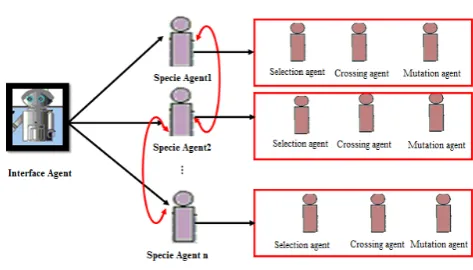
[image:3.595.306.543.536.671.2]A. Architecture of our approch
Fig 1. Architectur of our approch
1. Crossover of the selected sub-population. 2. Update the obtained sub-population (Child). 3. Mutation of the sub-population child crossed.
4. Update the mutated sub-population child. 1. Creation of initial population (cities, deposits, liaison ...) 2. Sort by rank
Do
3. Creating an agent for each species rank
4. Launch the local genetic algorithm to each agent species
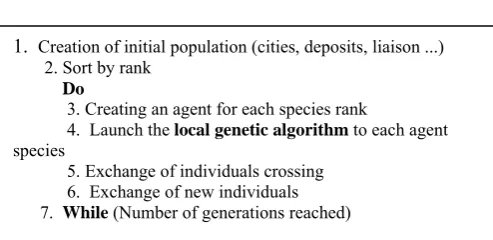
5. Exchange of individuals crossing 6. Exchange of new individuals 7. While (Number of generations reached) Based on the work of [16], our approach is
reflected on the distribution individuals by each species to control crossover and mutation. It is inspired particularly the theory of ecological niches and species. To solve the DRP, we must define our initial population, the sorting of this population (by rank), for this we use the multi-agent approach as a platform responsible for distribution of NSGA-II.
The approach we propose is particularly inspired from the theory of ecological kennels and species. In fact in nature, living beings are subdivided into a number of species.
Given a DRP, the Interface agent generates an initial population randomly. Thereafter, this initial population is subdivided into sub-populations, at that time; the Interface agent creates a specie agent for each sub-population and then requests him to begin implementing its genetic algorithm.
B. Description of agents
Any agent has the structure composed of:
-His contacts (agents it knows and with which it can communicate)
-The Static knowledge - The dynamic knowledge. Species Agents
Species as an agent has:
•Contacts: Other species agents and Interface agent
•Static knowledge: variables and constraints of the problem, parameters of the local genetic algorithm (mutation probability, crossover probability, number of generations, etc...)
• Dynamic knowledge: is the population of chromosomes varies from one generation to another.
Interface agent
Interface has an agent as:
• Contact: all the species agents, • Static knowledge: data of the problem (DRP)
• Dynamic knowledge: best chromosome (best partial solution) [17].
VI. DETAILED DESCRIPTION OF OUR APPROCH
Each species agent can crossing and mutate with other species agents, to select an agent, a simple call will be made to the responsible agent for this operator, the same crossover and mutation.
In our case, we always take the best individuals in each row to make the crossing. This choice is not random In fact; each species agent begins its genetic process on its own initial subpopulation initial.
This process gives the value returned to a subpopulation which is subjected to the process of crossing and mutation once, which corresponds to a generation.
We recall that the agents will continue their behavior as the stopping criteria specified by the user is not yet reached. Indeed, if an agent receives a message, it stops its behavior, saves the context, updates its local knowledge, and thereafter takes the context and his behavior at a time.
A. Global Distributed Genetic Algorithm NSGAII
Fig 2. Global Distributed Genetic Algorithm NSGAII
First, we will create our initial population randomly, if this population is created, it will be organized by the principal non-domination in many ranks.
NR= number of ranks.
In this stade, the interface agent will create the species agent.
NAE= number of the species agent. NR must be equal to NAE (NR=NAE).
Every species agents is composed of a selection agent, a crossing agent and mutation agent. This species agent its self will create its own local genetic algorithm, this event will be repeated until the stopping condition is satisfied.
[image:4.595.304.551.68.188.2]B. Local Distributed Genetic Algorithm NSGAII
Fig 3. Local Distributed Genetic Algorithm NSGAII
In the local algorithm, there is a species agent (which is responsible of crossing) the one who will cross the selected sub population, then the interface agent update the crossed sub population. And them, this crossed sub population will be mutated by the mutation agent.
Finally, the interface agent updates this sub population.
VII. OBTAINEDRESULTS
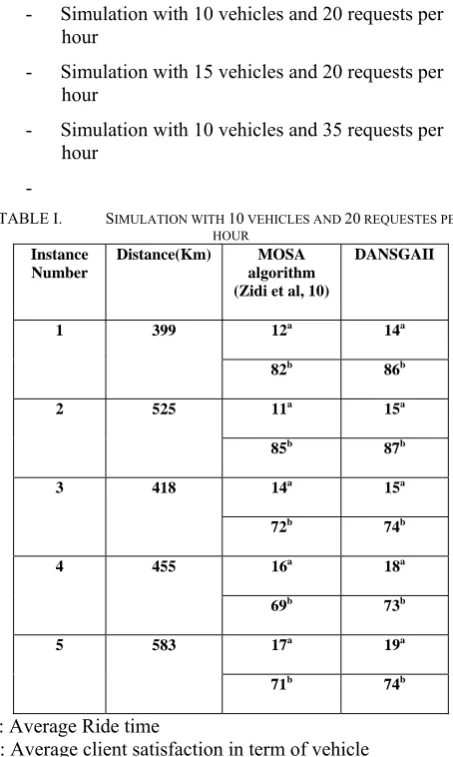
In our approach, we compared the average travel time, customer satisfaction in terms of vehicles and a run times, we take three examples:
- Simulation with 10 vehicles and 20 requests per hour
- Simulation with 15 vehicles and 20 requests per hour
- Simulation with 10 vehicles and 35 requests per hour
-TABLE I. SIMULATION WITH 10 VEHICLES AND 20 REQUESTES PER HOUR
Instance Number
Distance(Km) MOSA algorithm (Zidi et al, 10)
DANSGAII
1 399 12a 14a
82b 86b
2 525 11a 15a
85b 87b
3 418 14a 15a
72b 74b
4 455 16a 18a
69b 73b
5 583 17a 19a
71b 74b
a: Average Ride time
b: Average client satisfaction in term of vehicle
TABLE II. SIMULATION WITH 15 VEHICLES AND 20 REQUESTS PER HOUR
Instance Number
Distance(Km) MOSA algorithm (Zidi
et al, 10)
DANSGAII
1 468 14a 16a
60b 70b
2 483 13a 15a
85b 86b
3 480 14a 17a
51b 61b
4 412 15a 16a
70b 72b
5 548 16a 18a
76b 80b
TABLE III. SIMULATION WITH 10 VEHICLES AND 35 REQUESTES PER HOUR
Instance Number
Distance(Km) MOSA algorithm (Zidi
et al, 10)
DANSGAII
1 359 14a 16a
65b 70b
2 405 15a 15a
71b 72b
3 310 15a 16a
70b 70b
4 310 15a 15a
70b 71b
5 449 17a 19a
61b 64b
TABLE IV. COMPUTINGTIME(INSECONDS)
MOSA algorithm DANSGAII
52S 72S
In our tests, the time is in minutes, traveled distance in kilometer and the client satisfaction is in percent rounded to the nearest integer. In Table 1, 2 and 3, we present the results obtained by the application of the DNSGAII on five instances of problems.
After presenting our results and the results obtained in [11], we notice that our approch shows results better than those of [11] in term of average client satisfaction in term of vehicle, because the DNSGAII have an advantage in multi-objective optimization, is its ability to find multiple solutions thanks to diversification the solutions over the Pareto frontier. But the résults obtained by [13] is better than those of our results in terme of average ride time and comptuting time because the MOSA can find a set of Pareto solutions in a short time this is important if you need a rapid response, and then find more solutions by repeating the trials for detailed information about the Pareto frontier.
VIII. CONCLUSION
[image:5.595.52.279.90.469.2]However, improvements can be made on our approach: -Hybridization of DGA NSGA-II with other methods or accurate algorithms;
-Application of the approach on real data;
-Improvement of the stoppage conditions of our genetic algorithm such as the stability (convergence);
-Improvement of the stoppage conditions of our genetic algorithm to accelerate convergence but without falling on local optima (premature convergence).
REFERENCES
[1] I. Li Gørtz , “Hardness of Preemptive Finite Capacity Dial-a-Ride”, 2006.
[2] H.N. Psaraftis,“A dynamic programming approach to the single-vehicle, many-to-many immediate request dials a ride problem”, 130–154, 1980.
[3] J.Nelson,"Demand Responsive Transport Services: Toward the Flexible Mobility Agency”,Italy: ENEA,2004.
[4] S. O. Krumke, W. E. de Paepe, D. Poensgen, M. Lipmann, A. Marchetti- Spaccamela and L. Stougie,” On minimizing the maximum flow time in the online dial-a-ride problem”, 2006. [5] J.F.Cordeau and Laporte, “The Dial-a-Ride Problem: Models and
Algorithms. Les Cahiers duGERAD G–2006–78, 2006.
[6] M. Nabaa, B. Zeddini and P. Tranouez, « Approche décentralisée pour résoudre le problème du transport à la demande », 2004 [7] N.H.M. Wilson, Sussman, J.Wong and H.Higonnet,”Scheduling
Algorithms for dial-a-ride systems. Technical Report USL TR-70-13,
Urban SystemsLaboratory, Massachusetts Institute of Technology,
Cambridge, MA, 1971.
[8] G.R. Mauri, L.A.N. Lorena, “A Multiobjective Model and Simulated Annealing Approach for a Dial-a-Ride Problem”, Workshop dos
Cursos de Computação”, 2006.
[9] J.F.Cordeau and Laporte, “A Tabu Search Heuristic for the Static Multi- Vehicle Dial-a-Ride Problem”,Transportation Research B 37, 579-594, 2003.
[10] T.Garaix,J.Didier, Feill, Dominique, A.Christian and C.Élodie, « Transport à la demande points à points en zone peu dense. Proposition d’une méthode d’optimisation de tournées, 2005. [11] I. Zidi, K. Zidi,K. Mesghouni and k. Ghedira, “A Contribution to the
Modeling and the Resolution of a Multi-objective Dial a Ride Problem”, The Second International Conference on Engineering Systems Management & Applications, 2010.
[12] M.P.Vecchi, S. Kirkpatrick,D.C. and Gellat,”Optimization by simulated annealing. Science”, vol 220:pp 671- 680, 1983.
[13] K.Deb, A. Pratap, S.Agarnwal, and T.Meyarivan,”AFast Elitist Multiobjective Genetic Algorithm: NSGAII”, IEEE Transactionon Evolutionary 6, no, 182-197, 2002.
[14] M.Amara and K. Zidi, Feature Selection Using a Neuro-Genetic Approach For Arabic Text Recognition, in the Proceedings of the The 4th International Conference on Metaheuristics and Nature
Inspired Computing, Sousse, Tunisia, 2012.
[15] K. Deb, S. Agrawal, A. Pratap and T. Meyarivan,”A fast and elitist multiobjective genetic algorithm for multi-objective optimization: NSGA-II. In Proceedings of the Parallel Problem Solving from Nature”, 849-858, 2000.
[16] S. Bouamama, B. Jlifi and K. Ghédira,”D2G2A: a Distributed Double Guided Genetic Algorithm for Max_CSPs”, Springer, 2003. [17] A. Raddaoui and K. Zidi, “Distributed Genetic Algorithm NSGA II
for solving the DRP”, in the Proceedings of the The 4th International
Conference on Metaheuristics and Nature Inspired Computing,