2017 3rd International Conference on Electronic Information Technology and Intellectualization (ICEITI 2017) ISBN: 978-1-60595-512-4
A Distributed Method for Dynamic Adjusting
of the Task-Platform Relation
Jieyong Zhang, Songhua Huang, Peng Sun, Guanyu Chen*
and Ruijie Wu
ABSTRACT
Dynamic adjusting of the task-platform relation is a hotspot problem in military operational command field during the wartime, and a distributed method for it is present in this paper. Firstly, the constituent part of the distributed military strength organization is represented, and then a distributed coordination framework of the dynamic adjusting of the task-platform relation is designed. This coordination framework has two parts: the intra-module and the external cooperation module. The intra-module combines with an N-best algorithm and a tradeoff strategy to achieve the allocation once again in the inner of decision maker; and the external cooperation module achieves the collaboration between decision makers when task accuracy is less than the desired accuracy. Finally this method for dynamic adjusting of the task-platform relation is proved to be effective through simulation experiment, and the applicability of this method in different situations is also discussed.
________________________________
Jieyong Zhang, Songhua Huang, Science and Technology on Information Systems Engineering Laboratory, Jiangsu, China;
Jieyong Zhang, Peng Sun, Guanyu Chen* E-mail:[email protected], Ruijie Wu, Institute of Information and Navigation, Air Force Engineering University, Shanxi, China;
Jieyong Zhang, Songhua Huang, Collaborative Innovation Center for Novel Software and Industrialization, Jiangsu, China;
INTRODUCTION
Scientific allocation of platforms is the core issue of task planning research [1],
[2]. This problem can be described as follows [3], [4]:The goal of the battle is to
complete the mission, and tasks are the sub-goals of the mission. There are time constraints between tasks, and a task is an activity that requires a set of relevant resources to be processed; a platform is a physical entity with specified resource capabilities to execute the resulting plan. The problem of task planning is to allocate platforms to tasks substantially.
Reasonable task planning is of great significance for the battle command. To establish mathematical model by minimizing the completion time of the mission, Levchuk proposed a multidimensional dynamic list scheduling (MDLS) algorithm in three-phrase normative design of organization [5]-[7]. Zhang formulated a cycle MDLS algorithm to solve the allocated problem with constraints of the completion time [8]. In general, there is a great environmental uncertainty in the warfare, such as the processing time of the task, the depletion of the platform and so on. Considering this uncertainty, Mo and Zhang put forward a new mathematical model maximizing the probability of mission completion [9], [10].
The above methods belong to centralized task planning. To cope with the uncertain and dynamic mission environment [11], [12], the military strength organization pattern has varied from a centralized control to a more flexible distributed delayering control. Due to the limited of decision-making ability, command and control is centralized in large-scale organization. Distributed decision-making reduces the work load of decision-makers, and increases the scheduling efficiency of platforms which means decision-makers having more autonomy. An important research problem is how to realize the maximization of decision benefits. Park put forward a distributed auction algorithm under different communication structure [13]. On account of large-scale nonlinear planning problem, Han proposed an optimization-based distributed planning algorithm based on blackboard collaborative framework [14].
In this paper, our work focuses on the distributed and dynamic planning adjusting. The paper is organized as follows. We introduce the key concepts describing the distributed planning problem and mathematical formulations in Section 2. We proposed a distributed collaborative framework to realize the planning dynamic adjusting in Section 3. In Section 4, we present the simulation results and empirical results from the experiment. This paper concludes with summary and future directions for research in Section 5.
PLANNING ENVIRONMENT
Definition 1 Resource:A resource is a measurable physical or virtual entity used in the processing of tasks, and each task is specified by resource requirements in each functional resource category, and each platform provides resource capabilities.
Definition 2Task:A task is an activity that requires a set of relevant resources to be processed. A task i (i=1, 2 …I) is characterized by the following properties. I is the number of tasks.
1)ts i, :the start time of task i.
2)tp i, :
the processing time of task i.
3)Ril = (Ril,…,RiL) : resource requirement vector, where Ril is the number of
units of resource type l l( 1,..., )L required for successful processing of task i. 4)i= priority of task i.
Definition 3 Platform:A platform is a physical entity with specified resource capabilities that can be used to process tasks. Each platform type j j( 1,..., )J is defined by its properties as follows.
1)rj(rj1,...,rjL)
: resource capability vector, where rjl is the number of units of resource type l possessed by platform type j.
2)nj: the number of available platforms for platform type j.
Definition 4 DMs:DMs are intelligent entities who utilize knowledge and wisdom of the planning domain to select an appropriate plan among a range of alternative scenarios. Each DM is defined by its properties as follows.
1) m { ,...,1 } T
DM NT
S T T
= the set of tasks owned by DMs, NT is the number of tasks.
2) m { ,...,1 } P
DM NP
S P P
= the set of platforms dominated by DMs, NP is the
number of platforms.
DISTRIBUTED PLANNING PROBLEM
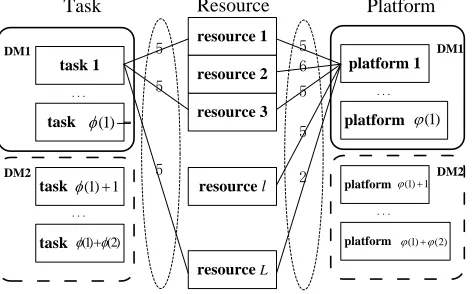
The planning problem is one of matching platforms’ capabilities to the tasks’ requirements over the resource categories as shown in Figure 1. However, each DM
p has only a limited number of platforms ( )p and a set of assigned tasks ( )p for which he/she is responsible. We define the allocation relationship between tasks and
platforms. The platform allocation of task i is shown as follows.
1
T
[ ,..., ,..., ]
, 0
i ij iJ
ij ij
y y y
y y
i y
Where yij indicates how many platforms of type j are allocated to task i and Z is
the set of integers.
task 1
task task (1)
(1) 1
task (1)(2)
...
...
platform 1
platform platform (1)
(1) 1
platform (1)(2)
... ... DM1 DM1 DM2 DM2 resource 1 resource 3 resource 2
resource l
resource L
Task Resource Platform
[image:4.612.189.425.121.268.2]5 5 5 5 2 5 6 5
Figure 1. Distributed planning problem.
Individual Task Model
To solve the problem of matching platforms’ capabilities to the individual task requirements, we introduce the concept of accuracy to evaluate how well the
platforms’ capabilities match the tasks’ requirement. Each resource category l has a
satisfaction degree zil and we compute the radio of assigned resources to the require
resources for each resource category l. When the radio is greater than 1 which means
this kind of resource is enough, we set zil= 1; Otherwise, we set zil= radio. We seek a
task execution accuracy metric zi as follows.
1 1
min(1, / )
[ ,..., ,..., ] i
z
il
i il iL
J
jl ij il j
z r y R
z z z
(1) il zis the satisfaction degree of resource category l. To define the accuracy well, we adapt the geometric mean as our accuracy metric. On the one hand, the accuracy is 0 if missing any required resource category; on the other hand, increasing the minimum ratio will increase the accuracy the most.
1 ( ) ( )
( ) ( )r i il l r i
Acc i z
(2)Here, r i( ) denotes the set of resource categories required by task i. r i( ) is the cardinality of r i( ).
1
max ( )
. . 0
Z,0 ,
J
ij j
ij ij j
Acc i s t y D y y n j
(3)D is the upper bound on the number of platforms that can be allocated to an individual task; nj
is the available number of platform j. The individual task planning problem in (3) is a mixed integer nonlinear programming problem (MINLP), and this problem can be transformed into a integer linear programming problem [14], so we rewrite (3) as
( )
1
1
max
. . , 1
0
Z,0 ,
il l r i J jl ij il il j il J ij j
ij ij j
z r y s t z z
R y D y y n j
(4)Platform Pricing Model
Distributed task planning dynamic adjusting problem can be described like this: When the environment of battlefield gets changed, a DM can’t accomplish tasks only using his own platforms. So we need to adjust the platform allocation plan to adapt the exchange variation of environment. To get tasks executed well, a DM need borrow some platforms from other DMs with a price. So, we write down the platform pricing model to evaluate this price. There is a matching degree vil of each resource category l between platform j and task i. We compute the radio of resources owned by platform j to the require resources for each resource category l. When the radio is greater than 1 which means this kind of resource is matched completely, we set vil= 1; otherwise, we set vil= radio. We seek a platform matching degree metric vi as follows
1
min(1, / )
[ ,..., ,..., ]
i v
il
i il iL
ij il
v y R
v v v
(5)
Here, vil denotes the matching degree between platform j and task i. Then, we
( ) / ( ) ( )
r i
il l j
v
E i num j
r i
( ) (6)num(j) denotes the number of platform j. Platform j has different price to different task. Finally, we compute the weighted average of them to get the final platform’s price.
1
1 2
( ) ( )
...
NT i j i
NT
E i price j
(7)i
is the weight of task i, and price j is the price of platform j. ( )
Optimizing Target
ADM must pay the price if he/she need borrow some platforms from other DMs, and formulation (7) measures this price. The set of platforms borrowed from other DMs is Sborrow { ,...,P1 PN}; N is the number of platforms. The final
benefit of a DM equals to the sum of all tasks’ accuracy subtracting the price of platforms that borrowed from other DMs. Revenue function of a DM is as follows.
1 ,
( ) ( )
T DM
NT N
i
j i i S
W Acc i price j
(8)In distributed environment, global profit is the sum of all DMs’ profits. So the final target of this model is to maximize the global profit.
1 1 , 1
max ( ) { ( ) ( )}
T DM m
M M NT N
i
m m i i S j
V W m Acc i price j
(9)COLLABORATION FRAMEWORK
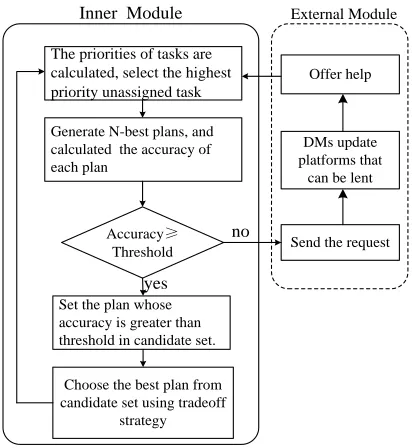
The first part is an inner platform allocation module. When these parameters have changed, a DM tries to adjust the allocation plan by using his/her own platforms to meet the requirements of tasks.
The second part is an external collaboration module. If the accuracy of a task is less than the desired accuracy threshold via inner module, the DM send out a request to other DMs to borrow necessary platforms to improve the accuracy to the desired accuracy threshold with least price.
The priorities of tasks are calculated, select the highest priority unassigned task
Generate N-best plans, and calculated the accuracy of each plan
Accuracy≥
Threshold
Set the plan whose accuracy is greater than threshold in candidate set.
Send the request Offer help
DMs update platforms that
can be lent
Choose the best plan from candidate set using tradeoff
strategy
External Module Inner Module
[image:7.612.194.400.198.422.2]no yes
Figure 2. Distributed collaboration framework.
Inner Allocation Module
This module is a platform allocation algorithm including a N-best algorithm and a tradeoff strategy.
STEP 1 The priorities of tasks are calculated by using a weight length algorithm [15]. Once the priorities are calculated, the task list is sorted in decreasing order of priorities and we select the task with highest priority to generate N-best allocation plans.
STEP 2 Compare the task accuracy with the accuracy threshold. If the best allocation plan provides a greater accuracy than the threshold, go to step 3; otherwise, go to external collaboration module.
N-best ALGORTTHM
N-best algorithm [16] can generate N plans for a task, and it can provide DMs with more choices and help them decide which plan is better.
The basic process about N-best algorithm is illustrated as follows.
STEP 1 Partition the problem into several sub-problems with constraints according to the current best answer [2].
STEP 2 Solve for each sub-problem and set the solution to candidate set.
STEP 3 Select the solution from the candidate set which can maximize the target function in (2), and set it as the next best solution.
TRADEOFF STRATEGY
High priority tasks are usually allocated platforms preferentially which can result in poor accuracy performance on later tasks. This paper put forward a tradeoff strategy to solve this problem. We apply the tradeoff strategy to balance the platform allocation plans among tasks. For each task, tradeoff strategy generates N allocation plans and assigns best available platforms for the remaining tasks using a greedy strategy. Finally, we select the most suitable plan from N plans by calculating which plan maximizes the mission objective in (10).
1
( ) ( , ) ( , )
max{ ( ) | 1,..., }
I i
B k Acc i k Acc i k
k arg B k k N
(10)Here, k donates (1 , Z)
th
k k N k allocation plan, B k( ) is the objective
function of kth allocation plan, and allocation plan k* donates the best plan which
can bring biggest global objective. External Collaboration Module
However, the accuracies of some tasks are still less than the desired accuracy threshold via inner module’s adjusting. In this situation, DMs need ask for necessary platforms from others to increase their accuracy.
In 2.2, we have introduced the concept of platform price. Obviously, a DM wants to pay the least price to borrow platforms from others to get his/her accuracy greater than the desired accuracy threshold. Here, the platform allocation plan of task i is {yi1,...,yiJ}, and the borrowed platforms set is {yi1,...,yiN}(1 N J), D
denotes the upper bound on the number of platforms that can be allocated to a single
task. nj is the number of available platforms j. This platform borrowing mechanism
1
1
min ( )
. . ( )
0
Z,0 ,
N
ij j
J
ij j
ij ij j
price y s t Acc i Th
y D
y y n j
(11)To realize the collaboration between DMs effectively, we introduce a coordinator as an information pool. First, a DM sends his request message to the information pool in a broadcast way. Other DMs can receive this request and make a decision about which platforms can be lent. Each DM provides platform prices using the platform pricing model. Finally, each DM gets his/her borrowed platforms via (11).
SIMULATION
Scenario Description
The task and platform data is abstracted from the MOC experiment [17]. There are I=11 tasks, and J=14 different types of platforms. The whole simulation is running on a computer with Intel(R) Core i5-2450M CPU 2.5GHz.
Result Analysis
Experiment 1. In the first experiment, we test the distributed collaboration framework on MOC scenario. We set i= 1, and the accuracy threshold is set at
75%. We find that the accuracies of T3, T9cannot reach the desired accuracy by using each individual DM’s platforms before coordination. The accuracies of T3, T9 are improved after coordination; T3 from 0 to 95.32%, T9 from 53.13% to 79.37%. The average accuracy is improved from 84.47% to 94.13%, and the average profit of DMs is improved from 3.097 to 3.253. However, there is an exception that the accuracy of T11 is decreased from 1 to 84.68%. This inflects that the distributed collaboration framework is an optimizing process balancing global accuracies.
Figure 3. Monte carlo method.
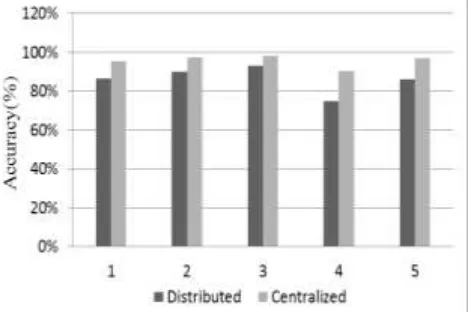
Experiment 3 Prewar platform allocation is a centralized planning problem, and genetic algorithm (GA) is an effective way to solve this large-scale nonlinear problem. In this section, we conducted five group experiments to compare our distributed algorithm with centralized GA algorithm to verify the feasibility of our distributed framework, and the average task accuracy is shown as Figure 4. The first group is getting task requirement changed; the second group is getting platform capability changed; the third group is getting one platform destroyed; the fourth group is getting 4 platforms destroyed; the last group is adding a new complex task. The former three groups belong to soft changes and the latter two groups are violent changes.
Figure 4. Comparison between distributed and centralized.
[image:10.612.182.418.429.585.2]accuracy of centralized planning is better than that of distributed planning. However, there are still obvious disadvantages for centralized planning. On the one hand centralized planning can alter the command and control structure which is undesired to commanders; on the other hand centralized planning has a greater computation complexity than distributed way and this cannot meet the requirement of timeliness in task planning dynamic adjusting.
CONCLUSIONS
In this paper, we have introduced a platform pricing model and a distributed collaboration framework to solve the task planning dynamic adjusting problem during the war. One is that the average accuracy of tasks and the average profit of DMs are increased with our distributed collaboration framework; the other is that our adjusting plans have a strong adaptability on general changes occurring during the war using our algorithm. In our future work, we plan to adopt our distributed model to study distributed command and control problems, and to optimize the structure of the command and control.
ACKNOWLEDGEMENTS
Supported by Natural Science Foundation of Shanxi Province of China (Grant
No. 2017JM6062) and the key laboratory fund for Equipment pre-research (Grant
No. 61421010201).
REFERENCES
1. Mandal S, Han X, Pattipati K R, et al. 2010. “Agent-Based Distributed Framework for Collaborative Planning” Proceedings of the 2010 IEEE International Conference on Aerospace conference. Big Sky, MT, 2010:1-11.
2. X. Han, H. Bui, S. Mandal, K. R. Pattipati, and D. L. Kleinman. 2013. “Optimization-based decision support software for a team-in-the-loop experiment: Asset package selection and planning,” IEEE Trans. Syst, Man, Cybern. A, Syst, Humans, vol. 43, no. 2, pp. 237-251. 3. H. Bui, X. Han, S. Mandal, K. R. Pattipati, and D.L. Kleinman, 2009. “Optimization-based
decision support algorithms for a team-in-the-loop planning experiment,” in proc. IEEE Int. Conf. Syst., Man, Cybern., Oct. 2009, pp. 4684-4689.
4. Yu F, Tu F, Pattipati K R. 2008. “Integration of a holonic organizational control architecture and multi-objective evolutionary algorithm for flexible distributed scheduling,” IEEE Trans, Syst., Man, Cybern, A, Syst, Humans-Part A: System and Humans, 38(5): 1001-1017.
5. Levchuk G M, Levchuk Y N, Luo J, et al. 2002 “Normative Design of Organizations—Part I: Mission Planning,” IEEE Trans, Syst., Man, Cybern, A, Syst, Humans, 32(3): 346-359. 6. G. M. Levchuk, Y. N. Levchuk, J. Luo, K. R. Pattipati, and D. L. Kleinman. 2002 “Normative
7. G. M. Levchuk, Y. N. Levchuk, J. Luo, K. R. Pattipati, and D. L. Kleinman. 2004. “Normative design of project-based organizations-PartⅢ: Modeling congruent, robust, and adaptive organizations,” IEEE Trans, Syst., Man, Cybern, A, Syst, Humans, vol. 34, no. 3, pp. 337-350.
8. Zhang Jieyong, Yao Peiyang, Li Fan. 2012. “An algorithm Task-Platform Relation Design under mission Completion Time Constraint, TPRDCTC,” Systems Engineering and Electronics, 34(8): 1621-1629.
9. Mu L, Zhang W M, Chen T, et al. 2010. “Task-Platform relation design model and algorithm for C2 organization structure under uncertainty,” Systems Engineering and Electronics, 32(12):2576-2583.
10. Zhang Y X, Chen C, Liu Z, et al. 2013. “Method for modeling and solving military mission planning with uncertain resource availability,” Journal of National University of Defense Technology, 35(3): 30-35.
11. S. G. Hutchins, W. G. Kemple, D. L. Kleinman, S. Miller, K. Pfeiffer, S. Weil, Z. Horn, M. Puglisi, and E. Entin, 2009. “Maritime headquarters with maritime operations center: A research agenda for experimentation,” in Proc. 14th Int. Command Control Res. Technol. Symp., Jun. 2009, pp. 1-32.
12. S. G. Hutchins, W. G. Kemple, D. L. Kleinman, S. Miller, K. Pfeiffer, Z. Horn, et al. 2010. “Maritime operations centers with integrated and isolated planning teams”, in proc. 15th
ICCRTS, pp. 1-26, Jun. 2010.
13. C Park, W An, K. R. Pattipati, and D. L. Kleinman, 2011. “Quantifying the Impact of Information and Communication Structures via Distributed Auction Algorithm: point to point communication structure,” IEEE Trans. Syst, Man, Cybern. A, Syst, Humans, vol. 42, no. 1, pp. 68-86.
14. X. Han, S. Mandal, K. R. Pattipati, and D. L. Kleinman, 2014. “Optimization-based Distributed Planning Algorithm: A Blackboard-Based Collaborative Framework,” IEEE Trans. Syst, Man, Cybern. A, Syst, Humans, vol. 44, no. 6, pp. 673-686.
15. B. Shirazi and M. Wang. 1988. “Design and analysis of heuristic functions for static task distribution,” in proc. Workshop Future Trends Distrib. Comput. Syst. 1990s. 1988, pp. 124-131.
16. K. G. Murthy. 1968. “An algorithm for ranking all the assignments in order of increasing costs,” Oper. Res., vol. 16, no, 3m pp. 682-687.