To the Minister for Enterprise, Trade and Employment and the Minister for Education and Science
Table of Contents
Foreword 7
Executive Summary 8
Chapter 1: Introduction 14
1.1 Introduction 14
1.2 Objectives 14
1. Methodology 15
1.4 Report Structure 15
Chapter 2: Trends in Irish Medical Devices Industry 16
2.1 Introduction 16
2.2 Employment in Irish Medical Devices Sector 16
2. Employment by Firm Ownership 18
2.4 Medical Devices Sales 19
2.5 Medical Devices Value-added 21
2.6 Regional Distribution of Medical Devices Companies 22
2.7 Conclusions 2
Chapter 3: United States/International Medical Devices Industry Trends 24
.1 Introduction 24
.2 Shipments by US Medical Devices Sector 24
. Employment in US Medical Devices Sector 26
.4 Value-added per Employee in US Medical Devices Sector 27
.5 US Mobile Investment Trends 27
Chapter 4: Medical Devices Skills 30
4.1 Introduction 0
4.2 Occupational Mix – Irish Sector 0
4. Occupational Mix – US Sector 1
4.4 Skills and the Medical Devices Value Chain 4
4.5 Conclusions 41
Chapter 5: Major Trends in the Medical Devices Space 42
5.1 Introduction 42
5.2 Medical Devices Space 42
5. Cross-cutting Trends 4
5.4 Technology Convergence 46
5.5 Irish Medical Devices Trends 48
5.6 Growth and Value-added by Industry 52
5.7 Conclusions 54
Chapter 6: Innovation and Entrepreneurship 55
6.1 Introduction 55
6.2 Where Innovation Occurs 55
6. Patterns of Development by Innovative Product Start-ups 57
6.4 Environment for Start-ups 59
6.5 Key Initiatives to Promote Innovation and Entrepreneurship 62
6.6 Conclusions 65
Chapter 7: Skill Needs and Solutions 66
7.1 Introduction 66
7.2 Employment Scenarios 66
7. Skill Demand under Scenarios 68
7.4 Engineers and Scientists 70
7.5 Technicians and Trades 7
7.6 Operators, Assemblers and Quality Control Staff 75
7.7 Medical Devices Industry Skills 77
7.8 Clinical Involvement 80
7.9 Skills for Convergence 80
7.11 Opportunities to Differentiate Ireland Based on Skills Supply 81
7.12 Conclusions 82
Chapter 8: Conclusions and Recommendations 85
8.1 Introduction 85
8.2 Building Operational Excellence 86
8. Driving Innovation 88
8.4 Entrepreneurs and Intrapreneurs 91
8.5 Industry Understanding and Specialist Skills 92
8.6 Technological Convergence 94
8.7 Industry Networks 95
8.8 Overview 96
Appendix A: Steering Group Members 97
Appendix B: EGFSN Members 98
Appendix C: Publications by the Expert Group on Future Skills Needs 99
Acknowledgments
The report is substantially based on research carried out by Publica Consulting and McIver Consulting on behalf of the Expert Group on Future Skill Needs and Forfás. Forfás would like to fully acknowledge the quality of their work.
Forfás is grateful to the many industry executives, academics and staff at expert organisations in Ireland who gave interviews as part of the study. In particular Forfás would like to acknowledge the substantial contribution made at various stages of the report by the Irish medical devices association.
Thanks are also due to the industry executives, academics, state government officials, executives of industry organisations met during study visits to the US, and to the leading US serial-entrepreneur-physician-engineer-academic, lawyer-counsellor-of start-ups and venture capital executives who were so generous with their experience and expertise. Forfás is grateful to Enterprise Ireland and IDA Ireland for their considerable assistance in arranging and carrying out the three study visits. Thanks are due to Mr. Ken McDonnell, a member of Enterprise Ireland’s Medical Devices Advisory Board, who arranged interviews with some of the leading lights in medical devices in Silicon Valley. Thanks are also due to other members of the Advisory Board for their advice and assistance. Minnesota State Colleges and Universities were also particularly helpful, for which we are grateful.
Foreword
On behalf of the Expert Group on Future Skills Needs, I am very pleased to introduce this report Future Skills Needs of the Irish Medical Devices Sector.
The medical devices sector is very important for Ireland. The sector produces a great variety of high value-added products and it provides significant high skilled employment here. The industry has grown significantly over the last decade and Ireland is now one of the leading global medical devices industry centres. While the sector faces challenges – as do other industries – there are many reasons to be confident of its future success. Inward investment into the medical devices sector in Ireland is continuing. The ‘Made in Ireland’
brand is highly valued for medical devices products and the industry is making greater use of R&D leading both to greater product and process innovation. A continuous focus on ongoing innovation is key for the industry to thrive and renew itself into the future. As technological convergence progresses, there will be an opportunity to position Ireland as a location that is well equipped to undertake R&D and production operations in bio-convergence products.
The aim of this report is to examine trends and drivers of change in the industry which will have the greatest impact over the period 2007-201; to determine the implications of these changes for the skills requirements of the sector; and to put forward specific recommendations for ensuring that skills will underpin the future development and growth of the industry. I am very pleased that the study has fully done this. It is recognition of the successful collaboration and commitment given by the many interested stakeholders involved – in industry, academia, state bodies and expert organisations.
I would like to thank everyone who contributed to the production of this report. This includes all those, in Ireland and the US from industry, academia and expert organisations who participated in interviews and discussions, all of which were invaluable in producing this report. I would like to record my fullest appreciation to members of IDA Ireland and Enterprise Ireland for their excellent support and sharing of expertise. I would like to express my gratitude to Dr. Sean Mc Donagh who chaired the Steering Group that oversaw the completion of the report, and to each member of the group for their full commitment and support. Finally, I would like to thank the team at Forfás for leading this project to a successful conclusion.
Anne Heraty
Executive Summary
Scope of Study
This study was commissioned by Forfás on behalf of the Expert Group on Future Skills Needs, at the request of Enterprise Ireland and the Irish Medical Technologies Council. The overarching objective of the study was to assess the skills requirements at all levels of the medical devices sector in Ireland, over the period 2007-201.
The terms of reference of the study were as follows:
1. Identify the structural trends and drivers of change in the industry which will have the greatest impact on skills requirements;
2. Determine the implications of these trends/drivers of change for the skills requirements of the sector;
. Deduce the implications for education and training provision; and
4. In the light of the foregoing analysis, put forward specific recommendations for ensuring that skills can be a spur to further development of the industry.
Methodology
The methodology had the following main components:
Secondary research;
Analysis of data on students and higher education courses;
Interviews with medical devices companies – both Irish and foreign-owned;
Interviews within the higher education sector;
Study visits to Massachusetts, Minnesota and Northern California; and
Interviews with industry, professional organisations and State Agencies.
Industry Profile
Ireland is one of the leading global medical devices industry centres. Inward investment from overseas has grown rapidly, particularly in manufacturing, but also in world-class research and development. The major medical devices industries here are in relatively high growth and high value-added activities such as the manufacture of medical and surgical instruments, and surgical appliances and supplies. There are also significant R&D operations. Employment in the sector here has risen rapidly over the decade and now stands at nearly 24,000. Foreign-owned companies account for over 90% of employment. Even so, employment in Irish-owned companies is rising somewhat faster than in foreign-owned companies. Sales by medical devices companies in Ireland are worth about €6 billion per annum – with exports accounting for over 95% of sales. “Made in Ireland” is considered one of the best labels a medical device can have. Challenges facing the sector are rising costs, unfavourable exchange rate trends, and improving
■
■
■
■
■
manufacturing capabilities of competing low cost economies. Globally the sector is in the early stages of what is likely to rapid convergence between technologies, with devices combining biomechanical, electronic and biologically active components.
Skills Strategy for Sector
The study presents two future employment scenarios for the sector, one based on a continuation of the level of growth seen since 2000, and the other based on slower growth. Projections are based on the view that the share of employment in operative level occupations is likely to fall, while that in engineering, scientific, technician, sales and purchasing occupations will rise. Aside from the possibility of strong
competing demand from other sectors, the supply of engineers and scientists appears likely to be sufficient in numbers, although there is an issue with the supply of electronic engineers. Technological convergence will deepen over time. There will be an opportunity to position Ireland as a location well equipped to undertake R&D and production operations in a range of bio-convergence products. The essence of a skills strategy for the medical devices sector must be on:
Building Operational Excellence
Building excellence in medical devices operations requires progress on three closely integrated fronts, all of which have significant skills implications.
Automation, to address the high costs associated with manual assembly;
Lean manufacturing, to eliminate waste and speed logistics; and
Improving quality and eliminating waste.
Driving Innovation
A focus on ongoing innovation is essential for the industry to renew itself into the future. Key skill-related areas where action is required are on providing the medical devices industry with the high-level engineering and scientific skills it requires for innovation; and achieving a greater involvement by Irish clinicians in medical device innovation.
Developing High-level Engineering and Scientific Skills
The main opportunity to differentiate Ireland on the basis of skills is in the supply of high quality engineers. Key areas where action is required to underpin the future supply of high-level engineering and scientific skills include:
Ensuring a supply of PhD graduates in relevant disciplines who are well prepared to enter the industry;
Better preparation for undergraduate biomedical and mechanical engineers to work as practical engineering designers; and
Greater involvement by electronic engineering departments in biomedical electronics, to produce a largely new flow of engineers.
■
■ ■ ■
■
■
■
■
Increasing Involvement by Clinicians in Medical Device Innovation
Attaining greater involvement by clinicians in medical device innovation is not just a matter of developing and translating clinical research, although this is a significant part of what is required. Significant medical devices innovations frequently emerge informally from the application of
engineering principles to clinician insights as much as from formal clinical research. Initiatives should be undertaken in a number of areas to develop the supply of people with combinations of clinical and engineering skills, as such people are particularly well suited to innovating in medical devices.
Increasing Entrepreneural and Intrapreneural Activity
Innovation resulting in entrepreneurship or intrapreneurship is crucial to the future of the medical devices sector in Ireland. It will lead to the development of a significant entrepreneurial indigenous sector, and underpin the future of the foreign-owned sector in Ireland. This will require a significant increase in entrepreneurial activity, developing new businesses, whether stand-alone or within existing companies. The evidence of the study visits to the US is that skills-type interventions can do much to boost entrepreneurial and intrapreneurial activity.
Developing Professional and Specialist Skills
Two broad types of professional development intervention are required. Firstly, a need for managers and professionals working in the medical devices sector to develop a broad working knowledge of a range of topics that are important and specific to the medical devices sector. Secondly, a need for a small number of managers and professionals to have a deep specialist knowledge in areas such as regulatory affairs and clinical trials management.
Meeting Opportunities of Deepening Technological Convergence
Technological convergence in medical devices will become deeper over time. It will impact on skills requirements in a number of ways. It will broaden the range of disciplines that are core to the medical devices sector, from mechanical engineering, biomedical engineering, materials engineering and medicine, to also include biological sciences, electronic engineering, pharmacology and chemistry. It is likely that technologies will emerge that are core to areas of convergence, and which will have to be understood by significant numbers of people from different disciplines.
Industry Networks
Interaction and networking between professionals and managers with interests in medical devices will be crucial for developing processes for innovation – reflecting what can be seen in California and Massachusetts.
The recommendations from the study are outlined as follows. Chapter 8 of the report puts each recommendation into more detailed context.
■
■
■
■
Recommendations
Recommendation 1: Centre for Medical Device Manufacturing Excellence
A Centre for Medical Device Manufacturing Excellence should be established in the higher education sector to assist industry in developing the skills required for automation, lean manufacturing and quality management.
The Centre is likely to operate in a number of modes, including: provision of short duration courses, on site or on-campus; provision of masters level courses, part-time and possibly full-time; contributing to undergraduate courses in relevant disciplines; and applied research with industry partners making high-level expertise available to smaller operations etc.
The Centre should be modest in scale and be established for a limited period, renewable while its services continue to be required. It would make use of existing facilities in the higher education sector. It is
envisaged that the Centre would be established on the basis of proposals from higher education institutions (possibly from consortia) to IDA Ireland and Enterprise Ireland, which would provide core funding. While actual costs would depend on the detailed arrangements for the Centre, it is estimated that core funding of the order of €5m capital and €1m recurring would be required.
Recommendation 2: Upskilling Operators and Technicians
Interested parties from Irish Medical Devices Association, FÁS, Skillnets and other organisations should, as appropriate, cooperate in the following.
Rolling out by companies of training leading to the award of the Level 5 FETAC Medical and Allied Devices Production Certificate.
The development of a course in biomedical technology leading to a special purpose Level 6
qualification. Participation should be paid for by companies, with some support from FÁS, Skillnets and other public providers of funding for training.
In-company and part-time courses to train technicians to work with automated medical device production systems. Participation should be paid for by companies with some support from FÁS, Skillnets and other public providers.
Institutes of Technology and medical devices companies should continue to cooperate in providing bioscience technician courses at Levels 6 and 7 to upskill operators, or in reskilling technically qualified people from other disciplines.
It is envisaged that approximately 5,000 assemblers, operators and technicians would require upskilling training in the next three years.
■
■
■
Recommendation 3: High-level Engineering and Scientific Skills
Higher education institutions involved in graduate studies in biomedical engineering should continue to work towards establishing a Fourth Level Graduate Education Institute, so as to prepare graduates to contribute effectively to medical devices sector innovation and to strengthen the network of relationships among future key players in Irish medical devices innovation. The Expert Group supports the need for such an institute. The EGFSN also acknowledges the need for excellence in proposals for such an institute. The Stanford Biodesign Programme, described in the body of this report would form a useful model for the Irish graduate school.
Institutions providing Level 8 to 10 programmes in biomedical engineering, and in mechanical engineering should identify ways in which they can better prepare their students to work in engineering design. Electronic engineering departments with interests in bioelectronic engineering should examine the scope to add biomedical content to their programmes, or to place additional emphasis on medical technologies in their research.
Recommendation 4: Engaging Irish Clinicians in Medical Devices Innovation
Entry into the new graduate programmes in medicine by engineering graduates has the potential to produce a supply of graduates qualified both in medicine and engineering. Medical and engineering schools should jointly create more opportunities for clinicians in training to undertake studies and/or research in medical technology and biomedical engineering. Medical schools should feature career paths involving participation in medical technology innovation.The Irish Medical Technologies Council should sponsor initiatives to raise the profile of innovation among clinicians, particularly those still in training. Industry and Enterprise Ireland should provide funding to support these interventions.
Recommendation 5: Developing Entrepreneurs and Intrapreneurs
Enterprise Ireland should continue to develop its range of training and coaching supports for medical devices entrepreneurs, and for prospective entrepreneurs. Enterprise Ireland should also consult with Irish higher education institutions interested in medical technologies with a view to the development of a programme to boost the supply of effective entrepreneurs and intrapreneurs. The Stanford Biodesign Fellowship Programme is one possible model to consider. The Irish programme should draw on leading US expertise in creating medical devices business.
Recommendation 6: Professional Development
Enterprise Ireland, in cooperation with the Irish Medical Devices Association and other interested parties, should consider commissioning the development of part-time professional education courses in:
Healthcare Economics and Reimbursement;
Intellectual Property in medical devices;
Sales Management and Marketing for Medical Devices; and
Venture Financing of Medical Devices Start-ups.
These courses should be targeted on industry professionals who are working in the area. It is envisaged that one iteration of each course would be run initially, with additional courses being run if demand is apparent. Part of the cost of the above provision(s) would be recovered from participants through fees.
Recommendation 7: Postgraduate Taught Courses
A Masters Course in Regulatory Affairs should be introduced by a higher education institution, either targeted specifically on the medical devices sector, or targeted jointly on medical devices and
pharmaceuticals sectors, but with a medical devices specialisation. It should be developed in collaboration with the industry in order to ensure relevance and encourage uptake. The course will be delivered in a number of different formats.
It is recommended that higher education institutions should consider the creation of a graduate diploma or masters degree in the design, management and conduct of clinical trials. It is envisaged that the cost of provision would be recovered from participants, as with other part-time postgraduate courses.
Recommendation 8: Technological Convergence
Technological convergence in medical devices will deepen over time. It will impact on skill requirements in a number of different ways.
As technological convergence in medical devices progresses the following should be introduced:
Courses in important convergence topics into undergraduate biomedical engineering courses;
Masters programmes in important convergence topics to facilitate graduates in specialising in key areas of skills demand, targeted on graduates both from relevant scientific and engineering disciplines; and
Specialist or cross-disciplinary undergraduate degrees, where clear industry demand exists.
Recommendation 9: Medical Devices Industry Networks
Interaction and networking between professionals and managers will be crucial to developing processes for innovation in the medical devices sector. The Irish Medical Technologies Council has significant potential to promote this interaction.
The Irish Medical Technologies Council should actively promote communication and networking between industry leaders, entrepreneurs, leading scientists and engineers, academics, clinicians and industry development agencies involved in medical technologies.
■
■
■
■
■
■
Chapter 1: Introduction
1.1 Introduction
This study was commissioned by Forfás on behalf of the Expert Group on Future Skills Needs, at the request of Enterprise Ireland and the Irish Medical Technologies Council.
The overarching objective of the study was to assess the skills requirements, at all levels from operatives through to post-doctoral researchers, of the medical devices sector in Ireland, over the period 2007-201.
1.2 Objectives
The objectives of the study were as follows:
Identify the structural trends and drivers of change in the industry which will have the greatest impact on skills requirements over this timeframe;
Determine the implications of these trends/drivers of change for the skills requirements of the sector. These may stem from the changing occupational composition of the sector as well as changes in the nature of particular occupations;
Deduce the implications for education and training provision in Ireland. Specifically, the study should:
Map the range of education and training provision in Ireland for the Sector;
Assess the adequacy of the current skills supply pipeline, both quantitatively and qualitatively, for the medical devices sector’s future requirements;
Assess the need for upskilling of the current workforce in the sector in the light of the likely industry trajectory and the current educational profile of the workforce;
Assess the requirements for conversion courses, post-graduate courses and professional development etc; and
Consider the requirement for certification and accreditation in recommendations for new education and training programmes;
In the light of the foregoing analysis, put forward specific recommendations for ensuring that skills can be a spur to the further development of the industry in Ireland.
■
■
■
■ ■
■
■
■
1.3 Methodology
The methodology had the following main components:
Secondary research;
Analysis of data on students and higher education courses;
Interviews with companies – both Irish and foreign-owned – from a range of areas within the sector;
Interviews within the higher education sector, covering academics responsible for teaching courses relevant to the sector, engineering and medical academics involved in higher education based research institutes relevant to the sector and other academics involved in research relevant to the sector;
Three study visits to the US – to Massachusetts, Minnesota and Northern California; and
Interviews with interested expert organisations, including industry and professional organisations and State Agencies.
1.4 Report Structure
Chapter 2 describes how the Irish medical devices industry has grown, and examines how it is structured. It reports on employment growth, firm ownership and regional distribution. It describes medical devices sales and exports and value-added.
Chapter 3 examines trends in the US/international medical devices industry, particularly important for Ireland as the US is the main source of medical devices inward investment. It provides an important model for innovation and entrepreneurship and is a significant export market.
Chapter 4 profiles the medical device industry skills starting with a review of occupational data for the Irish and US medical devices sectors. It then examines skills requirements in more detail, focusing on each major stage of the sector’s value chain.
Chapter 5 examines specific trends for the Irish medical devices sector in terms of clinical specialism, type of product, company, technology, research and development; higher education research; outsourcing and supply chains; and education and training developments.
Chapter 6 explores patterns of innovation and entrepreneurship in the medical devices sector. New product development, and incremental improvements to products, are centrally important to the future of both foreign-owned and Irish-owned medical devices companies in Ireland.
Chapter 7 looks at likely future demand for new recruits into the medical devices sector at all levels. It presents two employment scenarios and makes projections of demand based on these, and on assumptions about future patterns of upskilling in the sector. It then looks in more detail at skills
requirements and assesses the adequacy of the available supply in both quantitative and qualitative terms. It comments on measures that may be required to address the skills needs identified.
Chapter 8 outlines the main conclusions and recommendations of the report. ■
■
■
■
■
Chapter 2: Trends in Irish Medical
Devices Industry
2.1 Introduction
Ireland is one of the leading global medical devices industry centres, with an industry comparable in scale to those of Massachusetts and Minnesota, two of the main centres of medical devices in the US. This chapter describes how the industry has grown, and examines how it is structured.
Relevance of Chapter to Skills Analysis
The requirement for skills in any sector is influenced by employment trends in the sector. All other things being equal, a sector in which employment is growing rapidly will have a greater requirement for skills than a sector that is growing slowly. In order to understand likely future skills needs, it is important to have an understanding of trends in competitiveness, which are likely to influence future employment patterns and skills requirements.
Skills needs often also vary between different types of companies. For example, a company with manually intensive production operations has different skills requirements to one with automated operations. In many industries, including the medical devices sector, there are differences in profile between foreign-owned and Irish-owned companies that drive differences in skills requirements.
2.2 Employment in Irish Medical Devices Sector
[image:16.595.69.530.581.771.2]Employment in the Irish medical devices sector has risen rapidly since the early 1990s, as can be seen in Figure 2.1.
Figure 2.1: Employment in Irish Medical Devices Sector 1993 to 2006
Source: Census of Industrial Production, CSO, and analysis of Forfás Employment Database. 0
5,000 10,000 15,000 20,000
25,000 CIP – NACE 331 – Manufacture of Medical and Surgical Equipment and Orthopaedic Devices Medical Devices/Instrumentation Companies in Forfás
Employment Database
1993 1994 1995 1996 1997 1998 1999 2000 2001 2002 2003 2004 2005 2006
Most of the Irish sector is focused on the manufacture of medical and surgical instruments, and on surgical appliances and supplies. While the sector produces a great variety of products, there is a strong focus on technologies for minimally invasive surgery, particularly in cardiovascular surgery. The leading product categories produced by the industry are:
Stents (tubular devices inserted into constricted vessels and channels in the body to hold them open, generally using minimally invasive techniques); and
Instruments and delivery systems for minimally invasive surgery.
Within the area of surgical appliances, there is also significant activity in the manufacture of orthopaedic devices.
There is significant activity in the manufacture of ophthalmic goods (including contact lenses) and in diagnostic test kits.
While medical devices based on electronics and information technology form a major part of the sector globally, companies producing such devices form only a small part of the sector in Ireland.
Activity in dental-related manufacture is also very limited, mainly addressing the needs of the domestic market.
[image:17.595.72.525.517.762.2]Figure 2.2 disaggregates employment growth in the sector between different subsectors from 1996 to 2006, showing that most of the growth has come from surgical appliances at an average rate of 11% per annum. The percentage rate of employment growth in ophthalmic goods and in diagnostics has also been high, at approximately 15% per annum and 24% per annum respectively, although starting from a low base. The analysis in Figure 2.2 follows the medical devices categories in the North American Industry Classification System (NAICS), to facilitate comparisons with the US.
Figure 2.2: Employment in Irish Medical Devices Sector, Disaggregated by NAICS Subsector
Source: Based on analysis of Forfás Employment Database.
■
■
0 5,000 10,000 15,000 20,000
1996 1997 1998 1999 2000 2001 2002 2003 2004 2005 2006 25,000
Em
pl
oy
m
en
t
Electromedical and Electrotherapeutic Apparatus Manufacturing Laboratory Apparatus and Furniture Manufacturing
Surgical and Medical Instrument Manufacturing Surgical Appliance & Supplies Manufacturing
Dental Equipment and Supplies Manufacturing Ophthalmic Goods Manufacturing
In-vitro Diagnostic Substance Manufacturing Other Instrumentation
The main medical and surgical specialisms in which medical devices manufactured in Ireland are used are:
Cardiovascular;
Peripheral vascular;
Ophthalmics;
Orthopaedics;
Urology;
Imaging; and
Respiratory.
Diagnostic products are used in a wide range of medical (and even veterinary) specialisms.
2.3 Employment by Firm Ownership
[image:18.595.67.526.454.657.2]Foreign-owned companies account for over 90% of employment. Even so, employment in Irish-owned companies is rising somewhat faster than in foreign-owned companies, gradually raising the share of employment accounted for by the domestically-owned industry.
Figure 2.3: Medical Devices Employment in Ireland by Irish-owned Companies
Source: Based on analysis of Forfás Employment Database.
Most foreign-owned companies produce finished products. In some cases, production is from raw
materials. In other cases, production involves final assembly and test from components sourced externally, whether from subsuppliers or from other operations in their group.
■
■
■
■
■
■
■
Percentage Irish-owned
0 2% 4% 6% 8%
Most significant Irish-owned companies in the sector are engaged in subsupply, addressing various points in the value adding chain, including:
Assembly;
Production of components;
Production of packaging;
Testing;
Engineering development services; and
Consultancy.
In many cases, companies are involved in subsupply at a number of complementary points in the value adding chain. For example, a subsupply company that solves a manufacturing challenge is sometimes in a good position to also manufacture the product.
A small number of Irish companies are involved in developing and marketing finished products of their own.
2.4 Medical Devices Sales
[image:19.595.72.526.533.744.2]Sales by foreign-owned medical devices companies have risen significantly since 2000, although the rate of growth appears to have slowed down, as can be seen in Figure 2.4. Even so, average annual sales growth between 2000 and 2005 for these companies was 11.7% – representing substantially faster growth than for foreign-owned companies in any other Irish manufacturing or internationally traded services sector over the same period1.
Figure 2.4: Sales by Foreign-owned Medical Devices and Instruments Companies in Ireland
Source: Annual Business Survey of Economic Impact, 2005, Forfás.
■
■
■
■
■
■
0 1,000 2,000 3,000 4,000 5,000 6,000
2000 2001 2002 2003 2004 2005
Sales € M
Sales by Irish-owned companies have also increased significantly, although with a fall between 2004 and 2005, as can be seen in Figure 2.5.
Figure 2.5: Sales by Irish-owned Medical Devices and Instruments Companies
Source: Annual Business Survey of Economic Impact, 2005, Forfás.
Most of output from the medical devices sector is exported, either directly or after incorporation into the products of other medical devices companies.
As can be seen in Figure 2.6, direct exports from foreign-owned companies account for 96% of sales. With some foreign-owned subsupply activity, the actual percentage destined for foreign markets is even higher.
The share of sales by Irish-owned companies accounted for by direct exports is lower, reflecting mainly the fact that many are engaged in subsupply to the Irish operations of foreign-owned companies. Sales of finished products by Irish-owned companies to the domestic market also account for the lower proportion of exports as a percentage of sales.
Figure 2.6: Exports as Percentage of Sales of Medical Devices and Instruments Companies
Source: Annual Business Survey of Economic Impact, 2005, Forfás. 0
50 100 150 200 250
2000 2001 2002 2003 2004 2005
Sales €M
0 20% 40% 60% 80%
2002 2001
2000 2003 2004 2005
100%
[image:20.595.69.527.591.774.2]2.5 Medical Devices Value-added
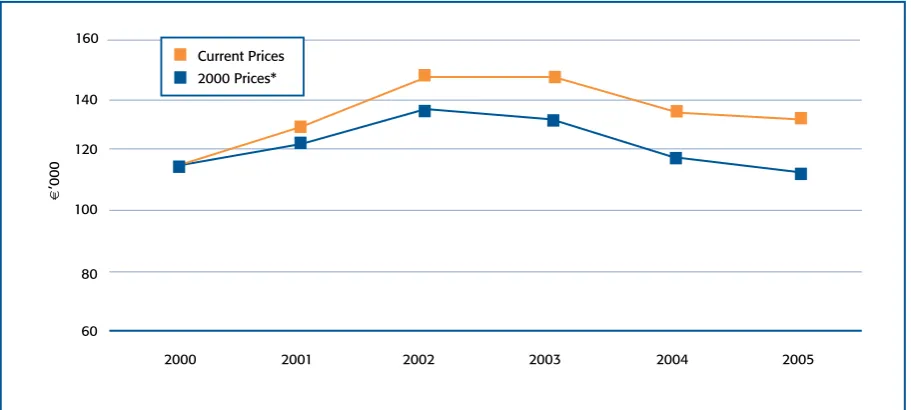
In real terms, value-added per employee in foreign-owned medical devices companies peaked in 2002, and then fell up to 2005, the most recent year for which data are available, as may be seen in Figure 2.7.
Given the very high-level of exports and the fact that much of the trade was with countries outside the European Union, it seems likely that much of this fall was driven by the strengthening of the euro, and that the trend looks somewhat more positive when viewed in dollar denominated terms by the US corporations that account for the majority of the industry. The value of the euro rose by 21% between mid-2000 and mid-2005, relative to the US dollar.
[image:21.595.71.527.376.581.2]Even so, if this trend in value-added per employee continued over a significant period, it would indicate a progressive loss of competitiveness that could threaten the sector’s future. It points towards a need for the foreign-owned companies in the sector to pay particular attention to productivity improvement over the period addressed by this report.
Figure 2.7: Value-added per Employee in Foreign-owned Medical Devices and Instruments Companies (€’000)
* Deflated by Consumer Price Index.
Source: Annual Business Survey of Economic Impact, 2005, Forfás.
Value-added per employee has developed more positively for Irish-owned companies since 2000, as can be seen in Figure 2.8. While it has been somewhat volatile, real growth in value-added per employee rose by 2.8% compound per annum between 2000 and 2005.
60 80 100 120 140
2002 2001
2000 2003 2004 2005
160
Current Prices 2000 Prices*
€
Figure 2.8: Value-added per Employee in Irish-owned Medical Devices and Instruments Companies (€’000)
* Deflated by Consumer Price Index.
Source: Annual Business Survey of Economic Impact, 2005, Forfás.
2.6 Regional Distribution of Medical Devices Companies
The main centre of the Irish medical devices sector is around Galway, with almost 40% of employment in the sector being in the West region, and 1% in Galway City and County. As well as being the leading centre of activity by foreign-owned medical devices companies, Galway is also the main centre of activity for indigenous start-ups.
Elsewhere, operations are widely spread across the country, but with just 8.7% of employment being in Dublin and the Mid-East.
A number of major companies have operations in more than one region, apparently partly to ensure that they do not outgrow the capacity of local labour markets to supply their needs.
0 10 20 30 40
2002 2001
2000 2003 2004 2005
50
Current Prices 2000 Prices*
€
Figure 2.9: Regional Distribution of Medical Devices Companies
Region Share of Employment
Border 9.0%
Dublin .8%
Mid-East 4.9%
Midlands 10.2%
Mid-West 10.8%
South-East 11.4%
South-West 10.9%
West 9.1%
Total 100.0%
Sources: Analysis of Forfás Employment Database.
Figure 2.9 provides data on the regional distribution of medical devices companies.
2.7 Conclusions
The Irish medical devices sector has a strong history of growth. It is predominantly foreign-owned,
although the Irish-owned component is growing. It is overwhelmingly an export industry, either directly, or through subsupply to exporting companies.
Value-added in foreign-owned companies has dipped since 2002, which may have been driven by exchange rate trends. Value-added in Irish-owned companies has risen.
Chapter : United States/
International Medical Devices
Industry Trends
3.1 Introduction
While medical devices industries are present in many countries, the behaviour of the US industry is particularly important to Ireland.
It is the source of most medical devices inward investment into Ireland, and leads globally in medical devices exports.
It provides an important model for innovation and entrepreneurship in medical devices.
The US domestic market is a significant market for both foreign and Irish-owned companies operating in Ireland.
Relevance of Chapter to Skills Analysis
The Irish medical devices sector is primarily an export sector. Most employment in the sector is in the Irish operations of US medical devices companies. Most employment in Irish-owned medical devices companies arises from servicing the needs of US-owned medical devices companies.
These factors make an understanding of US trends critical to any assessment of the sector’s future, whether the assessment is focused on skills or on other priorities. Trends in US employment, and in employment by US based companies in international locations, are particularly important to developing an understanding of current and future skills needs of the medical devices sector in Ireland.
3.2 Shipments by US Medical Devices Sector
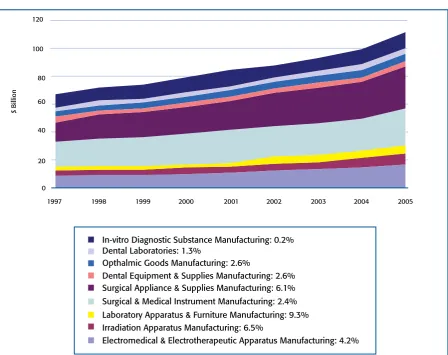
Figure .1 presents data on shipments by each of the main industries that form part of the US medical devices sector, with the following qualifications:
“Irradiation apparatus manufacturing” encompasses a range of medical and surgical products, including many medical imaging products, but also includes products with non-medical applications in areas such as security imaging; and
Definitions of the medical devices sector differ as to whether diagnostic products are included. “Diagnostic substances” are frequently encapsulated in a device, as in for example a pregnancy test.
The sector’s shipments grew strongly between 1997 and 2005, although the rate of growth varied between industries.
The value of shipments from “laboratory apparatus and furniture” manufacturing grew by a strong 9.% per annum compound.
■
■
■
■
■
Shipments from “surgical appliance and supplies manufacturing” also grew strongly, by 6.1% per annum compound.
Shipments from “irradiation apparatus manufacturing” similarly grew strongly by 6.5% per annum compound, although it seems likely that the growth was boosted by increased sales of security imaging equipment following 9/11, more than by organic growth in demand for medical and surgical imaging equipment.
Shipments from “electromedical and electrotherapeutic apparatus manufacturing” grew modestly, by 4.2% per annum compound.
[image:25.595.75.524.309.664.2]Shipments from other industries grew more slowly, at 2.6% per annum or less.
Figure 3.1: Value of Shipments by US Medical Devices Sector (US$ Billion)
Source: Data from US Annual Survey of Manufactures.
■
■
■
■
1997 1998 1999 2000 2001 2002 2003 2004 2005
100 120
In-vitro Diagnostic Substance Manufacturing: 0.2% Dental Laboratories: 1.3%
Opthalmic Goods Manufacturing: 2.6%
Dental Equipment & Supplies Manufacturing: 2.6% Surgical Appliance & Supplies Manufacturing: 6.1% Surgical & Medical Instrument Manufacturing: 2.4% Laboratory Apparatus & Furniture Manufacturing: 9.3% Irradiation Apparatus Manufacturing: 6.5%
Electromedical & Electrotherapeutic Apparatus Manufacturing: 4.2%
0 20 40
$ Billion
60 80
3.3 Employment in US Medical Devices Sector
[image:26.595.72.524.214.676.2]Figure .2 presents data on employment in each of the main industries that form part of the US medical devices sector. Employment in the sector as a whole is approximately flat over time.
Figure 3.2: Employment in US Medical Devices Sector
Source: Data from US Annual Survey of Manufactures. 0
50,000 100,000 150,000 200,000 250,000 300,000 350,000
N
o.
s
Em
pl
oy
ed
400,000 450,000
1997 1998 1999 2000 2001 2002 2003 2004 2005
In-vitro Diagnostic Substance Manufacturing Dental Laboratories
Opthalmic Goods Manufacturing
Dental Equipment & Supplies Manufacturing Surgical Appliance & Supplies Manufacturing Surgical & Medical Instrument Manufacturing Laboratory Apparatus & Furniture Manufacturing Irradiation Apparatus Manufacturing
3.4 Value-added per Employee in US Medical Devices Sector
[image:27.595.75.524.212.477.2]Value-added per employee in the sector varies sharply between industries, being relatively low for dental-related industries, and for “laboratory apparatus manufacturing”, as can be seen in Figure ..
Figure 3.3: Value-added per Employee in US Medical Devices Sector (US$)
Source: US Bureau of Labor Statistics.
3.5 US Mobile Investment Trends
US medical devices companies have substantial operations in other countries – mainly in Europe, Latin America, Canada and Asia. In contrast with many other manufacturing industries, however, the rate at which manufacturing has migrated to locations with low labour costs has been quite slow.
Figures .4 and .5 present data on employment in international affiliates in NAICS 451, which includes Electromedical and Electrotherapeutic Apparatus Manufacturing and Irradiation Apparatus Manufacturing, and NAICS 9, which includes all of the other medical devices sectors with the exception of In-Vitro Diagnostic Substance Manufacturing. As the trends in the data are consistent with qualitative information gathered specifically for the medical devices sector, and as medical devices companies account for a substantial part of the US employment in these NAICS industry codes, it is likely that the trends seen in these Figures broadly reflect medical devices trends.
The Figures show employment outside the US in US affiliates growing at a modest rate, with gradual growth in Europe being consistent with continuing growth in the Irish medical devices sector. Growth in Asia has been faster (7.1% compound per annum between 1999 and 2004 for the two NAICS sectors depicted), but is still much less than for many other sectors of manufacturing industry.
In-vitro Diagnostic Substance Manufacturing
300,000
250,000
200,000
150,000
100,000
50,000
0
Dental Laboratories
Ophthalmic Goods Manufacturing
Dental Equipment & Supplies Manufacturing
Surgical Appliances & Supplies Manufacturing
Surgical & Medical Instrument Manufacturing
Laboratory Apparatus & Furniture Manufacturing
Irradiation Apparatus Manufacturing
Figure 3.4: Employment in Majority Owned Affiliates of US Companies – NAICS 33451 – Navigational, Measuring & Other Instruments (’000s)
Source: Data from US Bureau of Economic Analysis.
Note: Approx. 500 employed in Middle East and 100 in African continent.
Figure 3.5: Employment in Majority Owned Affiliates of US Companies – NAICS 339 – Miscellaneous Manufacturing (’000s)
Source: Data from US Bureau of Economic Analysis. Note: Approx. 1,600 employed in African continent.
0
2004 2003
2002 2001
2000 1999
10 20 30 40
Employment (’000s)
50 60 70
Asia & Pacific Latin America & Other Western Hemisphere Europe
Canada
0
2004 2003
2002 2001
2000 1999
20 40 60 80 100 120 140 160 180
Asia & Pacific Latin America & Other Western Hemisphere Europe
Canada
[image:28.595.76.523.463.705.2]The growth in Asia appears to be partly at the expense of US neighbours, with overall employment in Latin America and Canada falling.
Falling employment in Latin America is significant, as many US medical devices companies have operations in Mexico, many of them supplying components for final assembly and test in the US, Canada or Ireland. It suggests that component manufacture may be more vulnerable than other activities to being moved to Asia. This is consistent with interview evidence that the country of origin is important to underpinning customer confidence in a source of medical devices, with the US, Canada, Ireland and Japan being countries that inspire particular confidence. The stated country of origin of an assembled product is typically determined by the location of final assembly and test, so the location in which components are manufactured is usually not visible to customers.
Issues of confidence drive medical devices companies to locate even manually intensive manufacturing in locations that inspire confidence. A substantial part of US (and Irish) employment in medical devices is still in labour-intensive manual assembly operations. The reputation of a medical devices company and its products can be damaged badly if a problem arises with a product, and the damage can be exacerbated greatly if it is not seen to have manufactured the product in a responsible way. Choices about the location of operations can affect both the reality and the external appearance of manufacturing risks, quite aside from country-of-origin labelling considerations.
Even so, medical devices companies are sensitive to cost. Even within the US, decisions on the location of operations are affected by labour costs, with new manufacturing operations often being established in lower cost regions. And although migration of manufacturing to Asia is relatively slow, it is happening. Companies are working hard on reducing costs, through reorganising supply chains, and through
improving their own operations with automation, lean manufacturing and improved quality management.
3.6 Conclusions
While the value of shipments by the US medical devices industry is growing, total US medical devices employment is flat.
Chapter 4: Medical Devices Skills
4.1 Introduction
This chapter profiles medical device industry skills. It starts with a review of occupational data for the Irish and US medical devices sectors. It then examines skills requirements in more detail, focusing on each major stage of the sector’s value chain in turn.
Relevance of Chapter to Skills Analysis
This chapter sets out the description of medical devices sector skills on which the remainder of the report is based.
The chapter provides both statistical information on the skills mix, and a description of the main skills required in the sector. Both types of information on skills are required to underpin the analysis. Statistical information is required to underpin quantitative aspects of the analysis. An understanding of the complexities of skills in the sector is required to underpin qualitative aspects of the analysis.
4.2 Occupational Mix – Irish Sector
[image:30.595.69.526.519.758.2]Figure 4.1 presents data on the mix of occupations in NACE . As the medical devices sector (NACE 1) accounts for approximately 77% of the employment in NACE , the occupational mix in this wider sector should well reflect the mix of occupations in medical devices.
Figure 4.1: Mix of Occupations in Ireland in NACE 33
Source: CSO QNHS data provided by SLMRU FÁS2.
2 The way in which occupations are grouped in this chart is partly driven by the need to comply with requirements regarding minimum numbers that can be published based on Quarterly National Household Survey data.
Managers: 5%
Engineers/Scientists/Analyst-programmers: 7% Technicians: 5%
Administration: 9%
Employment is dominated by manufacturing operations. Operatives and similar roles account for more than half of employment. Technicians and trades such as fitters and electricians, most of whom work in manufacturing, account for almost another 20%. Based on interview evidence, a significant proportion of those medical devices employees classified in national statistics as operatives, are termed technicians by their employers.
Engineers, scientists and computing professionals, who may work in R&D or operations, and who are central to the sector’s capability to innovate, account for just 6.7% of employment in NACE .
The sector also employs a small but significant number of people in medical auxiliary roles, such as nurses, reflecting companies’ contact with clinicians and involvement with clinical trials, as well as their own occupational health needs.
As with other sectors, significant numbers are employed in management, administration sales and purchasing – a total of 16%.
4.3 Occupational Mix – US Sector
The level of precision and detail that is possible in the Irish data is limited by the fact that the data source – the Quarterly National Household Survey is a sample survey that is not designed to produce accurate data on groups that are small in number. For this reason, it is useful also to look at US data for the sector.
Figure 4.2: Mix of Occupations in NAICS 33451 and 3391
Occupational Group % Share in NAICS 33451 % Share in NAICS 3391
Management Occupations 9.55 6.7
Business and Financial Operations Occupations 7.29 .28
Computer and Mathematical Science Occupations 8.6 1.50
Architecture and Engineering Occupations 2.66 5.70
Life, Physical, and Social Science Occupations 1.6 1.2
Legal Occupations 0.10 0.09
Education, Training, and Library Occupations 0.05 0.00
Arts, Design, Entertainment, Sports, and
Media Occupations 0.82 0.57
Healthcare Practitioner and Technical Occupations 0.11 1.20
Healthcare Support Occupations 0.00 0.12
Food Preparation and Serving Related Occupations 0.02 0.0
Building and Grounds Cleaning and
Maintenance Occupations 0.9 0.57
Sales and Related Occupations .57 .5
Office and Administrative Support Occupations 11.16 14.10
Construction and Extraction Occupations 0.20 0.08
Installation, Maintenance, and Repair Occupations .22 2.20
Production Occupations 28.49 54.01
Transportation and Material Moving Occupations 1.42 5.5
All Occupations 100 100
Source: Bureau of US Labor Statistics.
Points to note when interpreting the above Figure are that:
“Architecture and Engineering Occupations” and “Life, Physical and Social Science Occupations” include both professional level and technician occupations;
“Construction and Extraction Occupations” includes occupations such as electricians that are also commonly present in manufacturing environments; and
Between them, the “Production Occupations” and “Transportation and Moving Occupations” categories are roughly equivalent to the “Operatives” category in Figure 4.1. Most of those classified as being in “Transportation and Moving Occupations” are involved in movement of materials within the
manufacturing plant, although some truck drivers are also included.
At this high-level of classification, the mix of occupations in the US in NAICS 91 is quite similar to that seen for the Irish sector in Figure 4.1. The most significant difference is that the Irish sector appears to have a somewhat larger share of engineers, scientists, and technicians and computing professionals – 12% in the Irish data versus a total of 8.4% for “Architecture and Engineering”, “Life, Physical and Social Science” and “Computer and Mathematical Science” Occupations in the US data. This difference is probably a function of the Irish sector being concentrated in some of the more knowledge intensive medical devices industries, and also of the significant levels of R&D undertaken in Ireland.
■
■
Figure 4. provides more detailed US data on the key engineering and scientific occupations for NAICS 91.
Figure 4.3: Employment in Engineering and Scientific Occupations in NAICS 3391 (2006)
Engineering Occupations No.s Employed % Total Employment
Biomedical Engineers 2,160* 0.71
Chemical Engineers 100 0.0
Computer Hardware Engineers 50 0.02
Electrical Engineers 410 0.1
Electronics Engineers, Except Computer 10 0.04
Health and Safety Engineers, Except Mining Safety
Engineers and Inspectors 70 0.02
Industrial Engineers 4,560 1.49
Materials Engineers 260 0.09
Mechanical Engineers ,60 1.10
Engineers, All Other 790 0.26
Electrical and Electronics Drafters 50 0.02
Mechanical Drafters 410 0.1
Drafters, All Other 120 0.04
Electrical and Electronic Engineering Technicians 460 0.15
Electro-Mechanical Technicians 270 0.09
Industrial Engineering Technicians 1,670* 0.55
Mechanical Engineering Technicians 840 0.27
Engineering Technicians, Except Drafters, All Other 570* 0.19
Life, Physical, and Social Science Occupations
Biochemists and Biophysicists 50 0.02
Microbiologists 160 0.05
Biological Scientists, All Other 420* 0.14
Medical Scientists, Except Epidemiologists 20 0.10
Chemists 480 0.16
Materials Scientists 50** 0.02
Market Research Analysts 870 0.28
Social Scientists and Related Workers, All Other 80 0.0
Biological Technicians 170 0.06
Chemical Technicians 450 0.15
Environmental Science and Protection Technicians,
Including Health 0 0.01
Life, Physical, and Social Science Technicians, All Other 90 0.0
Some key points to note are:
The absolute number of engineers and scientists employed in medical devices in the US is small compared to many other technology industries;
While biological scientists, chemists, biological technicians and chemical technicians are present in the sector, they are heavily outnumbered by engineers and engineering technicians;
The sector employs more mechanical engineers than biomedical engineers, which probably reflects the fact that strong mechanical engineering design is very important to the sector. There is considerable overlap between the two disciplines, making graduates in either of these disciplines good candidates for many engineering roles. Strong mechanical engineering design skills are important to the sector;
The sector has relatively large numbers of industrial engineers, reflecting its strong manufacturing focus; and
The number of specialist materials engineers is low, despite the importance of specialist biocompatible materials in the sector, and the number of materials scientists is much lower again.
4.4 Skills and the Medical Devices Value Chain
4.4.1 Introduction
This section outlines the main elements of the medical devices value chain, and describes the main areas of skill in each.
4.4.2 Medical Device Innovation
Classical Innovation Process
Traditionally, most medical device innovation comes from interaction between clinicians and engineers. It is based on the sound application of existing mechanical or electronic engineering technologies – often mature technologies – to clinical problems.
Most medical devices start with a clinical insight, that a new or modified device might allow clinicians to achieve:
Better clinical outcomes;
Reduced costs, often through less time in theatre or shortened patient stays; or
Greater patient comfort. ■
■
■
■
■
■
■
■
The more fundamental innovations typically come from leading clinicians seeking to innovate in clinical practice, which may or may not be in the context of formal research activity.
More incremental innovations may be initiated by clinicians, or by engineers seeking improved
engineering solutions. Engineers still rely on the clinical insights of leading clinicians to validate their ideas. The main engineering disciplines for medical devices innovation are mechanical, electronic and biomedical. Biomedical engineering combines mechanical (sometimes electronic) engineering with biomedical
sciences and biocompatible materials science.
The innovation process typically goes through a succession of prototypes, leading to the production of functioning prototypes that can be used in clinical trials. The prototypes are typically produced by highly skilled technicians.
In addition to clinical and engineering skills, innovators must have a good understanding of regulatory affairs, as they impact on innovation, or at very least, access to good regulatory affairs advice.
Skills that allow innovators to assess market opportunities are also important, including market analytic
and strategic skills similar to those required in many other industries, to allow innovators to assess the size and viability of markets, and to develop sound business strategies.
Access to good expertise in healthcare economics and reimbursement is also important, as even a good product will only be successful if healthcare providers can get the costs of using it reimbursed at an economic level by healthcare funders. Companies targeting the US market often decide whether or not to proceed with a device on the basis of whether they expect it to be reimbursable at an economic level by Medicare and Medicaid, the major government sources of reimbursement. These account for a large part of the market in their own right, and their decisions on reimbursement are frequently reflected by private healthcare insurers.
Other skills to which innovating companies need access are in:
Professional skills in intellectual property;
Skills relating to funding, including specialist medical devices skills among venture capital firms, and among law firms advising medical devices companies engaged in fundraising; and
Capability to efficiently identify and introduce innovators to the right partners that they need at each stage in innovation. A wide range of experts consulted in the US study visits highlighted capabilities in this area as critical to the success of new medical devices businesses, and highlighted the strong web of relationships required to facilitate it as a key factor determining the success of any region in building and retaining an innovative medical devices industry.
Depending on the innovator’s own engineering skills, and on the specific character of the device under development, access to first class contract engineering and prototyping services can be important.
Innovation and Convergence
Technological convergence is increasingly bringing biologically active substances into the medical device sector’s products, both small molecule substances and the large molecule, and even cellular, products of biotechnology. This trend is making skills in biological sciences, chemistry and pharmacology
increasingly important to innovation in medical devices, alongside the clinical and engineering skills that have traditionally dominated innovation.
■
■
4 One key emerging area is that of diagnostic arrays capable of undertaking large numbers of diagnostic tests on a single sample simultaneously. These arrays are devices similar to electronic integrated circuits, featuring an array of many cells, each containing a different biological analytic substance to undertake a different test. A key emerging application is in genetic analysis, to assist in diagnosing genetically-influenced diseases, or to facilitate personalised medicine. Personalised medicine will respond to a person’s individual genetic profile by identifying individuals at elevated risk of specific diseases, and by guiding clinicians as to what treatments will be most effective given a person’s individual genetic make-up. In many cases, for example, the effectiveness of a pharmaceutical in treating a condition varies depending on the individual’s genetic make-up.
Technological convergence is also bringing new patterns of innovation to the fore. Fundamental medical device innovations have traditionally started from a clinical insight, partly because mechanical engineering technology, and significant parts of electronic engineering technology, are relatively mature.
However, when technologies are changing rapidly, this can inspire innovations in products in which they are used. Rapid developments in biotechnology, and areas of electronic engineering technology such as sensors and telemetry, are creating opportunities for technology-led innovation in medical devices that did not exist before. Clinical insight remains core to the innovation process, but it will not always be the starting point for major innovations into the future.
One consequence is that formal research leading to the development of platform technologies with a range of possible applications is likely to become more important to medical devices innovation. The traditional approach to medical devices innovation focuses tightly on developing a solution to a specific clinical problem, usually with a belief that there is a fairly high probability that a working solution can be developed. With less mature technologies, it is typically much less certain that the outcome of an R&D effort will solve any single specific problem. It is necessary that the effort try to produce a platform technology with a slate of possible applications, to maximise the likelihood that at least one will work.
Innovation in Diagnostics
Traditionally, innovation skills in diagnostics have differed from those in other medical devices industries, being primarily about high-level biological sciences skills, supported by technician level skills. Skills in regulatory affairs, marketing, healthcare economics and reimbursement are as important as in other medical devices industries, as are skills in intellectual property, funding and identifying partners.
However, convergence is bringing engineering skills into diagnostics innovation. Traditional diagnostic kits requiring limited engineering innovation will continue to form a major part of the diagnostics industry, but products combining biological components with electronics and ICT components are rapidly becoming significant4.
4.4.3 Clinical Trials
In order to confirm their effectiveness and safety, medical devices undergo clinical trials before they are brought to market.
Two main medical devices regulatory systems are important to the sector – those of the US Food and Drug Administration (FDA) and the European Union. On the whole, clinical trials requirements that they impose for medical devices are much more limited than those for pharmaceuticals, allowing medical devices to be brought to market more quickly than drugs, and at much lower cost.
It can also depend on the extent to which the product is similar to other devices already in use. The US FDA’s 510K approval process allows medical devices deemed substantially similar to those already in use to be approved with a greatly reduced requirement for trials. Interviewees suggest that the majority of new devices requiring approval are approved for US use under this process.
A pharmaceutical component to a device generally increases the extent of the requirement for clinical trials substantially, even though the drug has typically already been approved for other applications. If the drug is deemed to be the main component of the device, or if it has not been approved for other purposes, this can cause the product to be classified as pharmaceutical for regulatory purposes, greatly increasing the clinical trials requirement.
Clinical trials require skills in the following main areas:
The clinicians that have contributed to bringing a new medical device to the level of a trialable product have a critical role to play in clinical trials. They often carry out the first trials themselves, and their confidence in the device is important to recruiting other clinicians to take part later trial phases. They may also take a wider role in a clinical trial, for example in training other clinicians to use the device clinically;
Skills in design and management of clinical trials are required to produce reliable evidence that meets regulatory requirements;
The conduct of clinical trials is regulated, and regulatory affairs skills are required to ensure and demonstrate compliance; and
Front line skills in conducting clinical trials are required.
Internationally, many clinical trials specialists come from nursing backgrounds, after taking further qualifications in the design, management and conduct of clinical trials.
4.4.4 Production
Biomechanical and Bioelectronic Devices
There is considerable diversity among medical devices production processes.
Common machine processes include, among others:
Injection moulding of polymers;
Extrusion of polymers;
Drawing of wires;
Braiding of wires;
A wide range of coating processes;
Automated assembly of electronic components; and
Heat sealing of polymers. ■
■
■
■
■
■
■
■
■
■
While production of some medical devices products is heavily automated, many devices are assembled, tested and packaged manually.
This diversity means that there are considerable variations in the mix of skills required between different medical devices production operations.
Key occupational areas involved in day-to-day operations include the following.
Manual Assembly Operatives – Manual assembly operatives account for a substantial share of medical devices production employment in Ireland and the US. The main skills required are manual dexterity, the ability to conscientiously comply with formal working procedures, sufficient awareness to identify visible problems with components and assemblies, and the flexibility to move between assembling different products. They are typically qualified to Leaving Certificate level or equivalent, and may have taken a medical devices qualification at Level 5 in the National Framework of Qualifications.
Machine Operators (sometimes termed “technicians”, depending on the company and on their level of responsibility) – Machine operators operate machines, loading raw materials, watching for problems, and in many cases setting the machine up and undertaking basic troubleshooting and maintenance. Skill requirements are generally increasing over time, as operators take more responsibility in areas such as troubleshooting, maintenance and quality assurance. They are typically qualified to Leaving Certificate level or equivalent, and may have taken a medical devices qualification at Level 5 in the National Framework of Qualifications.
Technicians – Technicians working in production can have a wide variety of roles, in areas such as toolmaking, machine set-up, troubleshooting, maintenance, monitoring the operation of automated systems, and technical testing for quality assurance. They are typically qualified to around Level 6 (Craft Certificate or Higher Certificate) or Level 7 (Ordinary Bachelor Degree or (legacy qualification) National Diploma) in the National Framework of Qualifications, or have technical training or qualifications of some other sort. Some are qualified to a higher level.
Quality Control and Quality Assurance Staff – Depending on the level of automation, manual and visual inspection can play a major role in medical devices quality control. These roles are often filled by very experienced operatives and operators, typically with additional training in quality control, quality assurance and sometimes quality improvement.
Operations Managers and Supervisors – These roles are similar to those in other industries, except that they need strong skills relating to operating in a highly regulated environment.
A number of roles concerned with the design, improvement and management of production processes are also important in the sector, including the following:
Production Engineers/Industrial Engineers/Automation Engineers/High-level Technicians – These are engineering roles concerned primarily with bringing products into production, with optimising production processes, with keeping production processes in control, and with technical troubleshooting beyond the comfort zone of those concerned with day-to-day operations. They are mostly undertaken by people with Honours Bachelor or masters degrees in engineering disciplines such as production engineering, manufacturing engineering, mechatronic engineering or mechanical engineering. Highly skilled technicians, typically with qualifications around Level 7 in the National Framework of
Qualifications also have a significant role in this. ■
■
■
■
■
Process Design Engineers – Process