ANISOTROPY OF THE FRACTURE TOUGHNESS IN AGED INCONEL 718
G. Liu, D.K. Rehbein and 0. Buck Ames Laboratory-USDOE
and Material Science and Engineering Department Iowa State University, Ames, IA 50011
INTRODUCTION
INCONEL 718 is a widely used material for applications at temperatures up to 650°C. Many research groups have studied the properties of INCONEL 718 at different conditions[1,2]. It is known that, after several thousand hours at 650 °C, INCONEL 718 shows roughly a 75% decrease in the Charpy V-notch impact energy[3].
However, any anisotropic characteristics of this steel have not been investigated in adequate detail. Consequently, in order to maintain the integrity of the components, it is important to clarify the orientation dependence of the mechanical properties of INCONEL 718.
The techniques that provide at least qualitative information on a possible orientation dependence of the mechanical properties of the materials concerned could be the hardness measurement,the small punch
( SP) test technique developed at Ames Laboratory[4,5], and the acoustic nondestructive evaluation(NDE) [6-8].
This paper presents our efforts to determine the anisotropic properties of aged INCONEL 718. The test results include hardness, small punch test ductility, yield stress, ultimate stress, fracture toughness J1c, and ultrasonic attenuation. The anisotropy parameter Kii
is defined to describe the extent of orientation dependence.
TEST MATERIALS AND GRIENTATION
A
Fig.1 The diagrammatical figure showing the orientation.
HARDNESS ANISOTROPY OF INCONEL 718
The hardness measurements were taken along directions A, B, and C for every heat and aging time combination. The results are shown in Fig.2. HRC is the hardness of the tested materials on the Rockwell C-type scale.
MECHANICAL PROPERTY ANISOTROPY OF INCONEL 718
The small punch(SP) test technique was used to measure the mechanical properties of INCONEL alloy 718. The ductility is defined by the end of plastic deformation and crack
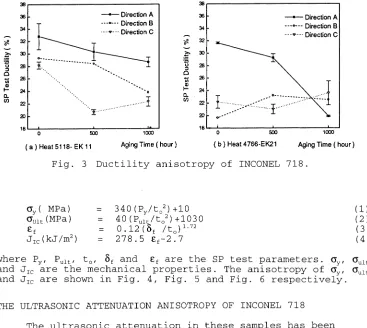
initiation[4]. The fracture strain Ef was used as the ductility which can be calculated according to the equation (3) below. The test results are shown in Fig. 3.
Semianalytical relationships among the small punch test parameters and the mechanical properties of INCONEL 718 are [9]:
(.) a:
J:
..
"'
.,
"'
"E
..
J: 455
- Direclion A
[image:2.505.170.336.33.165.2] [image:2.505.77.432.447.606.2]45.0 ---•--- Direclion B
... Oiection C
445
440
435
430 ...
425
420
0 500 1000
Aging 11me ( hour )
(.)
a:
J:
..
..
.,
"'
"E
..
J: 455
- - Diraction A 45.0
---•--- Diraction B
44.5 ... Diraction C
440
435
430
42.5
420~~---500~---~1000~
Agingllme ( hour )
(a) Heai5118-EK 11 (b) Heal4766- EK 21
>!!
.
~
=5 u
[image:3.505.74.441.37.365.2] [image:3.505.76.428.439.617.2]:I 0 ;;
.,
1-0.. II) 36 34 -DiractionA --- Direction B ... Direction C36
34
-DirectionA --- Diraction B ... Direction C
32 >!!
.
3230 -~ 30
I..
28
··---·--·--
... ~ :I 2828 24 22 ···-
...•
... ·!
0;;
.,
281- 24
0..
II)
22
3l 'I· .... 3l
18 18
0 500 1000 0 500 1000
( a) Heat5118- EK 11 Aging Time ( hour) ( b) Heat4766-EK21 Aging Time ( hour)
Fig. 3 Ductility anisotropy of INCONEL 718.
O"y ( MPa) O"ult (MPa) Ef
JIC (kJ /ID2)
340 {Py/t02 ) +10
40 {Pult/t02 ) +1030
0.12{Bf /t0)1.72
278.5 Ec2.7
(1) (2) (3) (4)
where Py, Pult• t0 , Bf and Ef are the SP test parameters. cr , crult
and J1c are the mechanical properties. The anisotropy of crY, crult
and J1c are shown in Fig. 4, Fig. 5 and Fig. 6 respectively.
THE ULTRASONIC ATTENUATION ANISOTROPY OF INCONEL 718
The ultrasonic attenuation in these samples has been
measured. The frequency dependence of attenuation in both heats
in direction B, is shown in Fig. 7. Theorientation dependence of
the attenuation is shown in Fig.8, where the transducer frequency is 20 MHz and the attenuation was measured at 16 MHz.
1400 1400
-DirectionA
1300
-DiractionA 1300 ---•··- Direction B
---•··· Diraction B ... Direction C
.,
13!0 0..::il
1100
~ c
~ 1000
II)
..,
!KlO äi >= 800... Diraction C
~
I ...
.f···-...
1:····----···--···
"'
13!0 0..::il
1100
.s::.
Ö> c
1oo0 I!! iii
..,
!KlO äi >= 800~
t...
.
···•·· .•... _ · .. _ .. :-:--<:.:···
... ·· ...
~~~0---~500~---~1000~ ~~~0---~500~---~1000~
( a ) Heat5118-EK11 Aging Time ( hour l ( b ) Heat4 766-EK21 Aging Time ( hour)
"'
Q.::E
i
c:g II) J!l
"'
E...
5..
..
.,
c: .s:."'
:> {:.e
~
&t 1450- - Diraction A
---•--- Diraction B ···•···· Diraction C
1400
··· .. I
1350 ...
1300
0 500 1000
Aging Time ( hour) ( a) Heat 5118-EK11
"'
Q.
::E
=
"'
c:g II) J!l
"'
E ...
5 1450~---~ -DiractionA ---•--- Diraction B ···•···· Diraction C1400
r.:~:.::.:.~:.~~
~···r~
1350
1300 L-~o---soo~---1~ooo--J
Aging Time ( hour) ( b) Heat 4766-EK21
Fig. 5 Ultimate strength anisotropy of INCONEL 718.
96 so 96 so 7S 70 65 lll 5S -e-Dinic!IOflA
-- o--DinaciiOfl B
... O.raclion C
o.. ... ..
I
··..... ..
·.
·---
...•
"I·· .. ··
0 500
(a) Heat5118-EK11
.... ···I
1000
Aging Time ( hour)
so
110
..
70..
]
lll"'
:> {:. 50e
3<> o40
l!
LI.. 30
3l
0 500
(b) Heat 4766-EK21
-e-DII&CiianA -- •-- tMctian B
... ..,. ... Direclion c
1000
Aging Time ( hour)
[image:4.505.80.426.144.307.2] [image:4.505.79.424.151.479.2]e
~
0.8 - - Heat 4766-EK21 (Oh)
--- Heat 4766-EK21 ( 500h) Heat 4766-EK21 (1000h)
!.
06.s
c0 0.4
~
"
c<! 0.2
12 14 16 18 20 22 24 26
Frequency (Mhz)
(a) Heat 5118-EK11
08
I
!.
06
.s
c0 04
"1;
"
c<! 0.2
- - Heat 5118-EK11 ( Oh) --- Heat 5118-EK11 (500h)
·· · Heat5118-EK11 (1000h)
14 16 18 20 22 24 26
Frequency (Mhz)
(b) Heat 4766-EK21
Fig_ 7 Frequency dependence of attenuation.
0~ O~r---,
0.22
I
0~
8. 0.18
.s
50.16
-~
E
s
<
014012
- - Direction A
---•--- Diraction B
I
·-
·"~"'"::2
:s;:
010 .__..._0 _________ _,500 ____ ~---,000.__,
Aging Time ( hour )
(a ) Heat 5118-EK11
oeo
075 070 065
060 055 050 045
040
035 0.30
-DirectionA
---o---Direction B ... Diraction C
----r
....}
I· ...
0.25 '--'---"=---'----'
500 1000
Aging Time ( hour)
(b) Heat 4766-EK21
DISCUSSION
From Fig. 2-6 and 8, it is obvious that there exists anisotropy of Inconel 718 in hardness, strength, fracture toughness, and ultrasonic attenuation.
We define the anisotropy parameter Kii as:
( 5)
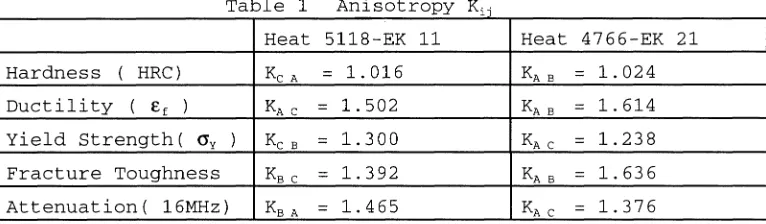
where i is the direction in which the quantity is maximum in value and j is the direction in which the quantity is minimum in value. Then, i and j can be A, B or C, which means Direction A, E or C with notations defined in Fig.1, and Q is the quantity, such as hardness, yield stress, fracture toughness, etc. As the
anisotropy was concerned, the maximum anisotropy is of interest. Then, the following Table 1 listed the results.
It can be seen that the anisotropy in ductility and fracture toughness could be as large as 1.6. During aging process, the direction with minimum properties of INCONEL 718 will change. Thus, the anisotropy should be taken into account when the component life extension was assessed.
The ultrasonic attenuation was best fitted by
( 6)
where f is the frequency. C1 and C2 are constants. D is the mean
grain diameter. Thus, the attenuation in INCONEL 718 is in the regions of stochastic scattering ( A
=
D) and diffusionscattering(
A
« D ) . It may be pretty accurate to measure thegrain size by NDE methods. And the mechanical properties of materials depend on the microstructure features[6]. However, the anisotropy in INCONEL 718 can be investigated by the acoustic measurement, but to correlate the mechanical properties and the attenuation coefficient in INCONEL 718 steel needs further work.
Table 1 Anisotropy K i
Heat 5118-EK 11 Heat 4766-EK 21 Hardness ( HRC) Kc A
=
1. 016 KA B=
1. 024 Ductility ( Ef ) KA c=
1. 502 KA B=
1.614 [image:6.505.73.456.420.532.2]CONCLUSIONS
The mechanical properties( Hardness, ductility, yield
stress, and fracture toughness) and the ultrasonic attenuation in INCONEL 718 are anisotropic. The anisotropy parameter Kii was defined as the maximum-to-minimum value ratio.
The ductility and fracture toughness anisotropy may be as large as 1.6. In different heatS of INCONEL alloy, the direction with minimum fracture toughness is dependent on the aging time.
The small punch test parameters can be used to predict the mechanical property anisotropy in materials by using the
relationship of equations (1)-(4).
The ultrasonic attenuation coefficient af
could be exploited to characterize the anisotropy in materials. However, the relation between the ultrasonic attenuation
coefficient af and the mechanical properties is not linear and not well understood.
ACKNOWLEDGMENTS
Ames Labaratory is operated for the US Department of Energy by Iowa State University under contract No. W-7405-ENG-82. This work was supported by the Office of Basic Energy Sciences, Division of Materials Sciences.
REFERENCES
1. R.L. Kennedy, W.D. Cao and W.M. Thomas, Advanced Materials & Processes, 33, 3/96.
2. J.W. Brooks and P.J. Bridges, Advanced Materials & Processes,1431, 3/1996.
3. W.G. Reuter, A.M. Porter, and N.M. Carlson, SPIE Conference Proceedings, Volumes 2454-2458, WA: SPIE, 1995. 4. J.M. Baik, J. Kameda and 0. Buck, Sripta Metall., 17 (1983). 5. J.M. Baik, J. Kameda and 0. Buck, STP 888, eds. W.R.Corwin
and G. E. Lucas ( Philadelphia, PA: ASTM, 1986), 92. 6. 0. Buck, Journal of Metals, p17, Oct. , 1992.
7. W.N. Reynolds and R.L. Smith, British J. of NDE,291,9,1985.
8. R.L. Smith, Ultrasonics, p211, Sept., 1982.
9. G. Liu, J. Kameda and 0. Buck, " Small Punch Tests for Evaluating the Mechanical Properties of INCONEL Alloy 718",