Abstract—Over the past several years the ability to manage
the knowledge has become a crucial and intensive matter within the society. To remain at the forefront, organisations need a good capacity to subsist, develop, organize and utilize their employees’ capabilities. Given the increased interest in knowledge as a source for company growth, the fundamental questions are: 1. By using what approach an organisation can achieve a competitive advantage based on its key resources? 2. In which processes it should invest to reform knowledge management in line with its objectives and needs? 3. How to develop processes and practices that promote knowledge sharing? The advantages of knowledge management for the organisations include improvement in the quality of work, benefitting from up-to-date information, increased efficiency, enhancement of productivity, better decision making, progressing the ability to satisfy the customers’ needs, increase in the ability to meet the fundamental needs and develop the country, possibility of change and fast adaptability. The purpose of this article is to make clear how the creation and application of knowledge can be the engine of organisational performance and growth. The critical success factors in knowledge assessment methods to help the establishment of knowledge management are identified. The current models and methods to implement knowledge management are discussed with the emphasis on knowledge economy and benefiting from information technology to enhance organisational expertise and create a competitive enterprise.
Index Terms— competitive enterprise, knowledge economy,
knowledge management, knowledge-based organisation, organisational expertise.
I. INTRODUCTION
oday’s world known as the age of knowledge and explosion of information is an era in which knowledge is regarded as the most important capital and an inexhaustible wealth for the organisations and institutions in the human society. The definition of knowledge management is the art of creating value by leveraging intangible assets, i.e. knowledge management is a perspective on management of the firm as a whole, encompassing activities in all relevant managerial areas (Sveiby, 2005). This wealth is more important than other treasures such as oil, gas, and natural mines in this period. Knowledge management (KM) is a science that has emerged in the last two decades (Dalkir, 2005) and now it has strong wings for flying. It is known that in a knowledge-based economy knowledge management is a fundamental and strategic element in the business. It accelerates the pace of the organisation in confronting the
challenges and winning the new opportunities of the market. Nowadays change in the attitude of managers in the organisations has given rise to emergence of a new generation of organisational managers who are valuable because of their ability in organisation, innovation, competition and establishment of a good and right relationship with their customers.
Intellectual capital has some characteristics that distinguishes it from other assets; these characteristics include the following (Dalkir,2005):
1- Use of knowledge does not consume it. 2- Transferal of knowledge does not result in
losing it.
3- Knowledge is abundant, but the ability to use it is scarce.
4- Much of an organisation’s valuable knowledge walks out the door at the end of the day. The key main point is that efficiency and potential benefit of knowledge management is not in knowing but it is in the ability to implement knowledge actively and creatively. The companies don’t become successful just because they know, rather the secret of their success is active and creative application of what they know. (Carl, Frappaolo, 2009).
In such organisations knowledge management means the process of discovering, acquiring, developing, creating, maintaining, evaluating and applying knowledge by the right person in the organisation; and this is realized thorough establishment of a link between the human resources, information and communications technologyand creation of a suitable structure for attaining the organisational goals. In the new age, knowledge management is not confined to codified and documented knowledge. (Wiig, 1993)
Many organisations and corporations in the world seek to enhance their competitive position and increase their effectiveness, productivity, and organisational expertise so that they promote their enterprise by relying on their tacit and explicit knowledge (Balogun, 2004).
To achieve this goal, knowledge management seeks to capture knowledge, wisdom and added-value experiences of the staff and also to apply, restore and maintain the knowledge as one of the organisation’s assets. With no doubt today knowledge is one of the main competition tools in the current and future markets. At the present time, many organisations have invested in the area of knowledge development, knowledge capture and transfer at various levels and they have been successful, however, many others have failed. Lack of the right mechanisms for evaluating and implementing knowledge management, has made this type of investment into an additional cost in the mind-set of the managers.
Nowadays creation and application of knowledge is
Enhancing Economic Growth, Organizational
Expertise, and Competitiveness With The Use
of Knowledge Management
Maryam Nazarizade, Amir Azizi
T
Student of MA, Department of Management Science and Research branch, Islamic Azad University Tehran, Iran.
Email: [email protected]
Faculty member of department of Industrial Engineering, Faculty of engineering, Science and Research branch, Islamic Azad University, Tehran, Iran
Knowledge
Explicit
Knowledge (recorded)
in documents
& artefacts
Embedded
Processes Products Rules Procedures
Tacit
Culture
Beliefs Perceptions
Ideals Values Emotions Attitudes Mental models
Focus Humour
Know-how
Skills
Capabilities
Expertise
Individuals
Organizational Structural
More necessary for competitiveness and continuation of the organisations and industries. Knowledge cannot be saved or captured as easy as other resources and also cannot be simply managed and applied systematically. Up to now, in most organisations of the country, for example in different sectors of petroleum industry, information technology(IT) has had the main share in knowledge management; so that a key factor behind all the knowledge management activities is IT. However, careful attention must also be paid to the fact that technology of information processing is not the only component and the pivot of knowledge management; to mention other components of knowledge management we should refer to change in decision-making procedures, methods of documentation, structure of establishment and the process of organisational establishment, leadership and the intellectual property right in knowledge management, the way doing works.
An organisation based on knowledge is fundamentally different from organisation based on the traditional competitive advantages. (Senge & Scharmer, 2001). The factors of specialization and professional expertise, problem solving ability, thinking ability, communication skills, and self-management motivation can significantly explicate the status of knowledge productivity in an organisation. (Yazdan Shenas, 2016)
II. CONCEPT OF KNOWLEDGE
Expert systems rely on a corpus of knowledge. The knowledge is derived or captured from the expertise of human experts – sometimes without the capturers realizing/ grasping the embedded semantics and implications of the knowledge items. Radding believes that organisational knowledge is wisdom and expertise that are the result of learning and experience. Truggle (2002) defines the knowledge as far beyond the data and information. (Radding, 2008).
Figure1. Interaction of data, information, knowledge, wisdom (DIKW) (Redrawn based on Sooknonan, 2001, knowledge management
in public sector)
Botha et al (2008) emphasizes that in businesses and organisations in general, knowledge is encountered mainly in three forms:
explicit knowledge, as represented in databases, memos, notes, documents, etc.
embedded knowledge, which is encountered in business rules, processes, manuals, in the organisation’s culture, codes of conductand ethics, etc.;
tacit knowledge, which is present in the minds of human stakeholders.
Figure2. Three varieties of knowledge, (Redrawn based on Botha et al, 2008,Coping with continuous change in the business environment)
Business knowledge may also be divided into individual, organisational and structural knowledge. Individual knowledge resides only in the minds of the employees. Organisational knowledge results from the learning that occurs on a group or division level. Structural knowledge is embedded in the culture and make-up of the organisation through processes, manuals, business rules and codes of conduct and ethics. (Botha et al, 2008)
Figure3. Business knowledge (Redrawn based on Botha et al, 2008,Coping with continuous change in the business environment)
A. Different types of knowledge
For our practical and technological approach to the subject, we recognize and differentiate between five different types of knowledge, namely:
Know-what: refers to knowledge about facts or some truth; also known as declarative knowledge.
Know-why: refers to knowledge about principles and laws in nature, the human mind and society. It involves deep knowledge of cause-and effect relationships.
Know-how: refers to skills, i.e. the ability to do something; that is to apply ‘know-what’ knowledge to complex real-world problems. This is also known as procedural knowledge. Know-who: involves information about who knows what and who knows what to do. It is typically a kind of knowledge developed and kept within the boundaries of a group such as an organisation or community of practice.
Know-when: refers to knowledge involving timing. One of the most valuable types of knowledge in a business context is
Wisdom
Knowledge
Information
Data
Less
Content volume
Level of value abstractio
K
no
wl
edge
Know-what About facts/truths
Know-why
About principles, conventions, and
laws of ...
Know-how About skills and
expertise
Know-who About who knows
what and what to do
Know-when About knowledge
of timing
Inter-organizational Level
Organizational Level
Collective Group
Level
Socialization-Tacit to Socialization-Tacit
Internalization- Explicit to Tacit
Externalization- Tacit to Explicit
Combination- Explicit to Explicit
TK is amplified through dynamic
interactions between four
modes of knowledge conversion.
Individuals
- hold tacit knowledge (TK) they have acquired through hands-on experience. They are the heart of thecreating process.
Knowledge is often passed on through
metaphor
predictive knowledge – the ability to look ahead to a certain condition and adjust before that condition occurs. (Garvin, 1993)
Figure4. Five types of knowledge (Redrawn based on Garvin, 1993, Building a learning organisation)
B. The knowledge conversion life cycle:
The knowledge-creating company is as much about ideals as it is about ideas. And that fact fuels innovation. The essence of innovation is to recreate the world according to a particular vision and ideal. To create new knowledge means quite literally to recreate the company and everyone in it in a non-stop process of personal and organisational self-renewal.
In the knowledge-creating company, inventing new knowledge is not a specialized activity. It is a way of behaving, indeed a way of being, in which everyone is a knowledge worker.
New knowledge always begins with the individual [In each case] an individual’s personal knowledge is transformed into organisational knowledge valuable to the company as a whole. Making personal knowledge available to others is the central activity of the knowledge-creating company. It takes place continuously and at all levels of the organisation. (Nonaka, 1991)
Figure5. Matrix of knowledge conversion (Redrawn based on Nonaka and Takeuchi, 1995, The knowledge-creation company: How Japanese
companies create the dynamics of innovation)
In 1998 Nonaka expanded the SECI model by introducing the concept of place (Depres and Chauvel, 2000). A place in knowledge management is a space for dynamic knowledge
conversion.
Originating Place: a space where individuals share emotions, feelings, experiences, etc.
Interacting Place: a space where tacit knowledge is made explicit.
Cyber Place: a space of interaction in a virtual world. It implicates the combination of new and existing explicit knowledge to generate new explicit knowledge throughout the organisation.
Exercising Place: a space that facilitates the conversion of explicit knowledge into tacit knowledge.
From this description of Place, it is clear that knowledge is context dependent. It cannot be separated from its ‘place’ in any meaningful way. Each knowledge-creating process requires a space, which should be recognized by the organisation (Depres and Chauvel, 2000).
Figure6. Spiral Model of Knowledge Creation-
Continual Dialogue Between Tacit and Explicit Knowledge (Redrawn based on Nonaka, 1998,A Dynamic Theory of Organisational Knowledge
Creation)
The knowledge conversion lifecycle is a powerful model for knowledge management. It clearly indicates that knowledge management should at least be concerned about managing the opportunities for enabling the sharing, capturing, learning and distribution of knowledge. (Botha et al, 2008)
III. KNOWLEDGE MANAGEMENT THEORIES
In future, the only source of competitive advantage would be the knowledge possessed by an organisation. (Peter Senge, 1999). knowledge management is a process contributing to the selection, organisation, distribution and creation of knowledge and experience in order to achieve competitive advantage. In fact, knowledge management is controlling smooth flow of knowledge and conveying it to
F
ro
m Ta
ci
t
k
n
o
w
le
d
g
e
Ex
p
li
ci
t
k
n
o
w
le
d
g
e
Socialisation of T to T People talk with each other and share
the knowledge
Externalisation of T to E Individual transmits knowledge through some documents such as the book,
paper, and report
Internalisation of E to T Upon studying the
documents or available content,
people learn and use it.
Combination of E with E Existing knowledge, documented or saved in computer, is recombined
and their relationship is defined To
Knowledge sharing and dissemination.
Knowledge acquisition and
application.
Knowledge capture
and/or creation.
the users who need it, so that using the received knowledge they act with a remarkably fast pace and quality.
This helps the organisations in problem solving, learning, strategic planning and dynamic decision making. It is a change from the industrial business model _ in which the capital of an organisation is tangible such as production equipment, machine, land and etc._ to the organisations whose main assets like knowledge and expertise are intangible.
Davis and Meyer (1998) provide thorough coverage of this rapid change and its resulting implications and effects, in the appropriately named book Blur: The speed of change in the connected Economy.
In his book, The Third Wave, Alvin Toffler (1981) describes the creation of wealth in terms of three broad waves:
First wave – The agricultural era: wealth creation was and still is tightly attached to land;
Second wave – The industrial era: wealth creation happens through industrial production, including mass production, mass consumption, mass education, mass media all linked together and served by specialized institutions;
[image:4.595.307.543.537.751.2] Third wave – The information era: wealth creation is tightly linked to information and knowledge handling. Table I. Three broad waves, Redrawn based on Alvin Toffler (1981), The
Third Wave.
Peter Drucker believes that in the world of today’s economy, knowledge is not the result of a learning process, or a homogeneous resource or within other production resources such as labor, capital, and land rather it’s a much more crucial resource for the present age. (Drucker, 1998).
Hoffman believes that knowledge management is the process of knowledge production and sharing in such a way that it could be efficiently used in the organisation The goal of knowledge management is to harness and apply the knowledge and information and provide easy access to it for all the staff. So that they do their job better. (Hoffman et al,2005).
A. Knowledge management cycle model
■ There are a number of different approaches to the knowledge management cycle such as those by McElroy, Wiig, Bukowitz and Willams, and Meyer and Zack.
■ By comparing and contrasting these approaches and by validating them through experience gained to date with knowledge management practice, the major stages are identified as knowledge capture and creation, knowledge sharing and dissemination, and knowledge acquisition and application.
■ The critical processes throughout the knowledge management cycle assess the worth of content based on
organisational goals, contextualize content in order to better match with a variety of users, and continuously update with a focus on updating, archiving as required, and modifying the scope of each knowledge object. (Dalkir, 2005)
B. An integrated KM cycle
On the basis of four major approaches to knowledge management cycles presented from McElroy (2003), Wiig (1993), Bukowitz and Willams (2000), and Meyer and Zack (1996), we can distill an integrated knowledge management cycle. The three major stages are:
1. Knowledge capture and/or creation. 2. Knowledge sharing and dissemination.
3. Knowledge acquisition and application. (Dalkir,2005)
Figure7. The KM cycle, Redrawn based on Dalkir, 2005,Knowledge management in Theory and Practice
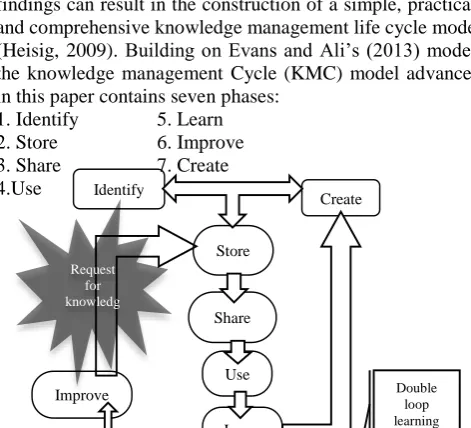
In 2009, Heisig took a more empirical approach to identifying knowledge management activities used to manage organisational knowledge, which can be used to inform the construction of a new integrated knowledge management life cycle model. Heisig (2009) judged many of the terms used to identify knowledge management activities to be essentially synonymous, and concluded that knowledge management activities fell into six broad categories. Of these, the six most frequently mentioned activities included: use, identify, create, acquire, share and store. By integrating the knowledge management life cycles reviewed thus far with Heisig’s findings can result in the construction of a simple, practical, and comprehensive knowledge management life cycle model (Heisig, 2009). Building on Evans and Ali’s (2013) model, the knowledge management Cycle (KMC) model advanced in this paper contains seven phases:
1. Identify 5. Learn 2. Store 6. Improve 3. Share 7. Create 4.Use
Wave
Labor Age
Intermediat e Resources
Main Resources
Product
Production Site
The Agricultural era
Farmer
Cattle and sheep
Land
Farm product
Farm
Managers
Workers
Energy
Technology
Factory
Thinking and research
Knowledge workers
Information
Knowledge
Institute, University The Industrial era The Information era
Update
Identify
Create
Store
Share
Use
Learn Improve
Request for knowledg
e
Double loop learning
Figure8. The Knowledge Management Cycle Model, Redrawn based on Evans and Ali, 2013, Bridging knowledge management life cycle theory
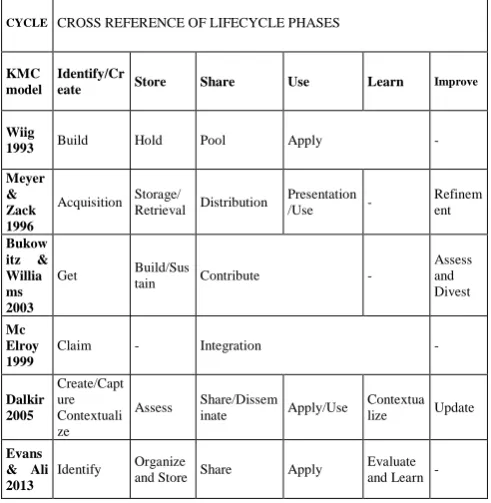
Following a similar depiction of life cycle phases as Evans and Ali’s (2013) summary table, a cross-reference chart is presented:
Table II. Cross reference of KM lifecycle phase (Recreated from Evans and Ali, 2013, Bridging knowledge management life cycle theory and practice)
CYCLE CROSS REFERENCE OF LIFECYCLE PHASES
KMC model
Identify/Cr
eate Store Share Use Learn Improve Wiig
1993 Build Hold Pool Apply - Meyer
& Zack 1996
Acquisition Storage/
Retrieval Distribution
Presentation /Use -
Refinem ent
Bukow itz & Willia ms 2003
Get Build/Sus
tain Contribute -
Assess and Divest
Mc Elroy 1999
Claim - Integration -
Dalkir 2005
Create/Capt ure Contextuali ze
Assess Share/Dissem
inate Apply/Use
Contextua lize Update
Evans & Ali 2013
Identify Organize
and Store Share Apply
Evaluate and Learn -
The main contribution of the KMC model is that it provides a holistic view of the knowledge life cycle, by building on previous life cycles and Heisig’s (2009) analysis of knowledge management frameworks. It further extends previous models by including different knowledge forms, integrating the notion of second order or double loop learning, and associating some facilitating initiatives and technologies for each of its phases. The addition of the learn and improve phases ties in the value creation aspect of the knowledge life cycle more closely and provides more flexibility, allowing for feedback and reuse of different phases. The addition of the double loop learning highlights the learning and improving aspects and shows how the KMC model can lead to a cycle of continuous improvement. One of the major reasons to process knowledge is for individuals, groups and the organisation itself to learn, to remember what it has learned and to leverage the collective expertise in order to perform more efficiently and more effectively. (Evans et al, 2014)
IV. REQUIREMENTS AND PREREQUISITES FOR ESTABLISHMENT OF THE KM SYSTEM:
Most of the scholars believe that one of the major issues raised in this era is the concept of knowledge management. knowledge management is a rapidly evolving approach and pays much attention to the recent challenges in order to increase the efficiency and improve the effectiveness of the business-centric processes and their continuous innovation (Bouthillier& Shearer, 2002)
By referring to the term ‘knowledge workers’ Drucker showed that the world is rapidly moving from the production-based economy (workers) toward a knowledge-production-based economy (knowledge workers). The need for knowledge management based on the growth in perception of business community originates from the fact that knowledge is regarded an important element in organisational performance
and access to a sustainable competitive advantage. Organisations consider knowledge as the most valued and strategic resource. The main point in knowledge management is how to share and diffuse the knowledge acquired in organisational learning (team works), to a scale larger than these teams i.e. throughout the organisation. The ultimate objective of the knowledge is to make life better but in the area of enterprise in the organisations, knowledge aims to create or increase the value and merit for the corporation and all beneficiaries ( Yazdan shenas, 2016)
Support and active involvement of all the top, middle, and operational mangers in order to establish the knowledge management system effectively;
Cooperation and empathy of all the staff and managers in administrative procedures of the system;
Allocation of proper financial and physical resources in administrative procedures of the system;
Required trust between the managers and staff for the purpose of experience sharing;
Holding the required training courses on knowledge management system with the help of Education department;
Encouraging and rewarding the best experiences.
A. KM Strategies: (Von Krogh, Roos, Kleine, 1998)
von Krogh (1995) distinguishes between individual knowledge and social knowledge, and an epistemological approach is taken to managing organizational knowledge. Whereas the definition of organization has been problematic and the term is often used interchangeably with information, a number of issues must be addressed:
- How and why individuals within an organization come to know.
- How and why organizations, as social entities, come to know.
- What counts for knowledge of the individual and the organization.
- What are the impediments in organizational knowledge management.
In 1998, von Krogh, Roos, and Kleine examined the fragile nature of knowledge management in organizations in terms of the mind-set of the individuals, communication in the organization, the organizational structure, the relationship between the members, and the management of human resources. These five factors could impede the successful management of organizational knowledge for innovation, competitive advantage, and other organizational goals. If there is no legitimate language to express new knowledge in the individual, contributions will fail. If the organizational structure does not facilitate innovation, knowledge management will fail. If individual members are not eager to share their experiences with their colleagues on the basis of mutual trust and respect, there will be no generation of social, collective knowledge within that organization. Finally, if those contributing knowledge and strategies are not highly evaluated and acknowledged by top management, they will lose their motivation to innovate and develop new knowledge for the firm.
1. Strategy of knowledge as a business strategy which is a comprehensive method for knowledge management at organisational level and it is mostly regarded as a product.
2. Strategy of intellectual capital management that emphasizes the use and promotion of investments already existed.
3. Strategy of responsibility for the capital of individual knowledge which supports the staff and encourages them to develop their knowledge and skills and share their knowledge with each other. 4. Strategy of knowledge creation which highlights
innovation and creation of new knowledge through the research and development units.
5. Strategy of knowledge transfer which is considered the best activity for improving the quality of work and efficiency in the organisation
6. Strategy of customer-centric knowledge which is applied with the purpose of understanding the clients and their needs so that their needs are carefully met. V. KNOWLEDGE MANAGEMENT IMPLEMENTATION PROCESS The management of knowledge is considered as an important and necessary factor for the competitive growth of an organisation (Valmohammadi, 2010). The decision to implement knowledge management is a major activity for any organisation. The success or failure of the organisation could be due to this decision, and therefore, it is very important that proper consideration be given to all aspects of knowledge management implementation before a final commitment is made. It is necessary to ensure that all the expected benefits of the decision are realized. knowledge management is a set of procedures, infrastructure, and technical and managerial tools designed towards creating, sharing, and leveraging information and knowledge within and around an
organisation (Holsapple, 2000). It is also defined as a systematic, organized, explicit, and deliberate ongoing process of creating, disseminating, applying, renewing, and updating knowledge for achieving organisational objectives. (Pillania, 2008) These definitions clearly state how knowledge management can contribute to organisational effectiveness (Hlupic, 2002). The knowledge management implementation is largely dependent upon various knowledge management enablers (KMEs).
A. Implementation perspective of KM
The implementation perspective on knowledge management concerns factors that facilitate the success of knowledge management projects, along with those challenges that may be foreseen and avoided.
According to KPMG* insightful brochure there are five implementation steps of a successful knowledge management implementation. Successful implementation is
done in a systematic way, building on successive ‘layers’ of increasing knowledge-rich organisational capability – away from a ‘knowledgechaotic’ business situation towards an ideal of a ‘knowledge-centric’ situation. Along the way, the organisation becomes knowledgeaware, then knowledge-enabled and knowledge-managed. (KPGM survey, 2003)
* KPMG is a professional service company.
Seated in Amstelveen, the Netherlands, KPMG employs 189,000 people and has three lines of services: financial audit, tax, and advisory. Its tax and advisory services are further divided into various service groups. The name "KPMG" stands for "Klynveld Peat Marwick Goerdeler."
Figure9. KPMG’s five-step implementation stack (Redrawn based on Botha, 2008, Coping with continuous change in the business environment)
The knowledge management implementation has been divided into modules, and each module is independent of the others. Four main modules have been identified, namely, (1) the institutionalization, (2) acceptance, (3) routinization, and (4) infusion modules.
The implemented factors consist of business strategy, organisational structure, and knowledge team. Knowledge audit and knowledge map are perceived as important but are the least implemented factors (Wei, 2006). There are many KMEs such as culture, leadership, technology, organisational adjustments, employee motivation, and external factors which can influence the success of knowledge management initiatives (Holsapple, 2000).
The use of the AHP method in determining the success or failure in knowledge management implementation initiation module is illustrated. Figure10 shows the possible outcome of implementation and attributes for the initiation module structured in a hierarchy. This constitutes a three-level hierarchy.
Based on the insights gleaned from analytic hierarchy process, Anand (2012) highlighted the procedures to predict the probability of successful KM implementation. The AHP method gave him the ability to structure complex,
multi-KPMG International3 has implemented an advanced global knowledge management system. An online messaging, collaboration, and knowledge-sharing platform, is reportedly the first system of its kind built entirely from standard Microsoft components—Microsoft Windows NT Server, including Microsoft Exchange, Site Server, and Microsoft Office, Outlook, and Internet Explorer.
Knowledge-centric
Knowledge managed
Knowledge-enabled
Knowledge-aware
Knowledge-chaotic
Figure10. The procedures to predict the probability of successful KM implementation (Redrawn based on Anand, 2012, Knowledge Management Implementation: A Predictive Model
person, multi-attribute, and multi-period problem hierarchically.
B. Documentation methods in KM
Types of techniques for documenting the experiences in knowledge management
There are different techniques for knowledge documentation but since the purpose of this research is to review the techniques for documenting the experiences; and experience is of tacit knowledge type, this paper is limited to explanation of techniques for tacit knowledge documentation. The following techniques have the maximum ability in acquisition and capture of deep tacit knowledge (Milton,2007);(Mohammad & Alsaiyd, 2010) (Dalkir and Liebowitz, 2011)
• Simulation • Interview • Modelling • Event reporting
• Reverse teaching (Flipped learning) • Observation
• Concepts mapping • Case studies • Scenario building • Story-telling
C. Proposed frameworks for documentation of
experiences in KM
A knowledge management-based framework shown as in Figure11 is proposed for the effective integration of archives resources as a top-level design by Xiaomi An Wenlin et al (2017).
Figure11. A knowledge management framework for the optimal utilization of national archive resources (Redrawn from Xiaomi An Wenlin et al, 2017,A knowledge management framework for effective integration of
national archives resources in China)
It should be noted that an effective technique for documenting the experiences should be able to transform the tacit knowledge into the explicit knowledge as best as possible and also possess the following features: (cooke, 1994) (Dalkir and Liebowitz, 2011)
It should separate the expert from his task and job for a certain period of time;
Non-experts should also be able to understand the extracted knowledge;
It should focus on key knowledge of the individuals;
It should obtain deep tacit knowledge of the individuals;
It should be able to justify the knowledge extracted from several experts in a certain field;
It should be able to maintain the extracted knowledge.
D. Proposed model for documenting the managers’
experiences
+Step of recognition, training and interaction o Preparing the interview executive team;
o Identifying and selecting the managers for the study; o Explicating the importance of extracting the experiences so that the managers under study believe it;
o Training the interviewers and editors of knowledge; o Conducting initial open interviews with selected managers in order to know about their general characteristics, experiences, records, successes, failures, major business challenges, and specialties.
+Acquiring the experience of organisational managers o Extraction and acquisition of the mangers’ knowledge and experience using the story-telling technique and semi-structured interview in the first session.
o Using the technique of reverse learning in order to get the managers’ approval for the obtained stories in the former sessions and remind them about those stories during next sessions.
o Forming, unifying and editing the stories.
+Storage and documentation of the mangers’ experience o Putting the stories in an appropriate format
o Designing a website for communicating the stories to others
VI. MODELS FOR KMESTABLISHMENT IN ORGANISATIONS:
Figure12. KM establishment models (Redrawn based on Dalkir, 2005, Knowledge management in Theory and Practice)
A. Initial skills for establishment of KM in leading
organisations:
Organisations should attain the required skills in five major activities in order to develop knowledge management and enhance it.
1- The power to solve the problems systematically.
2- The capability to learn lessons from the success of other organisations and apply new solutions.
3- Make use of their past and current experience.
4- Compare themselves with successful organisations and model themselves on those successful organisations. 5- The capability of fast and effective communication of knowledge through all levels of the organisation.
Rearrangement of the KM roles by people
Collaboration with e-governance: adequate legal control, collaborations among stakeholders, accountability systems, power shift, risk control
Communication with e-service: management innovation, administrative control, information resources management, treatment of complains, user
feedback
Connectivity with e-services: standardization control, adoption of ICT, provision of people-centric service
R
ee
nginee
ring
of
the
KM
ac
ti
vit
ies
by
pr
oc
es
se
s
VII. CRITICAL FACTORS OF KM SUCCESS IN LEADING ORGANISATIONS (EVANS,2003)
• Leadership in knowledge management • Culture in knowledge management • Procedures in knowledge management • Enhancement of knowledge marketing • Human resources management • Training and education • Resources
• Motivation aids • Processes and activities • Organisational infrastructure • Organisational strategy • IT
• Measurement method
• Increase in the number of involved individuals and their skills
• Technological infrastructure
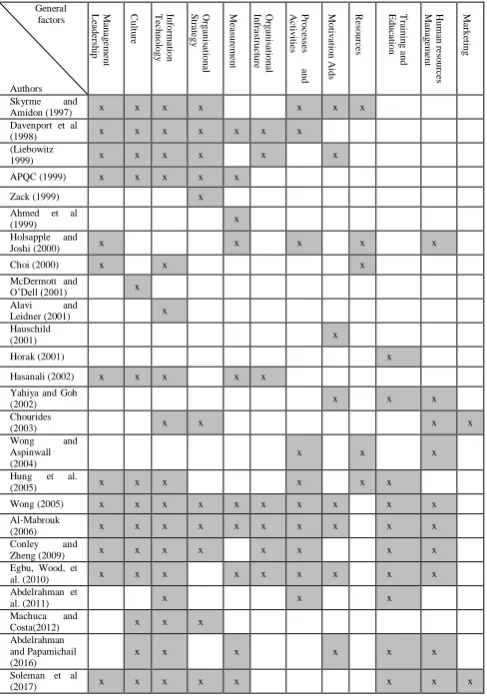
Given the importance of knowledge management in achieving competitive advantage, in order to build and adopt KMS there are many factors that influence the success of these projects. Many researchers have studied the critical success factors (CSFs) inherent in knowledge management (Abdelrahman and Papmichail, 2016; Skyrme and Amidon, 1997; Hasanali, 2002; Chourides 2003; Hung 2005; Khalid 2006; Conley and Zheng 2009; Egbu, Wood et al. 2010; Conley 2011; Mas-Machuca and Costa 2012). Seven CSFs have been identified in an international study of practice and experience of leading organisations in knowledge management, these factors include knowledge management Systems Usage, Organisational Culture, Knowledge Sharing, Decision Making Processes, Perceived Ease of Uses, Perceived Usefulness and knowledge management Practices (Abdelrahman and Papmichail, 2016). Moreover, Davenport et al. (1998) examined the practices of 31 knowledge management projects in 24 companies in order to determine the factors linked to their effectiveness. Among the projects, 18 were classified as successful, from which eight CSFs were identified to have contributed to their effectiveness. These eight CSFs linked knowledge management to senior management support, knowledge-friendly culture, technical and organisational infrastructure, standard and flexible knowledge structure, clear purpose and language, economic performance or industry value, multiple channels for knowledge transfer, and change in motivational practices. However, the authors referred that linking the identified factors to the success of knowledge management should be viewed as assumptions only. Baldanza and Stankosky (1999) designed a model for knowledge management with four pillars, including four critical success factors to adopt knowledge management in a beneficial way. The four pillars are leadership, organisation, technology and organisational learning. Additional taxonomies for CSFs have been introduced by other researchers, for instance Liebowitz (1999) presented six factors that embody the need for a knowledge management strategy with support from senior management, a chief knowledge officer (CKO) or equivalent, and knowledge management infrastructure, knowledge ontologies and repositories, knowledge management systems and tools, the need for incentives to encourage knowledge sharing and a supportive culture. Most of these factors identified in this paper were devised from important lessons learnt from organisations that applied knowledge management in different sectors (i.e: oil industry).
Researchers around the globe have suggested additional factors, for example, Choi (2000) conducted an empirical study in Nebraska University and found that three CSFs in particular influence the successful implementation of knowledge management. These factors were information technology, top management leadership/commitment, and information systems. Similar studies have been conducted to discover CSFs in knowledge management such as that of Hasanli, (2002) who identified five CSFs relevant to the 8 successful implementation of knowledge management; leadership, culture, structure, roles and responsibilities, information technology infrastructure and measurement. More recently, Abdelrahman and Papamichail (2016) and Jennex (2017) agrees that knowledge management is essential for today’s firms and recognises the following critical components for the successful implementation of a KMS: a knowledge strategy that identifies users, sources, processes, storage strategy, motivation and commitment of users including incentives and training; an organizational culture and structure that supports learning and the sharing and use of knowledge; senior management support including allocation of resources, leadership, and providing training; and finally there needs to be a clear goal purpose for the KMS. From the literature review, it is possible to discern that most CSFs for adopting knowledge management and KMS revolve around leadership and management, culture, information technology, strategy, human resources, training and education, marketing and measurements.
Table3 shows a summary of the studies that have investigated CSFs. General factors Authors M a na g e m e nt L ea de rs h ip Cul tu re Inform a tion T ec hnol ogy O rga ni sa tiona l S tra te gy M e a sur e m e nt O rga ni sa tiona l Infra st ruc ture P roc e ss e s a nd A c tiv iti e s M ot iv a tion A ids Re sourc e s T ra ini n g a nd E duc a tion H um a n re sour c e s M a na g e m e nt M a rke ting
Skyrme and
Amidon (1997) x x x x x x x
Davenport et al
(1998) x x x x x x x
(Liebowitz
1999) x x x x x x
APQC (1999) x x x x x
Zack (1999) x
Ahmed et al
(1999) x
Holsapple and
Joshi (2000) x x x x x
Choi (2000) x x x
McDermott and O’Dell (2001) x Alavi and
Leidner (2001) x Hauschild
(2001) x
Horak (2001) x
Hasanali (2002) x x x x x Yahiya and Goh
(2002) x x x
Chourides
(2003) x x x x
Wong and Aspinwall (2004)
x x x
Hung et al.
(2005) x x x x x x
Wong (2005) x x x x x x x x x x
Al-Mabrouk
(2006) x x x x x x x x x x
Conley and
Zheng (2009) x x x x x x x x
Egbu, Wood, et
al. (2010) x x x x x x x x x
Abdelrahman et
al. (2011) x x x
Machuca and
Costa(2012) x x x Abdelrahman
and Papamichail (2016)
x x x x x x
Soleman et al
[image:8.595.306.550.434.784.2](2017) x x x x x x x x
A. Leadership in knowledge management • Commitment and support by the top management
Obviously, success in administrating the programs, techniques, and new approaches depends on top managers’ commitment and their practical support. Thus, administration and leadership of knowledge management requires budgeting, structure and other facilities and resources; and it is the top management who allocates the resources based on the objectives and strategies of the organisation and the priorities given to each of them. Top management in the organisation can show his commitment and practical support for knowledge management in different ways including active participation in various phases of knowledge management implementation; taking into consideration the extent of the individuals’ knowledge performance in performance evaluation systems; promotion, reward, encouragement and punishment; auditing the knowledge performance of the organisational units at the end of each fiscal period and other solutions proportional to the context and especial situation of each organisation. (Walczak, S., 2005)
• Teaching knowledge management concepts at the organisational level
First of all, it is necessary that the top management gain full awareness about different aspects of the knowledge management implementation process, rules and principles of leading the experts and its importance in achieving organisational competitiveness; and then convey this awareness to different layers of the organisation. In so doing, different subdivisions of the organisation will treat the subject rationally and they will effectively cooperate and collaborate in the process. (Walczak, S., 2005)
•Providing a proper cultural ground
The organisation’s culture should back the knowledge-based movement of the staff. In such a culture, learning, teaching, training, creativity and innovation, knowledge sharing, communication of experiences and skills to other employees, enhancing the capability, modelling from others knowledge and experiences, free flow of information, expression of the beliefs and ideas, a good atmosphere for the employees’ discussion, high participation level and study and research are considered as value. Therefore, by providing the required cultural ground, management will lay the foundations for a knowledge system which includes creation of a common goal for continuous learning; encouraging the people at all levels to take lessons from their work; paying attention to the employees’ competencies, moving in direction of change in the staff’s mindset, team learning, and creation of systematic thinking. (Qilichli, B., 2009)
• Provision of technological infrastructure
Different uses of IT, as effective tools, may facilitate the knowledge management processes.
Leadership of knowledge management should bear in mind that information technology Tool would be useful in the whole knowledge life-cycle, i.e. creation, storage, application. (Sveiby et al, 2005)
• Creation of a suitable organisational structure
knowledge management implementation, as all other duties and activities, requires an appropriate organisational structure and establishment. In this regard, it is essential that serious
attention be paid to the mentioned establishments; thus they should be examined from the two following aspects:
1- To act as a headquarter: in this regard, it is better that a committee composed of top managers of all the organisational units (under the title of steering committee or another suitable title) be set up and take proper decisions on determination and development of policies and overall plans of the knowledge management procedure.
2- To act as a guild: here, the administrative and operational tasks in knowledge management procedure are done by the executives of this unit. Implementing all directives issued by the steering committee, carrying out the measurement processes, conducting analyses, planning, reform and improvement measures, and other follow-up activities are also among the above-mentioned duties. (Qilichli, B., 2009)
• Creation of knowledge centers
These centers may be established physically of virtually. The aim of establishing such centers is to provide, maintain, improve and update the knowledge. (Sveiby et al, 2005) • Measuring the organisational knowledge performance The leader should determine a method for knowledge management measurement and execute it in order to develop and enhance knowledge management and achieve the intended goals. (Sveiby et al, 2005)
• Analysis
Measuring the organisational knowledge performance during a period of time will finally render a series of numbers and digits which will be meaningless without conducting an analysis on them. Here the knowledge management leader should allocate them a certain weight based on the organisational situation and also the level of each knowledge performance indicator’s effect on key performance indices, so that the results present a more actual image of the evaluation. (Micic, R., 2015)
• Programming
Programming for the next term is done with regard to the results obtained from the analysis process and the knowledge objectives of the organisation. To achieve the objectives determined by the manager, all the organisational units should collaborate in such a way that according to the determined indices and their weight factors at the end of a certain period, the objectives are achieved. (Micic, R., 2015) • Taking required measures and making changes
Managers should constantly regulate and review knowledge management process during certain time periods. For example, one of the reasons for may be the employees’ inability to use tacit or hidden knowledge; in this case, it is required that we use the suitable techniques and methods so that this important and valuable resource of the organisation enters the operational cycle and leads to productivity and consequently increase in key performance indices. (Dulebohn et al. 2012)
B. Organisational Culture
Knowle dge Assess
ment Method
ology
Human Development
Index
Knowledge Economy
Index
Government Economic
Motives
Government Economic Issues
Government Political Issues
Knowledge Index
Creativity and Innovation
Human Resources
Education
Gender
Information and Communication
Technology
unique configuration of norms, values, beliefs and ways of behaving that characterise the way groups and individuals combine to get things done (Eldrige and Crombi, 1974; Schein, 2010).
C. Training and Education
Training and education is another important factor that needs to be considered when adopting successful KMS. Training is usually provided for employees, to enhance their understanding of the concept of knowledge management (Moffett, 2003). It can also provide a common language and perception of how employees might define and think about knowledge (Wong, 2005). Moreover, employees could be trained and educated to use the knowledge management systems and other technological techniques for managing knowledge, thus ensuring that they utilise the full potential and capabilities offered by these technologies.
VIII. KNOWLEDGE ASSESSMENT METHODOLOGY IN KNOWLEDGE ECONOMY
According to the definition released by world bank the knowledge assessment is divided to two different subgroups: (Katarzyana,2016)
1. Human Development Index, 2. Knowledge Economy Index, illustrated in figure13:
While the importance of knowledge has been stressed upon as a core aspect of business management, it is essential to ensure the effective utilization of that knowledge to execute a successful business. This underscores the need for knowledge management, wherein knowledge can be understood under diverse perspectives depending on its definition and applications (Alavi & Leidner, 2001). Because KSs and knowledge transfer typically involve social interactions and economic relationships, research and development (R&D) expertise does not automatically translate into innovation or entrepreneurial activity. To reach the market, any invention and entrepreneurial activity must undergo a lengthy process of refinement, reinvention, and redefinition (Nelson & Romer, 1996).
Also, the adoption and spread of tacit and social knowledge depend on the cumulative experience and organisational structures of public and private institutions (Edmondson, Winslow, Bohmer, & Pisano, 2003). As the institutional loci
of the new knowledge sources can differ, they can tap into these sources with the help of diverse organisations such as knowledge-intensive consulting firms, universities, and public research institutes (PRIs) (Grimpe & Kaiser, 2010). PRIs play a critical role in the creation, discovery, and diffusion of knowledge for public and domestic industries via governmental policies (OECD, 2011).
A systematic KS-level assessment is necessary from the following three perspectives. First, from the perspective of firms, knowledge outsourcing strategy is important wherein they can selectively concentrate on strategically important business activities by gaining knowledge from external sources, improving their capability to generate competitive advantages (Mudambi & Tallman, 2010). However, we note that knowledge processing involves difficulties pertaining to knowledge generation and its high cost so that it involves sharing of a firm’s knowledge, which can be one of its most critical sources of business competitiveness, and exposes the firm to confidentiality vulnerabilities with regard to third- party transactional partners. These properties may discourage the use of knowledge transactions by firms in the market (Tallman & Shenkar, 1994). The relationships among collaborators involved in knowledge-intense activities such as R&D have also been emphasized (Levitt & Thelwall, 2016).
PRIs, as government-oriented organisations interested in public and national profits, can be trustworthy knowledge-sharing providers, and in order to fulfill this role, first and foremost, they must be capable of providing valuable KSs. Second, from an institutional perspective, evaluating the contribution of KSs can help the institutional management of PRIs. PRIs need to achieve many goals using the limited resources at their disposal. Under these circumstances, the resources need to be allocated wisely in order to obtain the best results. Thus, a systematic analysis on the contribution of KSs may guide the PRIs as to which KSs should be focused upon.
Third, from a governmental perspective, PRIs, especially in the case of Korea (OECD, 2011), have evolved to fulfill governmental goals and social needs; their missions have changed over time in consideration of these goals and needs. Accordingly, the chronological changes in business environments necessitate the development of new services and/or modifications to existing services in a timely manner. Such changes in services can affect scientific and technological knowledge diffusion from the PRIs, in turn accelerating firms’ business because of the improvements in the KSs. Successful domestic businesses can be a stimulus for national economic growth and improved competitiveness. (Jeongsub C., Byunghoon K (2017))
IX. KNOWLEDGE-BASED ECONOMY
The new term of knowledge-based economy has emerged within the last decade and the organisations should implement knowledge management to achieve progress in a knowledge-based economy. knowledge management is the process of creating value from intangible assets of the organisation. Karl-Erik Sveiby (2001), the Sweden scholar brought up the issue of intangible assets in the organisations and concluded that knowledge asset of an organisation is its main asset.
Knowledge asset in the organisation include the knowledge and teachings created in the minds of the experts and managers in the organisation during the work processes and Figure13. The structure of Knowledge Assessment Methodology (Redrawn
it is considered as the main competitive advantage in the age of knowledge-based economy. These assets emerge in the form of expertise in the people’s minds. (Sveiby, 2005). knowledge management is a mixture of concepts from several fields such as knowledge-based systems, software engineering, business processes reengineering, human resources management, artificial intelligence, industrial engineering, total quality management, and organisational behavior. During the last two decades, studies of the scholars active in the field of management and industrial engineering such as Sveiby, Davenport, Nonaka, Wiig, Pursak etc. have attracted the attention of big industries so that they pay more attention to these tacit and intangible assets; and currently more than 70% of the member companies in the Fortune500 list have adopted knowledge management mechanisms. For better performance, business processes in the organisation, need the knowledge. knowledge management procedures in the organisation should have the ability to process the required knowledge for realization of organisational business procedures and do it efficiently and effectively.
To obtain economic and competitive advantage we need to evaluate knowledge in the organisation. (Gorji, Alipourian, 2011)
X. THE ROLE OF IT IN KM
A. KM and IT
Living in an era of rapid change, Don Tapscott articulates this well in his much referenced book “The Digital Economy”: Today we are witnessing the early, turbulent days of a revolution as significant as any other in human history. A new medium of human communications is emerging, one that may prove to surpass all previous revolutions – the printing press, the telephone, the television – in its impact on our economic and social life. The computer is expanding from a tool for information management to a tool for communication, enabling a new economy based on the networking of human intelligence. The Age of Networked Intelligence is an age of promise. It is not simply about the networking of technology but about the networking of humans through technology ... But the Age of Networked Intelligence is also an age of potential peril. For individuals, organisations, and societies that fall behind, punishment is swift ... This is an age of networking not only of technology but of humans, organisations, and societies. (Tapscott, 1996)
One of the relevant issues in organisational KM, is the remarkable progress of information and possessing a technological infrastructure. Here, the problem is that the organisations invest in it unilaterally without taking into account all dimensions and related issues. Results have shown that investment in IT and using it while ignoring the tacit knowledge would lead to rapid loss of the aforementioned advantage. Thus, the organisation should not expect to create and maintain competitive advantage by such kind of investment. This in turn will have a negative effect on the firm’s ability to create a sustainable competitive advantage. Therefore, the main question raised here is how to keep a balance between the tacit and explicit knowledge use so that we witness a positive effect on the firm’s achievements. Nonaka and Takeuchi believe that only the mankind can play a pivotal role in knowledge creation. Computers are nothing but a tool possessing a great information processing capacity. Malhotra maintains that KM necessarily includes some organisational procedures
which are a complementary combination of two capacities: i.e. information processing capacity by the IT and innovation capacity of the human (Johannessen, J.A; Olaisen, J; Olsen, B, 2001)
B. Required organisational capacities in KM creation
For a long time, it has been recognised that technology and specifically information technology (IT) serves as a key enabler of business change and innovation. This insight has recently been expanded, in the sense that we now realise that technology can be strategically employed to become a key driver of change and innovation. Thus, it is not simply the case that necessary change can be facilitated (enabled) by technology; rather, the very presence of technology stimulates (drives) a need for change.
IT will become the competitive resource to differentiate and provide competitive advantage. The factors driving demand for IT in the new economy with knowledge management as a prominent factor are summarised as follows:
The emerging global economy globalisation;
Dramatic changes in terms of competition;
Competition-driven changes in enterprise strategy and structure;
Enterprise critical success factors;
Continuous enterprise transformation and knowledge management
Figure14. Required capacities in KM creating (Redrawn from Malhotra Yogesh, 2003, Knowledge Management for E-Business Performance)
C. The role of IT in documentation of experiences
Documentation of experiences is mostly a methodology rather than a technology or product. IT is a crucial tool for achieving success in the system of experiences documentation. In the system experiences documentation, the storage and communication technologies can be used. Electronic documents management systems allow for registration, storage and retrieval of knowledge obtained from the experiences. Communication technologies allows the user to access the required experiences and connect with each other and the owners of experience, in particular. E-mail, internet, intranet and other web-based tools provided communication competencies. Communication technologies allow for the simultaneous or non-simultaneous use of an experience in one place or different places. There are so many benefits in establishing the documentation, evaluation and dissemination of experiences through IT (Turban E., Mclean E., Wether B, 2002)
D. Required Technologies in KM
processes and technology that is based on information, knowledge, and the knowledgeable people involved the so-called knowledge workers.
Table IV. Technologies needed in KM (Originally created)
E. Information Technology infrastructure in KM
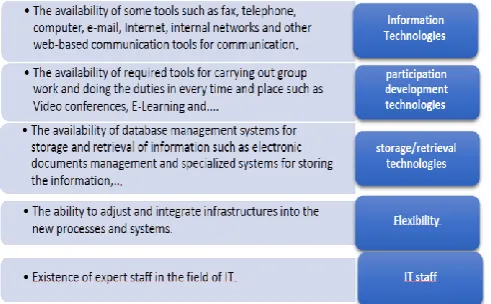
One of the relevant issues in organisational KM, is the remarkable progress of information and possessing a technological infrastructure.
Here, the problem is that the organisations invest in it unilaterally without taking into account all dimensions and related issues. Results have shown that investment in IT and using it while ignoring the tacit knowledge would lead to rapid loss of the aforementioned advantage. Thus, the organisation should not expect to create and maintain competitive advantage by such kind of investment. However, different uses of IT, as effective tools, may facilitate the KM processes and they would be useful in the whole knowledge life-cycle, i.e. creation, storage, application. Using high technology will accelerate the pace and accuracy of service and the customers will be more satisfied (Moradzadeh, Karimi, 2010)
Figure15. IT: The infrastructure in KM (Originally created)
XI. CONCLUSION AND DISCUSSION
Rapid change is a defining characteristic of modern world. It has a huge impact on society, economy, organisations and business. The latest management tool to respond to this challenges of the new millennium is the idea of KM. An extensive body of literature has emerged recently, covering KM and its process and assessment, as well as technologies applicable to KM.
This article aims to classify the idea of KM. Knowledge management theories, concepts, life cycles and requirements are the first pointed areas. Through the article a part will lay the establishment and implementation of KM. As Nonaka
once quoted: “In an economy where the only certainty is uncertainty, the one sure source of lasting competitive advantage is knowledge”, KM models mentioned in here, present different perspective on the key conceptual elements to provide a sound understanding of the disciplines of KM. The rest investigates documentations and KM assessment methods.
An alluring aspect of KM is to be accessed efficiently in economy. Critical success factors and ways to facilitate collecting and transforming knowledge like IT are taking place in this article.
In recent researches Anand (2012), Evans and Ali (2013), and Soleman (2017) focus on richness and insight into the prediction of success/failure and prior examination process for initiating KM. Anand specially tried the predictive model based on the analytical hierarchical process to help managers in KM implementation. The critical success factors affecting KM implementation are incorporated into a model to help managers by Evans and Soleman. The world of science should be merged with the world of business; the involvement of the government needs to be increased, the government should implement pro-innovative policies facilitating the application of knowledge in business. A further study on how to approach and merge these three worlds “knowledge”, “business” and “government” is recommended and needed to assist in managers’ operation.
REFERENCES
[1] Abdelrahman, M., and Papamichail, K. N. (2016). The Role of Organisational Culture on Knowledge Sharing by Using Knowledge Management Systems in MNCs. In AMCIS.
[2] Abdelrahman, M., Papamichail, K. N., and French, S. (2011). Knowledge Management System's Characteristics that facilitate Knowledge Sharing to Support Decision Making Processes in Multinational Corporations. In AMCIS.
[3] Alavi, M. and Leidner, D. E. (2001). Review: Knowledge Management and Knowledge Management Systems: Conceptual Foundations and Research Issues. MIS Quarterly, 25, 107-136.
[4] Alavi, M., & Leidner, D.E. (2001). Review: Knowledge management and knowledge management systems: Conceptual foundations and research issues. MIS quarterly, Vol. 25, No.1, Pp: 107-136.
[5] Anand, A.; Kant, R.; Patel, D. P.; Singh, M. D.; (2012) Knowledge Management Implementation: A Predictive Model Using an Analytical Hierarchical Process, Springer Science+Business Media New York. [6] Balogun ،O. ،Hawisa ،H. and Tannock ،J. (2004), "Knowledge
Management for Manufacturing: The Product and Process Database " ، Journal of Manufacturing Technology Management ،Vol. 25 ،No. 7 ، Pp:245-260.
[7] Botha, Antonie, Kourie, Derrick, Snyman, Retha (2008) Coping with continuous change in the business environment, “Knowledge management and knowledge management technology”, Oxford, Chandos.
[8] Bouthillier, F & Shearer,K (2002)”Understanding knowledge management and information management: The need for an empirical perspective”, Information Research, 8,1
[9] Choi, Y. S. ((2000).) An empirical study of factors affecting successful implementation of knowledge management. The University of Nebraska, Lincoln. The University of Nebraska, Lincoln.: 154. [10] Chourides, P. (2003). "Excellence in knowledge management: an
empirical study to identify critical factors and performance measures." Measuring Business Excellence 7(2): 29.
[11] Conley, C. A. and W. Zheng (2009). "Factors critical to knowledge management success." Advances in Developing Human Resources 11(3): 334-348.
[12] Cooke, N. (1994). Varieties of knowledge elicitation techniques. International Journal of Human-Computer Studies, No.41, Pp:801-849. [13] Dalkir, K. (2005) Knowledge management in Theory and Practice,
McGill University. Elsevier Inc.
[14] Dalkir, K., & Liebowitz, J. (2011). Knowledge management in theory and practice, 2nd edition, Cambridge, MA: MIT.