© 2019, IRJET | Impact Factor value: 7.211 | ISO 9001:2008 Certified Journal | Page 2855
STUDY ON THE PERFORMANCE OF RUBBERISED BITUMEN WITH
PLASTIC WASTE
Abdul Rishan
1, Abhijith O Pillai
2, Mubashira M
3, Ren Shibu
4, Emy Paulose
51
Abdul Rishan, B.tech,Civil Engineering, Dr.APJ Abdul Kalam Technological University.
2Abhijith O Pillai, B.tech,Civil Engineering, Dr.APJ Abdul Kalam Technological University.
3
Mubashira M, B.tech,Civil Engineering, Dr.APJ Abdul Kalam Technological University.
4
Ren Shibu, B.tech,Civil Engineering, Dr.APJ Abdul Kalam Technological University.
5Prof.Emy Paulose, Assistant Professor, M.A.College of Engineering. Kothamangalam.
---***---Abstract -
Many roads agencies have been experiencingproblem of premature failure of pavements like potholes, roughness, cracks etc. which leads to poor performance of roads and its life. On the other hand, plastics, rubbers, etc. are increasing day by day. Plastics are user friendly but not eco-friendly as they are non-biodegradable. Generally it is disposed by way of land filling or incineration of materials which are hazardous. The better binding property of plastics in its molten state has helped in finding out a method of safe disposal of waste plastics, by using them in road laying Waste like plastic bottles, polymers, cups, waste tyres can be re-used by powdering or blending it with crusher’s and can be coated over aggregate and bitumen by any heating process. Specifically, in this project, we use plastic which are cut into small square strips(1cm x 1cm) and then mixed with aggregates. Once the plastic waste is separated from municipal solid waste, the organic matter can be converted into manure and used. The results from Marshall Stability Test show that the mixed polymer coated aggregates have higher strength after finding the OBC(Optimum Bitumen Content). The change in the bitumen and aggregate properties after the addition of plastic have also contributed much in this project’s success. The main objective of this project is to analyze and study how the waste plastic will be effectively utilized in the construction of flexible pavement as a binder material.
Key Words: bitumen, aggregate, plastic reuse, NRMB, VG30, Marshall Stability test.
1.INTRODUCTION
Road network is the mode of transportation which serves as the feeder system as it is the nearest to the people. So the roads are to be maintained in good condition. The quality of roads depends on materials used for construction. Pavements are generally of two types: flexible and rigid pavement. A flexible pavement is the one which has a bitumen coating on top and rigid pavements which are stiffer than flexible ones have PCC or RCC on top. The flexible pavements are built in layers and it is ensured that under application of load none of the layers are overstressed. The
maximum intensity of stress occurs at top layer, hence they are made from superior material mainly bitumen.
In the construction of flexible pavements, bitumen plays the role of binding the aggregate together by coating over the aggregate. It also helps to improve the strength of the road. But its resistance towards water is poor. Anti-stripping agents are being used. Bitumen is a sticky, black and highly viscous liquid or semi-solid which can be found in some natural deposits or obtained as by-product of fractional distillation of crude petroleum. It is the heaviest fraction of crude oil, the one with highest boiling point (525°C) .Various Grades of Bitumen used for pavement purpose:30/40, 60/70 and 80/100.
Natural rubber modified bitumen is used for the prolongation of life of state roads. The need to adopt rubber for the use of construction of the roads is mainly that it reduces the cost of construction and also recycled rubber is used as it minimizes the environment pollution. The utilization of recycled rubber in pavement construction sector can be a very promising and environmentally friendly what to eliminate the nations stock of scrap. A steady stream of huge volume of waste remnant or natural rubber is generated due to the continual increase in the production of waste generated by the population. The availability of the Natural Rubber (Latex) is enormous, as the rubber is a product obtained from Latex (e.g., mattresses, gloves, swim caps, balloons) has become part of daily life. If it is not recycled, its present disposal is either by land filling or by incineration. Both the processes have certain impact on the environment.
© 2019, IRJET | Impact Factor value: 7.211 | ISO 9001:2008 Certified Journal | Page 2856
The studies on the thermal behavior and binding property ofthe Natural Rubber promoted a study on the preparation of Natural Rubber-bitumen blend and its properties to find the suitability of the blend for road construction. ―The initial cost is higher by around 20 per cent, but life-cycle cost is considerably lesser than roads surfaced using modified bitumen.
Rubberized bitumen is a mixture of hot bitumen and crumb rubber derived from postconsumer waste or scrap tyres. It is used extensively in the highway paving industry in the USA, particularly in the states of Arizona, California and Texas. It is a material that can be used to seal cracks and joints, be applied as a chip seal coat and added to hot mineral aggregate to make a unique asphalt paving material. The American Society of Testing and Materials defines rubberized bitumen as “a blend of asphalt cement [bitumen], reclaimed tyre rubber and certain additives, in which the rubber component is at least 15% by weight of the total blend and has reacted in the hot asphalt cement [bitumen] sufficiently to cause swelling of the rubber particles.”
2. LITERATURE REVIEW
S Varun, Dr. S. Sreenatha Reddy(2016)"Experimental Study on Characterization of Bitumen Mixed with Plastic Waste" stated that the modified mixture have a better result compared to the non-modified mixture. By adding Polyethylene Terephthalate (PET) to the bitumen a better binding between binder and aggregates was obtained. The penetration values of plain bitumen decrease on increase of the PET content .The results also show that the addition of PET makes the modified bitumen harder and more consistent than plain bitumen which results in improvement in the rutting resistance of the mix. This study shows ductility of plain bitumen increases with the addition of PET. The increase in the ductility values were observed as 78.4, 83.4, 86.16, 89.2, 92.33, 96.16, 99.06, 101.63 cm on addition of PET from 2-12% respectively, as compared to the plain bitumen, whereas, the ductility value declines at 14% PET addition . The study also shows that the flashpoint value increases as PET% increases. Similarly the fire point value also increases significantly up to 12%,whereas slight decline in the value was observed at 14% PET Flash and fire point of bitumen is generally observed between 280 0 C to 320 0 C. From the present investigation it has been observed that the inflammability of the blend (PB+2-14% PET) decreases as the percentage of PET increases. When PET was added beyond 10%, the similar trend was also observed in case of fire point. The value of fire point significantly increases as PET increases, whereas, a slight decline in the value was observed at 14% PET. The trend shows that the addition of 12% PET in plain bitumen may work efficiently to resist the burning hazards. In this study also shows that the Marshal Stability value is maximum at 8% of PET .
F. Onyango(2015) ―"Effect of Rubber Tyre and Plastic
Wastes Use in Asphalt Concrete Pavement" stated that the penetration value decreased with an increase for plastic in the bitumen modified bitumen with LDPE content greater than 5% had penetration values falling outside the allowable range of the 60/70 penetration grade bitumen. Also the LDPE tends to stiffen the bitumen therefore increasing its consistency. The softening point values increased with an increase in plastic content. The addition of up to 7% LDPE by weight will still result to an acceptable range of penetration. Ductility decreased with an increase in the plastic content in the bitumen The results of all the LDPE modified binders tested were within the specification range of 50 -100cm. The dynamic viscosity of the bitumen increased with an increase in plastic content. Higher viscosity values are an indication of stability whereas lower values indicate greater susceptibility to rutting of the mix.
Athira R Prasad (2015) ― “Bituminous Modification with Waste Plastic and Crumb Rubber” stated that the modifiers when used in 6% by weight of bitumen can improve the stability of pavements, best among them being PET bottles. Here the test was conducted by adding 5%, 5.5%, 6%, 6.5%, 7% bitumen by weight of aggregates to form BC mix and hence the optimum bitumen content obtained was 5.1% and the optimum plastic content was obtained as 6%. Since the Marshall Stability is higher in case of PET bottles compared to rubber, they can be regarded as the best modifier among two
Rishi Singh Chhabra, Supriya Marik (2014)"A Review Literature on the Use of Waste Plastics and Waste Rubber Tyres in Pavement” stated that the use of waste plastic and waste rubber tyre in construction of roads brings out a better performance. Since there is better binding of bitumen with plastic and tyre. The frequency of voids is also reduced due to increased bonding and area of contact between polymers and bitumen. This ultimately helps in decreasing the moisture absorption and oxidation of bitumen by entrapped air. Hence, the roads can withstand heavy traffic, thereby making them more durable. Whereas the mixing of rubber aggregate on the other hand while mixing in the bituminous mix decreases the quantity of stone aggregate by volume, makes it more flexible and also increases the flexural strength in the uppermost layer of the highways. The waste tyres can be used as well sized aggregate in the various bituminous mixes if it is cut in the form of aggregate and can be called as rubber aggregate. This not only minimizes the pollution occurred due to waste tyres but also minimizes the use of conventional aggregate which is available in exhaustible quantity.
3. METHODOLOGY
© 2019, IRJET | Impact Factor value: 7.211 | ISO 9001:2008 Certified Journal | Page 2857
Fig.1: Sequence of project
4
. PROPORTIONING OF MATERIALS
Proportioning of materials include proportion of aggregates for bituminous concrete and proportion of bitumen for OBC.
Sieve analysis of 6mm nominal size aggregate, 12mm nominal size aggregates and M-sand is done. Proportioning is done by Trial and error method and the results are compared with standard results of Bituminous Concrete.
Results Obtained
12 mm aggregate – 26%
6 mm aggregate – 17%
M-SAND – 51%
FILLER(OPC) -- 6%
5. TESTS
5.1
MARSHALL STABILITY TEST:-
Optimum bitumen content is determined by Marshall Stability Test.
Bruce Marshall formerly bituminous engineer with Mississippi state highway department formulated Marshall Method for designing bituminous mixes. Marshall test procedure was later modified and improved upon by I.S Corps of engineer through the extending research and correlation studies. ASTM and other agencies have standardized the test procedure. Generally, this stability test
is applicable to hot mix design bitumen and aggregates with max size of 2.5cm. In India, bituminous concrete mix is commonly designed by Marshall method.
The test is extensively used in routine test programs for the paving jobs. There are two major future of the Marshall method of designing mixes namely:
1. Density – void analysis
2. Stability-flow test
The stability of the mix is defined as a maximum load carried by a compacted specimen at a standard test temperature of 60°C. the flow is measured as the deformation in units of 0.25mm between no loads and maximum loads carried by the specimen during the stability test.(the flow value may also be measured by the deformation units of 0.1mm)
.
Fig (a) Specimens in water bath Fig (b) Testing of specimen
Determination of OBC by Marshall Stability Test
Preparation of modified bitumen mixes
Testing of individual properties of aggregates
Proportioning of aggregate
© 2019, IRJET | Impact Factor value: 7.211 | ISO 9001:2008 Certified Journal | Page 2858
6.2 MODIFIED BITUMINOUS MIX (NRMB)
RESULTS
Marshall Stability tests were conducted on NRMB mixes with varying proportion of modified bitumen. Values of marshal stability , bulk density , percentage air voids, flow value and VFB for each cylinder were obtained and the following graphs were plotted.
Marshall stability v/s modified bitumen %
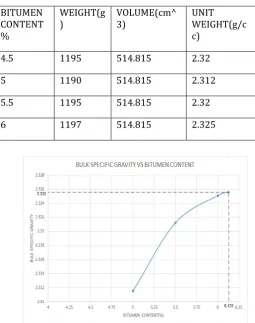
Bulk density v/s bitumen %
Percentage voids v/s bitumen by weight
From the above graphs the average value of optimum bitumen content (OBC) was obtained.
Flow value v/s bitumen %
VFB v/s bitumen %
Table 6.2(a) : Marshall Stability Result
BITUMEN CONTENT % MARSHALL STABILITY VALUE(KN)
4.5 9.5756
5 18.6336
5.5 13.1988
6 10.999
Unit weight of each cylindrical specimen of varying percentage bitumen was determined.
BITUMEN CONTENT %
WEIGHT(g
) VOLUME(cm^3) UNIT WEIGHT(g/c c)
4.5 1195 514.815 2.32
5 1190 514.815 2.312
5.5 1195 514.815 2.32
6 1197 514.815 2.325
Percentage voids of each cylindrical specimen of varying percentage of modified bitumen were determined
BITUMEN CONTENT% % AIR VOIDS
4.5 3.894
5 3.162
5.5 1.631
[image:4.595.308.564.118.442.2]© 2019, IRJET | Impact Factor value: 7.211 | ISO 9001:2008 Certified Journal | Page 2859
From the above 3 graphs the optimum bitumen contentobtained = (5+6.125+4.425)/3
= 5.2%
Flow value v/s modified bitumen content
BITUMEN CONTENT % FLOW VALUE (mm)
4.5 1.4
5 1.5
5.5 2.69
6 2.20
Voids filed bitumen(VFB) v/s bitumen content
BITUMEN CONTENT % VFB %
4.5 72.3336
5 78.079
5.5 88.408
6 97.6033
Flow value corresponding to OBC = 1.6mm
VFB corresponding to OBC = 83%
7
. BITUMINOUS MIX (VG30) RESULTS
Table 7(a) : Marshall Stability Result of VG30
BITUMEN CONTENT % MARSHALL STABILITY VALUE(KN)
4.5 12.34
5 18.55
5.5 20.704
© 2019, IRJET | Impact Factor value: 7.211 | ISO 9001:2008 Certified Journal | Page 2860
Unit weight of each cylindrical specimen of varyingpercentage bitumen was determined.
Table 7(b) : Bitumen Content Vs Unit Weight
BITUMEN
CONTENT% UNIT WEIGHT(g/cc)
4.5 2.2882
5 2.292
5.5 2. 294
6 2.301
Percentage voids of each cylindrical specimen of varying percentage of modified bitumen were determined.
Table 7(c) : Bitumen Content Vs % air voids
BITUMEN CONTENT% % AIR VOIDS
4.5 5.261
5 3.979
5.5 2.784
6 0.0137
The optimum bitumen content of VG30 is found as
5.5%.
8. DETERMINATION OF OPTIMUM PLASTIC
CONTENT
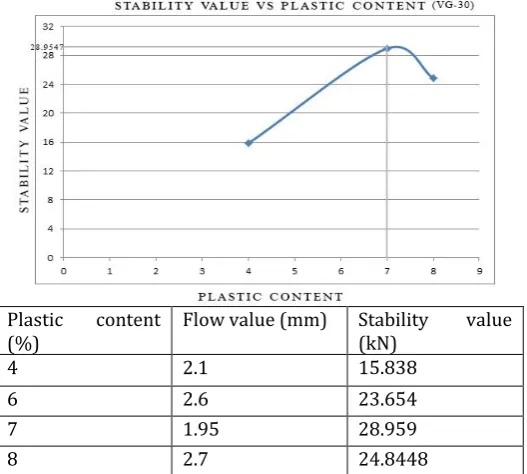
Towards the optimum bitumen content so obtained, we had added 4%,6%,7% and 8% of shredded plastic. The mould is prepared for conducting the Marshall Stability test. Graph has been plotted for both NRMB and VG30 specimens,
From the graph the optimum plastic content has traced.
Plastic content
(%) Flow value (mm) Stability (kN) value
4 2.1 15.838
6 2.6 23.654
7 1.95 28.959
8 2.7 24.8448
The optimum plastic content for bitumen VG30 grade is obtained as 7%.
NRMB :-
Plastic content
(%) Flow value (mm) Stability (kN) value
4 1.8 26.1588
6 2.6 28.416
7 2.5 30.874
8 2.3 24.844
[image:6.595.305.569.107.344.2] [image:6.595.305.562.464.720.2]© 2019, IRJET | Impact Factor value: 7.211 | ISO 9001:2008 Certified Journal | Page 2861
9. Variation in performance when VG30 is replaced
with NRMB
Plot % of plastic content on the X-axis and stability on the Y-axis to get maximum Marshall Stability as well as optimum plastic content of bitumen mix of NRMB and VG30. Both NRMB and VG30 gave maximum Marshall Stability value for 7%of plastic content. While VG30 gave a stability value of 28.95 kN for 7% plastic content, the stability value for the same plastic content given by NRMB was 30.87 kN. Thus the modified bitumen NRMB was showing better results compared to normal bitumen, VG30.
10. Conclusion
Both NRMB and VG30 gave maximum Marshall Stability value for 7% of plastic content. Hence with an optimum plastic content of 7% the properties of bituminous mix can be enhanced such as to reduce the air void present between aggregates and bind them together so that no bleeding of bitumen occur. It can also be noted that the modified bitumen NRMB was showing better results compared to normal bitumen VG30.The possible reasons for the increase in the stability value of NRMB mix can be better adhesion between aggregates and binder, thus capable for providing homogeneous blend with bitumen, without causing aggregate stripping.
Modified bitumen with plastic and rubber increases the life of flexible pavement due to high stability value and especially the pavement requires low maintenance cost. Moreover, the plastics which are hazardous if disposed continuously in open and left to degrade in our environment can be effectively utilized along with bitumen, finding more safer and eco-friendly way of their disposal. Hence as a conclusion NRMB with plastic modifier can be an environment friendly and economic approach in the field of flexible road construction.
ACKNOWLEDGEMENT
It is a great pleasure to acknowledge all those who have assisted and supported us for successfully completing our project.
First of all, We thank God Almighty for his blessings as it is only through his grace that we are able to complete project successfully.
We take this opportunity to extend our sincere thanks to our project guide Prof. Emy Paulose, Department of Civil Engineering for her support and contributions for the success of our project.
We extend our sincere thanks to Project Coordinator, Prof. Alice Mathai, Professor Civil Engineering Department for her valuable support and suggestions. We also thank other
members of the Civil Engineering Department for their support during the preparation of the project.
We are also grateful to Dr. Binoy Alias M., Head of Civil Engineering Department, for the valuable guidance as well as timely advice which helped during the preparation of the project.
We also thank Dr. Solly George, Principal, Mar Athanasius College of Engineering for her encouragement and support.
We whole-heartedly thank our classmates and our parents, for their valuable suggestions and support.
REFERENCES
[1] D Vasavi Swetha , Dr. K. Drgarani (2014)―”Effect Of
Natural Rubber On The Properties Of Bitumen And Bituminous Mixes” -International Journal of Civil Engineering and Technology , page (9-21).
[2] F. Onyango, Salim R. Wanjala, M. Ndege, L. Masu (2015)
― “Effect of Rubber Tyre and Plastic Wastes Use in Asphalt Concrete Pavement “-International Journal of Civil, Environmental, Structural, Construction and Architectural Engineering, page (1358-1362).
[3] K. Rajesh Kumar, Dr. N. Mahendran (2014) ―
“Experimental Studies on Modified Bituminous Mixes Using Waste HDPE and Crump Rubber” - International
Journal of Emerging Technology and Advanced Engineering, page (587-597).
[4] Athira R Prasad, Dr. Sowmya N J (2015) ― “Bituminous
Modification With Waste Plastic And Crumb Rubber “‖
IOSR Journal of Mechanical and Civil Engineering ,
page(108-115).
[5] Anirudh Gottala , Kitali Sai Nandha (2015)― “A Study On
Effect Of Addition Of Natural Rubber On The Properties Of Bitumen And Bitumen Mixes”-International Journal of Science Technology and Engineering, page (206-212)
[6] Krishnapriya M G (2015)‖ “Performance Evaluation Of
Natural Rubber Modified Bituminous Mixes”‖ International Journal of Civil, Structural, Environmental and Infrastructure Engineering Research and Development (IJCSEIERD), page(108-110).
BIOGRAPHIES
ABDUL RISHAN
© 2019, IRJET | Impact Factor value: 7.211 | ISO 9001:2008 Certified Journal | Page 2862
ABHIJITH O PILLAIB-Tech Civil Engineering, M.A.COLLEGE OF ENGINEERING KOTHAMANGALAM
MUBASHIRA M
B-Tech Civil Engineering, M.A.COLLEGE OF ENGINEERING KOTHAMANGALAM
REN SHIBU
B-Tech Civil Engineering, M.A.COLLEGE OF ENGINEERING KOTHAMANGALAM