A Super-Resolution Land-Cover Change Detection Method Using
Remotely Sensed Images with Different Spatial Resolutions
Xiaodong Li, Feng Ling, Giles M. Foody, IEEE Fellow, and Yun Du
X. Li, F. Ling and Y. Du are with the Key laboratory of Monitoring and Estimate for
Environment and Disaster of Hubei province, Institute of Geodesy and Geophysics,
Chinese Academy of Sciences, Wuhan 430077, PR China (e-mail:
[email protected]). G. M. Foody is with School of Geography, University of
Nottingham, University Park, Nottingham NG7 2RD, U. K.
Abstract—The development of remote sensing has enabled the acquisition of information on land-cover change at different spatial scales. However, a trade-off
between spatial and temporal resolutions normally exists. Fine-spatial-resolution
images have low temporal resolutions, whereas coarse spatial resolution images have
high temporal repetition rates. A novel super-resolution change detection method
(SRCD) is proposed to detect land-cover changes at both fine spatial and temporal
resolutions with the use of a coarse-resolution image and a fine-resolution land-cover
map acquired at different times. SRCD is an iterative method that involves
endmember estimation, spectral unmixing, land-cover fraction change detection, and
super-resolution land-cover mapping. Both the land-cover change/no-change map and
from–to change map at fine spatial resolution can be generated by SRCD. In this
study, SRCD was applied to synthetic multispectral image, Moderate-Resolution
Imaging Spectroradiometer (MODIS) multispectral image and Landsat-8 Operational
Land Imager (OLI) multispectral image. The land-cover from–to change maps are
found to have the highest overall accuracy (higher than 85%) in all the three
experiments. Most of the changed land-cover patches, which were larger than the
coarse-resolution pixel, were correctly detected.
I. I
NTRODUCTIONThe detection of Earth’s surface change serves as the basis for global change
studies, and is critical to the understanding of the interactions between human and
environmental systems. Remotely sensed data have become a primary data source for
monitoring land use/cover distribution and its changes at different scales [1]. At the
global scale, the coarse (low) spatial resolution images are the main data for
land-cover monitoring. For instance, land-cover change products based on MODIS
images at annual steps and 500 m spatial resolution for 2001-present have been used
for global monitoring and assessment purposes. Coarse spatial resolution remote
sensing systems have typically a high temporal repetition rate, which allow the timely
detection of land-cover changes. For example, MODIS allows the entire surface of the
earth to be monitored every 1 to 2 days since 2002. However, because of the relatively
coarse spatial resolution of the images acquired the level of spatial detail detected is
low. At the local-regional scale, land-cover change is often detected with the use of
fine (high) spatial resolution remotely sensed images, such as those acquired by the
Landsat Thematic Mapper (TM), Landsat Enhanced Thematic Mapper Plus (ETM+),
and Systeme Pour l'Observation de la Terre (SPOT) sensors. However, owing to the
trade-off between spatial and temporal resolution, fine-resolution images are often
acquired at a relatively low temporal resolution. Thus regional land-cover change
products are typically updated infrequently. For instance, the National Land Cover
Database (NLCD) land-cover change product for the U.S.A. with a spatial resolution
of 30 m is updated every 5 years approximately. Furthermore, fine-resolution images
usually cover a relatively small area, making their use difficult for regional or global
land-cover monitoring due to the great amount of processing time and labor required.
The accurate and timely detection of land-surface changes is a challenging task.
Land-cover change detection is crucial to understand and quantify land-cover change,
which is increasingly recognized as an important driver of global environmental
change [2]. The most widely used land-cover change detection methods are
methods, such as image differencing [3], vegetation index differencing [4], and
change vector analysis [5]. However, these change detection methods are based on
per-pixel comparison and require the same spatial resolution for bi-temporal images.
Different resolution images are usually resampled during the spectral change
detection process. A problem occurs when spectral modalities are different, and
simple change detection (e.g., image differencing and thresholding) is often unreliable
or impossible in case channels do not overlap well in the spectral ranges. Medium- or
fine-resolution images are the main data sources for change detection; however, they
are acquired at low temporal repetition rates, and land-cover changes are detected
infrequently. By contrast, coarse-resolution images, which have high temporal
repetition rates, are the main data sources of land-cover change detection at a global
scale. Unfortunately, the aforementioned per-pixel-based change detection methods
assume homogeneity within a single pixel, resulting in no quantifiable changes at the
sub-pixel level. In fact, most coarse-resolution image pixels are composed of several
land-cover/land-use types, and the mixed pixel problem seriously affects the change
detection accuracy. Spectral unmixing or soft classification algorithms do not assign a
mixed pixel to a single land-cover class but instead generate class area proportion or
fraction images that represent proportional areas of different land-cover classes within
mixed pixels. Spectral mixture analysis can be used to derive land-cover area
proportion images, and changes can be detected by comparing the “before” and “after”
area proportion images of each endmember[6]. Applying spectral unmixing to
bi-temporal or a series of multitemporal images for change detection can potentially
reveal important sub-pixel level information, such as the endmember abundance
variation in a given location [7-10]. Spectral unmixing-based change detection
methods provide the addition/subtraction of an endmember in the abundances and are
based on the images with the same spatial resolution. In addition, He´garat-Mascle et
al. [11] used images with different spatial resolutions to detect sub-pixel land-cover
proportional change. A coarse-resolution image was unmixed and a fine-resolution
image was spatially degraded to generate the bi-temporal class area proportion images.
change in the class proportions of each coarse-resolution pixel was detected. However,
only the coarse-resolution pixel change instead of the fine-resolution pixel change
was detected, because spectral unmixing can only determine the coarse-resolution
pixel land-cover area proportions and does not provide information on class labels at a
sub-pixel scale.
Super-resolution land-cover mapping (SRM) is a technique used to generate
land-cover maps with a finer spatial resolution than the input data. Various algorithms,
such as pixel swapping algorithm [12, 13], Hopfield neural networks-based SRM [14],
Markov-random-field-based SRM [15, 16], the spatial-spectral managed SRM [17,
18], spatial interpolation based SRM [19, 20], direct mapping based SRM [21],
example-based SRM [22] and intelligence system based SRM [23], have been
proposed to address the SRM problem. SRM predicts the spatial distribution of each
class in each coarse-resolution pixel and provides more sub-pixel-scale land-cover
information than spectral unmixing[24]. Traditionally, SRM is applied to a
monotemporal coarse-resolution image to predict a fine-resolution land-cover map for
the time period it represents. SRM is an ill-posed inverse problem because many
fine-resolution land-cover maps can satisfy the SRM constraints, and traditional
methods using a single image are limited in terms of the spatial detail represented and
the accuracy of the final map produced. Additional datasets can, therefore, be adopted
in SRM. A historic fine-resolution land-cover map may, for example, be used to
enhance SRM. Ling et al. [25] first proposed a sub-pixel land-cover change mapping
method by integrating a coarse-resolution image and a fine-resolution land-cover map
that pre-dates the former. In this method, the sub-pixel class labels in the
fine-resolution map with unchanged or increased class area proportions are preserved
in the final fine-resolution land-cover map output from the SRM, and other sub-pixels
are allocated based on the land-cover maximum spatial dependence model. Li et al.
[26] proposed a spatial-temporal Markov-random-field-based SRM, in which the data
on land-cover temporal dependence is the input to the analysis. Xu and Huang [27]
proposed a spatial-temporal pixel-swapping algorithm based SRM, which extended
et al. [28] proposed a spatial-temporal Hopfield neural network based SRM, in which
temporal transition information of sub-pixels was added compared with traditional
Hopfield neural network based SRM.
Although the capability of SRM to extract fine-resolution land-cover information
is increased with the use of a fine-resolution land-cover map that pre-dates the
coarse-resolution image, the existing methods have three major limitations in the
detection of land-cover change at fine spatial and temporal scales:
(1) With current SRM methods, the required information on endmembers, which
can represent the spectral information of land-cover components, is typically assumed
available. However, endmember information is often unavailable; thus, the extraction
of endmembers in SRM is necessitated. Endmembers represent the spectrally pure
components of a given image and are central to SRM. A considerable number of
image endmember extraction algorithms, including the manual endmember selection
tool [29], pixel purity index [30], N-FINDR [31], and automatic methods [32, 33],
have been proposed in the recent years [34]. Manual endmember extraction methods
are laborious, whereas iterative and automatic endmember extraction methods have
been analyzed using only monotemporal imagery. When a fine-resolution land-cover
map that pre-dates or post-dates the coarse-resolution image is available, useful
information about land-cover configurations at a former or later time is available to
facilitate SRM analysis.
(2) Current methods consider only the case wherein the fine-resolution
land-cover map pre-dates the coarse-resolution image. Coarse-resolution remotely
sensed images have been available for decades, particularly from such systems as
MODIS and NOAA Advanced Very High Resolution Radiometer. With the
development of remote sensing technology, remote-sensing systems with enhanced
(finer) spatial resolution are increasing in number. As such, the fine-resolution images
that post-date their corresponding coarse-resolution images may often be available in
land-cover monitoring. However, this scenario has not been studied for current SRM
methods.
predicted by SRM, land-cover change information is not provided. Map-to-map
methods demonstrate a potential in fine-resolution change detection using images of
different spatial resolutions, owing to the capability of SRM to generate land-cover
map of a spatial resolution finer than that of the input image. Land-cover change
information can be derived by comparing the land-cover maps of the same fine spatial
resolution; these land-cover maps are generated from fine-resolution images based on
hard classification and from coarse-resolution images based on SRM. This change
detection method provides land-cover change information and trajectories that users
typically desire, particularly a simple binary change/no-change map and the detailed
from–to change trajectory information [6].
In order to address the above issues, a super-resolution change detection method
(SRCD) is proposed. SRCD uses a combination of a fine-resolution land-cover map
and a coarse-resolution image to detect land-cover change/no-change information and
from–to information at fine spatial and temporal resolutions. The fine-resolution
land-cover map can either pre-date or post-date the coarse-resolution image. The
proposed method is based on the assumption that the land-cover class types are
invariant during the period [35, 36]. The endmembers are estimated and iteratively
updated in SRCD. The remainder of this paper is organized as follows. Section II
introduces the SRCD method. Section III examines the performance of SRCD using
synthetic, MODIS, and Landsat images as well as for scenarios in which the
fine-resolution land-cover map pre-dates and post-dates coarse-resolution image.
Section IV concludes this paper.
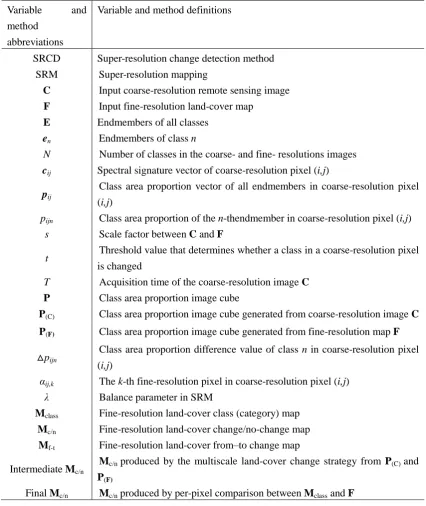
TABLE I.
LIST OF IMPORTANT VARIABLES AND METHOD DEFINITIONS
Variable and
method abbreviations
Variable and method definitions
SRCD Super-resolution change detection method
SRM Super-resolution mapping
C Input coarse-resolution remote sensing image
F Input fine-resolution land-cover map
E Endmembers of all classes
en Endmembers of class n
N Number of classes in the coarse- and fine- resolutions images
cij Spectral signature vector of coarse-resolution pixel (i,j)
pij
Class area proportion vector of all endmembers in coarse-resolution pixel (i,j)
pijn Class area proportion of the n-thendmember in coarse-resolution pixel (i,j)
s Scale factor between C and F
t Threshold value that determines whether a class in a coarse-resolution pixel
is changed
T Acquisition time of the coarse-resolution image C
P Class area proportion image cube
P(C) Class area proportion image cube generated from coarse-resolution image C
P(F) Class area proportion image cube generated from fine-resolution map F
△pijn
Class area proportion difference value of class n in coarse-resolution pixel (i,j)
αij,k The k-th fine-resolution pixel in coarse-resolution pixel (i,j)
λ Balance parameter in SRM
Mclass Fine-resolution land-cover class (category) map
Mc/n Fine-resolution land-cover change/no-change map
Mf-t Fine-resolution land-cover from–to change map
Intermediate Mc/n
Mc/n produced by the multiscale land-cover change strategy from P(C) and
P(F)
Final Mc/n Mc/n produced by per-pixel comparison between Mclass and F
A. SRCD Description
with I × s × J × s pixels with N land-cover classes in it. F can either pre-date or post-date C. The scale factor between F and C is denoted by s, and each coarse-resolution pixel contains s × s fine-resolution pixels. Let Mclass be the fine-resolution land-cover map with I × s × J × s pixels produced by SRM. Endmember matrix E is a B × N matrix, in which each column vector en corresponds
to the spectrum vector of the n-th endmember. Let P be an I × J × N array denoting the class area proportion cube. The N × 1 vector representing the class area proportion of all endmembers in the pixel (i,j) is denoted by pij, and pijn is the area proportion of
the n-th endmember in the pixel (i,j).
SRCD uses a coarse-resolution remotely sensed image C at acquisition time T and a fine-resolution land-cover map F as inputs. SRCD outputs a fine-resolution land-cover change/no-change map Mc/n and a fine-resolution from–to change map
Mf-t. Both Mc/n and Mf-t are produced by comparing F with the estimated fine-resolution land-cover map Mclass at time T.
Central to the proposed SRCD method is the estimation of Mclass from C. Mclass and the endmember matrix E are the two interactive variables in SRCD. If E is known,
Mclass can be produced from C using SRM [25]. Frequently, E is an unknown variable and is estimated from C, given the land-cover area proportion image cube P with the
use of spectral unmixing [11, 37]. P can be derived by spatially degrading Mclass, which is also an unknown variable in SRCD and is iteratively estimated and updated
by determining E [11]. An iterative approach is used in SRCD to solve the endmember matrix E and fine-resolution land-cover map Mclass coupling problem, that is, both variables E and Mclass are estimated and updated iteratively.
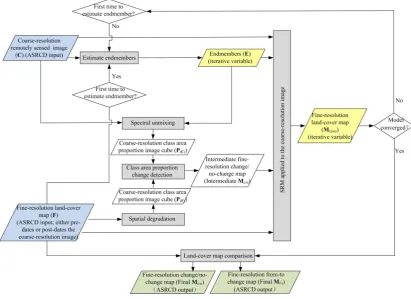
The iterative SRCD starts from the estimation of the endmember matrix E at time T. At the first iteration, F, which pre-dates or post-dates C, is used as a substitute of Mclass at time T, which would be accurate if all fine-resolution pixels are unchanged in the time period covered. At each iteration, the estimation of E is solved using a pseudo-inverse method, which employs C and Mclass as inputs. Once E is estimated,
are re-estimated and updated with each iteration. SRCD is iteratively run until
convergence is achieved. Once SRCD converges, Mclass is compared with the input F to produce the final land-cover change/no-change map Mc/n and from–to change map
Mf-t. The flowchart of SRCD is shown in Fig. 1.
Fig. 1. The flowchart of the proposed SRCD method.
B. Endmember Matrix E Estimation
In SRCD, the endmember matrix E is estimated based on C and Mclass at time T.
Mclass is degraded into the coarse-resolution land-cover area proportion image cube P by dividing the number of fine-resolution pixels of each class by the total number of
fine-resolution pixels in a coarse-resolution pixel (i.e., s2). The pixel spectrum is the result of a mixture of different endmember spectral signatures. We assume that the
observed signals can be decomposed linearly (linear mixing assumption) and the
measured contributions of the endmembers are proportional to their surface areas[38].
Based on the linear mixing assumption, the spectral signature cij for pixel (i,j) can be
[image:9.595.92.504.175.474.2]ij E ij
c p (1)
where is an error term accounting for any noise in the imaging chain and other
model inadequacies. In accordance with the mean square error minimization criterion,
E in the image is estimated by searching for the solutions that minimize the squared error between the observed spectrum cij and the approximated spectrum, i.e.,
2
1 1 1
[ ] argmin
I J N ij ijn n i j n
p
E c e . (2)
Equation (2) is a pseudo-inverse problem. The endmember matrix E can be estimated according to the class area proportion image cube P and the coarse-resolution image C in (2).
C. Fine-Resolution Land-Cover Map M
classEstimation
Once E is estimated, Mclass at time T can be derived using SRM applied to C. In SRCD, SRM does not label all fine-resolution pixels in the image as traditional SRM
methods do. Instead, it only updates the labels of changed fine-resolution pixels
according to an intermediate fine-resolution change/no-change map (intermediate
Mc/n). The generation of Mclass involves the production of the intermediate Mc/n and SRM. More specifically, the production of the intermediate Mc/n involves the generation of bi-temporal coarse-resolution images, the establishment of a multiscale
land-cover change strategy to downscale these bi-temporal class area proportion
image cubes to fine-resolution scale, and the determination of the class area
proportion change thresholds in the bi-temporal class area proportion image cubes to
quantify area proportion change in each coarse-resolution pixel. The procedures are
explained below.
1) Coarse-Resolution Land-Cover Class Area Proportion Estimation
The coarse-resolution land-cover area proportion image cube P at time T is estimated using spectral unmixing, given the coarse-resolution image C and
model[39]. Based on the mean square error minimization criterion, the class area
proportion vector pij in the coarse-resolution pixel (i,j) is estimated by searching for
the solutions that minimize the following expressions:
2 1
[ ] argmin
N
ij ij ijn n n
p
p c e (3)
0 pijn 1, n1, ,N (4)
1
1 N
ijn n
p
. (5)Equation (3) is a constrained inverse problem, and two constraints in (4) and (5)
are imposed on the objective function of (3) [40]. Then, C is unmixed and transformed into the class area proportion image cube P(C) according to the linear mixture model.
F is spatially degraded into the class area proportion image cube P(F). In the generation of P(F), the class area proportion values of each class in each coarse-resolution pixel are calculated by dividing the number of fine-resolution pixels
of each class by the total number of fine-resolution pixels in the coarse-resolution
pixel (i.e., s2).
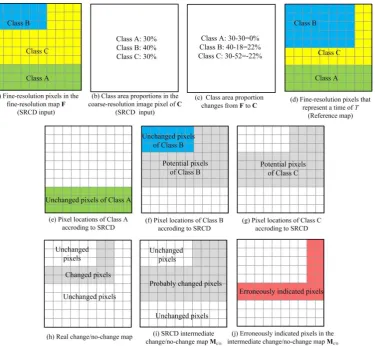
Fig. 2. Production of the intermediate change/no-change map (intermediate Mc/n)
With bi-temporal coarse-resolution class area proportion image cubes P(C) and
P(F), a multiscale land-cover change strategy is applied to downscale these class area
proportion image cubes to produce the intermediate Mc/n by incorporating the input map F. The SRCD method is based on a simplistic view of land-cover change trajectory; this method compares the change in the class area proportion of each class
from the fine-resolution map F to the coarse-resolution image C. If the area proportion of a class in a coarse-resolution pixel appears to be unchanged (e.g., Class
A in Fig. 2), then the number and location of the fine-resolution pixels of that class in
F are unchanged in C. If the area proportion of a class in a coarse-resolution pixel appears to have increased from F to C (e.g., Class B in Fig. 2), then the fine-resolution pixels of that class in F are unchanged, and some fine-resolution pixels in F from class(es) that decreased in class area proportion have transformed into that class in the coarse-resolution image pixel. If the area proportion of a class in a
[image:12.595.98.474.69.415.2]then the fine-resolution pixels of that class in F include those that may have transformed into fine-resolution pixels of other classes, and no fine-resolution pixels
in F are assumed to have transformed from other classes into that class in the coarse-resolution image pixel. Thus, the fine-resolution pixels of a class in F that decrease in area proportion probably contain the set of changed pixels. As a result, in
F, the fine-resolution pixels with unchanged and increased class area proportions from
F to C (e.g., Class A and Class B in Fig. 2) are probably the unchanged fine-resolution pixels, whereas the fine-resolution pixels with decreased class area proportions from
F to C (e.g., Class C in Fig. 2) are probably the changed fine-resolution pixels in the coarse-resolution pixel. In addition, some unchanged fine-resolution pixels may be
erroneously indicated as being changed pixels in the SRCD intermediate Mc/n (e.g., Class C in Fig. 2 (j)). Thus, SRCD may have overestimated the number of changed
pixels but underestimated the number of unchanged pixels. As a result, the SRCD
intermediate Mc/n contains commission errors of changed pixels and omission errors of unchanged pixels.
3) Iterative Determination Method for Class Area Proportion Change Threshold
In Fig. 2, the omission errors of unchanged pixels are permitted, whereas the
commission errors of unchanged pixels are forbidden. This difference is because the
SRM in SRCD only updates the fine-resolution pixel labels that are changed in the
intermediate Mc/n. If the commission error of unchanged pixels is large, the SRM in SRCD is essentially a traditional SRM that labels all fine-resolution pixels, and the
information in F is merely used. The discrimination of unchanged fine-resolution pixels in the intermediate Mc/n is thus important and is implemented by injecting a threshold t to quantify the amount of unchanged pixels in each coarse-resolution pixel. SRCD employs an iterative class area proportion change thresholding approach,
commission errors of unchanged pixels in the intermediate Mc/n. Through the SRCD iterations, the endmember matrix E is re-estimated, and the accuracy of class area proportion image cube P increases. More potential unchanged fine-resolution pixels should be determined in the intermediate Mc/n. The SRCD is iterated until the completion of a predefined number of iterations.
The iterative SRCD class area proportion change thresholding scheme is
implemented. Let pijn be the area proportion difference value of class n in the
coarse-resolution pixel (i,j). It is calculated by subtracting the area proportion value of class n in the pixel (i,j) in the class area proportion image cube P(F) from that in the
class area proportion image cube P(C). Let treal (treal 0) be the real threshold value
for detecting class area proportion change. On the basis of the multiscale land-cover
change strategy, the fine-resolution pixels with unchanged class area proportion
(pijn [ treal,treal]) or increased class area proportion (pijn(treal,1]) from F to C
are labeled as unchanged in the intermediate Mc/n. Let tini be the initial threshold
value and t be the iterative threshold value. The threshold value t is iteratively decreased from a high value that approximates the higher bound of 1 to a low value
that approximates the lower bound of treal at an interval of t (t <0) to
gradually detect the increased and unchanged pixels. Initially, t is set to a high value, and fine-resolution pixels with progressively increasing class area proportion from F
to C(pijn t) are labeled as unchanged in the intermediate Mc/n. Then, t is gradually
decreased at an interval of t, and more fine-resolution pixels with increased or unchanged class area proportion are labeled as unchanged based on the criterion
ijn t
p
. When t approximates the treal value, the pijn t criterion ensures that
all the fine-resolution pixels with increased class area proportion (pijn(treal,1]) and
unchanged class area proportion (pijn [ treal,treal]) are correctly detected and
fine-resolution pixels are gradually reduced.
4) SRM
SRM in SRCD is used to produce the fine-resolution land-cover map Mclass by updating fine-resolution pixels which are changed in the intermediate Mc/n. In SRCD, the spatial-spectral managed algorithm proposed by Ling et. al [18] is modified only
to label changed fine-resolution pixel labels. This SRM is simple implement and has
fast convergence rate. In addition, this SRM has the similar objective function with
the Markov-random-field-based SRM, yet it does not require the endmembers
covariance matrix information as Markov-random-field-based SRM does [15].
The SRM algorithm comprises a spatial term, a spectral term, and a balance
parameter. The spatial term encodes prior knowledge on land-cover spatial patterns
assuming that spatially proximate observations of a given property are more similar
than distant observations. The spectral term measures the spectral difference between
the observed and synthetic pixel spectra. The balance parameter is utilized to balance
the contributions of the spatial and spectral terms.
The objective function (E) of SRM is characterized as
(1 )
spatial spectral
E E E (6)
where spatial
E is the spatial term, spectral
E is the spectral term, and is the balance
parameter.
The SRM spatial term aims to maximize the spatial dependence of neighboring
fine-resolution pixels based on the maximal spatial dependence model, given that the
spatially proximate observations of a given property are more similar than more
distant observations [41]. The spatial term for the k-th(k1, ,s2) fine-resolution pixel in coarse-resolution pixel (i,j), aij k, , is computed as
, , , ( ) , 1 ( ) ( ), ( ) , ij k spatialij k ij k l
l a ij k l
E c a c a c a
d a a
N
. (7)
,
inside a square window whose center is aij k, (aij k, itself is not included in the
window), and al is a neighborhood fine-resolution pixel of aij k, in N(aij k, ). Here,
the size of the neighborhood N(aij k, ) was set to 2×s-1 [16, 42]. d a
ij k, ,al
is the Euclidian distance between aij k, and al . c a( ij k, ) and c a( )l are the land-coverclass labels for fine-resolution pixels aij k, and al.
c a( ij k, ), ( )c al
equals to 0 if,
( ij k) ( )l
c a c a and 1 otherwise.
The spectral term is utilized to link the observed remotely sensed image to the
fine-resolution labeled map being modeled. The area proportion of class n in pixel (i,j), pijn, is calculated by spatially degrading the fine-resolution label map Mclass according to the scale factor. The SRM spectral term for coarse-resolution pixel (i,j) is expressed as
T1 1
,
N N
spectral
ij ijn n ij ijn n
n n
E i j p p
c
e c
e . (8)Therefore, the objective function (E) of SRM is calculated as
2
,
1 1 1 1 1
( ) (1 ) ,
I J s I J
spatial spectral ij k
i j k i j
E E c a E i j
. (9)The accuracy of SRM is dependent on the balance parameter that balances the
spatial and spectral terms. When the balance parameter yields a relatively low value
for the spatial term, the land-cover class area proportions barely change, and the prior
land-cover spatial patterns have little influence on Mclass. Conversely, when the balance parameter yields a relatively high value for the spatial term, Mclass may be oversmoothed, and the spectral information provided by the observed remotely sensed
image may be lost [42].
An adaptive balance parameter estimation method for SRM in SRCD is proposed.
The optimal balance parameter is estimated based on the energy balance analysis
proposed by Tolpekin and Stein [42]. If a fine-resolution pixel label, with its true label
,
( ij k)
in the spatial term becomes spatial
E
, and that in the spectral term becomes spectral
E
simultaneously. Therefore, to generate the correct class label on this fine-resolution
pixel, the local contribution on the goal energy from the considered fine-resolution
pixel should be lower for c a( ij k, ) than for c a( ij k, ), and it necessitates the
contribution of the spectral term to compensate for the gain of the spatial term. The
limiting value of is determined to balance the changes in the spatial and spectral
terms in (10).
spatial spectral
E E
(10)
The change in the spatial term spatial
E
is formulated as
, N( ) ( ) ( , ( )) ( , ( )) ij k spatiall l l
l a
E q a c a c a q
(11)where
,
N( ij k) ( ) 1l
l a a
and 0 q controls the overall magnitude of theweights of the spatial term. The parameter depends on the neighborhood system
size and the configuration of class labels ( )c al in the neighborhood N(aij k, ). The
parameter value can be set as a constant [16, 42] or be estimated automatically
[43]. In this paper, the parameter is set to 0.03 according to [16, 42] for simplicity.
The change in the spectral term spectral
E
before and after the update of the pair of
fine-resolution pixel labels can be formulated as
T 2 2 spectral E s s
e e e e
. (12)
Once spatial
E
and spectral
E
are calculated, a range of the balance parameters
that all satisfy (10) can be derived. Solving spatial spectral
E E
and recalling
/ (1 )
q q
, the optimal value * is acquired as
* 1 1 spectral E
If *, the model will result in oversmoothing. On the other hand, an extremely low value of does not fully utilize the spatial information in the model.
The value of spectral
E
is related to the class spectral separability, and the average
value Espectral is suggested to be used as a substitute for spectral
E
when class
separability values for different pairs of classes are different [42].
1 1 1 ( 1) 2 N N spectral a spectral E E N N
. (14)Equation (13) is then rewritten as
* 1 1 spectral E
. (15)
5) SRCD Energy Minimization
The optimal Mclassis generated by minimizing the SRCD objective function in (6). The SRM problem is characterized by a large solution space. Simulated annealing has
been proposed to solve various global optimization problems, and avoid being trapped
in the local minimum by controlling the acceptance of some inferior solutions which
increase the objective function's value [44]. The acceptance of inferior solutions is
dependent on a parameter κm. κm is iteratively changed according to
1
m m
. (16)
The parameter (0,1) controls the rate of temperature decrease. With the
decrement of κm, the inferior solutions will be accepted with low probability, and
simulated annealing terminates when κm is very small where the global minimum of
the objective function is reached. The initial temperature κm was set to 3, the maximal
iteration number was set to 120, and the parameter was set to 0.9 [16, 42].
SRCD is iterated until the threshold value reaches a predefined value or a
predefined number of iteration has been completed. Once SRCD converged, Mclass is compared with F to generate the fine-resolution land-cover change/no-change map
SRCD Method
Objective: Estimate fine-resolution change/no-change map Mc/n and from–to
change map Mf-t
Input: Fine-resolution land-cover map F, coarse-resolution image C, scale factor
s between F and C. 1. Initialization:
Set the initial threshold tini, step threshold t, the initial iteration number ite=0 and total iteration number itetotal
2. Using F as the initial Mclass
3. Iteratively SRCD do
{
ite=ite+1
Spatially degrade Mclass to class area proportion image cube P(M)(class
area proportion image cube calculated from Mclass) according to scale factor s
Estimate endmember matrix E using C and P(M) based on linear mixture
model
Unmix C based on E to P(C) (class area proportion image cube calculated
from C)
Spatially degrade F to class area proportion image cube P(F) (class area
proportion image cube calculated from F) according to scale factor s Calculate class area proportion difference image P(C)- P(F)
Update threshold t value: t=tiniite t
Detect the area proportion change of each class in each coarse-resolution pixel
Generate the intermediate Mc/n based on threshold t
Use SRM to update labels of fine-resolution pixels in Mclass which are
changed in the intermediate Mc/n
}
until ite= itetotal
4. Producing the final Mc/n and Mf-t
Per-pixel comparison of F and Mclass
Result: Mc/n and Mf-t
E. Accuracy Metric
The pixel-based quality metrics were used to assess the accuracy of Mc/n and Mf-t by comparing the result change maps with the reference data. The accuracies of the
accuracies of the different land-cover from–to changes in Mf-t were also assessed. The accuracies of the changed and unchanged pixels in the intermediate Mc/n produced by the multiscale land-cover change strategy from P(C) and P(F) or final Mc/n produced by per-pixel comparison between Mclass and F were measured using the omission error, commission error, and F1-score. The F1-score is the harmonic mean of precision,
which represents the measure of exactness or quality, and recall, which represents the
measure of completeness or quantity [46]. The per-class accuracies of different
land-cover from–to changes in Mf-t were assessed using the producer’s and user’s accuracies.
III. E
XPERIMENTSA
NDR
ESULTSExperiments using synthetic multispectral image, real MODIS multispectral
remotely sensed image and real Landsat-8 multispectral image were conducted in
order to assess the proposed SRCD method. The fine-resolution map post-dated the
coarse-resolution image in the synthetic image experiment, and pre-dated the
coarse-resolution image in the MODIS and Landsat-8 image experiments. SRCD is
not compared with other methods, because there is, to our knowledge, no other
method focusing on the extraction of fine-resolution land-cover change information
using different spatial resolution images without prior endmember information.
A. Synthetic Image Experiment
1) Data Preparation
A synthetic multispectral image was used in this experiment. The test data were
obtained based on NLCD in 2001 and 2006, respectively. NLCD is a land-cover
classification scheme that has been applied consistently at a spatial resolution of 30 m
across the U.S.A.. NLCD is based primarily on the unsupervised classification of
Landsat satellite data. NLCD 2001 and 2006 are geo-registered to the Albers Equal
Area projection grid [47]. There are 16 land-cover classes in NLCD. Introducing too
many classes would affect the spectral unmixing accuracy for linear mixture model
reclassified into 4 classes, namely, Water-Wetlands (WW), Developed-Barren (DB),
Shrubland-Herbaceous (SH), and Planted/Cultivated (PC).
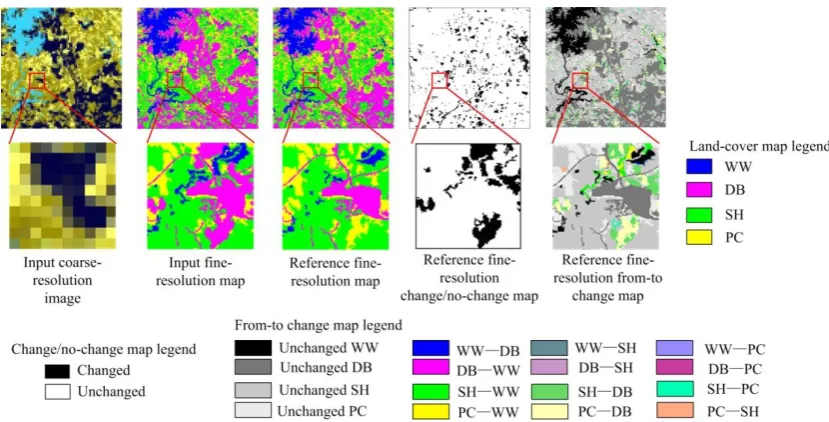
The reference fine-resolution map was generated from NLCD 2001, and the
input fine-resolution map was generated from NLCD 2006. Both maps contain 800 ×
800 pixels located in Charlotte (Fig. 3). The changed fine-resolution pixels account
for 7.8% of all pixels in the study area. The input coarse-resolution multispectral
image was simulated from the fine-resolution reference map. A fine-resolution
multispectral image was produced first. The number of bands was set to 6 to
accommodate for a dimensionality constraint in spectral unmixing. The 4 endmember
signature digital number (DN) values were set to [750, 400, 225, 20, 80, 130]T, [310,
70, 107, 390, 360, 330] T, [160, 295, 455, 605, 720, 960] T, and [440, 520, 750, 890,
980, 520] T. T is the transposition operator. The covariance matrices for all the classes
were set to A·I, where A=500 is a constant and I is 6 by 6 identity matrix [42]. The fine-resolution multispectral image was first produced according to the reference map
and class endmembers. The spectral response of each class was normally distributed
in each waveband. The fine-resolution multispectral image was then spatially
degraded to the coarse-resolution multispectral image with the scale factor s=10. The reference fine-resolution land-cover change/no-change map and from–to change map
were produced by a per-pixel comparison of the NLCD 2001 and 2006 land-cover
Fig. 3. SRCD input and reference images of synthetic image experiment. The zoomed area contains 100 × 100 fine-resolution pixels.
The initial SRCD parameters were set. The initial class area proportion change
threshold value, tini, can be set between 0 and 1. A high tini value would extend the
SRCD convergence time, whereas a low tini value would eliminate small-sized
unchanged land-cover patches in the intermediate change/no-change map. Thus, the
initial class area proportion change threshold value was set to tini 0.5. A low t
value would extend the SRCD convergence time, whereas a high t value would reduce the number of unchanged land-cover patches in the intermediate and final
change/no-change maps. Thus, the step class area proportion change threshold value
was set to t 0.05. The number of total iterations was set to itetotal= 20. SRCD is
terminated with a class area proportion change threshold value of
0.5
ini total
tt ite t . The SRCD results are shown in Fig. 4.
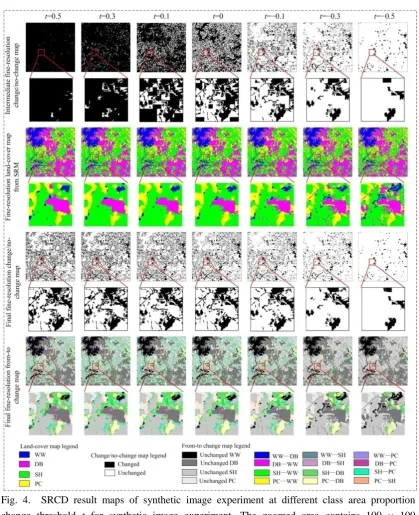
[image:23.595.91.506.74.285.2]Fig. 4. SRCD result maps of synthetic image experiment at different class area proportion
change threshold t for synthetic image experiment. The zoomed area contains 100 × 100
fine-resolution pixels.
Fig. 4 summarizes the SRCD results, highlighting the intermediate
fine-resolution change/no-change maps used for SRM, the fine-resolution land-cover
maps generated by SRM, and the final output fine-resolution change/no-change maps
and from–to change maps at different class area proportion change threshold t values. More fine-resolution pixels were indicated as having changed labels in the
intermediate change/no-change map than in the final output change/no-change maps
[image:24.595.89.509.63.579.2]to the fine-resolution pixels indicated as changed in the intermediate
change/no-change map, which indicated parts of the changed pixels in the
intermediate change/no-change map as unchanged pixels in the final
change/no-change map.
The performance of SRCD varied with the class area proportion change
threshold t. When the threshold is t0.3, most fine-resolution pixels were indicated as having changed in the intermediate change/no-change map. The changed
fine-resolution pixel labels were determined by SRM. Many rounded patches were
evident in the subset images because SRM adopted the land-cover maximum spatial
dependence model, which could have oversmoothed the land-cover patches. With the
decrease in threshold t, more fine-resolution pixels were detected as unchanged in the intermediate change/no-change map, and more land-cover patches in the input
fine-resolution map, which were identified as unchanged, were preserved in the
land-cover map produced by SRM. More unchanged fine-resolution pixels were also
observed in the final fine-resolution change/no-change and from–to change maps.
When the threshold is t 0.3, most fine-resolution pixel labels in the input fine-resolution map with unchanged class area proportion were preserved in the
land-cover map, and the final change/no-change and from–to change maps were
approximate to the reference maps.
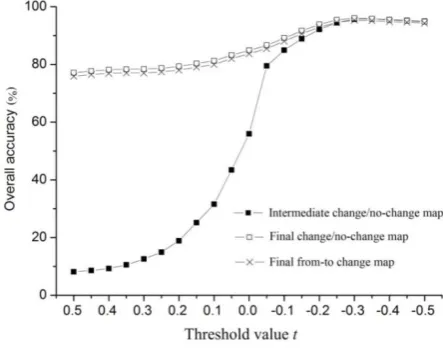
Fig. 5. Overall accuracies of intermediate change/no-change maps, final change/no-change maps, and final from–to change maps for synthetic image.
[image:25.595.186.408.526.700.2]well as the final from–to change maps, are shown in Fig. 5. The overall accuracies of
all the maps increased gradually with a decrease in threshold t when t is higher than −0.3 and decreased with a decrease in threshold t when t is lower than −0.3. The final
change/no-change maps exhibited a higher overall accuracy than the intermediate
change/no-change maps for each threshold t value. This result is due to difference in the data sources used for generating these maps: the intermediate change/no-change
map was produced using the class area proportion information at the coarse-resolution
scale, whereas the final change/no-change map was produced by comparing
land-cover maps at the fine-resolution scale. The highest overall accuracies of the
final change/no-change map and the from–to change maps were 96.00% and 95.28%,
respectively, when t 0.3.
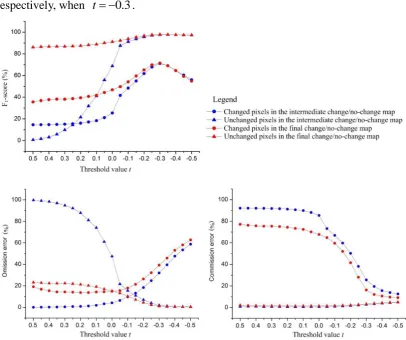
Fig. 6. The F1-scores, omission errors, and commission errors of unchanged and changed
fine-resolution pixels in the intermediate and final fine-resolution change/no-change maps for the synthetic image experiment.
The accuracies of the intermediate and final change/no-change maps were
[image:26.595.94.501.313.653.2]in Fig. 6. The F1-score for the changed pixels in the intermediate and final
change/no-change maps increased gradually with a decrease in threshold t when t is higher than −0.3, and decreased when the threshold t is lower than −0.3 because many
changed pixels were erroneously identified as unchanged pixels. The intermediate and
final change/no-change maps have the highest F1-score (higher than 71%) for changed
pixels when the threshold t 0.3. The F1-scores for unchanged pixels in the intermediate and final change/no-change maps increased gradually with a decrease in
threshold t when t is higher than −0.3 and remained almost unchanged when the threshold t is lower than −0.3. The highest F1-score for unchanged pixels was higher than that for changed pixels in the intermediate and final change/no-change maps.
This is because most pixels were unchanged in the study area, and the majority of
pixels were identified as unchanged by SRCD when the threshold t 0.3. The final change/no-change maps produced by comparing land-cover maps at the
fine-resolution scale have higher F1-scores for changed and unchanged pixels than the
intermediate change/no-change maps produced using the class area proportion
information at the coarse-resolution scale at most threshold t values.
The omission errors of unchanged pixels decreased with a decrease in threshold t. This result is because most unchanged fine-resolution pixels were initially indicated
as having changed; however, with a decrease in threshold t, the detected unchanged fine-resolution pixels increased, and more unchanged fine-resolution pixels were
correctly detected. By contrast, the omission errors of changed pixels increased with a
decrease in threshold t because almost all fine-resolution pixels were initially detected as having changed. With a decrease in threshold t, the detected changed fine-resolution pixels decreased, and more actually changed pixels were erroneously
identified as unchanged.
The commission errors of changed pixels decreased with a decrease in threshold
t. This result is because almost all the fine-resolution pixels were initially detected as having changed; however, with a decrease in threshold t, the detected changed fine-resolution pixels decreased, and many of the initially erroneously detected
errors of unchanged pixels were low and remained almost unchanged with a decrease
in threshold t. When threshold t is lower than −0.3, the commission errors of the unchanged pixels increased, whereas the commission errors of the changed pixels
decreased with a decrease in threshold t. Therefore, more changed pixels were erroneously detected as unchanged, and less unchanged pixels were erroneously
detected as changed.
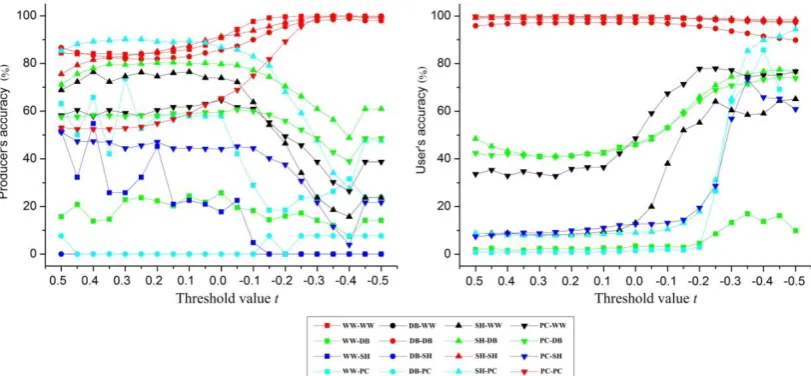
Fig. 7. The producer's accuracy and user's accuracy of different land-cover from–to changes for synthetic image experiment.
The producer’s accuracy and user’s accuracy of different land-cover from–to
changes for the synthetic image experiment are shown in Fig. 7. The producer’s
accuracies of WW—WW, DB—DB, SH—SH, and PC—PC increased with a decrease
in threshold t, whereas the producer’s accuracies of the other land-cover changes decreased with a decrease in threshold t. The number of correctly detected unchanged classes increased, whereas the number of correctly detected changed classes
decreased. The producer’s accuracies of DB—PC and WW—SH were 0% because
only 13 fine-resolution pixels had a DB—PC change and 62 fine-resolution pixels had
a WW—SH change in the 2001–2006 reference from–to change map. These changed
patches were smaller than a coarse-resolution pixel, which contained s2=100 fine-resolution pixels. The producer’s accuracies of unchanged classes have a
dominant effect on the global accuracy in the from–to change map because more than
[image:28.595.96.502.221.409.2]accuracies of unchanged classes decreased, whereas those of the changed classes
increased with a decrease in threshold t. Fig. 8 shows the reference endmember signatures, extracted initial endmember signatures at t0.5, and extracted final endmember signatures at t 0.3 . A good match between the reference and estimated endmember signatures was observed at t 0.3.
Fig. 8. Reference endmember signatures (reference DN), estimated endmember signatures at 0.5
t (initial DN) and at t 0.3 (final DN) for the synthetic image experiment.
B. MODIS Image Experiment
1) Data Preparation
MODIS multispectral images were adopted to assess SRCD based on real
remotely sensed images. The study area is located near Sorriso (12º33'21"S and
55º42'31"W) in Mato Grosso State, Brazil. This area is in the Brazilian Amazon Basin,
and is mainly covered by tropical forests but which has undergone a deforestation in
recent years. The experiment data include a Landsat-5 TM image with a spatial
resolution of 30 m acquired on August 13, 2000, a Landsat-7 ETM+ image with a
spatial resolution of 30 m acquired on July 18, 2005, and a single eight-day surface
reflectance MODIS product (MOD09A1) with a spatial resolution of 463 m taken in
July 2005. The TM image was geo-registered to the ETM+ image. The TM image
acquired in 2000 was digitized to the input fine-resolution land-cover map with forest
and nonforest in it, and the ETM+ image acquired in 2005 was digitized to the
reference map. The MODIS image comprising 7 spectral bands (620 nm - 2055 nm)
was used as the SRCD input coarse-resolution image. The MODIS image was
re-projected into the Universal Transverse Mercator coordinate system and then
resampled to a spatial resolution of 450 m using the nearest neighbor algorithm. A
[image:29.595.89.509.200.274.2]ETM+ images were adopted (Fig. 9). The scale factor s is set to 15. The changed fine-resolution pixels account for 22.8% of all pixels in the study area.
SRCD was implemented for the scenarios in which the fine-resolution map
pre-dated the coarse-resolution image. The reference fine-resolution land-cover
change/no-change map and from–to change map were produced by a per-pixel
comparison of the 2000 and 2005 land-cover maps. The SRCD parameters were set as
in the synthetic image experiment: tini 0.5, t 0.05, and itetotal=20.
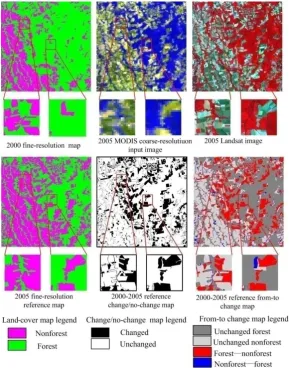
Fig. 9. SRCD input and reference images of MODIS image experiment. The zoomed area contains 300 × 300 fine-resolution pixels.
[image:30.595.153.443.245.614.2]Fig. 10. Experimental results of MODIS image experiment
The input images, reference maps, and result maps are shown in Fig. 9 and Fig.
10. Deforestation occurred in the region during the periods represented. Some of the
deforestations exhibited a fishbone pattern because of the expansion of the nonforest
patch (such as the left zoomed area), whereas some of the deforestations were in
clear-cut areas (such as the right zoomed area). More pixels were detected as
unchanged pixels with a decrease in threshold t. As a result, the changed pixels marked in black decreased, whereas the unchanged pixels marked in white increased
in the intermediate and final change/no-change maps. The changed land-cover
trajectories marked in blue and red decreased, whereas the unchanged land-cover
trajectories marked in gray increased in the from–to change maps with a decrease in
threshold t. In the reference from–to change map in Fig. 9, forest–nonforest change trajectory patches marked in red were more than nonforest–forest change trajectory
trajectory in the study area. Most of the spatial patterns of the changed land-cover
trajectories were correctly mapped onto the from–to change map when t 0.3. The forest–nonforest patches were mapped with rounded shape, and some of the spatial
details were lost. This result is attributed to the use of the land-cover maximal spatial
dependence model by SRM in producing the changed land-cover patches; this model
could oversmooth class boundaries.
Fig. 11. The F1-scores for changed and unchanged pixels in the intermediate and final
fine-resolution change/no-change maps for MODIS image experiment.
Fig. 11 shows the F1-scores for changed and unchanged pixels in the
intermediate and final fine-resolution change/no-change maps. For changed pixels,
the intermediate change/no-change maps obtained F1-scores lower than 50% when
0
t and obtained F1-scores higher than 60% when t0. For unchanged pixels, the F1-scores obtained by the intermediate change/no-change maps were lower than 50%
when t 0 and higher than 80% when t0. The final change/no-change maps have F1-scores higher than 60% for changed pixels and higher than 90% for
unchanged pixels. The highest F1-score of the final change/no-change map is
[image:32.595.172.417.221.429.2]Fig. 12. The producer's accuracy and user's accuracy of different land-cover from–to changes for MODIS experiment.
Fig. 12 shows the producer’s and user’s accuracies of different land-cover
from–to changes at different threshold t values. The producer’s accuracies of nonforest–nonforest and forest–forest changes increased, whereas the producer’s
accuracies of forest–nonforest and nonforest–forest changes decreased because more
fine-resolution pixels were detected as unchanged with a decrease in threshold t. The producer’s accuracies of nonforest–nonforest and forest–forest changes were higher
than those for forest–nonforest and nonforest–forest changes. This result is because
the unchanged pixel labels were determined by the input fine-resolution land-cover
map, whereas the changed pixel labels were determined by SRM. The producer’s
accuracy of forest–nonforest change was higher than that for nonforest–forest change.
The main reason is that the forest–nonforest patches were usually larger than the
coarse-resolution pixel; thus, SRM with the maximum land-cover spatial dependence
model was suitable for mapping these patches [24]. By contrast, nonforest–forest
patches were usually found along patch boundaries with linear shapes wherein the
SRM may have oversmoothed the patches. The pixel number of the nonforest–forest
change accounts for 2.0% of all the pixels, and the pixel number of the
forest–nonforest change accounts for 20.7% of all the pixels in the 2000–2005
reference fine-resolution from–to change map. Thus, the forest–nonfores change
detection accuracy has a more dominant effect on the overall change detection
whereas those of changed classes increased with a decrease in threshold t. This result is because the number of pixels of changed classes marked in blue and red decreased,
whereas the number of pixels of unchanged classes marked in gray increased with a
decrease in threshold t. The overall accuracy of the form–to change map increased from 83.27% when t0.5 to 87.15% when t 0.3 and then decreased to 85.98% when t 0.5.
C. Landsat-8 OLI Image Experiment
1) Data Preparation
A Landsat multispectral images was adopted as the coarse-resolution image in
this experiment. The study area is located in Wuhan (30º21'70"N and 114º15'19"E),
China. A Landsat-8OLI image acquired on June 13, 2013 was selected as the relative
coarse-resolution image. The Landsat-8 OLI image has 9 multispectral bands. The
first 7 bands of OLI image with a spatial resolution of 30 m were selected as the
coarse-resolution image for SRCD input. The 8th band (panchromatic band) of OLI
image was not used because it has a spatial resolution of 15 m, and the 9th band (cirrus
band) of OLI image was not used because it is not suitable for detecting land-covers.
Two Google Earth optical images with fine spatial resolution, which were acquired on
August 14, 2010 and on June 13, 2013 were selected. The Google Earth optical
images were geo-registered to the ETM+ image. The 2010 Google Earth image was
digitized to the SRCD input previous fine-resolution land-cover map, and the 2013
Google Earth image was digitized to the reference map. There are 4 land-cover
classes in the fine-resolution maps, which are water, grass, impervious surface and
bareland. A subset of 40 × 40 pixels Landsat-8 OLI image was used as the SRCD
input coarse-resolution image. The previous and reference land-cover maps contains
200 × 200 pixels (Fig. 13). The scale factor s is set to 5. The changed fine-resolution pixels account for 12.5% of all pixels in the study area. The reference fine-resolution
land-cover change/no-change map and from–to change map were produced by a
were set as in the synthetic and MODIS image experiments: tini 0.5, t 0.05,
[image:35.595.114.483.126.341.2]and itetotal=20.
Fig. 13. SRCD input and reference images of Landsat-8 OLI image experiment.
2) Results
Fig. 14. Experimental results of Landsat-8 OLI image experiment.
[image:35.595.88.511.404.707.2]in subsets A to F in the reference from–to change map. The grass–bareland changes in
subsets C, D, and E were mainly caused by the expansion of the previously bareland.
Other land-cover changes were unremarkable, such as in subset G. In Fig. 13, more
pixels were identified as unchanged pixels with a decrease in threshold t. In the final change/no-change maps, the changed pixels marked in black decreased, whereas the
unchanged pixels marked in white increased with a decrease in threshold t. In the final from–to change maps, the land-cover changes marked in color decreased with a
decrease in threshold t. The erroneously detected from–to changes (bareland–grass and water–grass) in the bottom-left corner of the image appeared when t 0.3 and disappeared when t 0.3. This result may be attributed to the fact that the bareland and water patches in the bottom-left corner were small in the reference map and were
detected as changed and oversmoothed by SRM when t 0.3. The grass–bareland changes in subsets A to E were detected in the from–to change maps when t 0.5. The shapes of the changed patches were smoothed because of the spatial smoothing
effect of SRM. As a result, the grass–bareland changes in subsets A and B had
rounded shapes; being smaller than the coarse-resolution pixel, grass–bareland
changes in subset F were eliminated in the from–to change map because of the
oversmoothing effect of SRM. The grass–bareland changes in subset C were detected
as having a linear shape when t 0.5 and were similar to those in the reference from–to change map in Fig. 13. Some of the changed patches that were smaller than
Fig. 15. The F1-scores for changed and unchanged pixels in the intermediate and final
fine-resolution change/no-change maps for Landsat image experiment.
Fig. 15 shows the F1-scores for changed and unchanged pixels in the
intermediate and final fine-resolution change/no-change maps. The F1-scores for
changed pixels in the intermediate and final change/no-change maps increased
gradually with a decrease in threshold t when t 0.3, and decreased when the 0.3
t . The F1-score for unchanged pixels in the intermediate and final change/no-change maps gradually increased with a decrease in threshold t when
0.3
t and remained almost unchanged when t 0.3. The highest F1-score for changed pixels was 56.39% in the intermediate change/no-change map when
0.3
[image:37.595.194.400.73.270.2]t and 61.37% in the final change/no-change map when t 0.3.
[image:37.595.94.505.522.724.2]