BEHAVIOUR OF PERIODIC PRESSURISED COMPOSITE
STRUC-TURES
Theofanis Ampatzidis and Dimitrios Chronopoulos
Institute for Aerospace Technology & The Composites Group, University of Nottingham, NG7 2RD, UK email: [email protected]
Periodic structures are very common in engineering, such as airplane fuselages and train rails. This periodicity has been observed to be the cause of banded frequency response after mechanical excitation. This response can be engineered so that noise and vibrations to be isolated or even annihilated. In addition to this, further methods of inducing band-gaps without weight penalty are of interest among the researchers. In this paper a parametric survey was conducted examining the impact of the core geometry and the pressure in the core cells on the suppression of the vibrations. An infinite composite sandwich beam with hollow and pressurised core cells as periodic band gap inducing factors was examined. The periodic theory was used to predict the effect of pressured core cells periodicity on wave propagation and band gaps generation. Three low order finite el-ements (FE) models were used in this survey, which consisted of a small section of the simple sandwich beam with homogeneous core, with hollow core and with pressurised hollow core
Keywords: band gap, wave finite elements, vibrations, pressurised composite structures
1.
Introduction
Periodic structures consist of infinite assembly of identical elements, usually called cells, joined in an identical manner. These structures, also calledbandedstructures, have been subject of research for more than a century. Floquet [1] was the first to publish research on periodic structures, where he studied 1D Mathieu’s equation. His work was followed by Rayleigh [2], who arrived at a form of Floquet’s theorem. In this century, Mead firstly introduced Wave Finite Elements (WFE) Method in [3] which is based on Brillouin’s periodicity theory (PT) [4] and Floquet’s and Bloch’s theorems. In [5] his work on wave propagation in periodic structures was reviewed. The WFE has recently found applications in predicting the vibroacoustic and dynamic performance of composite panels and shells [6, 7, 8, 9, 10, 11, 12] , with pressurized shells [13, 14] and complex periodic structures [15, 16, 17, 18] having been investigated. The variability of acoustic transmission through layered structures [19, 20], as well as wave steering effects in anisotropic composites [21] have been modelled through the same methodology.
the periodic cells of the core. Hussein et al. derived dispersion relations for periodic materials and examined the analysis [24] and design [25] of them. Based on these works, Liu et al. [26] produced a research focusing on the wave motion and banded response of four different types of periodicity in 1D beams. In addition to this work, Wu et al. [27] examined the banded behaviour of sandwiches with corrugated core, focusing on the geometry of the core and Chen et al. [28] examined the wave propagation in sandwich with periodic core. In the latter work, two different materials periodically forming the core of the sandwich were examined. WFE method has, also, been used to examine the banded behaviour of a periodic beam in [29].
In this work the periodic theory used in [30] has been adopted to examine the banded behaviour of infinite composite sandwich beam with hollow core as band gap inducing factor. Additionally, pressure was examined as a method to actively control banded behaviour of the structure. The paper is organised as follows: in Sec.2 the methodology used to get the banded behaviour of the examined structures is described. In Sec.3 the wave dispersion characteristics of each case are sought using the methodology described in the previous section. Numerical results are presented and all the cases are compared with each other commenting on the effect of hollow core length and pressure on the banded behaviour of the beam. In Sec. 4 conclusions and thoughts on the results of the presented work are drawn.
2.
Methodology
2.1 Description of the method
The periodic theory adopted on 1D in current work is the one used in [30]. A general structure with 1D periodicity was considered. A periodic shell can be extracted from the structure and modeled using a FE model with degrees of freedom q (see Fig. 1 ). Steady-state harmonic vibration of frequency ω is considered in what follows and all response quantities are represented by complex amplitudes so that
q(t) =Re{qeiωt} (1)
In 1D the degrees of freedomqof the cell can be partitioned into left (L), interior (I) and right(R) degrees of freedom. According to Floquet’s theorem, the equation that relates the displacements on the two edges of the section is [3]:
qR=λqL, fR=−λfL, (2)
where λ = e−ikLx, with L
x being the periodic element’s lenght, k being the wavenumber and
εx =kLx being the ’phase constant’.
The complete vector of local degrees of freedom for 1D can be ordered so that
q=qT
I qTL qTR
T
(3)
The undamped equation of motion for the cell is given by
K−ω2M
q=f (4)
whereKandMare the stiffness and mass matrices, respectively,fis the vector of the nodal forces. In order to write the propagation relation in Eq. (1) in matrix form, we consider matrixR, which
R=
I 0
0 I
0 Ie−iεx
(5)
q=Rq0, where q0 = [qIqL]T (6)
The resulting homogenous quation in the reduced set of coordinates is then given by
K0−ω2M0
q0 =f (7)
where
K0 =RH(εx)KR(εx), M0 =RH(εx)MR(εx) (8)
and where RH denotes the complex conjugate, or else called Hermitian, transpose ofR. When a particular set of phase constantsεx are specified then we get a standard eigenvalue problem. The eigenvaluesΩ2 indicate the frequencies at which a wave can propagate in the structure when a given phase is specified between the edges of the cell.
2.2 Stress stiffening
As in this work a scenario of pre-stressed structure was examined, pre-stress stiffness matrixKs had to be calculated. Considering that a static analysis had been solved, the updated stiffness matrix was calculatedK[31]:
K=K0+Ks (9)
whereK0the original element stiffness matrix and:
Ks =
Z Z Z
GTτGdxdydz (10)
whereG is a matrix of shape function derivatives andτ is a matrix of the current Cauchy (true) stressesσin the global Cartesian system.
The updated matrixKwas then used in the periodic theory described in the previous subsection to get the wavenumbers and eigenvectors of the pre-stressed structure.
3.
Numerical Results
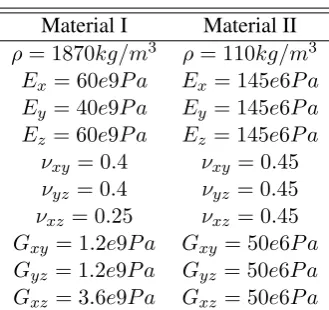
In this work the flexural wave of an infinite composite sandwich beam was examined, as shown in Fig. 1. The mechanical characteristics of each material used in the models are listed in Table 1, where
Ei is the modulus of elasticity in directioni,vij is the Poisson’s ratio foriandj being the directions of extension and contraction, respectively,ρis the density andGij is the shear modulus of elasticity in directionj on the plane whose normal is in directioni. In Fig.2z axis is depicted. ANSYS 14.0 was used during the FE modelling. Linear 8-node ANSYS SOLID45 solid element was chosen for the segment’s meshing, which comprises a 3D displacement field and three degrees of freedom per node (translations in the x, y, and z directions) [31].
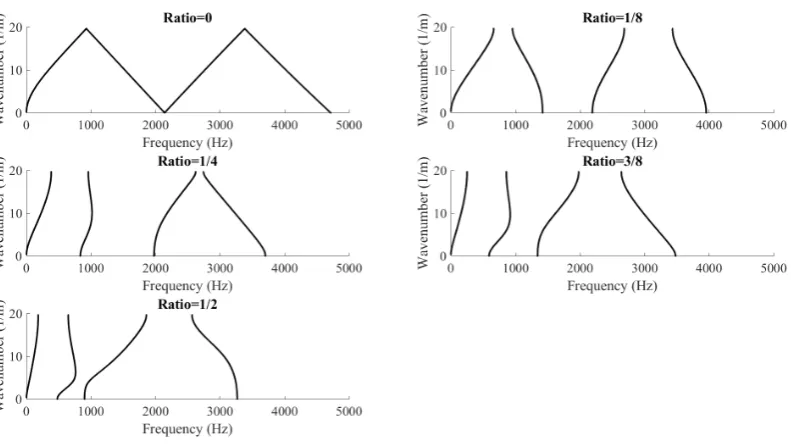
All three models had the same core (hc = 10mm) and skin thickness (hs = 1mm) and four different ratios were tested (Ratio = (hollow core length)/(cell length) =Lh/Lx), along with homogenous core one (Ratio = 0) . The sandwich cell wasLx = 16cmlong and each element was Le = 1cm. The beam’s width was2cm.
3.1 Results
Figure 1: Infinite beam with periodic cell.
Figure 2: Geometry of infinite beam.
Figure 3: Pressure asked in the hollow part of the core.
Table 1: Material properties
Material I Material II ρ= 1870kg/m3 ρ= 110kg/m3
Ex= 60e9P a Ex = 145e6P a Ey = 40e9P a Ey = 145e6P a Ez = 60e9P a Ez = 145e6P a
νxy = 0.4 νxy = 0.45 νyz = 0.4 νyz= 0.45 νxz = 0.25 νxz= 0.45 Gxy = 1.2e9P a Gxy = 50e6P a Gyz= 1.2e9P a Gyz= 50e6P a Gxz = 3.6e9P a Gxz = 50e6P a
impedance mismatch which is responsible for the creation of band gaps. For the same reason it can be seen that the band gaps frequencies change significantly as theRatiochanges, since the source of the impedance mismatch alters characteristics. It worths noting that the third band-gap ofRatio = 1/4 is significantly smaller than the other cases examined.
[image:4.595.211.379.451.607.2]Figure 4: Graphs of the flexural waves of the different ratios Ratio with no pressure asked on the skins.
might lead to practical applications in future research. Additionally, further research might lead to stiffer and more durable materials which will increase the pressure capacity of the structure and hence potential band-gap control.
Table 2: Band gaps frequencies, in Hz
1st 2nd 3rd
Ratio=1/8
no pressure 664.2−955.1 1422−2192 2687−3433
p= 10kP a 664.2−955.1 1422−2192 2687−3433
p= 100kP a 664.4−955.2 1422−2192 2687−3433
p= 1M P a 665.6−956.2 1426−2194 2690−3436
Ratio=1/4
no pressure 385.2−837 1018−1980 2624−2746
p= 10kP a 385.2−837.2 1018−1980 2624−2746
p= 100kP a 385.6−838.3 1018−1981 2624−2748
p= 1M P a 388.5−849.7 1022−1987 2628−2759
Ratio=3/8
no pressure 251.5−593.1 916.2−1344 1981−2642
p= 10kP a 251.6−593.1 920.5−1344 1981−2642
p= 100kP a 252.3−596.1 921.2−1346 1982−2643
p= 1M P a 259−621.9 927.7−1358 1995−2652
Ratio=1/2
no pressure 183.3−479.2 762.5−900.9 1859−2569
p= 10kP a 184.8−481.9 763.8−902.6 1860−2572
p= 100kP a 197.6−505.6 775.9−917.8 1871−2593
[image:5.595.163.428.465.760.2]4.
Conclusion and further work
In this work a parametric study of frequency banded behaviour of and infinite periodic pressurised composite sandwich beam was examined. Both the length of the hollow part of the core and the pressure asked on its skins were considered as the parameters in the analyses. It was proven that the length of the hollow core plays significant role in the wave propagation and hence the frequencies of the band gaps. On the other hand, the pressurised beams did not have notable different banded behaviour concerning the flexural vibration that was the one examined in this work. Nevertheless, the behaviour pressurised beams exhibited allows the space for promising potentials as a method to actively control banded behaviour of structures and further research on the specific case is due.
References
1. Floquet, G. Sur les équations différentielles linéaires à coefficients périodiques, Annales scientifiques de l’École normale supérieure, vol. 12, pp. 47–88, (1883).
2. Rayleigh, L. Xvii. on the maintenance of vibrations by forces of double frequency, and on the propaga-tion of waves through a medium endowed with a periodic structure,The London, Edinburgh, and Dublin Philosophical Magazine and Journal of Science,24(147), 145–159, (1887).
3. Mead, D. A general theory of harmonic wave propagation in linear periodic systems with multiple cou-pling,Journal of Sound and Vibration,27(2), 235–260, (1973).
4. Brillouin, L.,Wave propagation in periodic structures: electric filters and crystal lattices, Courier Corpo-ration (2003).
5. Mead, D. Wave propagation in continuous periodic structures: research contributions from southampton, 1964–1995,Journal of sound and vibration,190(3), 495–524, (1996).
6. Chronopoulos, D., Troclet, B., Ichchou, M. and Lainé, J. A unified approach for the broadband vibroa-coustic response of composite shells,Composites Part B: Engineering,43(4), 1837–1846, (2012).
7. Chronopoulos, D., Troclet, B., Bareille, O. and Ichchou, M. Modeling the response of composite panels by a dynamic stiffness approach,Composite Structures,96, 111–120, (2013).
8. Chronopoulos, D., Ichchou, M., Troclet, B. and Bareille, O. Efficient prediction of the response of layered shells by a dynamic stiffness approach,Composite Structures,97, 401–404, (2013).
9. Chronopoulos, D., Ichchou, M., Troclet, B. and Bareille, O. Predicting the broadband vibroacoustic re-sponse of systems subject to aeroacoustic loads by a krylov subspace reduction,Applied Acoustics,74(12), 1394–1405, (2013).
10. Chronopoulos, D., Ichchou, M., Troclet, B. and Bareille, O. Thermal effects on the sound transmission through aerospace composite structures,Aerospace Science and Technology,30(1), 192–199, (2013).
11. Chronopoulos, D., Ichchou, M., Troclet, B. and Bareille, O. Predicting the broadband response of a layered cone-cylinder-cone shell,Composite Structures,107, 149–159, (2014).
12. Chronopoulos, D., Ichchou, M., Troclet, B. and Bareille, O. Computing the broadband vibroacoustic response of arbitrarily thick layered panels by a wave finite element approach, Applied Acoustics, 77, 89–98, (2014).
13. Polenta, V., Garvey, S., Chronopoulos, D., Long, A. and Morvan, H. Optimal internal pressurisation of cylindrical shells for maximising their critical bending load,Thin-Walled Structures,87, 133–138, (2015).
15. Antoniadis, I., Chronopoulos, D., Spitas, V. and Koulocheris, D. Hyper-damping properties of a stiff and stable linear oscillator with a negative stiffness element,Journal of Sound and Vibration,346, 37–52, (2015).
16. Chronopoulos, D., Collet, M. and Ichchou, M. Damping enhancement of composite panels by inclusion of shunted piezoelectric patches: A wave-based modelling approach,Materials,8(2), 815–828, (2015).
17. Chronopoulos, D., Antoniadis, I., Collet, M. and Ichchou, M. Enhancement of wave damping within metamaterials having embedded negative stiffness inclusions,Wave Motion,58, 165–179, (2015).
18. Chronopoulos, D., Antoniadis, I. and Ampatzidis, T. Enhanced acoustic insulation properties of composite metamaterials having embedded negative stiffness inclusions,Extreme Mechanics Letters, (2016).
19. Chronopoulos, D. Design optimization of composite structures operating in acoustic environments,Journal of Sound and Vibration,355, 322–344, (2015).
20. Ben Souf, M., Chronopoulos, D., Ichchou, M., Bareille, O. and Haddar, M. On the variability of the sound transmission loss of composite panels through a parametric probabilistic approach,Journal of Computa-tional Acoustics,24(01), 1550018, (2016).
21. Chronopoulos, D. Wave steering effects in anisotropic composite structures: Direct calculation of the energy skew angle through a finite element scheme,Ultrasonics,73, 43–48, (2017).
22. Ruzzene, M. and Scarpa, F. Control of wave propagation in sandwich beams with auxetic core,Journal of intelligent material systems and structures,14(7), 443–453, (2003).
23. Ruzzene, M. and Tsopelas, P. Control of wave propagation in sandwich plate rows with periodic honey-comb core,Journal of engineering mechanics,129(9), 975–986, (2003).
24. Hussein, M. I., Hulbert, G. M. and Scott, R. A. Dispersive elastodynamics of 1d banded materials and structures: analysis,Journal of sound and vibration,289(4), 779–806, (2006).
25. Hussein, M. I., Hulbert, G. M. and Scott, R. A. Dispersive elastodynamics of 1d banded materials and structures: design,Journal of Sound and Vibration,307(3), 865–893, (2007).
26. Liu, L. and Hussein, M. I. Wave motion in periodic flexural beams and characterization of the transition between bragg scattering and local resonance,Journal of Applied Mechanics,79(1), 011003, (2012).
27. Wu, Z.-J., Li, F.-M. and Wang, Y.-Z. Vibration band gap behaviors of sandwich panels with corrugated cores,Computers & Structures,129, 30–39, (2013).
28. Chen, J. and Sun, C. Wave propagation in sandwich structures with resonators and periodic cores,Journal of Sandwich Structures & Materials,15(3), 359–374, (2013).
29. Domadiya, P. G., Manconi, E., Vanali, M., Andersen, L. V. and Ricci, A. Numerical and experimental investigation of stop-bands in finite and infinite periodic one-dimensional structures,Journal of Vibration and Control,22(4), 920–931, (2016).
30. Cotoni, V., Langley, R. and Shorter, P. A statistical energy analysis subsystem formulation using finite element and periodic structure theory,Journal of Sound and Vibration,318(4), 1077–1108, (2008).