ISSN Online: 2163-0356 ISSN Print: 2163-0283
DOI: 10.4236/ijis.2019.91003 Jan. 29, 2019 44 International Journal of Intelligence Science
Solving Intuitionistic Fuzzy Linear
Programming Problem
Arpita Kabiraj
1, Prasun Kumar Nayak
2, Swapan Raha
11Department of Mathematics, Siksha Bhavana (Institute of Sciences), Santiniketan, India
2Department of Mathematics, Midnapore College (Autonomous), Midnapore, India
Abstract
Intuitionistic Fuzzy Set (IFS) can be used as a general tool for modeling problems of decision making under uncertainty where, the degree of rejection is defined simultaneously with the degree of acceptance of a piece of informa-tion in such a way that these degrees are not complement to each other. Ac-cordingly, an attempt is made to solve intuitionistic fuzzy linear program-ming problems using a technique based on an earlier technique proposed by Zimmermann to solve fuzzy linear programming problem. Our proposed technique does not require the existing ranking of intuitionistic fuzzy num-bers. This method is also different from the existing weight assignment me-thod or the Angelov’s meme-thod. A comparative study is undertaken and inter-esting results have been presented.
Keywords
Intuitionistic Fuzzy Set, Intuitionistic Index, Intuitionistic Fuzzy Number, Intuitionistic Fuzzy Linear Programming Problem, Fuzzy Linear
Programming Problem
1. Introduction
Optimization problems exhibit some level of imprecisions and vagueness. Such phenomena have been well-captured through fuzzy sets in modeling these prob-lems. Applications of fuzzy set theory in optimization of decisions have been studied extensively ever since the introduction of fuzzy sets. The theory of fuzzy sets proposed by Zadeh is a realistic and practical means to describe the objec-tive world that we live in and has also been successfully applied in various other fields.
In decision making problems, the concept of maximizing decision under
un-How to cite this paper: Kabiraj, A., Nayak, P.K. and Raha, S. (2019) Solving Intuitio-nistic Fuzzy Linear Programming Problem. International Journal of Intelligence Science, 9, 44-58.
https://doi.org/10.4236/ijis.2019.91003
Received: December 18, 2018 Accepted: January 26, 2019 Published: January 29, 2019
Copyright © 2019 by author(s) and Scientific Research Publishing Inc. This work is licensed under the Creative Commons Attribution International License (CC BY 4.0).
http://creativecommons.org/licenses/by/4.0/
DOI: 10.4236/ijis.2019.91003 45 International Journal of Intelligence Science certainty was proposed by Bellman and Zadeh [1]. This concept was adopted to problems of mathematical programming by Tanaka and others. Zimmermann [2] presented a fuzzy approach to multi-objective linear programming problems. He also studied the duality relations in fuzzy linear programming. Fuzzy linear pro-gramming problem (FLPP) with fuzzy coefficients was formulated by Negoita [3] and called robust programming. Dubois and Prade investigated linear fuzzy constraints [4]. Tanaka and Asai also proposed a formulation of fuzzy linear programming with fuzzy constraints and suggested a method for its solution which is based on inequality relation between fuzzy numbers [5]. This ranking of fuzzy numbers is an important issue in the study of optimization using fuzzy set theory.
Recent years have witnessed a growing interest in the study of decision mak-ing problems under uncertainty with intuitionistic fuzzy sets/numbers [6] [7] [8] [9] [10]. Out of several higher order fuzzy sets, intuitionistic fuzzy set introduced by Atanassov [11] [12] [13] [14] has been found to be highly useful in dealing with imprecision. Since this fuzzy set generalization can present the degrees of membership and non-membership of an element of the set with a degree of he-sitancy, the knowledge and semantic representation becomes more meaningful and applicable. Authors in [15] presented an overview on IFS viz., some defini-tions, basic operadefini-tions, some algebra, modal operators and also its normalization. Later, D. Dubey [16] proposed an approach based on value and ambiguity in-dices to solve LPPs with data as Triangular Intuitionistic Fuzzy Numbers. Par-vathi and Malathi [17] [18] worked on the intuitionistic fuzzy decisive set me-thod which, is a combination of bisection meme-thod and phase one of the simplex method to obtain a feasible solution. In [19], the authors described a method to approximate a TIFN to a nearly approximated interval number. The average ranking index is also introduced here to find out order relations between two TIFNs. On ranking intuitionistic fuzzy numbers, some work had been reported in the literature. Mitchell [20] considered the problem of ranking a set of intui-tionistic fuzzy numbers to define a fuzzy rank and a characteristic vagueness factor for each intuitionistic fuzzy number. Ranking using score function is in-troduced in [21]. Here, all the arithmetic operations of TIFN are based on
(
α β,)
-cut method. Ranking of intuitionistic fuzzy number with expected in-terval is introduced in [22]. A. N. Gani, S. Abbas [23] worked on a new average method for finding an optimal solution for an intuitionistic fuzzy transportation problem. The main feature of this method is that it requires very simple arith-metical calculations and avoids large number of iterations. An accuracy function to defuzzify TIFN is also used here. The concept of an intuitionistic fuzzy set is a generalization of the concept of a fuzzy set.DOI: 10.4236/ijis.2019.91003 46 International Journal of Intelligence Science for interval-valued intuitionistic fuzzy numbers for decision making.
In this paper, our aim is to propose a method to solve intuitionistic fuzzy li-near programming problem (IFLPP) using a technique based on an earlier tech-nique proposed by Zimmermann [2] for solving fuzzy linear programming problems. First, we represent such an uncertain optimization problem in the form of a LPP where each of the coefficients of the objective and the constraints are considered as IFS’s and the inequalities as intuitionistic fuzzy inequalities. These IFS’s are first defuzzified based on maximum membership and is trans-lated into a LPP with crisp coefficients and intuitionistic inequalities. Next, the reduced IFO problem is restructured according to Bellman and Zadeh to an or-dinary LPP where decisions are based on maximum membership and minimum non-membership. This technique does not require the existing ranking of intui-tionistic fuzzy numbers. This method is also different from the Weight assign-ment method, Angelov’s method as well as the modified subgradient method to solve IFLPP using FLPP technique. A comparative study is performed and inter-esting results are presented.
The paper is organized in six sections. The introductory section is followed by presentation of some basic concepts necessary for the development of a mechan-ism for solving intuitionistic fuzzy linear programming problems. In this section, basic concept of Triangular Intuitionistic Fuzzy Number (TIFN) is described. In Section 3, we discuss fuzzy linear programming problem and introduce a new method analogous with it, to solve IFLPP when both the coefficient matrix of the constraints and cost coefficients are intuitionistic fuzzy in nature. In Section 4, there is a comparative study between some of the other optimization techniques with our proposed technique for solving an intuitionistic fuzzy linear program-ming problem. Section 5 concludes the present paper and refers to some prob-lems for further studies which is followed by a list of references in the last sec-tion.
2. Preliminaries
Definition 1 [19] Let U =
{
x x1, , ,2 xn}
be a finite universal set. AnIntuitio-nistic fuzzy set (IFS) A in a given universal set U is an object having the form
( ) ( )
{
j, A j , A j : j}
A= x µ x ν x x ∈U
where the functions µA:U→
[ ]
0,1 and νA:U→[ ]
0,1 respectively define the degree of membership and the degree of non-membership of an elementj
x ∈U , such that they satisfy the following conditions:
( )
( )
0≤µA xj +νA xj ≤ ∀ ∈1, ;x Uj
known as intuitionistic condition. The degree of acceptance µA
( )
x and of non-acceptance νA( )
x can be arbitrary.DOI: 10.4236/ijis.2019.91003 47 International Journal of Intelligence Science which is called the Atanassov’s intuitionistic index of the element xj in the set
A or the degree of uncertainty or the indeterministic part of xj or a measure
of hesitation. Obviously, 0≤πA
( )
x ≤1; ∀ ∈xj U . When πA( )
x = ∀ ∈0, x U,i.e., µA
( )
x +νA( )
x =1, A becomes a fuzzy set. Therefore, a fuzzy set is a spe-cial Intuitionistic Fuzzy Set (IFS).Definition 3 [15] Let A and B be two Atanassov’s IFSs defined on U. A B⊂ if and only if µA
( )
xj ≤µB( )
xj and νA( )
xj ≥νB( )
xj ; for anyj
x ∈U .
Definition 4 [15] Let A and B be two Atanassov’s IFSs defined on U. A B= if and only if µA
( )
xj =µB( )
xj and νA( )
xj =νB( )
xj ; for all xj∈U.Definition 5 [19] An intuitionistic fuzzy set A of U is said to be normal if
0 x U
∃ ∈ such that
µ
Aj( )
x0 =1, (soν
Aj( )
x0 =0).Definition 6 [19] A subset
(
α β,)
-cut of U, generated by IFS A, where[ ]
, 0,1
α β∈ are fixed numbers such that α β+ ≤1 is defined as
( )
( )
{
}
, j : A j , A j .
Aα β = x ∈U µ x ≥α ν x ≤β
Thus, the
(
α β,)
-cut of an intuitionistic fuzzy set to be denoted by A(α β, ), is defined as the crisp set of elements x which belong to A at least to the degreeα
and which does not belong to A at most to the degree β.Definition 7 [19] An intuitionistic fuzzy number (IFN) Aj is
1) an intuitionistic fuzzy subset of the real line ℜ;
2) normal, i.e., ∃ ∈ℜx0 such that
µ
Aj( )
x0 =1, (soν
Aj( )
x0 =0);3) convex for the membership function, i.e.,
(
)
(
1 1 2)
min{
( )
1 ,( )
2}
; 1, 2 ,[ ]
0,1 ;j j j
A x x A x A x x x
µ λ + −λ ≥ µ µ ∀ ∈ℜ ∈λ
4) concave for the non-membership function, i.e.,
(
)
(
1 1 2)
max{
( )
1 ,( )
2}
; 1, 2 ,[ ]
0,1 .j j j
A x x A x A x x x
ν λ + −λ ≤ ν ν ∀ ∈ℜ ∈λ
Definition 8 [19] A triangular intuitionistic fuzzy number (TIFN) , , ; ,
t
a a
A = a l r w u is a special IFS on the real number set ℜ, whose
member-ship function and non-membermember-ship functions are defined as follows:
( )
;
;
0; otherwise
t
a
A
a
x a l w a l x a l
x a r x w a x a r
r
µ
− +
− ≤ <
= + − ≤ ≤ +
(1)
and
( )
(
)
(
)
(
)
(
)
;
;
1; otherwise
t
a
a A
a x u x a l
a l x a l
x x a u a r x
a x a r r
ν
− + − +
− ≤ <
= − + + −
≤ ≤ +
(2)
where l, r are called spreads and a is called mean value. wa and ua represent
DOI: 10.4236/ijis.2019.91003 48 International Journal of Intelligence Science respectively such that they satisfy the condition
0≤wa ≤1, 0≤ua ≤1 and 0≤w ua+ a ≤1.
Note 1.: From the above definitions we see that the numbers µA
( )
x and( )
A x
ν reflect respectively the extent of a degree of acceptance and that of rejec-tion of an element x to the set A, and the number πA
( )
x is the extent of in-determinacy.3. Intuitionistic Fuzzy Programming Technique
We consider the linear programming problem (LPP) with cost of decision va-riables and co-efficient matrix of constraints represented as trapezoidal fuzzy in nature:
( )
( )
1
, j k j max n k k
k
c x f x f x Z c x
=
= = = =
∑
subject to
1 , 1 ; 0
n
jk k j k
k=A x B j m x
≤ ≤ ≤ ≥
∑
where,( )
1; for ; for 0; for jk jk jk jkjk jk jk A
jk
jk jk
x a
a d x
x a x a d
d
x a d
µ < + − = ≤ ≤ + ≥ +
(3)
( )
1; for ; for 0; for j j j jj j j
B
j
j j
x b
b p x
x b x b p
p
x b p
µ < + − = ≤ ≤ + ≥ +
(4)
( )
1; for ; for 0; for k k k kc k k k
k k k x x x x x α α β
µ α α β
β α β < + − = ≤ ≤ + ≥ +
(5)
The class of fuzzy linear programming models is not uniquely defined as it depends upon the type of fuzziness as also its specification as prescribed by the decision maker. Accordingly, the class of FLPP can be broadly classified as:
1) LPP with fuzzy inequalities and crisp objective function, 2) LPP with crisp inequalities and fuzzy objective function, 3) LPP with fuzzy inequalities and fuzzy objective function,
4) LPP with fuzzy resources and fuzzy coefficients, also termed as LPP with fuzzy parameters, i.e., elements of c A B, , are fuzzy numbers.
DOI: 10.4236/ijis.2019.91003 49 International Journal of Intelligence Science [11]. It is an extension of fuzzy optimization in which the degrees of rejection of objective(s) and constraints are considered together with the degrees of sa-tisfaction. According to different interpretations, distinct IFLPP could be for-mulated.
In this paper, we try to examine the case in which all the co-efficients and the right hand side constants appearing in the constraints are modeled as TIFN and then reformulated as a LPP with intuitionistic fuzzy inequalities and objective function.
1
max n I
k k k
Z c x
=
=
∑
subject to
1 ; 1 ; 0 for 1
n
I I
jk k j k
k=A x B j m x k n
≤ ≤ ≤ ≥ ≤ ≤
∑
where,
(
1 2)
, , ; , , , , ; , , , , ; ,
and , , , .
I I I
k k k k k k jk jk jk jk jk jk j j j j j j
n
c c l r A a l r B b l r
x x x x
ν µ ν µ ν µ
= = =
′ =
As co-efficients are TIFN so maximum membership occurs at c ak, jk and bj,
hence the above given problem is reformulated as
1
max n k k
k
J Z c x
=
= =
∑
subject to
1 , 1 ; 0
n
jk k j
k=a x b j m x
≤ ≤ ≤ ≥
∑
where the inequality relations ≤ are considered as intuitionistic fuzzy
inequali-ties.
For the objective function, the intuitionistic fuzzifier max is understood in the sense of the satisfaction of the aspiration level Z0 as best as possible. To solve
this we first choose an appropriate membership and non-membership function for each of the intuitionistic fuzzy inequality. In particular, µ0 and ν0 denote
respectively the membership and non-membership functions for the objective function and µ νj, j
(
j=1,2, , m)
respectively denote the membership and non-membership function for the jthconstraint. Let0
p , and p jj
(
=1,2, , m)
be the permissible tolerances for the objective function and the jth constraint. Then, we decide µ ν0, 0 and µ νj, j(
j=1,2, , m)
to be non-decreasing andcontinuous linear membership and non-membership functions as per the choice given below:
( )
0
0
0 0 0 0
0
0 0
1; for
1 ; for
0; for
J Z
Z J
x Z p J Z
p
J Z p
µ
>
−
= − − ≤ ≤
< −
DOI: 10.4236/ijis.2019.91003 50 International Journal of Intelligence Science
( )
0
0
0 0 0 0
0
0 0
0; for
0.9 ; for
1; for
J Z
Z J
x Z p J Z
p
J Z p
ν > − − = − ≤ ≤
< −
(7)
( )
1; for 1
2
1 ; for 1 1
0; for 1
jk j jk j
j j jk j j
j
jk j j
A x b A x b
x b A x b p
p
A x b p
µ
< −
− +
= − − ≤ ≤ + −
> + −
(8)
( )
0; for 1
0.9
; for 1 1
1; for 1
jk j jk j
j j jk j j
j
jk j j
A x b A x b
x b A x b p
p
A x b p
ν
< −
− +
= − ≤ ≤ + −
> + −
(9)
This leads to the following equivalent crisp LPP:
( )
( )
( )
( )
0 0
max , min
subject to ,
, , < 1 0 j j x x x x x α β µ α ν β µ α ν β β α α β
≥ ≤
≥ ≤
≤ + ≥
(10)
where α β, denotes respectively the minimal acceptance degree and the max-imal degree of rejection, which, in turn, implies that
(
)
( )
( )
max
subject to ,
, 1
0
x x
x
α β
µ α ν β α β α β
−
≥ ≤
≥ + < ≥
(11)
Now, the above can be solved easily by using usual simplex method.
Thus, the following are the steps proposed to solve the LPP under the intui-tionistic fuzzy environment
Algorithm:
Input: An Intuitionistic fuzzy LPP in mathematical form. Output: Optimal solution and corresponding decision.
Step 1: Choose an aspiration level Z0 of the objective function and set
to-lerances for objective as well as constraints so that required solution become feasible.
Step 2: Defuzzify the intuitionistic fuzzy sets appearing as co-efficients in the objective and the constraints and subsequently rewrite the system with crisp numbers and intuitionistic inequalities.
Step 3: Construct membership function µ and non-membership function
ν
for the objective and the constraints depending on the choice of Z0 and to-lerances as set.rejec-DOI: 10.4236/ijis.2019.91003 51 International Journal of Intelligence Science tion β , formulate the following equivalent ordinary Linear programming
problem:
( )
( )
( )
( )
(
)
0 0
max , min
subject to ,
, , 1,2, ,
, 1
0
j j
x x
x x j m
x
α β µ α ν β µ α ν β β α α β
≥ ≤
≥ ≤ = ≤ + <
≥
(12)
where x=
(
x x1, , ,2 xn)
′, µ µ0, j are the membership of the objective andconstraints and ν ν0, j denote the non-membership functions for the objective
and constraints respectively.
Step 5: Accordingly, the above formulation is equivalent to:
(
)
( )
( )
max
subject to ,
, 1
0
x x
x
α β
µ α ν β α β α β
−
≥ ≤
≥ + < ≥
(13)
Step 6: Solve the ordinary linear programming problem using simplex tech-nique.
Example 1: Let us consider an intuitionistic fuzzy LPP as in the following:
(
) (
)
(
)
(
)
(
)
(
)
(
)
(
)
(
)
1 2 1 2
1 2
1 2
max , 12,5,13 30,10,10
subject to 3,2,1 6,4,1 13,5,2
4,1,2 6,5,4 7,4,2
I I
I I I
I I I
f x x x x
x x x x = + + ≤ + ≤ (14)
System (14) is defuzzified into the crisp model as,
(
1 2)
1 21 2
1 2
max , 12 30
subject to 3 6 13 4 6 7
J f x x x x
x x x x = = + + ≤ + ≤ (15)
where ≤ is considered as intuitionistic fuzzy inequality.
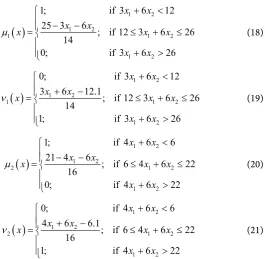
According to Zimmermann’s approach for a symmetric model, we assume that Z0=66, 12,p0= p1=14, 16p2= . We have to set p p1, 2 so that solution
becomes feasible. For the given problem p1≥14, 16p2 ≥ . The membership and
non-membership functions
(
)
0, , , 1,20 i i i
µ ν µ ν = are as given below:
( )
1 20
1; if 66
12 30 54; if 54 66
12
0; if 54
J x x x J J µ > + − = ≤ ≤ < (16)
( )
1 20
0; if 66
65.1 12 30 ; if 54 66
12
1; if 54
DOI: 10.4236/ijis.2019.91003 52 International Journal of Intelligence Science
( )
1 2
1 2
1 1 2
1 2
1; if 3 6 12
25 3 6 ; if 12 3 6 26 14
0; if 3 6 26
x x
x x
x x x
x x µ + < − − = ≤ + ≤ + > (18)
( )
1 2 1 21 1 2
1 2
0; if 3 6 12
3 6 12.1; if 12 3 6 26 14
1; if 3 6 26
x x
x x
x x x
x x ν + < + − = ≤ + ≤ + > (19)
( )
1 2 1 22 1 2
1 2
1; if 4 6 6
21 4 6 ; if 6 4 6 22 16
0; if 4 6 22
x x
x x
x x x
x x µ + < − − = ≤ + ≤ + > (20)
( )
1 2 1 22 1 2
1 2
0; if 4 6 6
4 6 6.1; if 6 4 6 22 16
1; if 4 6 22
x x
x x
x x x
x x ν + < + − = ≤ + ≤ + > (21)
Following Zimmermann’s approach to solve (14), we need to solve the fol-lowing crisp LPP:
( )
( )
( )
0 0
max , min
subject to ,
, ( ) ; 1,2
, 1
0
j j
x x
x x j
x
α β µ α ν β µ α ν β β α α β
≥ ≤
≥ ≤ =
≤ + < ≥
(22)
where
α
is the degree up to which the aspiration level Z0 of the decision maker is accepted and β is the degree of its rejection.Accordingly, we have the formulation:
(
)
1 2 1 2 1 2 1 2 maxsubject to 12 12 30 54 12 12 30 65.1
14 3 6 25
14 3 6 12.1
x x x x x x x x α β α β α β − − − ≤ − − − − ≤ − + + ≤ − + + ≤ 1 2 1 2
16 4 6 21
16 4 6 6.1
, 1 0 x x x x x α β β α α β
+ + ≤ − + + ≤
≤ + < ≥
(23)
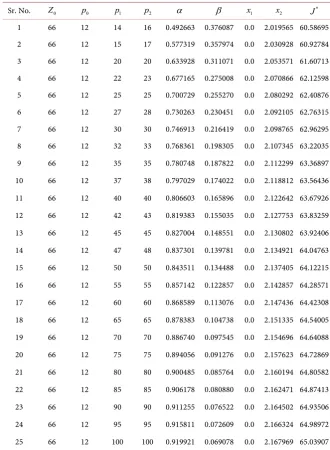
Now, by using simplex algorithm, we solve the above problem and obtain the solution as x1 =0.0 , x2=2.019565 , α =0.492663 , β =0.3760870 ,
* 60.58695
J = .
[image:9.595.274.540.69.328.2]DOI: 10.4236/ijis.2019.91003 53 International Journal of Intelligence Science
Table 1. Solution for different p p1, 2 in case of IFLPP.
Sr. No. Z0 p0 p1 p2 α β x1 x2 J*
1 66 12 14 16 0.492663 0.376087 0.0 2.019565 60.58695 2 66 12 15 17 0.577319 0.357974 0.0 2.030928 60.92784 3 66 12 20 20 0.633928 0.311071 0.0 2.053571 61.60713 4 66 12 22 23 0.677165 0.275008 0.0 2.070866 62.12598 5 66 12 25 25 0.700729 0.255270 0.0 2.080292 62.40876 6 66 12 27 28 0.730263 0.230451 0.0 2.092105 62.76315 7 66 12 30 30 0.746913 0.216419 0.0 2.098765 62.96295 8 66 12 32 33 0.768361 0.198305 0.0 2.107345 63.22035 9 66 12 35 35 0.780748 0.187822 0.0 2.112299 63.36897 10 66 12 37 38 0.797029 0.174022 0.0 2.118812 63.56436 11 66 12 40 40 0.806603 0.165896 0.0 2.122642 63.67926 12 66 12 42 43 0.819383 0.155035 0.0 2.127753 63.83259 13 66 12 45 45 0.827004 0.148551 0.0 2.130802 63.92406 14 66 12 47 48 0.837301 0.139781 0.0 2.134921 64.04763 15 66 12 50 50 0.843511 0.134488 0.0 2.137405 64.12215 16 66 12 55 55 0.857142 0.122857 0.0 2.142857 64.28571 17 66 12 60 60 0.868589 0.113076 0.0 2.147436 64.42308 18 66 12 65 65 0.878383 0.104738 0.0 2.151335 64.54005 19 66 12 70 70 0.886740 0.097545 0.0 2.154696 64.64088 20 66 12 75 75 0.894056 0.091276 0.0 2.157623 64.72869 21 66 12 80 80 0.900485 0.085764 0.0 2.160194 64.80582 22 66 12 85 85 0.906178 0.080880 0.0 2.162471 64.87413 23 66 12 90 90 0.911255 0.076522 0.0 2.164502 64.93506 24 66 12 95 95 0.915811 0.072609 0.0 2.166324 64.98972 25 66 12 100 100 0.919921 0.069078 0.0 2.167969 65.03907
4. An Illustrative Study
In Section 3, instead of IFLPP if we take the corresponding FLPP and solve the same using Zimmermann’s technique [2] [30] [31] [32] [33] [34], Weight as-signment method [35] and Angelov’s method [24] [36] [37] for the previous example and some of the other problems then, a comparative study can be per-formed for a better understanding of the utility of the proposed method.
Problem 1:
(
) (
)
(
)
(
)
(
)
(
)
(
)
(
)
(
)
1 2 1 2
1 2
1 2
max , 12,5,13 30,10,10
subject to 3,2,1 6,4,1 13,5,2
4,1,2 6,5,4 7,4,2
I I
I I I
I I I
f x x x x
x x
x x
= +
+ ≤
+ ≤
DOI: 10.4236/ijis.2019.91003 54 International Journal of Intelligence Science Problem 2:
(
) (
)
(
)
(
)
(
)
(
)
(
)
(
)
(
)
1 2 1 2
1 2
1 2
max , 20,5,13 25,10,10
subject to 6,2,1 10,4,1 660,5,2 0.5,1,2 0.3,5,4 47,4,2
I I
I I I
I I I
f x x x x
x x
x x
= +
+ ≤
+ ≤
(25)
Problem 3:
(
) (
)
(
)
(
)
(
)
(
)
(
)
(
)
(
)
1 2 1 2
1 2
1 2
max , 2,1.9,2 3,2.9,2
subject to 1,2,1 2,4,1 6,5,2
2,1,2 1,5,4 6,4,2
I I
I I I
I I I
f x x x x
x x
x x
= +
+ ≤
+ ≤
(26)
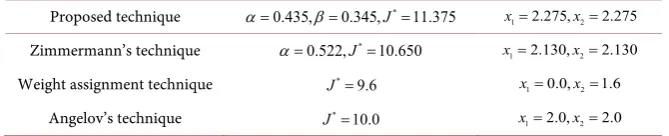
Result and discussion: Table 1 lists the solution of (14) for different values of
1
p and p2. It is easy to observe that the optimal solution is close to 66 which
correspond to x1=0.0 and x2=2.167969. Moreover, we observe that the
same result is attained for values satisfying
α β
+ <1. Next, Tables 2-4 present the difference of the solutions for the problems in (24), (25) and (26) using Zimmermann’s technique for solving FLPP, Weight Assignment technique for solving FLPP, Angelov’s technique for solving FLPP and proposed technique for solving IFLPP. The solution obtained by our proposed method for solving IFLPP is found to be the same as that obtained using fuzzy technique. However, fuzzy optimization handles only the degrees of either of the acceptance or rejection one at a time while it becomes necessary in some cases to consider both degrees of acceptance and rejection for handling efficiently optimization under uncer-tainty.In fact, there are some cases where due to insufficiency in the available infor-mation, the evaluation of the membership and non-membership functions to-gether gives better and/or satisfactory result than considering either the mem-bership value or the non-memmem-bership value. Accordingly, there remains a part indeterministic on which hesitation survives. Certainly fuzzy optimization is unable to deal such hesitation since in this case here membership and non-membership functions are complement to each other. Here, we extend Zimmermann’s optimization technique for solving FLPP. In our proposed tech-nique, sum of membership degree and non-membership degree always taken as strictly less than one and hence hesitation arises. Consequently, to achieve the aspiration level Z0 of the objective function, our proposed method for solving
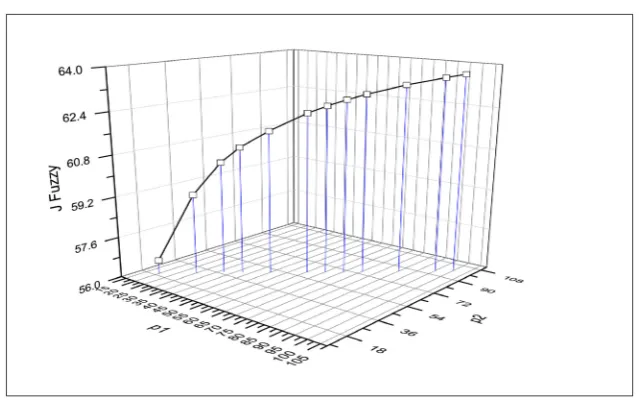
IFLPP converge rapidly as seen in Figure 1. In fuzzy environment, to obtain the same Z0 we have to set very large values of the tolerances which may
some-times be absurd. Figure 1 shows the value of the objective function J* in our
proposed technique. For the same tolerances solution of the FLPP in Zimmer-mann’s technique is presented in Figure 2.
5. Conclusions
DOI: 10.4236/ijis.2019.91003 55 International Journal of Intelligence Science problem into a crisp (non-fuzzy) LPP. The advantage of the IFO problem is two-fold: they give a rich apparatus for formulation of optimization problems and, on the other hand, the solution of IFO problems can satisfy the objective(s) with a greater degree than the analogous fuzzy optimization problem.
[image:12.595.213.533.366.566.2]Figure 1. For Problem 1 the value of J with our proposed approach.
Figure 2. For Problem 1 the value of J with Zimmermann’s approach.
Table 2. Optimal solution using different techniques for Problem 1.
Proposed technique α=0.919921,β=0.069078,J*=65.03907
1 0.0, 2 2.167969
x = x =
Zimmermann’s technique α=0.922641 x1=0.0,x2=2.122642
[2] [30] [31] [32] [33] [34] J*=63.67926
Weight assignment
technique [35] J*=54 x1=0.0,x2=0.9 Angelov’s technique [24]
[image:12.595.201.540.616.736.2]DOI: 10.4236/ijis.2019.91003 56 International Journal of Intelligence Science
Table 3. Optimal solution using different techniques for Problem 2.
Proposed technique α=0.7415,β=0.2126,J*=2156.25
1 97.40, 2 8.33
x = x =
Zimmermann’s technique α =0.8132,J*=2125.35
1 92.23, 2 11.23
x = x =
Weight assignment technique J*=940.8
1 19.6, 2 0.0
x = x =
Angelov’s technique J*=2122.0
1 87.1, 2 15.2
x = x =
Table 4. Optimal solution using different techniques for Problem 3.
Proposed technique α=0.435,β=0.345,J*=11.375
1 2.275, 2 2.275
x = x =
Zimmermann’s technique α =0.522,J*=10.650
1 2.130, 2 2.130
x = x =
Weight assignment technique J*=9.6
1 0.0, 2 1.6
x = x =
Angelov’s technique J*=10.0
1 2.0, 2 2.0
x = x =
There is considerable scope for research in this domain. In future, this re-search work could be extended to some other uncertain environment such as representation using Pythagorean fuzzy set [38], interval neutrosophic set [39] etc. This also includes, in particular, an attempt to find solution for a class of IFLPP without converting them to crisp LPP and to compare other existing fuzzy optimization techniques with the proposed one.
Acknowledgements
This research is supported by UGC SAP-DRS Phase-III programme at the De-partment of Mathematics. UGC’s financial support is highly appreciated.
Conflicts of Interest
The authors declare no conflicts of interest regarding the publication of this pa-per.
References
[1] Bellman, R.E. and Zadeh, L.A. (1970) Decision Making in a Fuzzy Environment. Management Science, 17, 141-164. https://doi.org/10.1287/mnsc.17.4.B141
[2] Bector, C.R. and Chandra, S. (2005) Fuzzy Mathematical Programming and Fuzzy Matrix Games. In: Studies in Fuzziness and Soft Computing, Volume 169, Sprin-ger-Verlag, Berlin Heidelberg, 57-94.
[3] Negoita, C.V. (1981) The Current Interest in Fuzzy Optimization. Fuzzy Sets and Systems, 6, 261-269. https://doi.org/10.1016/0165-0114(81)90004-X
[4] Dubois, D. and Prade, H. (1980) Systems of Linear Fuzzy Constraints. Fuzzy Sets and Systems, 3, 37-48. https://doi.org/10.1016/0165-0114(80)90004-4
[5] Tanaka, H. and Asai, K. (1984) Fuzzy Linear Programming Problems with Fuzzy Numbers. Fuzzy Sets and Systems, 13, 1-10.
https://doi.org/10.1016/0165-0114(84)90022-8
[image:13.595.207.542.189.257.2]DOI: 10.4236/ijis.2019.91003 57 International Journal of Intelligence Science [7] Garg, H., Rani, M., Sharma, S.P. and Vishwakarma, Y. (2014) Bi-Objective Optimi-zation of the Reliability-Redundancy Allocation Problem for Series-Parallel System. Journal of Manufacturing Systems, 33, 353-367.
https://doi.org/10.1016/j.jmsy.2014.02.008
[8] Garg, H., Rani, M., Sharma, S.P. and Vishwakarma, Y. (2014) Intuitionistic Fuzzy Optimization Technique for Solving Multi-Objective Reliability Optimization Problems in Interval Environment. Expert Systems with Applications, 41, 3157-3167. https://doi.org/10.1016/j.eswa.2013.11.014
[9] Garg, H. (2016) A Novel Approach for Analyzing the Reliability of Series-Parallel System Using Credibility Theory and Different Types Of Intuitionistic Fuzzy Num-bers. Journal of Brazilian Society of Mechanical Sciences and Engineering, 38, 1021-1035. https://doi.org/10.1007/s40430-014-0284-2
[10] Garg, H. (2018) Some Arithmetic Operations on the Generalized Sigmoidal Fuzzy Numbers and Its Application. Granular Computing, 3, 9-25.
https://doi.org/10.1007/s41066-017-0052-7
[11] Atanassov, K. (1986) Intuitionistic Fuzzy Sets. Fuzzy Sets and Systems, 20, 87-96. https://doi.org/10.1016/S0165-0114(86)80034-3
[12] Atanassov, K. (1995) Ideas for Intuitionistic Fuzzy Sets Equations, Inequations and Optimization. Notes on Intuitionistic Fuzzy Sets, 1, 17-24.
[13] Atanassov, K. (1999) Intuitionistic Fuzzy Sets: Theory and Applications. Physi-ca-Verlag, Berlin Heidelberg, 1-137. https://doi.org/10.1007/978-3-7908-1870-3 [14] Atanassov, K. (1994) New Operations Defined over the Intuitionistic Fuzzy Sets.
Fuzzy Sets and Systems, 61, 137-142. https://doi.org/10.1016/0165-0114(94)90229-1 [15] Ejegwa, P.A., Akowe, S.O., Otene, P.M. and Ikyule, J.M. (2014) An Overview on
Intuitionistic Fuzzy Sets. International Journal of Scientific & Technology Research, 3, 142-145.
[16] Dubey, D. and Mehra, A. (2011) Linear Programming with Triangular Intuitionistic Fuzzy Number. European Society for Fuzzy Logic and Technology, 563-569. https://doi.org/10.2991/eusflat.2011.78
[17] Parvathi, R. and Malathi, C. (2012) Intuitionistic Fuzzy Linear Optimization. Notes on Intuitionistic Fuzzy Sets, 18, 48-56.
[18] Parvathi, R. and Malathi, C. (2012) Intuitionistic Fuzzy Linear Programming Prob-lem. World Applied Sciences Journal, 17, 1802-1807.
[19] Seikh, M.R., Nayak, P.K. and Pal, M. (2013) Notes on Triangular Intuitionistic Fuzzy Numbers. International Journal of Mathematics in Operational Research, 5, 446-465. https://doi.org/10.1504/IJMOR.2013.054730
[20] Mitchell, H.B. (2004) Ranking Intuitionistic Fuzzy Numbers. International Journal of Uncertainity, Fuzziness and Knowledge-Based Systems, 12, 377-386.
https://doi.org/10.1142/S0218488504002886
[21] Nagoorgani, A. and Ponnalagu, K. (2013) An Approach to Solve Intuitionistic Fuzzy Linear Programming Problem Using Single Step Algorithm. International Journal of Pure and Applied Mathematics, 86, 819-832.
https://doi.org/10.12732/ijpam.v86i5.6
[22] Nishad, A.K. and Singh, S.R. (2014) Linear Programming Problem with Intuitionis-tic Fuzzy Numbers. International Journal of Computer Applications, 106, 22-28. [23] Gani, A.N. and Abbas, S. (2014) A New Average Method for Solving Intuitionistic
DOI: 10.4236/ijis.2019.91003 58 International Journal of Intelligence Science [24] Angelov, P.P. (1997) Optimization in an Intuitinistic Fuzzy Environment. Fuzzy
Sets and Systems, 86, 299-306. https://doi.org/10.1016/S0165-0114(96)00009-7 [25] Hussain, R.J. and Kumar, P.S. (2012) Algorithmic Approach for Solving
Intuitionis-tic Fuzzy Tansportation Problem. Applied Mathematical Sciences, 6, 3981-3989. [26] Hussain, R.J. and Kumar, P.S. (2012) The Transportation Problem in an
Intuitionis-tic Fuzzy Environment. International Journal of Mathematics Research, 4, 411-420. [27] Hussain, R.J. and Kumar, P.S. (2013) An Optimal More-for-Less Solution of Mixed Constraints Intuitionistic Fuzzy Transportation Problems. International Journal of Contemporary Mathematical Sciences, 8, 565-576.
https://doi.org/10.12988/ijcms.2013.13056
[28] Ye, J. (2011) Expected Value Method for Intuitionistic Trapezoidal Fuzzy Multicriteria Decision-Making Problems. Expert Systems with Applications, 38, 11730-11734. https://doi.org/10.1016/j.eswa.2011.03.059
[29] Wan, S. and Dong, J. (2014) A Possibility Degree Method for Interval-Valued Intui-tionistic Fuzzy Multi-Attribute Group Decision Making. Journal of Computer and System Sciences, 80, 237-256. https://doi.org/10.1016/j.jcss.2013.07.007
[30] Zimmermann, H.J. (1975) Description and Optimization of Fuzzy Systems. Inter-national Journal of General System, 2, 209-215.
https://doi.org/10.1080/03081077508960870
[31] Zimmermann, H.J. (1978) Fuzzy Programming and Linear Programming with Sev-eral Objective Functions. Fuzzy Sets and Systems, 1, 45-55.
https://doi.org/10.1016/0165-0114(78)90031-3
[32] Zimmermann, H.J. and Zysno, P. (1980) Latent Connectives in Human Decision Making. Fuzzy Sets and Systems, 4, 37-51.
https://doi.org/10.1016/0165-0114(80)90062-7
[33] Zimmermann, H.J. (1980) Testability and Meaning of Mathematical Models in So-cial Sciences. Mathematical Modelling, 1, 123-139.
https://doi.org/10.1016/0270-0255(80)90012-3
[34] Zimmermann, H.J. (1983) Fuzzy Mathematical Programming. Computers and Op-erations Research, 10, 291-298. https://doi.org/10.1016/0305-0548(83)90004-7 [35] Thakre, P.A., Shelar, D.S. and Thakre, S.P. (2009) Solving Fuzzy Linear
Program-ming Problem as Multi Objective Linear ProgramProgram-ming Problem. Proceedings of the World Congress on Engineering, 2, 978-988.
[36] Angelov, P.P. (1994) Approximate Reasoning Based Optimization. Yugoslav Jour-nal of Operations Research, 4, 11-17.
[37] Angelovs, P.P. (1995) Intuitionistic Fuzzy Optimization. Notes on Intuitionistic Fuzzy Sets, 1, 123-129.
[38] Garg, H. (2018) A Linear Programming Method Based on an Improved Score Func-tion for Interval-Valued Pythagorean Fuzzy Numbers and Its ApplicaFunc-tion to Deci-sion-Making. International Journal of Uncertainty, Fuzziness and Knowledge-Based Systems, 26, 67-80. https://doi.org/10.1142/S0218488518500046