Available Online at www.ijcsmc.com
International Journal of Computer Science and Mobile Computing
A Monthly Journal of Computer Science and Information Technology
ISSN 2320–088X
IJCSMC, Vol. 4, Issue. 7, July 2015, pg.513 – 522
RESEARCH ARTICLE
Shortest Path Searching for Road
Network using A* Algorithm
Shrawan Kr. Sharma
1, B.L.Pal
21M.Tech Scholar, Computer Science & Engineering, Mewar University, Gangrar, Chittorgargh-312901, India
2
Computer Science & Engineering, Mewar University, Gangrar, Chittorgargh-312901, India
ABSTRACT : In city area traffic the shortest path finding is very difficult in a road network. Shortest path searching is very important in some special case as medical emergency, spying, theft catching, fire brigade etc. There are various path searching algorithm like A* algorithm, Dijkstra etc in the market. The A* algorithm is fastest and provide the best shortest path. It uses heuristic to find the path. In present era only one directional search algorithm are used, we will use the Bi-directional search method for searching the path instead of Dijkstra algorithm due to demand of time and situations because of its robustness as well as its variants. This method reduces the searching time of the system and gets the fastest and best path. We will also compare the Dijkstra to A* algorithm s to show its performance in different-different ceases on the basis of different-different – different-different parameters.
Keywords – A* algorithm, Dijkstra algorithm, Bi-directional, Path Searching, heuristic
I.
INTRODUCTION
Computing best possible routes in road networks from a given source to a given target location is an everyday
problem. Many people frequently deal with this question when planning trips with their cars. There are also
many applications like logistic planning or traffic simulation that need to solve a huge number of such route
queries. Current commercial solutions usually are slow or inaccurate. The gathering of map data is already well
advanced and the available road networks get very big, covering many millions of road junctions. Thus, on the
one hand, using simple-minded approaches yields very slow query times. This can be either inconvenient for the
client if he has to wait for the response or expensive for the service provider if he has to make a lot of computing
power available [1]. On the other hand, using aggressive heuristics yields inaccurate results. For the client, this
balancing act between speed and sub optimality of the computed routes. Due to these reasons, there is a
considerable interest in the development of more efficient and accurate route planning techniques [2].
A* algorithm is a graph search algorithm that finds a path from a given initial node to a given goal node. It
employs a "heuristic estimate" h(x) that gives an estimate of the best route that goes through that node. It visits
the nodes in order of this heuristic estimate. It follows the approach of best first search [3].
II.
R
ELATEDW
ORKIn A* Search a technique from the field of Artificial Intelligence, is a goal-directed approach, i.e., it adds a sense
of direction to the search process. For each vertex, a lower bound on the distance to the target is required. In
each step of the search process, the node v is selected that minimizes the tentative distance from the source s
plus the lower bound on the distance to the target t. This approach can be combined with bidirectional search.
The performance of the A* search depends on a good choice of the lower bounds. If the geographic coordinates
of the nodes are given and we are interested in the shortest (and not in the fastest) path, the Euclidean distance
from v to t can be used as lower bound. This leads to a simple, fast, and space-efficient method, which,
however, gives only small speedups [3][4]. It gets even worse if we want to compute fastest paths. Then, we
have to use the Euclidean distance divided by the fastest speed possible on any road of the network as lower
bound. Obviously, this is a very conservative estimation. Goldberg et al. Even report a slow-down of more than
a factor of two in this case since the search space is not significantly reduced but a considerable overhead is
added [5].
A)
Dijkstra AlgorithmDijkstra algorithm is an algorithm for finding the shortest paths between nodes in a graph, which may represent,
for example, road networks. It was conceived by computer scientist Edsger W. Dijkstra in 1956 and published
three years later.[4][5] The algorithm exists in many variants; Dijkstra original variant found the shortest path
between two nodes,[6] but a more common variant fixes a single node as the "source" node and finds shortest
paths from the source to all other nodes in the graph, producing a shortest path tree.
B)
A* Algorithm
A* algorithm is a graph search algorithm that finds a path from a given initial node to a given goal node. It
employs a "heuristic estimate" h(x) that gives an estimate of the best route that goes through that node. It visits
the nodes in order of this heuristic estimate. It follows the approach of best first search. The secret to its success
is that it combines the pieces of information that Dijkstra algorithm uses (favoring vertices that are close to the
starting point) and information that Best- First-Search uses (favoring vertices that are close to the goal). In the
standard terminology used when talking about A*, g(n)represents the exact cost of the path from the starting
point to any vertex n, and h(n) represents the heuristic estimated cost from vertex n to the goal[7]. The A*
algorithm depends on evaluating the best next step in searching for a path. This is done by evaluating each of the
possible next steps against a heuristic to give a value that can be used to sort the list and hence determine the
III.
A* Algorithm: working method
A. Unidirectional: It works by maintaining two lists; the open list and the closed list. The open list initially
contains the start node; it contains all nodes that are yet to be considered. If the open list becomes empty
then there is no possible path. The closed list starts out empty and contains all nodes that have already been
considered /visited. The core loop of the algorithm selects a node from the open list with the lowest
estimated cost to reach the goal. If the selected node is not the goal it puts all valid neighbouring nodes into
the open list and repeats the process. Part of the magic in the algorithm is that all nodes that are created keep
a reference to their parent. This means that from any node we can track backwards to get a path from the
node and the start node [9].
i.
Pseudo code
1) At initialization add the starting location to the open list and empty the closed list
2) While there are still more possible next steps in the open list and we haven’t found the target: A) Select the most likely next step (based on both the heuristic and path costs)
B) Remove it from the open list and add it to the closed C) Consider each neighbor of the step. For each neighbor: i) calculate the path cost of reaching the neighbor
ii) If the cost is less than the cost known for this location then remove it from the open or closed lists (since we’ve now found a better route)
iii) If the location isn’t in either the open or closed list then record the costs for the location and add it to the open list (this means it’ll be considered in the next search). Record how we got to this location
The loop ends when we either find a route to the destination or we run out of steps. If a route is found we back track up the records of how we reached each location to determine the path.
Example
Initial step
Step 1
Step 2
Step 3
Step 4
Step 5
Step 6
Figure 1: One direction method in A* algorithm
B)
Bi-directional search
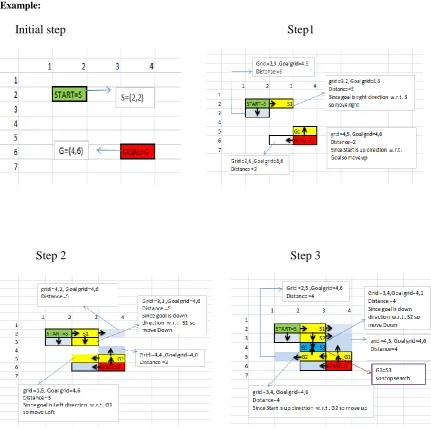
As the name suggests, bidirectional search suggests running 2 simultaneous searches, one from the initial state and the other from the goal state, those 2 searches stop when they meet each other at some point in the middle of
the graph
.
.Pseudo code
1) At initialization add the starting and goal location to the open list and empty the closed list 2) Begin with a starting node with options for further travel: Also have a list of coordinates with
nodes demonstrating movement options towards goal intersection 3) Consider each neighbour of the step. For each neighbor:
i) calculate the path cost of reaching the neighbor
ii) If the cost is less than the cost known for this location then remove it from the open or closed lists (since we’ve now found a better route)
iii) If the start and goal path cost is same then intersect
Example:
Initial step
Step1
Step 2
Step 3
Figure 2: Bi-directional search in A* algorithm
IV.
E
XPERIMENTR
ESULT ANDA
NALYSISA) A* algorithm use one directional
Figure 3: A* algorithm use one directional
B) Dijkstra algorithm one directional
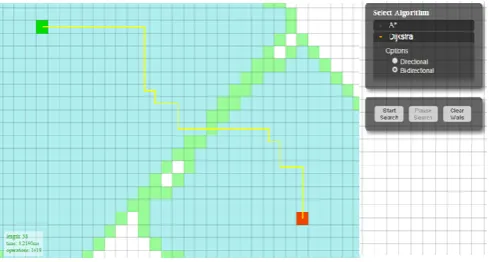
Figure 4: Dijkstra algorithm use one directional
C) A* algorithm using Bidirectional
Figure 5: A* algorithm using Bidirectional
The obstacle problem:
In many time we can search the path finding the lot of traffic is occur in that case the path searching is difficult .So we can get the solution which algorithm(A* or Dijkstra ) is perform best in the obstacle as use traffic. The obstacle is find in the grid then the searching way is change and find the new pathA)
A* algorithm use one directional with obstacle
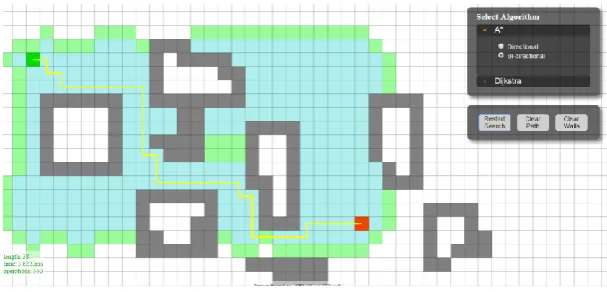
Figure 7: A* algorithm use one directional with obstacle
B)
Dijkstra algorithm on directional with obstacle
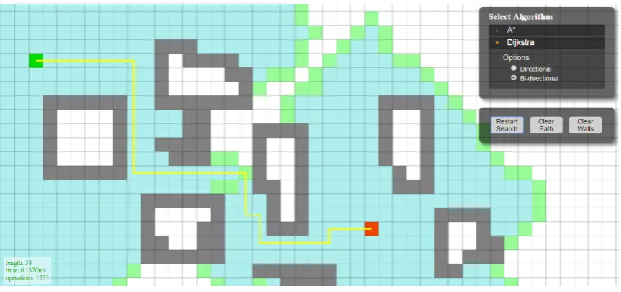
Figure 8 Dijkstra algorithms one directional with obstacle
C)
A * using Bi-directional with obstacle
D)
Dijkstra algorithm Bidirectional use with obstacle
Figure 10 Dijkstra algorithm Bidirectional use with obstacle
V. RESULTANALYSIS
Without obstacle:
The result table show main difference of the time and number of operation. Time is very important for any searching manner so that this result show the A* algorithm is best performing in One or Bi-directional as per Dijkstra algorithm.Table 1: Compression of A* or Dijkstra without obstacle
With obstacle:
The result table show main difference of the time and number of operation using in obstacle. We analysis that when the obstacle is occur in that case the A*algorithm performing much better than Dijkstra. So that A* algorithm performing better in all case as comparing Dijkstra algorithmAlgorithm Condition Length Time Operation
A star One-Direction 38 3.8190 553
Dijkstra One-Direction 38 14.8760 1933
A star Bi-direction 38 0.5920 348
Dijkstra Bi-direction l 38 8.2140 1618
Algorithm Condition Length Time Operation
A star One direction 38 5.095 361
Dijkstra One direction 38 12.1030 1601
A star Bi-direction 38 3.8220 550
C
ONCLUSIONAccording this study we can say that the A* algorithm is perform better then the Dijkstra algorithm in all the
case (obstacle and without obstacle) except in uninformed search. .the A* algorithm has generated the best
shortest path for other algorithm so that it is the best shortest path search algorithm.
Acknowledgements
Foremost, I would like to express my sincere gratitude to my advisor B.L. Pal for the continuous support of my
study, for his patience, motivation, enthusiasm, and immense knowledge. His guidance helped me in all the time
of research and writing of this paper. I could not have imagined having a better advisor and mentor for this
paper.
Besides my advisor, I would like to Special thank Mr. Shiv Kumar and my Friends and well wisher: Bhupesh
Sharma and Abhishek Sharma, for their encouragement, insightful comments, and hard questions. Last but not
the least; I would like to thank my brother Nand Lal Sharma and my Wife Neelam Sharma supporting me
spiritually throughout my life.
R
EFERENCES[1] David Poole and Alan Mackworth. ,"ARTIFICIAL INTELLIGENCE FOUNDATIONS OF COMPUTATIONAL
AGENTS"2010
[2]K.Rohila, P.Gouthami, Priya M,"Dijkstra’s Shortest Path Algorithm for Road Network",IJIRCCE,Vol. 2, Issue 10,
October 2014,ISSN(Online): 2320-9801
[3]Abhishek Goyal,Prateek Mogha,Rishabh Luthra,Ms. Neeti Sangwan,"PATH FINDING: A* OR DIJKSTRA’S?"IJITE
Vol.02 Issue-01, (January, 2014) ISSN: 2321–1776
[4]Dominik Schultes,"Route Planning in Road Networks",page 22-29
[5][Kai Gutenschwager,Axel Radtke,"THE SHORTEST PATH: COMPARISON OF DIFFERENT APPROACHES AND
IMPLEMENTATIONS FOR THE AUTOMATIC ROUTING OF VEHICLES",Proceedings of the 2012 Winter Simulation
Conference,
[6] Fredman, Michael Lawrence; Tarjan, Robert E. (1984). Fibonacci heaps and their uses in improved network optimization
algorithms. 25th Annual Symposium on Foundations of Computer Science. IEEE. pp. 338–346.
doi:10.1109/SFCS.1984.715934.
[7] Sreekanth Reddy Kallem,"Artificial Intelligence Algorithms:,IOSRJCE) ISSN: 2278-0661, ISBN: 2278-8727 Volume 6,
Issue 3 (Sep-Oct. 2012), PP 01-08
[8] Patrick Lester,"A* Pathfinding for Beginners",article apge 1-3
[9] Ben Coppin,"Artificial Intelligence Illuminated”, A* algorithm, page 108-110,JONES AND BARTLETT
PUBLISHERS,2004
[10] Pohl, Ira (1971), "Bi-directional Search", in Meltzer, Bernard; Michie, Donald, Machine Intelligence 6, Edinburgh
Author Profile
Shrawan Kumar Sharma is currently pursuing masters degree program {M.tech} in
Computer science and engineering in Mewar University, India. His research interest
includes soft computing, Mobile computing, DBMS, Network Security, Graphic
programming, Fuzzy and Data Mining and etc.
B. L. Pal: working as an Assistant Professor in computer science and information
technology department, Mewar University, Chittorgarh, India. He has done B. Tech. in
Information Technology from AAI_DU Allahabad U.P. and his M.tech.(SIT) from
DAVV Indore. He is also published some paper in international journals and has
attended international conferences. He has more than three years teaching experience.
His area of interest for research work includes Wireless Communication,