Efficient Statistical Zero-Knowledge Authentication Protocols
for Smart Cards Secure Against Active & Concurrent Attacks
Mohammad Sadeq Dousti and Rasool Jalili
Data & Network Security Lab, Department of Computer Engineering, Sharif
University of Technology, Tehran, Iran
{dousti@ce, jalili@}sharif.edu
Abstract
We construct statistical zero-knowledge authentication protocols for smart cards based on general assumptions. The main protocol is only secure against active attacks, but we present a modification based on trapdoor commitments that can resist concurrent attacks as well. Both pro-tocols are instantiated using lattice-based primitives, which are conjectured to be secure against quantum attacks. We illustrate the practicality of our main protocol on smart cards in terms of storage, computation, communication, and round complexities. Furthermore, we compare it to other lattice-based authentication protocols, which are either zero-knowledge or have a similar structure. The comparison shows that our protocol improves the best previous protocol.
Keywords. Statistical Zero Knowledge; Authentication; Smart Cards; Post-Quantum Cryptog-raphy; Lattice-based Cryptography.
1
Introduction
Authentication protocols are ubiquitous in everyday computing. They are present when checking email, making monetary transactions, connecting to a mobile/wireless network, and so on. From one point of view, the authentication protocols can be divided into two broad categories. In one category, the protocol is executed over an untrusted infrastructure, and the parties carrying the authentication need not be physically present in a specific location. Authentication over the Internet (or other public networks) is the best example of this type. In the other category, the party to be authenticated must be present in a pre-specified location, and it is assumed that the infrastructure connecting him to an honest verifier is trusted (i.e., no eavesdropping on or tampering with the data in transit is possible). Authentication via smart cards, security tokens, badges, magnet stripes, and biometrics fall into the second category, though in this paper we only focus on authentication protocols that can be carried out by a processor (such as a smart card). For this reason, we pick smart cards as therepresentatives
of this category.
There are a number of features unique to smart-card authentication protocols:
• There is usually a single session between the smart card and the reader.
• The authentication protocol does not need a notion of key exchange, as the infrastructure is trusted.
• The smart card has limited resources regarding the storage, computation, and communication.
An abridged version of this paper is published in International Journal of Computer
Mathematics, January 2015. The paper is accessible from:
• Once inserted into the reader, the smart card cannot communicate with the outside world (except forcontactless smart cards, which might communicate with another device in close range).
A security concern regarding the authentication protocols is that of the malicious verifiers. A malicious verifier poses herself as an honest verifier, engages in the protocol, deviates from the protocol, and tries to gain knowledge about the secret stored on the smart card. While bilateral authentication protocols may help by aborting the protocol in case one of the parties fails to authenticate herself to another, it does not prevent partial leakage of information. The leakage might be undesirable for systems which require a high level of security.
The best workaround is to use zero-knowledge authentication protocols, which guarantee that the verifier learns nothing about the secret. However, this high level of security comes at a price: Zero-knowledge authentication protocols are often too resource intensive to be used in practice. On the contrary, this paper aims to demonstrate a zero-knowledge authentication protocol for smart cards, with many attractive properties:
• The round complexity of the protocol is near optimal. More specifically, the minimum number of passes for a zero-knowledge proof with negligible soundness error is shown to be 3 [1] (and 4 if the simulation is black-box), while our protocol has only 5 passes. Most zero-knowledge authentication protocols in the literature do not even have a constant number of rounds.
• The protocol has a significantly lower communication complexity than similar protocols. In practice, the communication complexity determines the round complexity as well: For instance, ISO/IEC 7816-4 defines theApplication Protocol Data Unit(APDU), which is the communication unit between a smart card and the reader. An APDU can carry up to 255 bytes of data. There-fore, our protocol has a significantly lowerpractical round complexity than similar protocols, even if their theoretical round complexity is lower. SeeSection 4.3 for more information.
• The protocol is provably secure based on the standard cryptographic assumptions. Furthermore, we provide an exact security [2] analysis, which reveals the minimum level of security achievable with any choice of parameters.
• The protocol is based on general assumptions, such as the existence of commitment schemes and trapdoor one-way permutations. Therefore, it can be instantiated based on the specific needs of each environment.
• The protocol is statistically zero knowledge, meaning that it does not leak any knowledge about the secret, even to an infinitely powerful malicious verifier.
• The protocol constructs (commitment and trapdoor one-way permutation) are instantiated based on lattice problems, which are believed to resist quantum attacks.
• The lattice-based instantiation uses very simple operations, such as multiplying a matrix by a vector (while protocols based on the RSA or discrete logarithm require the costly modular expo-nentiation operations). Therefore, the computational cost of the protocol is very low.
• The protocol, as well as its lattice-based instantiation, are modified to resist concurrent attacks. While smart cards are not usually used in the concurrent setting, it is theoretically instrumental to consider this setting as well.
cards. From the theoretical point of view, we will compare our protocol to other lattice-based zero-knowledge authentication protocols for smart cards, and show that the proposed protocol is superior in terms of computation and communication complexities, while essentially achieving the same round and storage complexities (seeSection 4.3). From a practical standpoint, zero-knowledge protocols are recommended for environments with tight security requirements, such as the data centers or military bases. In this paper, we provide evidence that our zero-knowledge authentication protocol can be implemented on smart cards, thereby satisfying the needs of security-critical (and perhaps other) environments.
Remark 1. Following a preliminary version of this work [3], Boorghany and Jalili [4] implemented our protocol, as well as several recent lattice-based authentication protocols on a real smart card. Their result shows the practicality and superiority of the protocol proposed in this paper, and is
discussed briefly inRemark 6. C
1.1
Why Lattices?
In this paper, we picked a particular instantiation of our general protocol based on lattices. For us, the most appealing feature of lattices is that no quantum attacks are known against lattice problems, and research offers evidence that both quantum and ordinary attacks require exponential time to break lattice-based constructions (for instance, see [5] and the references thereof). This stands in sharp contrast to factorization or discrete logarithm problems, for which polynomial-time quantum algorithms exist [6]. Therefore, on the advent of quantum computers, many authentication protocols for smart cards will be rendered insecure, while our lattice-based protocol will not be affected.
Other major attractions of lattice-based cryptography are the existence of worst-case to average-case reductions between lattice problems, asymptotic efficiency, and simple matrix operations. The first attraction is theoretically appealing, while the latter two are practically significant. For instance, consider asymptotic efficiency: For 80 bits of security, RSA-1024 is used, which beats most known lattice-based encryptions in efficiency. In contrast, for 128 bits of security, RSA-3072 is used, which is not as efficient as several lattice-based encryptions [7]. For higher bits of security, lattice-based encryptions are much more efficient than most number-theoretic encryptions. Furthermore, simple matrix operations allow lattice-based primitives to be easily implemented. In contrast, number-theoretic constructions require more complex operations, such as the modular exponentiation used in RSA.
For these reasons, lattice-based cryptography is preferable on constraint devices such as smart cards, when a high-level of security is desired.
1.2
Contributions
The main contribution of this paper, as descried above, is to offer a general zero-knowledge protocol for smart-card authentication, and prove its exact security. We also provide a specific lattice-based instantiation, which resists quantum attacks.
Other contributions of this paper are as follows.
• We provide a formal model and a formal definition for smart-card authentication. The details of our model and definition are taken from several references, but we compare and consolidate them into a single definition (Definition 1).
• Using trapdoor commitments, we show how our general protocol can be modified to resist attacks in a more hostile environment.
• We prove a series of useful lemmas in the appendix, which might be of independent interest.
1.3
Organization
The rest of this paper is organized as follows: Section 2 introduces the preliminaries needed for the rest of the paper, and surveys the related work. Section 3 presents the statistical zero-knowledge authentication protocol, and proves its exact security. Section 4instantiates the general constructions of the protocol with lattice-based primitives, and analyzes the practical efficiency of the instantiated protocol. Section 5discusses how trapdoor commitments can be used to modify the general protocol, so that it remains secure when the adversary can mount concurrent attacks on the protocol. It also instantiates the trapdoor commitments using lattice-based constructions. Section 6 concludes the paper, and provides future directions to improve the work.
This paper has an appendix, which is separated from the main text to improve the clarity, and so that the reader can focus on the main ideas of the paper. It defines the standard notions in cryp-tography, such as trapdoor one-way permutations, commitments, statistical distance, zero-knowledge protocols, and lattice-based problems. It also provides some useful lemmas which might be of inde-pendent interest.
2
Preliminaries and Related Work
In this section, we first define the main notations used throughout the paper, and then present a formal model and definition for smart-card authentication. Finally, we survey the papers in the area of lattice-based authentication.
Fairly standard definitions are omitted from this section, but are mentioned inAppendix Afor self containment. The reader familiar with cryptography can safely skip this appendix, but we recommend to at least skim over Appendix A to get familiarized with the names and conventions we used for various cryptographic constructions.
2.1
Notation
We use the following general abbreviations: PPT for probabilistic polynomial time, ZK for zero knowledge, and SZK for statistical zero knowledge.
A function is called negligible, if it vanishes faster than the reciprocal of any positive polynomial. A function isoverwhelming, if it is at most negligibly less than 1. The notatione←RS corresponds
to selectinge uniformly at random from the (finite) setS. For a random variable X, let [X] denote thesupport ofX. That is,
[X] ={x|Pr[X =x]>0} .
The function lg(·) indicates the logarithm to the base two. The concatenation and XOR operators are denoted by “comma” and⊕, respectively. For a stringx, we use|x|to indicate its length. Similarly, ifS is a set,|S| indicates its cardinality.
We denote byhA, Bia protocol betweenAandB. Moreover,hA, Bi(x) denotes the same protocol when the common input ofAand B isx. If either of the parties have a private input, that input is written in parenthesis next to its name. For instance,hA(y), Bi(x) is the protocol whereAhas private inputy. Finally, subscriptingrto the name of a party means that we fixed the randomness of that party tor.
We typeset matrices (resp. vectors) by bold-face uppercase (resp. lowercase) Latin letters. For
p≥ 1, the p-norm of a vector v = (v1, . . . , vn) is denoted bykvkp def
= (Pn
i=1|vi|p)
1/p
. Notice that kvk∞ = maxi|vi|. In the special case of Euclidean (or `2) norm, we may simply usekvk instead of
Adversary = (V∗, P∗) Q
V∗ State
Information P
∗
2) Information Transition
3) Impersonation Attack 1) Information
Gathering
V P
P
.. .
P
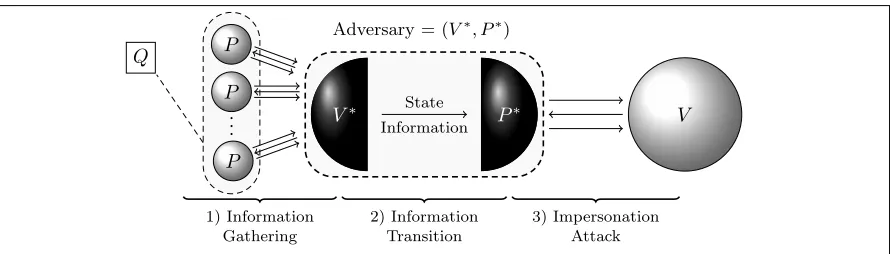
Figure 1: The smart-card authentication model.
2.2
Authentication: Model and Definition
In order to prove the security properties of cryptographic constructions, we need asecurity model and asecurity definition. The securitymodel defines aspects such as the computational restrictions on the parties and the adversary, as well as how they communicate during the execution of the cryptographic construction. The model can be very general, and may be shared by several functionalities (see [8] as an example). The securitydefinition, however, is specific to the functionality under investigation. It defines what it means for the functionality to be securewithin a particular model. In many occasions, the security definition first defines a “winning condition” for the adversary, and then defines the cryptographic construction to be secure if the advantage of the adversary in winning is only negligible. If the cryptographic construction is rather simple, the model and the definition may be unified together [9]. However, for complex constructions, there must be a separate model and a separate definition. This is especially the case for the authentication protocols, where the complexity of mod-eling/definition is so high that many authentication models and definitions were proposed. To name just a few, see [10–19]. See also [20–23] for a comparison of these works.
Since the focus of this paper is on efficient zero-knowledge authentication protocols, we have to choose a proper model which allows the authentication protocol to satisfy both efficiency and zero-knowledge properties. The aforementioned papers try to model an environment similar to the Internet, where the adversary is free toconcurrently execute many versions of the authentication protocol. The zero-knowledge property is not necessarily preserved under the concurrent executions [1]. Moreover, it is known that only round-inefficientzero-knowledge protocols are concurrently secure. More precisely, only protocols with round complexity ˜Ω(logn) can be (black-box) zero knowledge [24].
Several works try to augment the standard model, and offerconstant-round zero-knowledge proto-cols. This includes thetiming model [25], thebare public-key model [26], and thenon–black-box zero knowledge [27]. However, to the best of our knowledge, no efficient zero-knowledge authentication protocols were designed and implemented in these models. Moreover, they have no formal definition for authentication protocols.
Another approach, and the one we will take in this paper, is to model the adversary in a physically restricted way. In this approach, the adversary cannotsimultaneously communicate with the honest prover and the honest verifier [28]. (We assume that the prover is the entity trying to authenticate himself to the verifier.) The model is known as the smart-card authentication model, since it was first developed with the resource restrictions of smart cards in mind. Moreover, it has no notion of
key exchange, which is fitted to the case of smart cards, where it is physically guaranteed that the adversary cannot “hijack” the session after an honest party is authenticated. Finally, the model only supportsunilateral authentication, where only the first party proves his identity to second one, but not vice versa.
Let us briefly describe the smart-card authentication model. All parties in the model are proba-bilistic polynomial-time (PPT) interactive Turing machines. The honest prover and the honest verifier are denoted byP and V, respectively. The adversaryAis composed of a pair of colluding machines (V∗, P∗), whereP∗andV∗play the roles of the cheating prover and the cheating verifier, respectively. The communication model is illustrated in Figure 1. As shown in the figure, the adversary attacks the protocol in three stages: information gathering, information transition, and imperson-ation. In theinformation gathering stage, the adversary plays the role of a cheating verifierV∗, and interacts with the honest proverP for some polynomial number of times. In this stage, V∗ tries to gather fromP as much information as she can. Let us denote the stateofV∗ after it halts byst. In
theinformation transition stage,stis given to the cheating proverP∗. Finally, in theimpersonation
stage, P∗(st) tries to misrepresent herself (as P) to the honest verifier V. It is very important to note that the smart-card authentication model does not allowP∗ to communicate withP. In other words,V∗ halts before the stage two (and therefore, the stage three) starts. This modeling effectively prevents attacks such as the Mafia Fraud [53] or the Chess Grandmaster Problem [54], since both attacks require the cheating prover to be “wired” to the honest prover.
The attackAmounts onhP, Viis categorized based on the type of interaction betweenV∗ andP
in the information gathering stage. The categories, in increasing order of strength, are as follows:
• One-shot: P∗ attempts to impersonate toV, given only the common input. In other words,P∗
does not receive any information fromV∗.
• Passive: V∗ does not actually interact withP, and merely eavesdrops on honest protocol execu-tions.
• Honest verifier: V∗ follows the prescribed program ofV while interacting withP.
• Active: V∗ interacts withP sequentially. In other words,V∗ does not start interacting with a new copy ofP if it is already in the middle of interaction with another copy ofP. See [44–46] for example uses of this terminology.
• Concurrent: V∗ is free to concurrently interact with a polynomial number ofP’s.
• Resetting: V∗ has oracle access to each copy ofP. In particular, not only can V∗ run them concurrently, but also it can reset (or rewind) each copy to a previous state. This attack was first defined in [26] for zero-knowledge protocols. [55] applies the attack to authentication protocols.
As pointed out in the beginning of this section, the zero-knowledge property is not necessarily preserved under concurrent attacks. However, (auxiliary-input) zero-knowledge is preserved under active (i.e., sequential) attacks [56]. Therefore, an (auxiliary-input) zero-knowledge protocolhV, Piis as secure underactive attacks as it is underone-shot attacks.1
Now that we described the model, let us define the syntax and semantics of authentication protocols in this model. Syntactically, an authentication protocol consists of a triple (G, P, V), where G is a PPT algorithm, andP and V are PPT interactive Turing machines. On input 1n, the algorithm G
generates a pair (x, y). Then, y is handed over to P as the private input, x is set as the common input, and the protocolhV, P(y)i(x) is executed. After the exchange of at most a polynomial (inn) number of messages,V always halts, and outputs either 1 (“accept”) or 0 (“reject”). Let us denote the verifier’s output byJhV, P(y)i(x)K, which might be different from a single bit in case we are dealing with a malicious verifier. Next, we define what it means for a protocol to be a secure authentication protocol.
Definition 1 (Secure Authentication Protocol). A triple (G, P, V) is called asecure authenti-cation protocol in the smart-card model if the following holds:
1. Completeness:For allnand for any pair (x, y)∈[G(1n)], the verifierV of the honest interaction
hV, P(y)i(x), accepts with overwhelming probability (inn).
2. Soundness: For all c > 0, and for any PPT adversarial coalition A= (V∗, P∗), and for large enoughn, the quantity:
AdvAttack
A,(G,P,V)(n)
def
=
PrhJhV, P∗(st)i(x)K= 1
(x, y)←G(1
n), st← JhV
∗, Q(y)i(x)
K
i
, (1)
is less thann−c. Here, the probability is taken over the coin tosses ofG,Q,V, andA= (V∗, P∗). The behavior ofV∗and the interactive functionQ(x, y) varies depending on theAttacktype:
• One-shot: V∗simply outputs the empty string as her state.
• Passive: Upon each invocation,Q(x, y) outputs a transcript of the honest executionhV, P(y)i(x) with fresh randomness.
• Honest-verifier: V∗ andQ(x, y) behave asV andP(x, y), respectively.
• Active: Q(x, y) keeps a flagF, indicating whether an instance ofP(x, y) is currently running (initially,F = 0). Q accepts the special message “New”. Upon receiving this message, Q
replies with⊥ifF = 1. Otherwise,F is set to 1, andQ(x, y) will behave like P(x, y) with fresh randomness. IfP(x, y) halts, the flagF will be set to 0 again.
• Concurrent: Q(x, y) keeps a set ID (initially empty), and accepts the special message
New(id). Upon receiving this message,Qchecks whetherid∈ID, and replies with⊥if this
is the case. Otherwise,QsetsID ←ID∪ {id}, and spawns a new instance of P(x, y) with fresh randomness andidas identifier—denotedPid(x, y). V∗can communicate withPid(x, y)
by prefixing each message withid.
• Resetting: This attack is similar to the previous one, but in additionQ(x, y) accepts the message Reset(id). Upon receiving this message, Q checks whether id ∈ ID, and replies with ⊥ if this is not the case. If id ∈ ID, Q resets Pid(x, y) to its initial state, without
refreshingPid’s randomness.
Remark 2. The term “soundness” in the definition of an authentication protocol should not be confused with the same term used in the definition of zero-knowledge proofs (or,cryptographic proofs, in general). Note that the soundness inDefinition 1 is with respect to thesmart-card authentication model, where the interactions involves the four parties P, V, P∗, and V∗. On the other hand, the soundness in the definition of cryptographic proofs merely involvesP∗andV. Moreover, the soundness inDefinition 1is with respect to some input distributionG(1n), while the soundness in cryptographic proofs is with respect to all admissible inputs.
We remark that the meaning of the term “completeness” remains the same in both authentication
protocols and cryptographic proofs. C
2.3
Lattice-Based ZK Proofs & Authentication: Related Work
In this section, we briefly survey zero-knowledge proofs and authentication protocols based on lattices.
Appendix A.5studies the necessary terminology to understand lattice problems.
Micciancio–Vadhan’s protocol is statistical zero knowledge (SZK), so even an infinitely powerful malicious verifier cannot gain any knowledge from the prover, except with negligible probability. Moreover, their protocol does not need a short-and-nearly-orthogonal basis, because the prover is not going to solve CVP. He merely knows one problem-solution pair (Y, X), generated by himself. Because the soundness error of the base protocol is 12, it must be repeated super-logarithmically in order to obtain a protocol with negligible soundness error. This repetition cannot be performed in parallel, since otherwise the zero-knowledge property would collapse.
Lyubashevsky [46] presented a 3-pass authentication protocol based on the hardness of the SVP in all lattices, and a more efficient protocol based on the hardness of SVP in ideal lattices. Both protocols do not feature perfect completeness, and neither one is zero knowledge.
Kawachiet al.[47] introduced another authentication protocol based on the worst-case hardness of GapSVP. This protocol is a version of Stern’s authentication protocol [58]. It assumes the availability of a random matrix A ∈ Zn×m
q generated by a trustee (here, n, m, and q are properly chosen
integers). The prover of the authentication protocol has a public keyy ∈ Zn, and proves that he
knows a secretx∈ {0,1}m, such thaty=Ax (modq). The approximation factor used in their work
was smaller than those of Micciancio–Vadhan [57] and Lyubashevsky [46], so the security is based on a weaker assumption. The base protocol of [47] is statistical zero knowledge. It requires super-logarithmic repetitions to make the soundness error negligible. To reduce the round complexity, the authors suggest to run the base protocol in parallel. The parallel version is no longer ZK. Nonetheless, Kawachiet al. prove that it is a secure authentication protocol.
In another attempt, Lyubashevsky [48] presented an authentication protocol based on the worst-case hardness of SVP and using lattice-based hash functions. He argues that, while the proposed lattice-based authentication protocols are asymptotically as efficient as number-theoretic ones, their concrete performance is not much good, due to the fact that the former treats “challenge bits” in-dividually, while the latter treats them as a whole. He then tries to improve some of the previous lattice-based authentication protocols by exploiting the limited algebraic structure of the underlying lattice. The base protocol of [48] has acompleteness error of 1−e−1 ≈0.63, and therefore some parts of it are repeated (in parallel) to achieve almost perfect completeness. The protocol is not zero-knowledge, but is proved to be secure under active attacks. It has a communication cost significantly lower than Micciancio–Vadhan and Kawachiet al. protocols.
Xagawa and Tanaka [49] proposed two statistical zero-knowledge proofs of knowledge for NTRU encryption [59], based on a variant of Stern’s authentication protocol [47,58]. The first protocol is for the “knowledge of secret key,” while the other is for “the knowledge of plaintext.” The former protocol can be used directly for authentication. The base protocol has a soundness error of 23, and should be repeated super-logarithmically.
Cayrel et al. [50] introduced another authentication protocol, based on the code-based authen-tication protocol of Cayrel and V´eron [51], which in turn is based on Stern’s protocol [58]. The assumption used here is the hardness of the SIS problem (as in [47]), which is milder than the as-sumption of Lyubashevsky [48]. However, since the soundness error of this protocol is smaller than both [47] and [48], it achieves the same level of security in fewer rounds.
Silvaet al.[52] followed [50], and built a similar authentication protocol based on the hardness of the SIS problem. The authentication protocol consists of the repetition of a 5-pass base zero-knowledge protocol with soundness error close to 12.
3
A Statistical Zero-Knowledge Authentication Protocol
Se-cure Against Active Attacks
In this section, we exhibit a five-pass statistical zero-knowledge (SZK) authentication protocol. The number of passes isalmost optimal: Goldreich and Krawczyk [61] proved that three-pass black-box zero-knowledge proofs (with negligible soundness error) exist only for BPP languages. Itoh and Sakurai [62] generalized this result to the case ofproofs of knowledge. Katz [63] demonstrated further restrictions on the class of languages having four-pass, black-box zero-knowledge proofs.
Our protocol is inspired by the “proof of computational power” of Okamoto et al. [64], but it is far more efficient. One reason is that their protocol uses bit commitments, which are much slower than ordinary commitments, and have a high communication complexity. A close inspection of the proof in [64] shows that thebitcommitments cannot be simply replaced withgeneralcommitments, without modifying the protocol. This is because the extractor in the proof of [64] uses the following property: Given the commitmentc←Com(x;r) and the randomnessr, one can efficiently compute
x. All bit commitment schemes satisfy this property, since xis a single bit, and it can be efficiently verified whether c = Com(0 ;r) or c =Com(1 ;r). However, general commitment schemes do not necessarily satisfy this property, and therefore the proof of [64] does not carry over for the case of
generalcommitment schemes.
Another important difference between our protocol and that of Okamotoet al.[64] is that we use trapdoor permutations, while they use one-way functions with few preimages2. Utilizing trapdoor permutations has the followingpractical advantages: (1) Inverting a (general) one-way function with
few preimages requires super-polynomial time provers, while inverting a trapdoor permutation can be achieved by a polynomial-time prover who uses the trapdoor. (2) The prover of the protocol in [64] must commit to all possible preimages and send the commitments to the verifier, which is wasteful of bandwidth. In contrast, we use a trapdoor permutation, which has a single preimage for each image (due to its one-to-one nature).
Finally, we prove that our protocol is a secure authentication against active attacks. Later, in
Section 5, we further extend the protocol to remain secure against concurrent attacks.
3.1
Protocol Description
Our protocol is listed in Protocol 1. Any trapdoor permutation (TDP) and any non-interactive statistically-hiding commitment can be used to instantiate the protocol. Please note that the corre-sponding definitions and notation are provided in AppendicesA.1andA.3, respectively.
The description of the commitment scheme desc(Comn) is included as the “public parameter.”
This means that the proverP and the verifierV both have access to it, and know that it is selected honestly. There are many approaches to this end, several of which are as follows:
1. P andV have already agreed upon desc(Comn) through an out-of-band mechanism. The most
common way is to consider V as a server, and P as a client: The server chooses the public parameter as well as the credentials of each client, and delivers them to each client via an out-of-band mechanism (such as a token or a smart card).
2. The public parameter is selected via the so-calledcommon reference string (CRS) [65].
3. Atrusted third party (TTP) selects the public parameter. For instance, in thepublic key infras-tructure (PKI) model, the TTP is a certificate authority (CA). Each CA can embed the public parameter in the public key of its clients, or more efficiently, in its own public key.
Public parameter: Description of a non-interactive statistically-hiding commitment scheme, denotedComn, chosen according toGenC(1n).
Prover’s public key: Description of a TDP, denotedπn, chosen according toGenP(1n).
Prover’s private key: The trapdoortn associated with πn.
Protocol Description
1. P picks ann-bit random stringun, choosesρn←Rnd`(n), and sendsV a commitment toun by
computingcn←Comn(un;ρn).
2. V picks a random elementxn in dom(πn)⊆ {0,1}n using the domain sampling algorithm:
xn ←Samp(desc(πn)).
She then evaluatesπn onxn byyn←Eval(desc(πn), xn), and sendsyn to P.
3. Ifyn∈ {/ 0,1}n,P outputs a special symbol⊥and aborts.
P invertsyn using the trapdoor: wn ←InvP(desc(πn), tn, yn).
P sendsV the value un of step 1 ifwn=⊥, and the valueσn←un⊕wn otherwise.
4. V sendsP a value zn equal toxn.
5. Ifzn =wn 6=⊥, thenP will sendV the valueρn. Otherwise,P outputs a special symbol⊥and
aborts.
Verification Step: V computesvn←σn⊕xn, and acceptsiff cn =Com(vn;ρn).
Protocol 1: A statistical zero-knowledge authentication protocol based on any TDP and any non-interactive statistically-hiding commitment scheme. Notice that ifP and V act honestly, then zn =
wn =xn andvn =un; otherwise, they might be different.
The prover P has the description of a TDP in his public key, and the associated trapdoor in itsprivate key. The notions of public and private keys are not to be confused with the public key
encryption schemes. Moreover, although the most common way to securely distribute public keys is via PKI, they can be securely distributed via out-of-band mechanisms in small- or medium-sized environments. Let us denote the public parameter and the prover’s public key collectively byin.
The prover P of Protocol 1 can always prove his ability to invert the TDP, using the associated trapdoor. Therefore, the protocol hasperfect completeness. On the other hand, we will prove that no adversary can impersonate the prover, except with negligible probability (assuming the security of the TDP and the commitment). Therefore, the protocol hasnegligible soundness error.
Let us now describe each step ofProtocol 1in detail:
• In step 1, the prover commits to some random valueun, which is later used in step 3 as a one-time
pad key. This step is not necessary to prove the zero-knowledge property (Section 3.2). However, without this step, the proof of the security of authentication does not go through (Section 3.3).
• In step 2, the verifier sends the prover a challenge yn in the range of πn, whose pre-image xn is
known to him.
• In step 3, the prover makes the syntactic checkyn∈ {0,1}n, and aborts otherwise.
If the check succeeds, he computeswn, the inverse ofyn underπn. The inversion algorithm may
or may not succeed. In the latter case, it returns a special symbol ⊥. This is the case if (an adversarially-chosen) yn is not in the range ofπn. Since deciding whether an element belongs to
otherwise, some knowledge might leak to the malicious verifier. Let us illustrate this point with an example.
Assume that πn: QRm → QRm is a the Rabin’s TDP (see the end of Appendix A.1 for the
notation and definition of Rabin’s TDP). It is well known that deciding whether a given number is a quadratic residue is a hard problem [66]. Therefore, there is no efficient algorithm to decide whetheryn belongs torange(πn). Now, consider a prover that aborts the protocol if he receives a
quadratic non-residue, and continues otherwise. Such prover will leak knowledge about whether
yn belongs toQRm, and therefore the protocol will not be zero knowledge.
To foil this attack, the prover will simply continue the protocol if the inversion of yn under πn
fails: Ifwn=⊥, the prover sendsun to V; otherwise, he sendsun⊕wn to V.
Remark 3. Ifπnis such that it is efficiently decidable whether a given value belongs torange(πn),
we can modify the protocol so that P immediately rejects if yn ∈/ range(πn). This change will
result in a more efficient protocol, and simplifies proofs of security. C
• In step 4, the verifier sends the value zn, supposed to be equal to the value xn = πn−1(yn) he
picked at step 2 (however, a cheating verifier may opt to send a valuezn 6=xn). Note that if the
value yn sent at step 2 was not in the range of πn, the (cheating) verifier would not be able to
find a properzn. In this case, for whatever value she sends at this step, the prover will abort the
protocol in the next step.
• In step 5, the prover first checks whether the value received from the verifier is valid, and if so, decommitscn. Otherwise, the prover will output⊥and abort the protocol.
In the verification step, the verifier checks whether the prover has acted honestly. This is done by finding the randomness in the one-time pad, and verifying whethercn is properly opened.
3.2
Zero-Knowledge Property
Let (desc(πn), tn)∈[GenP(1n)], anddesc(Comn)∈[GenC(1n)]. Define
Rn def
={(in, tn)|in= (desc(πn),desc(Comn))} ,
and letR def= S
n∈NRn. In this section, we prove the following theorem through a series of lemmas (seeAppendix A.4for related definitions):
Theorem 1. Protocol 1is statistical zero-knowledge (SZK) forP onR. Moreover, the zero-knowledge simulator rewindsV∗ at most once, and the statistical distance between the simulated and real views is at most the hiding gap of the commitment scheme (as defined byEquation 17in Appendix A.3).
Notice that since the definition of zero knowledge (Definition 5) quantifies over all inputs in R, this property must hold regardless of the distribution used to choose the input. More specifically,
Theorem 1holds regardless of the randomness used byGenC(1n) and
GenP(1n) to generateComn
andπn, respectively. Put differently, the theorem holds for any statistically-hiding commitment and
any TDP.
Proof. LetS be SZK simulator described byAlgorithm 1. Notice that we used “primes” to connect the variables in the simulation to those in the real execution. For instance, the variableu0ncorresponds
to un. Moreover, note that the simulator runs in probabilistic polynomial time, and it rewinds the
verifier at most once: If the simulation does not halt after step 5,S will rewind the verifier exactly once. Otherwise, no rewinding takes place.
Input (in): Public parameterdesc(Comn), and prover’s public keydesc(πn).
1. Commit to a random n-bit value u0n by choosing ρ0n ← Rnd`(n), and computing c0n ←
Comn(u0n;ρ0n).
2. RunVr∗0 as a black box, to get the challenge: yn0 ←Vr∗0(in, c0n).
3. Ifyn0 ∈ {/ 0,1}n,OUTPUT(i
n, r0, c0n,⊥) and halt.
Letσn0 be a randomn-bit value. 4. Letzn0 ←Vr∗0(in, c0n, σ0n).
5. Ifyn0 6=Eval(desc(πn), zn0), then
OUTPUT(in, r0, c0n, σn0,⊥) and halt.
IOtherwise, let w0←zn0, which in turn equalsπ−1
n (y0n). RewindVr∗0 as follows:
5.1 Letσn00←u0n⊕w0n andzn00←Vr∗0(in, c0n, σ00n).
5.2 Ifz00n6=wn0, thenOUTPUT(in, r0, c0n, σn00,⊥) and halt.
5.3 OUTPUT(in, r0, c0n, σn00, ρ0n).
Algorithm 1: The algorithm for the SZK simulatorS ofProtocol 1.
upon receiving each message. Let P1, P2, and P3 be the random variables describing the verifier’s view upon receiving the first, second, and third prover’s message, respectively. Similarly let S1, S2, and S3 be the random variables describing the verifier’s view upon receiving the first, second, and third simulated message, respectively. Below, we will prove that ∆(Pi;Si) is exponentially small for
i∈ {1,2,3}.
To simplify the proof, we will use “helper” random variables as well. These random variables are implicitly defined by the protocol and the simulation. For instance, picking a random n-bit string
un corresponds to sampling from the uniform distribution Un on n-bit strings. Continuing in this
manner, we denote byX the random variable corresponding to the variablex. As an example, con-sider the random variableYn0, which corresponds toy0n defined in step 2 of the simulation. We stress thatUn,Un0,Un00, andUn000 are independent uniform distributions on n-bit strings, andR andR0 are
random variables whose support is infinitely long bit strings, where each bit is chosen uniformly and independently. Moreover, notice thatin is a fixed string, and not a random variable.
Stage 1. The prover computesCn=Comn(Un), and the simulator computesCn0 =Comn(Un0). Since
∆(Un;Un0) = 0, An application ofFact 2 ofAppendix A.2shows that ∆(Cn;Cn0) = 0. Furthermore,
because R and Cn are independent, andR0 andCn0 are independent, we apply Fact 3of Appendix A.2to show that:
∆(P1;S1)
def
= ∆ (in, R, Cn) ; (in, R0, Cn0)
= ∆(R;R0) + ∆(Cn;Cn0) = 0 .
Stage 2. Let V2 = (in,R,ˆ Cˆn,Σˆn) represent the verifier’s current view, which might be either the
real viewP2= (in, R, Cn,Σn) or the simulated viewS2= (in, R0, Cn0,Σ0n). Letf be the function that
the verifier applies to its view to compute the challenge; i.e., ˆYn ←f(in,R,ˆ Cˆn). If ˆYn ∈ {/ 0,1}n, then
ˆ
Σn =⊥. Since R∼R0 andCn ∼Cn0, Corollary 1ofAppendix A.2shows that Yn ∼Yn0. Therefore,
the probability that Σn=⊥equals the probability that Σ0n=⊥. This shows that if ˆYn∈ {/ 0,1}n, the
random variablesP2 andS2 are identically distributed.
In the rest, we implicitly assume that ˆYn ∈ {0,1}n. Define ˆWn ←πn−1( ˆYn). Let E be the event
• S2= (in, R0, Cn0, Un00)
• P2|E= (in, R, Cn, Un)
• P2|E= (in, R, Cn, Un⊕Wn)
Define the permutationgonV2 as follows: g is the identity permutation ifE. Otherwise, it permutes
V2 as follows: (in,R,ˆ Cˆn,Σˆn) g
−→(in,R,ˆ Cˆn,Σˆn⊕Wˆn). Notice thatg satisfies the following properties:
• It mapsS2to a random variable withidentical distribution. More precisely, sinceUn00is
indepen-dent fromWn, we haveUn00⊕Wn∼Un000. Hence,
S2= (in, R0, Cn0, U
00
n) g
−→(in, R0, Cn0, U
000
n )∼S2 . • It maps P2|E to itself (becausegis the identity permutation ifE).
• It maps P2|E to a random variable identically distributed withP2|E.
According toLemma 4 of Appendix A.2, ∆(P2;S2) = ∆(g(P2) ;g(S2)) = ∆(P2|E;S2). Further-more, sinceRis independent from (Cn, Un) andR0is independent from (Cn0, Un0), we can applyFact 3
ofAppendix A.2:
∆(P2|E;S2) = ∆
(R, Cn, Un) ; (R0, Cn0, Un00)
= ∆(R;R0) + ∆(Cn, Un) ; (Cn0, Un00)
,
where ∆(R;R0) = 0 becauseR∼R0. Consequently, the following relations hold:
∆(P2;S2) = ∆
(Cn, Un) ; (C 0 n, U
00 n) =1 2 X c,u
Pr[Un=u, Cn=c]−Pr[U 00 n =u, C
0 n=c]
(2) =1 2 X c,u
Pr[Cn=c|Un=u] Pr[Un=u]−Pr[C 0
n=c] Pr[U 00 n =u]
(3)
= 2−n−1X c,u
Pr[Comn(Un) =c|Un=u]−Pr[Comn(U 0 n) =c]
(4)
= 2−n−1X c,u
Pr[Comn(u) =c]− X
u0
Pr[Comn(Un0) =c|U 0 n=u
0
] Pr[Un0 =u 0
]
(5)
= 2−n−1X c,u
Pr[Comn(u) =c]−2 −nX
u0
Pr[Comn(u0) =c]
(6)
= 2−n−1X c,u 2 −nX u0
Pr[Comn(u) =c]−Pr[Comn(u 0
) =c]
(7)
≤2−2n−1X u,u0
X
c
Pr[Comn(u) =c]−Pr[Comn(u 0
) =c]
(8)
= 2−2nX u,u0
∆(Comn(u) ;Comn(u 0
))≤2−2nX u,u0
(2−δn) = 2−δn . (9)
Let us briefly discuss the above (in)equalities. Equation 2follows from the definition of the statis-tical distance. InEquation 3, we used the definition of conditional probability, and the independence of U00
n and Cn0. Equation 4 uses the definitions Cn = Comn(Un) and Cn0 = Comn(Un0), as well
as the fact that Pr[Un = u] = Pr[Un0 = u] = 2−n. In Equation 5, two identities are used: First,
Pr[Comn(Un) = c| Un =u] equals Pr[Comn(u) =c]. Second, we used the law of total probability
that Pr[Comn(Un0) =c|Un0 =u0] equals Pr[Comn(u0) =c], and Pr[Un0 =u0] = 2−n. InEquation 7, a
simple identity is used: Letabe an invariable quantity inx. Then, P
x∈Xa=|X|a. Incorporating
this identity into our case, we have: Pr[Comn(u) =c] = 2−nPu0Pr[Comn(u) =c]. Inequality 8is
obtained by applying the triangle inequality. Equation 9uses the definition of statistical distance, as well as the fact that ∆(Comn(u) ;Comn(u0)) = 2−δn, as required by the statistical hiding of the
commitment (cf. Equation 17 inAppendix A.3).
Stage 3. If ˆΣn6=⊥, the protocol continues. Lethbe the function that the verifier applies to its view
to computezn. In other words, let ˆZn←h(V2), whereV2is eitherP2orS2. Since ∆(P2;S2)≤2−δn, we can applyFact 2ofAppendix A.2to conclude that ∆(Zn;Zn0)≤2−δn.
LetF be the event thatZn=πn−1(Yn), andF0 be the event thatZn0 =π−n1(Yn0). BecauseYn∼Yn0
and ∆(Zn;Zn0)≤2−δn, it holds that|Pr[F]−Pr[F0]| ≤2−δn. Now consider the following two cases:
1. If neitherF norF0 happens: Both the simulator and the prover output⊥and halt.
2. If both F and F0 happen: The prover decommits by outputting ρn. The simulator has the
preimage of y0n, and therefore constructs the rest of the verifier’s view identical to what the prover would do.
Notice that in both cases, the outputs ofSandP are identical. ApplyingLemma 5ofAppendix A.2,
we get ∆(P3;S3)≤2−δn, which concludes the proof.
3.3
Secure Authentication
In this section, we prove thatProtocol 1is a secure authentication protocol againstactive attacks in the smart-card model defined inSection 2.2. Contrary to the proof of zero-knowledge property given in the previous section, we have to assume that the input to the parties is chosen according by a PPT algorithmG(1n), as defined below:
Let (desc(πn), tn)←GenP(1n), and desc(Comn)←GenC(1n) Define in
def
= (desc(πn),desc(Comn))
OUTPUT (in, tn)
Theorem 2. LetGbe the algorithm defined above, andhP, VibeProtocol 1. Then, the triple(G, P, V)
is a secure authentication protocol againstactive attacksin the smart-card model, assuming thatGenP is a TDP generator, and GenC is a generator for statistically-hiding and computationally-binding commitments.
It is straightforward to see that upon interacting with an honest prover P, the honest verifier
V always accepts. Therefore, Protocol 1 has perfect completeness. It remains to prove that the soundness condition ofDefinition 1holds as well. First recall the following notations3:
• n: the hiding gap of the commitment scheme, which as defined byEquation 17, equals 2−δn .
• αn def
= AdvActive
A,(G,P,V)(n): The advantage of A in mounting an active attack against the triple (G, P, V), as defined inDefinition 1.
• βn def
= AdvBinding
P∗,
GenC(n): Probability that P
∗ can break the binding property of a commitment
generated byGenC, as defined in Definition 4.
• ιn def
=AdvInvert
MA,Gen4: The advantage ofMA in inverting an element in the range of some TDP, as
defined by Equation 12inAppendix A.1. (The machinesM andAwill be defined below.)
LetTGenC(n) be an upper bound on the running time ofGenC(1n). Moreover, for any oracle machine
M, letTMA(n) be an upper bound on the running time of MA on security parameter 1n, including
the total computation time ofA. Similarly, let ThV∗,Qi(n) and ThV,P∗i(n) be upper bounds on the
total running time of the parties in the protocolshV∗, QiandhV, P∗i, respectively, when the security parameter is 1n. The following lemma gives a direct relationship, in terms of the exact security [2], between the time and success probability of an active adversary against the authentication protocol, and the time and success probability of a TDP invertor.
Lemma 1. There exists a PPT oracle machine M, such that for alln∈N and for any active PPT adversaryA= (V∗, P∗)against the triple (G, P, V), whereV∗ interacts with P at mostτ
n times, the
following holds. Ifαn> βn+τnn andβn6= 1, then:
ιn ≥
α
n−βn−τnn
1−βn
2
. (10)
Furthermore,TMA(n)≤2 ThV∗,Qi(n) +ThV,P∗i(n)+TGenC(n).
Proof. LetM be the oracle Turing machine described inAlgorithm 2. On a high level,M first tries to simulate a sequential prover forV∗, and then interacts with P∗. Consequently, if the adversarial coalitionA = (V∗, P∗) succeeds in misrepresenting herself as the honest prover, M will invert the trapdoor permutation with probability related to the success probability ofA. Details follow.
Initially, M generates the description of a statistically-hiding commitment. It then simulates the execution ofProtocol 1: First as an honest sequential prover denoted Q(seeDefinition 1), and next as an honest verifier. Finally,M tries to invert ˆyn.
To simulate Q for V∗, algorithm M uses the SZK simulator S. As stated in Theorem 1, the statistical distance between the output ofS and the real-world view of V∗ is at mostn, in a single
execution. Ahybrid argument shows that this distance will increase to at mostτnn inτn executions.
Consider stages 1 and 2 of Algorithm 2. Let st be the output generated by V∗ before it halts, assumingV∗ interacts with the real prover instead of the simulator. As stated above, the statistical distance between the random variables corresponding to st and st0 is at most τnn. Let α0n be the
success probability ofP∗ in breaking the authentication protocol, when its input isst0 instead ofst. An application ofFact 2of Appendix A.2shows that the output distribution ofP∗ on inputsstand
st0 are at mostτnn far apart. We therefore get|α0n−αn| ≤τnn, which guaranteesα0n≥αn−τnn.
Let E1 be the event that V∗ succeeds in the impersonation attack, E2 be the event that V∗ successfully breaks the binding of the commitment scheme, andE3 be the event thatMA does not output⊥in step 2(e). By definition, Pr[E1] =α0n and Pr[E2] =βn. Sinceβn 6= 1 by the premise, we
can conditionE1onE2. Using the law of total probability:
α0n= Pr[E1] = Pr[E1∩E2] + Pr[E1|E2] Pr[E2] ≤βn+ Pr[E1|E2](1−βn) .
Now notice that Pr[E3] = Pr[E1|E2], sinceMAwill not halt in step 2(e) if and only ifV∗succeeds in impersonation without breaking the binding of the commitment. Therefore,
Pr[E3]≥α 0
n−βn
1−βn
≥αn−βn−τnn 1−βn
.
By the premise, we know that the lower bound for Pr[E3] is positive. Now notice that stage 3 of
Input: A pair (desc(πn),yˆn) selected from the quadruple (desc(πn), tn,xˆn,yˆn)←Gen4(1n).
0. Initialization: Letdesc(Comn)←GenC(1n), andin ←(desc(πn),desc(Comn)).
1. Simulate Q for V∗: The algorithm M has black-box access to V∗, while it internally runs the SZK simulator S(in). The goal is to simulate a sequential Q(in, tn) forV∗, such that the
simulated output ofV∗is indistinguishable from its real output (Qis defined byDefinition 1).
M keeps a flagF, indicating whether an instance ofS(in) is currently running (initially,F = 0).
M also accepts the special message “New”. Upon receiving this message, M replies with ⊥ if
F = 1. Otherwise, F is set to 1, and M will behave like S(in) with fresh randomness. If S
requires a message fromV∗,M will obtain it from V∗. If S outputs any string,M will forward its most recent suffix toV∗. IfSasks to rewind the verifier,M will rewindV∗to the state before
S was spawned. IfS halts, the flagF will be set to 0 again.
As soon asV∗ halts,M gets its outputst0, and proceeds to the next stage.
2. Simulate V for P∗: The algorithm M simulates V for P∗ twice: (1) for some yn whose
corresponding xn is chosen by M. This step is to obtain the valueun; (2) for the specific ˆyn,
whereM exploits the valueun obtained in previous step.
(a) Let cn←Pr∗(in, st0).
(b) Letxn ←Samp(desc(πn)) andyn ←πn(xn).
(c) Letσn ←Pr∗(in, st0, yn) andun←σn⊕xn.
(d) Letρn ←Pr∗(in, st0, yn, xn).
(e) Ifcn 6=Comn(un;ρn),OUTPUT⊥and halt.
3. Invertyˆn: IfM did not halt, useun to invert ˆyn:
(a) RewindPr∗ to step (c) and run it on ˆyn. That is, letσ∗n←Pr∗(in, st0,yˆn).
(b) Letx∗
n ←σn∗⊕un. If ˆyn =πn(x∗n) thenOUTPUTx∗n; else OUTPUT⊥.
Algorithm 2: Description of algorithmM, which inverts ˆyn underπn using black-box access to an
active adversaryA= (V∗, P∗) againstProtocol 1.
yn. Therefore, the probability thatM does not output ⊥in step 3(b) equals Pr[E3]. Consequently,
ιn = (Pr[E3])2≥
α
n−βn−τnn
1−βn
2
.
Finally, let us compute the running time of M. The running time of the initialization stage is at mostTGenC(n). ByTheorem 1, the simulator rewindsV∗ at most once. Therefore, the running time of stage 1 is at most 2ThV∗,Qi(n). Lastly, notice that each of the stages 2 and 3 simulates a single
execution of hV, P∗i, and hence can be executed in at most ThV,P∗i(n). Consequently, TMA(n) ≤
2 ThV∗,Qi(n) +ThV,P∗i(n)+TGenC(n), as required. Proof ofTheorem 2is a straightforward consequence ofLemma 1:
Proof (Theorem 2). By assumption, GenP is a TDP generator, and GenP is a generator for a statistically-hiding and computationally-binding commitment. Therefore, for large enoughn, the quantitiesιn,βn, andn are negligible inn. Furthermore,τn is always a polynomial inn, sinceV∗is
Consequently, Equation 10 mandates that αn be a negligible quantity in n, which implies that Protocol 1is a secure authentication protocol against active attacks.
3.3.1 How to Interpret Lemma 1for Practical Purposes
In practice, it is desirable to achieve a certain level of security, say 128-bit security. Below, we will interpret the meaning of a level of security, as well as how to achieve it based on the results ofLemma 1. Let us first examine a simple case. Consider an algorithm which outputs the correct answer with probability p. If this algorithm is executed 1/p times, the probability that it outputs the correct answer is 1−(1−p)1/p>1−e−1≈0.63. Therefore, the success probability of such an algorithm is at least a constant (i.e., 63%) if it is executed 1/ptimes.
In cryptography, it is customary to compare the running times of algorithms with constant success probabilities. For instance, 128 bits of security means that no algorithm can break the scheme with constant success probability in less than 2128steps.
Let us go back to the main question: How to interpret the results ofLemma 1? The crucial point is to differentiate between online and offline attacks. For instance, the adversary can try to invert the TDP offline, but to try her chance against the authentication scheme, she must be online. For this reason,αn is sometimes called anabsolute constant, which means it can be set regardless of the
computational power of the adversary. This fact is best explained in [67, p. 190]:
“The [. . .] probability of forgery is an absolute constant, and thus there is no need to pick [. . . a very small αn, to] safeguard against future technological developments. In most
applications, a security level of 2−20suffices to deter cheaters. No one will present a forged passport at an airport, give a forged driver’s license to a policeman, use a forged ill badge to enter a restricted area, or use a forged credit card at a department store, if he knows that his probability of success is only one in a million. [. . .] For national security applications, we can change the security level to 2−30.”
For a security level of 2−30, the adversary has to present the forged smart card 230times to the verifier, to have a constant probability of masquerading. Assuming each authentication attempt takes only one second,4 a success will be attainable (with constant probability) just once in 230 seconds ≈34 years, regardless of the computational power of the adversary. By then, the adversary will probably be arrested due to fraud.
Similar toαn, the advantagenof the adversary in breaking thehidingproperty of the commitment
is an absolute value. The reason is that the statistical hiding of the commitment holds regardless of the computational power of the adversary. Assume that the adversary is given the ability to verify the identity of a given smart card (that is, the adversary plays the role ofV∗). Depending on the situation, the number of times the adversary may maliciously verify the smart card (i.e., the quantity
τn) varies. A conservative choice is 230; that is, the adversary can pose itself as the real verifier for over
a billion times. It seems that no real-life malicious verifier can reach this number, even if the smart card is stolen, and the adversary can verify the protocol for as many times as she wants. Now let
n≤2−61. For small enough values ofβn, this satisfies the premise ofLemma 1thatαn> βn+τnn.
Finally, we get to choose the valuesιnandβn. Momentarily assume thatβnis negligible relative to
αn−τnn≥2−31. Therefore,Lemma 1presents an inverter with execution timeTMA(n) and success
probabilityιn'(αn−τnn)2≥2−62. The lemma boundsTMA(n) by twice the timeA can interact onlinewith the honest provers and verifier. A real-world assumption isTMA(n)≤225bit operations.
If the best known algorithm to invert the TDP has a complexity more than 225/2−62 = 287, we can assume that the authentication protocol is secure. This is because the existence of an adversary
against the authentication protocol is translated (viaLemma 1) to the existence of an inverter against the TDP with success probability better than the best known algorithm, which is deemed impossible. In this paper, we assume 128-bit security; therefore,ιn, βn≤2−128.
Remark 4. The astute reader might ask whyβn is taken to be so small, whileLemma 1does not
seem to require such a small success probability. The reason is thatβnis anofflineparameter. That is,
the adversary may break the binding property offline (via preprocessing), and then attempt to attack the authentication protocol. The same holds forιn: The adversary can find the trapdoor offline, and
then attack the authentication protocol. Therefore, the protocol designer must choose the parameters to foil offline attacks as well. It seems that a security level of 2100 or more is the recommended choice for the near future. We therefore picked the conservative 128-bit security. C
4
An Efficient Instantiation of Protocol 1, Secure Against
Quantum Attacks
In this section, we implement the commitment and the TDP used inProtocol 1, in such a way that the protocol remains secure against quantum attacks. Notice that the zero-knowledge property is already guaranteed to hold against infinitely powerful adversaries, and therefore we only focus on the security of the authentication protocol. At the end of this section, we give an overall estimate of the efficiency of our protocol, and compare it to other protocols in the literature. Definitions related to lattice problems are given inAppendix A.5.
4.1
Constructing the Commitment
Kawachi et al.[47,68] suggest a lattice-based commitment. The computational-binding property of their scheme is based on the hardness of the SIS problem, while its statistical-hiding property holds unconditionally.
Given an integern, let m=m(n), and q=q(n) be integers bounded by a polynomial inn. The generatorGenCof Kawachiet al.’s commitment scheme works as follows: On input 1n, it outputs a
matrixA, chosen uniformly from Zn×m
q . In this scheme, `(n) =m/2, and the distributionRnd`(n) from which the commitment randomness is sampled is the uniform distribution over{0,1}m/2.
To commit to a stringx∈ {0,1}m/2, we first pickr←
Rndm/2. Letx andrdenote the column vectors corresponding toxandr, respectively. Moreover, letx||rdenote the column vector obtained from appendingrtox. The commitment is then defined by:
Comn(x) def
=A(x||r) modq . (11)
The following lemma is proven in [68, Lemma 5.3.2]:
Lemma 2. The commitment defined above is:
• statistically hiding with statistical gap 2q−dn/4 ifm >2n(1 +d) lgqfor some positive constant d; • computationally binding if collision-finding SIS∞q,m,n,1 is hard.5 In other words, collision-finding
SIS∞q,m,n,1 reduces to breaking the computational-binding property of the commitment.
The second condition can be interpreted both theoretically and practically. In theory, the SIS problem is proven hard via an efficient reduction from worst-case SIVP to the average-case SIS. The most recent result is [69, Theorem 4], which gives the best current reduction. The theorem, cast for the case of
SIS∞q,m,n,1, is as follows: 5 [68] reducesSIS2
Lemma 3. For q ≥√m ·nΩ(1), there is an efficient reduction from SIVP
ω(√mnlogn) to
collision-findingSIS∞q,m,n,1 with non-negligible advantage.
The lower bound given for q in Lemma 3is essentially optimal, as the problem is trivially easy for
q≤√m [69]. However, the scope of this reduction is limited to theasymptotic case. In practice, the SIS problem might be hard, regardless of whether other lattice problems can be efficiently reduced to it. The following formula, suggested in [70], gives a heuristic for the shortest SIS solution attainable by the best algorithm, assumingm≥p
nlgq/lg~:
min{q,22
√
nlgqlg~} ,
where~is thehermit factor of the algorithm. The current best algorithm, BKZ 2.0 [71], requires over 2128 steps to achieve
~= 1.006. Therefore, by settingn= 128, q= 257 and m≥pnlgq/lg~ ≈345,
we can be sure that it is highly unlikely that current algorithms can find vectors shorter than 61 in the corresponding SIS problem, in less than 2128 steps. Consequently, if√m <61, then the security against an adversary attacking the binding property is at least 128 bits.
On the other hand, m should be large enough to satisfy the statistical gap. Setting m = 2560 (which still satisfies√m <61), we achieve a statistical gap of 2−62, as desired (seeSection 3.3.1).
Given the parameters n = 128, m = 2560, and q = 257, the size of the SIS matrix (i.e., the description of the commitment) will be nmdlgqe ≈ 360 KB. However, by defining the SIS over rings [72–76], one can reduce this size by a factor ofn, and thus achieving a SIS matrix as small as 2.8 KB. (The ring setting requiresnto be a power of 2,mto be a multiple ofn, andq≡1 (mod 2n) to be a prime. All requirements are satisfied by our choice of parameters.)
4.2
Constructing the TDP
There are several TDPs with conjectured security against quantum attacks. The oldest ones are McEliece [77] and Niederreiter [78], which are based on the coding theory (see [79] for more infor-mation). While McEliece and Niederreiter are sometimes called “encryption,” they do not satisfy the semantic security property, and are actually TDPs.6 McEliece and Niederreiter are dual to each other, in the sense that an attacker that breaks one can break another [82]. The precise assumptions underlying the security of the Niederreiter TDP is studied in [81], while [83] examines the practical security of both McEliece and Niederreiter: For 80-bit security, the size ofdesc(πn) is 56 KB. It grows
to 188 KB for achieving 128-bit security.
Another option is to use lattice-based TDPs. Micciancio and Peikert [84] examine how LWE and ring-LWE problems can be used to construct TDPs. However, based on their results, the size of
desc(πn) is prohibitively large for smart cards.
A third option is to incorporate a lattice-based encryption, instead of a TDP. The protocol and its proof of security should change minimally to reflect this modification. Recently, a very efficient set of parameters were proposed for the ring-LWE encryption [7,85]. Specifically, achieving 128-bit security is possible withn= 256, q = 7,681, and s= 11.31, for which the size of the system parameter and the public key isn|q| ≈416 bytes, and the size of the secret key isn|5s| ≈192 bytes. (Notice thatn
is a power of 2, andq≡1 (mod 2n) is a prime, which is required for ring operations.)
4.3
Overall Analysis
In this section, we analyze the overall complexity of our protocol, and compare it to several other lattice-based authentication protocols. We picked protocols which have a ZK-like structure; that is, they are either ZK or obtained by executing some base ZK protocol in parallel). The list is not
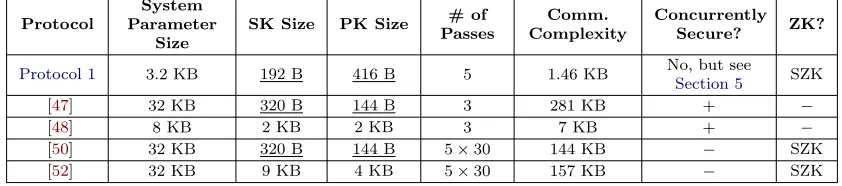
Table 1: Comparison of several lattice-based authentication protocols at 128-bit security. (Quantities in bytes are underlined to be easily distinguishable from those in Kilobytes.)
Protocol
System Parameter
Size
SK Size PK Size # of Passes
Comm. Complexity
Concurrently Secure? ZK?
Protocol 1 3.2 KB 192 B 416 B 5 1.46 KB No, but see
Section 5 SZK
[47] 32 KB 320 B 144 B 3 281 KB + −
[48] 8 KB 2 KB 2 KB 3 7 KB + −
[50] 32 KB 320 B 144 B 5×30 144 KB − SZK
[52] 32 KB 9 KB 4 KB 5×30 157 KB − SZK
exhaustive; yet protocols not listed here are either too inefficient (such as [46]), or are similar to the protocols we mentioned here (e.g., [49] is similar to [47]).
Remark 5. There might be more efficient lattice-based authentication protocols for smart cards, such as simple challenge-response protocols which use lattice-based encryption or signature. However, as described inSection 1, the main idea of this paper is to propose an efficient zero-knowledge au-thentication protocol which can be implemented on smart cards for environments with tight security requirements. Therefore, we did not compare our protocol with those without a ZK-like structure.C
Table 1gives an overview of the comparison. Notice that for the sake of readability, some numbers are denoted in bytes, while others are in Kilobytes (= 1024 bytes). In protocols like [47], the base protocol is ZK, but the protocol designers use the parallel repetition which is not ZK anymore. In such cases, the table does not consider the protocol as ZK.
Below, we will describe our choice of parameters for each protocol. It is assumed that the protocols must satisfy 128-bit security, with soundness error at most 2−30, and completeness error less than 2−20.
• Our protocol (Protocol 1): We described the choice of parameters to get a secure commitment and a secure TDP in Sections 4.1 and4.2, respectively. Specifically,nC = 128,mC= 2560, and
qC = 257 for the commitment (SIS) matrix, and nT = 256, qT = 7,681, and sT = 11.31 for the
TDP (LWE) matrix, with 128-bit message length. The communication complexity is therefore
nC|qC|+ 2nT|qT|+mC+ 128 +nT|5sT| ≈1.5 KB.
• Kawachi et al. [47]: We set parameters similar to ours: n = 128, m = 2560, and q = 257. This protocol requires another commitment matrix, which should be able to commit to binary strings whose length is M =nd(lgm!)/ne+n|q| = 26,496. For this, we pick a random matrix from Zn×M
q . Since the soundness error of the base protocol is 23, it is required to be repeated
t = 52 times so that its soundness error is at most 2−30. The communication complexity is
t(3n|p|+ 2 + (2dlgm!e+m)/3 +m|p|)≈281 KB.
• Lyubashevsky [48]: Fig. 2 of [48] gives four sets of parameters for 80-bit security. We used the first set of parameters, but adjusted κto achieve 128-bit security: n= 512,m= 4, σ= 127, κ= 44, and p≈232. The completeness error of the protocol is 1−1/e. To make the the completeness error less than 2−20, we must repeat the protocol fort = 31 times. [48, p. 610] gives a series of tricks to improve the efficiency, which we will incorporate here. The most important trick is to use a hash function such as the SHA-256 in the first step of the protocol. Using the notations of [48], the communication complexity is 256·t+|Gm|+|Dc| ≈7 KB.
• Silva et al. [52]: The public parameter is exactly as in [50], but the prover’s public and private keys differ. Again, the soundness error of the base protocol is almost 1/2. The communication complexity of the protocol ist(3n|q|+2|t|+1+m+m|q|+(dlgm!e+m)/2)≈157 KB. Interestingly, while this protocol is more efficient for 80-bit security than [50] (see [52]), it is less efficient at 128-bit security.
AsTable 1shows, the best previous protocol was [48]. Below, we will compare our protocol with this protocol.
In terms of communication complexity,Protocol 1 improves [48] by a factor of 5, while requiring less than half storage.
Since all protocols (except ours) mentioned in Table 1 are repeated several times, they need to perform many lattice-based computations. However, our protocol makes only two lattice operations: a SIS and an LWE-based encryption. Therefore, our protocol is much more efficient in terms of computation complexity. In particular, since the base protocol of [48] has similar operations to ours, and it is repeated 30 times,Protocol 1improves [48] by a factor of 30.
The theoretical round complexity of Protocol 1 is 5, which is close to the best (i.e., 3). Let us now consider the practical round complexity: As described in Section 1, smart cards transmit data in units called the Application Protocol Data Unit (APDU), which can carry up to 255 bytes of data. Therefore, our protocol requires at leastd1.46 KB
255 B e= 6 passes (rather than 5) to perform the authentication in practice. The round complexity of other protocols discussed above is much higher due to their high communication complexity. For instance, [48] requires at leastd7 KB
255 Be= 29 passes (rather than 3).
The final point is that our protocol is statistical zero knowledge, while [48] is not. On the other hand, [48] is secure against concurrent attacks. While such attacks arenotpractical against real-world smart cards (because the smart card does not have enough resources to take part in multiple sessions simultaneously), it is certainly advantageous to study these attacksin theory. In the next section, we present a modification to our protocol to make it resilient to concurrent attacks.
Remark 6. As pointed out in Remark 1, the recent work of Boorghany and Jalili [4] shows the practicality ofProtocol 1, by implementing it on a real smart card. Noting that no competitors in
Table 1(except our protocol) can be implemented practically, Boorghany and Jalili took a different approach for comparison: they first constructed authentication protocols from efficient lattice-based signature schemes [86,87], and then implemented the results on a smart card.
The results of [4] show that on a Feitian FT-Java/H10CR Java Card, Protocol 1 is almostthree
times faster than the authentication protocol based on [87], which is in turn twice faster than the authentication protocol based on [86]. Furthermore, they showed that it takes almosthalf a second
to executeProtocol 1on an AVR ATxmega64A3 microcontroller.
As an added bonus, we mention that Protocol 1 is an statistical zero knowledge authentication protocol, while the authentication protocols based on [86,87] are not even zero knowledge. C
5
Modifying Protocol 1 to Thwart Concurrent Attacks
The zero-knowledge simulator ofProtocol 1does not work in the concurrent setting, since itrewinds
the verifier. Diagram 1 of [25, p. 410] illustrates the difficulty that arises when dealing with rewinding simulators in the concurrent setting. This statement can be generalized to the extent of denying any
black-box simulator for the protocol: [24] proves a logarithmic lower bound on the round complexity of black-box CZK protocols, whileProtocol 1is constant round.
Furthermore, the protocol is not known to remain a secure authentication protocol against con-current attacks, sinceAlgorithm 2makes explicit use of the zero-knowledge simulator to simulate Q