An Enhanced Group Mobility Protocol for
6LoWPAN-Based Wireless Body Area
Networks
A.Parimala 1, Geethapriya2, C.Murthy3
Assistant Professor, Department of Electronics and Communication Engineering, SKP Engineering College
Tiruvannamalai, Tamilnadu, India1
Associate Professor, Department of Electronics and Communication Engineering, SKP Engineering College
Tiruvannamalai, Tamilnadu, India1, 2, 3
ABSTRACT: The IPv6 over low power wireless personal area network (6LoWPAN) has attracted lots of attention recently because it can be used for the communications of Internet of things. In this paper, the concept of group-based network roaming in proxy mobile IPv6 (PMIPv6) domain is considered in the 6LoWPAN-based wireless body area networks. PMIPv6 is a standard to manage the network-based mobility in all-IP wireless network. However, it does not perform well in group-based body area networks. To further reduce the handoff delay and signaling cost, an enhanced group mobility scheme is proposed in this paper to reduce the number of control messages, including router solicitation and router advertisement messages as opposed to the group-based PMIPv6 protocol. Simulation results illustrate that the proposed handoff scheme can reduce the handoff delay and signaling cost. The packet lossratio and the overhead can also be reduced.
KEYWORDS: ireless body area networks, proxy MIPv6, handoff delay, signaling cost, 6LoWPAN.
I. INTRODUCTION
issue because most of the sensors are powered by battery only. Using network-mobility scheme for mobile sensors is a proper solution because it can reduce signaling cost. When the sensors change the point of attachment, there is a delay time before obtaining the IP configuration. Therefore, how to decrease the times of exchanging the control messages in case that a number of sensors attach on one MAG is also an important issue. To solve the above problem, a new format of control messages for carrying many other identifiers in one message is proposed in this paper so as to reduce the numbers of the control messages and shorten the handoff delay. An enhanced group-based handoff scheme, which adopts the new formatted control messages, is proposed. The proposed handoff scheme contains three phases, namely the registration, up-link handoff, and down-link handoff phases. Simulation results have shown that the proposed protocol can reduce the signaling cost and handoff latency for mobile sensors and it can also decrease the overhead of the Mobile Access Gateway (MAG) in PMIPv6.
II. PRELIMINARIES
This section introduces the system model first followed by describing the basic idea.
A. SYSTEM MODEL
The proposed protocol is designed for a WBAN consists of 6LoWPAN sensors and a Personal Area NThe MAG emulates the home link of MBS by replying the Router Advertisement (RA) message to the MBS. Thus, the MBS can configure the same address through the HNP in PMIPv6 domain. There is a centralized LMA in the PMIPv6 domain, which acts like a home agent for all mobile nodes. For increasing the coverage of one MAG scope, 6LoWPAN is in beacon-enable mode and equips with the FFDs to support multi-hop communications. Hence, the packet can successfully send to the MAG through multi-hop communications and vice versaetwork (PAN).
<Header,ICMP,MN_I D,LL_I D>, where Header contains the addresses of the source and destination, ICMP is a protocol for TCP/IP layer, MN_I D and LL_I D contain mobile node-identifier and link-layer identifier, respectively. The link-layer identifier can be represented as <Header, ICMP, HNP>, where HNP contains the home network prefix of the sensor that assigned by the LMA.
B. BASIC IDEA
The basic idea of this work is to reduce the handoff delay and signaling cost for WBAN roams in PMIPv6. A new format of control message is proposed to combine the necessary information of the sensors into one message and thus the number of control messages can be substantially reduced. Besides, an enhanced group-mobility scheme is proposed to further reduces the handoff delay time between the LMA and the MAG. The signaling cost can also be reduced due to the group management. Fig. 2 illustrates the difference of signaling cost among three protocols.It illustratesthe difference on delay time among the three protocols. The vertical axis represents the delay time during handoff process.The proposed group-based protocol can reduce the times of sending control messages and thus decreases the delay time.
III. AN ENHANCED GROUP-BASED HANDOFF SCHEME
To achieve the goal of reducing the signaling cost and delay time, three phases are proposed, namely the registration, up-link handoff, and down-link handoff phases. The proposed group-based handoff scheme works as follows: When a group of body sensors enter a PMIPv6 domain and attaches to an access link, the registration phase starts. One of the body sensors in the group needs to act as a coordinator and only the coordinator needs to exchange the control messages with the MAG. During the registration phase, only one RSEG, RAEG, PBUEG, and PBAEG messages are sent and thus reduces lots of signaling and registration cost. The body sensor performs an active scan periodically by sending a beacon request to the nearby FFDs. The nearby FFD, that receives the beacon request from the body sensor, advertises a beacon message including their MAG-IDs. Upon receiving the beacon messages, the body sensor decides whether itself is still in the same MAG or has moved to another MAG by comparing the current MAG-ID with the previous MAG-ID. If the body sensor has detected that it has moved to the new MAG, it then associates with the new MAG by performing the up-link handoff phase. After the up-link handoff phase, the down-link handoff phase starts. The details of the new packet format, the registration, up-link handoff, and down-link handoff phases are shown in the following subsections.
A. THE REGISTRATION PHASE:
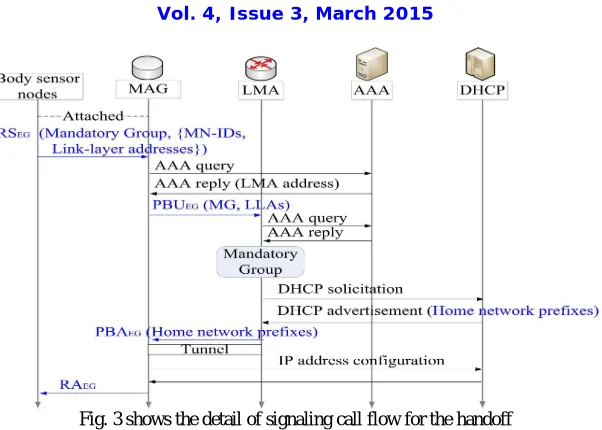
The registration phase aims to reduce the amount of control messages. Fig. 7 illustrates the signaling call flow. One of the body sensors needs to act as a coordinator, which can interact with other sensors in 6LoWPAN environment. All the sensors use DHCP-based address configuration. The procedure of the group - based registration is given as follows: When a group of body sensors enter a PMIPv6 domain and attaches to an access link, the body sensor sends an RSEG
message by multi-hop transmissions to the MAG Upon the MAG received the RSEG message, the MAG uses all the
LL_I Di one by one for authentication by sending the AAA query. After a successful authentication, the AAA server sends a reply which includes the LMA’s address and the MN’s profile. After the MAG gets the LMA’s address, MAG then sends a PBUEG message, which contains all the identifiers, to the LMA.Once the LMA receives the PBUEG
message, LMA performs access authentication to verify whether PBUEG message is genuine or not.If the PBUEG
Fig2.An example of the registration phase.
The body sensors one by one. After the delegating router replies the unique HNPs for the body sensors (still one by one), the LMA creates the binding cache entry, stores the prefixes information, and assigns a BN, which is also added in the binding cache for classifying the body sensors into one group.Then, the LMA replies a PBAEG message, which includes all of the body sensors’ HNPs and BN, to the MAG. The LMA also sets up its endpoint of the bidirectional tunnel to the MAG. S6 After the MAG received the PBAEG message, the MAG stores the BN and requests the addresses from the DHCP server on behalf of the body sensors. The DHCP server then configures the respective Home of address (HoA) from those prefixes and sends it to the MAG. Upon received those messages, the MAG stores the IP address and sent an RAEG message back. In the first step, the group of body sensors are attached to an access first, Si
then sends the RSEG message which contains all the identifiers to the LMA on behalf of the group of the body sensors. In the 5th step, the LMA replies a PBAEG,message including all the HNPs and BN number of the body sensor group to the MAG. The LMA also sets up its endpoint of the bi-directional tunnel to the MAG. Upon receiving the DHCP advertisement messages, the: RAEG message, which contains B1 and the function of ACK, to the group of body sensors.
Fig. 3 shows the detail of signaling call flow for the handoff
Upon the LMA receives this message, LMA can obtain the rest sensors’ information due to previously assigned BN, which is stored in the binding cache. After the LMA has confirmed all the information of sensors, the LMA will remove the binding and routing states if the LMA does not receive any PBU message within the given amount of time. Then, the LMA replies a PBA message and informs the MAG not to send other unnecessary deregistration PBU
message. This way, the proposed scheme can reduce (n − 1) times of sending deregistration PBU to advertise the LMA.
IV. PROPOSED METHOD
A. PARTICLE SWARM OPTIMIZATION (PSO)
(A) Single-sighted, where individuals only compare themselves to the next best. (B) Ring topology, where each individual compares only to those to the left and right. (C) Fully connected topology, where everyone is compared together. (D) Isolated, where individuals only compare to those within specified groups.Neighborhood definitions and how they're used have different effects on the behavior of the algorithm.The particles' data could be anything. In the flocking birds example above, the data would be the X, Y, Z coordinates of each bird. The individual coordinates of each bird would try to move closer to the coordinates of the bird which is closer to the food's coordinates (gBest). If the data is a pattern or sequence, then individual pieces of the data would be manipulated until the pattern matches the target pattern.The velocity value is calculated according to how far an individual's data is from the target. The further it is, the larger the velocity value. In the birds example, the individuals furthest from the food would make an effort to keep up with the others by flying faster toward the gBest bird. If the data is a pattern or sequence, the velocity would describe how different the pattern is from the target, and thus, how much it needs to be changed to match the target.Each particle's pBest value only indicates the closest the data has ever come to the target since the algorithm started.The gBest value only changes when any particle's pBest value comes closer to the target than gBest. Through each iteration of the algorithm, gBest gradually moves closer and closer to the target until one of the particles reaches the target.It's also common to see PSO algorithms using population topologies, or "neighborhoods", which can be smaller, localized subsets of the global best value. These neighborhoods can involve two or more particles which are predetermined to act together, or subsets of the search space that particles happen into during testing. The use of neighborhoods often help the algorithm to avoid getting stuck in local minima.
Fig.7. Graph illustrates No of nodes Vs efficiency
V. CONCLUSION
The PSO and genetic algorithm is proposed in order to reduce delay and achieving better efficiency. A new format of control message is proposed to combine the necessary information of the sensors in to one message and thus it can reduce the number of control messages.
REFERENCES
1.D. Saha, A. Mukherjee, I. S. Misra, and M. Chakraborty, “Mobility support in IP: A survey of related protocols,” IEEE Network, vol. 18, no. 6, pp. 34–40, Nov. 2004.
2. H. Soliman and C. Castelluccia, Hierarchical Mobile IPv6 Mobility Management, British, Royal Flying Corp., Aug. 2005.
3. Chen, S. Gonzalez, A. Vasilakos, H. Cao, and V. C. M. Leung, “Body area networks: A survey,” Mobile Netw. Appl., vol. 16, no. 2, pp. 171–193, 2011.
4.D. He, C. Chen, S. Chan, J. Bu, and A. Vasilakos, “Retrust: Attackresistant and lightweight trust management for medical sensor networks,” IEEE Trans. Inf. Technol. Biomed., vol. 16, no. 4, pp. 623–632, Jul. 2012.
5.D. He, C. Chen, S. Chan, J. Bu, and A. Vasilakos, “A distributed trust evaluation model and its application scenarios for medical sensor networks,” IEEE Trans. Inf. Technol. Biomed., vol. 16, no. 6, pp. 1164–1175, Nov. 2012.
6.Z. Zhang, H. Wang, A. Vasilakos, and H. Fang, “Ecgcryptography and authentication in body area networks,” IEEE Trans. Inf. Technol. Biomed., vol. 16, no. 6, pp. 1070–1078, Nov. 2012.
7. R. Istepanian, E. Jovanov, and Y. Zhang, “Guest editorial introduction to the special section on mhealth: Beyond seamless mobility and global wireless health-care connectivity,” IEEE Trans. Inf. Technol. Biomed., vol. 8, no. 4, pp. 405–414, Dec. 2004.