Collusion Resistant Watermarking Schemes for
Cryptographic Functionalities
Rupeng Yang1,2, Man Ho Au2?, Junzuo Lai3?, Qiuliang Xu4?, and Zuoxia Yu2 1
School of Computer Science and Technology, Shandong University, Jinan, 250101, China
2 Department of Computing, The Hong Kong Polytechnic University, Hung Hom, Hong Kong, China
[email protected], [email protected] 3 College of Information Science and Technology, Jinan University,
Guangzhou, 510632, China [email protected] 4
School of Software, Shandong University, Jinan, 250101, China
Abstract. A cryptographic watermarking scheme embeds a message into a program while preserving its functionality. Recently, a number of watermarking schemes have been proposed, which are proven secure in the sense that givenone marked program, any attempt to remove the embedded message will substantially change its functionality.
In this paper, we formally initiate the study of collusion attacks for wa-termarking schemes, where the attacker’s goal is to remove the embedded messages givenmultiplecopies of the same program, each with a differ-ent embedded message. This is motivated by practical scenarios, where a program may be marked multiple times with different messages.
The results of this work are twofold. First, we examine existing cryp-tographic watermarking schemes and observe that all of them are vul-nerable to collusion attacks. Second, we construct collusion resistant wa-termarking schemes for various cryptographic functionalities (e.g., pseu-dorandom function evaluation, decryption, etc.). To achieve our second result, we present a new primitive called puncturable functional encryp-tion scheme, which may be of independent interest.
Keywords: Watermarking, Watermarkable PRF, Collusion Resistance, Public Extraction
?
1
Introduction
A watermarking scheme allows one to embed some information into a program1 without significantly changing its functionality. It has many natural applications, including ownership protection, information leaker tracing, etc.
The formal definition of watermarking schemes for programs is first presented by Barak et al. in [BGI+01]. Subsequently, new properties of watermarking schemes are presented in [HMW07, NW15, CHV15]. They are briefly summa-rized below.
• Unremovability:This is the essential security property for watermarking schemes, which requires that it should be hard to remove or modify the embedded information in a marked program without destroying it.
• Public Extraction: Anyone should be able to extract the embedded in-formation in a marked program. In other words, the extraction key will be made public.
• Public Marking:Anyone should be able to embed information into a pro-gram. In other words, the marking key will be made public.
• Unforgeability: Only the authorized entity who holds the marking key should be able to embed information into a program. Obviously, it requires keeping the marking key secret and is not compatible with the “public mark-ing” property.
• Message-Embedding: This property allows one to embed a given string (instead of merely a mark symbol) into the watermarked program.
Despite being a natural concept and perceived to have a wide range of appli-cations, watermarking schemes provably secure against arbitrary removal strate-gies were not presented until 2015. In [CHN+16] (which is a merged version of [NW15] and [CHV15]), Cohen et al. construct a publicly extractable watermark-ing scheme for the evaluation algorithm of pseudorandom functions (PRFs) from indistinguishability obfuscators. Based on the watermarkable PRF families, they also construct watermarkable public key encryption (PKE) schemes and water-markable signature schemes. However, Cohen et al.’s schemes do not achieve standard unforgeability. Subsequently, Yang et al. [YAL+18] improve the water-markable PRF in [CHN+16] to achieve both standard unforgeability and public extraction simultaneously.
Peikert and Shiehian [PS18] construct privately programmable PRF from LWE, which provides another way to instantiate watermarkable PRF from standard assumptions. Recently, in [QWZ18] and [KW19], watermarkable PRFs with pub-lic marking are constructed from constraint-hiding constrained PRF and punc-turable extractable PRF respectively, both of which can be instantiated from standard lattice assumptions.
Besides, a very simple yet elegant construction of watermarking scheme for any PKE scheme is presented by Baldimtsi et al. [BKS17]. However, their scheme does not support multi-message-embedding inherently. That is, each program can only be marked with at most one message during the life-time of the scheme.
Collusion Resistance of Watermarking schemes. In practical applications, it is usually required that unremovability of watermarking schemes should hold under “collusion attacks”, where the attacker can access several copies of the same pro-gram embedded with different information. As a concrete example, consider the following scenario. A software development company developed a program and would like to outsource its testing to several organizations. To prevent these or-ganizations from leaking the program, the company will employ a watermarking scheme to embed the name of the target organization into the copy being sent. Here, the watermarking scheme should enable the company to trace program leakers even when a few target organizations collude.
However, for all previous watermarking schemes [CHN+16, BLW17, KW17, BKS17,PS18,YAL+18,QWZ18,KW19], the unremovability is only proved against an adversary who attempts to remove or modify the embedded message given a single marked program2, and it is unknown whether they are secure against collusion attacks. Thus, the following question arises naturally:
Can we build collusion resistant watermarking scheme?
1.1 Our Results
In this paper, we explore the existence of watermarking schemes secure against collusion attacks. First, we observe that unfortunately, all existing watermarking schemes arevulnerableto collusion attacks (we elaborate this in Sec. 2). Then, we consider how to develop watermarkable cryptographic primitives secure against the collusion attacks. Specifically, our contributions are as follows.
• We present the notion ofcollusion resistant watermarking scheme to capture collusion attacks. It requires a stronger unremovability (namely, collusion resistant unremovability) that allows the adversary to obtain watermarked circuits embedded with different messages for the same functionality. 2 In a concurrent work [GKM+19], collusion resistant watermarking schemes for
• We give a construction of collusion resistant watermarkable PRF, which is the first watermarkable cryptographic primitive provably secure against the collusion attacks. To achieve this, we introduce a new message-embedding technique in the watermarking setting and propose a new primitive, namely,
puncturable functional encryption scheme, which we believe will find addi-tional applications in constructing advanced cryptographic primitives.
• Based on our construction of collusion resistant watermarkable PRF, we also construct watermarkable PKE schemes and watermarkable signature schemes, both of which have collusion resistant unremovability.
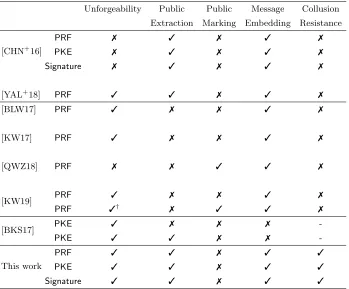
We compare the main features achieved by current watermarking schemes and our watermarking schemes in Table 1. We remark that in addition to col-lusion resistance, our schemes can achieve many desirable features, including public extraction, unforgeability, and message-embedding.
Table 1:The Comparison.
Unforgeability Public Public Message Collusion
Extraction Marking Embedding Resistance
[CHN+16]
PRF 7 3 7 3 7
PKE 7 3 7 3 7
Signature 7 3 7 3 7
[YAL+18] PRF 3 3 7 3 7
[BLW17] PRF 3 7 7 3 7
[KW17] PRF 3 7 7 3 7
[QWZ18] PRF 7 7 3 3 7
[KW19] PRF 3 7 7 3 7
PRF 3† 7 3 3 7
[BKS17] PKE 3 7 7 7
-PKE 3 3 7 7
-This work
PRF 3 3 7 3 3
PKE 3 3 7 3 3
Signature 3 3 7 3 3
†: Weaker versions of unforgeability are achieved for this scheme.
Theorem 1.1 (Informal). Assuming the worst-case hardness of appropri-ately parameterized GapSVP and SIVP problems and the existence of in-distinguishability obfuscator, there exist collusion resistant watermarkable PRF/PKE/signature schemes.
Remark 1.1. It is worth noting that our constructions of collusion resistant wa-termarking schemes rely on the existence of indistinguishability obfuscator. How-ever, this seems essential, at least for collusion resistant watermarkable PRF. To see this, recall that as proved in [BGI+01], watermarking scheme perfectly pre-serving the functionality of the watermarked program does not exist. Thus, a marked key of PRF must evaluate differently with the original key on some in-puts, i.e., the marked key can be viewed as a constrained key of the original key. Besides, the marked key should hide its constrained inputs, since otherwise, the attacker is likely to remove the embedded messages via resetting outputs on constrained inputs. Therefore, we can approximately view a collusion resistant watermarkable PRF as a collusion resistant constraint-hiding constrained PRF, which, as shown in [CC17], can imply indistinguishability obfuscator. Nonethe-less, we are not able to formalize this intuition. It is an interesting open problem to give a formal construction of indistinguishability obfuscator from collusion resistant watermarkable PRF.
1.2 Related Works
Additional Related Works on Watermarking Schemes. In this paper, we concentrate on watermarking schemes provably secure against arbitrary removal strategies. There are also numerous works (see [CMB+07] and references therein) attempting to use ad hoc techniques to watermark a wide class of digital objects, such as images, audios, videos, etc. However, these constructions lack rigorous security analysis and are (potentially) vulnerable to some attacks.
In another line of research [NSS99, YF11, Nis13], watermarking schemes for cryptographic objects (e.g., the key, the signature, etc.) are constructed and rigorously analyzed. However, their security definition considers a restricted ad-versary that will not change the format of the watermarked objects.
Puncturable Symmetric Key Functional Encryption. One byproduct of this work is a new primitive called puncturable functional encryption. A simi-lar primitive, which is called puncturable symmetric key functional encryption, is also studied in previous works [BV15, KNT18]. In particular, it is used to construct the indistinguishability obfuscator in these works.
Traitor Tracing Scheme. The notion of collusion resistant watermarking scheme is somewhat similar to the notion of traitor tracing scheme, which aims at tracing secret key leakers among a set of users holding functionally equivalent secret keys in a broadcast encryption setting. Since first presented in [CFN94], traitor tracing has been formally studied for a long time (see e.g., [BSW06, BN08, BZ14, NWZ16, GKW18, CVW+18] and references therein for an overview of previous works).
Generally, in a traitor tracing scheme, there is a common public keypk and each user holds a different secret key. Data encrypted under the common public key can be decrypted by all users in the system. Moreover, there exists a tracing algorithm, which outputs a set of users on input a “pirate decoder” that can decrypt ciphertexts under pk. It is guaranteed that the tracing algorithm can identify at least one of the users in the coalition that produces the pirate decoder.
Comparing watermarking and traitor tracing. Both (collusion resistant) water-marking and traitor tracing will issue copies of a program (or a key), which are embedded with some information, to users and aim at recovering the embedded information from a functionally-similar program/key generated by them. How-ever, solutions to the traitor tracing problem do not yield watermarking schemes directly, since these two notions also have several inherent differences.
First, in a traitor tracing scheme, secret keys of users are issued by a center, while in a watermarking scheme, user can choose their watermarked programs themselves. Another difference is that in a traitor tracing scheme, secret keys of all users are functionally equivalent, while in a watermarking scheme, programs with different functionalities can be watermarked in the same watermarking scheme. Besides, traitor tracing schemes focus on tracing secret key leakers in an encryption scheme, while watermarking schemes aim at marking general purpose programs (although we only know how to watermark some specific cryptographic functionalities currently).
A closer look at how to construct traitor tracing schemes. In [BSW06], Boneh et al. present a classic paradigm to construct traitor tracing schemes, which is also used or adapted in many subsequent works [BZ14, NWZ16, GKW18]. The construction proceeds in two steps.
First, a private linear broadcast encryption (PLBE) scheme is constructed. Recall that a PLBE scheme has a sequence (sk1, . . . , skN) of N secret keys for a public key and each ciphertext is labeled with an integer in [0, N]. A secret key ski is only able to decrypt a ciphertext with label j when j < i. Thus, a ciphertext with label 0 can be decrypted by all secret keys, while a ciphertext with label N can not be decrypted by any secret key. Also, it is required that it is computationally infeasible to distinguish a ciphertext with labelj and that with labelj−1 ifskj is not given.
outputsiif there exists a “large gap” in decryption success probability between ciphertexts labeled withi−1 and those labeled withi. Note that the decoder can decrypt with a high success probability on ciphertext labeled with 0 (due to the usefulness of the decoder) and can decrypt with a negligible success probability on ciphertext labeled with N (due to the security of PLBE), thus, there must exists a large gap in decryption success probability betweeni−1 andifor some i∈[N]. Also, as no one could distinguish ciphertexts labeled withi−1 and that labeled with iwithout ski, the large gap must occur between i−1 andi such that the colluders possess ski. Therefore, the tracing algorithm can recover at least one of the colluders.
1.3 Roadmap
The rest of the paper is organized as follows. We give an overview of our con-struction in Sec. 2. Then in Sec. 3, we review notations used in this work. We present the formal definition of collusion resistant watermarkable PRF in Sec. 4. Then in Sec. 5, we define and construct puncturable functional encryption, which is employed to construct collusion resistant watermarkable PRF. We show our main construction of collusion resistant watermarkable PRF in Sec. 6 and present constructions of collusion resistant watermarking schemes for public key primitives in Sec. 7. Finally, in Sec. 8, we conclude our work with a few possible future works.
2
Technical Overview
In this section, we provide an overview of our construction of collusion resis-tant watermarkable PRF. Our starting point is the watermarking schemeWM0 presented in [CHN+16] (or more accurately, its variant in [YAL+18]). We first explain whyWM0(and all previous watermarking schemes) are not collusion re-sistant and describe the main challenges in achieving collusion resistance. Then we give a high-level idea on how to address these challenges.
A brief overview of WM0. Roughly speaking, WM0 works as follows. The extraction key/marking key pair ofWM0is a public key/secret key pair (pk, sk) of a PKE scheme. To embed a message msg into a PRF key k, the marking algorithm outputs an obfuscation of the following circuit, which evaluates the functionPRF(k,·) correctly at all points, except for some “punctured points”.
C(x) =
(
f(µ)⊕msg ifµ=Dec(sk, x)∈ V PRF(k, x) otherwise.
Here,Decis the decryption algorithm of the underlying PKE scheme,V is a set defined by the PRF keykandf is a suitable function.
key pk. Next, it evaluates the circuit on the ciphertext and obtains an output z. Finally, it computesmsg=z⊕f(µ). The above extraction procedure will be repeated multiple times and the extraction algorithm will output the majority result or an “UNMARKED” symbol if no majority is found.
Security of the scheme relies on the fact that punctured points (i.e. those decrypted to a string in V) are hidden3. As a result, the adversary, who is only allowed to alter the marked circuit slightly, is not able to change the output values on a large enough fraction of punctured points, and thus the extraction algorithm can still extract the correct message.
Why WM0 is not collusion resistant? However, if watermarked circuits embedded with different messages for the same PRF key k are given, one can easily locate all punctured points via comparing the outputs of the circuits. In addition, it is easy to modify or remove the embedded messages via resetting outputs on all punctured points.
In more detail, given two circuitsC1andC2that are generated by embedding different messages, saymsg1 and msg2, into the same PRF keyk, an attacker can output a circuit C∗ embedded with a new messagemsg∗ as follow:
C∗(x) =
(
C1(x)⊕msg1⊕msg∗ if C1(x)6=C2(x).
C1(x) otherwise.
It is not hard to see thatC∗will compute the PRF with keykcorrectly on almost all inputs except that it will outputf(µ)⊕msg∗on an input whose decryption µ is in V. Therefore, the attacker can compromise the unremovability of WM0 via a collusion attack4.
Since nearly all5 previous watermarking schemes are constructed following the blueprint proposed in [CHN+16], we can use a similar strategy to show that they are not collusion resistant. We stress that all collusion attacks are based on the fragility of the way messages are embedded and do not take advantage of the concrete instantiations of the schemes.
The challenge in achieving collusion resistance. To better explain why
WM0 is not able to achieve collusion resistance, we describeWM0 in a modular manner.
In a high level, on input a PRF key k and a message msg, the marking algorithm ofWM0 works as follows:
3
One could find some punctured points via generating them from public information, but cannot distinguish a random punctured point from a random point in the input space.
4 We remark that this will not affect the claimed security ofWM
0. The attacks only show that WM0 is not applicable in scenarios where collusion attacks are a legit threat.
5
1. Generates two sequences X = (x1, . . . , xl) and Y = (y1, . . . , yl), where xi andyi are in the input space and the output space of the watermarked PRF respectively. More concretely, inWM0, for each pair (xi, yi),xi =Enc(pk, µ) andyi=f(µ) for someµ∈ V.
2. Encodes the messagemsg into a sequenceZ = (z1, . . . , zl) =encode(X,Y, msg), whereziis also in the output space of the watermarked PRF. In more detail, messages are encoded intoZvia a simple “exclusive or” operation in
WM0, i.e., zi=yi⊕msg fori∈[1, l].
3. Outputs a circuit that computes the PRF withkcorrectly on inputs outside
X and outputszi on inputxi (here, xi is called a punctured point). Correspondingly, we can abstract the extraction algorithm of WM0, which takes as input a watermarked circuitC, as follows:
1. Samples a set of pairs{xi, yi} inX × Y. 2. Evaluates zi =C(xi) for eachxi.
3. Recovers the message msg =decode({xi, yi, zi}). Here, the decoding algo-rithm outputs the majority ofyi⊕zi.
The key observation underlying our collusion attack is that the simple “xor” encoding scheme is fragile in the collusion setting. First, for two different mes-sages msg and msg0, let (z1, . . . , zl) = encode(X,Y, msg) and (z01, . . . , zl0) =
encode(X,Y, msg0), then we havez
i6=zi0 fori∈[1, l]. This makes it easy to lo-cate all punctured points inX by comparing outputs of circuits embedded with different messages. In addition, it is easy to overwrite the encoded message in a codeword Z = (z1, . . . , zl). For example, one can reset zi =zi⊕∆ fori∈[1, l] to xor the encoded message with ∆.
In [KW17, QWZ18, KW19], different message encoding schemes are applied. However, all of them inherit the aforementioned weakness to some extent, and thus are not robust against collusion attacks.
To solve this problem, we need to develop a robust message encoding scheme, where decode can recover the original embedded messages even if a collusion attacker can locate some punctured points6and will reset outputs on its located punctured points. Next, we explore how to develop a robust message encoding scheme and integrate it with the other part ofWM0.
Addressing the challenge: a robust message encoding scheme. We de-sign our encoding scheme via using ideas from the realm of traitor tracing. In particular, our scheme is inspired by the well-known framework presented in [BSW06] (we recall this framework in Sec. 1.2).
The message space of our encoding scheme is [1, N]7. The input of the encod-ing algorithm is two sequences X = (x1, . . . , xl),Y= (y1, . . . , yl) and a message
6
This seems unavoidable since circuits embedded with different messages should be run differently on some points to enable message extraction.
7
msg ∈[1, N]. Here, we divide the whole sequenceX intoN parts, namely,X1, . . . ,XN, each of which is labeled with an index in [1, N] (we elaborate how to defineXi later). To encode a messagemsg, the encoding algorithm setszi =yi ifxi ∈ X1∪ X2∪. . .Xmsg and setszi to be the correct PRF output otherwise. The output of the encoding algorithm is the sequence (z1, . . . , zl).
We also modify the decoding algorithm. It takes as input a set of tuples (xi, yi, zi), where (xi, yi) is sampled from X × Y and zi is the output of the tested circuit on inputxi, and works as follows:
1. Setp0= 1 andpN+1= 0.
2. For ind ∈ [1, N], estimate the fraction pind of “correctly reprogrammed” points in setXind, where a pointxi is “correctly reprogrammed” ifyi =zi. This can be accomplished via testing polynomially-many points inXind. 3. If there exists ind ∈ [0, N] such that |pind−pind+1| is noticeable (i.e., a
“large gap” atindis found), output the messagemsg=ind. Here,msg= 0 denotes the code is not decodable (i.e., the circuit is unmarked).
Next, we argue why our new message encoding scheme is robust under collu-sion attacks. Observe that, given a few (say 2) circuitsC1andC2embedded with messagesmsg1andmsg2 respectively (w.l.o.g. assumingmsg1< msg2), the at-tacker can locate punctured points inXindforind∈(msg1, msg2] by comparing outputs ofC1 andC2. However, we note that
• If the attacker cannot distinguish punctured points inXind1 and Xind2 for
ind1, ind2∈ (msg1, msg2], it cannot make|pind1−pind2|noticeable via
re-setting outputs on located punctured points.
• If the attacker cannot distinguish a punctured pointxi∈ Xindfrom a random point forind6∈(msg1, msg2], it will not be able to reset the output on such xi. Thus, we havepind= 1 forind∈[1, msg1] andpind= 0 forind∈(msg2, N].
Consequently, if the aforementioned indistinguishability properties are guaran-teed, the large gap(s) must occur at either msg1 or msg2 (or at both points), i.e., the decoding algorithm could output the embedded message(s).
One problem of the above solution is that the message space is restricted to be a polynomial-size set. This is because the decoding algorithm needs to scan all indices linearly to find a large gap. Addressing this problem, we employ the refined binary search presented in [BCP14, NWZ16] to search the “large gap”. The search algorithm can find all (polynomially-many) large gap points from anexponentially large interval in a pre-defined polynomial time, as long as
|pind1−pind2|is negligible for all (adaptively chosen) interval [ind1, ind2)⊆[0,
N + 1] not containing a large gap point. In this way, we can set the message space to be [1, N] for an exponentially largeN.
achieve indistinguishability properties required by our robust message encoding scheme. More precisely, we will argue that for a collusion attacker, who can locate some punctured points via comparing outputs of watermarked circuits embedded with different messages, both the unlocated punctured points and labels of the located punctured points are hidden.
Labeling punctured points with indices. Recall that in WM0, the domain of the PRF is the ciphertext space of a PKE scheme and punctured points are en-cryptions of plaintexts in a set V. To label a punctured point with an index ind, we appendindto the underlying plaintext, i.e., we defineXind={Enc(pk, µkind)}µ∈V, wherepkis the public key of the underlying PKE scheme and serves
asWM0’s extraction key.
Hiding punctured points and labels. Next, we explore how to hide unlocated punctured points and labels of located punctured points. For simplicity, we con-sider an adversary who gets two watermarked circuits C1 and C2 for the same PRF key k, which are embedded with messages msg1 and msg2 respectively, wheremsg1< msg2. Recall that our message encoding scheme is able to recover the embedded messages if the following two properties are guaranteed:
• Pseudorandomness of punctured points in Xind for an adaptively chosen ind6∈(msg1, msg2].
• Indistinguishability between punctured points inXind1 andXind2 for
adap-tively chosenind1, ind2∈(msg1, msg2].
Unfortunately, the PKE scheme employed inWM0, which is a puncturable encryption scheme, does not provide the desired properties. To see this, consider an input xfrom Xind, where ind∈(msg1, msg2]. SinceC1(x)6=C2(x), a secret key that can decrypt x must be included in both C1 and C2 (otherwise, the circuit cannot recognize it and deal with it properly). However, the puncturable encryption scheme cannot guarantee indistinguishability on ciphertexts that are decryptable.
To bridge the gap, we present a new cryptographic primitive that we call
puncturable functional encryption and replace puncturable encryption used in
WM0 with it. Roughly speaking, a puncturable functional encryption scheme enhances a functional encryption scheme with the puncturing capability and enjoys both security of functional encryption schemes and that of puncturable encryption schemes. Especially, similar to a functional encryption, it has the “adaptive indistinguishability” property, which could ensure indistinguishability of ciphertexts as long as no secret key distinguishing them is provided. Also, similar to a puncturable encryption, it has the “ciphertext pseudorandomness” property, which could ensure pseudorandomness of a ciphertext given a secret key punctured on it.
Now, for two punctured points x1 and x2 in Xind1 and Xind2 respectively,
where ind1, ind2 ∈(msg1, msg2], since none of them will be reprogrammed in
from the adaptive indistinguishability of the puncturable functional encryption scheme directly. Meanwhile, for a punctured points xin Xind forind6∈(msg1, msg2], sinceC1(x) =C2(x), we can regardC1 and C2 as the same circuit when considering pseudorandomness of x. Thus, the pseudorandomness of x can be reduced to the ciphertext pseudorandomness of the puncturable functional en-cryption scheme, just as what has been argued in the original security proof (in the non-collusion setting) forWM0.
Constructing puncturable functional encryption. To construct a punc-turable functional encryption scheme, we employ a functional encryption scheme, a puncturable encryption scheme, and a statistical sound non-interactive zero-knowledge (NIZK) proof. We integrate them via a “two-layer encryption” ap-proach.
More precisely, a plaintext is first encrypted into an inner ciphertext using the functional encryption scheme. Then the NIZK proof is employed to prove that the inner ciphertext is properly encrypted. Finally, both the inner ciphertext and the proof is encrypted into an outer ciphertext under the puncturable encryption scheme. When decrypting a ciphertext, the decryption algorithm first decrypts the outer ciphertext. It aborts if the proof is invalid and outputs the decryption of the inner ciphertext otherwise. Main security properties of the constructed puncturable functional encryption (namely, adaptively indistinguishability and ciphertext pseudorandomness) reduce to corresponding security properties of underlying functional encryption and puncturable encryption respectively.
3
Notations
Letabe a string, we usekakto denote the length ofa. LetSbe a finite set, we usekSkto denote the size ofS, and uses← S$ to denote sampling an elements uniformly from setS. For a stringaand a setSof strings, we useakSto denote the set {x:∃s∈ S, x=aks}. For nelementse1, . . . , en, we use{e1, . . . , en} to denote a set containing these elements and use (e1, . . . , en) to denote an ordered list of these elements. We writenegl(·) to denote a negligible function, and write poly(·) to denote a polynomial. For integers a≤b, we write [a, b] to denote all integers fromatob. For two circuitsC1andC2, we writeC1≡C2to denote that for any input x, C1(x) = C2(x). Following the syntax in [BLW17], for a circuit familyC indexed by a few, saym, constants, we writeC[c1, . . . , cm] to denote a circuit with constantsc1, . . . , cm.
Chernoff Bound. We make use of the Chernoff bound in our security proof. There are various forms of the Chernoff bound, here we use the one from [Goe15].
Lemma 3.1 (Chernoff Bounds).LetX=Pn
i=1Xi, whereXi= 1with
prob-ability pi and Xi = 0 with probability 1−pi, and all Xi are independent. Let µ=E(X) =Pn
i=1pi. Then
Pr[X ≥(1 +δ)µ]≤e− δ
2
Pr[X ≤(1−δ)µ]≤e−δ
2
2µ for all 0< δ <1.
Besides, we also employ some cryptographic primitives and their definitions are recalled in Appendix A.
4
Definition of Collusion Resistant Watermarkable PRF
In this section, we give the formal definition of the collusion resistant watermark-able PRF, which is adapted from definitions of watermarkwatermark-able PRF in previous works [CHN+16,BLW17,KW17]. The main difference between our definition and previous ones is that the unremovability holds against an adversary that can ob-tain polynomially-many (instead of one) watermarked circuits for the same PRF key from the challenge oracle. Besides, the extraction algorithm takes an addi-tional parameterq, which can be roughly viewed as the number of colluders, as input. The correctness and the unforgeability hold for arbitrary positive integer q; for the unremovability, a large enoughqis needed. In particular, ifqis larger than the number of colluders, the extraction algorithm can extract a non-empty subset of the coalition, while using a smallerqmay lead to an error symbol.
Remark 4.1. Our definition of collusion resistant unremovability implicitly re-quires that the adversary is only allowed to obtain a bounded number (i.e.,q) of watermarked circuits from the challenge oracle. Thus, it falls into the category of “bounded collusion resistance”. Nonetheless, in our definition, the boundqdoes not need to be fixed in the setup phase and may be varied in different extraction procedures. In fact, if the extractor has a way to know the number of colluders in advance, the scheme remains secure against an arbitrary number of colluders. Besides, since the extraction algorithm is able to detect if a smallerqis used, in practice, the extractor can re-execute the extraction algorithm with a larger q after receiving an error message from the extraction algorithm.
Definition 4.1 (Watermarkable PRFs [CHN+16, BLW17, KW17, adapted]). Let PRF = (PRF.KeyGen,PRF.Eval) be a PRF family with key space K, input space {0,1}n and output space {0,1}m. The watermarking
scheme with message space M for PRF (more accurately, the evaluation algorithm of PRF) consists of three algorithms:
• Setup.On input the security parameter λ, the setup algorithm outputs the mark keyM K and the extraction keyEK.
• Mark. On input the mark key M K, a secret key k ∈ K of PRF, and a messagemsg∈ M, the marking algorithm outputs a marked circuitC. • Extract.On input the extraction keyEK, a circuitC, and a parameterq, the
extraction algorithm outputs either a setL ⊆ M or a symbol UNMARKED or an error symbol⊥.
• Functionality Preserving. C(·) and PRF.Eval(k,·) compute identically on all but a negligible fraction of inputs.
• Extraction Correctness.Pr[Extract(EK,C, q)6={msg}]≤negl(λ).
Before presenting the security definition of collusion resistant watermarkable PRF, we first introduce oracles the adversaries can query during the security experiments. Here, the marking oracle is identical to the one defined in previous works, while we redefine the challenge oracle to capture the scenario that the adversary can obtain multiple circuits embedded with different messages for the same secret key.
• Marking OracleOM
M K(·,·).On input a messagemsg∈ Mand a PRF key k∈ K, the oracle returns a circuitC←Mark(M K, k, msg).
• Challenge OracleOC
M K(·).On input a polynomial-size setMof messages from M, the oracle first samples a key k∗ ← PRF.KeyGen(1λ). Then, for eachmsg∗
i ∈M, it computes C∗i ←Mark(M K, k∗, msg∗i). Finally, it returns the set{C∗1, . . . ,CQ∗}, where Q=kMk.
Definition 4.3 (Collusion Resistant Unremovability). The watermarking scheme for a PRF is collusion resistant unremovable if for any polynomialq, for all polynomial-time (PPT) and unremoving-admissible adversaries A, we have
Pr[ExptURA,q(λ) = 1] ≤ negl(λ), where we define the experiment ExptUR and unremoving-admissibility as follows:
1. The challenger samples(M K, EK)←Setup(1λ)and returnsEK toA. 2. Then,Ais allowed to make multiple queries to the marking oracle.
3. Next, Asubmits a set M∗ of Q messages in Mto the challenge oracle and gets a setC∗ of circuits back.
4. Then,Ais further allowed to make multiple queries to the marking oracle. 5. FinallyAsubmits a circuit˜C. The experiment outputs 0 if
(a) q < Q and eitherExtract(EK,˜C, q) is a non-empty subset of M∗ or it
equals to the error symbol⊥.
(b) q≥QandExtract(EK,C˜, q)is a non-empty subset ofM∗. Otherwise, the experiment outputs 1.
Here, an adversary A is unremoving-admissible if there exists circuit C∗i ∈ C∗ that C∗i and˜Ccompute identically on all but a negligible fraction of inputs.
Definition 4.4 (δ-Unforgeability). The watermarking scheme for a PRF is
δ-unforgeable if for any polynomial q ≥ 1 and for all PPT and δ -unforging-admissible adversaries A, we have Pr[ExptUFA,q(λ) = 1] ≤negl(λ), where we define the experiment ExptUFand unforging-admissiability as follows:
1. The challenger samples(M K, EK)←Setup(1λ)and returnsEK toA.
2. Then,Ais allowed to make multiple queries to the marking oracle.
3. Finally,Asubmits a circuitC˜. The experiment outputs 0 if Extract(EK,˜C, q) =UNMARKED; otherwise, the experiment output 1.
Here, let Q0 be the number of queries A made to the marking oracle, then an adversary Ais δ-unforging-admissible if for all i∈[1, Q0], its submitted circuit
˜
Cand the circuit Ci compute differently on at least aδfraction of inputs, where
5
Puncturable Functional Encryption
In this section, we define puncturable functional encryption and give a concrete construction. A puncturable functional encryption scheme can achieve function-alities and security of both puncturable encryption schemes and functional en-cryption schemes. Besides, as we will use the puncturable functional enen-cryption scheme together with an indistinguishability obfuscator, we also require it to have an “iO-compatible correctness”, which demands a decryption consistency for different secret keys. More precisely, when using two secret keyssk1,sk2 for functionsf1,f2respectively, for any stringctin the ciphertext space, either both secret keys will fail in decrypting it or there exists a plaintext µ in the plain-text space that decrypting ct under sk1 and sk2 will lead to f1(µ) and f2(µ) respectively.
5.1 Definition of Puncturable Functional Encryption
Definition 5.1 (Puncturable Functional Encryption).A puncturable func-tional encryption scheme for a family of functionF8with plaintext space{0,1}m
and ciphertext space{0,1}n consists of five algorithms:
• Setup.On input the security parameter λ, the setup algorithm outputs the master public key/master secret key pair(mpk, msk).
• KeyGen. On input the master secret key msk and a function f ∈ F, the key generation algorithm outputs a secret keysk forf.
• Enc. On input the master public key mpk and a message msg ∈ {0,1}m,
the encryption algorithm outputs the ciphertextct.
• Dec.On input a secret key sk and a ciphertextct∈ {0,1}n, the decryption
algorithm outputs a stringmsg or a decryption failure symbol⊥.
• Puncture.On input a secret keyskand two ciphertexts ct1, ct2, the
punc-ture algorithm outputs a puncpunc-tured secret keysk0.
Next, we describe properties of puncturable functional encryption schemes. Definition 5.2 (Properties of Puncturable Functional Encryption).
A puncturable functional encryption scheme PFE = (Setup,KeyGen,Enc,Dec,
Puncture) with plaintext space{0,1}m, ciphertext space {0,1}n and supported
function familyF is required to have the following properties.
• Correctness.For any message msg ∈ {0,1}m and any f ∈ F, let (mpk, msk)←Setup(1λ), sk←KeyGen(msk, f), and ct←Enc(mpk, msg), then
we havePr[Dec(sk, ct) =f(msg)] = 1.
• Sparseness. For any f ∈ F, let (mpk, msk) ← Setup(1λ), sk ←
KeyGen(msk, f), and ct ← {$ 0,1}n, then we have Pr[Dec(sk, ct) 6=⊥] ≤ negl(λ).
8
In this work, we concentrate on schemes supporting function familyFof polynomial-size circuit with output space{0,1}m
• Punctured Correctness.For anyf ∈ F, any stringsct0, ct1∈ {0,1}nand
any unboundedadversaryA, we have
Pr
(mpk, msk)←Setup(1λ); sk←KeyGen(msk, f);
sk0 ←Puncture(sk,{ct0, ct1}); ct← A(mpk, msk, sk, sk0);
: ct6∈ {ct0, ct1}∧
Dec(sk, ct)6=Dec(sk0, ct)
≤negl(λ)
• iO-Compatible Correctness. For each master public key/master secret key pair (mpk, msk), the ciphertext space can be divided into two disjoint parts, namely, the valid ciphertext set V(mpk,msk) and the invalid
cipher-text set I(mpk,msk), which satisfy V(mpk,msk) ∪ I(mpk,msk) = {0,1}n and
V(mpk,msk)∩ I(mpk,msk)=∅. The iO-compatible correctness requires that:
1. For anyf ∈ F and any unbounded adversaryA, we have:
Pr
(mpk, msk)←Setup(1λ); sk←KeyGen(msk, f); ct← A(mpk, msk, sk);
:ct∈ I(mpk,msk)∧
Dec(sk, ct)6=⊥
≤negl(λ)
2. For anyf1, f2∈ F and any unbounded adversaryA, we have:
Pr
(mpk, msk)←Setup(1λ); sk1←KeyGen(msk, f1); sk2←KeyGen(msk, f2); ct← A(mpk, msk, sk1, sk2);
:
ct∈ V(mpk,msk)∧ (∀msg∈ {0,1}m,
Dec(sk1, ct)6=f1(msg)∨
Dec(sk2, ct)6=f2(msg))
≤negl(λ)
• Adaptive Indistinguishability.For any PPT adversaryA1,A2, we have:
Pr
(mpk, msk)←Setup(1λ); (st, msg0, msg1)← A
Omsk(·)
1 (mpk);
b← {0,1};
ct←Enc(mpk, msgb); b0← A2(st, ct);
:b=b0
≤1/2 +negl(λ)
whereOmsk takes as input a functionf ∈ F and outputs a secret keysk←
KeyGen(msk, f); for allf submitted to the oracleOmsk,f(msg0) =f(msg1);
and theOmskcan only be queried two times. Note that in our security proof
• Ciphertext Pseudorandomness. For any PPT adversary A1, A2, we have: Pr
(st, msg, f)← A1(1λ); (mpk, msk)←Setup(1λ); sk←KeyGen(msk, f); ct0←Enc(mpk, msg); ct1
$
← {0,1}n;
sk0←Puncture(sk,{ct0, ct1}); b← {0,1};
b0 ← A2(st, mpk, sk0, ctb, ct1−b);
:b=b0
≤1/2 +negl(λ)
5.2 Construction of Puncturable Functional Encryption
In this section, we present our construction of puncturable functional encryption. Letλbe the security parameter. Letn, m, l, n0 be positive integers that are polynomial inλ. Our construction is based on the following three building blocks:
• A functional encryption scheme FE = (FE.Setup,FE.KeyGen,FE.Enc,
FE.Dec) with plaintext space{0,1}m, ciphertext space {0,1}n and encryp-tion randomness space R. Also, we require that it supports a family F of polynomial-size circuit with output space{0,1}m.
• A statistically sound NIZK proof system NIZK = (NIZK.KeyGen,
NIZK.Prove,NIZK.Verify) forL, where
L={(mpk, ct) :∃(msg, r), ct=FE.Enc(mpk, msg;r)}. and require that the proof size isn0 when proving a statement inL.
• A puncturable encryption scheme PE = (PE.KeyGen,PE.Puncture,
PE.Enc,PE.Dec) with plaintext space {0,1}n+n0 and ciphertext space {0, 1}l.
We construct PFE = (PFE.Setup,PFE.KeyGen,PFE.Puncture,PFE.Enc,
PFE.Dec) for F, which has a plaintext space {0,1}m and a ciphertext space
{0,1}l, as follows:
• Setup. On input a security parameter λ, the setup algorithm generates (mpk, msk) ← FE.Setup(1λ), crs ← NIZK.KeyGen(1λ), and (pk, sk) ← PE.KeyGen(1λ). Then it outputs the master public keyM P K = (mpk, crs, pk) and the master secret keyM SK = (msk, sk, mpk, crs) ofPFE.
• KeyGen. On input a master secret key M SK = (msk, sk, mpk, crs) of
PFEand a function f ∈ F, the key generation algorithm generates f sk← FE.KeyGen(msk, f) and outputs a secret key SK = (f sk, sk, mpk, crs) of
• Enc. On input a master public key M P K = (mpk, crs, pk) of PFE and a message msg ∈ {0,1}m, the encryption algorithm first samples r ∈ R. Then, it computes ct = FE.Enc(mpk, msg;r), and π ← NIZK.Prove(crs, (mpk, ct),(msg, r)). Finally, it outputsCT ←PE.Enc(pk, ctkπ).
• Dec.On input a secret keySK= (f sk, sk, mpk, crs) ofPFEand a ciphertext CT ∈ {0,1}l, the decryption algorithm first decryptsCT with the secret key ofPEand getsctkπ←PE.Dec(sk, CT). It aborts and outputs⊥ifctkπ=⊥
or NIZK.Verify(crs,(mpk, ct), π) = 0. Otherwise, it outputs FE.Dec(f sk, ct).
• Puncture. On input a secret key SK = (f sk, sk, mpk, crs) of PFE and two ciphertextsCT1, CT2∈ {0,1}l, the puncture algorithm generatessk0←
PE.Puncture(sk,{CT1, CT2}) and outputsSK0= (f sk, sk0, mpk, crs). Theorem 5.1. If FE is a secure functional encryption for F with perfect cor-rectness and (two-key) adaptive security, NIZK is a NIZK proof system with adaptively statistical soundness and adaptive zero-knowledge for languageL, and PE is a secure puncturable encryption scheme, thenPFEis a secure puncturable functional encryption as defined in Sec. 5.1.
We give proof of Theorem 5.1 in Appendix B.
6
Construction of Collusion Resistant Watermarkable
PRF
In this section, we show how to obtain collusion resistant watermarkable PRF families. In particular, we construct a collusion resistant watermarking scheme for any puncturable PRF with weak key-injectivity and constrained one-wayness. Let λ be the security parameter. Let δ be a positive real value and d = λ/δ =poly(λ). Let n, m, l, κ be positive integers that are polynomial in λ and n=l+poly(λ). Let
PRF= (PRF.KeyGen,PRF.Eval,PRF.Constrain,PRF.ConstrainEval) be a family of puncturable PRF with key space K, input space {0,1}n, and output space{0,1}m. Our watermarking scheme forPRFis built on the following building blocks.
• A puncturable functional encryption scheme PFE = (PFE.Setup,
PFE.KeyGen,PFE.Puncture,PFE.Enc,PFE.Dec) with plaintext space {0, 1}(d+1)·l+κ, ciphertext space {0,1}n and encryption randomness space R. Also, we require that it supports a familyF of polynomial-size circuits with output space{0,1}(d+1)·l+κ.
• A family of prefix puncturable PRFF= (F.KeyGen,F.Eval,F.Constrain,
F.ConstrainEval) with input space{0,1}(d+1)·land output spaceK.
• An indistinguishability obfuscatoriOfor all polynomial-size circuits.
• Two pseudorandom generatorsG:{0,1}l→ {0,1}n andG0 :{0,1}l
2 → {0,
• A family of collision-resistant hash function H with input space {0,1}d·m and output space{0,1}l.
We construct WM = (WM.Setup,WM.Mark,WM.Extract), which has a message space {0,1}κ\{0κ}= [1,2κ−1], as follows:
• Setup. On input a security parameter λ, the setup algorithm first sam-ples H ← H$ and generates K ← F.KeyGen(1λ). Then it generates (mpk, msk) ← PFE.Setup(1λ) and sk ← PFE.KeyGen(msk,ID), where ID : {0, 1}(d+1)·l+κ → {0,1}(d+1)·l+κ is the identity function, i.e., for any x ∈ {0, 1}(d+1)·l+κ, ID(x) =x. Next, it computes
E←iO(Ext[mpk, K]), whereExt
is defined in Figure 19. Finally, the output of the setup algorithm is (M K, EK) whereM K= (sk, K, H) andEK= (H,E).
• Mark.On input a mark keyM K= (sk, K, H), a secret keyk∈ KforPRF
and a messagemsg, the marking algorithm outputs a circuit C←iO(M[sk, K, H, k, msg]), where Mis defined in Figure 110.
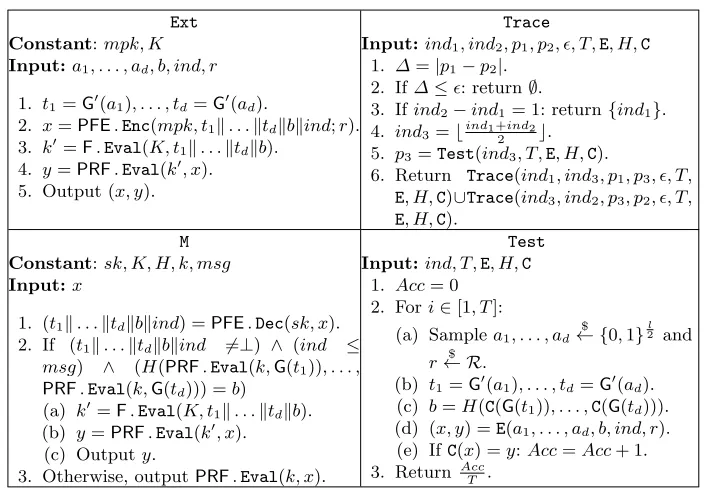
• Extract.On input an extraction keyEK = (H,E), a circuit C, and a pa-rameterq, the extraction algorithm first computes = 1/((κ+ 1)·q+ 1), T =λ/2, andS=q·(κ+ 1) and sets a variablecounter = 0. Then it com-putesL=Trace(0,2κ,1,0, , T,
E, H,C), whereTrace(·) is defined in Figure 1.
In this procedure, the algorithm also maintains the variable counter and increase it by 1 each time the functionTest(·) defined in Figure 1 is invoked. The algorithm aborts and outputs⊥oncecounter > S. In case the algorithm does not abort, it checks the setLreturned byTrace. It outputs⊥ifL=∅
and outputsUNMARKEDifL={0}. Otherwise, it outputsL.
Theorem 6.1. If PRF is a secure puncturable PRF with weak key-injectivity and constrained one-wayness,PFEis a secure puncturable functional encryption scheme as defined in Sec. 5.1,Fis a secure prefix puncturable PRF,GandG0 are pseudorandom generators,His a family of collision-resistant hash function, and iOis a secure indistinguishability obfuscator, thenWMis a secure watermarking scheme with collusion resistant unremovability and δ-unforgeability, as defined in Sec. 4, forPRF.
We present the proof of Theorem 6.1 in Appendix C.
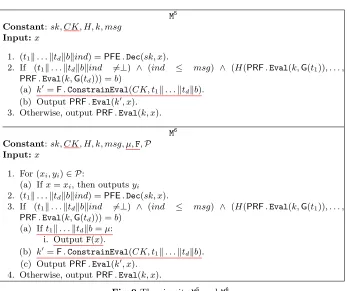
Here, we provide a brief overview on how to prove the collusion resistant unremovability ofWM. For simplicity, we consider an adversary who only gets two circuitsC1andC2 for the same secret keykembedded with messagesmsg1 and msg2 respectively, wheremsg1 < msg2, and omit its advantage in viewing the public key and querying the marking oracle.
9
The circuitExt, as well as all circuitsExt(·) appeared in the security proofs forWM
will be padded to the same size. 10
Ext Constant:mpk, K Input:a1, . . . , ad, b, ind, r
1. t1=G0(a1), . . . , td=G0(ad).
2. x=PFE.Enc(mpk, t1k. . .ktdkbkind;r). 3. k0=F.Eval(K, t1k. . .ktdkb).
4. y=PRF.Eval(k0, x). 5. Output (x, y).
M Constant:sk, K, H, k, msg Input:x
1. (t1k. . .ktdkbkind) =PFE.Dec(sk, x). 2. If (t1k. . .ktdkbkind 6=⊥) ∧ (ind ≤
msg) ∧ (H(PRF.Eval(k,G(t1)), . . . ,
PRF.Eval(k,G(td))) =b) (a) k0=F.Eval(K, t1k. . .ktdkb). (b) y=PRF.Eval(k0, x). (c) Outputy.
3. Otherwise, outputPRF.Eval(k, x).
Trace
Input:ind1, ind2, p1, p2, , T,E, H,C 1. ∆=|p1−p2|.
2. If ∆≤: return∅.
3. If ind2−ind1= 1: return{ind1}. 4. ind3=bind1+ind2 2c.
5. p3=Test(ind3, T,E, H,C).
6. Return Trace(ind1, ind3, p1, p3, , T, E, H,C)∪Trace(ind3, ind2, p3, p2, , T, E, H,C).
Test Input:ind, T,E, H,C
1. Acc= 0 2. Fori∈[1, T]:
(a) Samplea1, . . . , ad $
← {0,1}2l and
r← R$ .
(b) t1=G0(a1), . . . , td=G0(ad). (c) b=H(C(G(t1)), . . . ,C(G(td))). (d) (x, y) =E(a1, . . . , ad, b, ind, r).
(e) IfC(x) =y:Acc=Acc+ 1. 3. Return Acc
T .
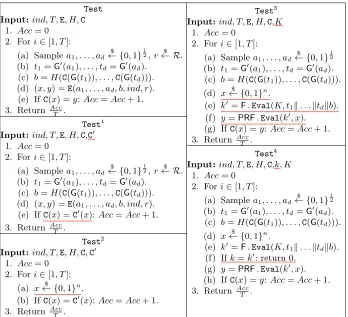
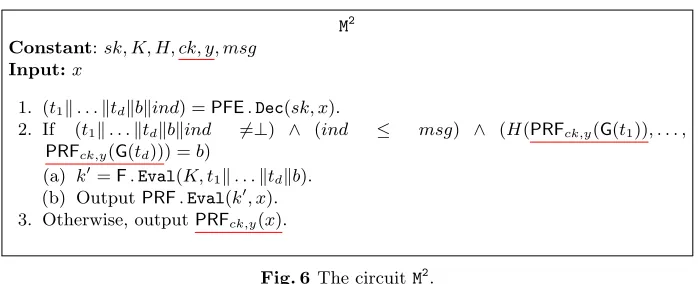
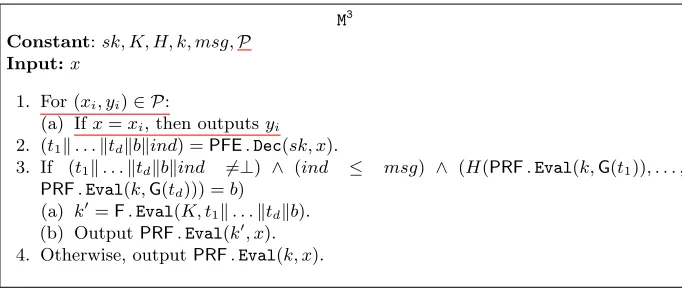
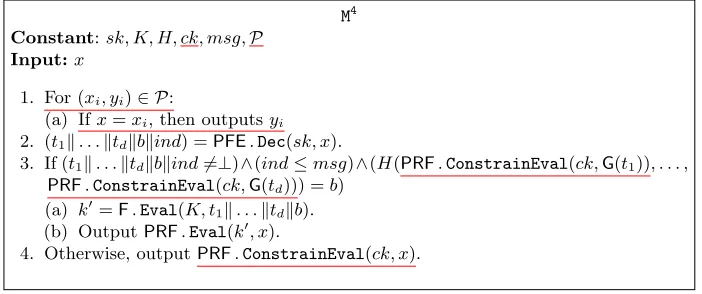
Fig. 1 The circuitExt, the circuitM, the functionTrace, and the functionTest
Following the syntax used in Sec. 2, we denote an input encrypted from t1k. . .ktdkbkindsatisfyingb=H(PRF.Eval(k,G(t1)), . . . ,PRF.Eval(k,G(td))) as a punctured point labeled with an indexind. Also, we useXind to denote the set of all punctured points labeled with the indexind.
First, as shown in [BCP14, NWZ16], theTracealgorithm can output a non-empty subset of{msg1, msg2}if the adversary cannot distinguish 1) two punc-tured points labeled with different indices adaptively chosen from (msg1, msg2] and 2) a punctured point labeled with an index adaptively chosen outside (msg1, msg2] and a random point.
For two punctured points inXind1 andXind2 respectively, whereind1, ind2∈
(msg1, msg2], both of them are properly punctured and reprogrammed in C2 while none of them are punctured inC1, thus the decryption (in bothC1andC2) do not need to distinguish them. So, their indistinguishability comes from the adaptive indistinguishability ofPFE.
The adaptive indistinguishability ofPFEalso implies indistinguishability of two punctured points in Xind1 and Xind2 when both ind1 and ind2 are in [1,
It is worth noting that when arguing indistinguishability between a punctured point fromX1 and a random input, we also need to show that the marked cir-cuits are able to hide punctured points that are punctured and identically repro-grammed in all circuits. This indicates that our construction of watermarkable PRF involves a collusion resistant constraint-hiding constrained PRF implicitly.
7
Collusion Resistant Watermarking Schemes for Other
Cryptographic Functionalities
In this section, we show how to construct watermarking schemes for advanced cryptographic functionalities, including the decryption algorithm of a PKE scheme and the signing algorithm of a signature scheme. The constructions are based on the observation that the PKE scheme (and the signature scheme) con-structed in [SW14] has a decryption algorithm (resp. signing algorithm) that is nothing more than a puncturable PRF evaluation. The observation was initially presented in [NW15, CHN+16] and was used to construct the watermarkable PKE scheme and the watermarkable signature scheme therein.
Here, as an example, we give a detailed description for how to construct collusion resistant watermarkable PKE schemes and omit the construction for collusion resistant watermarkable signature schemes. We start by presenting the formal definition of watermarkable PKE scheme. Then we give our construction based on a puncturable PRF, an indistinguishability obfuscator, a puncturable functional encryption scheme, and some standard cryptographic primitives.
7.1 The Definition
The collusion resistant watermarkable PKE scheme can be defined similarly as collusion resistant watermarkable PRF, with the main difference being that in the challenge oracle, the adversary is further given the public key corresponding to the watermarked secret key.
Definition 7.1 (Watermarkable PKEs [CHN+16, adapted]).LetPKE= (PKE.KeyGen,PKE.Enc,PKE.Dec)be a PKE scheme with secret key spaceSK. The watermarking scheme with message spaceMforPKE(more accurately, the decryption algorithm ofPKE) consists of three algorithms:
• Setup.On input the security parameter λ, the setup algorithm outputs the mark keyM K and the extraction keyEK.
• Mark.On input the mark key M K, a secret key sk ∈ SK of PKE, and a messagemsg∈ M, the marking algorithm outputs a marked circuitC. • Extract.On input the extraction keyEK, a circuitC, and a parameterq, the
extraction algorithm outputs either a setL ⊆ M or a symbol UNMARKED or an error symbol⊥.
• Functionality Preserving. C(·) and PKE.Dec(sk,·) compute identically on all but a negligible fraction of inputs.
• Extraction Correctness.Pr[Extract(EK,C, q)6={msg}]≤negl(λ).
Before presenting the security definition of the collusion resistant watermark-able PKE, we first introduce oracles the adversaries can query during the security experiments. Note that in the challenge oracle, the adversary is further given the challenge public key.
• Marking Oracle OM
M K(·,·). On input a message msg ∈ M and a secret key keysk∈ SK, the oracle returns a circuitC←Mark(M K, sk, msg).
• Challenge OracleOC
M K(·).On input a polynomial-size setMof messages fromM, the oracle first generates a key pair (sk∗, pk∗)←PKE.KeyGen(1λ). Then, for eachmsgi∗∈M, it computesCi∗←Mark(M K, sk∗, msg∗i). Finally, it returns the set{C∗1, . . . ,C∗Q}, whereQ=kMk, and the public keypk∗. Definition 7.3 (Collusion Resistant Unremovability). The watermarking scheme for a PKE is collusion resistant unremovable if for any polynomialq, for all PPT and unremoving-admissible adversaries A, we have Pr[ExptURA,q(λ) = 1]≤negl(λ), where we define the experimentExptURand unremoving-admissibility as follows:
1. The challenger samples(M K, EK)←Setup(1λ)and returnsEK toA.
2. Then,Ais allowed to make multiple queries to the marking oracle.
3. Next, Asubmits a set M∗ of Q messages in Mto the challenge oracle and gets a setC∗ of circuits as well as a public keypk∗ back.
4. Then,Ais further allowed to make multiple queries to the marking oracle. 5. FinallyAsubmits a circuit˜C. The experiment outputs 0 if
(a) q < Q and eitherExtract(EK,˜C, q) is a non-empty subset of M∗ or it equals to the error symbol⊥.
(b) q≥QandExtract(EK,C˜, q)is a non-empty subset ofM∗. Otherwise, the experiment outputs 1.
Here, an adversary A is unremoving-admissible if there exists circuit C∗i ∈ C∗ that C∗i and˜Ccompute identically on all but a negligible fraction of inputs.
Definition 7.4 (δ-Unforgeability). The watermarking scheme for a PKE is
δ-unforgeable if for any polynomial q ≥ 1 and for all PPT and δ -unforging-admissible adversaries A, we have Pr[ExptUFA,q(λ) = 1] ≤negl(λ), where we define the experiment ExptUFand unforging-admissiability as follows:
1. The challenger samples(M K, EK)←Setup(1λ)and returnsEK toA.
2. Then,Ais allowed to make multiple queries to the marking oracle.
3. Finally,Asubmits a circuitC˜. The experiment outputs 0 if Extract(EK,˜C, q) =UNMARKED; otherwise, the experiment output 1.
Here, let Q0 be the number of queries A made to the marking oracle, then an adversary Ais δ-unforging-admissible if for all i∈[1, Q0], its submitted circuit
˜
Cand the circuit Ci compute differently on at least aδfraction of inputs, where
7.2 The Construction
Letλ be the security parameter. Let δbe a positive real value andd=λ/δ= poly(λ). Let n, m, l, κ be positive integers that are polynomial in λ and n = l+poly(λ). Our watermarkable PKE scheme is built from the following building blocks:
• A family of puncturable PRF PRF = (PRF.KeyGen,PRF.Eval,
PRF.Constrain,PRF.ConstrainEval) with key space K, input space {0, 1}n, and output space{0,1}m.
• A puncturable functional encryption scheme PFE = (PFE.Setup,
PFE.KeyGen,PFE.Puncture,PFE.Enc,PFE.Dec) with plaintext space {0, 1}(d+1)·l+κ, ciphertext space {0,1}n and encryption randomness space R. Also, we require that it supports a familyF of polynomial-size circuit with output space{0,1}(d+1)·l+κ.
• A family of prefix puncturable PRFF= (F.KeyGen,F.Eval,F.Constrain,
F.ConstrainEval) with input space{0,1}(d+1)·land output spaceK.
• An indistinguishability obfuscatoriOfor all polynomial-size circuits.
• Three pseudorandom generatorsG:{0,1}l→ {0,1}n,G0:
{0,1}l2 → {0,1}l,
and ˜G:{0,1}λ→ {0,1}n.
• A family of collision-resistant hash function H with input space {0,1}d·m and output space{0,1}l.
For completeness, we first recall how PKE scheme PKE is constructed in [SW14].
• KeyGen. On input a security parameter λ, the key generation algorithm first samplesk← K$ . Then, it computesP←iO(Encrypt[k]), whereEncrypt
is defined in Figure 2 and is properly padded. Finally, the output of the key generation algorithm is (pk, sk) wherepk=Pandsk=k.
• Enc. On input a public key pk = P and a message msg ∈ {0,1}m, the encryption algorithm samplesr← {$ 0,1}λ and outputsP(msg, r).
• Dec.On input a secret keysk=kand a ciphertextct= (x, z), the decryp-tion algorithm outputsmsg=PRF.Eval(k, x)⊕z.
Encrypt Constant:k
Input:msg, r
1. x= ˜G(r).
2. z=PRF.Eval(k, x)⊕msg. 3. Outputct= (x, z).
Fig. 2 The circuitEncrypt.
Next, we construct the watermarking schemeWM= (WM.Setup,WM.Mark,
• Setup. On input a security parameter λ, the setup algorithm first sam-ples H ← H$ and generates K ← F.KeyGen(1λ). Then it generates (mpk, msk) ← PFE.Setup(1λ) and sk ← PFE.
KeyGen(msk,ID), where ID : {0, 1}(d+1)·l+κ → {0,1}(d+1)·l+κ is the identity function, i.e., for any x ∈ {0, 1}(d+1)·l+κ, ID(x) =x. Next, it computes
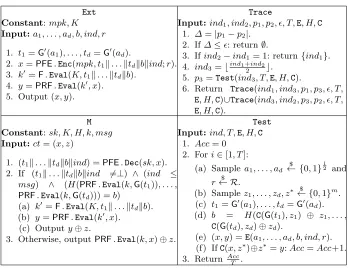
E←iO(Ext[mpk, K]), whereExt
is defined in Figure 3 and is properly padded. Finally, the output of the setup algorithm is (M K, EK) whereM K= (sk, K, H) andEK= (H,E).
• Mark.On input a mark keyM K= (sk, K, H), a secret keyk∈ KforPKE
and a messagemsg, the marking algorithm outputs a circuit C←iO(M[sk, K, H, k, msg]), where Mis defined in Figure 3 and is properly padded.
• Extract.On input an extraction keyEK = (H,E), a circuit C, and a pa-rameterq, the extraction algorithm first computes = 1/((κ+ 1)·q+ 1), T =λ/2, andS=q·(κ+ 1) and sets a variablecounter= 0. Then it com-putesL=Trace(0,2κ,1,0, , T,E, H,C), whereTrace(·) is defined in Figure 3.
In this procedure, the algorithm also maintains the variable counter and increase it by 1 each time the functionTest(·) defined in Figure 3 is invoked. The algorithm aborts and outputs⊥ once counter exceeds S. In case the algorithm does not abort, it checks the setLreturned by Trace. It outputs
⊥ifL=∅ and outputsUNMARKEDifL={0}. Otherwise, it outputsL. Theorem 7.1. If PRF is a secure puncturable PRF with weak key-injectivity and constrained one-wayness,PFEis a secure puncturable functional encryption scheme as defined in Sec. 5.1,Fis a secure prefix puncturable PRF,G,G0 andG˜ are pseudorandom generators,His a family of collision-resistant hash function, and iO is a secure indistinguishability obfuscator, then WM is a secure water-marking scheme with collusion resistant unremovability and δ-unforgeability for PKE.
Proof. Proof of Theorem 7.1 can be proceeded similiarly as the proof of Theorem 6.1, so we omit its details here.
One subtle issue in the proof is that the adversary can additionally obtain a public key from the challenge oracle, which is an obfuscated circuit containing the challenge key k∗. So, we need to further argue that the public key will not leak additional information of k∗. Recall that through the whole security proof, either k∗ or its equivalent version or its contrained version punctured on a random point will appear in the view of the adversary. In the first case, the public key will not provide additional information aboutk∗. In the second case, k∗ can be replaced with its equivalent version in the public key and due
to the indistinguishability of iO, this cannot be detected by the adversary. In the third case, k∗ can be replaced with its contrained version in the public key. Since the probability that the random punctrued point falls in the range of ˜Gis negligible, by the indistinguishability of iO, this will also not affect the adversary’s advantage.
Ext Constant:mpk, K Input:a1, . . . , ad, b, ind, r
1. t1=G0(a1), . . . , td=G0(ad).
2. x=PFE.Enc(mpk, t1k. . .ktdkbkind;r). 3. k0=F.Eval(K, t1k. . .ktdkb).
4. y=PRF.Eval(k0, x). 5. Output (x, y).
M Constant:sk, K, H, k, msg Input:ct= (x, z)
1. (t1k. . .ktdkbkind) =PFE.Dec(sk, x). 2. If (t1k. . .ktdkbkind 6=⊥) ∧ (ind ≤
msg) ∧ (H(PRF.Eval(k,G(t1)), . . . ,
PRF.Eval(k,G(td))) =b) (a) k0=F.Eval(K, t1k. . .ktdkb). (b) y=PRF.Eval(k0, x). (c) Outputy⊕z.
3. Otherwise, outputPRF.Eval(k, x)⊕z.
Trace
Input:ind1, ind2, p1, p2, , T,E, H,C 1. ∆=|p1−p2|.
2. If ∆≤: return∅.
3. If ind2−ind1= 1: return{ind1}. 4. ind3=bind1+ind2 2c.
5. p3=Test(ind3, T,E, H,C).
6. Return Trace(ind1, ind3, p1, p3, , T, E, H,C)∪Trace(ind3, ind2, p3, p2, , T, E, H,C).
Test Input:ind, T,E, H,C
1. Acc= 0 2. Fori∈[1, T]:
(a) Samplea1, . . . , ad $
← {0,1}2l and
r← R$ .
(b) Samplez1, . . . , zd, z∗ $
← {0,1}m . (c) t1=G0(a1), . . . , td=G0(ad). (d) b = H(C(G(t1), z1) ⊕ z1, . . . ,
C(G(td), zd)⊕zd).
(e) (x, y) =E(a1, . . . , ad, b, ind, r). (f) IfC(x, z∗)⊕z∗
=y:Acc=Acc+1. 3. Return Acc
T .
Fig. 3 The circuitExt, the circuitM, the functionTrace, and the functionTestfor the watermarkable PKE scheme.
signature scheme constructed in [SW14], the pseudorandom random function will compute on all points in its domain (rather than points in the range of a pseudorandom generator), thus, we cannot argue indistinguishability between a verification key generated from a normal key and that generated from a con-strained key. To circumvent this problem, we modify the construction of signa-ture scheme slightly and use a watermarked PRF key in the obfuscated circuit of the verification key. But this will lead to a weaker watermarkable signature scheme, which needs the marking key of the watermarking scheme when gener-ating a signing key/verification key pair of the signature scheme.
8
Conclusion and Future Works
In this work, we initiate the study of collusion resistant watermarking by defining and constructing collusion resistant watermarking schemes for common crypto-graphic functionalities, including PRF, PKE, and signature.
program on a fraction of inputs for some non-negligible . In this setting, since the attacker is able to reset the outputs on a non-negligible fraction of inputs, internal variables generated during the extraction procedure may signif-icantly depart from what is expected. In previous works with -unremovability (e.g., [CHN+16, QWZ18, KW19]), this issue is tackled by repeating some sub-procedure multiple times and deciding based on majority. Unfortunately, in our construction, as the extraction algorithm needs to analyze the fraction of re-programmed points in a set, it seems implausible to use the “repeating-and-choosing-majority” trick. How to construct collusion resistant watermarking schemes with-unremovability for non-negligible is an interesting open prob-lem.
Another interesting direction is to explore the possibility of instantiating a collusion resistant watermarkable PRF from standard assumptions. As dis-cussed in Sec. 1.1, a collusion resistant watermarkable PRF can be approxi-mately viewed as a collusion resistant constraint-hiding constrained PRF, which can imply indistinguishability obfuscator. However, we have not provided a for-mal reduction. It is interesting to forfor-mally construct an indistinguishability ob-fuscator from a collusion resistant watermarkable PRF or construct a collusion resistant watermarkable PRF from standard assumptions.
Besides, it is also interesting to construct collusion resistant watermarking schemes with other desirable features, e.g., constructing collusion resistant wa-termarking schemes with public marking.
Acknowledgement. We appreciate the anonymous reviewers for their valu-able suggestions. Part of this work was supported by the National Natural Sci-ence Foundation of China (Grant No. 61572294, 61602396, 61632020, U1636205), Early Career Scheme research grant (ECS Grant No. 25206317) from the Re-search Grant Council of Hong Kong, the Innovation and Technology Sup-port Programme of Innovation and Technology Fund of Hong Kong (Grant No. ITS/356/17), and the MonashU-PolyU-Collinstar Capital Joint Lab on Blockchain. Junzuo Lai was supported by National Natural Science Founda-tion of China (Grant No. 61922036, 61572235), and Guangdong Natural Science Funds for Distinguished Young Scholar (No. 2015A030306045).
References
[BCP14] Elette Boyle, Kai-Min Chung, and Rafael Pass. On extractability ob-fuscation. InTCC, pages 52–73. Springer, 2014.
[BFM88] Manuel Blum, Paul Feldman, and Silvio Micali. Non-interactive zero-knowledge and its applications. InSTOC, pages 103–112. ACM, 1988. [BGI+01] Boaz Barak, Oded Goldreich, Rusell Impagliazzo, Steven Rudich, Amit Sahai, Salil Vadhan, and Ke Yang. On the (im) possibility of obfuscat-ing programs. InCRYPTO, pages 1–18. Springer, 2001.
[BLW17] Dan Boneh, Kevin Lewi, and David J Wu. Constraining pseudorandom functions privately. InPKC, pages 494–524. Springer, 2017.
[BN08] Dan Boneh and Moni Naor. Traitor tracing with constant size cipher-text. InCCS, pages 501–510. ACM, 2008.
[BPW16] Nir Bitansky, Omer Paneth, and Daniel Wichs. Perfect structure on the edge of chaos. InTCC, pages 474–502. Springer, 2016.
[BSW06] Dan Boneh, Amit Sahai, and Brent Waters. Fully collusion resistant traitor tracing with short ciphertexts and private keys. In EURO-CRYPT, volume 4004, pages 573–592. Springer, 2006.
[BSW11] Dan Boneh, Amit Sahai, and Brent Waters. Functional encryption: Definitions and challenges. InTCC, pages 253–273. Springer, 2011. [BV15] Nir Bitansky and Vinod Vaikuntanathan. Indistinguishability
obfus-cation from functional encryption. In FOCS, pages 171–190. IEEE, 2015.
[BZ14] Dan Boneh and Mark Zhandry. Multiparty key exchange, efficient traitor tracing, and more from indistinguishability obfuscation. In CRYPTO, pages 480–499. Springer, 2014.
[CC17] Ran Canetti and Yilei Chen. Constraint-hiding constrained PRFs for NC1 from LWE. InEUROCRYPT, pages 446–476. Springer, 2017. [CFN94] Benny Chor, Amos Fiat, and Moni Naor. Tracing traitors. InCRYPTO,
pages 257–270. Springer, 1994.
[CHN+16] Aloni Cohen, Justin Holmgren, Ryo Nishimaki, Vinod Vaikuntanathan, and Daniel Wichs. Watermarking cryptographic capabilities. InSTOC, pages 1115–1127, 2016.
[CHV15] Aloni Cohen, Justin Holmgren, and Vinod Vaikuntanathan. Publicly verifiable software watermarking. Cryptology ePrint Archive, Report 2015/373, 2015. https://eprint.iacr.org/2015/373.
[CMB+07] Ingemar Cox, Matthew Miller, Jeffrey Bloom, Jessica Fridrich, and Ton Kalker. Digital watermarking and steganography. Morgan Kaufmann, 2007.
[CVW+18] Yilei Chen, Vinod Vaikuntanathan, Brent Waters, Hoeteck Wee, and Daniel Wichs. Traitor-tracing from LWE made simple and attribute-based. InTCC, 2018.
[DSDCO+01] Alfredo De Santis, Giovanni Di Crescenzo, Rafail Ostrovsky, Giuseppe Persiano, and Amit Sahai. Robust non-interactive zero knowledge. In CRYPTO, pages 566–598. Springer, 2001.
[FLS99] Uriel Feige, Dror Lapidot, and Adi Shamir. Multiple noninteractive zero knowledge proofs under general assumptions. SIAM Journal on Computing, 29(1):1–28, 1999.
[GGH+13] Sanjam Garg, Craig Gentry, Shai Halevi, Mariana Raykova, Amit Sa-hai, and Brent Waters. Candidate indistinguishability obfuscation and functional encryption for all circuits. In FOCS, pages 40–49. IEEE, 2013.
[GGM84] Oded Goldreich, Shafi Goldwasser, and Silvio Micali. How to construct randolli functions. InFOCS, pages 464–479. IEEE, 1984.
[GKM+19] Rishab Goyal, Sam Kim, Nathan Manohar, Brent Waters, and David J Wu. Watermarking public-key cryptographic primitives. InCRYPTO, pages 367–398. Springer, 2019.
[Goe15] Michel Goemans. Lecture notes on Chernoff bounds. http://math. mit.edu/~goemans/18310S15/chernoff-notes.pdf, February 2015. [Gro10] Jens Groth. Short non-interactive zero-knowledge proofs. In
ASI-ACRYPT, pages 341–358. Springer, 2010.
[GVW12] Sergey Gorbunov, Vinod Vaikuntanathan, and Hoeteck Wee. Func-tional encryption with bounded collusions via multi-party computation. InCRYPTO, pages 162–179. Springer, 2012.
[HMW07] Nicholas Hopper, David Molnar, and David Wagner. From weak to strong watermarking. TCC, pages 362–382, 2007.
[KNT18] Fuyuki Kitagawa, Ryo Nishimaki, and Keisuke Tanaka. Obfustopia built on secret-key functional encryption. InEUROCRYPT, pages 603– 648. Springer, 2018.
[KW17] Sam Kim and David J Wu. Watermarking cryptographic functionalities from standard lattice assumptions. InCRYPTO. Springer, 2017. [KW19] Sam Kim and David J. Wu. Watermarking PRFs from lattices: Stronger
security via extractable PRFs. InCRYPTO, pages 335–366. Springer, 2019.
[Nis13] Ryo Nishimaki. How to watermark cryptographic functions. In EU-ROCRYPT, pages 111–125. Springer, 2013.
[NSS99] David Naccache, Adi Shamir, and Julien P Stern. How to copyright a function? InPKC, pages 188–196. Springer, 1999.
[NW15] Ryo Nishimaki and Daniel Wichs. Watermarking cryptographic pro-grams against arbitrary removal strategies. Cryptology ePrint Archive, Report 2015/344, 2015. https://eprint.iacr.org/2015/344. [NWZ16] Ryo Nishimaki, Daniel Wichs, and Mark Zhandry. Anonymous traitor
tracing: How to embed arbitrary information in a key. In EURO-CRYPT, pages 388–419. Springer, 2016.
[O’N10] Adam O’Neill. Definitional issues in functional encryption. Cryptology ePrint Archive, Report 2010/556, 2010. https://eprint.iacr.org/ 2010/556.
[PS18] Chris Peikert and Sina Shiehian. Privately constraining and program-ming PRFs, the LWE way. InPKC. Springer, 2018.
[QWZ18] Willy Quach, Daniel Wichs, and Giorgos Zirdelis. Watermarking PRFs under standard assumptions: Public marking and security with extrac-tion queries. InTCC, 2018.
[SW14] Amit Sahai and Brent Waters. How to use indistinguishability obfusca-tion: deniable encryption, and more. InSTOC, pages 475–484. ACM, 2014.
[YAL+18] Rupeng Yang, Man Ho Au, Junzuo Lai, Qiuliang Xu, and Zuoxia Yu. Unforgeable watermarking schemes with public extraction. In SCN, pages 63–80. Springer, 2018.
[YF11] Maki Yoshida and Toru Fujiwara. Toward digital watermarking for cryptographic data.IEICE transactions on fundamentals of electronics, communications and computer sciences, 94(1):270–272, 2011.