© 2014, IJCSMC All Rights Reserved 815
Available Online atwww.ijcsmc.com
International Journal of Computer Science and Mobile Computing
A Monthly Journal of Computer Science and Information Technology
ISSN 2320–088X
IJCSMC, Vol. 3, Issue. 5, May 2014, pg.815 – 820
RESEARCH ARTICLE
SERIAL COMPUTING vs. PARALLEL
COMPUTING: A COMPARATIVE
STUDY USING MATLAB
Abhay B. Rathod
1, Rajratna Khadse
2, M Faruk Bagwan
3Department of Electronics and Telecomm. Engg, Jawaharlal Darda Institute of Engg. and Tech. Yavatmal, India
1 [email protected]; 2 [email protected]; 3 [email protected]
Abstract— parallel computing has been around for many years but it is only recently that interest has grown due to the introduction of multi core processor at a reasonable price for the common people. The goal of this paper is to analyze and compare serial algorithm with parallel algorithm using parallel matlab toolbox.
Keywords— Central Processing Unit (CPU); Graphics Processing Unit (GPU) ; Parallel Computing Toolbox; Multicore Processor; parallelism
I. INTRODUCTION
The Parallel Computing is evolved from serial computing that attempts to emulate what has always been the state of affairs in natural World [6].
Serial and Parallel Computing [6]
Traditionally, software has been written for serial computation:
n a single computer having a single Central Processing Unit (CPU).
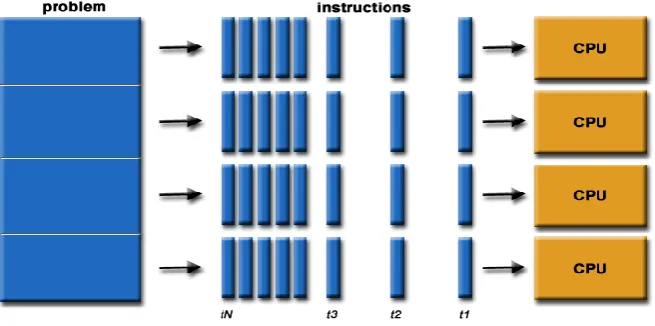
Parallel computing is the simultaneous use of multiple compute resources to solve a computational problem:
part is further broken down to a series of instructions.
© 2014, IJCSMC All Rights Reserved 816
Fig. 1 Parallel Matlab using local workers for execution of task[5].
II. SERIAL VS.PARALLEL PROGRAMMING
A. Serial programming
Serial programming involves a consecutive and ordered execution of processes one after another. In other words with serial programming, codes or processes are run one after another in a succession fashion.
Fig. 1 Serial programming (Source: https://computing.llnl.gov/tutorials/parallel_comp/)
B. Serial coding
clc; clear all;
min_matrix =500; max_matrix =500;
serial = zeros([1 length(min_matrix:max_matrix)]); count = 1;
for mat_size = min_matrix:max_matrix
%Generate random matrices
© 2014, IJCSMC All Rights Reserved 817
matrix2 = round(matrix2 * 100);
tic;
result_norm = matrix1 * matrix2; serial(count) = toc;
clc;
disp('Matrix 1'); disp(matrix1); disp('Matrix 2'); disp(matrix2);
disp('Normal Result'); disp(result_norm);
fprintf('Normal Time:%0.04f s\n',serial(count));
end
C. Limits to serial programming
Both physical and practical reasons pose significant constraints to simply building ever faster serial computers [3]:
Transmission speeds - the speed of a serial computer is directly dependent upon how fast data can move through hardware. Absolute limits are the speed of light (30 cm/nanosecond) and the transmission limit of copper wire (9 cm/nanosecond). Increasing speeds necessitate increasing proximity of processing elements.
Limits to miniaturization - processor technology is allowing an increasing number of transistors to be placed on a chip. However, even with molecular or atomic-level components, a limit will be reached on how small components can be. Economic limitations - it is increasingly expensive to make a single processor faster. Using a larger number of moderately fast commodity processors to achieve the same (or better) performance is less expensive.
Current computer architectures are increasingly relying upon hardware level parallelism to improve performance:
Multiple execution units
Pipelined instructions
Multi-core
D. Parallel Programming
Parallel programming involves the concurrent computation or simultaneous execution of processes or threads at the same time. Parallel programming, we have multiple processes execute at the same time.
© 2014, IJCSMC All Rights Reserved 818
In [3] author discusses the advantages of Parallel computing they are as follows
Save time and/or money:
In theory, throwing more resources at a task will shorten its time to completion, with potential cost savings. Parallel computers can be built from cheap, commodity components.
Solve larger problems:
II. Many problems are so large and/or complex that it is impractical or impossible to solve them on a single computer, especially given limited computer memory.
III.
Provide concurrency:
A single compute resource can only do one thing at a time. Multiple computing resources can be doing many things simultaneously
Parallel programming involves:
o Decomposing an algorithm or data into parts
o Distributing the parts as tasks which are worked on by multiple processors simultaneously
o Coordinating work and communications of those processors or cores.
E. Parallel coding:
tic; spmd
result_norm = matrix1 * matrix2; end;
parallel(count) = toc;
tic; spmd
result = applyFoxMultiplier(matrix1,matrix2); end;
fox(count) = toc;
function out_matrix = applyFoxMultiplier(matrix1,matrix2) rows = size(matrix1,1);
cols = size(matrix1,2);
out_terms = zeros([rows cols]);
if(size(matrix1,1) == size(matrix2,1) && size(matrix1,2) == size(matrix2,2))
for stage=0:rows-1 %Stage 0 for i=0:rows-1 for j=1:cols
%Find the mod val
mod_val = mod(i+stage,rows); mod_val = mod_val + 1;
out_terms(i+1,j) = out_terms(i+1,j) + (matrix1(i+1, mod_val) * matrix2(mod_val,j)); end
end end end
© 2014, IJCSMC All Rights Reserved 819
III. RESULT AND DISCUSSION
Theoretically number of steps required for Normal algorithm is more than that required for the Fox algorithm. Fox algorithm takes n+1 steps whereas the Normal algorithm takes n*n steps to do the same calculations.
TABLE I
NUMBER OF STEPS REQUIRED FOR MATRIX MULTIPLICATION USING NORMAL ALGORITHM AND FOX ALGORITHM:
Matrix size (n) Normal algorithm (n*n) Fox algorithm (n+1)
10 100 11
50 2500 51
100 10000 101
150 22500 151
A practical analysis for the performance of serial and parallel algorithm is carried out using Matlab version 7.0 software. Serial algorithm requires less time to execute the code than parallel algorithm if executed sequentially.
TABLE III
SERIAL COMPUTING EXECUTION TIME FOR INTEL I3DUAL CORE PROCESSOR:
Size of matrix Number of Workers Normal algorithm execution time(s) Fox algorithm execution time(s)
100×100 - 0.0414 0.1544
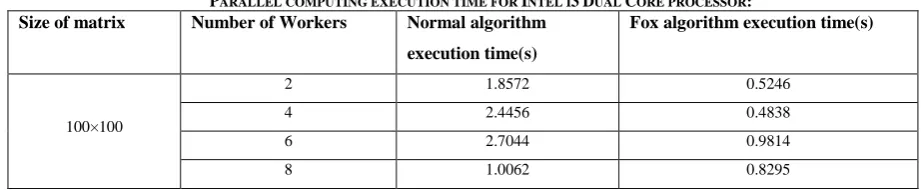
For Intel i3 Dual Core processor, the parallel computing execution time for matrix multiplication using Normal and Fox algorithm using 2, 4, 6 and 8 workers is carried out and it is found that Fox algorithm is having the least time delay. Again it has shown that if we converts serial algorithm into parallel it takes more time to execute the code where as if we take parallel algorithm such as Fox algorithm for matrix multiplication it takes less time as compare to Serial algorithm.
TABLE IIIII
PARALLEL COMPUTING EXECUTION TIME FOR INTEL I3DUAL CORE PROCESSOR:
Size of matrix Number of Workers Normal algorithm execution time(s)
Fox algorithm execution time(s)
100×100
2 1.8572 0.5246
4 2.4456 0.4838
6 2.7044 0.9814
8 1.0062 0.8295
IV.CONCLUSIONS
Serial processing was the best way of computing data sets until hardware and software technologies finally caught up and made true parallel processing a reality. With the advent of multi-core processors and the universal expectation that the number of cores on a chip will increase exponentially over the next years (in line with the original prediction of Moore's law [11]), with little or no increase in sequential performance in sight, parallelism, be it implicit or explicit, will become fundamental in all application areas where performance matters.
ACKNOWLEDGMENT
The authors wish to thanks Dr. A. W. Kolhatkar, and Dr. S. M. Gulhane for their comments and time to time valuable suggestion. REFERENCES
[1] D. Vijaya Krishna and Dr. P. Sammulal, “Advances in Parallel Computing from the Past to the Future”, International Journal of Advance Research in Computer Science and Management Studies, Volume 1, Issue 4, pp 16-23, September 2013.
[2] Nimrod Megiddo, “Applying Parallel Computation Algorithms in the Design of Serial Algorithms”, Journal of the Association for Computing Machinery, Vol. 30, No. 4, pp. 852-865, October 1983.
[3] David A. Bader, Bernard M. E. Moret, and Peter Sanders ,“Algorithm Engineering for Parallel Computation” Springer-Verlag Berlin Heidelberg, pp. 1–23, 2002.
[4] Prabhudev S Irabashetti, “Parallel processing in processor organization”, International Journal of Advanced Research in
Computer and Communication Engineering, Vol. 3, Issue 1,pp. 5150-5153, January 2014.
© 2014, IJCSMC All Rights Reserved 820
[6] P. Durgaprasad,” Parallel Computing: High Performance”, International Journal of Emerging Technology and Advanced
Engineering , Volume 1, Issue 2, pp.97-101, December 2011.
[7] Ron Choy , Alan Edelman,” Parallel MATLAB: Doing it Right”,pp.1-27, November 15, 2003. [8] Daniel S. Priece,” Parallel Computing”, pp.55-65.
[9] Speeding up MATLAB Applications, The Math Works, Inc.,pp.1-15, 2011.
[10]Nadya Bliss, “Addressing the Multicore Trend with Automatic Parallelization”, Lincoln Laboratory Journal, Volume 17, Number 1, pp.187-197, 2007.
![Fig. 1 Parallel Matlab using local workers for execution of task[5].](https://thumb-us.123doks.com/thumbv2/123dok_us/1984916.1262415/2.595.128.481.320.482/fig-parallel-matlab-using-local-workers-execution-task.webp)