Differential Attacks on Reduced SIMON
Versions with Dynamic Key-guessing Techniques
No Author Given
No Institute Given
Abstract. SIMON is a family of lightweight block ciphers which are designed by the U.S National Security Agency in 2013. It has total-ly 10 versions corresponding to different block size 2n and key length lk, named as SIMON2n/lk. In this paper, we present a new differential
attack by considering the sufficient bit conditions of the previous dif-ferential paths. Based on the bit conditions, we successfully propose a new type of dynamic key-guessing technique which greatly reduces the key space guessed. Our attacks work on the reduced SIMON of all 10 suggested versions, which improve the best previous results by 2 to 4 rounds. For verification, we implemented a practical attack on 19-round SIMON32 in a PC, and the experimental data confirm the correctness of the attack, which also fit the theoretical complexity and success rate very well. It is remarked that, our cryptanalysis only provides a more accurate security evaluation, and it does not mean the security problem of the whole SIMON family.
Keywords:SIMON, lightweight block cipher, bit condition, differential attack, dynamic key-guessing
1
Introduction
Today, lightweight block ciphers for resource-constrained applications such as RFID tags and sensor networks have received much attention. During the last decade, many lightweight ciphers have been proposed, such as PRESENT[7], LED[11], PRINCE[8], KANTAN[9] and CLEFIA[19] etc.
In 2013, NSA published the specifications of two lightweight block cipher families SIMON and SPECK[3] which can perform well both in hardware and software. Especially, compared with the other lightweight block cipher primitives, SIMON and SPECK perform competitively in hardware and software platforms respectively.
instead of XOR differences, and it is widely used to attack or evaluate hash functions[24,22,10,21,18,17]. The core of modular differential attack can be re-garded as three steps: Firstly the adversary cancels the unwanted avalanche arisen from a given input difference by various complex bit-carry control tech-niques and finds a specifical optimized differential path. Then he determines a set of sufficient bit conditions to obtain the specific differential path. Finally the adversary fulfills various techniques including message modifications to guaran-tee more bit conditions hold, and this improves the success rate of the attack. The basic idea of our attack is to merge two types of differential attacks. Specif-ically, we get the sufficient bit conditions using similar techniques as that of the modular differential attack, and then apply some new techniques especially dynamic key-guessing technique to ensure more bit conditions are satisfied. In addition, cryptanalysis based on bit conditions are also used in condition differ-ential cryptanalysis which was introduced by Knellwolf et al. in [13] to analyze the stream cipher.
Related WorksSince the SIMON family was announced, it has attracted a lot of attention of the cryptographers. Before previewing the previous works on SIMON family, we briefly give some explanations about the versions of SIMON.
SIMON2n/lk denotes a SIMON version with block size 2n and key length lk.
SIMON2nstands for the SIMON versions with block size 2n. For example,
SI-MON48 has two versions SISI-MON48/72 and SISI-MON48/96 corresponding to key length 72 and 96 respectively. Alkhzaimi and Lauridsen[2] presented the first security analysis of all the versions. They gave differential attacks on 16-round SIMON32, 18-round SIMON48, 24-round SIMON64, 29-round SIMON96 and 40-round SIMON128, as well as impossible differential attacks on 14, 15, 16, 19, and 22 rounds of the corresponding versions of SIMON. At FSE 2014, Biryukov and Velichkov [6] found new differentials up to 13, 15 and 21 rounds for SIMON32, SIMON48, SIMON64 respectively. As a result, 19-round SIMON32/64, 20-round SIMON48/72, 20-round SIMON48/96, 26-round SIMON64/96 and 26-round SI-MON64/128 were attacked with about 234, 252, 275, 289 and 2121 encryptions, respectively. In addition, at the same workshop, Abed and List [1] independent-ly used another differential to attack 18, 19, 26, 35 and 46 rounds of SIMON versions of 5 different block sizes, respectively.
Our ContributionsIn this paper, we use the existing differentials in [6,20,1] to analyze the reduced SIMON versions. The sketch of our attack is as follows.
Firstly, we extend several rounds on the top and the bottom of the previous differentials, and get the target differential path to attack. We obtain the suf-ficient bit conditions of the extended differential paths by investigating bitwise behavior of differences in the paths. All the bit conditions can be categorized into two types. The first type only depends on plaintexts or ciphertexts, which can be handled by choosing plaintexs, ciphertexts and building the data structures. The other type of conditions is related to the secret key.
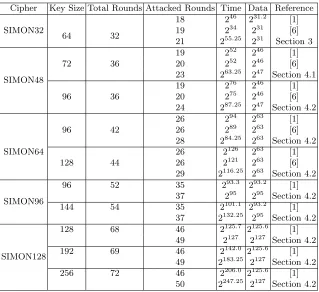
guess-Table 1.Summary of Differential Attacks on SIMONs
Cipher Key Size Total Rounds Attacked Rounds Time Data Reference SIMON32
64 32
18 246 231.2 [1]
19 234 231 [6]
21 255.25 231 Section 3
SIMON48
19 252 246 [1]
72 36 20 252 246 [6]
23 263.25 247 Section 4.1
19 276 246 [1]
96 36 20 275 246 [6]
24 287.25 247 Section 4.2
SIMON64
26 294 263 [1]
96 42 26 289 263 [6]
28 284.25 263 Section 4.2
26 2126 263 [1]
128 44 26 2121 263 [6]
29 2116.25 263 Section 4.2
SIMON96
96 52 35 293.3 293.2 [1]
37 295 295 Section 4.2
144 54 35 2101.1 293.2 [1]
37 2132.25 295 Section 4.2
SIMON128
128 68 46 2125.7 2125.6 [1]
49 2127 2127 Section 4.2
192 69 46 2142.0 2125.6 [1]
49 2183.25 2127 Section 4.2
256 72 46 2206.0 2125.6 [1]
50 2247.25 2127 Section 4.2
ing some subkey bits (or equivalent key bits) involved in these conditions, which depend on the specific bits or the bit differences of intermediate variables. Conse-quently, we propose a dynamic key-guessing technique which reduces the number of secret key bits guessed greatly. For example, in the attack on 21-round SI-MON32, we find 223.9 solutions of 49-bit subkey for a filtered palintext pair. It
implies that, for the collected pair, we need to guess 223.9 subkey space instead
of 249in the conventional differential attack.
As a result, our attacks work on these reduced versions with 2 to 4 round-s more than the previouround-s attackround-s. The time complexitieround-s of our attackround-s on
the 21-round SIMON32/64, 23-round SIMON48/72, 24-round SIMON48/96,
28-round SIMON64/96, 29-round SIMON64/128, 37-round SIMON96/96,
37-round SIMON96/144, 49-round SIMON128/128, 49-round SIMON128/192 and
50-round SIMON128/256 are 255.25, 263.25, 287.25, 284.25, 2116.25, 295, 2132.25, 2127, 2183.25and 2247.25encryptions, respectively. Our results are summarized in Table 1.
21-round SIMON32, and implements a practical attack expriment on 19-round SIMON32 in a PC. The attacks on the other versions of SIMON are given in Section 4. Finally, we conclude this paper in Section 5.
2
Brief Description of SIMON
2.1 Notations
The following notations are used in this paper:
Xr−1 the input of ther-th round
Lr−1 the left half of ther-th round input
Rr−1 the right half of ther-th round input
Kr−1 the subkey used in ther-th round
Xi thei-th bit of X, the index of bits is from left to right
X≪r the left rotation ofX by r bits
X≫r the right rotation ofX by r bits
⊕ bitwise exclusive OR (XOR)
∩ bitwise AND
∆X the XOR difference ofX andX0
+ addition operation
% modular operation
2.2 Brief Description of Block Cipher SIMON
The SIMON block cipher is a Feistel structure with a 2n-bit state, wheren is
required to be 16, 24, 32, 48, or 64. SIMON2n with anmn-bit key is referred
to as SIMON2n/mn, wherem= 2,3,4. There are 10 suggested versions with d-ifferent numbers of roundsnr. All versions of SIMON use similar round function.
Round Functions For high performance on both hardware and software plat-forms, SIMON utilizes an extremely simple round function which iterates many
rounds. The functionF(x) = ((x≪1)∩(x≪8))⊕(x≪2) is a non-linear
transformation from {0,1}n to {0,1}n, which is built by 3 bitwise operations
⊕, ∩ and ≪. Let the plaintext P = (L0, R0), and the i-th round function is described in the following.
Li =Ri−1⊕F(Li−1)⊕Ki−1, Ri =Li−1,
wherei= 1, ..., nr. (Rnr, Lnr) is the ciphertextC.
To describe our differential attack with bit conditions conveniently, we give a bitwise description of the round function. Let Li ={Xni, Xni+1, . . . , X2in−1},
Ri ={X0i, X1i, . . . , Xni−1}, and Ki ={K0i, K1i, . . . , Kni−1}, then the i-th round
function is denoted as:
where j= 0,1, . . . , n−1, and Xi
n is the left-most bit ofLi, X2in−1 is the
right-most bit ofLi,Xi
0is the left-most bit ofRi, andXni−1is the right-most bit ofRi.
Key Schedules The key schedules generate a sequence of nr round subkeys
{K0, ..., Knr−1}from the master key{k
0, k1, ..., km−1}. For different key lengths
mn, the key schedules are given as follows, when i= 0,1, . . . , m−1,Ki =ki; and wheni=m, m+ 1, . . . , nr,
if m= 2, Ki=c⊕(zj)i−m⊕Ki−m⊕(Ki−m+1≫3)⊕(Ki−m+1≫4), if m= 3, Ki=c⊕(zj)i−m⊕Ki−m⊕(Ki−m+2≫3)⊕(Ki−m+2≫4), if m= 4, Ki=c⊕(zj)i−m⊕Ki−m⊕Ki−m+1⊕(Ki−m+1≫1)
⊕(Ki−m+3≫3)⊕(Ki−m+3≫4).
Here c = 2n−4,zj is the version-dependent choice of constant sequence. For
more details, please refer to [3]. In fact, the key schedules are linear, so the
master key can be deduced from anymnindependent bits of subkeys.
2.3 Some Observations
Observation 1 ([12]) Let ∆x=x⊕x0,∆y=y⊕y0, then
(x∩y)⊕(x0∩y) =∆x∩y,
(x∩y)⊕(x∩y0) =x∩∆y,
(x∩y)⊕(x0∩y0) = (x∩∆y)⊕(∆x∩y)⊕(∆x∩∆y).
Observation 2 Given two inputs Xi−1 and (Xi−1)0 of the i-th round, where ∆Xi−1=Xi−1⊕(Xi−1)0. Then we can compute the output difference ∆Xi of the i-th round function without any key bit guessing , and obtain a subkey bit according to the following four cases(for j= 0,1, . . . , n−1).
1. When(∆Xi
(j+1)%n+n, ∆X i
(j+8)%n+n) = (0,0), there is no key bit involved in
∆Xji+1+n. 2. When (∆Xi
(j+1)%n+n, ∆X i
(j+8)%n+n) = (0,1), K i−1
(j+1)%n is computed from
the value of∆Xji+1+n. 3. When (∆Xi
(j+1)%n+n, ∆X i
(j+8)%n+n) = (1,0), K i−1
(j+8)%n is computed from
the value of∆Xji+1+n.
4. When(∆X(ij+1)%n+n, ∆X(ij+8)%n+n) = (1,1), one equivalent key bitK(ij−+1)%1 n⊕
K(ij−+8)%1 n is computed from∆Xji+1+n(j < n).
Since the subkeyKi−1is linear with the output ofXi, it is obvious that∆Xi is independent withKi−1.
By partial encryption and Observation 1, we deduce the following equations.
∆Xji+1+n= (∆X(ij+1)%n+n∩X i
(j+8)%n+n)⊕(X i
(j+1)%n+n∩∆X i
(j+8)%n+n) ⊕(∆X(ij+1)%n+n∩∆X
i
(j+8)%n+n)⊕∆X i
(j+2)%n+n⊕∆X i
Xi
(j+1)%n+n= (X i−1
(j+2)%n+n∩X i−1 (j+9)%n+n)
⊕X(i−j+3)%1 n+n⊕X(ij−+1)%1 n⊕K(ij−+1)%1 n, (2) X(ij+8)%n+n= (X
i−1
(j+9)%n+n∩X i−1
(j+16)%n+n)
⊕X(i−j+10)%1 n+n⊕X(ij−+8)%1 n⊕Ki−1(j+ 8)%n. (3)
It is obvious that Observation 2 is obtained from equations (1)-(3). In other word, given a equation ∆Xji+1+n = b, where b = 0 or 1, Observation 2 implies that,
1. When (∆Xi
(j+1)%n+n, ∆X i
(j+8)%n+n) = (0,0) and ∆X i
(j+2)%n+n⊕∆X i j =
b⊕1, there is no solution of the subkey (K(i−j+1)%1 n, K(ij−+8)%1 n).
2. When (∆X(ij+1)%n+n, ∆X(ij+8)%n+n) = (0,0) and∆X(ij+2)%n+n⊕∆Xji =b, there are 4 solutions of (K(i−j+1)%1 n, K(ij−+8)%1 n).
3. When (∆Xi
(j+1)%n+n, ∆X i
(j+8)%n+n) = (0,1), there are two solutions of (K(i−j+1)%1 n, K(ij−+8)%1 n).
4. When (∆Xi
(j+1)%n+n, ∆X i
(j+8)%n+n) = (1,0), there are two solutions of (K(i−j+1)%1 n, K(ij−+8)%1 n).
5. When (∆X(ij+1)%n+n, ∆X(ij+8)%n+n) = (1,1), there are two solutions of (K(i−j+1)%1 n, K(ij−+8)%1 n).
From Observation 2, we know that, the equation∆Xji+1+n =b has all the 4 solutions only with probability 18. It has 2 solutions with probability 34 and no solution with probability 18. This is an example of the dynamic key bit guessing. In our attacks, we can explore more strategies of the dynamic key bit guessing according to different bit conditions. It is obvious that, we can greatly reduce the key space to be guessed by solving enough bit equations.
3
Differential Attack on SIMON32
In this section, we describe the details of differential attack on round-reduced SIMON32/64. We utilize the recent 13-round differential in [6] to attack 21-round SIMON32 by adding 4 rounds on the top and 4 rounds at the bottom. We first find a set of sufficient bit-difference conditions to make 21-round differential path hold, then deduce the equations related to subkey bits for a chosen plaintext-ciphertext pair, and finally calculate the subkey solutions to the equations. Based on the number of subkeys counted, we can distinguish the right subkey fast. Here, we also implement a attack expriment on 19-round SIMON32 in a PC in order to verify the correctness of our attack. For simplicity, we replaceC={Rnr, Lnr}
byC={Lnr, Rnr}in the rest of this paper.
3.1 Sufficient Conditions for Differential Path of 21-round SIMON32
For this attack, we consider the following 13-round differential with probability 2−28.56,
After prefixing 4 rounds on the top and appending 4 rounds at the bottom, we extend the 13-round differential path to 21 rounds. It is easy to obtain a set of sufficient bit conditions thar lead to the input and output differences of the 13-round differentialD1 (see Table 2). We select a plaintext pair to make the input
difference in the first row of Table 2 and the output difference in the last row hold. It is easy to verify that 16 conditions in bold from round 1 and round 20 are independent of subkey bits, 28 conditions in bold from rounds 2-4 and 17-19 are related to subkey bits. If all the 44 conditions (16+28) hold, the other conditions in the extended path hold with probability 1. So these 44 conditions are sufficient to lead to the input and output differences of the 13-round differential D1, and
we call them a set of sufficient conditions of the differential path.
Table 2: Sufficient Conditions of Extended Differential Path of 21-round SIMON32
Rounds Input Differences of Each Round
0 0, *, 0, 1, *, *, *, *, *, 0, 0, 0, 0, *, *, *, *, 1, *, *, *, *, *, *, 0, *, 0, *, *, *, *, * 1 *, 0,0,0,0,1, *, *, 0, *, 0,0,0,0,0, *, 0, *, 0, 1, *, *, *, *, *, 0, 0, 0, 0, *, *, * 2 0, *, 0, 0,0,0,0,1, *, 0, 0, 0, 0,0,0,0, *, 0, 0, 0, 0, 1, *, *, 0, *, 0, 0, 0, 0, 0, * 3 0, 0, 0, 0, 0, 0,0,0, 0,1, 0, 0, 0, 0, 0,0, 0, *, 0, 0, 0, 0, 0, 1, *, 0, 0, 0, 0, 0, 0, 0 4 0,0, 0, 0, 0, 0, 0, 0,0, 0, 0, 0, 0, 0, 0, 0, 0, 0, 0, 0, 0, 0, 0, 0, 0, 1, 0, 0, 0, 0, 0, 0
4→17 13-round differentialD1
17 0, 1, 0, 0, 0, 0, 0, 0, 0, 0, 0, 0, 0, 0, 0, 0,0, 0, 0, 0, 0, 0, 0, 0, 0,0, 0, 0, 0, 0, 0, 0 18 *, 0, 0, 0, 0, 0, 0, 0, 0, *, 0, 0, 0, 0, 0, 1, 0,1, 0, 0, 0, 0, 0,0,0, 0, 0, 0, 0, 0,0,0
19 0, *, 0, 0, 0, 0, 0, *, *, 0, 0, 0, 0, 1, *, *, *, 0, 0, 0, 0,0,0,0, 0, *, 0, 0,0,0,0,1
20 *, 0, 0, 0, 0, *, *, *, 0, *, 0, 1, *, *, *, *, 0, *, 0,0,0,0,0, *, *, 0,0,0,0,1, *, * 21 0, *, 0, *, *, *, *, *, *, 1, *, *, *, *, *, *, *,0,0,0,0, *, *, *,0, *,0,1, *, *, *, *
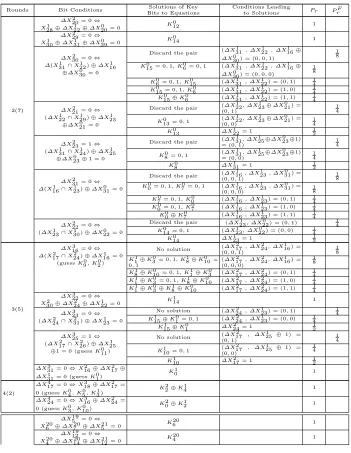
We put the 16 conditions which are independent of the secret key in Table 3, and the 28 conditions related to the secret key in the 2rd column of Table 4 in Appendix. The clue of our attack is to build the structures in the data collection phase to get 16 conditions independent of the secret key, and get 28 equations on key bits from the other 28 conditions, then find the possible solutions of these equations to reduce the key space searched. Table 4 gives solutions of the key bits in the 3rd column, the 4th column is the conditions for the equation
to have the solutions in 3rd column, and the Pr in the 5th column denotes
the probability that the equations hold, and PF
r means the probability that a
wrong bit condition occurs which results in the dissatisfaction of the differential path(we call it a failure event).
Table 3: Conditions of Differential of 21-round SIMON32 that are Independent of Subkeys
RoundsiNumber of Conditions
1 8 ∆X1[18] = 0, ∆X1[19] = 0, ∆X1[20] = 0, ∆X1[21] = 1, ∆X1[27] = 0,∆X1[28] = 0,∆X1[29] = 0,∆X1[30] = 0 20 8 ∆X20[3] = 0, ∆X20[4] = 0, ∆X20[5] = 0, ∆X20[6] = 0,
∆X20[10] = 0,∆X20[11] = 0,∆X20[12] = 0,∆X20[13] = 1
Table 4: Solutions of Subkey Bits Corresponding to Differential Path of 21-round SIMON32 Rounds Bit Conditions Bits to EquationsSolutions of Key Conditions Leadingto Solutions Pr P Fr
2(7)
∆X220 = 0⇔
X281 ⊕∆X221 ⊕∆X020 = 0 K
0
12 1
∆X229 = 0⇔
X301 ⊕∆X311 ⊕∆X029 = 0 K
0
14 1
∆X230 = 0⇔ ∆(X131∩X122 )⊕∆X116
⊕∆X30 = 00
Discard the pair (∆X 1
31 ,∆X22 ,1 ∆X116⊕
∆X30 ) = (00 ,0,1)
1 8
K015 = 0,1,K6 = 00 ,1 (∆X31 ,1 ∆X22 ,1 ∆X116⊕ ∆X30 ) = (00 ,0,0)
1 8
K6 = 00 ,1,K150 (∆X31 ,1 ∆X122 ) = (0,1) 1 4
K15 = 00 ,1,K06 (∆X31 ,1 ∆X122 ) = (1,0) 14
K150 ⊕K60 (∆X31 ,1 ∆X122 ) = (1,1) 14
∆X221 = 0⇔
(∆X122∩X129 )⊕∆X123 ⊕∆X21 = 00
Discard the pair (∆X22 ,1 ∆X231 ⊕∆X021 ) =
(0,1) 14
K13 = 00 ,1 (∆X 1
22 ,∆X231 ⊕∆X021 ) = (0,0) 14
K013 ∆X22 = 11 12 ∆X223 = 1⇔
(∆X131∩X124 )⊕∆X125 ⊕∆X230 ⊕1 = 0
Discard the pair (∆X31 ,1 ∆X251 ⊕∆X023⊕1) = (0,1)
1 4
K8 = 00 ,1 (∆X 1
31 ,∆X251 ⊕∆X023⊕1) = (0,0) 14
K80 ∆X31 = 11 12 ∆X231 = 0⇔
∆(X161 ∩X23 )1 ⊕∆X31 = 00
Discard the pair (∆X 1
16 ,∆X123 ,∆X31 ) =0
(0,0,1) 18
K0 = 00 ,1,K07 = 0,1 (∆X16 ,1 ∆X123 ,∆X31 ) =0
(0,0,0) 18
K07 = 0,1,K00 (∆X16 ,1 ∆X123 ) = (0,1) 14
K00 = 0,1,K70 (∆X16 ,1 ∆X123 ) = (1,0) 14
K00⊕K07 (∆X16 ,1 ∆X123 ) = (1,1) 14
∆X222 = 0⇔
(∆X231 ∩X30 )1 ⊕∆X22 = 00
Discard the pair (∆X123 ,∆X22 ) = (00 ,1) 14
K14 = 00 ,1 (∆X23 ,1 ∆X22 ) = (00 ,0) 1 4
K014 ∆X23 = 11 12
3(5)
∆X316 = 0⇔ ∆(X172 ∩X24 )2 ⊕∆X16 = 01
(guessK09 ,K02 )
No solution (∆X17 ,2 ∆X24 ,2 ∆X16 ) =1 (0,0,1)
1 8
K11⊕K3 = 00 ,1,K18⊕K010 =
0,1
(∆X17 ,2 ∆X24 ,2 ∆X16 ) =1
(0,0,0)
1 8
K81⊕K10 = 00 ,1,K11⊕K30 (∆X17 ,2 ∆X224 ) = (0,1) 14
K11⊕K3 = 00 ,1,K18⊕K010 (∆X17 ,2 ∆X224 ) = (1,0) 1 4
K11⊕K30⊕K18⊕K010 (∆X17 ,2 ∆X224 ) = (1,1) 14
∆X322 = 0⇔
X302 ⊕∆X242 ⊕∆X122 = 0 K
1
14 1
∆X323 = 0⇔
(∆X242 ∩X31 )2 ⊕∆X23 = 01
No solution (∆X24 ,2 ∆X123 ) = (0,1) 14
K151 ⊕K01 = 0,1 (∆X24 ,2 ∆X123 ) = (0,0) 14
K115⊕K10 ∆X24 = 12 12 ∆X325 = 1⇔
(∆X217∩X226 )⊕∆X125 ⊕1 = 0 (guessK011 )
No solution (∆X172 , ∆X251 ⊕ 1) = (0,1)
1 4
K10 = 01 ,1 (∆X 2
17 , ∆X251 ⊕ 1) = (0,0)
1 4
K110 ∆X17 = 12 12 ∆X31 = 03 ⇔X216⊕∆X172 ⊕
∆X31 = 0 (guess1 K1 )0
K01 1
4(2)
∆X17 = 04 ⇔X183 ⊕∆X17 =2
0 (guessK04 ,K5 ,0 K3 )1 K
2
2⊕K14 1
∆X24 = 04 ⇔X163 ⊕∆X24 =2
0 (guessK03 ,K10 )0
K02⊕K12 1
∆X519= 0⇔
X620⊕∆X207 ⊕∆X521= 0 K 20
6 1
∆X12 = 019 ⇔
X420⊕∆X2014⊕∆X12 = 021 K
20
4 1
∆X619= 0⇔ ∆(X207 ∩X2014 )⊕∆X820
⊕∆X621= 0
Discard the pair (∆X 20
7 ,∆X14 ,20 ∆X208 ⊕
∆X6 ) = (021 ,0,1)
1 8
K720= 0,1,K2014 = 0,1 (∆X 20
7 ,∆X14 ,20 ∆X208 ⊕
∆X6 ) = (021 ,0,0)
1 8
K14 = 020 ,1,K720 (∆X720,∆X14 ) = (020 ,1) 14
K207 = 0,1,K1420 (∆X720,∆X14 ) = (120 ,0) 14
K720⊕K2014 (∆X720,∆X14 ) = (120 ,1) 1 4
∆X15 = 119 ⇔
(∆X207 ∩X200 )⊕∆X120 ⊕∆X21
15⊕1 = 0
Discard the pair (∆X 20
7 ,∆X120⊕∆X1521⊕
1) = (0,1) 14
K200 = 0,1 (∆X 20
7 ,∆X120⊕∆X1521⊕ 1) = (0,0)
1 4
K200 ∆X720= 1 12
∆X13 = 019 ⇔
(∆X2014∩X205 )⊕∆X1520 ⊕∆X13 = 021
Discard the pair (∆X14 ,20 ∆X1520⊕∆X13 ) =21
(0,1) 14
K205 = 0,1 (∆X 20
14 ,∆X1520⊕∆X13 ) =21 (0,0) 14
K205 ∆X14 = 120 12
∆X719= 0⇔ ∆(X820∩X15 )20 ⊕∆X217 = 0
Discard the pair
(∆X820 ,∆X2015 ,∆X7 )21
= (0,0,1) 18
K820= 0,1,K2015 = 0,1 (∆X 20
8 ,∆X2015 ,∆X7 )21 = (0,0,0) 18
K15 = 020 ,1,K820 (∆X820,∆X15 ) = (020 ,1) 14
K208 = 0,1,K1520 (∆X820,∆X15 ) = (120 ,0) 14
K820⊕K2015 (∆X820,∆X15 ) = (120 ,1) 14
∆X14 = 019 ⇔
(∆X1520∩X6 )20 ⊕∆X2114 = 0
Discard the pair (∆X15 ,20 ∆X14 ) = (021 ,1) 1 4
K620= 0,1 (∆X15 ,20 ∆X14 ) = (021 ,0) 14
K206 ∆X15 = 120 12
18(5)
∆X818= 0⇔ ∆(X199 ∩X190 )⊕∆X820= 0]
(guessK1 ,20 K2010 )
No solution (∆X 19
9 ,∆X190 ,∆X8 ) =20
(0,0,1) 18
K019⊕K220 = 0,1, K199 ⊕ K11 = 020 ,1
(∆X919,∆X190 ,∆X8 ) =20
(0,0,0) 18
K019⊕K20
2 = 0,1,K919⊕K2011 (∆X919,∆X0 ) = (019 ,1) 14
K919⊕K11 = 020 ,1,K019⊕K202 (∆X919,∆X0 ) = (119 ,0) 1 4
K919⊕K1120⊕K019⊕K220 (∆X919,∆X0 ) = (119 ,1) 14
∆X718= 0⇔ X819⊕∆X199 ⊕∆X720= 0
(guessK209 )
K198 1
∆X181 = 1⇔(∆X919∩X2 )19 ⊕∆X20
1 ⊕1 = 0 (guessK203 )
No solution (∆X 19
9 , ∆X120 ⊕1) =
(0,1) 14
K192 = 0,1 (∆X 19
9 , ∆X120 ⊕1) = (0,0)
1 4
K192 ∆X919= 1 12
∆X14 = 018 ⇔
X619⊕∆X190 ⊕∆X14 = 020 K
19
6 1
∆X15 = 018 ⇔
(∆X019∩X7 )19 ⊕∆X2015 = 0
No solution (∆X019,∆X15 ) = (020 ,1) 1 4
K197 = 0,1 (∆X019,∆X15 ) = (020 ,0) 14
K197 ∆X019= 1 12
17(2)
∆X917= 0⇔ X1018⊕∆X919= 0 (guessK12 ,20 K2013 ,K11 )19
K1018⊕K1912 1
∆X017= 0⇔ X818⊕∆X019= 0 (guessK2 ,20 K2011 )
K818⊕K1910 1
In the 3rd column of Table 4, for example,K012 means that there are 1 solution to the corresponding equation, K06 = 0,1 means that 0 and 1 are all solutions to the corresponding equation.
3.2 Key-Recovey Attack on 21-round SIMON32
In this subsection, we describe a key recovery attack on 21-round SIMON32/64. Since there are 8 conditions in the input of the 2nd round, which are independent of the secret key, we make use of these conditions to construct structures, so as to reduce the time complexity of collecting plaintext-ciphertext pairs. In the process of key recovery attack, we use the above observations to reduce the guessed key space greatly.
1. There are 10 conditions on the plaintext differences, 8 conditions in the
in-put of the 2nd round. We divide the plaintexts into 218 structures with
232−18 = 214 plaintexts. By Observation 2, K0
j is independent of ∆Xj1, which does not impact the structure. According to the round function
defi-nition and conditions on Table 3, we build the following 8 equationsX1
j = (X(0j+1−n)%n+n∩X(0j+8)%n+n)⊕X(0j+2)%n+n⊕Xj0−n, wherej= 18,19,20,21, 27,28,29,30. Because there are 10 conditions on plaintexts, we fix 10 bits ofXi0(i= 16,18,19,25,26,27,28,1,8,10), and 8 bits ofXj1to be constants, and obtain each structure by solving the above equations system.
2. For structures A and A0 with 3 different bits (X190 , X10, X211), we find the corresponding ciphertexts, and save them into a table indexed by Xt21(t= 1,2,3,4,8,10,16,18) with ∆Xt21 = 0. There are about 214×2−8 = 220 re-maining pairs for each structure.
3. We build 217structures, and filter out the remaining pairs by decrypting one
round according to the conditions in Table 2. Then there are 217−1+20−10= 226 pairs left. Store the pairs in tableT.
In data collection phase, we need about 217+14= 231encryptions for the
cho-sen plaintexts, and about 217+20 = 237 one round computations to decide the
conditions which is equivalent to 233 encryptions. For the 231 collected plain-texts, we get about 217−1+28−14 = 230 pairs satisfying the input difference of the 13-round differential D1. Hence, there are about 230−28.56= 2.7 right pairs
occurred on average.
Filtering the Wrong Plaintext PairsBecause the conditions leading to nec-essary solutions in round 2 and 19 are independent of the secret key, for each pair in T, we first discard those wrong pairs which are not consistent with the conditions in rounds 2 and 19. For conditions (∆X2
30= 0,∆X212 = 0,∆X232 = 1).
we get the probability that all the three equations have solutions is 17
32 from
Ta-ble 4, In other words, the probability of no solution for the three equations is
PF r =
15
32 which is called failure event.
Applying similar method to conditions (∆X312 = 0,∆X222 = 0), (∆X619= 0,
∆X1519 = 1,∆X1319 = 0), (∆X719 = 0,∆X1419 = 1), we get the probabilities that
equations have solutions are 11
16, 17 32,
11
16 respectively. There are 2
26×(17 32)
2×
(11 16)
2≈223.1pairs remaining after discarding false pairs, which are stored inT 1
.
Computing Subkey Candidates By partial encryptions and decryptions, there are totally 50 bits of subkeys involved in the 28 conditions, of which 49 bits are independent according to key schedules(K20
1 can be deduced from the other
49-bit subkeys). Given a plaintext pair in T1, we obtain 28 equations of 49-bit
independent subkeys by partially encrypting the first 4 rounds, and decrypting the last 4 rounds. According to the specific bit-differences in the corresponding 21-round differential path, we compute all the solutions to the 28 equations, and every solution is a possible candidate for 49-bit subkeys. We collect all the solutions of corresponding 223.1 pairs, and the right subkey will occur with an
is dynamic. For the different pairs which result in the same differential path, we deduce the solutions of different subkeys. The subkeys solved are determined by specific differences in the differential path. To detect the correct key, we main-tain lots of counters of size 249, initialized with 0. Given a plaintext pair inT
1,
the computation details of 28 equations of 49-bit subkeys are as follows.
1. Choose a new pair in T1
2. There are 7 equations obtained by partially encrypting round 2 (see Table 4).
– For conditions (∆X2
30 = 0,∆X212 = 0,∆X232 = 1), we partially encrypt
round 2, and deduce that
∆(X311 ∩X221 )⊕∆X161 ⊕∆X300 = 0, (4) (∆X221 ∩X291 )⊕∆X231 ⊕∆X210 = 0, (5) (∆X311 ∩X
1
24)⊕∆X 1 25⊕∆X
0
23⊕1 = 0. (6)
Because the pairs which are inconsistent with conditions in round 2 and round 19 have been discarded corresponding to the specific path, so the failure event dose not occur.
From
X311 = (X 0 16∩X
0 23)⊕X
0 17⊕X
0 15⊕K
0 15, X221 = (X230 ∩X300 )⊕X240 ⊕X60⊕K60, X291 = (X300 ∩X210 )⊕X310 ⊕X130 ⊕K13,0
X241 = (X 0 25∩X
0 16)⊕X
0 26⊕X
0 8⊕K
0 8,
equations (4)-(6) should have solutions about subkey (K0
15, K60, K130 ,
K0
8) with the following cases depending on the values of (∆X221 ,∆X311 ,
∆X161 ⊕∆X300,∆X231 ⊕∆X210 ,∆X251 ⊕∆X230 ⊕1).
• (0,0,0,0,0): there are 16 solutions to the above the three equations.
• (0,1,∗,0,∗): there are 4 solutions to the three equations for each of 4 the cases.
• (1,0,∗,∗,0): there are 4 solutions to the three equations for each of 4 the cases.
• (1,1,∗,∗,∗): there are 2 solutions to the three equations for each of 8 the cases.
Clearly, we get in total 64 solutions for 17 cases, thus there are 6417 values of subkeys (K0
15,K60,K130 ,K80) for each pair in T1 on average.
– Similarly, solving the equations (∆X2
31 = 0, ∆X222 = 0), we get about 32
11 values of subkeys (K 0
0,K70,K140 ).
– For the equations (∆X2
20= 0, ∆X292 = 0), we get a solution of subkeys
(K0 12,K140 ).
In Step 2, by solving 7 equations and combining these obtained subkeys, we get 6417×32
11×2
−1values of subkeys (K0
0,K60,K70,K80,K120,K130 ,K140 ,
K0
3. For every subkey obtained in Step 2, by partially encrypting round 3, we get 5 equations. Guessing all subkeys (K0
9,K20,K110 ,K10), we use similar method
above to solve the 5 equations, and get about 2 values of subkeys (K0 3⊕K11,
K0
10⊕K81,K141,K10⊕K151 ,K101 ,K01) for each guess. By the end of this step,
we will get 6417×32 11×2
4values of subkeys involved in the first 3 rounds for
each pair inT1.
4. Under the above computed subkeys, we get 2 corresponding equations about
subkey bits depending on conditions of∆X4
17 = 0, ∆X244 = 0 with
proba-bility 1. We can get one value of subkey bit (K2
2⊕K41,K02⊕K21) for every
guessed subkey (K0
4,K50,K31,K30,K100 ). By the end of this step, we will get 64
17 × 32 11×2
9 values of subkey bits involved in first 4 rounds conditions for
every pairs inT1.
5. Applying the above similar method to the last 4 rounds, we also get 6417× 32
11×2
9 values of subkeys involved in the 4 rounds conditions for every pair
inT1.
6. Combining all the subkeys computed from Step 4 to Step 5, we deduce (6417)2×(32
11)
2×217 ≈223.9 solutions of the 49-bit subkeys for every chosen
pair inT1. Renew the corresponding counter by these solutions.
7. Go to Step 1 until no pairs in T1 left.
Complexity EvaluationLet Nr be the number of plaintext pairs in T1, Cs
be the number of solutions to subkey for every pair in T1, and Ckey be the
number of candidate subkeys obtained by Computing Subkey Candidates. Then
Ckey=Nr×Cs. It is obviously that the time complexity of Computing Subkey
Candidates (denoted asTcsc) is dominated by updating subkey counter in Step
6. Hence, the time complexity of Computing Subkey Candidates is estimated by the formula (4)
Tcsc =Ckey/(n×nr), (4)
where we assume that the counter updating is equivalent to n1 time-round
com-putations, andnris the attack rounds. Therefore, the complexity of Computing
Subkey Candidates is about Tcsc = Ckey/(n×nr) = (Nr ×Cs)/(n×nr) = 223.1×223.9≈238.6encryptions.
Since the expected count of the right key is 2.7, we choose the subkeys whose counts are greater than or equal to 3, and exhaustively search them by trail encryptions. We apply the Poisson distribution in as follows to compute the
number of the remaining subkeys. The probability that the event ξ occurs k
times is
Pr[ξ=k] = λ k
k! ×e
−λ,
whereλis the expectation ofξ.
Let|sk|be the number of independent subkeys in the extended rounds which is used to deduce the input and output differences for a pair to satisfy the differential path. Because a wrong subkey occurs with probability pe = 2C|sk|s ,
the expected count of a wrong subkey for all pairs in T1 is λe = Nr×pe =
223.1× 223.9
to be searched is
249(1−Pr[ξe= 0]−Pr[ξe= 1]−Pr[ξe= 2]) = 240.25.
So, we search 240.25 49-bit subkeys, and tranverse 15-bit subkey, which needs 255.25 encryptions. We denote the exhaustive search complexity asTes, and the total time complexity is obviously dominated by Tes.
Since the expected count of the right key is λr = 2.7, the probability that the right key count is greater than or equal to 4 is
1−Pr[ξr= 0]−Pr[ξr= 1]−Pr[ξr= 2] = 0.51.
Therefore, our attack on 21-round SIMON32/64 needs 255.25 encryptions
with 231chosen plaintexts, and the success probability is about 51%.
General Formula of Complexity Evaluation Let N be the pairs left in
the data collection which are used to sieve the right key, nc be the number of
conditions related to subkeys sk in the extended rounds for differential attack. It is easy to prove thatCkey = 2|sk|×N×2−nc without consideration of filtering the wrong plaintext pairs.
Hence, the time complexity of Computing Subkey Candidates is computed by formula (5).
Tcsc = 2|sk|×N×2−nc/(n×nr) (5)
The expected count of a wrong subkey for all remaining pairs in data collection is obtained by formula (6)
λe=N×2−nc (6)
3.3 Experimental Results of the Attack on 19-round SIMON32
In order to verify the correctness of our attacks, with the above 13-round dif-ferential mounted rounds 3-16, we first statistics the number of right pairs for all 232plaintexts with 100 random masterkeys respectively, there are about 4.95
right pairs satisfying a 13-round differential.
Furthermore, by prefixing 3 rounds on the top and appending 3 rounds at the bottom, we use the 13-round differentialD1to attack 19 rounds, and expiriment
a key recovery on 19-round SIMON32/64 with 231 chosen plaintexts. There are
totally 18 bits of subkey involved in 14 conditions of the extended differential
path. By using the above attack method, there are about 212×(17
32)
2 ≈210.17
pairs left for 231 chosen plaintexts after data collection and filtering, and there
are about 216possible subkeys, those whose count is greater than or equal to 3
is about:
218(1−Pr[ξe= 0]−Pr[ξe= 1]−Pr[ξe= 2]) = 29.25.
4
Differential Attack on Other SIMON versions
In this section, we describe the differential attacks on round-reduced SIMON48, SIMON64, SIMON96 and SIMON128 respectively.
4.1 Differential Attack on SIMON48
We utilize a 16-round differential D : (800000,220082) → (800000,220000) in
[20] with probability 2−44.65 to mount 23-round attack on SIMON48/72 by
adding 3 rounds on the top and 4 rounds at the bottom, and 24-round attack
on SIMON48/96 by adding one more round on the top.
Attack on 23-round SIMON48/72For the differential D, decrypt the first 3 rounds and encrypt the last 4 rounds. It is easy to obtain a set of sufficient bit conditions (see Table 6).
There are 11 conditions on plaintexts and 16 conditions not related subkey bits in rounds 1-2 (∆X2
40=∆X421 ⊕∆X400 = 1,∆X472 =∆X251 ⊕∆X470 = 0). We
build 226 structures, and filter out the chosen pairs according to the conditions independent of secret key, there are N = 226−1+33−16 = 242 pairs left. We get 226−1+42−21= 246pairs satisfying the input difference of the differential. Hence, the expected count of the right key isλr= 246−44.65≈2.6.
According to the key schedule, we find there are 64-bit independent subkey required to guess in order to conform the pathD, i.e, |sk|= 64. To distinguish
the correct key, we maintain a counter of size 264, which is the memory
com-plexity. There are nc = 44 bit conditions relating to the subkey bits in the 7
extended rounds. We apply the dynamic key-guessing method to compute the subkey candidates which may lead to the input and output differences of the
high probability differentialD for a pair, and update the corresponding subkey
counter. The time complexity of Computing Subkey Candidates is computed by equation (5) which equals to 264×242×2−44/(24×23) = 252.9encryptions. By equation (6), the expected count of a wrong subkey for all remain pairs in data collection is λe =N ×2−nc = 2−2. Since the expected count of the right key
λr= 2.6, we choose the subkeys whose count is greater than 2, and exhaustive-ly search them by trail encryption. Then, the number of the remaining subkeys which should be searched is 264(1−Pr[ξ
e= 0]−Pr[ξe= 1]−Pr[ξe= 2]) = 255.25. Therefore, the exhaustive search complexity is 28×255.25= 263.25encryptions,
which demonstrates the time complexity.
Since the expected count of the right key is λr = 2.6, the probability that the right key count is greater than or equal to 3 is 1−Pr[ξr = 0]−Pr[ξr =
1]−Pr[ξr = 2] = 0.48. Therefore, our attack on 23-round SIMON48/72 needs
263.25encryptions with 247chosen plaintexts, and the success probability is about 48%.
According to 12 conditions not related to any key bit in the input differences of plaintexts and the first three rounds, we divide the plaintexts into 212 sets.
Each set is a structure with 248−12= 236plaintexts. We build 211structures, and
get 211−1+72−36 = 246 pairs satisfying the input differences of the differential.
Hence, there are about 246−44.65 = 2.6 right pairs. It means that the expected
count of the right key isλr= 2.6.
We apply th method above, the time complexity of Computing Subkey Can-didates is computed by equation (5) which equals to 288×257×2−59/(24×24) =
276.8 encryptions. The expected count of a wrong subkey for all 247 chosen
plaintexts is still λe = 2−2. Therefore, the exhaustive search complexity is 28×288(1−Pr[ξe = 0]−Pr[ξe= 1]−Pr[ξe = 2]) = 287.25. Since the expected count of the right key is λr = 2.6, the success rate is also 0.48. Consequently,
our attacks on 24-round SIMON48/96 needs 287.25encryptions with 247 chosen
plaintexts, and the success probability is about 48%.
4.2 Differential Attacks on SIMON64/96/128
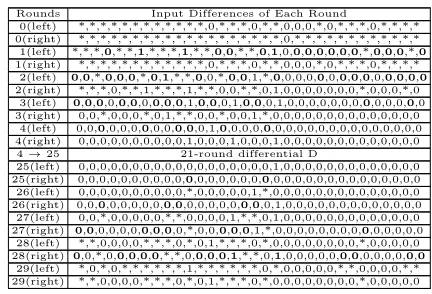
Here, we give a brief description of the differential attacks on SIMON64, SI-MON96 and SIMON128 with the similar method mentioned in the Section 3. Attack on SIMON64 VersionsWe invoke a 21-round differential with
prob-ability 2−60.21 in [20] to mount a 28-round attack on SIMON64/96 by adding
3 rounds on the top and 4 rounds at the bottom. We deduce 25 conditions on plaintexts, and 21 conditions in the first two rounds not relating to secret key, and 34 conditions relating to 69 bit equivalent subkeys (see Table 7).
We prefix one round on the top of the 28-round attack to launch the 29-round attack on SIMON64/128. There are 8 conditions on plaintexts, and 18 conditions in the first three rounds independent of secret key, and 54 conditions related to 101 bit equivalent subkeys (see Table 7).
Attack on SIMON96 VersionsApplying a 30-round differential with
prob-ability 2−92.2 in [1], we mount a 37-round attack on SIMON96 with 3 rounds
on the top and 4 rounds in the tail (see Table 8). There are 47 conditions on plaintexts, 25 conditions in the first two rounds not relating to secret key. For the 103-bit subkey from the 59 sufficient conditions, we show that the 103-bit subkey can be computed from a 88-bit subkey for SIMON96/96.
Attack on SIMON128 Versions From a 41-round differential with
proba-bility 2−124.6 in [1], we mount a 49-round attack on SIMON128/128 and
SI-MON128/192 by adding 4 rounds on the top and 4 rounds in the tail (see Table 9). There are 69 conditions on plaintexts, and 21 conditions in the first three rounds not relating to secret key bits. There are 168-bit subkeys involved in the 76 sufficient conditions. By key schedules, we know that 168-bits of subkey can be obtained from 164 bit subkeys for SIMON128/192, and obtained from 122 bit subkeys for SIMON128/128 respectively.
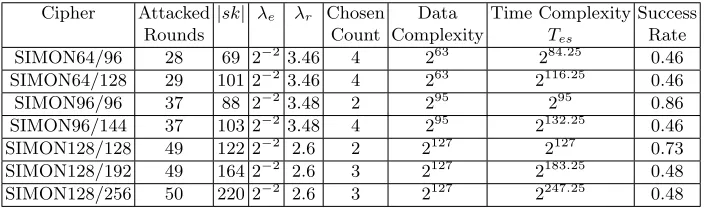
We choose plaintexts to construct structures using the similar techniques as described in Section 3, and apply the dynamic key-guessing method to compute the subkey candidates which lead to the input and output differences of the differential for a pair, and update the corresponding subkey counter. The time complexity is computed by equation (5). The time complexities and success rates are summarized in Table 5.
Table 5.Differential Attacks for Reduced SIMONs
Cipher Attacked|sk| λe λr Chosen Data Time Complexity Success
Rounds Count Complexity Tes Rate
SIMON64/96 28 69 2−2 3.46 4 263 284.25 0.46
SIMON64/128 29 101 2−2 3.46 4 263 2116.25 0.46
SIMON96/96 37 88 2−2 3.48 2 295 295 0.86
SIMON96/144 37 103 2−2 3.48 4 295 2132.25 0.46
SIMON128/128 49 122 2−2 2.6 2 2127 2127 0.73
SIMON128/192 49 164 2−2 2.6 3 2127 2183.25 0.48 SIMON128/256 50 220 2−2 2.6 3 2127 2247.25 0.48
5
Conclusion
In this paper, we present the improved differential attacks on SIMON32, SI-MON48, SIMON64, SIMON96, and SIMON128 with 2 to 4 more rounds than previous attacks. The main contribution of our work is to compute sufficient conditions to ensure the differential path hold, and obtain the corresponding subkey bits equations. Based on the equations, we reduce the key space searched greatly. Furthermore, we present a new method to build structures in data col-lection phase, and decrease the time complexity of sieving the collected pairs. Our technique can be applied to other lightweight block ciphers depending on the bitwise operations.
References
1. Abed, F., List, E., Lucks, S., b Wenzel: Differential Cryptanalysis of Round-Reduced SIMON and SPECK. In: FSE (2014)
2. AlKhzaimi, H., Lauridsen, M.M.: Cryptanalysis of the SIMON Family of Block Ciphers. IACR Cryptology ePrint Archive 2013, 543 (2013)
3. Beaulieu, R., Shors, D., Smith, J., Treatman-Clark, S., Weeks, B., Wingers, L.: The SIMON and SPECK Families of Lightweight Block Ciphers. IACR Cryptology ePrint Archive 2013, 404 (2013)
4. Biham, E., Biryukov, A., Shamir, A.: Cryptanalysis of Skipjack Reduced to 31 Rounds Using Impossible Differentials. pp. 12–23. Springer-Verlag (1999)
6. Biryukov, A., Roy, A., vesselin Velichkov: Differential Analysis of Block Ciphers SIMON and SPECK. In: FSE (2014)
7. Bogdanov, A., Knudsen, L., Leander, G., Paar, C., Poschmann, A., Robshaw, M., Seurin, Y., Vikkelsoe, C.: Present: An Ultra-Lightweight Block Cipher. Crypto-graphic Hardware and Embedded Systems-CHES 2007 pp. 450–466 (2007) 8. Borghoff, J., Canteaut, A., G¨uneysu, T., Kavun, E.B., Knezevic, M., Knudsen,
L.R., Leander, G., Nikov, V., Paar, C., Rechberger, C., Rombouts, P., Thomsen, S.S., Yal¸cin, T.: PRINCE - A Low-Latency Block Cipher for Pervasive Computing Applications - Extended Abstract. In: ASIACRYPT. pp. 208–225 (2012)
9. Canni`ere, C.D., Dunkelman, O., Knezevic, M.: KATAN and KTANTAN - A Family of Small and Efficient Hardware-Oriented block ciphers. In: CHES. pp. 272–288 (2009)
10. De Canni`ere, C., Rechberger, C.: Finding SHA-1 characteristics: General result-s and applicationresult-s. In: Lai, X., Chen, K. (edresult-s.) Advanceresult-s in Cryptology – ASI-ACRYPT 2006. Lecture Notes in Computer Science, vol. 4284, pp. 1–20. Springer (Dec 2006)
11. Guo, J., Peyrin, T., Poschmann, A., Robshaw, M.: The LED Block Cipher. In: Cryptographic Hardware and Embedded Systems–CHES 2011, pp. 326–341. Springer (2011)
12. Khn, U., Ag, D.B.: Improved Cryptanalysis of MISTY1. In: In: Fast Software En-cryption, 9th International Workshop, FSE 2002. Volume 2365 of LNCS., Springer-Verlag. pp. 61–75. Springer-Verlag (2002)
13. Knellwolf, S., Meier, W., Naya-Plasencia, M.: Conditional differential cryptanaly-sis of nlfsr-based cryptosystems. In: Abe, M. (ed.) ASIACRYPT. Lecture Notes in Computer Science, vol. 6477, pp. 130–145. Springer (2010), http://dblp. uni-trier.de/db/conf/asiacrypt/asiacrypt2010.html#KnellwolfMN10
14. Knudsen, L.: DEAL-a 128-bit Block Cipher. complexity 258(2) (1998)
15. Knudsen, L.R.: Truncated and Higher Order Differentials. In: Preneel, B. (ed.) Fast Software Encryption – FSE’94. Lecture Notes in Computer Science, vol. 1008, pp. 196–211. Springer (Dec 1994)
16. xuejia lai: Higher Order Derivatives and Differential Cryptanalysis. communica-tions and cryptography (1994)
17. Leurent, G.: Construction of differential characteristics in ARX designs application to skein. In: Canetti, R., Garay, J.A. (eds.) Advances in Cryptology - CRYPTO 2013 - 33rd Annual Cryptology Conference, Santa Barbara, CA, USA, August 18-22, 2013. Proceedings, Part I. Lecture Notes in Computer Science, vol. 8042, pp. 241–258. Springer (2013),http://dx.doi.org/10.1007/978-3-642-40041-4_14
18. Mendel, F., Nad, T., Schl¨affer, M.: Finding SHA-2 characteristics: Searching through a minefield of contradictions. In: Lee, D.H., Wang, X. (eds.) Advances in Cryptology – ASIACRYPT 2011. Lecture Notes in Computer Science, vol. 7073, pp. 288–307. Springer (Dec 2011)
19. Shirai, T., Shibutani, K., Akishita, T., Moriai, S., Iwata, T.: The 128-Bit Blockci-pher CLEFIA (Extended Abstract). In: FSE. pp. 181–195 (2007)
20. Siwei Sun, Lei Hu, M.W.P.W.K.Q.X.M.D.S.L.S.: Automatic enumeration of (related-key) differential and linear characteristics with predefined properties and its applications. Cryptology ePrint Archive, Report 2014/747 (2014), http: //eprint.iacr.org/
22. Theobald, T.: How to break Shamir’s asymmetric basis. In: Coppersmith, D. (ed.) Advances in Cryptology – CRYPTO’95. Lecture Notes in Computer Science, vol. 963, pp. 136–147. Springer (Aug 1995)
23. Wagner, D.: The Boomerang Attack. In: Knudsen, L.R. (ed.) Fast Software En-cryption – FSE’99. Lecture Notes in Computer Science, vol. 1636, pp. 156–170. Springer (Mar 1999)
24. Wang, X., Yin, Y.L., Yu, H.: Finding collisions in the full SHA-1. In: Shoup, V. (ed.) Advances in Cryptology – CRYPTO 2005. Lecture Notes in Computer Science, vol. 3621, pp. 17–36. Springer (Aug 2005)
A
Differential Conditions
Here, we list some differential conditions used in our cryptanalysis.
Table 6: Sufficient Conditions of Extended Differential Path of 23/24-round SIMON48 Rounds Input Differences of Each Round
0 0,*,*,*,*,*,*,0,*,*,*,*,*,*,*,*,*,*,*,*,*,*,*,*,*,*,*,*,*,*,*,*,*,*,*,*,*,*,*,*,*,*,*,*,*,*,*,* 1 *,0,0,*,*,0,*,*,0,0,*,0,*,*,*,0,*,*,1,*,*,*,1,*,0,*,*,*,*,*,*,0,*,*,*,*,*,*,*,*,*,*,*,*,*,*,*,* 2 0,*,0,0,1,*,0,0,*,0,0,0,0,0,*,*,0,0,*,0,1,*,*,0,*,0,0,*,*,0,*,*,0,0,*,0,*,*,*,0,*,*,1,*,*,*,1,* 3 0,0,1,0,0,0,1,0,0,0,0,0,0,0,0,0,1,0,0,0,0,0,1,0,0,*,0,0,1,*,0,0,*,0,0,0,0,0,*,*,0,0,*,0,1,*,*,0 4 1,0,0,0,0,0,0,0,0,0,0,0,0,0,0,0,0,0,0,0,0,0,0,0,0,0,1,0,0,0,1,0,0,0,0,0,0,0,0,0,1,0,0,0,0,0,1,0 4→20 16-round differential D
20 1,0,0,0,0,0,0,0,0,0,0,0,0,0,0,0,0,0,0,0,0,0,0,0,0,0,1,0,0,0,1,0,0,0,0,0,0,0,0,0,0,0,0,0,0,0,0,0
21 0,0,1,0,0,0,1,0,0,0,0,0,0,0,0,0,*,0,0,0,0,0,1,*,1,0,0,0,0,0,0,0,0,0,0,0,0,0,0,0,0,0,0,0,0,0,0,0 22 0,*,0,0,1,*,0,0,*,0,0,0,0,0,*,*,0,0,*,0,1,*,*,0,0,0,1,0,0,0,1,0,0,0,0,0,0,0,0,0,*,0,0,0,0,0,1,* 23 *,0,0,*,*,0,*,*,0,0,*,0,*,*,*,0,*,*,1,*,*,*,1,*,0,*,0,0,1,*,0,0,*,0,0,0,0,0,*,*,0,0,*,0,1,*,*,0
24 0,*,*,*,*,*,*,0,*,*,*,*,*,*,*,*,*,*,*,*,*,*,*,*,*,0,0,*,*,0,*,*,0,0,*,0,*,*,*,0,*,*,1,*,*,*,1,*
Table 7: Sufficient Conditions of Extended Differential Path of 28/29-round SIMON64 Rounds Input Differences of Each Round
0(left) *,*,*,*,*,*,*,*,*,*,*,*,0,*,*,*,0,*,*,0,0,0,*,0,*,*,*,0,*,*,*,* 0(right) *,*,*,*,*,*,*,*,*,*,*,*,*,*,*,*,*,*,*,0,*,*,*,*,*,*,*,*,*,*,*,* 1(left) *,*,*,0,*,*,1,*,*,*,1,*,*,0,0,*,*,0,1,0,0,0,0,0,0,0,*,0,0,0,*,0
1(right) *,*,*,*,*,*,*,*,*,*,*,*,0,*,*,*,0,*,*,0,0,0,*,0,*,*,*,0,*,*,*,* 2(left) 0,0,*,0,0,0,*,0,1,*,*,0,0,*,0,0,1,*,0,0,0,0,0,0,0,0,0,0,0,0,0,0
2(right) *,*,*,0,*,*,1,*,*,*,1,*,*,0,0,*,*,0,1,0,0,0,0,0,0,0,*,0,0,0,*,0 3(left) 0,0,0,0,0,0,0,0,0,0,1,0,0,0,1,0,0,0,1,0,0,0,0,0,0,0,0,0,0,0,0,0 3(right) 0,0,*,0,0,0,*,0,1,*,*,0,0,*,0,0,1,*,0,0,0,0,0,0,0,0,0,0,0,0,0,0
4(left) 0,0,0,0,0,0,0,0,0,0,0,0,1,0,0,0,0,0,0,0,0,0,0,0,0,0,0,0,0,0,0,0 4(right) 0,0,0,0,0,0,0,0,0,0,1,0,0,0,1,0,0,0,1,0,0,0,0,0,0,0,0,0,0,0,0,0 4→25 21-round differential D
25(left) 0,0,0,0,0,0,0,0,0,0,0,0,0,0,0,0,0,0,1,0,0,0,0,0,0,0,0,0,0,0,0,0 25(right) 0,0,0,0,0,0,0,0,0,0,0,0,0,0,0,0,0,0,0,0,0,0,0,0,0,0,0,0,0,0,0,0 26(left) 0,0,0,0,0,0,0,0,0,0,*,0,0,0,0,0,1,*,0,0,0,0,0,0,0,0,0,0,0,0,0,0 26(right) 0,0,0,0,0,0,0,0,0,0,0,0,0,0,0,0,0,0,1,0,0,0,0,0,0,0,0,0,0,0,0,0 27(left) 0,0,*,0,0,0,0,0,*,*,0,0,0,0,1,*,*,0,1,0,0,0,0,0,0,0,0,0,0,0,0,0 27(right) 0,0,0,0,0,0,0,0,0,0,*,0,0,0,0,0,1,*,0,0,0,0,0,0,0,0,0,0,0,0,0,0 28(left) *,*,0,0,0,0,*,*,*,0,*,0,1,*,*,*,0,*,0,0,0,0,0,0,0,0,*,0,0,0,0,0 28(right) 0,0,*,0,0,0,0,0,*,*,0,0,0,0,1,*,*,0,1,0,0,0,0,0,0,0,0,0,0,0,0,0
29(left) *,0,*,0,*,*,*,*,*,*,1,*,*,*,*,*,*,0,*,0,0,0,0,0,*,*,0,0,0,0,*,* 29(right) *,*,0,0,0,0,*,*,*,0,*,0,1,*,*,*,0,*,0,0,0,0,0,0,0,0,*,0,0,0,0,0
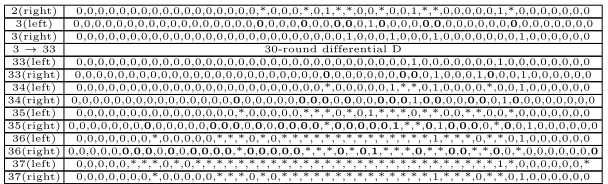
Table 8: Sufficient Conditions of Extended Differential Path of 37-round SIMON96 Rounds Input Differences of Each Round
0(left) 0,0,0,0,0,0,0,0,0,*,0,0,0,*,0,*,*,*,0,*,*,1,*,*,*,*,*,*,0,0,*,*,*,1,0,0,0,1,*,*,0,1,0,0,0,0,0,0 0(right) 0,*,0,0,0,*,0,*,*,*,0,*,*,*,*,*,*,*,*,*,*,*,*,*,*,*,*,0,*,*,*,*,*,*,0,1,*,*,*,0,*,0,0,0,0,0,0,0 1(left) 0,0,0,0,0,0,0,0,0,0,0,0,0,0,0,0,0,*,0,0,0,*,0,1,*,*,0,0,*,0,0,1,*,*,0,0,0,0,0,1,*,0,0,0,0,0,0,0 1(right) 0,0,0,0,0,0,0,0,0,*,0,0,0,*,0,*,*,*,0,*,*,1,*,*,*,*,*,*,0,0,*,*,*,1,0,0,0,1,*,*,0,1,0,0,0,0,0,0
2(right) 0,0,0,0,0,0,0,0,0,0,0,0,0,0,0,0,0,*,0,0,0,*,0,1,*,*,0,0,*,0,0,1,*,*,0,0,0,0,0,1,*,0,0,0,0,0,0,0 3(left) 0,0,0,0,0,0,0,0,0,0,0,0,0,0,0,0,0,0,0,0,0,0,0,0,0,0,0,1,0,0,0,0,0,0,0,0,0,0,0,0,0,0,0,0,0,0,0,0 3(right) 0,0,0,0,0,0,0,0,0,0,0,0,0,0,0,0,0,0,0,0,0,0,0,0,0,1,0,0,0,1,0,0,0,1,0,0,0,0,0,0,0,1,0,0,0,0,0,0 3→33 30-round differential D
33(left) 0,0,0,0,0,0,0,0,0,0,0,0,0,0,0,0,0,0,0,0,0,0,0,0,0,0,0,0,0,0,0,1,0,0,0,0,0,0,0,1,0,0,0,0,0,0,0,0 33(right) 0,0,0,0,0,0,0,0,0,0,0,0,0,0,0,0,0,0,0,0,0,0,0,0,0,0,0,0,0,0,0,0,0,1,0,0,0,1,0,0,0,1,0,0,0,0,0,0 34(left) 0,0,0,0,0,0,0,0,0,0,0,0,0,0,0,0,0,0,0,0,0,0,0,*,0,0,0,0,0,1,*,*,0,1,0,0,0,0,*,0,0,1,0,0,0,0,0,0 34(right) 0,0,0,0,0,0,0,0,0,0,0,0,0,0,0,0,0,0,0,0,0,0,0,0,0,0,0,0,0,0,0,1,0,0,0,0,0,0,0,1,0,0,0,0,0,0,0,0
35(left) 0,0,0,0,0,0,0,0,0,0,0,0,0,0,0,*,0,0,0,0,0,*,*,*,0,*,0,1,*,*,*,0,*,*,0,0,*,*,0,0,*,0,0,0,0,0,0,0 35(right) 0,0,0,0,0,0,0,0,0,0,0,0,0,0,0,0,0,0,0,0,0,0,0,*,0,0,0,0,0,1,*,*,0,1,0,0,0,0,*,0,0,1,0,0,0,0,0,0
36(left) 0,0,0,0,0,0,0,*,0,0,0,0,0,*,*,*,0,*,0,*,*,*,*,*,*,*,*,*,*,*,*,*,*,1,*,*,*,0,*,*,0,1,0,0,0,0,0,0 36(right) 0,0,0,0,0,0,0,0,0,0,0,0,0,0,0,*,0,0,0,0,0,*,*,*,0,*,0,1,*,*,*,0,*,*,0,0,*,*,0,0,*,0,0,0,0,0,0,0
37(left) 0,0,0,0,0,*,*,*,0,*,0,*,*,*,*,*,*,*,*,*,*,*,*,*,*,*,*,*,*,*,*,*,*,*,*,*,*,*,*,1,*,0,0,0,0,0,0,* 37(right) 0,0,0,0,0,0,0,*,0,0,0,0,0,*,*,*,0,*,0,*,*,*,*,*,*,*,*,*,*,*,*,*,*,1,*,*,*,0,*,*,0,1,0,0,0,0,0,0
Table 9: Sufficient Conditions of Extended Differential Path of 49/50-round SIMON128 Rounds Input Differences of Each Round
0(left) 0,0,0,0,0,0,0,0,0,0,0,0,0,0,0,0,0,0,0,0,0,0,0,0,0,*,0,0,0,*,0,*,*,*,0,*,*,*,*,*,*,*,*,*,*,*,*,*,*,*,*,0,*,*,*,0,*,0,0,0,0,0,0,0 0(right) 0,0,0,0,0,0,0,0,0,0,0,0,0,0,0,0,0,*,0,0,0,*,0,*,*,*,0,*,*,*,*,*,*,*,*,*,*,*,*,*,*,*,*,*,*,*,*,*,*,*,*,*,*,*,*,*,0,1,0,0,0,0,0,0 1(left) 0,0,0,0,0,0,0,0,0,0,0,0,0,0,0,0,0,0,0,0,0,0,0,0,0,0,0,0,0,0,0,0,0,*,0,0,0,*,0,*,*,*,0,*,*,1,*,*,*,1,*,*,0,0,*,*,0,1,0,0,0,0,0,0 1(right) 0,0,0,0,0,0,0,0,0,0,0,0,0,0,0,0,0,0,0,0,0,0,0,0,0,*,0,0,0,*,0,*,*,*,0,*,*,*,*,*,*,*,*,*,*,*,*,*,*,*,*,0,*,*,*,0,*,0,0,0,0,0,0,0
2(left) 0,0,0,0,0,0,0,0,0,0,0,0,0,0,0,0,0,0,0,0,0,0,0,0,0,0,0,0,0,0,0,0,0,0,0,0,0,0,0,0,0,*,0,0,0,*,0,1,*,*,0,0,*,0,0,1,*,0,0,0,0,0,0,0 2(right) 0,0,0,0,0,0,0,0,0,0,0,0,0,0,0,0,0,0,0,0,0,0,0,0,0,0,0,0,0,0,0,0,0,*,0,0,0,*,0,*,*,*,0,*,*,1,*,*,*,1,*,*,0,0,*,*,0,1,0,0,0,0,0,0
3(left) 0,0,0,0,0,0,0,0,0,0,0,0,0,0,0,0,0,0,0,0,0,0,0,0,0,0,0,0,0,0,0,0,0,0,0,0,0,0,0,0,0,0,0,0,0,0,0,0,0,1,0,0,0,1,0,0,0,1,0,0,0,0,0,0 3(right) 0,0,0,0,0,0,0,0,0,0,0,0,0,0,0,0,0,0,0,0,0,0,0,0,0,0,0,0,0,0,0,0,0,0,0,0,0,0,0,0,0,*,0,0,0,*,0,1,*,*,0,0,*,0,0,1,*,0,0,0,0,0,0,0
4(left) 0,0,0,0,0,0,0,0,0,0,0,0,0,0,0,0,0,0,0,0,0,0,0,0,0,0,0,0,0,0,0,0,0,0,0,0,0,0,0,0,0,0,0,0,0,0,0,0,0,0,0,1,0,0,0,0,0,0,0,0,0,0,0,0 4(right) 0,0,0,0,0,0,0,0,0,0,0,0,0,0,0,0,0,0,0,0,0,0,0,0,0,0,0,0,0,0,0,0,0,0,0,0,0,0,0,0,0,0,0,0,0,0,0,0,0,1,0,0,0,1,0,0,0,1,0,0,0,0,0,0 4→45 41-round differential D
45(left) 0,0,0,0,0,0,0,0,0,0,0,0,0,0,0,0,0,0,0,0,0,0,0,0,0,0,0,0,0,0,0,0,0,0,0,0,0,0,0,0,0,0,0,0,0,0,0,0,0,1,0,0,0,1,0,0,0,1,0,0,0,0,0,0 45(right) 0,0,0,0,0,0,0,0,0,0,0,0,0,0,0,0,0,0,0,0,0,0,0,0,0,0,0,0,0,0,0,0,0,0,0,0,0,0,0,0,0,0,0,0,0,0,0,0,0,0,0,1,0,0,0,0,0,0,0,0,0,0,0,0 46(left) 0,0,0,0,0,0,0,0,0,0,0,0,0,0,0,0,0,0,0,0,0,0,0,0,0,0,0,0,0,0,0,0,0,0,0,0,0,0,0,0,0,*,0,0,0,*,0,1,*,*,0,0,*,0,0,1,*,0,0,0,0,0,0,0 46(right) 0,0,0,0,0,0,0,0,0,0,0,0,0,0,0,0,0,0,0,0,0,0,0,0,0,0,0,0,0,0,0,0,0,0,0,0,0,0,0,0,0,0,0,0,0,0,0,0,0,1,0,0,0,1,0,0,0,1,0,0,0,0,0,0
47(left) 0,0,0,0,0,0,0,0,0,0,0,0,0,0,0,0,0,0,0,0,0,0,0,0,0,0,0,0,0,0,0,0,0,*,0,0,0,*,0,*,*,*,0,*,*,1,*,*,*,1,*,*,0,0,*,*,0,1,0,0,0,0,0,0 47(right) 0,0,0,0,0,0,0,0,0,0,0,0,0,0,0,0,0,0,0,0,0,0,0,0,0,0,0,0,0,0,0,0,0,0,0,0,0,0,0,0,0,*,0,0,0,*,0,1,*,*,0,0,*,0,0,1,*,0,0,0,0,0,0,0
48(left) 0,0,0,0,0,0,0,0,0,0,0,0,0,0,0,0,0,0,0,0,0,0,0,0,0,*,0,0,0,*,0,*,*,*,0,*,*,*,*,*,*,*,*,*,*,*,*,*,*,*,*,0,*,*,*,0,*,0,0,0,0,0,0,0 48(right) 0,0,0,0,0,0,0,0,0,0,0,0,0,0,0,0,0,0,0,0,0,0,0,0,0,0,0,0,0,0,0,0,0,*,0,0,0,*,0,*,*,*,0,*,*,1,*,*,*,1,*,*,0,0,*,*,0,1,0,0,0,0,0,0
49(left) 0,0,0,0,0,0,0,0,0,0,0,0,0,0,0,0,0,*,0,0,0,*,0,*,*,*,0,*,*,*,*,*,*,*,*,*,*,*,*,*,*,*,*,*,*,*,*,*,*,*,*,*,*,*,*,*,0,1,0,0,0,0,0,0 49(right) 0,0,0,0,0,0,0,0,0,0,0,0,0,0,0,0,0,0,0,0,0,0,0,0,0,*,0,0,0,*,0,*,*,*,0,*,*,*,*,*,*,*,*,*,*,*,*,*,*,*,*,0,*,*,*,0,*,0,0,0,0,0,0,0