ISSN(Online): 2319-8753 ISSN (Print): 2347-6710
I
nternational
J
ournal of
I
nnovative
R
esearch in
S
cience,
E
ngineering and
T
echnology
(A High Impact Factor, Monthly, Peer Reviewed Journal)
Visit: www.ijirset.com
Vol. 7, Issue 12, December 2018
Optimization of Milling Process Parameters
Using Taguchi Parameter Design Approach
P.Vijendran1, K. Sasank Kumar2, T. Venkata Divakara3
M.Tech Scholar, Dept. of MEC, MITS (UGC Autonomous), Madanapalle, AP, India1,2,3.
ABSTRACT: Manufacturing industries try to make high great products at decrease price to remain competitive within the market. The merchandise can be made the use of numerous production methods, including machining, etc. Milling is many of the most common machining processes used to make planar surfaces with faster material elimination and good floor first-rate. The vital objective of the technology of steel reducing is the solution of realistic issues associated with the green and particular removal of metal from work piece. It has been diagnosed that the dependable quantitative predictions of the numerous technological overall performance measures, preferably in the form of equations, are critical to broaden optimization techniques for deciding on slicing situations in procedure making plans. In this thesis experiments conducted to improve the floor end pleasant of aluminium alloy 6061 work piece by way of the use of carbide device, insert cutter, HSS and by using Taguchi’s approach including L9 orthogonal array. A series of experiments can be accomplished by means of various the milling parameters spindle speed, feed price and depth of reduce. The spindle speeds are 900rpm, 1100rpm and 1200rpm. The feed charges are 120mm/min, 210mm/min and 250 mm/min. Depth of cut is zero 0.5mm and 1.0mm and 1.5mm. Taguchi 294 P.Vijendranmethod is used to observe the impact of process parameters and establish correlation some of the reducing speed, feed and depth of reduce with recognize to the primary machinability component, surface end. Validations of the modelled equations are proved to be well within the settlement with the experimental statistics.
KEYWORDS: Machining, milling, Taguchi approach, aluminium alloy6061, spindle speed.
I. INTRODUCTION
II. LITERATUREREVIEW
ANIL CHOUBEY optimized “Optimization of gadget parameters of CNC Milling device for moderate metal using Taguchi layout and Single to Noise ratio Analysis” [1]. Balinder Singh minimized “Optimization of Input Process Parameters in CNC Milling Machine of EN24 Steel” [2]. N. Gopkrishna and M. Shiva Chander determined the surface roughness in the paper “Determining the Influence of Cutting Fluid on Surface Roughness during Machining of EN24 and EN8 steel by using CNC Milling Machine”. [3]. G., Krishna studied and investigated “Selection of Optimum Process Parameters in High Speed CNC End-Milling of Composite Materials Using Meta Heuristic Techniques –a Comparative Study Pare”. [4].B. Satish Kumar and N. Gopikrishna made an investigation in “optimization of turning process parameters, on EN 9 carbon steel using grey relational analysis”. [5]. G. Petropoulos, Ntziantzias, C. Anghel, made observations in “A predictive model of slicing forces in milling the usage of Taguchi & response floor strategies” [6]. C. Tsao, in his paper, “Grey–Taguchi technique to optimize the milling parameters of aluminum alloy”, studied parameters. [7].
III.METHODOLOGY Taguchi Method
ISSN(Online): 2319-8753 ISSN (Print): 2347-6710
I
nternational
J
ournal of
I
nnovative
R
esearch in
S
cience,
E
ngineering and
T
echnology
(A High Impact Factor, Monthly, Peer Reviewed Journal)
Visit: www.ijirset.com
Vol. 7, Issue 12, December 2018
Input parameters and their levels
Table 1: Process parameters.
PROCESS PARAMETERS LEVEL 1 LEVEL 2 LEVEL 3
Cutting speed (rpm) 900 1100 1200
Feed rate (mm/rev) 120 210 250
Depth of cut (mm) 0.5 1.0 1.5
IV.EXPERIMENTALINVESTIGATION
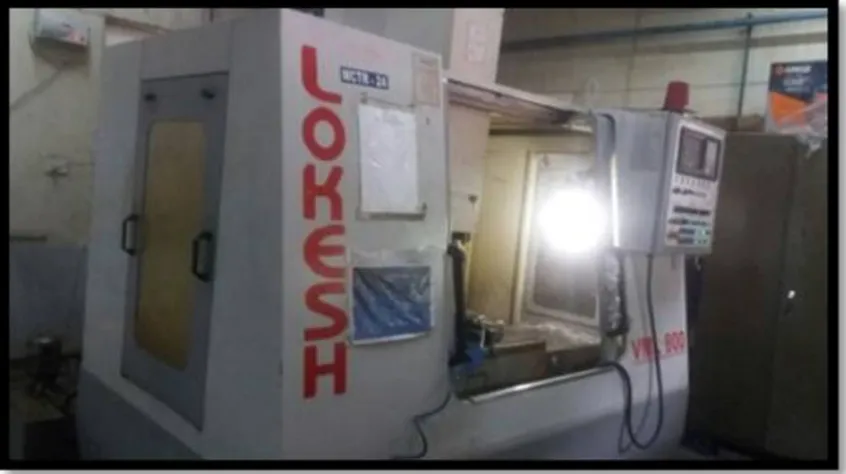
THE EXPERIMENTS ARE DONE ON THE CNC MILLING MACHINE WITH THE FOLLOWING PARAMETERS:
CUTTINGTOOLMATERIAL–CEMENTED CARBIDE TOOL,HSS AND INSERT CUTTER
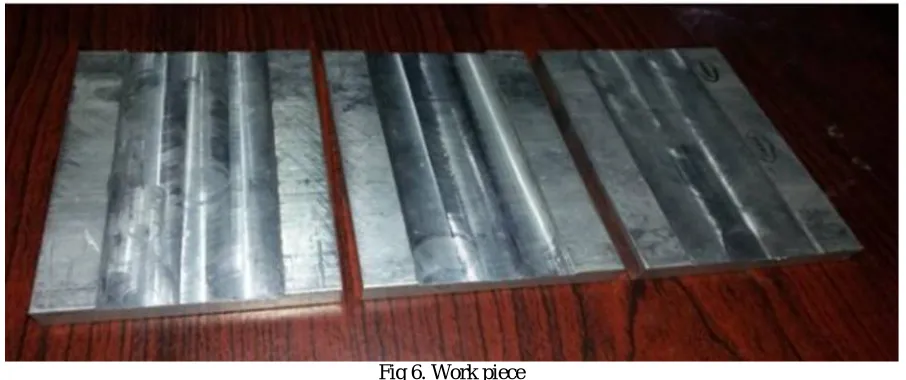
WORKPIECEMATERIAL– ALUMINIUM 6061
FEED–120MM/MIN,210MM/MIN,250MM/MIN
CUTTINGSPEED–900RPM,1100RPM,1200RPM,
DEPTHOFCUT–0.5MM,1.0MM,1.5MM
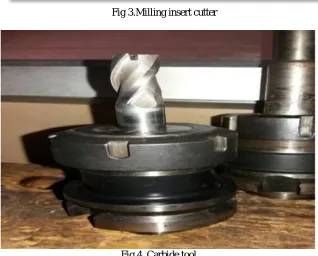
Fig 3.Milling insert cutter
Fig 4. Carbide tool
ISSN(Online): 2319-8753 ISSN (Print): 2347-6710
I
nternational
J
ournal of
I
nnovative
R
esearch in
S
cience,
E
ngineering and
T
echnology
(A High Impact Factor, Monthly, Peer Reviewed Journal)
Visit: www.ijirset.com
Vol. 7, Issue 12, December 2018
Fig 5. HSS tool
Fig 6. Work piece
VI.DESIGNOFEXPERIMENTS(DOE)
For selected input parameters experiments are designed using Taguchi L9 orthogonal standard array. For this purpose software Minitab 17 is used
Taguchi Design
Taguchi Orthogonal Array Design
L9 (3^3)
JOB NO SPINDLE SPEED(RPM)
FEED RATE(mm/min)
DEPTH OF CUT(mm)
1 900 120 0.5
2 900 210 1.0
3 900 250 1.5
4 1100 120 0.5
5 1100 210 1.0
6 1100 250 1.5
7 1200 120 0.5
8 1200 210 1.0
9 1200 250 1.5
Table 2: Experiment Process Parameters
VII. EXPERIMENTATION
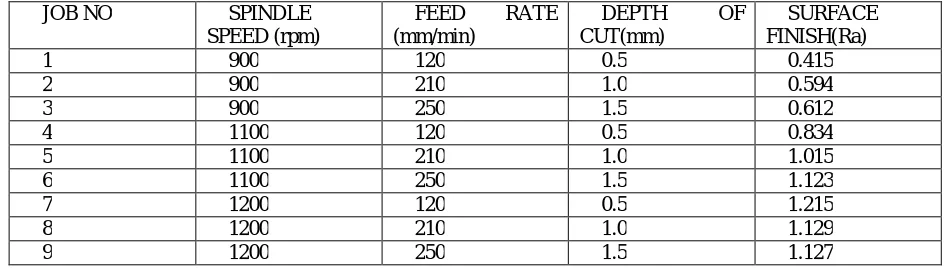
After design of experiment, 9 experiments are carried out in CNC vertical Face milling. After each experiment surface roughness is calculated. A quality characteristic for surface roughness is “larger is the better”.
JOB NO SPINDLE
SPEED (rpm)
FEED RATE (mm/min)
DEPTH OF CUT(mm)
SURFACE FINISH(Ra)
1 900 120 0.5 0.514
2 900 210 1.0 0.623
3 900 250 1.5 0.691
4 1100 120 0.5 0.912
5 1100 210 1.0 1.114
6 1100 250 1.5 1.253
7 1200 120 0.5 1.632
8 1200 210 1.0 1.412
9 1200 250 1.5 1.351
Table 3: Surface Finish for cemented carbide tool
JOB NO SPINDLE
SPEED (rpm)
FEED RATE (mm/min)
DEPTH OF CUT(mm)
SURFACE FINISH(Ra)
1 900 120 0.5 0.415
2 900 210 1.0 0.594
3 900 250 1.5 0.612
4 1100 120 0.5 0.834
5 1100 210 1.0 1.015
6 1100 250 1.5 1.123
7 1200 120 0.5 1.215
8 1200 210 1.0 1.129
9 1200 250 1.5 1.127
ISSN(Online): 2319-8753 ISSN (Print): 2347-6710
I
nternational
J
ournal of
I
nnovative
R
esearch in
S
cience,
E
ngineering and
T
echnology
(A High Impact Factor, Monthly, Peer Reviewed Journal)
Visit: www.ijirset.com
Vol. 7, Issue 12, December 2018
JOB NO SPINDLE
SPEED (rpm)
FEED RATE (mm/min)
DEPTH OF CUT(mm)
SURFACE FINISH(Ra)
1 900 120 0.5 0.346
2 900 210 1.0 0.456
3 900 250 1.5 0.594
4 1100 120 0.5 0.731
5 1100 210 1.0 0.912
6 1100 250 1.5 1.005
7 1200 120 0.5 1.116
8 1200 210 1.0 1.015
9 1200 250 1.5 1.112
Table 5: Surface Finish for high speed steel
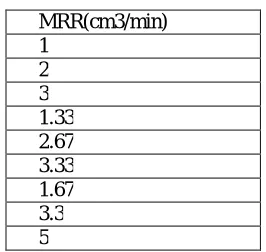
VOLUME REMOVED /C.T = L*W*T/C.T = E*T*FM
WHERE,
W= WIDTH OF CUT (MM),
T= DEPTH OF CUT (MM)
FM=FEED RATE (MM/MIN)
MRR(cm3/min) 1
2 3 1.33 2.67 3.33 1.67 3.3 5
VIII. RESULTS &DISCUSSION
TABLE 7:RESULTS TABLE OF SURFACE FINISH FOR CARBIDE
Taguchi Analysis: SURFACE FINISH versus speed, feed, depth of Response Table for Signal to Noise Ratios Smaller is better Response Table for Means
LEVEL SPEED FEED DEPTH
OF CUT
LEVEL SPEED FEED DEPTH OF
CUT
1 4.36714 0.77548 0.27501 1 0.6093 1.0193 1.0597
2 -0.69887 0.05861 0.76575 2 1.0930 1.0497 0.9620
3 -3.28807 -0.45390 -0.66056 3 1.4650 1.0983 1.1457
DELTA 7.65521 1.22938 1.42630 DELTA 0.8557 0.0790 0.1837
RANK 1 3 2 RANK 1 3 2
ISSN(Online): 2319-8753 ISSN (Print): 2347-6710
I
nternational
J
ournal of
I
nnovative
R
esearch in
S
cience,
E
ngineering and
T
echnology
(A High Impact Factor, Monthly, Peer Reviewed Journal)
Visit: www.ijirset.com
Vol. 7, Issue 12, December 2018
IX.CONCLUSION
In this thesis an attempt to utilize Taguchi optimization approach to optimize slicing parameters during excessive pace milling of aluminum alloy using cemented carbide reducing device. The slicing parameters are cutting velocity, feed charge and intensity of reduce for milling of labor piece aluminum alloy6061. In this paintings, the most efficient parameters of reducing pace are 900 rpm, 1100rIXpm and 1200rpm, feed charge are 120mm/min, 210mm/min and 250mm/min and intensity of cut are 0.5mm, 1.0mm and 1.5 mm. Experimental paintings is carried out by way of thinking about the above parameters. Cutting forces, surface end and slicing temperatures are established experimentally. Milling experiments could be performed to enhance the surface finish pleasant of aluminum alloy paintings piece through the usage of carbide ,insert cutter, HSS and with the aid of the usage of Taguchi’s method which include L9 orthogonal array. By observing the experimental effects via taguchi, the following conclusions was made: After completing the project it can be observed that optimal value of surface finish is obtained at third level of Spindle Speed and it was 1200rpm, third level of Feed Rate and it was 250mm/min and third level of Depth of Cut and it was1.5mm.After completing the project it can be observed that optimal value of material removal is obtained at third level of Spindle Speed and it was 1200rpm, second level of Feed Rate and it was 210mm/min and second level of Depth of Cut and it was1.0mm.
REFERENCES
1. M. Thakur and B. Singh, “Simulink Modal of Triple-Junction Solar Cell and MPPT Based on Incremental Conductance Algorithm for PV System,”vol. 5, no. 9, pp. 92–95, 2015.
2. V. K. P. K, C. A. Asha, and M. K. Sreenivasan, “design , simulation and hardware implementation of efficient solar power converter with high mpp tracking accuracy for dc microgrid applications,” pp. 380–387, 2014.
3. K. Supreeth, K. S. Sundar, and D. Balamurugan, “Performance Evaluation & Simulation of Solar Power System,” vol. 2, no. 7, 2014. 4. J. Park, H. Kim, Y. Cho, and C. Shin, “Simple Modeling and Simulation of Photovoltaic Panels Using Matlab / Simulink Modeling of
Photovoltaic Module,” vol. 73, no. Fgcn, pp. 147–155, 2014.
5. Shukla, M. Khare, and K. N. Shukla, “Modeling and Simulation of Solar PV Module on MATLAB / Simulink,” pp. 18516–18527, 2015. 6. E. G. S, P. S. Dhivya, and T. Sivaprakasam, “Solar Powered High Efficient Dual Buck Converter for Battery Charging,” pp. 448–452,2013. 7. J. Patel and G. Sharma, “modeling and simulation of solar photovoltaic module using matlab / simulink,” pp. 225–228, 2013.
8. S. S. Mohammed-, “Modeling and Simulation of Photovoltaic module using MATLAB / Simulink,” vol. 2, no. 5, 2011.
9. Nalbant, M., Gökkaya, H., Sur, G. "Application of Taguchi method in the optimization of cutting parameters for surface roughness in turning."Materials & Design. 28(4), pp. 1379-1385. 2007.DOI: 10.1016/j.matdes.2006.01.008.
10. Verma, N. K., Sikarwar, A. S. "Optimizing Turning Process by TaguchiMethod under Various Machining Parameters." International ResearchJournal of Engineering and Technology. 2(6), pp. 307-312. 2015.
11. Hasçahk, A., Çaydas, U. "Optimization of turning parameters for surfaceroughness and tool life based on the Taguchi method." InternationalJournal of Advanced Manufacturing Technology. 38(9), pp. 896-903.2008. DOI: 10.1007/s00170-007-1147-0
12. Kivak, T. "Optimization of surface roughness and flank wear using theTaguchi method in milling of Hadfield steel with PVD and CVD coatedinserts." Measurement. 50, pp. 19-28. 2014.DOI: 10.1016/j.measurement.2013.12.017
13. Zhang, J. Z., Chen, J. C., Kirby, E. D. "Surface roughness optimizationin an end-milling operation using the Taguchi design method." Journalof Materials Processing Technology. 184(1-3), pp. 233-239. 2007.