ISSN(Online): 2320-9801
ISSN (Print): 2320-9798
I
nternational
J
ournal of
I
nnovative
R
esearch in
C
omputer
and
C
ommunication
E
ngineering
(An ISO 3297: 2007 Certified Organization)
Vol. 4, Issue 1, January 2016
Face Authentication Using Efficient Deep
Convolutional Neural Network
Hayder M. Albehadili, Naz Islam
Dept. of Electrical and Computer Eng. University of Missouri-Columbia, MO 65203
ABSTRACT: Recently face recognition, face verification becomes an interest scope of many researchers because they have been widely used in variety of real world applications. This work presents different strategies of constructing robust systems for face verification. An efficient deep Convolutional Neural network (CNN) is proposed to be used for face authentication. Although various methods are used to accomplish face verification, in this work, CNN is used instead because it has several merits over existing approaches. Exploring more robust CNN structures that can highly influence model accuracy is demonstrated in this work also. Although face authentication has received vast interest recently, there are very few works achieved using deep convolutional neural network. Thus, in this work, a robust model and efficient deep learning model is proposed to significantly enhance classification performance over existing works. The proposed models are evaluated using Labeled Faces in the Wild (LWF) dataset
KEYWORDS: Face recognition; convolutional neural network; Siamese Network; LFW; efficient deep learning
I. INTRODUCTION
Recently, face recognition significantly becomes a vital research scope and there are several extensive works devoted to leverage and advance face recognition techniques [1, 2, 3, 4]. Also recent works from Google [5] and from Facebook [6] were presented. Valuable interest for this problem gains from wide range of problems needed to be manipulated. In addition, there is large number of real world applications using face recognition. One of the more valuable uses of face recognition is security applications whether using face recognition or identification. Face recognition can occur in one of two categories either face recognition or face authentication which is also called face identification. It is worth mentioning that face identification is comparison one to one. Means, given two images, the systems needs to tell whether the two images are identical or not whereas a face recognition is comparison one to all. Means, given an identity, the system needs to tell whether the input the identity is available within the dataset or not. In this work, both face authentication and recognition are presented.
Convolutional Neural Network (CNN) has been widely used in variety of applications. It achieves state-of-the-art for many challenge benchmarks. One of the most challenges that CNN achieves state-of-the-art is the ImageNet Large Scale Visual Recognition Challenge (ILSVRC) [7]. In addition, it is used for image recognition [8, 9, 10, 11], object detection [12, 13], image segmentation [14], and many other tasks.
In this work, CNN is used for challenge tasks represented by face recognition. The task is challenge and extensive research has been conducted to both tasks as it will be shown later. A robust CNN is proposed in this work to enhance existing state-of-the-art result. We propose novel CNN architecture for face authentications. Extensive experiments are conducted to evaluate proposed methods to show the robustness of our proposed approach. The work is compared to the most contemporary work and we show that we achieve superior results comparing to most recent works.
II. RELATED WORK
ISSN(Online): 2320-9801
ISSN (Print): 2320-9798
I
nternational
J
ournal of
I
nnovative
R
esearch in
C
omputer
and
C
ommunication
E
ngineering
(An ISO 3297: 2007 Certified Organization)
Vol. 4, Issue 1, January 2016
III.SIAMESE NETWORK
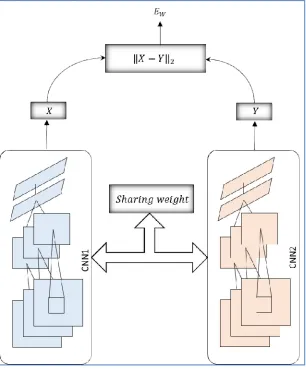
In this work, the same principle working of Siamese network for the face identification problem is recruited. However, different CNN architecture is used. To this end and before starting with the new architecture, it is worth to demonstrate how Siamese network works. It is originally used for signature verification but then it was adapted for face identification or verification. Siamese network is designed to receive pair of input face images and verify whether belong to the same person or not. Verifying identity is accomplished by non-linear similarity matric which is train by given pairs of positives and negative images to the Siamese network. Images belong to the same identity have small distance whereas images belong to different identity have large distance. Fig. 1 depicts the general sketch of Siamese network.
Thus, more robust CNN architectures used for face verification are explored in this work. By considering X and X
are the first and second images respectively, CNN architecture is trained to reduce the distance between the two images when the two images belong to the same identity and enlarge the distance if they are not belong to the same person. It is also worth mentioning that the two CNN appearing in fig. 1 are identical. Originally only one network is trained because they share weights parameters implicitly.
ISSN(Online): 2320-9801
ISSN (Print): 2320-9798
I
nternational
J
ournal of
I
nnovative
R
esearch in
C
omputer
and
C
ommunication
E
ngineering
(An ISO 3297: 2007 Certified Organization)
Vol. 4, Issue 1, January 2016
function demonstrated in [16] is used in this work as loss function on the top of CNN structure. Contrastive loss function works by enforcing similar patterns close to each other and different patterns far from each other [16].
IV.CONTRIBUTIONS
Robust CNN structures are used for face identification in this chapter. Face authentication is non-trivial tasks. Accordingly, more robust models used for face verification are extensively explored. Furthermore, new proposed model is presented at the end of this work. In addition, the proposed model is trained from scratch and also trained using pre-models. The last are the models implemented for gender classification used in this chapter. Thus we also provide study of whether training systems with the pre-trained models can influence system performance or not. The final proposed model achieves solid competitive results to the current state-of-the-art. Accomplished results are compared to the most recent contemporary works presented by deep CNN. Proposed model is evaluated on challenge Labeled Faces in the Wild (LFW) dataset.
V. PIPELINE STEPS OF DESIGNING VERIFICATION MODEL
There are different methods used for implementing face verification problem using deep CNN. However, in this work, we use the same principle of operation Siamese network but a new CNN architecture for face authentication is presented. The following procedures describe how face verification generally works:
The general structure of face verification used in this work is described in fig. 2.
Prepare input images as a pair of input face images. Each pair images are either similar or dissimilar. Means the input pair images either related to same identifiers or not.
Crop the input images to fit to the input size of CNN. In this work, we choose input face to be 128x128 pixels.
Advance the input pair images to the CNN structures. As shown in fig. 2, one of those images forwarded to the network A and the second one advanced to the network B.
Forward images in both networks and update weights according to the image passing through it. It worth mentioning that both networks share the weights. Hence both the network will be updated according to the both images. It is noticeable from fig. 2 that there are connections between the two networks meaning that they share weights.
ConstrastiveLoss is the last layer used to connect the two networks and it is a method proposed in [16]. This function attempts making two input patterns close to each other if they belong to the same identify and far from each other if they belong to different identities. Means, the distance between similar input patterns is small if they are belong to the same person. Whereas the distance is higher if the two input face images are not the same person.
ISSN(Online): 2320-9801
ISSN (Print): 2320-9798
I
nternational
J
ournal of
I
nnovative
R
esearch in
C
omputer
and
C
ommunication
E
ngineering
(An ISO 3297: 2007 Certified Organization)
ISSN(Online): 2320-9801
ISSN (Print): 2320-9798
I
nternational
J
ournal of
I
nnovative
R
esearch in
C
omputer
and
C
ommunication
E
ngineering
(An ISO 3297: 2007 Certified Organization)
Vol. 4, Issue 1, January 2016
VI.EXPERIMENTAL SETUP
ISSN(Online): 2320-9801
ISSN (Print): 2320-9798
I
nternational
J
ournal of
I
nnovative
R
esearch in
C
omputer
and
C
ommunication
E
ngineering
(An ISO 3297: 2007 Certified Organization)
Vol. 4, Issue 1, January 2016
Fig. 3. Sample of LFW dataset
VII. CONCLUSION
In this work, face verification is presented. Different deep models are presented for the task is proposed. Specifically, Extensive experiments are conducted on challenge benchmark. We showed that different network architectures can lead to different model performance. Siamese network is used for face verification but a robust CNN is demonstrated. The presented CNN model is evaluated using challenge LFW dataset. Competitive results are achieved comparing with recent works. Superior results are achieved on Adience dataset comparing with all works accomplished on the same dataset
REFERENCES
1. J. Sivic, M. Everingham, and A. Zisserman. Person spotting: Video shot retrieval for face sets. In Proc. CIVR, 2005.
2. J. Sivic, M. Everingham, and A. Zisserman. “Who are you?” – learning person specific classifiers from video. In Proc. CVPR, 2009. 3. C. Lu and X. Tang. Surpassing human-level face verification performance on lfw with gaussianface. AAAI, 2015.
4. M. Everingham, J. Sivic, and A. Zisserman. Taking the bite out of automatic naming of charactersin TV video. Image and Vision Computing, 27(5), 2009.
5. Florian Schroff, Dmitry Kalenichenko, James Philbin “FaceNet: A Unified Embedding for Face Recognition and Clustering” arXiv:1503.03832v3 [cs.CV] 17 Jun 2015
6. Yaniv Taigman, Ming Yang, Marc’Aurelio Ranzato, and Lior Wolf “DeepFace: Closing the Gap to Human-Level Performance in Face Verification” CVPR 2014.
7. Krizhevsky, Alex, Sutskever, Ilya, and Hinton, Geoffrey. ImageNet classification with deep convolutional neural networks. In Advances in Neural Information Processing Systems 25 (NIPS’2012). 2012.
8. Wanli Ouyang, Xiaogang Wang, Xingyu Zeng, Shi Qiu, Ping Luo, Yonglong Tian, Hongsheng Li, Shuo Yang, Zhe Wang, Chen-Change Loy, Xiaoou Tang “DeepID-Net: Deformable Deep Convolutional Neural Networks for Object Detection” CVPR 2015
9. Ross Girshick Forrest Iandola Trevor Darrell, Jitendra Malik, “Deformable Part Models are Convolutional Neural Networks” arXiv:1409.5403v2 [cs.CV] 1 Oct 2014.
10. Paul Viola and Michael Jones “Rapid Object Detection using a Boosted Cascade of Simple Features” COMPUTER VISION AND PATTERN RECOGNITION 2001.
11. Yuting Zhang , Kihyuk Sohn , Ruben Villegas, Gang Pan , Honglak Lee, “Improving Object Detection with Deep Convolutional Networks via Bayesian Optimization and Structured Prediction”, arXiv:1504.03293v1 [cs.CV] 13 Apr 2015.
12. Girshick, Ross and Donahue, Jeff and Darrell, Trevor and Malik, Jitendra,Rich feature hierarchies for accurate object detection and semantic segmentation”, Computer Vision and Pattern Recognition,2014