Ab initio study of intrinsic proles of liquid metals and
their reectivity.
B. G. del Rio1;, J. Souto2, M. M. G. Alemany2, and L. E. González1
1Departamento de Física Teórica, Universidad de Valladolid, Valladolid, Spain
2Departamento de Física de Partículas, Universidad de Santiago de Compostela, Spain
Abstract. The free surfaces of liquid metals are known to exhibit a stratied prole that, in favourable cases, shows up in experiments as a peak in the ratio between the reectivity function and that of an ideal step-like prole. This peak is located at a wave-vector related to the distance between the layers of the prole. In fact the surface roughness produced by thermally induced capillary waves causes a depletion of the previous so called intrinsic reectivity by a damping factor that may hinder the observation of the peak. The behaviour of the intrinsic reectivity belowthe layering peak is however far from being universal, with systems as Ga or In where the reectiviy falls uniformly towards the q ! 0 value, others like Sn or Bi where a shoulder appears at inter-mediate wavevectors, and others like Hg which show a minimum. We have performed extensive ab initio simulations of the free liquid surfaces of Bi, Pb and Hg, that yield direct information on the structure of the proles and found that the macroscopic capillary wave theory usually employed in order to remove the capillary wave components fails badly in some cases for the typical sample sizes aordable in ab initio simu-lations. However, a microscopic method for the determination of the intrinsic prole is shown to be succesful in obtaining meaningful intrin-sic proles and corresponding reectivities which reproduce correctly the qualitative behaviour observed experimentally.
1 Introduction.
Since the original prediction of Rice and coworkers that free liquid surfaces (FLS) of metals would exhibit surface layering in the density prole (DP)perpendicular to the interface [1], (z), almost a decade had to ellapse until this expectation was realized experimentally for the case of liquid Hg [2, 3], through the analysis of the x-ray reectivity of the FLS, R(qz), which showed a peak related to the layering. Since then, up to 2009 [4], measurements have been performed for other ve pure liquid metals, namely Ga, In, K, Sn and Bi [5]. All these studies were possible due to the advent of x-ray sources intense enough and reectometers precise enough to measure reectivities that decay by as much as 9/10 orders of magnitude as the wavevector increases above the position of the reectivity peak. The experimental
requirements to make such experiments feasible, as discussed in [5], basically limit the set of pure liquid metals candidates to these studies to those already mentioned, plus liquid Pb and possibly liquid Ge. A particular source of complications due to the liquid nature of the samples is the presence of thermally induced capillary waves (CW) which blur the so-called intrinsic prole, int(z), leading to an average prole, av(z), and deplete even more the measured reectivity, Rm(qz). The eects of CW are removed from Rm(qz) through the use of the macroscopic CW theory, that boils down to a division of Rm(qz) by a gaussian, Debye-Waller-like, factor that depends on a capillary roughness, cw, leading to the intrinsic reectivity, Rint(qz). In most cases, this is further divided by the Fresnel reectivity, RF(qz), that corresponds to a sharp at surface and accounts for the overall decay of Rint(qz). The resulting magnitude is called the surface structure factor, jint(qz)j2, which is directly related to the Fourier Transform of the electronic DP. Note that the capillary roughness depends on the temperature, T , and the surface tension, , of the liquid, on the atomic size, and on the lateral resolution of the detector.
The systems studied can be classied in three groups so far: those whose jint(qz)j2 decays monotonously from the layering peak towards qz ! 0 (Ga, In and K), those that display a shoulder at an intermediate qz (Sn and Bi) and those that display a minimum at an intermediate qz (Hg). The origin of such dierent behaviors must lie in the dierent electronic DPs, but these are not directly available to experiments. Instead model proles are proposed and the corresponding reectivities are tted to the measurements. The systems in the rst group can be adequately described by a simple model named distorted crystal model (DCM), in which the DP is described by layers of equally dense and equispaced gaussians of linearly increasing variance as the bulk is approached. The other groups require some modications to this model, changing either the positions or the density of some layer(s), in particular the outermost one. However the lack of uniqueness of model proles that reproduce a given reectivity poses a note to take into account in the interpretation.
An alternative route to study the FLS of metals is the use of computer simulations. These, however, rely on the availability of methods to describe properly the interaction among ions immersed in a valence electron sea, as adequate for a metal. In this respect, ab initio methods are certainly advantageous, since the underlying density functional theory (DFT) [6] shows a high degree of accuracy. Moreover, simulations give access to the atomic positions, so the DPs can be directly computed, and through them, the reectivity. In fact, ab initio simulations have already been performed for the FLS of Si[7], Na[8], Sn[9], Hg[10] and Cd[11].
Table 1. Simulation details.
i (Å 3) T (K) N Lx= Ly (Å) Lz (Å) Nc
Hg 0:0403 300 116 13:03 17:10 8000
Bi 0:0288 800 160 13:57 38:69 27000
Pb 0:0309 850 160 13:57 37:33 27000
to the CT procedure, which has already proved fruitful in the analysis of the FLS of molten potasium [15].
In this contribution we report a reanalysis of previous ab initio molecular dynamics (MD) simulations of the FLS of Hg, as well as new calculations for Pb and Bi. We discuss the dierences between the average and intrinsic proles as obtained through the CT procedure, highlighting the advantages of the latter. Also, when available, we compare our reectivities with the measured ones.
2 Theory.
The energy and the forces on the atoms for each MD conguration were computed through the use of DFT and pseudopotentials to describe the interaction between ions and valence electrons. The simulations for Hg [10] were performed using the Quantum Espresso (QE) code [16], and an ultrasoft pseudopotential with 12 valence electrons. In the cases of Pb and Bi we used the PARSEC code [17] along with norm-conserving pseudopotentials with 4 and 5 valence electrons respectively [18, 19]. The PARSEC code is very ecient, but it is not suited for ultrasoft pseudopotentials, which are a must for liquid Hg.
For the study of the FLSs we used N atoms in a slab geometry of initial width adequate to the experimental density, i, located in a tetragonal simulation box with Lz> Lx= Ly and periodic boundary conditions. The vacuum region separating the replicas of each slab is taken large enough so that the inter-slab interaction can be safely neglected. After equilibration at the desired temperature Nc microcanonical congurations were generated from which the dierent properties were sampled. The particular values used for the dierent systems are shown in table 1.
The average electronic DP is obtained from the evaluation of a histogram of the z-coordinates of the particles, after representing each particle by the projection of the atomic electron density onto the z-direction.
by partitioning the simulation cell equally across the xy plane. After computing the minimal surface that passes through these pivots we locate the atom closest to this surface and include it as a new pivot. Further recalculations of minimal surfaces that pass through the pivots and inclusions of the closest atom as pivot are repeated until a specied number of pivots is reached, which is 21 atoms for Hg and 19 atoms for Pb and Bi. This number is self-consistently obtained from the method (and of course depends on the sample sizes), because the use of a dierent number of nal pivots leads to intrinsic proles with strange shapes that include shoulders at either the outermost layer or the rst inner one. After the Fourier coecients have been obtained one can optionally truncate the series, while keeping the coecients, at lower cuto wavevectors. This leads to a smoother separation surface which does not go exactly trough all the pivots, but close to them. Such separation surface is more physically appealing, since in the liquid there are not only capillary waves, but also other types of excitations that inuence the vertical motion of the surface atoms, for instance transverse waves that propagate parallel to the surface. Due to the limited size of the samples used in ab initio simulations this further truncation of the series can only be performed one level, down to the next lower q compatible with the PBC. Finally, after the DPs have been computed the reectivities are obtained from the relations
(qz) = Z 1
0 dz exp[ iqzz]
d(z)=0 dz
R(qz)
RF(qz) = j(qz)j2: (1) where 0 is the density of the bulk liquid. When (z) is the intrinsic prole these relations lead to the intrinsic reectivity. However, when (z) is the average prole the resulting reectivity function includes the CW present in the simulation. From this the corresponding intrinsic reectivity, within the macroscopic CW theory, is obtained through the relation
RCWT int (qz)
RF(qz =
Rav(qz)=RF(qz) exp[ 2q2
z] (2)
where 2 includes the capillary roughness and also an intrinsic roughness, not really well dened but related to the atomic size [10].
3 Results and discussion.
3.1 Liquid Hg
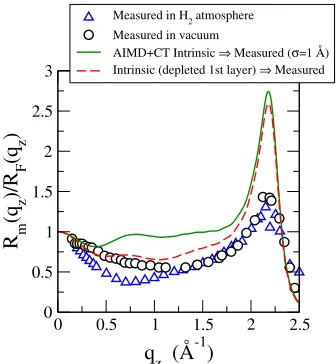
The experiments on liquid Hg at several temperatures [3], without correcting for CW, yielded a Rm(qz)=RF(qz) with a layering peak at qz = 2:2 Å 1 and a minimum at intermediate q between 0:6 and 1:2 Å 1 depending on the sample measured. A rst attempt to t the data with the DCM lead to an interlayer spacing of = 2:72 Å, but the t was not good. Two modications were proposed. The rst one included a quite broad ad-layer of very small density (0:1 to 0:30) located a few Å into the vapour region. The second one corresponded to an interface layer broadened and a little depleted and with an expanded distance to the next layer. This second model was more in line with the one used in the rst measurements [2], for which the rst interlayer distance was 1= 3:05 0:15 Å, and the rest were = 2:76 0:20 Å. The surface roughness was estimated as 1:0 Å.
0 5 10 15 z (Å)
0 1 2 3 4 5 6
ρint
(z)/
ρ0
Average electronic profile Intrinsic electronic profile g(r) X-ray, Inui (2003)
Figure 1. Intrinsic and average
elec-tronic density proles for Hg at 300 K. Also shown is the experimental pair cor-relation function of the bulkliquid.
0 0.5 1 1.5 2 2.5
qz (Å-1) 0
0.5 1 1.5 2 2.5 3
R m
(q z
)/R
F
(q z
)
Measured in H2 atmosphere
Measured in vacuum
AIMD+CT Intrinsic ⇒ Measured (σ=1 Å)
Intrinsic (depleted 1st layer) ⇒ Measured
Figure 2. Reectivities for Hg at 300 K.
modied through the CWT to be directly comparable to the measured one, showed a peak at a similar qz as the experiment but did not reproduce the intermediate minimum. The intrinsic electronic prole computed through the CT procedure is also shown in g. 1 and leads to the same 1 as the average prole, whereas the inner interlayer distance increases a little to 2:84 Å. The layers are however narrower and higher than in av(z). The layer positions correlate very well with the available pair distribution function of the bulk liquid [20]. It is interesting to note that int(z) cannot be t by the models used by experimentalists, since the rst two layers don't have a gaussian shape, although they can be reproduced as the sum of two gaussians for each layer. The resulting intrinsic reectivity has been modied through the same procedure and using the same parameters as in experiment [3] and is shown in g. 2. It keeps the correct peak position, although the height is overestimated, but it still does not produce the dip found in the measurements. Nevertheless, the form of the reectivity is very sensitive to small details in the prole, and a 10 % reduction of the height of the rst layer does produce a correct minimum in the qz region where it was experimentally observed. Therefore we can conclude that the expanded distance and a small depletion of the st layer are behind the appearance of the minimum, in line with the second experimental model.
3.2 Liquid Pb and Bi
0 5 10 15
z , r (Å)
0 2 4
ρ
(z)/
ρ0
, g(r)
Intrinsic profile Bi Intrinsic profile Pb g(r) Bi, Dahlborg (1986) g(r) Pb, Waseda
Figure 3. Intrinsic electronic density pro-les for Bi and Pb. Also shown are the exper-imental pair correlation functions of the bulk liquids. The dierent functions are shifted vertically for clarity.
0 0.5 1 1.5 2 2.5
qz (Å)
1 10 100
Rint (qz
)/R
F
(qz
)
Pb (x 2), AIMD + CT Bi, Experiment Bi, AIMD + CT Bi, outmost layer removed Bi, first 2 layers removed
Figure 4. Reectivities for liquid Bi and Pb (multiplied by two for clarity).
of the surface atoms, which are enhanced even more by the small number of them at the surface layer.
No experiments have been performed for the FLS of Pb. On the contrary, Bi (together with Sn) is one of the systems whose measured reectivity, when transformed into the intrinsic one, shows a shoulder at intermediate q values [4] between 0:6 and 1:4 Å 1. The authors constructed several models that could t the measured reectivity, with an adlayer on top of a DCM. The main conclusion was that the adlayer should be denser than the bulk in order to produce the shoulder, but dierent values of the width, position and density of the adlayer could do the job. The inner interlayer distance, as obtained from the DCM, was 2:83 0:05 Å.
The intrinsic electronic DP obtained for Bi and Pb are shown in g. 3, along with the correspondingexperimental g(r) [21, 22]. The shape of the layers is not DCM-like, requiring several gaussians for a proper t. The layer positions in general agree with the maxima of g(r) although some relaxation towards smaller distances is observed in the prole. Moreover, specic features as the shoulder of g(r) in Bi, are reected also in the shape of int(z). The inner interlayer distance in Bi is found to be 3:12 Å, somewhat larger than the one experimentally determined through the t to Rm(qz). Despite the many non-DCM features of the prole, its form is in line with one of the possible models put forward by Pershan and coworkers, with a very narrow outmost layer, at a slightly contracted distance to the inner layer (1 = 3:02 Å) and with a slightly enhanced integrated density.
included. Consequently we can conclude that the two rst layers are responsible for this kind of behaviour.
4 Conclusions.
The rst important point to note is that the CT procedure leads to converged DPs, which is not always the case for the average prole, possibly due to a combination of high temperature and low surface tension.
The combination of AIMD simulations and the CT procedure leads to reec-tivities which, either directly or with small modications, agree qualitatively with experiments.
The proles obtained are not in general well described by the DCM or variations thereof, but the general characteristics of the intrinsic proles are similar to the models proposed by the experimentalists. We observe a high degree of correlation between the bulk g(r) and the characteristics of the intrinsic prole, although with some relaxation in the distances, which become somewhat smaller. The particular behaviour of the reectivities has been traced back to the depletion of the rst layer in the case of Hg, and to a combined eect of the rst two layers in the case of Bi.
We acknowledge the support of MECD (FIS2012-33126and FIS2014-59279-P), Xunta de Galicia (AEFIS: AGRUP2015/11) and JCyL (VA104A11-2). BGR acknowledges the nan-cial support of the Universidad de Valladolid.
References
[1] M. P. d'Evelyn and S. A. Rice, Phys. Rev. Lett. 47, 1844 (1981). [2] O. M. Magnussen et al, Phys. Rev. Lett. 74, 4444 (1995). [3] E. DiMasi et al, Phys. Rev. B 58, R13419 (1998).
[4] P. S. Pershan et al, Phys. Rev. B 79, 115417 (2009).
[5] P. S. Pershan and M. L. Schlossman, Liquid Surfaces and Interfaces. Synchrotron X-ray Methods, (New York: Cambridge, 2012), and references therein.
[6] P. Hohenberg and W. Kohn, Phys. Rev. 136, B864 (1964); W. Kohn and L.J. Sham, Phys. Rev. 140, A1133 (1965).
[7] G. Fabricius et al, Phys. Rev. B 60, R16283 (1999).
[8] B. G. Walker, C. Molteni and N. Marzari, J. Phys.: Condens. Matter 26, S2575 (2004).
[9] L. Calderín, L. E. González and D. J. González, Phys. Rev. B 80, 115403 (2009). [10] L. Calderín, L. E. González and D. J. González, Phys. Rev. B 87, 014201 (2013). [11] L. Calderín, L. E. González and D. J. González, J. Phys.: Condens. Matter 25,
065102 (2013).
[12] E. Chacón and P. Tarazona, Phys. Rev. Lett. 91, 166103 (2003). [13] A. P. Willard and D. Chandler, J. Phys. Chem. B 114, 1954 (2010). [14] J. Kessler et al, J. Phys. Chem. B 119, 10079 (2015)
[15] E. Chacón, P. Tarazona and L. E. González, Phys. Rev. B 74, 224201 (2006). [16] P. Gianozzi et al, J. Phys.: Condens. Matter 21, 395502 (2009).
[17] M. M. G. Alemany et al, Phys. Rev. B 69, 075101 (2004); L. Kronik et al, Phys. Status Solidi B 243, 1063 (2006); M. M. G. Alemany et al, Comput. Phys. Comm. 177, 339 (2007).
[19] J. Souto et al, Phys. Rev. B 81, 134201 (2010).
[20] M. Inui, X. Hongand K. Tamura, Phys. Rev. B 68, 094108 (2003). [21] U. Dahlborgand M. Davidovi£, Phys. Chem. Liq. 15, 243 (1986).