Learning Language Identication Models: a Comparative Analysis of the
Distinctive Features of Names and Common Words
Stasinos Konstantopoulos
NCSR `Demokritos' Athens, Greece
Abstract
The intuition and basic hypothesis that this paper explores is that names are more characteristic of their language than common words are, and that a single name can have enough clues to condently identify its language where random text of the same length wouldn't. To test this hypothesis, n-gramm modelling is used to learn language models which identify the language of isolated names and equally short document fragments. As the empirical results corroborate the prior intuition, an explanation is sought for the higher accuracy at which the language of names can be identied. The results of the application of these models, as well as the models themselves, are quantitatively and qualitatively analysed and a hypothesis is formed about the explanation of this difference. The conclusions derived are both technologically useful in information extraction or text-to-speech tasks, and theoretically interesting as a tool for improving our understanding of the morphology and phonology of the languages involved in the experiments.
1. Introduction
Language identication is performed on different levels, from the acoustic and prosodic to the phonotactic or graphotactic, and has found various application in speech synthesis, information extraction and data mining.
Leaving aside language identication at the acoustic and prosodic level, we shall concentrate on identifying the lan-guage of a string of phonemes or graphemes. In fact, all of the methods and experiments presented here operate on graphemes, but this choice is driven by data availability rather than any underlying assumption that cannot be cir-cumvented.
We further concentrate on identifying the language of a sin-gle name, even when it is in isolation or in a document written in a different language. This is particularly interest-ing for language technology applications such as named-entity recognition or automatic transliteration, especially when spotting names transliterated into different orthogra-phy systems, e.g. spotting English-language named-entities in Chinese newspapers.
The intuition and basic hypothesis that the work presented here tests, is that names are more `characteristic' of their language than common words are, and that a single name might have enough clues to condently identify its lan-guage, where a common word of the same length wouldn't. The paper is structured as follows: rst an overview of the literature in language identication is provided, both in the framework of text categorization and for identifying the language of a single named entity in isolation (Sect. 2.). Then, in Sect. 3. we present an experimental setup for com-paring name and generic-text language identication, the results of which are analysed in detail in Sect. 4. and 5.. Finally, conclusions and future research directions are dis-cussed in Sect. 6..
2. Background
Guessing the language of a document falls under the larger area of text categorization, which aims at classifying a
doc-ument as belonging to one (or more) out of certain, pre-dened categories or subject codes. Document language is one of the possible dimensions of categorization, inter-esting for various document organization, data mining, and information extraction tasks.
2.1. Document-level categorization
In their seminal paper, Cavnar and Trenkle (1994) report experiments on language categorization using a simplen
-gram frequency algorithm. The language models consist of frequency counts of n-grams (up to 5-grams) for various
languages. To classify a document, the frequency counts of n-grams in the document are calculated and their
dis-tribution compared against the disdis-tribution of n-grams in
the language models. The model with the smallest distance from the distribution of the document, is assumed to be the language of the document.
This algorithm was tested on Usenet postings from the soc.culture newsgroup hierarchy. An eight-language corpus was generated semi-automatically: a rst pass op-erated under the assumption that the postings are in the language of the country or region under discussion in each newsgroup, and at a second pass discrepancies between the newsgroup's default language and the system's prediction were manually resolved.
With the 400 most frequentn-grams retained in the models,
and postings of at least 300 bytes of length, the system clas-sied the test set almost perfectly, achieving an accuracy of 99.8%. The authors also report an accuracy of 99.3% for postings that are under 300 bytes, without providing any further details of how accuracy drops with shorter test doc-uments.
Cavnar and Trenkle's algorithm has seen various imple-mentations and applications, the most notable probably be-ing the TEXTCAT1 implementation used in the SPAMAS -SASSIN2 spam lter. The TEXTCAT distribution includes
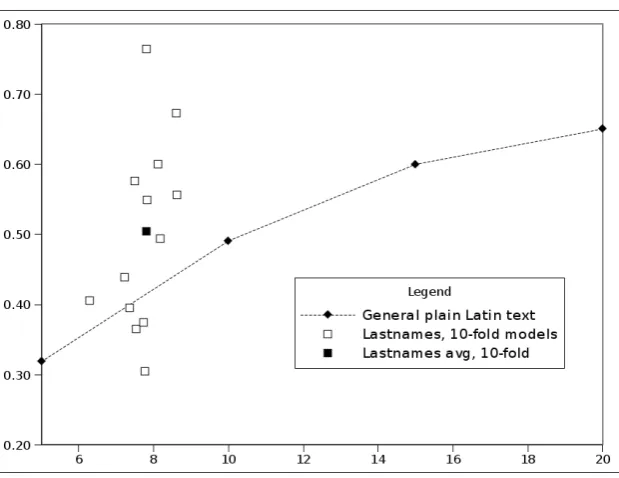
Figure 1: Graph plotting F-score of language identication against string length. The two lines plot language identication performance over general text of xed length. The outlined square marks show F-scores per language, against average name length of the language. The lled square mark averages these last results over all languages.
subsets, of which one is retained as testing data and the remainingN −1are used as training data. Training and
testing is repeatedN times (the folds), with each of theN
subsets used exactly once as testing data. TheN results
from the folds are averaged to produce a single estimation. Comparing the results of the JRC models and the names models, tested over names, we see that training models spe-cic to names has a most profound effect on performance, as shown in Figure 1. This graph shows the, so to speak, relative `discriminative density', of names and common words: last names are shown to carry a lot more potential per character than common words, as their average length is just under 8 characters, but can be predicted as accurately as common words of about 11 characters.
4. Derivational Morphology Analysis
Besides the purely methodological, and expected, result that one can get better performance by training name mod-els on names, a more interesting theoretical question is the reasons why this is the case. One can think of various pos-sible reasons, with varying degrees of theoretical interest. One of the most mundane analyses, for example, would be that names, being a more closed set that common words, offer themselves to over-specic modelling where high ac-curacy is achieved at the expense of generalization. Fortu-nately, such a hypothesis can be immediately refuted by the data in Table 2, as language models trained on names are, if anything, using shortern-grams than the ones trained on
common words.
This allows us to turn our attention to more interesting hypotheses, involving morpho-phonological or graphotac-tic features that (at least) European names possess, mak-ing language identication easier. Intuition suggests that surname forming typically involves a son of derivation
from rst names, so that different languages can be eas-ily recognized by such sufxes. Comparing, for example, Thomassen, Thomson, Tomasevic, and Tomasevicz one can immediately guess a Swede, an Englishman, a Czech, and a Pole.
This intuition was tested by counting what fraction of the
n-grams in the model includes the end-of-word symbol and
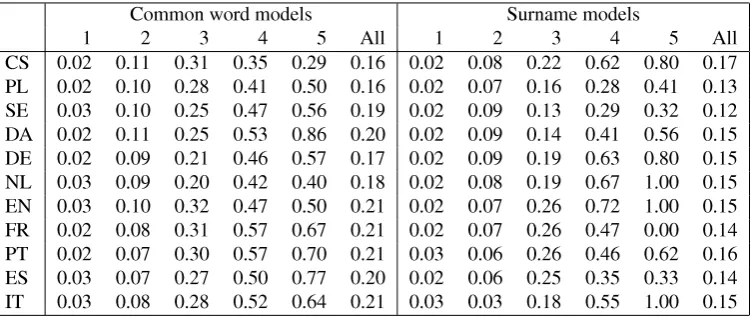
thus only matches word sufxes. Comparing the two sides of Table 3 one can easily see that sufxes are not more im-portant for name models than they are for common word models. In fact, they are a slightly smaller fraction of the overall number ofn-grams than in generic models.
A renement of this hypothesis is that a smaller number of distinct sufxes might have a wider distribution in names. That is, that the derivational morphology creating surnames involves fewer sufxes applied to larger number of name instances so that, even though they are fewer, the relevant
n-grams would have a heavier contribution to the language
identication scores. This hypothesis was tested by adding the weights with which sufxn-grams contribute to a
lan-guage's score, reecting the number of instances of these
n-grams in the training data. Again, as shown in Table 4
sufxes are not more important for name models than they are for generic word models.
An interesting observation can be made by comparing Ta-bles 3 and 4: sufxes are `heavier' n-grams, as smaller
fractions of distinctn-grams cover considerably larger
frac-tions on-gram instances. This shows that sufxes are
im-portant discriminators, which is to be expected as in all languages involved morphological markers are mostly suf-xes.4 However, this is true for both names and generic
words, and so cannot be the explanation for the higher
ac-4The notable exceptions being verbal inectional morphology
Common word models Surname models
Lang. n-gram length Avg n-gram length Avg
Model 1 2 3 4 5 Len 1 2 3 4 5 Len
Czchslvk 40 187 108 42 23 2.55 25 192 141 34 8 2.52 Polish 43 187 108 42 20 2.52 24 174 135 43 24 2.67 German 48 164 118 52 18 2.57 25 212 120 37 6 2.47 Danish 43 160 124 51 22 2.62 26 177 124 46 27 2.68 Swedish 45 142 107 66 40 2.79 27 185 116 45 27 2.65 Dutch 37 170 121 52 20 2.62 25 195 143 31 6 2.50 English 36 184 129 39 12 2.52 26 212 142 19 1 2.39 French 43 162 123 52 20 2.61 29 203 152 15 1 2.39 Portug 45 159 122 54 20 2.61 26 167 164 36 7 2.58 Spanish 44 156 124 55 21 2.63 26 180 160 31 3 2.51 Italian 42 161 124 49 24 2.63 22 159 168 44 7 2.64 SUM 466 1832 1308 554 240 2.61 281 2056 1565 381 117 2.54
Table 2: Distribution ofn-gram lengths in common word and surname models. The table shows the number of distinct n-grams in the model for each value ofn, regardless of the number of instances of eachn-gram found in the training data.
Common word models Surname models
1 2 3 4 5 All 1 2 3 4 5 All
CS 0.02 0.11 0.31 0.35 0.29 0.16 0.02 0.08 0.22 0.62 0.80 0.17 PL 0.02 0.10 0.28 0.41 0.50 0.16 0.02 0.07 0.16 0.28 0.41 0.13 SE 0.03 0.10 0.25 0.47 0.56 0.19 0.02 0.09 0.13 0.29 0.32 0.12 DA 0.02 0.11 0.25 0.53 0.86 0.20 0.02 0.09 0.14 0.41 0.56 0.15 DE 0.02 0.09 0.21 0.46 0.57 0.17 0.02 0.09 0.19 0.63 0.80 0.15 NL 0.03 0.09 0.20 0.42 0.40 0.18 0.02 0.08 0.19 0.67 1.00 0.15 EN 0.03 0.10 0.32 0.47 0.50 0.21 0.02 0.07 0.26 0.72 1.00 0.15 FR 0.02 0.08 0.31 0.57 0.67 0.21 0.02 0.07 0.26 0.47 0.00 0.14 PT 0.02 0.07 0.30 0.57 0.70 0.21 0.03 0.06 0.26 0.46 0.62 0.16 ES 0.03 0.07 0.27 0.50 0.77 0.20 0.02 0.06 0.25 0.35 0.33 0.14 IT 0.03 0.08 0.28 0.52 0.64 0.21 0.03 0.03 0.18 0.55 1.00 0.15
Table 3: Fraction of distinctn-grams that include the end-of-string, i.e. match sufxes.
curacy of the name models.
5. Distinctive Features
Having introduced the notion of ann-gram's `quality' or
`usefulness' as a language discriminator, we turn our at-tention to a way to quantify this notion so that models can be compared based on how good discriminators they com-prise. This quantication is based on the notion of informa-tion content and entropy.
Entropy is a measure of the lack of order, originally intro-duced in thermodynamic systems. Shannon (1948) trans-ferred the concept in information theory, dening it as the expected (on average) number of digits required to encode a message, using the most efcient encoding possible. For an alphabet ofkdistinct symbols, appearing with relative
frequenciespi, i= 1..k, the information content of symbol
iis−logpi bits. The entropy of the encoding is then the
generic language models of both languages, but is (also as ex-pected) absent from the name models. The Gaelic derivational prexes Mac- and Mc- appear in the English surnames, but not frequently enough to even appear in then-grams of the English
names model, with 83 and 31 instances in 1132 names, resp.
weighted average of the information contents of all sym-bols:
H =−
k
∑
i=1
pilogpi
and estimates the number of digits necessary to transmit each symbol. Low values of entropy imply a high level of organization and the existence of patterns in the signal. Given the appearance of ann-gram, we consider the
pre-dicted language the `signal' that needs to be transmitted. The information content of each language is, then, the neg-ative logarithm of the probability with which this language is predicted given the appearance of then-gram; this
prob-ability is estimated by the weight assigned to the n-gram
in each language's model, since heavier weights for a lan-guage make it more likely that this lanlan-guage will be pre-dicted. We can now calculate the entropy of then-gram as
a whole, and use this to estimate the overall `transmission efciency,' i.e., how good the n-gram is at restricting the
choice of language symbols that might be transmitted, so that the signal can be compressed.
To make this clearer, compare the distribution of the n
Common word models Surname models
1 2 3 4 5 All 1 2 3 4 5 All
CS 0.31 0.20 0.37 0.46 0.17 0.28 0.28 0.18 0.39 0.75 0.84 0.27 PL 0.28 0.18 0.32 0.53 0.56 0.25 0.23 0.15 0.28 0.50 0.50 0.23 DE 0.28 0.19 0.33 0.60 0.68 0.27 0.25 0.16 0.32 0.66 0.84 0.24 DA 0.29 0.19 0.37 0.63 0.88 0.28 0.25 0.16 0.28 0.64 0.62 0.25 SE 0.30 0.20 0.38 0.65 0.68 0.29 0.23 0.15 0.26 0.53 0.54 0.23 NL 0.31 0.20 0.34 0.59 0.50 0.30 0.26 0.17 0.31 0.73 1.00 0.25 EN 0.33 0.21 0.41 0.66 0.72 0.32 0.26 0.17 0.37 0.77 1.00 0.25 FR 0.32 0.21 0.45 0.73 0.67 0.31 0.26 0.16 0.32 0.50 0.00 0.23 PT 0.33 0.21 0.44 0.68 0.76 0.32 0.28 0.17 0.35 0.55 0.77 0.26 ES 0.33 0.21 0.44 0.71 0.80 0.33 0.27 0.17 0.33 0.39 0.38 0.25 IT 0.35 0.21 0.41 0.68 0.73 0.33 0.25 0.15 0.31 0.70 1.00 0.24
Table 4: Fraction ofn-gram instances that include the end-of-string, i.e. match sufxes.
Figure 2: Distribution of occurrences of the unigram e. The numbers are normalized to represent the per-mil fraction of all words in all languages where it appears as a unigram of a given language. The entropy of this distribution is 1.79
Figure 3: Distribution of occurrences of the bigram rz. The numbers are normalized to represent the per-mil fraction of all words in all languages where it appears as a unigram of a given language. The entropy of this distribution is 0.04
found across all languages, so that its presence does not help much compress the encoding of the language it dicted, as all languages are more or less likely to be pre-dicted, and this unigram has a high entropy. The bigram rz, on the other hand, is very informative and drastically sharp-ens the distribution of possible predictions in its presence, so that it has a very low entropy.
After calculating and adding up the entropy of alln-grams
in the generic language models we nd a total of934.3,
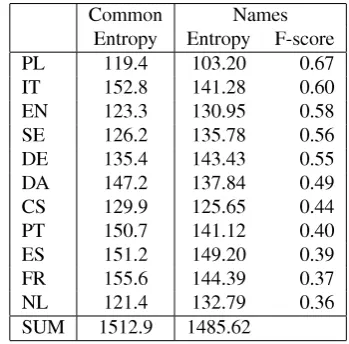
ver-Common Names Entropy Entropy F-score PL 119.4 103.20 0.67 IT 152.8 141.28 0.60 EN 123.3 130.95 0.58 SE 126.2 135.78 0.56 DE 135.4 143.43 0.55 DA 147.2 137.84 0.49 CS 129.9 125.65 0.44 PT 150.7 141.12 0.40 ES 151.2 149.20 0.39 FR 155.6 144.39 0.37 NL 121.4 132.79 0.36 SUM 1512.9 1485.62
Table 5: Entropies of distributions ofn-grams of each
lan-guage versus all the rest. The F-scores from Figure 1 are also shown.
sus932.4for alln-grams in the surnames models. Again,
this difference is too small to account for the observed in-crease in prediction accuracy.
A further renement of this calculation is necessary, in or-der to take into account the fact that, in our example, the bi-gram in Figure 3 is good at discriminating Polish from the rest, but not particularly useful in discriminating, say, Span-ish from Italian. In order to take this factor into account, we need to evaluate how informative ann-gram is for each
lan-guage, as if 11 binary decisions were to be made, with each decision placing a different language in juxtaposition with the remaining 10.
We, thus, calculate for eachn-gram in each language not
the entropy of its distribution among all languages as we did before, but the sum of the entropies of these 11 one-versus-all distributions. Summing up these sums for each language, we get the results shown in Table 5.
6. Conclusions and Future Research
The rst conclusion drawn from the experiments presented in this paper is that people's names offer themselves for more accurate language identication than common words. This conclusion has been repeatedly hinted at in previous work on grapheme-to-phoneme conversion and transliter-ation, where a language identication pre-processing step resulted in dramatic performance increase on the main task. What is interesting to note is that the performance reported here is on a par with the performance of human annotators, who reported that they could only condently predict a per-son's nationality in 43% of the data (cf. Section 2.2.). What is, however, even more interesting and surprizing is that the expected and intuitive explanation that surname for-mation relies heavily on few and language-specic mor-phemes does not hold (Section 4.). The application of infor-mation theory concepts and techniques to quantifying fea-tute quality, in pursuit of the features of names that make the difference, gives inconclusive but promising evidence: although the difference in the overall entropy of the models is not signicant (934.3 vs. 932.4, cf. Section 5.) there
seems to be a strong correlation between the predictive ac-curacy of the model and the one-versus-all quality measure given on Table 5.
This result can guide future research on the subject, as it can be used to identify the most promising features which to focus further experiments on. The correlation between the statistically extracted `important' n-grams on the one
hand, andn-grams that are known to be derivational
mor-phemes on the other can also give interesting hints. The main effort in pursuing this direction would be the creation of the morphological resources, as surnames derivation is not a subject commonly treated computationally.
A second future research direction is that of using a cross-linguistically uniform and uninformed representation. In the experiments presented here a small step in this direction was taken by dropping all diacritics, so that there will be fewer chances for `easy guesses' based on characters only found in a single language, but that creates the additional problem of accurately making all necessary the grapheme-to-phoneme conversions. An attractive alternative could be based on the assumption that transliteration to a completely different orthography to a large extend removes clues that are based on orthographic idiosyncrasies of the original lan-guage.
7. Acknowledgements
The idea of harvesting transfermarkt.de to extract people's nationalities was born four years ago, while discussing football with my good friend Evaggelos Litos.
The work described here was supported by the FP7-ICT project PRONTO.5 PRONTO develops methodologies for
the analysis and interpretation of textual, audio, and video data, aiming at the extraction of operational knowledge sup-porting and improving resource management.
8. References
William B. Cavnar and John M. Trenkle. 1994. N-gram-based text categorization. In Proceedings of Third
An-5http://www.ict-pronto.org/
nual Symposium on Document Analysis and Information Retrieval, Las Vegas, 1113 April 1994, pages 161175. Ariadna Font Llitj´os and Alan W. Black. 2001. Knowledge of language origin improves pronunciation accuracy of proper names. In Proc. of Eurospeech 2001, Aalborg, Denmark.
Fei Huang. 2005. Cluster-specic named entity translit-eration. In HLT '05: Proceedings of the conference on Human Language Technology and Empirical Meth-ods in Natural Language Processing, Vancouver, British Columbia, Canada, pages 435442, Morristown, NJ, USA. Association for Computational Linguistics. Stasinos Konstantopoulos. 2007. What's in a name? In
Petya Osenova, Erhard Hinrichs, and John Nerbonne, editors, Proceedings of Computational Phonology Work-shop, International Conf. on Recent Advances in NLP, (RANLP), Borovets, Bulgaria, September 2007.
Claude E. Shannon. 1948. The mathematical theory of communication. Bell Systems Technical Journal, 27:379423, 623656, July, October.
Murray F. Spiegel. 1985. Pronouncing surnames automati-cally. In Proc. Conf. of the American Voice Input/Output Society, pages 109132.
Ralf Steinberger, Bruno Pouliquen, Anna Widiger, Camelia Ignat, Tomaz Erjavec, Dan Tus¸, and D´aniel Varga. 2006. The JRC-Acquis: A multilingual aligned parallel corpus with 20+ languages. In Proc. of the 5th Interna-tional Conference on Language Resources and Evalua-tion (LREC'2006), Genoa, 2426 May 2006.
Paola Virga and Sanjeev Khudanpur. 2003. Translitera-tion of proper names in cross-lingual informaTranslitera-tion re-trieval. In Mari Broman Olsen, editor, Proceedings of the ACL 2003 Workshop on Multilingual and Mixed-language Named Entity Recognition, pages 5764. Tony Vitale. 1991. An algorithm for high accuracy name