Open-Source Boundary-Annotated Corpus for Arabic Speech and Language
Processing
Claire Brierley
1, Majdi Sawalha
2, Eric Atwell
1University of Leeds1 and University of Jordan2
1 School of Computing, University of Leeds, LS2 9JT, UK
2 Computer Information Systems Dept., King Abdullah II School of IT, University of Jordan, Amman, Jordan
E-mail: [email protected], [email protected], [email protected]
Abstract
A boundary-annotated and part-of-speech tagged corpus is a prerequisite for developing phrase break classifiers. Boundary annotations in English speech corpora are descriptive, delimiting intonation units perceived by the listener. We take a novel approach to phrase break prediction for Arabic, deriving our prosodic annotation scheme from Tajwīd (recitation) mark-up in the Qur‟an which we then interpret as additional text-based data for computational analysis. This mark-up is prescriptive, and signifies a widely-used recitation style, and one of seven original styles of transmission. Here we report on version 1.0 of our Boundary-Annotated Qur‟an dataset of 77430 words and 8230 sentences, where each word is tagged with prosodic and syntactic information at two coarse-grained levels. In (Sawalha et al., 2012), we use the dataset in phrase break prediction experiments. This research is part of a larger-scale project to produce annotation schemes, language resources, algorithms, and applications for Classical and Modern Standard Arabic.
Keywords: prosodic annotation; psycholinguistic chunking; phrase break prediction
1.
Introduction
It is universally recognised that whatever the language, people process speech (and text) in chunks (Ladd, 1996),
which in turn can be interpreted syntactically as function
word groups (Liberman and Church, 1992) and
prosodically as tone units (Croft, 1995; Roach, 2000). Phrase break prediction is a classification task within the Text-to-Speech synthesis pipeline that attempts to simulate human chunking strategies by assigning
prosodic-syntactic boundaries to input text. A
boundary-annotated and part-of-speech (PoS) tagged corpus (§2) is therefore an essential language resource for training such classifiers. Our research applies techniques honed on English (Brierley, 2011) to another stress-timed language, Arabic, and to the entire text of the Qur‟an. One novelty is that we derive a coarse-grained boundary annotation scheme for Arabic from traditional recitation
mark-up (Tajwīd) in the Qur‟an; this is then compared
with existing schemes for British and American English speech corpora (Taylor and Knowles, 1988; Beckman and Hirschberg, 1994). We then merge a PoS-tagged version of the text (Dukes, 2010) with our prosodic Qur‟an, where each of the 77430 words is classified in terms of a finite
set of boundary categories {major, minor, none}. An
additional novelty is that we use compulsory and
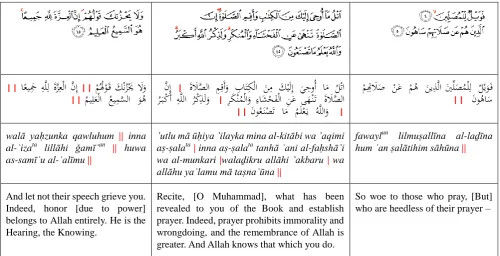
recommended {﴾٥٦﴿, ۘ, ۘ}and prohibited stops { ـ }
in Tajwīd mark-up (cf. Al-‟ashmuni, 1973) to segment the
text into 8230 sentences. Finally, we plan to evaluate the applicability of our Qur‟an dataset as a training corpus for predicting boundaries in Modern Standard Arabic (MSA) text. This entails the creation of a second (smaller) boundary-annotated corpus for MSA, which is also segmented into sentences. We thus offer two unique language resources for exploring the prosody-syntax interface in Arabic, intended for open-source distribution.
A related LREC submission (Sawalha et al., 2012) uses
our corpora to develop and evaluate the performance of
several probabilistic, syntax-based phrase break
classifiers.
2.
Boundary Annotation Schemes for
English
The Lancaster/IBM Spoken English Corpus or SEC (Taylor and Knowles, 1988) established a tripartite
boundary annotation scheme {major, minor, none}
for British English. Theoretically, major boundary
markers (||) in this scheme denote pauses, and minor
boundary markers (|) define tone units (Roach, 2000).
Tone units (i.e. intonational phrases or chunks) are
sequences that contain at least one accented word, namely: a word realised with pitch fluctuation on the syllable carrying primary stress (Croft, 1995). In practice, major
boundaries do not only denote sentence segmental pauses,
as in the following example from SEC A06 (informal news commentary on housing) annotated by Bryony Williams:
„…For the thousand Turkish workers and their families |
who lived in them |have left || taking advantage of a
double pay offer|| a cash grant from the government |
and money from Mannesmann | to return home ||…‟
In the above sentence, major boundary markers
correspond to a comma, a colon, and a full stop
respectively in the orthographic transcription of this utterance.
Speech corpora for American English, such as the
Boston University Radio News Corpus (Ostendorf et al.,
1995) use ToBI or the Tones and Break Indices annotation
scheme (Beckman and Hirschberg, 1994) which identifies
five theoretical levels of juncture between words:
{0,1,2,3,4}. Break index {0}denotes no separation or
cliticization (Ananthakrishnan and Narayanan, 2008),
while index {1} applies to most phrase medial junctures
between words. The „correct‟ labelling of coarticulation is debateable, as in this SAMPA phonetic transcription
/Di:jA:mi:/ where the army (i.e. two consecutive
words) is realised as one unit via the y-glide /j/. Index
{2} is a special (and somewhat ambiguous) case,
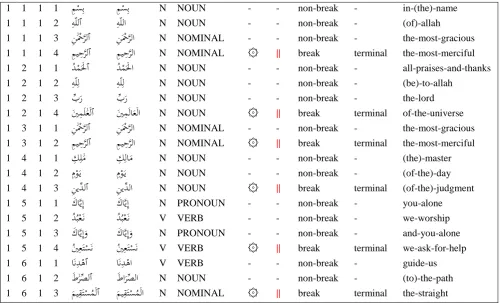
finer-grained PoS and either two or three boundary classes. Figure 5 shows sample training input to the tagger as nested lists of tuples with: (i) Arabic words as they
appear encoded in UTF-8; and (ii) a facsimile view of Arabic words in their normal orthographic form.
1 1 1 1
ِمْسِب
ِمْسِب
N NOUN - - non-break - in-(the)-name1 1 1 2
ِهَّللٱ
ِهَّللا
N NOUN - - non-break - (of)-allah1 1 1 3
ِنََْٰحَّرلٱ
ِنَْحَّرلا
N NOMINAL - - non-break - the-most-gracious1 1 1 4
ِمي ِحَّرلٱ
ِمي ِحَّرلا
N NOMINAL ۞ || break terminal the-most-merciful1 2 1 1
ُدْمَْلْٱ
ُدْمَْلْا
N NOUN - - non-break - all-praises-and-thanks1 2 1 2
ِهَّلِل
ِهَّلِل
N NOUN - - non-break - (be)-to-allah1 2 1 3
ِّبَر
ِّبَر
N NOUN - - non-break - the-lord1 2 1 4
َيِمَلََٰعْلٱ َيِمَلاَعْلا
N NOUN ۞ || break terminal of-the-universe1 3 1 1
ِنََْٰحَّرلٱ
ِنَْحَّرلا
N NOMINAL - - non-break - the-most-gracious1 3 1 2
ِمي ِحَّرلٱ
ِمي ِحَّرلا
N NOMINAL ۞ || break terminal the-most-merciful1 4 1 1
ِكِلََٰم
ِكِلاَم
N NOUN - - non-break - (the)-master1 4 1 2
ْوَ ي ِم
ِمْوَ ي
N NOUN - - non-break - (of-the)-day1 4 1 3
ِنيِّدلٱ
ِنيِّدلا
N NOUN ۞ || break terminal (of-the)-judgment1 5 1 1
َكاَّيِإ
َكاَّيِإ
N PRONOUN - - non-break - you-alone1 5 1 2
ُدُبْعَ ن
ُدُبْعَ ن
V VERB - - non-break - we-worship1 5 1 3
َكا
َّيِإَو
َكاَّيِإَو
N PRONOUN - - non-break - and-you-alone1 5 1 4
ُيِعَتْسَن ُيِعَتْسَن
V VERB ۞ || break terminal we-ask-for-help1 6 1 1
اَنِدْهٱ
اَنِدْها
V VERB - - non-break - guide-us1 6 1 2
َطََٰرِّصلٱ
َطاَرِّصلا
N NOUN - - non-break - (to)-the-path1 6 1 3
َميِقَتْسُمْلٱ َميِقَتْسُمْلا
N NOMINAL ۞ || break terminal the-straightFigure 4: Sample of the tab separated column file for our boundary-annotated Arabic corpus
[((u'\u0630\u064e\u0644\u0650\u0643\u064e', u'N'), u'non-break'), ((u'\u0627\u0644\u0652\u0643\u0650\u062a\u064e\u0627\u0628\u064f', u'N'), u'non-break'), ((u'\u0644\u064e\u0627', u'P'), u'non-break'), ((u'\u0631\u064e\u064a\u0652\u0628\u064e', u'N'), u'break'), ((u'\u0641\u0650\u064a\u0647\u0650', u'P'), u'non-break'), ((u'\u0647\u064f\u062f\u064b\u0649', u'N'), u'non-break'), ((u'\u0644\u0650\u0644\u0652\u0645\u064f\u062a\u0651\u064e\u0642\u0650\u064a\u0646\u064e', u'N'), u'break')]
[((
َكِلَذ
, N), non-break), ((ُباَتِكْلا
, N), non-break), ((َل
, P), non-break), ((َبْيَر
, N), break), ((ِهيِف
, P), non-break), ((ىًدُه
, N), non-break), ((َيِقَّتُمْلِل
, N), break)]Figure 5: A single Qur‟anic “sentence” as training input to the tagger: words are PoS-tagged via the set of {N, V, P} for binary classification
6.
Scheme Ratification on Modern
Standard Arabic
In a related LREC submission (Sawalha et al., 2012), we
construe our boundary-annotated and PoS-tagged Qur‟an as a „gold standard‟ for supervised learning of the phrase break prediction task. The Qur‟an is a rich dataset, despite its size, and has previously been used as an evaluative
„gold-standard‟ for machine learning (e.g. for Arabic
morphological analysers in Morpho Challenge 2009)2.
The general procedure is to train the classifier on a
2
http://research.ics.tkk.fi/events/morphochallenge2009/datasets.shtml
substantive sample of „gold-standard‟
boundary-annotated text, and to hold out a smaller sample from the same source for testing. Although target boundary sites in the test set are available to the researcher for comparative evaluation, they are missing from test data presented to the classifier. Classifier accuracy therefore equates to the number of correct boundaries retrieved during test.
6.1
Evaluation Metrics
Accuracy is a standard metric in machine learning. However, in the case of phrase break prediction, success