University of Bradford eThesis
This thesis is hosted in
Bradford Scholars
– The University of Bradford Open Access
repository. Visit the repository for full metadata or to contact the repository team
© University of Bradford. This work is licenced for reuse under a
Creative Commons
ARABIC LANGUAGE PROCESSING FOR TEXT
CLASSIFICATION
Contributions to Arabic Root Extraction Techniques,
Building An Arabic Corpus, and to Arabic Text Classification
Techniques
by
May Yacoub Adib AL-NASHASHIBI
Thesis submitted for the degree of
Doctor of Philosophy in Computer Science
School of Computing, Informatics and Media
University of Bradford
ii
Abstract
Keywords: Arabic language, Root extraction techniques, Corpus development, Text labeling, Term weighting methods, Document representation, Single-label text classification.
The impact and dynamics of Internet-based resources for Arabic-speaking users is increasing in significance, depth and breadth at highest pace than ever, and thus requires updated mechanisms for computational processing of Arabic texts. Arabic is a complex language and as such requires in depth investigation for analysis and improvement of available automatic processing techniques such as root extraction methods or text classification techniques, and for developing text collections that are already labeled, whether with single or multiple labels.
This thesis proposes new ideas and methods to improve available automatic processing techniques for Arabic texts. Any automatic processing technique would require data in order to be used and critically reviewed and assessed, and here an attempt to develop a labeled Arabic corpus is also proposed. This thesis is composed of three parts: 1- Arabic corpus development, 2- proposing, improving and implementing root extraction techniques, and 3- proposing and investigating the effect of different pre-processing methods on single-labeled text classification methods for Arabic.
This thesis first develops an Arabic corpus that is prepared to be used here for testing root extraction methods as well as single-label text classification techniques. It also enhances a rule-based root extraction method by handling irregular cases (that appear in about 34% of texts). It proposes and implements two expanded algorithms as well as an adjustment for a weight-based method. It also includes the algorithm that handles irregular cases to all and compares the performances of these proposed methods with original ones. This thesis thus develops a root extraction system that handles foreign Arabized words by constructing a list of about 7,000 foreign words. The outcome of the technique with best accuracy results in extracting the correct stem and root for respective words in texts, which is an enhanced
iii
based method, is used in the third part of this thesis. This thesis finally proposes and implements a variant term frequency inverse document frequency weighting method, and investigates the effect of using different choices of features in document representation on single-label text classification performance (words, stems or roots as well as including to these choices their respective phrases). This thesis applies forty seven classifiers on all proposed representations and compares their performances. One challenge for researchers in Arabic text processing is that reported root extraction techniques in literature are either not accessible or require a long time to be reproduced while labeled benchmark Arabic text corpus is not fully available online. Also, by now few machine learning techniques were investigated on Arabic where usual preprocessing steps before classification were chosen. Such challenges are addressed in this thesis by developing a new labeled Arabic text corpus
for extended applications of computational techniques.
Results of investigated issues here show that proposing and implementing an algorithm that handles irregular words in Arabic did improve the performance of all implemented root extraction techniques. The performance of the algorithm that handles such irregular cases is evaluated in terms of accuracy improvement and execution time. Its efficiency is investigated with different document lengths and empirically is found to be linear in time for document lengths less than about 8,000. The rule-based technique is improved the highest among implemented root extraction methods when including the irregular cases handling algorithm. This thesis validates that choosing roots or stems instead of words in documents representations indeed improves single-label classification performance significantly for most used classifiers. However, the effect of extending such representations with their respective phrases on single-label text classification performance shows that it has no significant improvement. Many classifiers were not yet tested for Arabic such as the ripple-down rule classifier. The outcome of comparing the classifiers' performances concludes that the Bayesian network classifier performance is significantly the best in terms of accuracy, training time, and root mean square error values for all proposed and implemented representations.
iv
Dedicated to my Mother and the beloved memory of my
Father
Mother, your dedication, unconditional love and the ethics that you patiently embedded in me while growing up have
motivated me to arrive where I am.
Father, although you passed away, yet your free spirit, dignity, decency, integrity, and diligence to provide us with better opportunities than you had shall always inspire me to be my
v
Acknowledgements
I would like first to thank the School of Computing, Informatics and Media especially the Department of Computing at the University of Bradford for the high standard facilities provided for the students and the friendly atmosphere among the faculty and research students. I would like to express my deepest appreciation to my supervisor Prof. Daniel Neagu whose encouragement, support, advice, and fruitful discussions have guided me throughout my study. Prof. Neagu’s support has made me not just enthusiastically working to develop a solid background on the subject, but also enjoying the process while doing so. I am grateful to Dr. Ali Yaghi for his support and guidance in the first phase of my research. His deep understanding of the Arabic language and experience has helped me a lot. I would like also to thank Petra University, Amman (Jordan) for partially financing my PhD study. My deep gratitude goes to the ex-vice president for academic affairs at Petra University Prof. Nizar El-Rayyes for his support throughout my study. Special thanks go to my colleagues, Basic Sciences Department at Petra University especially to the head of department Dr. F. Badawi and also Mr. I. Suweid for their encouragements. I would like to express my appreciation to my cousin Eng. Samia Al-Shahabi for her warm welcome and hospitality throughout the period of my study in UK. I would like also to thank all those who participated in the questionnaire I distributed for my research especially my uncle Mr. Mazin Al-Shahabi. My thanks go to Miss Rona Wilson for her cooperation when ever needed. I would like to thank all my friends especially Reema, Basima, Yasmina, Asma'a, and Ghadeer for their support and encouragement. Special thanks go to my friend Fatima for her help in printing the foreign Arabized words list. Finally my gratitude goes to my sister Rula and brothers Adib and Mohammad for their unlimited support, encouragement and love.
vi
List of Peer Reviewed Publications and Contributions
1- M. Y. Al-Nashashibi, A. Yaghi, and D. Neagu, "An improved root extraction technique for Arabic words" in proceedings of 2nd International conference on Computer Technology and Development ICCTD 2010, S. Mahmoud and Z. Lian (Eds.), pp. 264-269, 2-4 November, Cairo, Egypt, 2010. IEEE Explore. 2- M. Y. Al-Nashashibi, A. Yaghi, and D. Neagu, "Stemming Techniques for Arabic
Words: A Comparative Study" in proceedings of 2nd International conference on Computer Technology and Development ICCTD 2010, S. Mahmoud and Z. Lian (Eds.), pp. 270-276, 2-4 November, Cairo, Egypt, 2010. IEEE Explore. 3- M. Y. Al-Nashashibi, A. Yaghi, and D. Neagu, "An improved root extraction
technique for Arabic words" in Computational Linguistics in The Netherlands CLIN 2010, Poster session, 4 February, Utrecht University, Utrecht, The Netherland, 2010.
vii
Table of Contents
Acknowledgements v
List of Tables xi
List of Figures xiii
List of Abbreviations xvi
Chapter 1: Introduction 1
1.1 Introduction 1
1.2 Thesis Contributions 3
1.3 Motivation and Objectives 4
1.4 Research Questions 5
1.5 Research Approach Methodology 6
1.6 Thesis Organization 9
1.7 Summary 10
Chapter 2: Background and Related Work 11
2.1 Introduction 11
2.2 Arabic Corpora and Related Work 11
2.3 Stemming Techniques for Arabic 15
2.3.1 Rule-Based Techniques 16
2.3.2 Lexical-Based Techniques 16
2.3.3 Other Techniques 17
2.3.4 Comparison between Stemming Techniques 17
2.4 Text Classification Approaches Applied to Arabic Sources 20
2.4.1 Pre-Processing Steps for Text Classification 22
2.4.1.1 Document Representation 22
2.4.1.2 Dimensionality Reduction 24
2.4.1.2.1 Dimensionality Reduction by Stemming 25
2.4.1.2.2 Dimensionality Reduction by Term Selection
26
2.4.1.2.3 Dimensionality Reduction by Term Extraction
27
viii
2.4.2.1 Specific Machine Learning Techniques 29
2.4.2.2 Naïve Bayes Classifier 30
2.4.2.3 Example-Based Classifiers (k-NN Classifier) 30
2.4.2.4 Support Vector Machine Classifier 31
2.4.2.5 Comparison between Classifiers' Performance 32
2.5 Summary 33
Chapter 3: The Development of an Arabic Text Corpus and Pre-processing Steps
36
3.1 Introduction 36
3.2 Description of Newly Gathered Text collection 37
3.2.1 Newly Gathered Text Collection 37
3.3 Description of University of Leeds Arabic Contemporary Corpus 40
3.3.1 Original Categorization of LACC 40
3.3.2 Re-Categorization of LACC and Final Corpus
Categorization
43
3.4 Pre-processing Steps 47
3.4.1 Arabic Function Word List Construction 47
3.4.2 Arabic Text Pre-processing 48
3.5 Conclusions 48
Chapter 4: The Development of an Arabic Root Extraction System 50
4.1 Introduction 50
4.2 Rule-based Approach: 52
4.2.1 Description 54
4.2.2 Enhanced Rule-based Technique 55
4.2.3 Results of implementation 58
4.3 Weight-Based Approach 60
4.3.1 Description of Al-Shalabi Algorithm 61
4.3.2 Adjustment of Al-Shalabi Algorithm 63
4.3.3 First Expanded Weight-Based Method 65
4.3.4 Second Expanded Weight-Based Method 67
4.3.5 Results of Implementation 69
ix
4.4.1 First Accuracy Analysis Method 71
4.4.2 Native Arabic Speaker Accuracy Analysis 80
4.5 Foreign Arabized Words List 89
4.6 Final Proposed Root Extraction System 90
4.7 Conclusions and Future Work 91
Chapter 5: Arabic Single-Label Text Classification Methods 96
5.1 Introduction 96
5.2 Pre-processing Steps 97
5.2.1 The Proposed Modified TFIDF Term Weighting Method 97
5.2.2 Document Representation 98
5.2.2.1 Features Implemented Using Single Terms 98
5.2.2.2 Extending VSM Feature Representation Using Phrases
99
5.2.3 Implemented Feature Subset Selection Method 101
5.2.3.1 Chi-square method 101
5.3 Applied Text Classification Methods 102
5.3.1 Single-Label Classification Methods 102
5.3.1.1 Implemented Classifiers 103
5.4 Results of Implementations 105
5.4.1 Results of Implemented Single-Label Text Classification Methods
106
5.4.1.1 First Experiment 106
5.4.1.2 Second Experiment 134
5.5 Conclusions 138
Chapter 6: Critical Analysis of Text Classification Methods' Performances
140
6.1 Introduction 140
6.2 Effect of Using Phrases on Classification Performance 140
6.3 Comparison between Classifiers 142
6.3.1 Function Classifiers 143
6.3.2 Bayes-Based Classifiers 144
x
6.3.4 Rule Classifiers 152
6.3.5 Miscellaneous Classifiers 158
6.3.6 Meta Classifiers 159
6.3.7 Comparison between Classifiers 163
6.4 Conclusions and Future Work 166
Chapter 7: Conclusions and Recommendations 169
7.1 Research Contributions 169
7.2 Research Limitations 174
7.3 Recommendations for Further Work 174
References 177
Appendices 190
Appendix I: Relevant Detailed Background Information, Equations, And Comparisons in Literature Review, and Relevant Tables for Developed Corpus
190
Appendix II: Additional Detailed Information, Tables and Figures for Chapter 4
202
Appendix III: Additional Detailed Information, Tables and Figures for Implemented Root Extraction Techniques in Chapter 4
211
Appendix IV: Additional Detailed Information, Tables and Figures for Chapter 5
xi
List of Tables
Table 1: Number of Texts and Words in AT8 collection 38 Table 2: Source Websites and their Number of Texts in AT8 collection 39 Table 3: Number of Texts and Words in LACC Corpus 40 Table 4: Source Websites and their Number of Texts in the LACC Corpus 41 Table 5: Percentage of Texts and Words in LACC Corpus under major
domains
42
Table 6: Number of Texts and Words in LACC Corpus after Re-categorization
43
Table 7: Comparison between LACC and AT8 collections in terms of number of files according to AT8 categorization scheme
43
Table 8: Comparison between LACC and AT8 collections in terms of number of Words according to AT8 categorization scheme
44
Table 9: Comparison between LACC and AT8 collections in terms of number of files and Words according to LACC categorization scheme
44
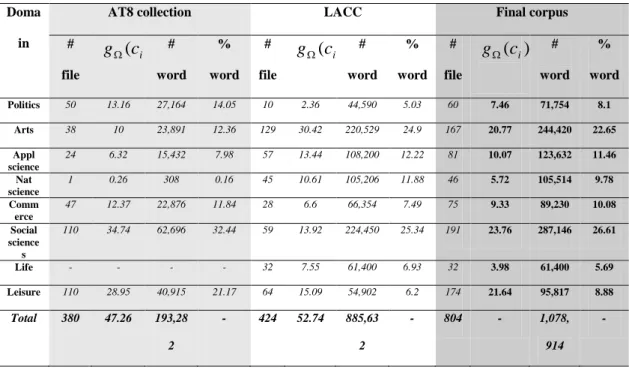
Table 10: Final Corpus' number of files and generality among classes 46 Table 11: Some examples of Function Word list 48 Table 12: Performance of Rule-Based algorithm and its Correction one in all
categories using AT8 collection
58
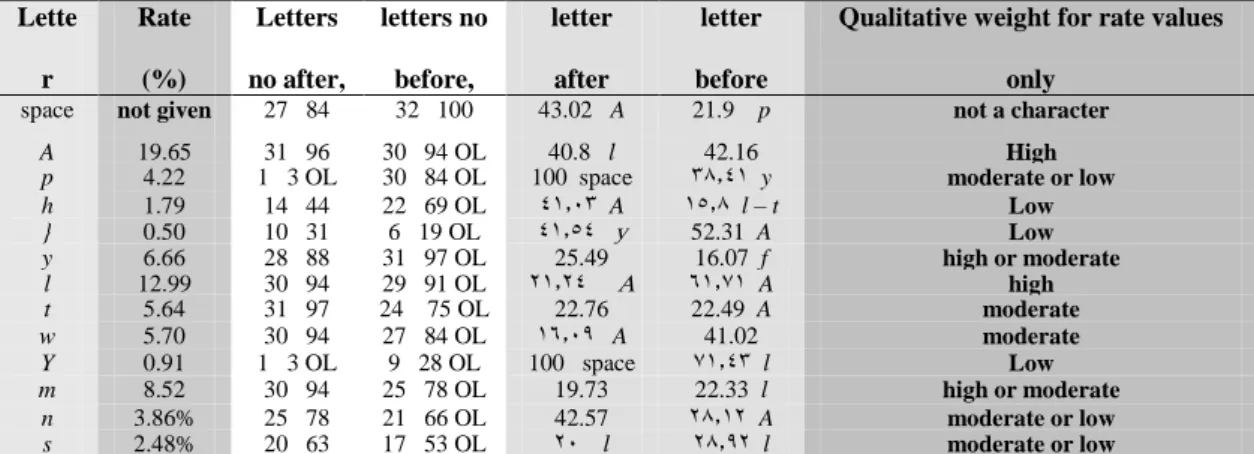
Table 13: Letter ranking in Al-Shalabi algorithm (derived from [17]) 62 Table 14: Weights of letter groups in Al-Shalabi algorithm (derived from
[17])
62
Table 15: Examples of extracted roots using Al-Shalabi algorithm (from right to left)
62
Table 16: Percentages of Letter Appearances in Texts 65 Table 17: Weights of Letter groups for EWBM1 algorithm 66 Table 18: Weights of Letter groups for EWBM2 algorithm 68 Table 19: Proposed weighting for Assigned Groups in algorithms 69 Table 20: Performance of weight-based algorithms in all categories using
AT8 collection
70
Table 21: Performance of weight-based with Correction algorithm in all categories using AT8 collection
xii Table 22: Accuracy results for all ten algorithms (all categories) using AT8
collection
72
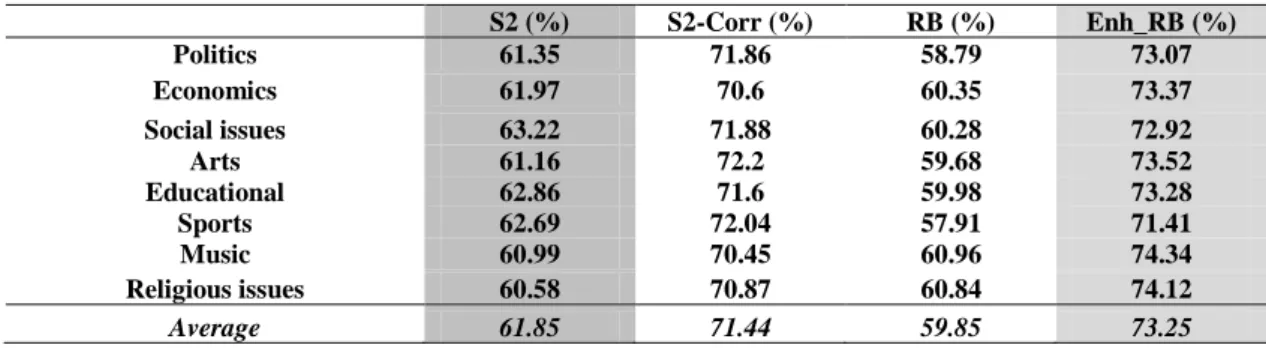
Table 23: Accuracy results for Rule-Based algorithm and Adjusted Al-Shalabi algorithm along with their Enhanced algorithms (all categories) using AT8 collection
74
Table 24: Variance values among categories for Rule-Based and Adjusted Al-Shalabi algorithms along with their Enhanced algorithms using AT8 collection
77
Table 25: Accuracy results for Rule-Based algorithm and Adjusted Al-Shalabi algorithm along with their Enhanced algorithms (all categories) using LACC Corpus
77
Table 26: Native Arabic speaker analysis of algorithm' accuracy (all categories) using AT8 collection
82
Table 27: Examples of foreign Arabized words list 90 Table 28: Number of different original implemented terms available in
feature lists processed from Corpus
99
Table 29: A paragraph taken from Addustour newspaper: (a) original paragraph (55 words), (b) paragraph (40 words, 19 three-word phrases) after removal of function words, punctuation marks, short vowels and/or numerals, (c) paragraph after words are put into two-word phrases (60 phrases) (here phrases are put between double quotes for illustration)
100
Table 30: Number of different proposed terms available in feature lists processed from Corpus
100
Table 31: Maximum F1M values at specific features number for implemented VSM representations along each classifier.
132
Table 32: F1M Improvement/Degradation by comparing implemented VSM representations performances at feature numbers presented in Table 31 for each classifier.
133
Table 33: Performance of implemented classifiers along different representations by selecting best 1000 features.
135
Table 34: Performance of best two classifiers among types for different representations by selecting best 1000 features.
xiii
List of Figures
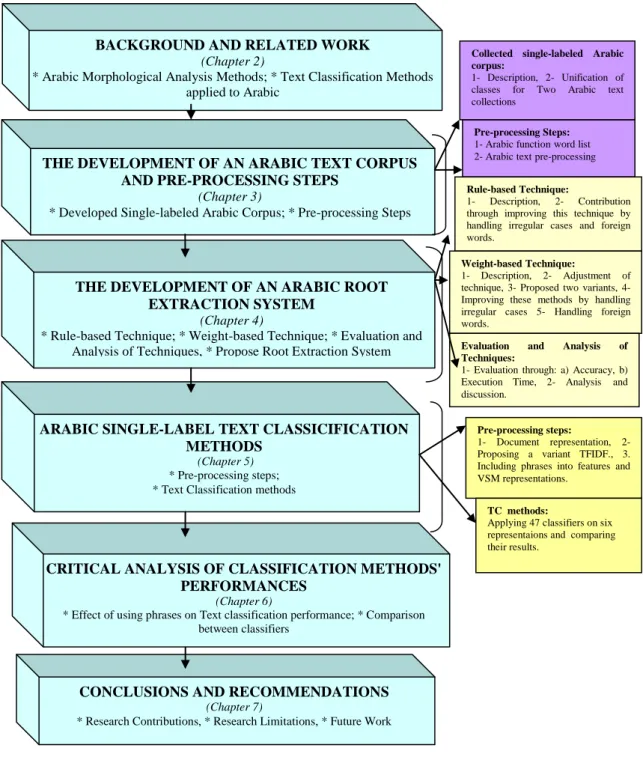
Figure 1: The structure of the thesis and steps followed in the research method
10
Figure 2: The structure of Chapter 2 12
Figure 3: Distribution of texts in AT8 along to (a) three major sources, (b) region
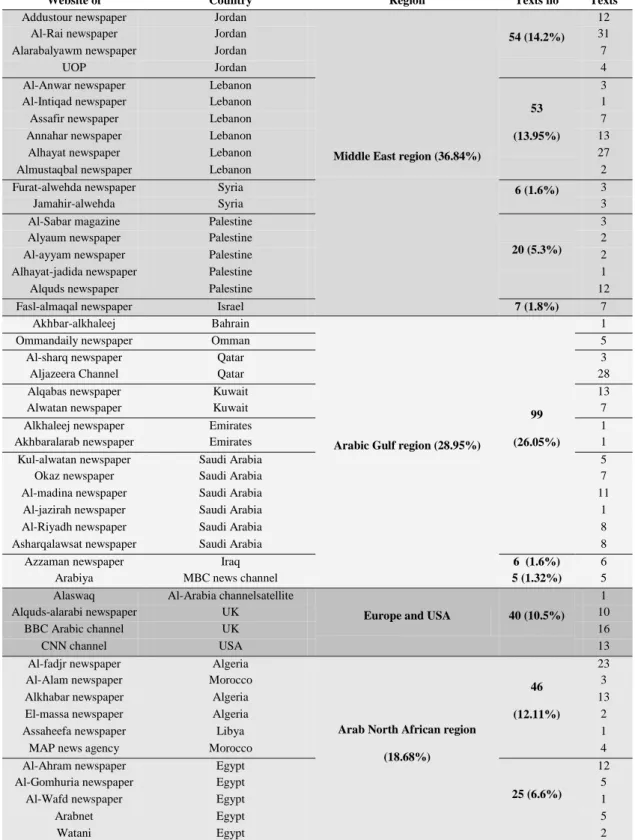
38
Figure 4: Distribution of texts in LACC along (a) three major sources, (b) region
42
Figure 5: Percentage in final Corpus according to LACC categorization scheme for (a) words, (b) files
45
Figure 6: Percentage in final Corpus according to AT8 collection categorization scheme for (a) words, (b) files
45
Figure 7: Distribution of texts in final Corpus along (a) three major sources, (b) region
46
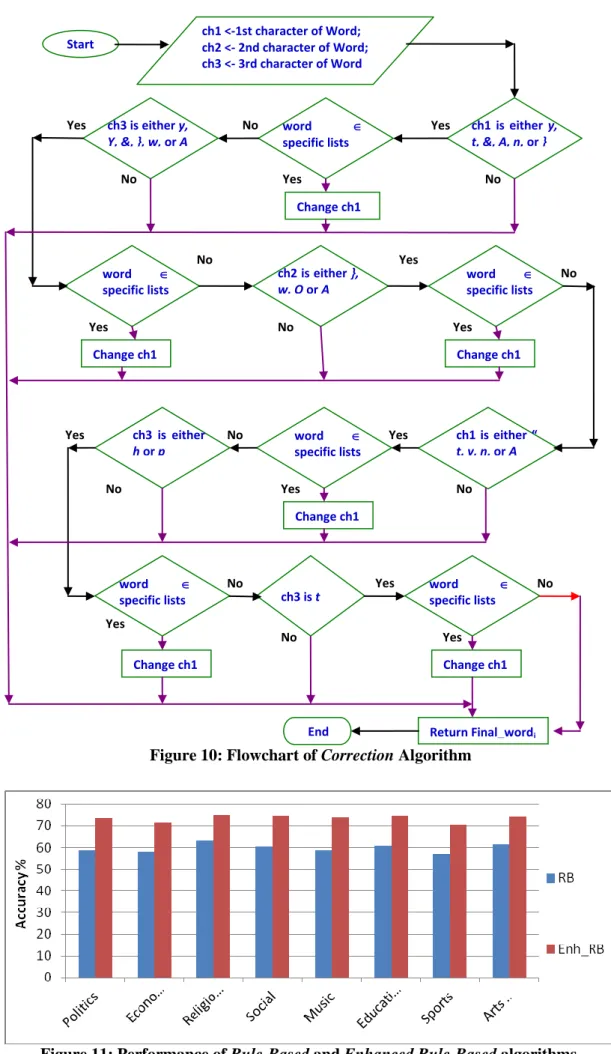
Figure 8: Pre-processing step before Arabic TC 49 Figure 9: A brief illustration of implemented root extraction techniques 53 Figure 10: Flowchart of Correction Algorithm 59 Figure 11: Performance of Rule-Based and Enhanced Rule-Based
algorithms
59
Figure 12: Comparison between accuracy results of all weight-based algorithms in all categories with the ones incorporating the Correction algorithm using AT8 collection
70
Figure 13: Comparison between average accuracy results of all weight-based algorithms with the ones incorporating the Correction algorithm using AT8 collection
70
Figure 14: Comparison between accuracy results of all algorithms in all categories with the ones incorporating the Correction one using AT8 collection
73
Figure 15: Comparison between average accuracy results of all algorithms with the ones incorporating the Correction one using AT8 collection
73
Figure 16: Comparison between accuracy results for Rule-Based algorithm and Adjusted Al-Shalabi algorithm along with their Enhanced algorithms (all categories) using AT8 collection
74
Figure 17: Variance values for all algorithms among all categories (points were connected here by smooth curves for illustration purposes only)
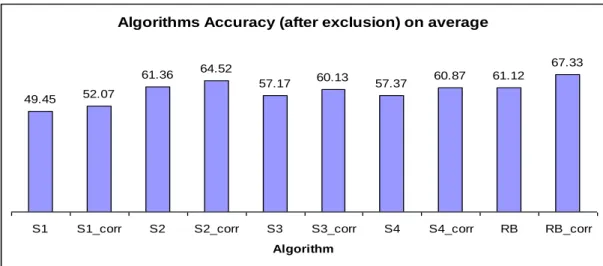
xiv Figure 18: Comparison between total variance results for the Rule-Based
and the Adjusted Al-Shalabi algorithms
76
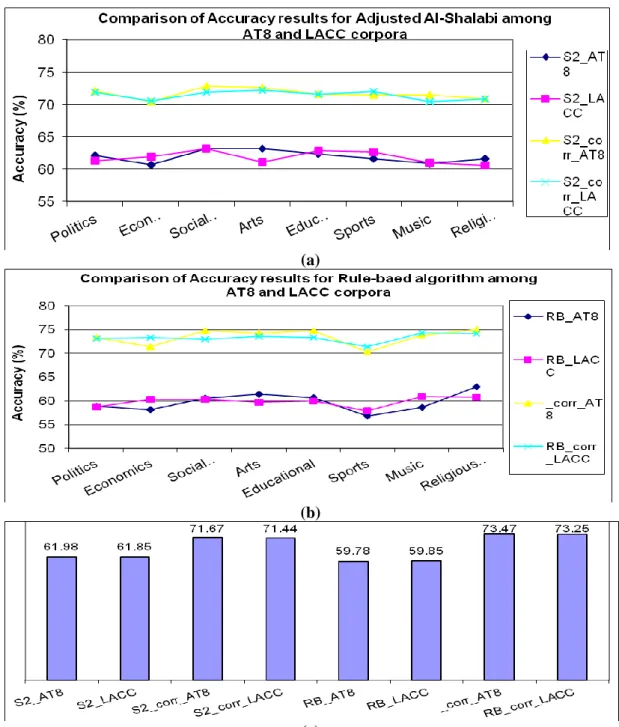
Figure 19: Comparison among AT8 and LACC corpora: (a) for Adjusted Al-Shalabi algorithm in all categories, (b) for Rule-based algorithm in all categories, (c) between two algorithms with their enhanced algorithms on average
78
Figure 20: Investigation of performance of both Adjusted Al-Shalabi and Rule-Based algorithms and their Enhanced algorithms as Length of texts increases with (a) change in their Execution time, (b) the difference in Execution time for each algorithm, (c) the Percentage of (difference in execution time by execution time for each algorithm)
79
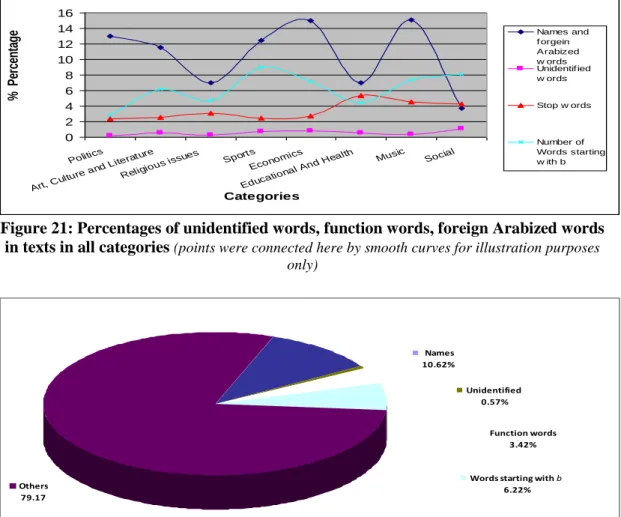
Figure 21: Percentages of unidentified Words, function Words, foreign Arabized Words in texts in all categories (points were connected here by smooth curves for illustration purposes only)
82
Figure 22. Average percentage for function Words, unidentified Words and foreign Arabized Words
82
Figure 23: Native Arabic speaker analysis of algorithm's accuracy 83 Figure 24: Native Arabic speaker analysis of algorithm's accuracy after
excluding number of names, transliterations, function Words and compounds from total number of Words in texts
84
Figure 25: Percentage of wrongly extracted weak Words by all algorithms 86 Figure 26: Percentage of wrongly extracted two-lettergeminated Words by
all algorithms
87
Figure 27: Percentage of wrongly extracted four-letter Words 88 Figure 28: The Flowchart of the Final Proposed Arabic Root Extraction
System
94
Figure 29: Basic Steps for Arabic TC classification 96 Figure 30: Comparison between classifiers' performance for Root VSM
representation according to their type (a) rules, (b) trees, (c) functions, (d) Bayes-based, (e) miscellaneous, (f) meta
109
Figure 31: Comparison between classifiers' performance for Stem VSM representation according to their type (a) rules, (b) trees, (c) functions, (d) Bayes-based, (e) miscellaneous, (f) meta
112
Figure 32: Comparison between classifiers' performance for Word VSM representation according to their type (a) rules, (b) trees, (c) functions, (d) Bayes-based, (e) miscellaneous, (f) meta
114
Figure 33: Comparison between classifiers' performance for RRP VSM representation according to their type (a) rules, (b) trees, (c) functions, (d) Bayes-based, (e) miscellaneous, (f) meta
xv Figure 34: Comparison between classifiers' performance for SSP VSM
representation according to their type (a) rules, (b) trees, (c) functions, (d) Bayes-based, (e) miscellaneous, (f) meta
119
Figure 35: Comparison between classifiers' performance for WP VSM representation according to their type (a) rules, (b) trees, (c) functions, (d) Bayes-based, (e) miscellaneous, (f) meta
122
Figure 36: Performance of different VSM representations as number of selected features varied using classifier (a) BN, (b) NBM, (c) Compl NB, (d) SMO, (e) Simple Logistic, (f) PART, (g) JRIP, (h) Ridor, (i) Decision Table, (j) J48, (k) LMT, (l) FT, (m) Simple Cart, (n) Random Forest, (o) Rep Tree, (p) Hyper Pipes, (q) END, (r) Filtered Classifier, (s) Logit Boost, (t) Random SubSpace, (u) AdaBoost.M1, (v) Rotation Forest, (w) Bagging, (x) Classification Via Regression
131
Figure 37: Comparison between Bayes-based classifiers' performance for all VSM representations according to (a) time, (b) RMSE
147
Figure 38: Comparison between tree classifiers' performance for all VSM representations according to (a) tree sizes, (b) time, (c) RMSE
151
Figure 39: Comparison between rule classifiers' performance for all VSM representations according to (a) rule numbers, (b) time, (c) RMSE
157
Figure 40: Comparison between meta classifiers' performance for all VSM representations according to (a) time, (b) RMSE
163
Figure 41: Comparison between best classifiers' performance for all VSM representations from different types according to (a) time, (b) RMSE
xvi
List of Abbreviations
ANN Artificial Neural Network
ARFF Attribute Relation File Format
BN Bayesian Network
DF Document Frequency
DM Data Mining
DR Dimensionality Reduction
EM Expectation Maximization
FSS Feature Subset Selection
IB Information Bottleneck
IE Information Extraction
IG Information Gain
IR Information Retrieval
KDD Knowledge Discovery from Databases
KDT Knowledge Discovery from Text
K-NN K Nearest Network
LC Label Cardinality
LD Label Density
LDC Linguistic Data Consortium
LSI Latent Semantic Indexing
MI Mutual Information
ML Machine Learning
MSA Modern Standard Arabic
NB Naïve Bayes
NLP Natural Language Processing
OR Odds Ratio
RBF Radial Basis Function
SMO Sequential Minimal Optimization
SOM Self Organizing Map
SVM Support Vector Machine
TC Text Classification
TFIDF Term Frequency Inverse Document Frequency
TM Text Mining
VSM Vector Space Model
1
Chapter 1: Introduction
1.1 Introduction
The early 90's represented a turning point for research in automatic Text Classification (TC) due to two factors [34]. The first was when the Internet became free to be accessed by everybody, anywhere and anytime. The second was the vast development of hardware capabilities as well as the increased number of required special purpose systems. Furthermore, the continuously increasing number of internet users whose mother-tongue is not necessarily English urged researchers to investigate new methods or improve existing ones in order to process and organize the immense volume of online data [147]. Usually such textual data were manually labeled to specific categories by human experts [20], which is an expensive and time consuming process.
Arabic language is among the top ten languages (7th place) used in the Web. Also, for Arabic users an internet penetration1 was found to be 17.5% and a growth in internet usage was 2,297.7% between the years 2000 and 2009 (further statistics and details of number of web sites, internet users in the Arab world are shown in appendix I)2,3. Such statistics emphasize the importance of applying Text Mining (TM) approaches especially TC to Arabic. However, Arabic language is a complex language and as such requires in depth investigation in terms of applying or improving available automatic processing techniques such as Natural Language
1
From: Internet World Stats, url: http://www.internetworldstats.com/stats7.htm [1/6/2010]
2 From url: http://www.labnol.org/internet/blogging/he-total-number-of-websites-on-earth/2257/ [1/6/2010] 3 From Royal Pingdom, url: http://royal.pingdom.com/2010/01/22/internet-2009-innumbers/ [1/6/2010]
2 Processing (NLP), and/or TC. Among NLP processes that require investigation for Arabic are morphological analysis and Machine Learning (ML) methods for TC.
Much research has been conducted for the development, improvement of Arabic light stemmers (i.e. outputs stems only) or morphological analyzers (i.e. outputs roots) according to the level of analysis required. Such applications were concentrated mostly for Information Retrieval (IR) whether by building stemmers that handle inflectional or derivational morphology. Examples of commercial morphological systems are Sakhr's4, Xerox's5, and MORPHO3's6 morphological analyzers. Reported Morphological analysis [28] systems for Arabic can be categorized into either systems that were implemented by individuals so as to be used partially in their academic research, or systems that were implemented by commercial institutes or companies as part of the market's needs for Arabic applications such as search engines. Since work in this thesis is within the first category, emphasis here will be on displaying its respective techniques. These techniques can be further subcategorized into: 1- Rule-based techniques as in [1], [18]; 2- Lexical-based techniques as in [56], [88]; and 3- Others as in [30], [15], [36], [124] and [17]. However, such techniques are not freely accessible on line for other researchers to use and compare except for Khoja's [111] morphological analyzer7 or Buckwalter's stemmer8 [41].
Although [26] there are many available Arabic corpora, yet there is no online bench mark large Arabic text corpus that is freely accessible for researchers to use for testing root extraction methods as well as ML methods.
4 Sakhr's morphological processor can be found at: http://www.sakhr.com
5 Xerox's morphological processor can be found at:
http://www.xrce.xerox.com/Research-Development/Historical-projects/Linguistic-Demos/Arabic-Morphological-Analysis-and-Generation
6 Morpho3's morphological processor can be found at: http://www.rdi-eg.com/technologies/Morpho.aspx 7 This analyzer was not accwssible to author at period of implementing root extraction techniques. 8 This stemmer's performance was lower than other reported extraction techniques [159] so not tested here.
3 There are many [92] ML methods that are used for classification or regression. This thesis concentrates on classification methods only. Most of these methods are not implemented so far for Arabic TC. This thesis's aim is to investigate and compare the performance of many TC methods for Arabic and test the effect of using different choices of features in document representation on TC performance by first improving and comparing the results of two root extraction methods.
1.2 Thesis Contributions
This thesis focuses on exploring different preprocessing methods and investigating their effect on TC performance. More specifically, this thesis focuses on investigating and improving root extraction methods. Its first contribution is that it improves two existing root extraction techniques, namely a rule-based method that extracts triliteral and quadriliteral roots and a weight-based one that extracts only triliteral roots. The improvements are performed through: 1- proposing and implementing an algorithm that handles irregular cases, 2- collecting a list of foreign Arabized words (aforementioned rule-based and weight-based root extraction methods do not handle), 3- proposing and adding a simple method to handle quadriliteral roots for the weight-based technique, and 4- investigating changing the weight options for letters in the weight-based technique on its performance. The importance of handling irregular and foreign Arabized cases comes from the fact that irregular words consist of weak9, two-letter geminated, hamzated, and eliminated-long-vowel words that are available in about 34% in texts10, whereas foreign Arabized words are available in about 11% in texts10. This thesis compares between these techniques in terms of their accuracy and execution time by testing their performances using a single-labeled Arabic corpus that is developed here.
9 We use here Haywood and Nahmad 1998 terminology for describing Arabic irregular forms.
4 The second contribution of this study is that it investigates the effect of using the outputs of the best reported accuracy root extraction technique (i.e. normalized words, stems, and roots) as well as including other feature choices (their respective phrases) in document representation on single-labeled TC performance using also the developed Arabic corpus.
This chapter presents an overview of the research problem as well as its rationale, and the organization of this study. Also, it presents a brief outline of this thesis.
1.3 Motivation and Objectives
With the vast and expanding use of the internet especially in the Arab world and the enormous number of websites/pages that are provided in Arabic, it has become a
necessity to have online tools/search engines that automatically
classify/retrieve/translate Arabic documents/web pages according to the needs of the respective users (whether individuals or companies such as online newspapers and journals). Generally, available search engines that provide such services for Arabic are limited and although the literature provides much research work that specifically concentrated on more effective morphological analysis methods and their effect on IR efficiency yet more research work is required to investigate and improve the accuracy of these methods and their effect on TC performance or effective translation.
Despite the recent research studies that investigated the effect of using roots/stems as alternatives of words in Vector Space Model (VSM) [155] for Arabic on TC performance such as in [148] or [154], yet there is no consensus regarding which of features root, stem or word should be used to provide best TC results. Also, the effect of using other feature choices on TC performance for Arabic was not investigated. Furthermore, there is neither available Arabic benchmark corpus nor an
5 online corpus that is freely accessible except the recently developed small Arabic contemporary corpus by University of Leeds (about 420 text documents). Thus, in literature, research works use different text collections (mostly collected on ad-hoc basis and usually small in size) for TC which makes it difficult to compare the results of such works to reach a conclusion.
Since this thesis's aim is to test the effect of using different choices of features in document representation on TC performance for Arabic, then a need for developing an Arabic corpus to be tested for both root extraction and TC methods, implementing and improving root extraction techniques performances in order to obtain roots and stems for respective words accurately. This is performed here by improving two root extraction methods and taking the outputs of best performing method to be used for feature choices. Furthermore, it proposes and implements a new variant of Term Frequency Inverse Document Frequency (TFIDF) weighting method and uses it to all investigated representations mentioned above in order to emphasize term presence among categories. It also, implements various TC methods using representations that use either words, stems, roots and/or their respective phrases and compares their performances. This work identifies the appropriate text collections, tools and procedures to satisfy the objectives mentioned above.
1.4 Research Questions
In order to satisfy the objectives stated in this thesis, the focus here is on the following four research questions:
Research Question (1)
What are the steps to develop an Arabic corpus from two different small collections to be manually classified as single-labeled corpus among eight classes?
6 What are the available root extraction methods to be implemented in this research? What are their disadvantages and how to improve and compare their performance in order to obtain the most correctly outputted stems and/or roots for respective words using the developed Arabic corpus?
Research Question (3)
How varying feature choices in Vector Space Model representation of corpus will affect the performance of various text classification methods as well as proposing and implementing a variant of TFIDF term weighting? If there is an improvement in text classification performance, would it be statistically significant?
Research Question (4)
Which classifiers applied to various representations of Arabic corpus have the best performance? Are the results obtained for such classifiers in agreement with previously reported studies?
1.5 Research Approach and Methodology
In order to achieve the objectives of this research, the current study and contributions are constructed in the following three phases:
1- To address the first research question, two labeled Arabic text collections are gathered and after investigating their characteristics, their labeling is unified in order to have a comparatively large corpus. This lead to the development of a single-labeled Arabic corpus: described in Chapter 3.
2- To address the second research question, two available root extraction methods are implemented and their advantages and disadvantages as well as performances are investigated. This lead to the improvement of these two root extraction techniques, proposing and implementing an adjustment method as well as two expanded methods for the second root extraction method, and the validation
7 of such improvements/investigations by implementing these techniques using the developed Arabic corpus and finally the proposal to develop a root extraction system that handles foreign Arabized words: described in Chapter 4.
3- To address the third and forth research questions, the author found that not many choices of features in document representation have been investigated. However, for some choices that are investigated, no report of significance testing is present to conclusively affirm which has better effect on TC performance. This is reached after studying what has been investigated in literature for Arabic TC in terms of feature choices, term weighting methods, and tested classifiers. Thus, the investigation of the effect of using various features in document representation when using a proposed variant TFIDF term weighing method on single-labeled TC performance is presnted in this thesis. Various classifiers of all types for Arabic are tested and the comparison and critical analysis of their performances for Arabic TC is presented: described in Chapters 5 and 6.
The first phase involves the following: 1- acquiring two text collections (the first one is collected by the author from various online newspapers, magazines and personal websites where she aimed to cover different geographical regions along classes specified, and the second was downloaded from University of Leeds website [25]),
2- investigating their characteristics and unifying their labeling under eight general domains.
The second phase consists in: 1- the development and improvement of two available root extraction techniques by extending their algorithms to handle irregular words,
2-proposing and implementing an adjustment method as well as two expanded methods of the second root extraction method that handles specific cases of quadriliteral roots. The validation of implemented algorithms was by using two
8 criteria: accuracy and execution time. After critically evaluating such algorithms a final root extraction system is proposed that would handle foreign Arabized words. The third phase involves applying the proposed variant of TFIDF method as well as representing features of documents in the corpus by either normalized words, stems, roots, or a hybrid of words and word phrases, stems and stem phrases, roots and root phrases. Then, such representations' effect on single-labeled TC performance is investigated using the WEKA tool [181]. This is performed by: 1- applying a feature subset selection technique for such representations in order to see if varying the number of best selected features would improve TC performance, 2- performing significance testing to verify whether indeed improvement/degradation in TC performance among representations is evident, 3- comparing between the performance of forty seven classifiers applied on above representations is presented whether between different classifiers of the same type or between classifiers among different types. The tested classifiers are categorized in WEKA tool among eight types: a) Nine Rule learners where six different classifiers are tested among this category, b) Thirteen Tree learners where eleven different classifiers are tested among this category, c) Eight Bayes-based learners where six different classifiers are tested among this category, d) Seven Function learners where five different classifiers are tested among this category, e) Two Miscellaneous learners where two classifiers are tested among this category, f) Twenty eight Meta learners where seventeen different classifiers are tested among this category, h) Four Lazy learners, and finally i) Four Multi-Instance (MI) learners. No classifiers are tested among those last two categories since either the classifiers had poor performance or are not applicable. Thus, only six types of classifiers are investigated here.
9
1.6 Thesis Organization
This thesis is composed of six chapters (excluding this one) as shown in Figure 1 where:
Chapter 2: critically reviews literature from the two main disciplines of this research: morphological analysis methods and text classification methods for Arabic as well as a brief description of available Arabic corpora.
Chapter 3: focuses on describing the two text collections, the texts' respective different classes, their characteristics, and the methodology of unifying their classes.
Chapter 4: presents our contributions towards improving two different approaches for extracting roots for inputted words. It also presents the methods for evaluating these approaches' performance, and proposes a root extraction system that incorporates the best features among such methods and handles foreign Arabized words.
Chapter 5: discusses the design of proposed text representations, proposes a variant TFIDF term weighing and implements these proposals for single-labeled text classification Also, forty seven classifiers performances are presented, compared, and tested for significance on implemented representations.
Chapter 6: critically evaluates and compares the performance of used classifiers on implemented document representations.
Chapter 7: presents the major conclusions of the research as well as any research contributions. Then, the limitations of this research are discussed along with recommended future work.
10
1.7 Summary
This chapter presents the overall scope of this research by providing background information, introducing it and research aims. It then introduces the research approach and methodology and finally it outlines the thesis structure. In the next chapter a detailed literature review is presented.
THE DEVELOPMENT OF AN ARABIC TEXT CORPUS AND PRE-PROCESSING STEPS
(Chapter 3)
* Developed Single-labeled Arabic Corpus; * Pre-processing Steps
CONCLUSIONS AND RECOMMENDATIONS
(Chapter 7)
* Research Contributions, * Research Limitations, * Future Work
Pre-processing Steps: 1- Arabic function word list 2- Arabic text pre-processing
THE DEVELOPMENT OF AN ARABIC ROOT EXTRACTION SYSTEM
(Chapter 4)
* Rule-based Technique; * Weight-based Technique; * Evaluation and Analysis of Techniques, * Propose Root Extraction System
BACKGROUND AND RELATED WORK
(Chapter 2)
* Arabic Morphological Analysis Methods; * Text Classification Methods applied to Arabic
Collected single-labeled Arabic corpus:
1- Description, 2- Unification of classes for Two Arabic text collections
Rule-based Technique:
1- Description, 2- Contribution through improving this technique by handling irregular cases and foreign words.
Weight-based Technique:
1- Description, 2- Adjustment of technique, 3- Proposed two variants, 4- Improving these methods by handling irregular cases 5- Handling foreign words.
Evaluation and Analysis of Techniques:
1- Evaluation through: a) Accuracy, b) Execution Time, 2- Analysis and discussion.
ARABIC SINGLE-LABEL TEXT CLASSICIFICATION METHODS
(Chapter 5)
* Pre-processing steps; * Text Classification methods
Pre-processing steps:
1- Document representation, 2- Proposing a variant TFIDF., 3. Including phrases into features and VSM representations.
TC methods:
Applying 47 classifiers on six representaions and comparing their results.
Figure 1: The structure of the thesis and steps followed in the research method CRITICAL ANALYSIS OF CLASSIFICATION METHODS'
PERFORMANCES
(Chapter 6)
* Effect of using phrases on Text classification performance; * Comparison between classifiers
11
Chapter2: Background and Related Work
2.1 Introduction
This chapter presents a brief review of the literature on the application of two major research areas for Arabic. The two areas are morphological analysis and TC as illustrated in Figure 2. Since the aim of this thesis is twofold, then this chapter first briefly presents different techniques for stemming Arabic words, and decides which of these techniques will be used and improved in order to provide more accurate results. This chapter then discusses briefly applied TC methods for Arabic and compares their respective results with those for English. However, since a collection of Arabic texts, preferably large in size, is required to evaluate the performance of both root extraction and TC methods, this chapter first briefly presents available Arabic text corpora and which to use (if applicable) or develop in this thesis.
The remainder of this chapter is organized as follows: next a brief review of available Arabic text corpora. Section 2.3 discusses and classifies briefly available Arabic root extraction techniques in the literature. Section 2.4 describes briefly applied single-label TC techniques on Arabic. Finally, summary is presented in Section 2.5.
2.2 Arabic Text Corpora
Newspaper articles available online are the common and frequent source for obtaining Arabic texts. Available Arabic corpora can be found for example at Linguistic Data Consortium (LDC)11 or European Languages Resources Association (ELRA)12 websites. Further information on such corpora can be found in [26].
11 LDC, University of Pennsylvania, USA, LDC website: http://ldc.upenn.edu/ [last accessed 1/5/2011] 12 ELRA website: http://www.elra.info/ [last accessed 1/5/2011].
12 Figure 2: The Structure of Chapter 2
For example ELRA has two Arabic corpora in Modern Standard Arabic (MSA) form. The first is An-Nahar newspaper text single-label corpus that contains about 270,000 texts and about 144 million words under 5 classes. The second is Al-Hayat Arabic single-label corpus under 7 classes. On the other hand, LDC has larger scale Arabic text corpora such as Arabic Newswire Part 1 corpus. This corpus, although without any labels, contains 383,872 texts, about 76 million words and about 666,094 unique words. Another example in LDC is the Arabic Giga word corpus with its 1st, 2nd, 3rd and 4th editions. Its 4th edition has 2,716,995 texts under one of three labels ('story', 'multi' (contains a series of unrelated blur13), and 'other' labels). All previous Arabic corpora are not freely accessible to researchers as the English RCV1-v2 [152], [127] or the Reuters-21578 [126] corpora. Thus, there is no available online benchmark freely accessible Arabic corpus, whether single or multi labeled. As such, two small text collections that are used in this thesis are described and arranged in one corpus as is thoroughly explained in Chapter 3. The first text
13 as stated in: http://catalog.ldc.upenn.edu/LDC2003T12
Available Stemming Techniques For Arabic
Single-label TC Techniques Applied on Arabic
Arabic Text Corpora
Lexical-based techniques Other techniques Rule-based techniques Applied Single-label TC Preprocessing steps before TC Document Presentation and Term Weighing
Dimensionality Reduction Specific classifiers NB, k-NN, SVM classifiers Introduction Classifiers comparison
13 collection was gathered from different websites and categorized into eight general domains. The second text collection was downloaded from University of Leeds website on January 2010 [25], originally categorized into eight other general domains.
Thus, next a brief description of methods in literature used for choosing general domains for manual classification of texts.
In 1996, Sinclair [165] proposed 35 domains to present texts. Later on Sharoff [163] categorized texts into eight general domains since Sinclair's categorization list, in his opinion, provides a too fine-grained list. The eight general domains are: 1- natural sciences (mathematics, biology, physics, chemistry ... etc), 2- applied sciences (agriculture, medicine, ecology, engineering, computing, transport .. etc), 3- social sciences (law, history, philosophy, psychology, language, education .. etc), 4- politics (inner, world), 5- commerce (finance, industry), 6- life (general domain e.g. fiction, conversation .. etc), 7- arts (visual literature, architecture, performing), 8- leisure (sports, travel, entertainment, fashion .. etc). However, Eibeed [64] suggested that Arabic articles be classified according to one of 10 domains that are: 1- general, 2- philosophy and psychology, 3- religion, 4- social sciences, 5- languages, 6- natural sciences and mathematics, 7- applied sciences, 8- arts, 9- literature, and 10- geography and history. In [64], O. Dawood suggested to have 15 domains that are as follows: 1- religion, 2- sports, 3- educational sciences and scientific research, 4- medicine and health, 5- encyclopaedias, 6- philosophy and psychology, 7- languages, 8- Arabic articles translated to other languages, arts, 9- Foreign articles translated to Arabic, 10- social sciences, 11- applied and natural sciences, 12- history and its sciences, 13- geography and geology, 14- mathematics, and 15- others. It is clear that
14 although the topics are more or less the same, the categorization process and numbers of general domains are different.
The enormous number of texts that is available online and is increasingly growing explosively on the web requires for such texts to be classified into domains or topics so that these texts can be for example retrieved easily. The determination of such domains is crucial for the accuracy of the classification process whether there is hierarchy in domains/genres or not. This is so since [165] if a text is to be classified among predefined classes that are Physics, Biology among others where this text's class is actually Bio-Physics (which is not among the predefined classes). Then, it is expected that results of classifying this text will be lower since the boundaries among such classes are neither fixed nor clear. The reason for this lower performance is partially due to the fact that the classifier is designed to only choose one class among those predefined, and then it would provide the wrong classification. However, for the same classes, if the classifier chooses more than one class, then it can provide a more representative answer to the classification required. One of the criteria [161] that a corpus is characterized by is the generality of its classes. A generality of a class ci is defined to be the percentage of documents dj in this class to the total number of documents in the corpus as shown in eq. 1.
} ) , ( { ) (c d d c T g i j j i (1)
Among the issues [178] related to multi-labeled data sets is how to identify the amount of data that is multi-labeled in such sets. A method for doing so is by using the concepts of Label Cardinality (LC) and Label Density (LD). For these concepts eq. (2) are provided below, where D: is data set with size |D|, |L| is number of labels; |Yi| is number of assigned labels for document di. Multi-labeled data sets vary in terms of their LC and LD values. An example [178] showing two data sets is for the
15 genbase and yeast sets with LC = 1.35, LD = 0.05 and LC = 4.25, LD = 0.3 respectively. From the equation for LC it is noticed that LC value does not depend on the number of labels in corpus but rather is the average number of labels per text in it. However, LD value depends on the number of labels assigned.
D i i Y D D LC 1 1 ) ( ,
D i i L Y D D LD 1 1 ) ( (2)In Chapter 3, the development of the Arabic text corpus is presented in detail where the two collections used to develop this corpus are described. Next is a description of stemming techniques for Arabic.
2.3 Stemming Techniques for Arabic
Large-scale morphological analyzers [49] usually outputs to the user besides the root for the inputted word further information. Such information may be the meaning of prefixes, suffixes, and/or root disambiguation. Reported Morphological analysis [28] systems for Arabic can be categorized into either systems that were implemented by individuals so as to be used partially in their academic research, or systems that were implemented by commercial institutes or companies as part of the market's needs for Arabic applications such as search engines.
Much research has been conducted for the development, improvement of Arabic light stemmers (i.e. outputs stems only) or morphological analyzers (i.e. outputs roots) according to the level of analysis required. Since the stemming techniques implemented in this work are within the first category, emphasis will be on displaying its respective techniques. These techniques can be further subcategorized into: 1- Rule-based techniques; 2- Lexical-based techniques; and 3- Others as will be described briefly in the following three subsections.
16
2.3.1 Rule-Based Techniques
Many Arabic morphological analysis approaches use rules, prefix and suffix lists to identify the possible roots for any Arabic word in MSA. Such approaches are thus called rule-based. However, building and implementing the rules for this analyzer is time consuming. These methods, based on the required level of analysis, can be [29] subcategorized into: a) one-level rules that analyze words at the stem level using regular concatenation, b) two-level rules that analyze words as roots + patterns + concatenation, and c) three-level rules that analyze words as roots + templates + vocalization + concatenation for obtaining their roots. Examples of stemming techniques that use one-level rules to produce stems are as in [120], [121], [9], [44], [29] and [50]; whereas examples of stemming techniques that provide roots (whether two-level or three-level rules) are as in [1], [18], [22], [3], [11], [48], [16] and [72].
Although approaches that obtain roots/stems use rules, these approaches differ in: a) the number of patterns, prefixes, suffixes used, rules' order in the approach, and the amount of included function words to be removed, b) applying a normalization step for some letters in words or not and if so to what letters, and c) applying/removing diacritics for words or not.
2.3.2 Lexical-Based Techniques
This method uses lexical databases, dictionaries, and/or thesaurus to establish, among other things, if the possible combinations of prefix-(root + pattern)-suffix is correct for the processed word. Some of the research works that use lexical databases, dictionaries, and/or thesaurus, use it along with methods as finite state transducers [35], while others use it with rules [41], [56], [87], [111] and [182]. However, such techniques are usually collected based on a corpus and so are limited. This limitation affects the performance of such analyzers negatively.
17
2.3.3 Other Techniques
The third method of stemming approaches, which is proposed for Arabic, cannot be in our opinion categorized into any of the previous two categories. Examples of such approaches are as in [54], [131], [151], [160], [49], [52], [28], [30], [15], [37], [124] and [17]. All the above research works except in [17] used either statistical or ML methods for morphological analysis.
Al-Shalabi, et al work [17] provided a rank, order and weight for each letter in the word according to its position and calculated the product of rank and weight. This method then only extracted a triliteral root for that word by choosing the three least product values for letters of word without any change in their positions. Implementing this method on a small set of Arabic abstracts reported an accuracy of about 90%. Most of the aforementioned ML methods are further explained and compared in appendix I.
ML methods, especially classification methods, usually require large corpora (as the Reuters-21578[126] corpus) for training in order to establish good results. Next is a comparison between the types of stemming techniques presented above.
2.3.4 Comparison between Stemming Techniques
Although much work [24] have been performed on Arabic morphological analysis and stemming especially for IR applications, yet few of such works handled specific cases of irregular words (i.e. weak, eliminated-long-vowel, two-letter geminated, and hamzated words) but not all of these cases except the works in [72] and [35]. It is noteworthy that in [72] no results were provided of the system implemented. Also, in [35] the Xerox demo14 is available, and although efficient it
14 Xerox demo can be found at
18 requires usually a relatively long time to provide the required roots (from about 1 hour to 7 day according to number and type of words provided).
The less-studied cases of irregular words are weak words [5], [42]. The lack of study of such irregular cases is partially expected since research works concentrated on building various light stemmers for IR especially in more recent times. Such concentration was due to the extensive research on whether to use stems or roots for improving IR performance.
When developing for Arabic a stemmer or morphological analyzer, important issues present themselves [24] such as under-stemming and over-stemming. Other issues that require handling for stemmers are compound words, proper nouns, foreign Arabized words, diacritization, word disambiguation and irregular forms of words. Also, available stemmers [22] automatically stem blindly words whether proper nouns, foreign Arabized words or others and thus perform poorly. Thus, there is a need to build an algorithm that handles some/all of these cases.
There is no comparative study available in the literature that compares between available Arabic stemmers and evaluates their performances except for the works in [160], [122] and [23]. The work in [160] compares between the performances of three different stemmers in terms of accuracy. Larkey et al work [122] compares between the performance of their light stemmer with other stemmers for IR as the well-known Khoja stemmer15, Buckwalter stemmer, and Diab's Lemmatizer [55]. The work in [23] compares the performance of six existing algorithms for root extraction, four of them are rule-based [16], [84], [172], and [169], one lexical-based [111] and the last is a weight-based one [17]. This work implemented such algorithms and compared their performance using a corpus that was built from 3,823 triliteral roots and applying 73 patterns with 18 suffixes and producing 27.6 million
19 words. The highest obtained accuracy among these six algorithms was the one of Ghwanmah, et al [84] work of 39% only. The results obtained in this work are rather interesting considering that the reported accuracy in original works were above 90%. However, the corpus used in this work is much larger than the ones used in the original papers stated above.
There was a discrepancy among the published studies [24] regarding which are better for IR, using words, stems or roots as in [3], [11], [97], [9], and [48]. Larkey, et al [121] verified that using either stems or roots improved significantly IR performance (much better than applying stemming on English for IR). Later on, Larkey, et al [122] concluded that the effect of using light stemming is the highest on IR for Arabic after comparing the effect of their light stemmer with other stemmers or root extractors. This agrees [51] with what is known that IR is more tolerant to over-conflation (i.e. removing letters at beginning or end that are not extra letters) than under-conflation. Also, although [158] word sense disambiguation has been reported to decrease retrieval effectiveness, yet by improving the correctness [51] of morphological analysis (here context sensitive which is an akin to sense disambiguation) retrieval results improved slightly. A drawback of context-sensitive morphological analysis is that it requires considerably more computing time than light stemming.
It is worth noting that names of places, countries, cities, months and foreign Arabized words compose about 11% of texts22. A more comprehensive percentages of words is described in [2] where the percentage of occurrence for proper nouns, 'verbs, nouns and adjectives', broken plurals, function words, and deverbals (i.e. infinitive forms, active and passive participles, analogous adjectives and nouns of place and time) are 1.14%, 16.01%, 24.3%, 7.87%, 0.37%, and 58.18% respectively.
20 Such percentages are based on the analysis of two million words using AraMorph16 and DIINAR.117 [57]. Thus, Arabic words are highly derivational. More specifically, weak18, two-letter geminated, hamzated, and eliminated-long-vowel words are available in about 13%, 7%, 11% and 2% (12% of weak words) in texts respectively19. Arab linguists and consequently early research works on morphological analysis, lexicons, and machine translation base the analysis of words on their root + pattern structure. However, Dichy and Farghaly [57] argued that this is not sufficient since root + pattern representation does not handle Ancient and medieval words as IsmAEyl as well as the complex grammar-lexis relations in Arabic words. This is so since such representation handles only verbs and deverbals. This was also emphasized by Abbès, et al [2] which showed that using only prefix-suffix combinations (without proclitics (i.e. letters at beginning of words as l, w, b) or enclitics (i.e. complement pronouns)) are more ambiguous than when such clitics are taken into consideration. On another point, Darwish, et al [51] investigated the effect of context sensitive morphological analyzers on IR. Results of this work show that better coverage and improved correctness have a dramatic effect on IR effectiveness. Next is a brief description of reported applied TC methods for Arabic and the effect of some preprocessing steps on their performances.
2.4 Text
ClassificationApproaches Applied to Arabic Sources
TM is an interdisciplinary area [87] that involves fields as ML and Data Mining (DM), Statistics and statistical methods, IR, and Natural Language Processing (NLP). Researchers have explored and developed many TM and NLP techniques and
16 AraMorph can be found at: hhtp://sourceforge.net/projects/aramorph, [last accessed 1/11/2011]
17 DIINAR.1 can be found at: http://catalog.elra.info/product_info.php?products_id=902, [last accessed 1/11/2011] 18 We use here Haywood and Nahmad 1998 [96] terminology for describing Arabic irregular forms.
19 Percentage values presented here are gathered from 40 texts chosen arbitrarily in the collection as will be described in Chapter 4.
21 algorithms especially to English language but few have been proposed for Arabic text automatic interpretation. This is partially due to the rich morphology [96] of Arabic language. TM methods, which are also known as DM methods for texts, are applied [92] for basically: 1- TC (supervised learning), 2- clustering (unsupervised learning), 3- IE, 4- association analysis, and 5- trend analysis. TC is the process of assigning a text document to one or more predefined classes based on its content [129].
Text processing techniques, such as TM methods, according to application, are applied at different levels [87] at: 1- word level, 2- sentence level, 3- document level or 4- document-collection level. If applied at word level, different processes might be applied by: a- taking word properties (such as homonymy, polysemy, synonymy, and hyponymy or word frequencies) into consideration, b- removal of function (stop) words, c- using stemming or lemmatization, d- using frequent n-grams, and finally e- using lexical relations databases such as Word Net (WN) for English or recently for Arabic (AWN). However, if text processing is applied at document level, it would be used, among others, for text summarization as in [138] when applied on English; and [68], [69] when applied on Arabic. Finally, when it is applied at document-collection level, several issues require handling such as choosing a representation of document, deciding a similarity function to compare documents, reducing the high dimensionality of documents by choosing an effective method to do so for categorization or clustering. One of possible applications of using ML techniques for Arabic is for language identification as in [162].
22 There are few available commercial tools or software that applies TM techniques on Arabic such as SakhrTM automatic commercial categorizer, keyword extractor, and summarizer [153] and [66] KP-Miner system20.
In the following subsection preprocessing steps for TC will be illustrated. In subsection 2.4.2 single-labeled TC methods applied to Arabic will be discussed.
2.4.1 Pre-Processing Steps for Text Classification
Applying TC techniques requires usually a preprocessing stage that would remove punctuation marks, function words and might return the remaining words to their stems (for Arabic words to their stems or roots). For English language, researchers perform the stemming step in order to reduce the high dimensionality of documents [161]. Since the research work on Arabic TC is rather new, many issues need to be investigated in order to establish its effect on TC. Among such issues are: document representation, types of features used, methods of weighting, and feature selection or extraction. Research work investigating such issues is presented next. 2.4.1.1 Document Representation
A text document dj is usually represented [161] as a vector of term weights
(wkj),dj w1j,...,wT j
, where T is the set of different terms (also called
features) that occur at least once in at least one document in the training set from the collection. Different approaches are used for document representatio