National Conference on Engineering Innovations and Solutions (NCEIS – 2018)
International Journal of Scientific Research in Computer Science, Engineering and Information Technology
© 2018 IJSRCSEIT | Volume 4 | Issue 6 | ISSN : 2456-3307
An Iot Approach to The Issues of Bus Commuters
Abhinav*, Akshari Nidugala, Prof. C. N. ChinnaswamyInformation Science and Engineering, The National Institute of Engineering, Mysuru, Karnataka, India
ABSTRACT
As we are rapidly moving towards the India, which Dr. A.P.J Abdul Kalam mentioned in his vision for India 2020, we have projected our nation as a developing country in transition to developed nation status. The development of smart cites is in full swing and several hundred crores of INR is being spent on the development of smart cities. Various sectors in economy have seen immense involvement of technology. Public transit, especially buses are considered as the lifeline of the nation. But, the development of this sector is very subtle since the last few decades. The introduction of Internet of Things(IoT) in the blooming silicon market provided us with an opportunity to enhance customer experience of bus commuters(especially daily commuters).With the integration of various sensors and Arduino modules, we have designed a solution for various problems( such as overcrowding) faced by the bus commuters on a daily basis. It will help immensely in the development of smart cities which will eventually lead to the nation’s overall development.
Keywords: IoT, Smart Cities, Arduino, Overcrowding
I.
INTRODUCTION
Public transport has always been the first priority for daily commute on every commoner’s mind. The reason why public transports are preferred is that, public transits are relatively cheaper than private travel. Private vehicles require servicing, insurance and repairs on a timely basis. Public transport on the other hand, offers concessions for elderly citizens and also students. Also, public transports are a boon to the environment. Big cities have public transport networks that reach out all around the city, thereby making it very convenient for people. Public transport comes as a boon to all those people who can’t drive and are dependent on their friends or relatives to do the driving. Public transportation can convey many more people in much less space than individual auto mobiles, which helps to keep traffic congestion lower, and helps riders avoid the stress
that comes from daily driving in highly congested areas.
some IoT based approaches that can help solve these problems faced by daily commuters.
This paper attempts to provide solutions to the problems stated above, we want to provide solutions with the help of this paper. For instance, a weight check can be installed on all the buses which will ensure that the buses do not run overloaded. Also, real time data can be provided to the passengers on their mobile devices, regarding the arrival and status of the buses. The status can be shown indicating whether the bus is filled or not. If a person finds his bus already filled, he need not wait until the bus arrives. He can make alternate arrangements. Also, real time information regarding any bus break downs on any route can be indicated on the mobile application.
The paper is organised as mentioned further. Section II talks about Methods Used in which, we have briefly explained the methods we have used as solutions to the aforementioned problems. Section III discusses Implementation Details, an in-depth view of how the proposed methods are implemented. Section IV and Section V contain and the Future enhancements of this presentation.
II.
METHODS USED
A. Overcrowding check
A weight sensor is to be installed on the bus, so that the weight can be monitored at all times. This will ensure that the buses are not getting overcrowded. The weight will be checked using a weighing scale built using load cells, Arduino module and a Load cell amplifier -HX711.The scale will be positioned on the buses.
B. Real time data using mobile application
For real time bus tracking, we will be using “The Transport Tracker Solution”. This can help us create an Android app which will capture the real time data and store it on an online NoSQL database “Firebase”.
The map built with the Google Map JavaScript API will provide the real time tracking of the vehicle.
III. IMPLEMENTATION DETAIL
A.Implementing weighing scale sensor
The weighing scale is built using load cells, Arduino module and HX711(load cell amplifier).A load cell is a transducer that can translate pressure (force) into factor for metallic strain gauges is typically around 2. Strain measurements rarely involve quantities larger than a few millistrain. For instance-suppose we apply a strain of 500µε. A strain gauge with a gauge factor of 2 will have a change in electrical resistance of only 0.1.
For a 120Ω gauge, this is a change of 0.12Ω.
0.12Ω is a very small number that cannot be detected at all. So we are going to need another device that takes that very small change in resistance and turn it into something that we can measure accurately.
That device that can help us achieve the above, is HX711.
A good way of converting small changes in resistance and into something more measurable is using a Wheatstone bridge.
In a Wheatstone bridge,R1/R2=R3/R4 implies Vout=0.
Vout=[(R3/(R3+R4)-R2/(R1+R2))]*Vin (1)
studied.
Figure 2. Full-bridge strain gauge circuit
Now, the load cell is connected using 5 wires to the HX711 load cell amplifier. The pins are- RED,BLK,WHT,GRN AND YLW.
Figure 3. Load cell wiring
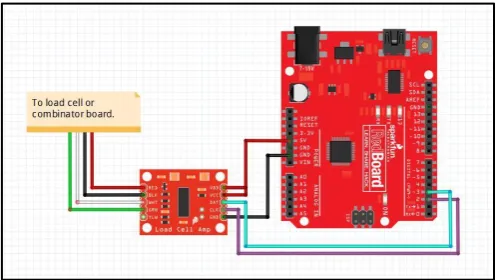
Once the load cell is connected to the amplifier, the loose ends of wires( VDD, VCC, DAT, CLK, GND) are connected to an Arduino/RedBoard board.
Figure 4. Load cells wires connected to HX711 Amplifier board
After the load cell, amplifier and microcontroller (Arduino/RedBoard) are set up; we can calibrate it to check the weight of the bus, using Arduino codes. The check will ensure that the buses are not overcrowded and accurate information will be processed and passed on to higher authorities, if the buses ply overloaded.
Figure 5. HX711 connected to Red Board
B. Implementation Details of the mobile Application
Different Components:
1. Map
An app based interface that displays information about the current buses plying on the route and the location of vehicle based on the concept of Digital Twin.
Figure 6. Real time information on map
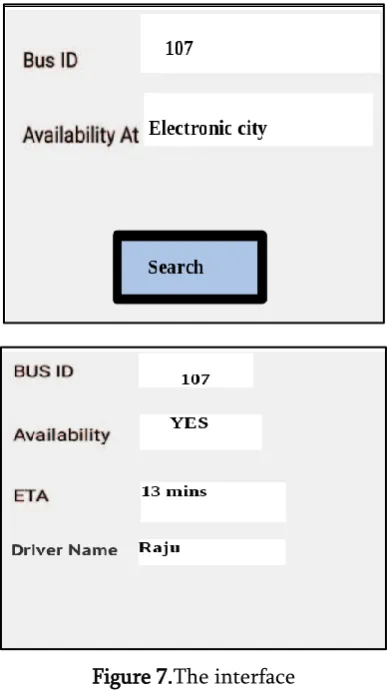
2. Bus Location
Figure 7.The interface 3. Admin’s Interface
The administrator will have the control of the application and will monitor the application for trends and with the help of Cookies we can suggest the customers frequently searched bus numbers for the ease of use.
4. The database backend
A Real time NoSQL database Firebase is used to store the vehicle location and occupant status data sent from the vehicle locator and provide real time data synchronization to the map and administrator’s overview.
IV.
CONCLUSION
The use of public transport needs to be encouraged as much as possible, in today’s world, where global warming is such a serious issue. Public transport is a very convenient means of commute for people. But, if people have to think twice before they wait at a stop every time, just to avoid an overcrowded bus, then public transport will not serve its purpose. This paper has presented some solutions that can be used,
to help daily commuters. Weighing scales that are built using load cells can help in ensuring that buses do not travel overcrowded. Also, a mobile application that informs passengers real time data related to buses in a route can help people save time, and plan their schedules and arrangements without getting disappointed waiting for a bus that does not people requesting information on the application can be used to bring the number of operational buses to a proportionate figure. Another enhancement is that, alternate routes can be provided to users if a certain bus suffers a break down.
VI.
REFERENCES
[1] American Public Transportation
Association,2015http://www.apta.com/mediace nter/ptbenefits/Pages/default.aspx
[2] Arduino. (2013). Arduino: Main Page [Online]. Available: http://www.arduino.cc/
[3] Mark Smith, ”Intelligent Mobile Application for Traffic Monitoring”,
[4] TNG, 2015, 2015 12th International Conference on Information Technology - New Generations (ITNG), 2015 12th International [5] Conference on Information Technology - New
Generations (ITNG)
[6] 15, pp. 621-625, doi:10.1109/ITNG.2015.103 [7] C Roman, R. Liao, P. Ball, S. Ou and M. de
Heaver, "Detecting On-Street Parking Spaces in Smart Cities: Performance Evaluation of Fixed and Mobile Sensing Systems," in IEEE Transactions on Intelligent Transportation Systems. DOI:10.1109/TITS.2018.2804169 [8] J Zambada, R. Quintero, R. Isijara, R. Galeana
Guadalajara, 2015, pp. 1-6. DOI:10.1109/ISC2.2015.7366202
[9] T M. Bojan, U. R. Kumar and V. M. Bojan, "An internet of things based intelligent transportation system,"2014 IEEE International Conference on Vehicular Electronics and Safety, Hyderabad, 2014, pp. 174-179. DOI:10.1109/ICVES.2014.7063743
[10] Z Y., Z. X., Z. S. and G. s., "Intelligent transportation system based on Internet of Things,"World Automation Congress 2012, Puerto Vallarta, Mexico, 2012, pp. 1-3.
[11] N Dlodlo, "The internet of things in transport management in South Africa,"2015 International Conference on Emerging Trends in Networks and Computer Communications
(ETNCC), Windhoek, 2015,
pp.19-26.DOI:10.1109/ETNCC.2015.7184802
[12] M Ramachandra, "IoT solution for scheduling in transport network,"2016 International Conference on Internet of Things and Applications (IOTA), Pune, 2016, pp.327-331.DOI:10.1109/IOTA.2016.7562746
[13] L. Chunli, "Intelligent transportation based on the Internet of Things,"2012 2nd International Conference on Consumer Electronics, Communications and Networks (CECNet),
Yichang, 2012, pp. 360-362.