ROLE of DC-MLI based D
-
STATCOM in
Distribution Network with FOC Induction
Motor Drive
Surbhi Aggarwal
1, Parag Nijhawan
2P.G. Student, Department of Electrical and Instrumentation Engineering, Thapar University, Patiala, India1 Assistant Professor, Department of Electrical and Instrumentation Engineering, Thapar University, Patiala, India 2
ABSTRACT: Rated voltage and rated frequency supply should be supplied to the consumer end. With the introduction of many non-linear loads at the consumer end, Power Quality problem is a serious threat to the Power System. The potency of D-STATCOM using SRF control theory in a Distribution Network with Field Oriented Control (FOC) Induction Motor drive as non-linear load with Diode-Clamped Multilevel inverter is examined. D-STATCOM is a shunt linked device used for the reactive power compensation, for harmonic elimination and load balancing. For high-power and medium-power applications, Multilevel inverters are used as they can extract input current and produce output voltage with very low distortion. Simulation of D-STATCOM using SRF control theory with 7 level Diode-Clamped Multilevel Inverter has been performed in MATLAB/SIMULINK.
KEYWORDS:DC-MLI, FACTS, Field Oriented Control (FOC), STATCOM, SRF, THD, VSI.
I. INTRODUCTION
Power System is a subsystem of Electrical Engineering which composes of the generating, transmiting and distributing sections of the electric power. It is the chief duty of Power System engineers is to meet the consumers electric power demand. With the introduction of many non-linear loads at the consumer end, Power Quality problem is a serious threat to the Power System. As per IEEE, “Power Quality is the concept of powering and grounding sensitive equipment in a matter that is suitable to the operation of that equipment”. Common Power Quality problems that can be observed in daily life are Voltage Sag, Voltage Swell, Voltage Flickering, Over-Voltage and Under-Voltage. Impulsive transients, Oscillatory transients and Harmonics are also Power Quality problems. At the distribution side, Custom Power devices are used which mainly include Unified Power Quality Conditioner (UPQC), Distribution Static Compensators (D-STATCOM) and Dynamic Voltage Restorer (DVR).
D-STATCOM, a shunt linked Custom Power device employed for the reactive power compensation at the distribution side. It is also used for elimination of harmonic level and balancing of the loads at the distribution end. Various control algorithms for extracting the reference source current components are defined in the literature to analyze the performance of D-STATCOM such as Instantaneous Reactive Power (IRP) theory, Adaline Based Control Algorithm, Load balancing, Synchronous Reference Frame (SRF) theory, Symmetrical Component Theory and many others. Among from all, IRP and SRF control algorithms are usually used.
Multilevel inverter finds usage in many industrial high power applications. Multilevel inverters produce output with more number of voltage levels, producing a more sinusoidal voltage waveform and however reducing the harmonic distortion in the system. Multilevel inverters are superior to conventional VSIs and CSIs due to their low distortion in the output voltage waveform and reducing the dv/dt stress on the switches.
II. CUSTOMPOWERDEVICES
The notion of Custom Power devices was made known by N. G. Hingorani in the Power System. At the distribution end, Custom Power devices are used whereas FACTS device are used at the transmission end. For improving the system reliability and power transfer quality at the transmission end, FACTS devices are used whereas the Custom Power devices are employed for Power Quality improvement that is transmitted to the end user.
Custom Power Park is defined as the consolidation of different CP devices in a particular area to improve both the current quality and voltage quality for both linear and non-linear loads. To achieve high Power Quality, DVR, Static Transfer Switches, Active Power Filters (APF) and backup generator are used. Customer Power Park serve the consumers who are in a request of high grade of power and are eager to pay an extra charge sum for the services provided to them.
Custom Power devices are classified into current breaking devices and compensating power devices. SSB, SSCL and SSTS are some of the current breaking or solid state devices. Compensating devices are either used to compensate the load power factor, unbalance load, etc. or to enhance supplied voltage. D-STATCOM, DVR and UPQC are the Compensating devices.
III.DISTRIBUTIONSTATICCOMPENSATOR(D-STATCOM)
Nowadays, many utilities and industries face the voltage sag problem which is one of the most common Power Quality issues caused due to the use of non-linear loads like motors, pumps, fans etc. at the distribution end. These loads draw excessively lagging power factor currents which reduce the flow of active power through the network and increase the losses on the system.
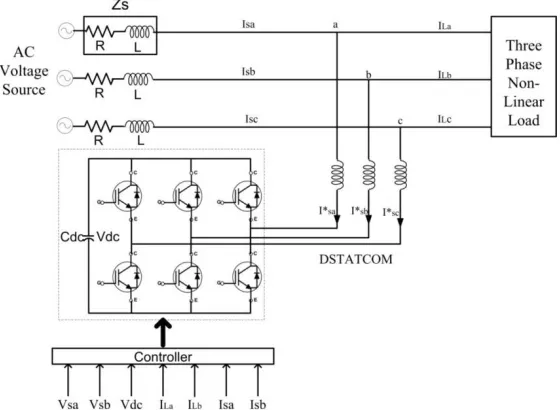
Fig. 1 Basic structure of D-STATCOM
Configuration of D-STATCOM
D-STATCOM mainly constitute of: 1. Voltage Source Converter 2. Coupling Transformer 3. DC Capacitor Voltage 4. LC Passive Filter
Control Strategy for D-STATCOM- SRF Theory
D-STATCOM is employed for harmonic easing; reactive power compensation or load balancing at the distribution end of the network. Different control theories or algorithms are used for extracting reference source currents. Some of the strategies SRF theory, IPR theory, Adaline Based algorithm, DC bus regulation for current compensation and some schemes based on artificial intelligence. Amongst from these schemes, SRF based theory is used to study the performance of the DSATCOM with Field Oriented Control (FOC) induction motor drive as a non-linear load is examined.
Synchronous Reference Frame (SRF) Theory
SRF theory, a d-q control theory is based on the conversion of 3 phase current frame a-b-c to synchronously rotating
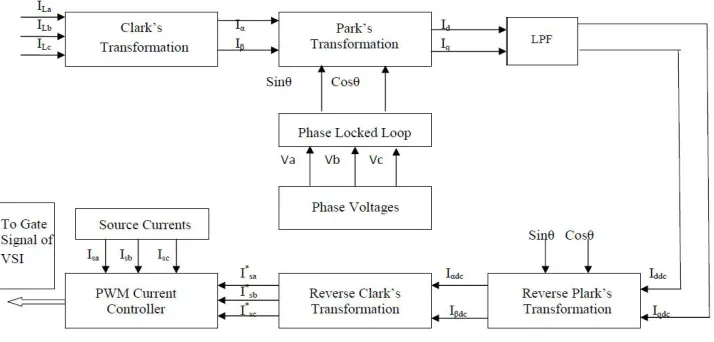
d-q frame. Schematic plan of SRF theory is explained in Figure 3. To the Phase Locked Loop (PLL) block, voltage signals Va, Vb and Vc are applied to obtain sine and cosine signals.
Load current signals ILa, ILb and ILc are converted from 3 phase quantities to 2 phase quantities i.e Iα and Iβ with the help
of Clark’s transformation following the equations:
Park’s transformation is used for converting balanced two-phase stationary quantities to 2-phase rotating reference frame.
After Clark’s Transformation, Park’s Transformation is done by using the following equation:
=
− (3)
=
⎣ ⎢ ⎢
⎡ − −
√
−√ ⎦⎥ ⎥ ⎤
(1)
=
⎣ ⎢ ⎢
⎡ − −
√
−√ ⎦⎥ ⎥
Fig. 2 Schematic plan of SRF based theory
Basic schematic plan of SRF based theory is shown in figure 2 describing all the steps involved in the SRF based theory. The sequence of all transformations is shown in figure.
For extraction the DC component from the synchronously rotated currents, Low pass filter is used. These extracted DC currents are altered back into IαDC and IβDC using Reverse Park’s Transformation equation:
=
− (4)
Reverse Clark’s Transformation is applied to obtain 3-phase Reference Source Currents I*sa, I*sb and I*sc from the
derived DC currents using the equation:
∗ ∗ ∗ = ⎣ ⎢ ⎢ ⎢ ⎢ ⎢ ⎡ √ √ − √ √ − − √ ⎦ ⎥ ⎥ ⎥ ⎥ ⎥ ⎤ ∗ ∗ ∗ (5)
IV.MULTILEVELCONVERTERS
C
onverter is a conversion device used to alter the nature of electric supply i.e. from DC to AC and vice-versa, DC to DC as well as AC to AC. Voltage source inverters (VSI) are basically two-level inverters. Basically, Multilevel inverter began with 3 level inverter. Multilevel inverters are fundamentally used to obtain sinusoidal voltage from several levels of voltage extracting input current with very low distortion operating at lower switching frequency; generate smaller torque ripples in the motor. These can generate output voltages with mature medium-power semi conductor technology with lower distortion. The output waveforms access a more sinusoidal wave with a reduced harmonic distortion when numbers of level are increased.DC-MLI: Diode-Clamped Multilevel Inverter
Nabae, Takahashi and Akagi put forward the first 3 levelDC-MLI in year 1981. The DC- MLI is also acknowledged as Neutral Point Clamped (NPC) Multilevel Inverter. Without requiring exact voltage match condition, it doubles the device voltage level. DC-MLI is basically used for Static VAR compensation, for inter- connection of high-voltage systems, Variable speed motor drives, mills, conveyors and so on.
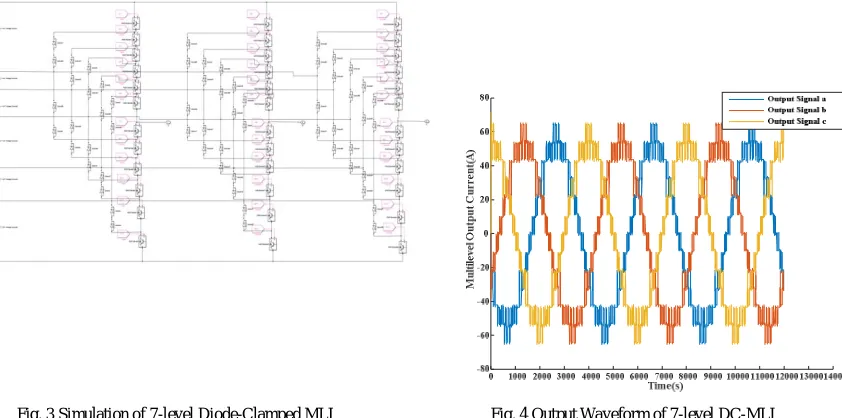
For p-level inverter, at the DC bus (p-1) capacitors are required producing p level of phase voltage with (2p-1) levels of output line voltage. Blocking diodes of high voltage rating are required for DCMLI with (p-1)*(p-2) number of clamping diodes required in each phase. Available commercial ratings of DCMLI are 2.2 to 6.6 kV, 3.7 to44MVA. For our work, Simulation of 7-level MLI is implemented on MATLAB/Simulink R2015b. Simulation of 7-level DC-MLI is shown in Figure 3.
Fig. 3 Simulation of 7-level Diode-Clamped MLI Fig. 4 Output Waveform of 7-level DC-MLI
MATLAB/SIMULATION of 7-level Diode-Clamped Multilevel inverter with its corresponding output waveform are shown in figure 3 and figure 4. A common DC bus is used for all 3 legs of the inverter and (VDC /6 ) is the voltage
across each capacitor. Each leg of inverter consists of six complimentary switch pairs such that only one switch is operated during the operation.
V. SYSTEMTESTANDRESULTS
In this paper, MATLAB/SIMULINK R2015b software has been used to design the D-STATCOM model based upon
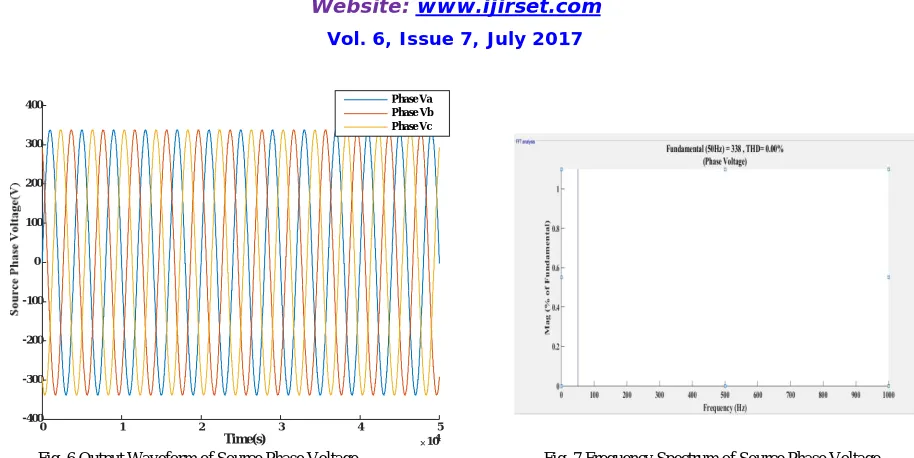
Fig. 6 Output Waveform of Source Phase Voltage Fig. 7 Frequency Spectrum of Source Phase Voltage
Figure 6 shows the output waveform of Source Phase Voltage with the corresponding Frequency Spectrum in Figure 7. The Total Harmonic Distortion (THD) level in the Source Phase Voltage is 0.0%.
Fig. 8 Output waveform of Source Current Fig. 9 Frequency Spectrum of Source Current
Figure 8 shows the output waveform of Source Current with the corresponding Frequency Spectrum in Figure 9. The Total Harmonic Distortion (THD) level in the Source Current is 0.0%.
Time(s) 104
0 1 2 3 4 5
-400 -300 -200 -100 0 100 200 300
400 Phase Va
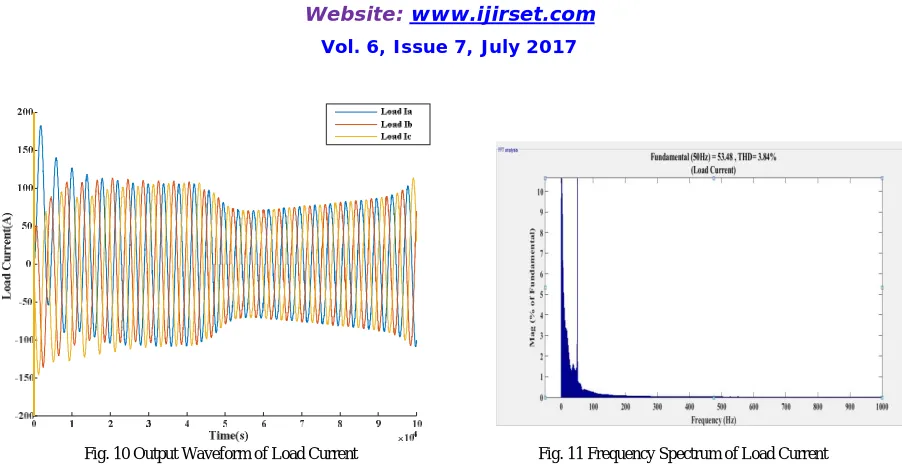
Fig. 10 Output Waveform of Load Current Fig. 11 Frequency Spectrum of Load Current
Figure 10 shows the output waveform of Load Current with the corresponding Frequency Spectrum in Figure 11. The Total Harmonic Distortion (THD) level in the Source Current is 3.84%.
Fig. 12 Output Waveform of Compensated Current Fig. 13 Frequency Spectrum of Compensated Current
Figure 12 shows the output waveform of Compensated Current with the corresponding Frequency Spectrum in Figure 13. The Total Harmonic Distortion (THD) level in the Compensated Current is 3.61%.
VI. CONCLUSION
In the present work, Power Quality and its problems has been discussed with their mitigation techniques. Different types of Custom Power devices are discussed in which particularly MATLAB/SIMULINK model of D-STATCOM has been modelled and simulated for Field Oriented Control (FOC) Induction Motor drive using the Synchronous Reference Frame (SRF) control theory. MATLAB/SIMULINK model of 7 level DC-MLI has also been developed. It is clearly observed from the test results that D-STATCOM efficiently eliminates the harmonics from load current making the 0% THD level for source current. With the use of Multilevel inverter, the output waveform is more sinusoidal with reduced harmonic distortion. From the present work, it can be concluded that D-STATCOM finds applications in effectively enhancing the Power Quality level at distribution side of the Power System.
REFERENCES
[1] F. Martzloff and T. Gruzs, "Power Quality site surveys: facts, fiction, and fallacies", IEEE Transactions on Industry Applications, vol. 24, no. 6, pp. 1005-1018, 1988.
[2] D. Flinn, C. Gilker and S. Mendie, "Methods for Identifying Potential Power Quality Problems", IEEE Cooper Power Systems, 1991.
[3] Ward D. J., Burke J. J. and Grifith D. C., "Power Quality-two different perspectives", IEEE Transactions on Power Delivery, vol. 5, no. 3, pp. 1501-1513, 1990.
[4] A. Sannino, J. Svensson and T. Larsson, "Power-electronic solutions to Power Quality problems", Electric Power Systems Research, vol. 66, no. 1, pp. 71-82, 2003.
[5] Singh B., Yadav I. and D. Kumar, "Mitigation of Power Quality Problems Using FACTS Controllers in an Integrated Power System Environment: A Comprehensive Survey", International Journal of Computer Science and Artificial Intelligence, vol. 1, no. 1, pp. 1-12, 2012. [6] A. Aigboviosa Peter, I. Kema Okakwu, E. Oluwasogo, A. Samson Alayande and A. Airoboman, "Influence of Power Quality Problem on the Performance of an Induction Motor", American Journal of Electrical Power and Energy Systems, vol. 4, no. 4, p. 39, 2015.
[7] Rao N. and Jayatheertha H., "Modeling and Simulation of D-STATCOM for Power Quality Enhancement in Distribution System", International Journal of Engineering Research & Technology, vol. 1, no. 5, 2012.
[8] N. Kaur, R. Sharma and J. Kaur, "Analysing the performance of D-Statcom in mitigating transients from distribution system", International Journal of Engineering Research and Technology, vol. 9, no. 1, pp. 17-28, 2016.
[9] Singh B. and Solanki J., "A Comparison of Control Algorithms for D-STATCOM", IEEE Transactions on Industrial Electronics, vol. 56, no. 7, pp. 2738-2745, 2009.
[10] E. K V and J. P, "Design and Analysis of D-STATCOM and Comparison of Various Control Algorithms", International Journal of Innovative Research in Electrical, Electronics, Instrumentation and Control Engineering, vol. 3, no. 1, 2016.
[11] Rakesh T., Madhusudhan V. and Sushama M., "SRF Control of MLI-D-STATCOM in Power Distribution Network", International Journal of Electrical, Electronics and Computer Systems (IJEECS), vol. 4, no. 9, 2016.
[12] R. Sharma and P. Nijhawan, "Role of D-STATCOM to Improve Power Quality of Distribution Network with FOC Induction Motor Drive as Load", International Journal of Emerging Trends in Electrical and Electronics, vol. 5, no. 1, 2013.
[13] R. vasava, "SRF based Control for Power Quality improvement using D-STATCOM", International Journal of Innovative and Emerging Research in Engineering, vol. 3, no. 4, 2016.
[14] Nijhawan P., Jain D. and Bhatia R., "Improved performance of Multilevel inverter-based distribution static synchronous compensator with induction furnace load", IET Power Electronics, vol. 6, no. 9, pp. 1939-1947, 2013.
[15] M. Bansal and N. Singh Bhangu, "Reducing Harmonics Distortion in Distribution Network Against The Induction Motor Drive Non Linear Load", International Journal for Science and Emerging Technologies with Latest Trends, vol. 9, no. 1, pp. 27-32, 2013.
[16] Singh A., Bhowmick S. and Shukla K., "Load Compensation with D-STATCOM and BESS", IEEE 5th India International Conference on. Power Electronics, 2012.
[17] Varaprasad K. S., "Comparison and Analysis on the Role of D-STATCOM and DVR with PI Controller to improve the Power Quality in Distributed Networks", International Research Journal of Computer Science, vol. 1, no. 2, 2014.