University of Windsor University of Windsor
Scholarship at UWindsor
Scholarship at UWindsor
Electronic Theses and Dissertations Theses, Dissertations, and Major Papers
2011
Effective Team Strategies using Dynamic Scripting
Effective Team Strategies using Dynamic Scripting
Robert Price
University of Windsor
Follow this and additional works at: https://scholar.uwindsor.ca/etd
Recommended Citation Recommended Citation
Price, Robert, "Effective Team Strategies using Dynamic Scripting" (2011). Electronic Theses and Dissertations. 416.
https://scholar.uwindsor.ca/etd/416
This online database contains the full-text of PhD dissertations and Masters’ theses of University of Windsor students from 1954 forward. These documents are made available for personal study and research purposes only, in accordance with the Canadian Copyright Act and the Creative Commons license—CC BY-NC-ND (Attribution, Non-Commercial, No Derivative Works). Under this license, works must always be attributed to the copyright holder (original author), cannot be used for any commercial purposes, and may not be altered. Any other use would require the permission of the copyright holder. Students may inquire about withdrawing their dissertation and/or thesis from this database. For additional inquiries, please contact the repository administrator via email
Effective Team Strategies using Dynamic Scripting
by
Robert G. Price
A Dissertation
Submitted to the Faculty of Graduate Studies
through Computer Science
in Partial Fulfillment to the Requirements for
the Degree of Doctor of Philosophy at the
University of Windsor
Windsor, Ontario, Canada
2011
Effective Team Strategies using Dynamic Scripting
by
Robert G. Price
APPROVED BY:
___________________________________ Dr. M. Katchabaw, External Examiner
The University of Western Ontario
___________________________________ Dr. M. Hlynka
Department of Mathematics and Statistics
___________________________________ Dr. D. Wu
School of Computer Science
___________________________________ Dr. Z. Kobti
School of Computer Science
___________________________________ Dr. S. Goodwin, Advisor
School of Computer Science
___________________________________ Dr. H. Maoh, Chair of Defense
Department of Civil & Environmental Engineering
Author’s Declaration of Originality
I hereby certify that I am the sole author of this thesis and that no part of this thesis has been published or submitted for publication.
I certify that, to the best of my knowledge, my thesis does not infringe upon anyone’s copyright nor violate any proprietary rights and that any ideas, techniques, quotations, or any other material from the work of other people included in my thesis, published or otherwise, are fully acknowledged in accordance with the standard
referencing practices. Furthermore, to the extent that I have included copyrighted material that surpasses the bounds of fair dealing within the meaning of the Canada Copyright Act, I certify that I have obtained a written permission from the copyright owner(s) to include such material(s) in my thesis and have included copies of such copyright clearances to my appendix.
Abstract
Forming effective team strategies using heterogeneous agents to accomplish a task can be a challenging problem. The number of combinations of actions to look through can be enormous, and having an agent that is really good at a particular sub-task is no guarantee
that agent will perform well on a team with members with different abilities. Dynamic Scripting has been shown to be an effective way of improving behaviours with adaptive
game AI. We present an approach that modifies the scripting process to account for the other agents in a game. By analyzing an agent’s allies and opponents we can create better
starting scripts for the agents to use. Creating better starting points for the Dynamic Scripting process and will minimize the number of iterations needed to learn effective
Dedication
Acknowledgements
Thanks to Dr. Goodwin for all the help you have provided over the years. Your topics made me want to learn, and your sense of humour helped make learning enjoyable. Your patience and guidance through earlier drafts of this work helped make this better.
Thanks to the rest of my committee: Dr. Hlynka, Dr. Kobti, Dr. Wu. Your suggestions from when we met earlier provided ideas which helped me improve this work.
Thank you also to Dr. Katchabaw, for joining my committee.
Table of Contents
Author’s Declaration of Originality ________________________________________ iii
Abstract_______________________________________________________________ iv
Dedication______________________________________________________________ v
Acknowledgements______________________________________________________ vi
List of Tables __________________________________________________________ ix
List of Figures __________________________________________________________x
Chapter 1: Introduction ___________________________________________________1
The importance of games ____________________________________________________ 1 Learning in games __________________________________________________________ 1 Dynamic scripting __________________________________________________________ 2 Problem topic ______________________________________________________________ 3 Thesis plan ________________________________________________________________ 4
Chapter 2: Background ___________________________________________________6
AI in Computer Games ______________________________________________________ 6 Evolutionary Algorithms_____________________________________________________ 6 Bayesian Networks _________________________________________________________ 7 Multi-agent systems _________________________________________________________ 7 Balance in Games___________________________________________________________ 8 Dynamic scripting in depth___________________________________________________ 9
Algorithm 1: Generating scripts for dynamic scripting ___________________________________ 10 Algorithm 2: Weight Adjustment ____________________________________________________ 12
Chapter 3: Experimental Design ___________________________________________16
NeverWinter Nights (NWN) overview _________________________________________ 16 Characters in NWN ________________________________________________________ 16 Roles and Abstraction ______________________________________________________ 19 Experimental Design _______________________________________________________ 22
Recreating the Arena______________________________________________________________ 24 Use Dynamic Scripting in different situations __________________________________________ 25 Find correlations between effective strategies and participating agents _______________________ 26 Create new teams, and synthesize starting strategies _____________________________________ 27 Verify strategies in the Arena _______________________________________________________ 28
Chapter 4: Results ______________________________________________________30
Discussion ________________________________________________________________ 45
Appendix A: Rulebase ___________________________________________________52
Appendix B: Synthesis of Starting Rulebases _________________________________55
Appendix C: Results_____________________________________________________57
Text-only version __________________________________________________________ 57 Wizard from FFCW v FFCW _______________________________________________ 57
Weights after 10 fights:____________________________________________________________ 57 Weights after 50 fights:____________________________________________________________ 58 Weights after 100 fights:___________________________________________________________ 59 Weights after 250 fights:___________________________________________________________ 60 Weights after 500 fights:___________________________________________________________ 61 Weights after 750 fights:___________________________________________________________ 62 Weights after 1000 fights:__________________________________________________________ 63
Cleric from FFCW v FFCW_________________________________________________ 65
Weights after 10 fights:____________________________________________________________ 65 Weights after 50 fights:____________________________________________________________ 66 Weights after 100 fights:___________________________________________________________ 67 Weights after 250 fights:___________________________________________________________ 68 Weights after 500 fights:___________________________________________________________ 69 Weights after 750 fights:___________________________________________________________ 70 Weights after 1000 fights:__________________________________________________________ 71
Appendix D: Results from NWN ___________________________________________73
Appendix E: Code Samples from NWN _____________________________________74 Code Sample 1: __________________________________________________________________ 74 Code Sample 2: __________________________________________________________________ 77 Code Sample 3: __________________________________________________________________ 78 Code Sample 4: __________________________________________________________________ 81 Code Sample 5: __________________________________________________________________ 84
Appendix F: Wizard and Sorcerer spells ____________________________________86
Appendix G: Bayesian Networks in Games __________________________________87
Introduction ______________________________________________________________ 87
Bayesian Networks _______________________________________________________________ 88 Using Bayesian Networks to Reconstruct the Environment ________________________________ 88 Difficulties with this approach ______________________________________________________ 90
Using a Bayesian Network to model an agent’s beliefs ___________________________ 91
Controlling Agents with Bayesian Networks ___________________________________________ 93
Implementation ___________________________________________________________ 94 Future Work _____________________________________________________________ 97 Conclusions_______________________________________________________________ 97
References ____________________________________________________________99
List of Tables
Table 1: Game genres ...6
Table 2: Example weights for spell picking...11
Table 3: White weights before normalization...12
Table 4: White weights after normalization...13
Table 5: Black weights before normalization ...13
Table 6: Black weights after normalization ...13
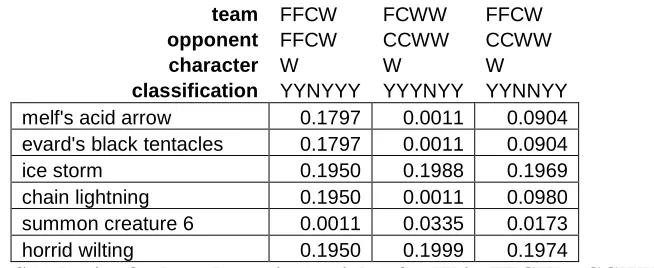
Table 7: Synthesis of selected starting weights for W in FFCW v CCWW ...28
Table 8: Spell weights for Wizard in FFCW v FFCW ...31
Table 9: Spell weights for Cleric in FFCW v FFCW ...34
Table 10: Spell weights for Wizard in FFFW v FFFW ...38
Table 11: Selected resultant weights of the "Ice Storm" spell ...42
Table 12: Results from FFCW v FFCW ...42
Table 13: Results from FFFW v FFFW ...43
Table 14: Results from CCWW v FFCW ...43
Table 15: Results from FFFW v FFFW compared to FFFS v FFFS ...45
Table 16: Synthesis of starting weights for W in FFCW v CCWW ...56
Table 17: Results from CCWW v FFCW ...73
List of Figures
Chapter 1: Introduction
The importance of games
Games are a good test-bed for artificial intelligence (AI) research, since they can be challenging, but easy to formalize. This makes it possible to measure how well new AI methods are working, and to demonstrate that behaviour that is generally thought to require intelligence is possible without putting human lives or property at risk. Recently, inexpensive yet powerful computer hardware has made it possible to simulate complex physical environments, resulting in an explosion of the video game industry [Mii06]. Computer games provide an environment for continual, steady advancement and a series of increasingly difficult challenges [Lai00]. Not only are video games an important test-bed for AI, but advances in video games help in other areas also. “Video games are particularly important in this regard, because in addition to their very realistic visual images and great sound, they are also highly interactive and increasingly collaborative, and thus a good launch pad for thinking about how people should best interact with all kinds of computer applications as well as with each other in the future” [Fri07]. Although this research can directly benefit the AI in video games, advances in machine learning and other AI techniques can have benefits in other areas as well.
Learning in games
“One of the main challenges for AI is to create intelligent agents that adapt, i.e. change their behaviour based on interactions with the environment, becoming more proficient in their tasks over time, and adapting to new situations as they occur.” [Sta06]
The following from [Sta05] states some of the properties video games have that challenge traditional reinforcement learning (RL) techniques.
1. Large state/action space. Since games usually have several different types of objects and characters, and many different possible actions, the state/action space that RL must explore is high-dimensional. Not only does this pose the usual problem of encoding a high
dimensional space (Sutton and Barto 1998), but in a real-time game there is the additional challenge of checking the value of every possible action on every game tick for every agent in the game.
2. Diverse behaviors. Agents learning simultaneously should not all converge to the same behavior because a homogeneous population would make the game boring. Yet since RL techniques are based on convergence guarantees and do not explicitly maintain diversity, such an outcome is likely.
3. Consistent individual behaviors. RL depends on occasionally taking a random action in order to explore new behaviors. While this strategy works well in offline learning, players do not want to see an individual agent periodically making inexplicable and idiosyncratic moves relative to its usual behavior.
4. Fast adaptation. Players do not want to wait hours for agents to adapt. Yet a complex state/action representation can take a long time to learn. On the other hand, a simple representation would limit the ability to learn sophisticated behaviors. Thus, choosing the right representation is difficult.
Machine learning is important in games, since it can allow them to be more interesting and realistic [Sta05]. Many games would benefit from having characters that adapt to new situations, as it would likely give the illusion that the characters understand what they are doing. Lately many games have improved visually, creating very realistic environments, but the AI controlling the characters have not improved as much. “A game’s top-notch graphics and sound manage to keep up a suspension of disbelief quite well. However, the behaviours of a character in a game are usually of an inferior quality. It is all too clear that the characters are lifeless, mindless drones controlled by a computer with little knowledge.” [Spr05]
At one point, all computer controlled agents were hard-coded, which meant that the game AI was implemented in the source code of the game itself. Therefore, a change regarding the game AI required a re-compilation of the game [Lad08]. Since then the dominant approach to programming game AI has been scripting, since they are easy to implement, interpret, and modify. Scripts are basically text files encoding the behaviour of game agents with if-then rules. Some modern games encourage the players to change and add content through the use of script editors and other tools. [Szi09] lists some disadvantages of scripts: They are labour-intensive, since they have to be reasonably complex to be used in a complex game environment, which causes them to be time-consuming to implement by hand, as they must be tested in many different situations. Because of their complexity, they are likely to contain undetected weaknesses that can be exploited. They are
predictable, and human players quickly recognize patterns in behaviours generated by scripts. Finally, since they are static, they are unable to adapt to a human player’s style.
Spronk et al. [Spr06] investigated a novel game AI learning technique called ‘dynamic scripting’ (explained below). They also performed a literature survey and communication with game developers to come up with computational and functional requirements for adaptive game AI to be applicable in practice: Speed, Effectiveness, Robustness, Efficiency, Clarity, Variety, Consistency, and Scalability. Dynamic scripting is a reinforcement learning technique that learns effective game AI scripts. For dynamic scripting to work, the game AI needs to be available in the form of scripts. This is the de-facto standard in commercial computer games [Lad08]. [Lad08] also states dynamic scripting “can only build scripts as good as the underlying rules. A bunch of bad rules won’t magically combine into a good tactic just because they are put together by a learning procedure.”
Dynamic scripting
[Spr06] uses the Neverwinter Nights (NWN, discussed more in Chapter 3) environment to combine scripting with a reinforcement learning process. This dynamic scripting maintains several rule databases, one for each agent type. A new script to control the behaviour of an agent is created from these rule databases whenever an agent is
getting increased. Over time, behaviours emerge from the characters that are more effective.
Figure 1: Outline of updating script weights from [Spr03]
[Spr03] states “because of their complexity, AI scripts are likely to contain weaknesses, which can be exploited by human players to easily defeat supposedly tough opponents”, and “because they are static, scripts cannot deal with unforeseen tactics employed by the human player and cannot scale the difficulty level exhibited by the game AI to cater to both novice and experienced human players.” The updating of weights and having
successful characters more likely to be included in future rounds is similar to the updating of weights in neural networks and successful offspring being chosen more often.
One anecdote praising the effectiveness of this type of learning comes from [Spr09]:
“BioWare has changed the AI in NeverWinter Nights significantly between versions 1.29 and 1.31… What is kind of funny is that the strategy now employed by the opponents is very similar to the strategy that dynamic scripting often learned when pitted against the earlier AI. I find it striking that dynamic scripting managed to discover in half an hour something that BioWare only added to the game after it had been out for more than a year and had been patched over a dozen times.”
In Chapter 2, more information is provided about how dynamic scripting works for an individual agent.
Problem topic
opponents or teammates into account. While performing research for [Pri10], it was observed that the rules did not seem to take the opponent into consideration when deciding what action to take. For example, one effective rule is to cast a defensive spell like “Globe of Invulnerability” at the beginning of combat. The “Globe of
Invulnerability” spell makes the spellcaster immune to certain spells cast at them by other spellcasters. However, it was also noticed that when put against a team that contained no spellcasters, the defensive spell was cast anyways. In this instance, casting this spell was a complete waste since it could offer no benefit and had an opportunity cost as it
prevented the spellcaster from casting an offensive spell that might have helped their team in combat. This observation leads to the following question:
Can dynamic scripting use information about teammates and opposing agents to create a better starting point for the script weights which in turn can be used to learn an effective rule ordering more quickly?
Dynamic scripting certainly provides an effective way to learn strategies, but the
strategies learned become less effective when the opponents change. Spronck’s work with dynamic scripting was effective, but it does not take the other agents participating in the fight into account when determining the best actions to take. [Spr04] notes “experimental evaluations indicated that, occasionally, the time needed for dynamic scripting to generate effective opponents becomes unacceptably long.”
Creating better starting points should shorten the number of iterations dynamic scripting needs to go through to create an effective strategy. [Pon04] uses different rulebases for different stages in a real-time strategy (RTS) game, and shows that taking context into account can lead to more-effective results. [Lad08] states that different agent classes have their own rulebases since they can have different actions available to them, showing that the effective rule orderings for one class do not imply similar rule orderings for other classes. In this research we will explore having an agent use a different rulebase
depending on the other agents in the area, specifically the opponents it will face and the teammates it has. This research supports to the following thesis:
Taking other agents into consideration will allow an individual agent using dynamic scripting to perform better than current scripting implementations.
The optimal behaviour of an agent in a combat situation will differ depending on the teammates and opponents that are participating in that combat. The following chapters in this dissertation will demonstrate how the performance of dynamic scripting can be improved by taking the other agents into account.
Thesis plan
Chapter 2: Background
In this chapter we give an overview of select topics to provide the necessary background required to understand this dissertation. It starts with an overview of AI used in computer games, followed by a description of some learning algorithms. A summary of selected multi-agent-systems research highlights relevant topics that emerge when teams of agents, as opposed to just groups of individuals, work together to accomplish a task. The issue of balance in games is discussed, and then the chapter ends with an explanation of dynamic scripting along with a walkthrough of an example to show how dynamic scripting updates weights in a script and change the actions an agent will take.
AI in Computer Games
Computer games have been around for over 50 years, and the field of game artificial intelligence has existed “since the dawn of video games in the 1970s” [Tou02]
Games can be classified into many categories, common ones described in the table below.
Category Description Role of AI
Action Player uses mostly his or her reflexes to win.
Game AI controls individual agents
Adventure Player follows a path, solving puzzles or quests to win.
None – characters react in pre-defined ways
Puzzle Players to solve puzzles. None
Role-Playing Player assumes the role of an in-game character, and solves quests.
Game AI controls individual agents
Simulation Players interact with a simulation. Game AI controls the simulation
Strategy Player uses tactical skills to guide agents to victory.
Game AI controls lots of agents
Table 1: Game genres
“Complex game AI is encountered mainly in role-playing games and strategy games” [Spr05]. In the past decade there have been game developers and game researchers tended to live in their own communities. Recently that has been improving, and there have been conferences and tracks devoted to Game AI. Many “mainstream” AI techniques have found their way into games. The following sections outline some of these techniques.
Evolutionary Algorithms
Evolutionary algorithms can be used to update the weights and structure of neural networks, through the use of a fitness function. Evolutionary algorithms use parents to generate successors through crossovers and mutations. In a crossover, two parents are used and partial information is taken from each parent, and combined to form a new ANN. In a mutation, one or more nodes are changed in a single network to form a new ANN.
Individual agents learning strategies have been the topic in [Sta02], [Sta06], where neural networks were used in a reinforcement learning game. The machine learning game discussed in these papers requires the player to set up scenarios where agents can learn the desired concepts in real time. The NeuroEvolution of Augmenting Topologies (NEAT) is an algorithm for learning that adjusts both the weights and the structure of ANNs, and was introduced in [Sta02]. NERO (Neuro-Evolving Robotic Operatives) is a game that uses an evolutionary algorithm using a fitness function based on the player’s input to train agents to perform tasks. The time it takes the agents to learn how to perform the tasks depends on how the player sets out the learning tasks. An artificial neural
network trained on a single, isolated very difficult task is unlikely to learn it well [Car97]. The default agents that come with NERO have sensors for where opponents are, but those sensors do not distinguish between different opponent types. This would prevent it from learning to use different tactics based on the opponents it is facing. This problem could be remedied by adding additional sensors, but that would increase the time it takes for the neural network to learn each task.
Bayesian Networks
A Bayesian Network is a data structure that can be used to represent dependencies among variables and to give a concise specification of a joint probability distribution. A Bayesian Network is a directed acyclic graph with the variables represented as nodes in the graph, with an edge between a parent node and a child node if the parent node directly influences the child node. It is usually easy for a domain expert to decide what influences exist in the domain. A Bayesian Network representation can take much less space to specify than a joint probability distribution, and can also be easier to represent. A good introduction to Bayesian networks can be found in [Cha91]. A Dynamic Bayesian Network is a Bayesian Network that represents a temporal probability model. One example of a how a Bayesian Network can be used in a game is explained in Appendix G.
Multi-agent systems
Multi-agent systems focus on how intelligent behaviour can naturally arise from the interaction between multiple agents that may cooperate or compete. The experiments run in [Tim07] focus mainly on the interactions between agents that compete. The
experiments described in this paper deal with both types of interactions-agents
cooperating with their teammates and competing against the opposing team. Flocking algorithms are an artificial life subcategory where lifelike flocks result from coordinated movements of multiple cooperating AI agents.
capable of adapting effectively to opponent tactics, and demonstrate how formations of agents can be formed dynamically to deal with changing circumstances. [Fal03] also deals with changing formations in games, and states that systems that dynamically change their strategy are sometimes criticized for being "slow to learn".
There has also been research done in agents forming teams amongst themselves, either by trust and reputation [Huy06], [Bar07], [Smi09], cooperating to accomplish tasks that the agents cannot perform themselves[Kra03], and teams that work together to accomplish goals based on joint intentions [Jen95], [Tam97].
[Jen95] distinguishes between a group of agents which independently have a goal which just happens to be the same and a group of agents which truly share a common goal. This distinction is important because the two relationships imply different consequences with interaction: the former gives rise to competition if resources are scarce, whereas the latter result in cooperation and coordination.
One domain where agents perform together is robot soccer. Bowling et al. [Bow04] noticed that “most robot soccer approaches involve single, static, monolithic team
strategies” and “there have been examples of seemingly superior teams being defeated by unexpected opponent play”. Although robot soccer is different than teams fighting in a game, there are many similarities. In both cases there are well-defined goals that need to be achieved in an adversarial setting by teams that have multiple members. The
environments are dynamic and unpredictable, and teams that can coordinate plans among several agents and adapt to changes often have an advantage.
Many machine learning techniques involve the use of a fitness function to evaluate
performance. A fitness function provides a measure of how well a solution is to achieving its goals. [Lad08] mentions that in many games the fitness functions “comes down to doing as much damage as possible on enemy agents while at the same time trying to avoid as much damage as feasible. Achieving this goal is more difficult than it sounds, but at least makes the design of a fitness functions quite straight forward.”
Balance in Games
The purpose of games is to “provide entertainment” [Ada07] and be enjoyed. “Game AI is all about fun…You have a customer who paid $40 for your game and he or she expects to be entertained.” [Tou02]. Adversarial type games become less enjoyable if one player always wins or loses so for this reason, games try to incorporate balance, so one type of agent does not dominate over all others.
Figure 2: Rock-Paper-Scissors dynamic
If one of the objects (rock, for example) were to win against paper as well as scissors, then a person could guarantee not losing by always picking rock. That would make the game unbalanced, and most people would find such a game to not be fun.It is generally assumed that a balanced game has a higher entertainment value than one that is too easy or too hard [Lan10].
If a game is too easy or too hard people lose interest. Different approaches have been used in the past to allow a player to change the difficulty of a game. Some games have cheat-codes that a player can use to help out if they find the game too difficult, or they have static difficulty levels (i.e.: easy, normal, and hard) that the player can pick from at the beginning of a game. In recent years, research has gone into varying the difficulty level of a game dynamically to keep the game interesting for the player. “Auto-dynamic difficulty refers to the ability of a game to automatically adapt the difficulty level of gameplay to match the skills and tolerances of a player.” [Bai05]
The rock-paper-scissors example is an extremely simple one, but serves as a good
illustration to explain balance. More discussion about balance and the rock-paper-scissors game can be found in [Ada07], as well as a reason to avoid dominant strategies (a
dominant strategy refers to a strategy that reliably produces the best outcome a player may achieve, no matter what the opponent does).
Dynamic scripting in depth
From a theoretical point of view, dynamic scripting belongs to the family of
After an encounter (i.e., a fight) between the human player and an opponent, the opponent’s knowledge base adapts by changing the rule-weight values in accordance with the success or failure rate of the rules that were activated during the encounter (i.e., rules that occurred in the opponent’s script). The new rule weight value is calculated as W +∆W, where W is the original rule weight value. The weight adjustment ∆W is expressed by the following formula:
{
}
{
}
≥ − − < − − = ∆ b F b b F R b F b F b P W 1 max maxRmax and Pmax are the maximum reward and maximum penalty
respectively, b ∈ <0, 1> is the break-even value, and F ∈ [0, 1] is the opponent’s fitness. The fitness is a relative measure of the opponent’s success, which is high for good results (victories) and low for bad results (defeats).
A simple example will help demonstrate how the weights are updated. For this example, two wizards will fight each other, and they will each have 10 spells to pick from. To keep things separate, we will call one White and the other Black. Each wizard will start with 50 hit points, and the fitness will be calculated as a percentage of the remaining hit points. The first step in the example is to pick the spells that will be used.
Algorithm 1: Generating scripts for dynamic scripting
(adapted from [Spr05])
rules is an array with the possible actions and associated weights (actions that lead to successful outcomes have higher weights)
scriptsize is the amount of rules to be placed in the script
maxtries to the maximum amount of tries to add a rule to the script
set sumweights to the sum of the weights of all of the rules set tries to 0
For every rule that needs to be added to the script
pick a random number between 0 and sumweights
go through each rule and add the weights until you get to a rule that increases the sum to a number greater than or equal to the random one
if that rule hasn't been added to the script yet then add it
increase tries by one
if tries >= maxtries then stop
In our example, scriptsize is 3, maxtries will be 10, and rules will be as described in the following table, along with the initial weights.
Spell Description Weight Percentage
Mage Armor Makes the mage harder to hit physically 10 0-9.99
Magic Missile Damages opponent 10-25 hp 10 10-19.99
Melf’s Acid Arrow Damages opponent 2-8 hp, plus extra damage subsequent rounds
10 20-29.99
Fireball Damages opponents 10-60 hp 10 30-39.99
Haste Doubles amount of physical attacks 10 40-49.99
Stoneskin Absorbs physical damage 10 50-59.99
Ice Storm Damages opponents 5-30 hp 10 60-69.99
Chain Lightning Damages opponent 15-90 hp 10 70-79.99 Spell Mantle Absorbs damage from enemy spells 10 80-89.99 Horrid Wilting Damages opponents 15-90 hp 10 90-99.99
Table 2: Example weights for spell picking
Creating White’s script for round 1: Sumweights = 100
Tries = 0
White picks ‘random’ number 38 for the first spell. Fireball is added to the script. White picks ‘random’ number 73 for the second spell. Chain Lightning is added to the script.
White picks ‘random’ number 30 for the third spell. Fireball is already in the script, so just increment tries.
White picks ‘random’ number 64 for the third spell. Ice Storm is added to the script. There are 3 spells, so stop.
Creating Black’s script for round 1: Sumweights = 100
Tries = 0
Black picks ‘random’ number 3 for the first spell. Mage Armor is added to the script. Black picks ‘random’ number 41 for the second spell. Haste is added to the script.
Black picks ‘random’ number 95 for the third spell. Horrid Wilting is added to the script. There are 3 spells, so stop.
Combat now happens:
In the first round of combat, White casts Fireball. Black is damaged by 13 hit points (37 remain). Black casts Mage Armor, which raises his defense against physical attacks. In the second round of combat, White casts Chain Lightning. Black is damaged by 42 points (killing him). Black casts Haste, which would have increased the attack speed.
Combat is now over for this trial. The fitness for White’s script is 1 (White has all of his initial hit points). The weights for the spells are now adjusted, as described by the
Algorithm 2: Weight Adjustment
(adapted from [Spr05])
adjustment is the amount a spell’s weight will be changed based on the last experiment. It can be positive or negative, depending on whether or not the last experiment was a win or a loss. The magnitude of the adjustment depends on how decisive the win or loss was. A close win will result in a small adjustment, while a resounding win will result in a large adjustment.
minweight is the smallest value we want a spell’s weight to be set to maxweight is the largest value we want a spell’s weight to be set to
set adjustment to an amount based on the fitness results of the last experiment
For every rule in the script
adjust the weight by the adjustment
if the weight is below minweight then set it to minweight
if the weight is above maxweight then set it to maxweight
end for
normalize the weights in the rulebase.
The last step keeps the sum of all the weights in a rulebase at 1. If a team won, the spells it used will have their weights increased. After normalization, all the weights would be lowered, resulting in the weights that were increased still having higher weights than before the experiment, and the weights that were not used lowered, so they will have a lower chance of being included in subsequent experiments. The adjustment maximum is 10% for the first spell, which is multiplied by 0.7 for subsequent rounds. It has been found that the earliest actions have a greater effect on whether the team wins or loses. The 0.7 was determined to be effective during initial experiments.
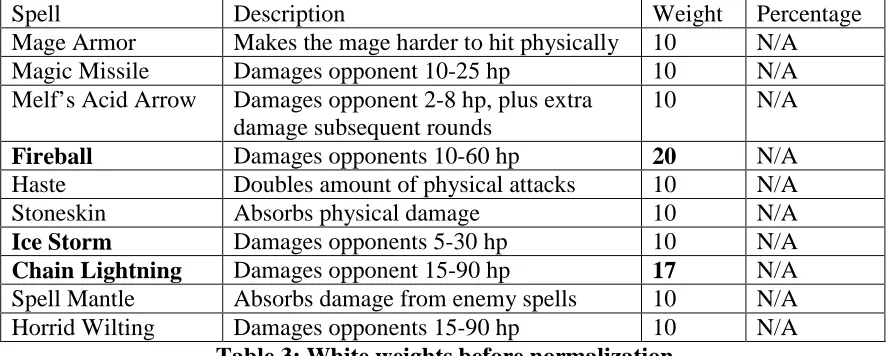
In our example, the maximum fitness was attained, so the maximum adjustments will occur. The weights for White before normalization occur below:
Spell Description Weight Percentage
Mage Armor Makes the mage harder to hit physically 10 N/A
Magic Missile Damages opponent 10-25 hp 10 N/A
Melf’s Acid Arrow Damages opponent 2-8 hp, plus extra damage subsequent rounds
10 N/A
Fireball Damages opponents 10-60 hp 20 N/A
Haste Doubles amount of physical attacks 10 N/A
Stoneskin Absorbs physical damage 10 N/A
Ice Storm Damages opponents 5-30 hp 10 N/A
Chain Lightning Damages opponent 15-90 hp 17 N/A Spell Mantle Absorbs damage from enemy spells 10 N/A
Horrid Wilting Damages opponents 15-90 hp 10 N/A
After normalization, the following weights represent the weights for White’s spells.
Spell Description Weight Percentage
Mage Armor Makes the mage harder to hit physically 8.55 0-8.54 Magic Missile Damages opponent 10-25 hp 8.55 8.55-17.09 Melf’s Acid Arrow Damages opponent 2-8 hp, plus extra
damage subsequent rounds
8.55 17.10-25.64
Fireball Damages opponents 10-60 hp 17.09 25.65-42.74
Haste Doubles amount of physical attacks 8.55 42.75-51.28
Stoneskin Absorbs physical damage 8.55 51.29-59.83
Ice Storm Damages opponents 5-30 hp 8.55 59.84-68.38
Chain Lightning Damages opponent 15-90 hp 14.53 68.39-82.91 Spell Mantle Absorbs damage from enemy spells 8.55 82.92-91.45 Horrid Wilting Damages opponents 15-90 hp 8.55 91.46-99.99
Table 4: White weights after normalization
The next time spells are picked, the ones that were successful will have a greater chance of being included in future rounds. The original weights for Black were the same for the original ones for White. After the fight, the spells that Black used will lowered, and the pre-normalized weights are shown below (assuming a minweight of 3).
Spell Description Weight Percentage
Mage Armor Makes the mage harder to hit physically 3 N/A
Magic Missile Damages opponent 10-25 hp 10 N/A
Melf’s Acid Arrow Damages opponent 2-8 hp, plus extra damage subsequent rounds
10 N/A
Fireball Damages opponents 10-60 hp 10 N/A
Haste Doubles amount of physical attacks 3 N/A
Stoneskin Absorbs physical damage 10 N/A
Ice Storm Damages opponents 5-30 hp 10 N/A
Chain Lightning Damages opponent 15-90 hp 10 N/A
Spell Mantle Absorbs damage from enemy spells 10 N/A
Horrid Wilting Damages opponents 15-90 hp 10 N/A
Table 5: Black weights before normalization
After normalization, the following weights represent the weights for Black’s spells.
Spell Description Weight Percentage
Mage Armor Makes the mage harder to hit physically 3.49 0-3.48 Magic Missile Damages opponent 10-25 hp 11.63 3.49-15.17 Melf’s Acid Arrow Damages opponent 2-8 hp, plus extra
damage subsequent rounds
11.63 15.18-26.74
Fireball Damages opponents 10-60 hp 11.63 26.75-38.37
Haste Doubles amount of physical attacks 3.49 38.38-41.86
Stoneskin Absorbs physical damage 11.63 41.87-53.49
Ice Storm Damages opponents 5-30 hp 11.63 53.50-65.12
Chain Lightning Damages opponent 15-90 hp 11.63 65.13-76.74 Spell Mantle Absorbs damage from enemy spells 11.63 76.75-88.37 Horrid Wilting Damages opponents 15-90 hp 11.63 88.38-99.99
The next time spells are picked, the ones that were not successful will have a lesser chance of being included in future rounds, and other spells are more likely to be tried.
Dynamic scripting starts exploiting knowledge after a few trials and explores new knowledge continuously. Dynamic scripting updates all state-action rules through a redistribution process, unlike Monte-Carlo learning which updates state-action values only after they have been executed. This may lead to dynamic scripting not converging on a solution. Non-convergence is essential for use in games, since the human player may choose to switch tactics so the learning task continuously changes. It can quickly respond to a variety of behaviours, and the rule orderings dynamic scripting uses in successful strategies can be learned automatically. [Tim07] experiments with three different rule ordering mechanisms for dynamic scripting. While dynamic scripting can learn effective tactics, it has no built-in mechanism to improve diversity, so it tends to converge to static, predictable scripts [Szi09].
One benefit of dynamic scripting worth highlighting is the fact that the scripts it creates do not require game designers to produce complex scripts to try and make agents act in ways that appear intelligent. One example of human coding that produces inadequate results can be found in [Spr05]:
“According to [Computer Role-Playing Game] tradition, dragons are both physically and mentally powerful creatures. While [the game] does not require the player to fight dragons, the designers realised that most players will attempt to do so anyway. Therefore they created complex game AI that should be able to humiliate any player bold enough to attack a dragon. Soon after the game’s release, weaknesses in the game AI were discovered that players could exploit to defeat any dragon in the game, even with a weak team. Furthermore, without exploiting game AI weaknesses, players could still design superior tactics that, while unforeseen by the game developers, allowed weak teams to take on dragons successfully. It is trivial for a dragon to recognise that its current behaviour is inadequate to deal with tactics used by attackers that, according to its domain knowledge, are no match for it. Were the dragons controlled by adaptive game AI instead of static game AI, an answer to the superior and exploiting tactics could have been discovered automatically, keeping up the challenge level of the game.”
Further explanation of static scripts producing inferior results occurs in Chapter 4: Results.
Dynamic scripting can learn effective tactics, but those tactics are specific to the situation being learned, which includes the teammates and opponents whose actions affect the effectiveness of the character’s actions. Changes to the teammates and opponents can require new effective strategies to be learned. If a game can start using starting weights that are “closer” to the weights of an effective strategy, it will lessen the time needed to learn an effective strategy and there will be less chance of a player encountering a
Strategy games could benefit from the following work. [Pol10] demonstrates how dynamic scripting can be used in a First-Person Shooter game, and [Sha10] shows how a companion controlled by a can learn the preferences of a player in a non-combat scenario (disarming traps) in a Role-Playing game.
The topics presented in this chapter will allow the reader to understand the contributions of this dissertation. Some assumptions need to hold true for this research to be useful. Firstly, the game that it is being applied to needs to use scripts. This will not be an issue in most cases, as scripts are used in most modern games. Since this research focuses on team strategies of heterogeneous agents, a game that only has one character type or a single character will not benefit from it. The following chapter introduces the game used in this study. It allows for thousands of combinations of players and millions of
Chapter 3: Experimental Design
This chapter starts by providing a description of the game that will be used for the experiments that will show that using knowledge about agent's allies and opponents will allow better scripts to be created. It explains the different character types, the large number of possibilities a player has to choose from when creating a character, which leads to an enormous amount of possible combinations for even a small team. It mentions a valid abstraction in these experiments, roles, which can classify the characters based on their abilities. This is a way of abstracting the most relevant details of a team allowing the size of a game’s problem space be reduced to a manageable size. It then describes the experiments that will be performed to support the thesis.
NeverWinter Nights (NWN) overview
NWN is a Role-Playing Game (RPG) created by BioWare Corportation. It is based on rules from the Dungeons and Dragons game and has won multiple awards. NWN ships with the Aurora Toolset, which gives the functionality to create modules for the game. The University of Alberta GAMES group created ScriptEase, which uses pattern templates that allows complex behaviours to be easily programmed. The ScriptEase project has many recent publications ([Cut08], [McN04], and [Zha09] are a few). These reasons make NWN a good tool for this research.
Characters in NWN
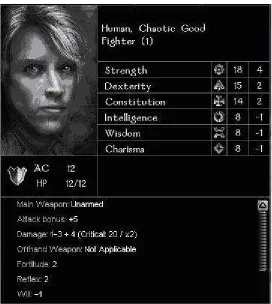
Figure 3: One possible Fighter in NWN
By examining the differences between the above figures, you will notice the first fighter has a higher Strength score (18, opposed to 17 for the second fighter), which leads to a larger Strength bonus (4, opposed to 3), resulting in larger “Attack bonus” and “Damage” values (+5 and 1-3 +4, opposed to +4 and 1-3 +3). This makes the first fighter more effective when it comes to melee combat. All characters that are created in NWN have the same number of ‘points’ to spend raising the different attributes. In the above example, the second fighter has higher Constitution and Wisdom scores than the first fighter (15 and 9, opposed to 14 and 8), but the bonuses for those scores in the last column are identical, so there is no meaningful advantage for the second fighter. There may be some scenarios where the second fighter might be preferred, but for the purposes of the
following experiments that involve fighting in an arena, the second fighter can be ignored.
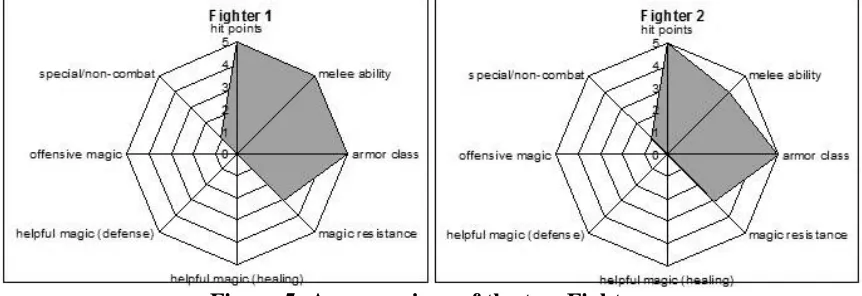
A graphical comparison of these two fighters appears below. To help with the analysis, the characters are classified based on the following abilities.
• Hit points (HP): These represent how much damage the character can take before falling. Other things being equal, a character with a high number of hit points will outlast a character with a low number of hit points in a fight.
• Melee ability: This is a representation of how well a character fights physically. A character with higher melee ability would be more likely to hit an opponent with a weapon.
• Armor class (AC): This represents how difficult it is to hit and damage the character. A character with a high AC is difficult to damage because he is either nimble and can avoid being hit, or can wear heavy armour.
• Magic resistance: A player with a higher magic resistance is more likely to avoid most or all of the damage from an opponent’s offensive spell.
• Helpful magic (healing): There are lots of spells that are beneficial to the members of a party. To help distinguish, we have divided them into two groups. The first type is ‘healing’, which returns HPs to a character that has been injured. The second type removes a harmful effect that is hindering an ally. For example, a character that has a high healing rating would be able to cast a spell that returns an injured fighter to full health.
• Helpful magic (defensive): This group of spells help a character or team by increasing various other abilities. These can include making a character more resistant to magic, increasing their AC so they are more difficult to hit, adding to their attributes so their other skills and abilities become more effective.
• Offensive magic: A player with a high offensive magic rating can cast spells that damage their opponents. For example, he might cast a spell called ‘Fire Ball’ which causes an explosion around his enemies.
• Special/non-combat: There are many abilities that are not directly related to
purchase more or better equipment than a character without that skill) would be useful for some people to have. These skills are important for gameplay, but due to the experiments involving combat, these skills will not play a role in the outcome.
The scale for each of the axes on these radar graphs are relative, with 0 meaning no ability in that area, and 5 meaning the best among the players in that area. The fighters have the best hit points of the characters under consideration, so they have the highest value along that axis. Since the second fighter is not as good as the first fighter with respect to melee ability, it has a lower ranking on that axis. Since it has no extra abilities to compensate, we can ignore the second fighter when trying to form the best team.
Figure 5: A comparison of the two Fighters
Roles and Abstraction
In the NWN game, there are different races and character classes the player can choose from, along with thousands of ways of assigning the attributes. The number of
combinations makes any exhaustive search of all possible teams intractable. There are 7 different races a player can pick from, each with different bonuses or penalties, and 11 different character classes. Even if you only looked at the 11 basic classes and looked at teams of 4 characters, there would still be 114, or 14641 combinations. A valid abstraction can be used to remove detail from the representation, making it simpler to find a solution. One useful abstraction is to group similar characters together based on the roles they are best suited for. The application of roles makes it more likely for this paper to be useful in games like NWN with millions of possible team combinations, since a game with only a few possible classes it might be able to determine a ‘best’ strategy for every situation by exhaustive search. Some games that ship have only a very limited number of playable characters that the player can choose to control. If one of the factors that influenced the decision to ship these games was the need to verify the combinations of playable characters, then this research may be used to make it easier for the game makers to include more playable characters in their games.
The concept of abstraction in games and other computer science problems has been explored by many others, including [Gil07] who uses abstraction to reduce the
The concept of roles is explained in [Lu05], where agents are classified by the capabilities they can offer. To help simplify selection process, roles can be used to guide search; first the roles that appear in the best teams can be determined, and then best character types to fill those roles can be found. Some character types are more effective than others at certain roles, and some can play more roles than others. The ‘Defender’, ‘Striker’, ‘Leader’, and ‘Controller’ roles are described in [Sch09] and refer to characters in the NWN game.
Roles can help simplify the search for the best team. As an example, a hockey coach might not put his best six players on the ice, especially if none of his top six players is a goalie. The concept of a goalie simplifies the search since it limits the criteria for the selection of that player to the abilities that are important for someone who is playing in that position.
Characters are classified in a role based on what they are best at ‘doing’. For example, the ‘Defender’ role should be played by a character who is tough, able to take and dish out a lot of physical damage, so the fighters described above could easily fall into this role. By examining the relative strengths of the team members, it is hoped that rule orderings learned through dynamic scripting can be avoided in situations where they will be less useful. For example, it should not be the case that a wizard would cast a spell that protects him against magic if none of the members on the opposing team can cast offensive magic. Also, some of the beneficial magic spells enhance a character’s other abilities. For
example, there is a spell called “Bull’s Strength”, which makes a character stronger. This spell will be most effective if it is used on a teammate that benefits from having a high Strength score, like a fighter (reasons described above), and not as useful if cast on a Wizard.
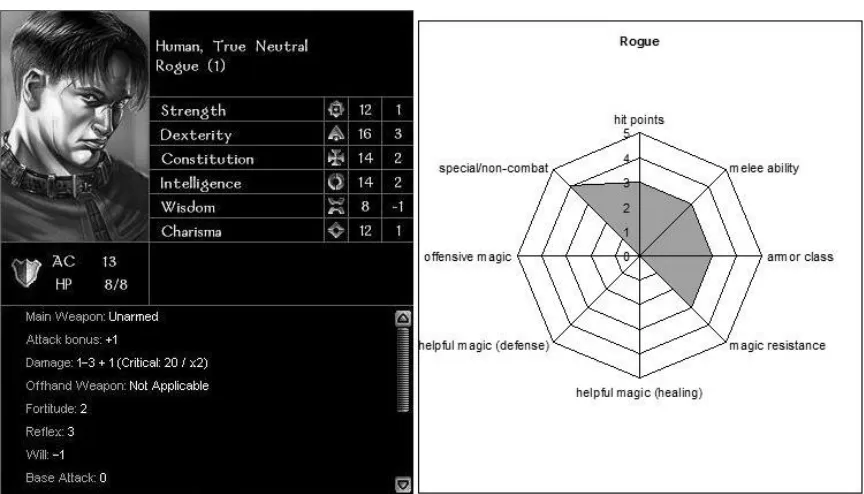
Figure 6: A Rogue in NWN, and relative strengths
A rogue has several abilities that can aid a team outside of combat, like finding traps. Under certain circumstances they can do well in combat, but generally they are less effective than a fighter due to limitations on the armour they can wear and the weapons they can use. They also have fewer HPs than a fighter, and lack the ability to cast magic spells.
A wizard is able to cast magic spells, and has powerful offensive spells. To balance this they have the fewest HPs, cannot wear armour, and are poor in melee combat.
Figure 8: A Cleric in NWN, and relative strengths
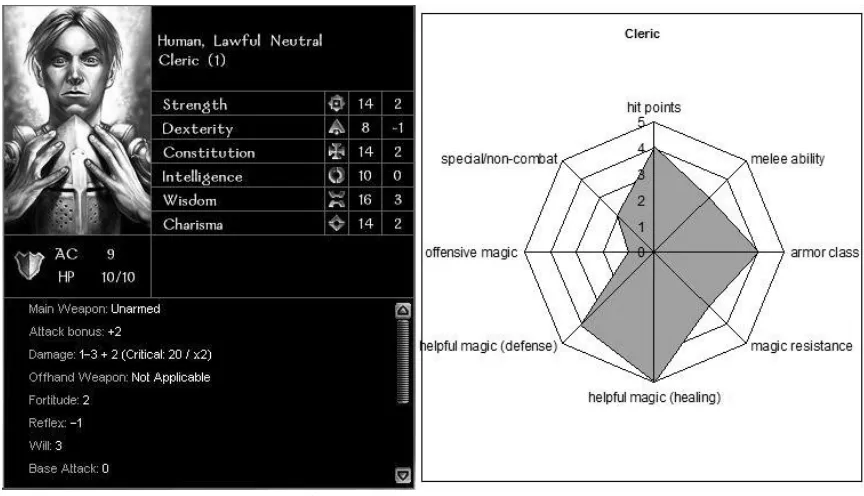
A cleric can cast healing spells and other magic that is beneficial to a party. They can also wear good armour, and are fairly good in melee combat.
We will use roles to simplify the number of combinations of team members. Fighters and Rogues have similar actions to choose from in combat. Wizards and Sorcerers can cast the same spells, so if a spell has been found to be effective in a certain situation when a Wizard is on a team, then that spell will also be effective if the team has a Sorcerer instead. There is a large overlap in the spells available to a Cleric and the spells available to a Druid and of the spells that are common to both classes, the effective ones are effective regardless of what character class has cast it.
Experimental Design
The purpose of these experiments is to see if information about the other agents (teammates and opponents) can be used to create better rule orderings faster, and to perform better than current scripting implementations. Since the characters that can cast spells have more options in their rulebases to choose from, this research will focus on their rule orderings (the fighters are effective by moving into combat and then attacking with their sword until combat is finished, the magic users have a large range of spells to choose from, which allows more possible strategies).
We propose expanding the rulebase in dynamic scripting to have different weights
down. In our experiments, we create our team from three different character types: fighter (F), cleric (C), and wizard (W). Briefly, a fighter is a tough character that cannot use magic, a cleric’s magic is mostly beneficial to his team, and a wizard has offensive magic that directly damages opponents. Should other character types be used, they would be grouped in the role that is closest to their capabilities – i.e., barbarian and monk types could be classified as F since they do not possess magic and have good melee abilities like a fighter. Experimental results will verify that this abstraction is effective in NWN.
At a high level, here are the steps that will be performed:
Step 1: Recreate a simple model of the NWN arena. By avoiding the NWN graphical user interface, results will be obtained faster. A text-based model of the NWN game will be created with the relevant rules. Some assumptions were made when making the text-based version. These assumptions include: Some area-effect spells damage all opponents; Fighters cannot attack on the first turn. More assumptions are listed in the next section. If these assumptions do not hold in the NWN arena, it does not mean that the results are invalid, but only that the discovered strategy in the text-based arena is not a valid strategy in the NWN arena. This step will allow results to be collected much faster than in the actual NWN game, and will provide a complex environment with many character types where the experiments that will support the thesis can be performed. It will also show that the abstraction from an actual commercial game to a text-only version is possible, which will allow this research to be applicable to other games
Step 2: Use dynamic scripting to come up with effective rule orderings for various scenarios (a team of magic users against opponents without magic users, a team with a wizard and many fighters against a team of magic users, a team of magic users against a balanced team). The results from each of these scenarios will be saved and used to create scripts in future steps. This step will also support the claim that a rule ordering that dynamic scripting creates for one character type will not necessarily be effective for that character in a different situation. Since other variables in the arena can be held constant while one factor is changed (for example, the same teammates against a different set of opponents), any changes to the resulting script that dynamic scripting produces can be attributed to the change of agents participating.
from this thesis will come from finding the spells that are most effective in certain situations and incorporating them in the scripts for those situations.
Step 4: Create new random teams and opponents. Run experiments with them using rules that should be effective against them based on the results of step 3. Compare the results of the teams with the static strategies delivered with the NWN game to those with strategies created from the results of the dynamic scripting experiments. This step will verify that scripts created with dynamic scripting can be more effective than those hand-created by experts, and taking the agents into consideration can create a better starting point.
Step 5: Verify the results by implementing the script in the NWN arena, and comparing them to the default learning strategies. If the scripts created by the above techniques can find an effective strategy against an opponent more quickly than by the dynamic scripting algorithm starting with the static scripts shipped with the game, we will be able to say that dynamic scripting can create an effective rule ordering more quickly by using information about opposing agents. This step will also show that this research can be applied to
improve a commercial game.
The steps are now described in more detail:
Recreating the Arena
As noted in [Tim06], by not using a graphical user interface we can simulate a large number of combats. Similar speed increases were found in these experiments by using a based simulation rather than using the actual NWN game. While creating the text-based simulation, some simplifying assumptions were made text-based on observations gathering information for [Pri10]. First observation: since the arena is small, area-effect spells almost always affected all of the enemies. For the text-based simulation, an area-effect spell will hit every opponent. As there are no “obstacles” (walls, pillars, doors) between the opponents, the rules about partial cover were not implemented. Second observation: when opponents had both melee (close-quarter) and ranged weapons (bows, etc.), the melee weapons were almost exclusively used, and the strategies learned always had the agents using their melee weapons instead of their ranged weapons. For the text-based simulation, the agents will only have melee weapons. Third observation: ‘fighter’ agents (in this context, fighter refers to any class whose primary function is to damage the opponent by getting into melee combat rather than by casting magic spells) would
were not implemented – occasionally a fighter can knock down an opponent after a hit, some bonuses to hit could occur if an attacker tried to hit someone from behind, an extra attack was allowed if someone tried to perform certain actions near an enemy. This kept the text-only version of the arena a simplified representation of the NWN arena. In a two dimensional world like the NWN arena, fighters could choose different opponents to attack if there were more than one nearby. In the text-based version, all attacks are concentrated on a single enemy, which can easily cause different results.
These assumptions might make the strategies learned unrealistic in some situations. The assumption of area-effect spells hitting all opponents for example would be unrealistic if the fighting was to occur in a large battlefield instead of the arena. For the purposes of these experiments, the assumptions should not affect the results. Verification of the strategies learned will occur in the last step when the fights are reproduced in the arena with the strategies learned.
Use Dynamic Scripting in different situations
Different teams will fight, and effective strategies will be learned. This will be similar to work described in [Spr05] and [Tim07]. It has already been shown in [Spr06] that this method will allow the agents of a team to learn an effective strategy against an opponent. This step is required to collect the data needed for the following step, where the effective strategies that the individual agents develop against different teams will be analysed. Optimal strategies will be learned with dynamic scripting for teams with different amounts of fighters, clerics, and wizards, against teams that also have different amounts of the above agents.
A rulebase will be initially set up and populated by letting certain teams of agents play against similar teams. Dynamic scripting will be used to come up with effective strategies for the cleric and wizard classes. Dynamic scripting will not be used for the fighter class, as that class basically had one effective action to perform: hit an opponent with its sword. The spells for the cleric and wizard classes will be taken from the default spell selection that came with the characters created in the NWN game. One exception will be made; wizard spell “invisibility” will be switched for a different spell of that level “web”, since there was a documented issue with the implementation of “invisibility” in the NWN dynamic scripting module.
Find correlations between effective strategies and participating agents
First, all of the strategies will be examined to see if common elements can be found (for example, while watching fights in arena, it was observed that there are certain situations when a rule is always a good idea, or always a poor one. It is always a poor decision for a character to run past enemy fighters, as that will allow the fighters to get extra attacks against the character, with bonuses from attacking from behind. It is always a poor decision for a wizard to start a combat by moving closer to the enemies and attacking with a melee weapon. A wizard can be much more effective by casting an offensive spell. It is a good decision for a cleric to heal a fighter on the same team that is wounded, regardless of the opponents being faced, as this will potentially allow the fighter to stay on his feet longer, which will help the team win. It is always a good idea to start combat by casting a spell that improves the abilities that a team mate is using, as this will maximize the amount of time the benefit will be in effect.
Since different scripts should be used in different situations, it is necessary to determine what rules are more effective in the different situations. The goal of this research is to see if the information about other agents can be used to create better starting points for dynamic scripting. There are two groups of agents that need to be examined when determining a strategy, an agent’s opponents and an agent’s teammates.
Opponents
The teams will be categorized by their relative strengths and weaknesses (for example, we may classify a team as having low melee abilities, average AC, …and high offensive magic ability, or having high melee abilities, high AC,… and no offensive magic abilities). An agent can come up with a strategy that is effective against one set of opponents but not effective against another. The scenario of a wizard casting a spell that protects him from magic is effective against opponents that have offensive magic capabilities, but not against opponents that have no offensive magic capabilities.
Teammates
The teammates of an agent will also be classified according to strengths and weaknesses. The most effective strategy a player can take may depend on the abilities of allies. A strategy for increasing the melee abilities of allies on a team will be more effective if there are teammates with high melee abilities to begin with. The scenario of a wizard casting a spell that increases the speed of a teammate is effective when there is a teammate who is a fighter, but much less effective when all of the teammates are also wizards.
In our experiments our fights will contain teams of four agents verses four agents. A team of four fighters (FFFF) would be the only team to fall in the hasF=Y, hasC=N, hasW=N set, whereas there are three teams in the hasF=Y, hasC=N, hasW=Y set (FFFW, FFWW, FWWW). Similar classifications can be made for the opponent teams: oHasF would be Y if the opponent team had fighters, and if an agent was fighting a team of FFWW, then oHasF and oHasW would be Y and oHasC would be N.
If an action is beneficial in a certain situation regardless of the teammates an agent has (for example, casting a spell that protects it from enemy magic), its weight should be independent of the values of hasF, hasC, and hasW. Similarly, if an action is beneficial in a situation regardless of the opponents (summoning a creature to help fight if there is no fighters on your team), then it should have a high value in all situations of oHasF, oHasC, and oHasW.
Create new teams, and synthesize starting strategies
Teams that have not been used in the above steps will be created, and starting strategies will be created from the results in the above step. The starting strategies will be made up of ‘common’ rules that are effective in all scenarios (healing a teammate who is injured), and of rules that have been found to be effective in similar situations (with similar teammates or against similar opponents). Fights will then occur as usual, and we will be able to determine the effectiveness of the new starting strategies against the default starting strategies. If the teams can consistently start with a dominant strategy using the new starting points than with the default strategies, then this will demonstrate the usefulness of this technique.
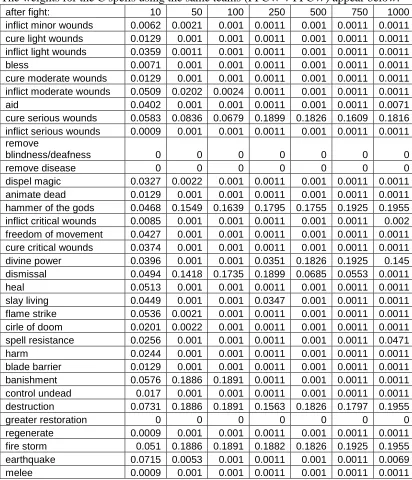
Other teams fought each other (FFFW), and then teams of different agents fought each other (FCWW vs. FFWW, FFFW vs. FFCW, FCWW vs. CCWW, etc.). The different teams and their weights were classified based on six functions hasF, hasC, hasW, oHasF, oHasC, and oHasW. These classifications are used to reduce the large number of possible combinations of character classes into a smaller number of groups to help determine the best starting strategy.
The training process was done a total of three times for each set of fights for verification purposes. Although exact matches were not expected for any of the weights, trends were observed, and the top spells in any given scenario were often the same spells in other scenarios, with slightly different weights. The variations in the results between different runs are expected as each round in combat has many random factors (whether or not a fighter hits its opponent with a sword, or the amount of damage a wizard does with an offensive spell). This randomness also affects the dynamic scripting process, as the weights that are updated depend on the fitness of the agents (whether or not the team won or not, and how decisive the win was).
![Figure 1: Outline of updating script weights from [Spr03] [Spr03] states “because of their complexity, AI scripts are likely to contain weaknesses,](https://thumb-us.123doks.com/thumbv2/123dok_us/1446798.1177267/14.612.110.539.102.320/figure-outline-updating-weights-complexity-scripts-contain-weaknesses.webp)