Traditional reference electrodes used for elec-trochemical measurements, such as the calomel and silver/silver chloride electrodes, have a limited range of applicability. The liquid junction is prob-lematic with these electrodes, and they cannot be used either with wholly solid-state electrochemical cells or for very high-temperature reactions such as those in molten electrolytes. The use of solid plat-inum electrodes in molten salts has been reported (1–14), but there are problems associated with the use in molten media of Pt electrodes. Under strongly alkaline conditions, they actually function as oxidation electrodes (2). It has been demonstrat-ed that Pt foil cannot act as a reference electrode in molten electrolytes, since it is neither stable nor depolarised (4). On the other hand, Pt wire immersed in molten NaCl/KCl can maintain a steady electrode potential for more than 12 hours, and shows electrochemical irreversibility. It can therefore can be used as a pseudo-reference elec-trode for the study of elecelec-trode reaction kinetics, with the advantages of simplicity, convenience and ease of operation (7). The Pt reference electrode performs well in geothermal brine solutions at high pressure and temperature (~ 250ºC). Unlike con-ventional reference electrodes (even when modified for high temperature), the Pt reference electrode is applicable to measurements in com-plex polluted brines (8).
In certain electrolytes, modification of the Pt surface is important for its stability. Anodised, non-porous Pt has demonstrated its usefulness as a solid-state reference electrode by virtue of its near-Nernstian behaviour, low hysteresis and rapid response (15). Modifications to Pt wire may extend its usefulness to more electrochemical systems. The use of polypyrrole (16), poly-1,3-phenylendiamine (15) or polyvinyl ferrocene (17) as a surface modifi-er can successfully suppress significant intmodifi-erfmodifi-erence by any coupled redox systems or contaminants. The fact that a Pt electrode can be modified with nitrogen-based polymers or be incorporated as part of a biosensor assembly (18) indicates its resistance to interference from these compounds.
Some of the problems associated with the refer-ence electrode can be solved outside the electrochemical cell. A reference electrode is defined as an ideal non-polarisable electrode; thus its potential does not vary with the current passing. In practice, no electrode follows this ideal behav-iour; consequently, the interfacial potential of the counterelectrode in the two-electrode system varies with the flow of current passed through the cell. In order to overcome this problem, a three-electrode cell can be used. The functions of the counterelectrode (in a three-electrode cell) are divided between the reference and auxiliary elec-trodes. The passage of current between the
Platinum as a Reference Electrode in
Electrochemical Measurements
By Kasem K. Kasem* and Stephanie JonesDepartment of Natural, Information, and Mathematical Science, Indiana University Kokomo, Kokomo, IN, 46904-9003, U.S.A.; *E-mail: [email protected]
The usefulness of platinum as an electrochemical reference electrode was investigated. Well known redox systems with one-electron single or multiple redox waves, and two-electron multiple redox waves were used as test regimes. The effects on electrode performance of variables such as the solvent, the physical state of the electrolyte and its temperature were investigated. Cyclic voltammetry (CV) was used to derive kinetic parameters for comparison with corresponding measurements on traditional reference electrodes. The results indicate that Pt can be used as a reference electrode under specific conditions in which traditional reference electrodes cannot be used.
working and auxiliary electrodes ensures that less current passes through the reference electrode. Furthermore, the three-electrode cell allows the potential between the working and reference elec-trodes to be controlled. Most electrochemical devices include an operational amplifier of high input impedance for the reference electrode input, to eliminate the possibility of any current passing through the reference electrode. Since no Faradaic process takes place at the reference electrode, its area relative to that of working electrode has no effect on the electrochemical results.
The physical form of the Pt reference electrode may contribute to its performance. Studies (19) indicate that the Pt mesh electrode yields very reproducible results, and that it can be used as a convenient reference electrode. On the other hand, Pt sheet or wire has been used in all-solid-state electrochemical cells at room temperature (20–22), and in reactions in frozen agar or frozen aqueous electrolytes (23, 24). Most of these stud-ies involved only one-electron redox systems.
In this study, the usefulness of Pt as a reference electrode in electrochemical systems was investi-gated using CV techniques. Single or multi-electron redox systems involving one- or two-electron redox waves were used in this study. To verify the suitability of Pt as a reference elec-trode, kinetic parameters were determined for comparison with corresponding measurements on traditional reference electrodes.
Experimental Details
The reagents FeCl3, KCl, K3[Fe(CN)6] and
K4[Fe(CN)6] were of analytical grade. A purified
agar powder was obtained from Sigma Chemical Co. All other reagents were of at least reagent grade and were used without further purification. Analytical grade nitrogen gas was used to purge oxygen from the electrolyte. Unless otherwise stat-ed, experiments were performed at 25ºC and 1 atm pressure.
To test the suitability of Pt as a reference elec-trode, a Pt wire reference electrode was coupled with a standard Ag/AgCl/Cl–reference electrode in a beaker containing 0.5 M KCl with or without the addition of 2 mM K3Fe(CN)6(potassium
hexa-cyanoferrate (III)) electrolyte. The two electrodes were connected briefly to the inputs of a Fluke 27 multimeter that has input impedance 200 MΩ. The voltage reading was used to assess the quality and suitability of the Pt reference electrode.
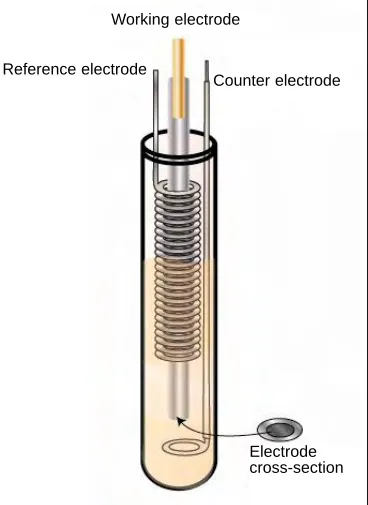
Electrochemical experiments were carried out using a 10 cm3cylindrical cell (Figure 1). The
ref-erence electrode, unless otherwise stated, was Pt. CV was performed first using Pt as a reference electrode and then using Ag/AgCl/Cl–as a refer-ence electrode. The counter (auxiliary) electrode was a Pt wire, and the working electrodes were glassy carbon (0.07 cm2) or Pt (0.02 cm2) in disc or
microelectrode (10 μm diameter or 7.85 × 10⁻⁷
cm2) configuration. Electrodes were positioned in
the cell in a similar way. The Pt wire reference electrode was coiled around the Teflon jacket of the working electrode; the counter electrode was placed at a distance from both the reference and working electrodes. The working electrodes were cleaned by polishing with 1 μm α-alumina paste or diamond paste, and rinsed with water and acetone prior to use. A BAS 100B Electrochemical Analyzer (Bioanalytical System, Inc.) was used to
Platinum Metals Rev., 2008, 52, (2) 101
Working electrode
Counter electrode Reference electrode
Electrode cross-section
perform the electrochemical studies. For frozen electrolyte experiments, the electrolyte was first frozen at –20ºC and measurements were per-formed at –5ºC.
Suitability Tests on Platinum Wire
Reference Electrodes
Prior to use as a reference electrode, Pt wire was mechanically polished using 600 grade sandpa-pers, followed by 2 μm diamond paste, and rinsed with deionised water. In an alternative method, the mechanically cleaned Pt wire was heated to 1000ºC for 10 minutes. The Pt wires with the different treatments were each coupled with a reference electrode of known potential as described in the Experimental Details section. The voltammetric reading was less than 0.2 mV in each case. This value is much lower than the standard maximum allowed for this test, which is 3 mV. These results indicate that Pt wire is an adequate reference elec-trode for routine laboratory use.
The suitability test showed that stirring or agita-tion has no effect on the performance of the Pt wire reference electrode. Several Pt wires of differ-ent lengths were subjected to the reference electrode suitability test. The results indicate that the surface area of the Pt wire has no effect on per-formance.
One of the most undesirable effects which a reference electrode can cause is a change in poten-tial during the course of an experiment. In CV studies, the quantity ΔEp(the difference between the reduction peak potential Epcand the oxidation peak potential Epa) is very important in the calcu-lation of the charge transfer rate constant kCT when diffusion is the dominant process. The calcu-lation is made using Equation (i) (25):
(DO/DR)αkCT (i)
(NFπ νDO/RT)1/2
where: Ψ is a dimensionless rate parameter, the value of which decreases from 20 to 0.1 as ΔEp increases from 0.061 V to 0.212 V (25); DO= dif-fusion coefficient of oxidation; DR = diffusion coefficient of reduction; N = number of electrons;
ν = scan rate (V s–1); F = Faraday constant; T = temperature; R = gas constant; α= transfer
coefficient. The validity of Pt as a reference elec-trode has been tested in each of the three systems described below.
One-Electron Redox System
Liquid aqueous, agar gel and frozen systems containing 5 mM of K3Fe(CN)6and 100 mM KCl
as supporting electrolytes were chosen as model systems for one-electron redox reactions. Figure 2(a) indicates that the use of Pt as a reference elec-trode shows a clear potential window in a redox-free electrolyte, whereas Figure 2(b) shows only a parallel shift in both Epcand Epawithout affecting the value of ΔEp, even in agar medium. Typical characteristics of diffusional redox waves are reported and displayed in Figures 2(c)–2(e).
The use of Pt as a reference electrode in a frozen electrolyte shows CV outcomes similar to those generated when Ag/AgCl/frozen Agar (KCl saturated) was used as a reference electrode. The results are displayed in Figure 3. These results were interpreted using a high pressure effect model (24).
Multi One-Electron System
1 mM of TCQN (7,7,8,8-tetracyanoquino-dimethane) in acetonitrile containing 0.2 M LiClO4
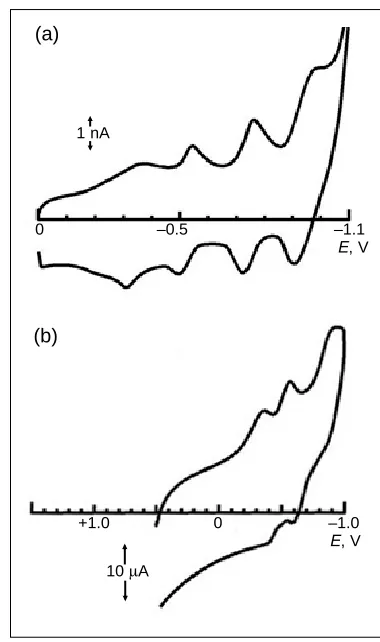
(lithium perchlorate) was used as a medium to investigate a multi-one electron redox system. Figure 4 displays the CV of this system using a Pt disc working electrode with a Pt wire electrode (solid trace), and Ag/AgCl/KCl (dashed trace) as reference electrodes. Two one-electron redox waves can be identified. It can be observed that increasing the scan rate from 5 mV s–1(Figure 4(a))
to 50 mV s–1(Figure 4(b)) generated well defined
redox waves. Measured ΔEpfor redox waves after ‘IR’ compensation (for the ohmic potential drop) indicates a typical one-electron wave character (amplitude 61 mV) which is very close to the theo-retical amplitude of 59 mV. The fact that the TCQN CV shows a consistent behaviour regard-less of the reference electrode used indicates that the results are attributable to the redox system and not to the type of reference electrode. This conclu-sion demonstrates the usefulness of Pt as reference electrode in non-aqueous media for multi one-electron redox systems.
Multi Two-Electron Redox System
5 mM H3PMo12O40(a Keggin heteropolyacid)
immobilised in agar gel containing H2SO4/KCl
was used as a model for a multi two-electron redox system. Either a glassy carbon microelectrode (10
μm diameter) or a disc electrode (0.07 cm2) was
used as a working electrode. The results are dis-played in Figure 5(a) (microelectrode) and Figure 5(b) (disc electrode). Figure 5 clearly illustrates the multi two-electron redox waves typical of phos-phomolybdic acid. The measured ΔEpfor each of the first two redox waves was less than 28 mV. The position of the formal potential of each of these waves was negatively shifted by approxi-mately 600 mV from that observed when a Ag/AgCl/KCl reference electrode was used.
Conclusions
Under certain conditions, such as high temper-ature or in molten electrolytes, where the usual reference electrodes such as calomel or Ag/AgCl/KCl electrodes cannot be used in elec-trochemical measurements, this study has demonstrated that Pt is the reference electrode of choice. Our study also shows that, under condi-tions where traditional reference electrodes are viable, Pt can replace them. Furthermore, in high-pressure electrochemical systems the change in the formal potential of the redox system follows Equation (ii):
ΔV° = –(δE°)TNF/δP (ii)
where δP is the partial derivative of the pressure.
Platinum Metals Rev., 2008, 52, (2) 103
= ipc = ipa
(d) (e)
= Epc = Epa
ip
,
μ
A
50
40
30
20
10
0 0.1 0.2 0.3 0.4 0.5 V½
ip
,
μ
A
50
40
30
20
10
0 0.1 0.2
V s–1 (c)
20 μA
+0.4 –0.4
E, V 0
+1.0 +0.5 0 –0.4
E, V 20 μA
(b)
–1.0 –2.0
E, V (a)
+1.0 0
Fig. 2 (a) CV at 0.20 V s–1of: ⎯GCE; - - -Pt reference electrode, in agar gel containing KCl; (b) CV at 100 V s–1of
Pt electrode in agar gel containing 5 mM K3[Fe(CN)6]/KCl: ⎯vs. Ag/AgCl (agar saturated KCl) as reference
electrode; - - -vs. Pt electrode; (c) CV of Pt electrode (0.02 cm2) in agar gel containing 5 mM K
4[Fe(CN)6]/KCl at:
0.020, 0.050, 0.10 and 0.150 V s–1(inner to outer CV traces, respectively); (d) Plot of i
In liquid electrolytes the change of the volume (ΔV°) originates in the outer sphere molecules in
the solvation layer. Traditional reference electrode components contribute to this volume change. The capability of a Pt wire to act alone as a reference electrode without any associated solvated ions, eliminates the error in calculation of ΔV°.
Consequently, the measured δE° relates more
specifically to the particular redox system. Our studies show a 3.5 mV change in the formal poten-tial (ΔE°) of [Fe(CN)6]–3/–4when the aqueous liquid
electrolyte is frozen. ΔE° was 98 mV when aqueous
gel electrolyte is frozen. It has been reported (26) that a change in the formal potential of the [Fe(CN)6]–3/–4system in a liquid electrolyte of 3.93 ×
10–5V atm–1took place when the system was
sub-ject to pressure. This change in the formal potential is equivalent to applying 89 atm and 2500 atm to frozen aqueous and gel electrolytes of [Fe(CN)6]–3/–4
respectively. The volumes of both the reference and counter electrode components will remain constant, because Pt wires were used as reference and counter electrodes; the change in the formal potential is due to the change in the volume of the redox ion. This is an additional advantage of using Pt as a reference electrode over the use of a traditional reference electrode under these conditions.
In conclusion, we have shown that where con-ventional reference electrodes are not suitable for some electrochemical measurements, Pt wire is a satisfactory reference electrode in various electro-chemical systems such as aqueous, non-aqueous, gel or frozen electrolytes, and for measurements under high pressure. Single or multi one- or two-electron redox systems were studied, with peak separation (ΔEp) indicating that Pt can be used reliably as a reference electrode under a variety of conditions.
+0.6 0 –0.6
E, V
10 μA (a)
0 –0.6
E, V (b)
6 μA
500 pA (c)
+0.6 +0.3 0 –0.3
E, V +0.6
Fig. 3 CV at 100 mV s–1for 5 mM [Fe(CN)
6]3–/4–: (a) Pt disc in aqueous KCl; (b) Pt disc in frozen KCl electrolyte;
Platinum Metals Rev., 2008, 52, (2) 105 1 D.-S. Kim, H.-J. Park, H.-M. Jung, J.-K. Shin, P.
Choi, J.-H. Lee and G. Lim, Jpn. J. Appl. Phys., 2004,
43, (6B), 3855
2 A. S. Afanas’ev and V. P. Gamazov, Zh. Fiz. Khim., 1964, 38, (12), 2823
3 I. Uchida and H. A. Laitinen, J. Electrochem. Soc., 1976, 123, (6), 829
4 H. C. Gaur and H. L. Jindal, Curr. Sci., 1968, 37, (2), 49
5 P. P. Leblanc and R. A. Rapp, J. Electrochem. Soc., 1992, 139, (3), L31
6 Yu. K. Delimarskii, L. S. Berenblyum and I. N. Sheiko, Zh. Fiz. Khim., 1951, 25, 398
7 Z. Xie and Y. Liu, Zhongguo Youse Jinshu Xuebao, 1998, 8, (4), 668
8 J. A. Sampedro, N. Rosas and B. Valdez, Corros. Rev., 1999, 17, (3–4), 253
9 J. Horiuchi and G. Okamoto, Sci. Pap. Inst. Phys. Chem. Res. (Jpn.), 1936, 28, 231
10 F. G. Bodewig and J. A. Plambeck, J. Electrochem. Soc., 1970, 117, (5), 618
11 B. Popov and H. A. Laitinen, J. Electrochem. Soc., 1970, 117, (4), 482
12 H. Goto and F. Maeda, Nippon Kagaku Zasshi, 1969,
90, (8), 787
13 J.-B. P. F. Lesourd and J. A. Plambeck, Can. J. Chem., 1969, 47, (18), 3387
14 O. A. Songina and A. A. Usvyatsov, Zavod. Lab., 1964, 30, (11), 1419
15 J.-H. Han, S. Park, H. Boo, H. C. Kim, J. Nho and T. D. Chung, Electroanalysis, 2007, 19, (7–8), 786 16 J. Ghilane, P. Hapiot and A. J. Bard, Anal. Chem.,
2006, 78, (19), 6868
17 P. J. Peerce and A. J. Bard, J. Electroanal. Chem. Interfacial Electrochem., 1980, 108, (1), 121
18 Y. Hanazato and S. Shiono, Anal. Chem. Symp. Ser., 1983, 17, (Chem. Sens.), 513
Fig. 4 CV of GCE (0.07 cm2) in agar gel containing 1
mM TCQN (7,7,8,8-tetracyanoquinodimethane) in 0.2 M
LiClO4in acetonitrile: ⎯Pt reference electrode,
-Ag/AgCl/Cl–reference electrode: (a) at 0.005 V s–1; (b) at
0.50 V s–1
1 nA
10 μA
+1.0 0 –1.0
E, V (b)
0 –0.5 –1.1
E, V (a)
Fig. 5 CV at 0.5 V s–1in 5 mM H
3PMoO40in agar gel
containing H2SO4/KCl for: (a) carbon microelectrode;
(b) GCE (0.07 cm2)
References
(a)
(b)
0 –0.2 –0.4 –0.6
E, V +0.2
+0.2 0 –0.2 –0.4 –0.6
E, V 4.0 μA
19 E. P. Jacobs and F. Doerr, Ber. Bunsen-Ges., 1972, 76, (12), 1271
20 J. A. Cox, A. M. Wolkiewicz and P. J. Kulesza, J. Solid State Electrochem., 1998, 2, (4), 247
21 P. J. Kulesza and Z. Galus, J. Electroanal. Chem., 1992, 323, (1–2), 261
22 P. J. Kulesza, L. R. Faulkner, J. Chen and W. G. Klemperer, J. Am. Chem. Soc., 1991, 113, (1), 379
23 K. K. Kasem, J. New Mater. Electrochem. Syst., 2005, 8, (3), 189
24 L. S. Books, C. Harris and K. K. Kasem, Am. J. Undergrad. Res., 2007, 5, (4), 25
25 A. J. Bard and L. R. Faulkner, “Electrochemical Methods: Fundamentals and Applications”, 1st Edn., John Wiley & Sons, New York, 1980, p. 231 26 J. I. Sachinidis, R. D. Shalders and P. A. Tregloan,
Inorg. Chem., 1994, 33, (26), 6180
The Authors
Dr Kasem K. Kasem is a Professor of Chemistry at Indiana University Kokomo, U.S.A. He is interested in
developments in the field of applied electrochemistry, especially in physical and analytical applications of chemically-modified electrodes. He also has interests in semiconductor photoelectrochemistry, the electrochemical behaviour of polymeric thin films, activation and metallisation of polymers, and the electrodeposition of metals and alloys.
![Fig. 2 (a) CV at 0.20 V s–1 of: ⎯ GCE; --- Pt reference electrode, in agar gel containing KCl; (b) CV at 100 V s–1 ofPt electrode in agar gel containing 5 mM K3[Fe(CN)6]/KCl: ⎯ vs](https://thumb-us.123doks.com/thumbv2/123dok_us/8621138.1410846/4.522.69.455.67.388/fig-reference-electrode-containing-ofpt-electrode-containing-kcl.webp)
![Fig. 3 CV at 100 mV s–1 for 5 mM [Fe(CN)6]3–/4–: (a) Pt disc in aqueous KCl; (b) Pt disc in frozen KCl electrolyte;(c) Pt microelectrode in frozen KCl electrolyte](https://thumb-us.123doks.com/thumbv2/123dok_us/8621138.1410846/5.522.69.454.66.381/aqueous-frozen-kcl-electrolyte-microelectrode-frozen-kcl-electrolyte.webp)