IJEDR1402113
International Journal of Engineering Development and Research (www.ijedr.org)1988
Get High Precision in Content-Based Image Retrieval
using Combination of Color, Texture and Shape
Features
1
Mr. Rikin Thakkar,
2Ms. Ompriya Kale
1Department of Computer engineering, 1
LJ Institute of Technology, Ahmedabad, India
1[email protected], 2[email protected]
________________________________________________________________________________________________________
Abstract— Content-based image retrieval has become hot topic for research. Only color, texture or shape feature extraction cannot give high precision. To get high precision, this paper proposes a new content-based image retrieval method that uses combination of color, texture and shape feature. The color moment will be calculated to extract the color feature, where the image will be converted from RGB to HSV color space. The Ranklet Transform is performed to extract the texture feature, where the image will be in gray-scale. The Hough Transform is performed to extract the shape feature, where the image will be in gray-scale. Experiment results show that using combination of color, texture and shape feature to compare and retrieve image is more accurate than using one of them only.
Index Terms— CBIR, Content-Based Image Retrieval (CBIR), Color Moment, Ranklet Transform, Hough Transform.
________________________________________________________________________________________________________
I.INTRODUCTION
Content Based Image Retrieval is the retrieval of images based on their visual features such as color, texture, and shape [1]. There are several advantages of image retrieval techniques compared to other simple retrieval approaches such as text-based retrieval techniques [2]. Image retrieval based on content is extremely useful in lots of applications such as geographical information architectural and engineering design, historical research, fashion and graphic design, medical diagnosis and remote sensing systems, etc. [3]. In the commerce department, before trademark is finally approved for use, there is need to find out if such or similar ones ever existed. In hospitals, some ailments require the medical practitioner to search and review similar X-rays or scanned images of a patient before proffering a solution [4].
CBIR systems extract features (color, texture, and shape) from images in the database. Each image is represented by a compact representation of its contents (color, texture, shape, and spatial information) in the form of a fixed length real-valued multicomponent feature vectors or signature [4]. This is called offline feature extraction [5]. The main advantage of using CBIR system is that the system uses image features instead of using the image itself. So, CBIR is cheap, fast, and efficient over image search methods.
A key component of the CBIR system is feature extraction. A feature is a characteristic that can capture a certain visual property of the image. CBIR differs from classical information retrieval in that the image databases are essentially unstructured, since digitized images consist purely of arrays of pixel intensities, with no inherent meaning. One of the key issues with any kind of image processing is the need to extract useful information from the raw data before any kind of reasoning about the image’s contents is possible [3].Early studies on CBIR used a single visual content such s color, texture, or shape to describe the image. The drawback of this method is that using one feature is not enough to describe the image. The image contains various visual characteristics. In this paper, we propose to extract color, texture and shape features from the image.
The rest of the paper is organized as the following. Section 2 presents the color, the texture and the shape features to represent the image. In Section 3, we introduce the proposed system for CBIR. System implementation and experimental results are given in Section 4. Section 5 summarizes our proposed system and some proposed future work.
II.RELATED WORK
All CBIR systems view the query image and the target images as a collection of features [4]. These features characterize the content of the image. The advantages of using image features instead of the original image pixels appear in image representation and comparison for retrieving. When we use the image features for matching, we almost do compression for the image and use the most important content of the image. This also bridges the gaps between the semantic meaning of the image and the pixel representation [6]. Each feature of image is explained here.
Color Feature
IJEDR1402113
International Journal of Engineering Development and Research (www.ijedr.org)1989
color descriptor have to be determined.The purpose of a color space is to facilitate the specification of colors. Each color in the color space is a single point represented in a coordinate system. Several color spaces, such as RGB, HSV, CIE L*a*b, and CIE L*u*v, have been developed for different purposes. Although there is no agreement on which color space is the best for CBIR, an appropriate color system is required to ensure perceptual uniformity. Therefore, the RGB color space, a widely used system for representing color images, is not suitable for CBIR because it is a perceptually non-uniform and device-dependent system. The most frequently used technique is to convert color representations from the RGB color space to the HSV. The HSV color space is an intuitive system, which describes a specific color by its hue, saturation, and brightness values. This color system is very useful in interactive color selection and manipulation [7]. After selecting a color space, an effective color descriptor should be developed in order to represent the color of the global or regional areas. Several color descriptors have been developed from various representation schemes, such as color histograms [10], color moments [12], color edge, color texture, and color correlation [11]. In this paper, we will use color moment method because it has the lowest feature vector dimension and lower computational complexity. ]. In color moment we have to find three parameters, the first-order (mean), the second (standard deviation), and the third -order (skewness) color moments have been proved to be efficient and effective in representing color distributions of images.
Texture Feature
In the field of computer vision and image processing, there is no clear-cut definition of texture. This is because available texture definitions are based on texture analysis methods and the features extracted from the image. However, texture can be thought of as repeated patterns of pixels over a spatial domain, of which the addition of noise to the patterns and their repetition frequencies results in textures that can appear to be random and unstructured. Texture properties are the visual patterns in an image that have properties of homogeneity that do not result from the presence of only a single color or intensity. The different texture properties as perceived by the human eye are, for example, regularity, directionality, smoothness, and coarseness.
Image textures have useful applications in image processing and computer vision. They include: recognition of image regions using texture properties, known as texture classification, recognition of texture boundaries using texture properties, known as texture segmentation, texture synthesis, and generation of texture images from known texture models. Since there is no accepted mathematical definition for texture, many different methods for computing texture features have been proposed over the years. Unfortunately, there is still no single method that works best with all types of textures. The commonly used methods for texture feature description are statistical, model-based, and transform-based methods [4].
Before we extract the texture feature from the image, we perform a preprocessing step using Ranklet Transform. The result of applying Ranklet Transform on the image is 3 ranklet images in different orientation (vertical, horizontal, and diagonal). Ranklet Transform belongs to a family of nonparametric, orientation-selective, and multiresolution features that has the wavelet style. It has been used for pattern recognition and in particular to face detection. Later on, it has been used for testing and estimating 3D structure and motion of objects [6]. From 2004, Ranklet Transform has been used in medical fields. It has been applied to the problems of tumoral masses detection in digital mammograms. Some tests show that Ranklet Transform performs better than some methods such as pixel-based and wavelet-based image representations. Ranklet Transform has three main properties. First, it is nonparametric that it is based on nonparametric statistics that deal with a relative order of pixels instead of their intensity values. Second, it is orientation selective that it is modeled on Haar wavelets. This means that for an image, vertical, horizontal, and diagonal ranklet coefficients are computed. Finally, it is multiresolution that the Ranklet Transform can be calculated at different resolutions using Haar wavelet supports. The powerful of using Ranklet Transform as a preprocessing step is to make the image invariant to rotation and any image enhancement operations. [4]
To calculate the texture moments for each ranklet image, we have to calculate the ranklet histogram (rh) and the ranklet co-occurrence matrix (rcmd,θ). And we can find other 9 ranklet parameters by the value of these two parameters.
Shape Feature
One of the common used features in CBIR systems is the shape. Shape of an object is the characteristic surface configuration as represented by the outline or contour. Shape recognition is one of the modes through which human perception of the environment is executed. It is important in CBIR because it corresponds to region of interests in images. Shape feature representations are categorized according to the techniques used. They are boundary-based and region-based.
In region based techniques, all the pixels within a shape are taken into account to obtain the shape representation. Common region based methods use moment descriptors to describe shape. Region moment representations interpret a normalized gray level image function as a probability density of a 2-D random variable. The first seven invariant moments, derived from the second and third order normalized central moments, are given by Hu. Because moments combine information across an entire object rather than providing information just at a single boundary point, they capture some of the global properties missing from many pure contour-based representations.
Comparing with region based shape representation; contour based shape representation is more popular. Contour based shape representation only exploits shape boundary information. Simple contour-based shape descriptors include area, perimeter, compactness, eccentricity, elongation, and orientation. Complex boundary-based descriptors include Fourier descriptors, grid descriptors, and chain codes.
In this paper we are going to convert our image from color image to black and white image, so we can use Hough transform on image easily.
IJEDR1402113
International Journal of Engineering Development and Research (www.ijedr.org)1990
have specific Parametric form. Hough transform is a powerful method for locating lines in image so that each line in page x-y is described as follows:xcos(θ) + ysin (θ) = ρ
So different ρ and θ values obtained and finally the largest value of them specifies the edge line. In fact edge line passes through all edge points. But finally a line is passed through the object edge or Side of the square-shaped object. so a point in Cartesian coordinate is mapped to a Sine wave and a point that have most shared sine Is considered as a candidate for The final line. Therefore if we choose a point that is edge we can convert it to a line. So a set of points is mapped to a set of lines in Cartesian coordinate.
III.PROPOSED ALGORITHM
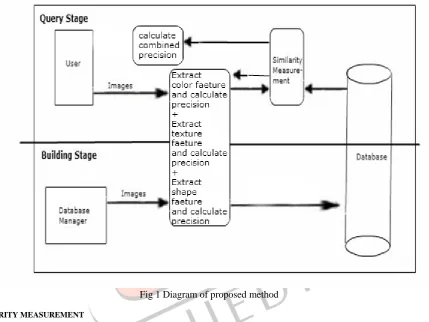
The proposed algorithm of the CBIR system is divided into two main steps. The first step is to extract the color feature, the texture feature and the shape feature from the image. The second step is to measure the similarity between the images using the extracted feature vectors. Figure describes the steps of the proposed method.
Fig 1 Diagram of proposed method
IV.SIMILARITY MEASUREMENT
One fundamental step in CBIR system is the similarity measures. Similarity between two images is to find the distance between them. The distance between two images can be calculated by using feature vectors that are extracted from the database images. Therefore, the retrieval result is not a single image, but many images will be retrieved. Different similarity measures have been proposed based on the empirical estimates of the distribution of features, so the kind of features extracted from the image and the arrangement of these features in a vector will determine the kind of similarity measures to be used. Different similarity measures will affect the retrieval performance of image retrieval significantly. [4]
One of the most popular similarity measurements is Euclidean Distance. Euclidean Distance is used to measure the similarity between two images with N-dimensional feature vector.
V.EXPERIMENTS AND RESULTS
We choose the database provided by James S. Wang for testing our proposed method. WANG [25] database is an image database where the images are manually selected from the Corel database. In WANG database, the images are divided into 10 classes. Each class contains 100 images. It is widely used for testing CBIR systems. Classification of the images in the database into 10 classes makes the evaluation of the system easy. Our proposed system is implemented using Matlab image processing. For evaluation, we use all the images in the database. Each image in the database went through the proposed method to extract the color feature and the texture feature. This step is made off line for the 1000 images in the database. The database now is ready for testing and evaluating our CBIR proposed system.[4]
Purpose: The algorithm is to retrieve images similar to the input image. Input: An RGB image, number of retrieved images n.
IJEDR1402113
International Journal of Engineering Development and Research (www.ijedr.org)1991
Method:Part I: Extract Color Feature
Step 1. Convert the input image from RGB color space to HSV color space. Step 2. Calculate the color moments for layer (H, S, and V).
Step 3. Construct the 9 dimension vector, color feature vector.
Part II: Extract Texture Feature
Step 1. Convert the input image from RGB color space to a gray-scale image.
Step 2. Apply the Ranklet Transform on that image. The output images will be in different orientation (vertical, horizontal, and diagonal)
Step 3. Calculate the texture moments for each ranklet image. Step 4. Construct the 11 dimension vector, texture feature vector.
Part II: Extract Shape Feature
Step 1. Convert the input image from RGB color space to a gray-scale image. Step 2. Apply the Hough Transform on that image.
Step 3. Construct the 6 dimension vector, shape feature vector
Part III: Retrieve the images:
Step 1. Retrieve the first n similar images to the input image by calculate the distance between the input image and the images in the database using only color feature.
Step 2. Calculate the precision.
Step 3. Retrieve the first n similar images to the input image by calculating the distance between the input image and the images in the database using only texture feature.
Step 4. Calculate the precision.
Step 5. Retrieve the first n similar images to the input image by calculating the distance between the input image and the images in the database using only shape feature.
Step 6. Calculate the precision.
Step 7. Retrieve the first n similar images to the input image by calculate the distance between the input image and the images in the database using color, texture and shape features.
Step 8. Calculate the precision.
To evaluate a CBIR system, we have to choose some performance metrics. The problem is that neither a standard image database nor a unique performance measure is available [4]. In CBIR, the most commonly used performance measures are Precision and Recall.
We are going to consider only precision, not recall. Precision is defined as the ratio of the number of retrieved relevant images to the total number of retrieved images [13]. We denote to the precision by P. Recall is defined as the ratio of the number of retrieved relevant images to the total number of relevant images in the database [13]. We denote to the recall by R [4].
In CBIR, if the precision score is 1.0, this means that every image retrieved by a search is relevant, but we do not know if the search retrieves all the images relevant to the query. If the recall score is 1.0, this means that all relevant images are retrieved by the search, be we do not know the number of irrelevant images were also retrieved [4].
Table 1 Precision of each category
Semantic Group Color features Texture features Shape features Color + texture
features
Color + Texture + Shape Features
Africans 0.301 0.212 0.229 0.6 0.71
Beaches 0.223 0.286 0.245 0.7 0.77
Buildings 0.215 0.311 0.289 0.8 0.91
Buses 0.276 0.269 0.244 0.7 0.79
Dinosaurs 0.656 0.361 0.88 0.7 0.93
Elephants 0.261 0.224 0.222 0.5 0.54
Flowers 0.317 0.386 0.343 0.7 0.76
Horses 0.42 0.244 0.399 0.5 0.62
Mountains 0.254 0.214 0.212 0.5 0.58
Foods 0.221 0.211 0.196 0.4 0.43
IJEDR1402113
International Journal of Engineering Development and Research (www.ijedr.org)1992
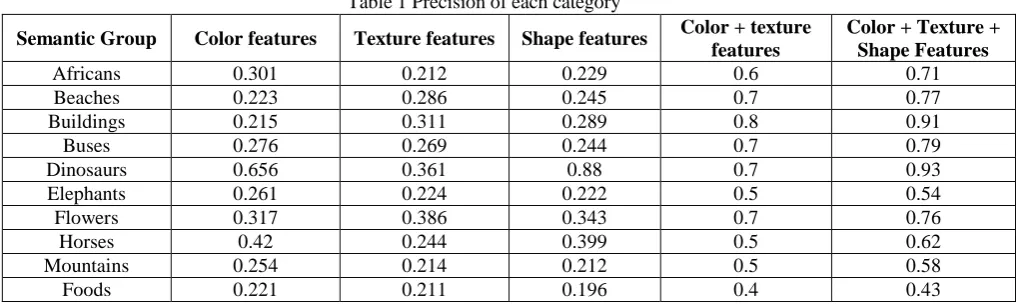
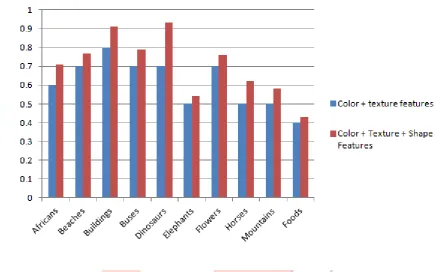
experiment. In the third phase, the proposed method will retrieve images similar to the input image according to the color feature and the texture feature. Table I shows the experimental results for each category by calculating the precision for each experiment [4]. In our proposed method we have added one more feature, shape feature. In our proposed method we will retrieve similar images from the database using the shape feature only. Also, the precision is calculated for each experiment. And then we will retrieve images similar to the input image according to the color feature, the texture feature and shape feature. Table I shows the experimental results for each category by calculating the precision for each experiment.Fig 2 Graph of precision VS categories.
It is clear from Table I that proposed method works very well when we use combination of color, texture and shape feature to retrieve images similar to the input image. Also, using the combination of color, texture and shape features to represent the image and retrieve images similar to it has more accuracy compared with only color feature or only shape feature or only texture feature. Fig.1shows a graph to visualize which method has more accurate results. also, the proposed method using both color and texture features has lower computational complexity sing only 20 dimension feature as compare to other methods that uses hundreds.
VI.CONCLUSION
CBIR has been a very active research area since 1995. Because of the complexity of image data, many challenges are issued. This paper proposes a new CBIR method that uses the combination of HSV color moment feature, Hough transform for shape extraction and Ranklet texture moment feature. WANG image database is used to evaluate the proposed method because it is widely used. Experimental results for ten class images showed that the proposed method has higher precision than those based on color, texture, shape and combination of two features. Because the method uses multi-features, which make use of each feature’s unique advantages, in addition the dimensions of features vector are low.
In the future, we propose a method that combines spatial features with the color, texture and shape feature to represent the image. This will give good results.
REFERENCES
[1] Barbeau Jerome, Vignes-Lebbe Regine, and Stamon Georges, “A Signature based on Delaunay Graph and Co-occurrence Matrix,” Laboratoire Informatique et, Systematique, Universiyt of Paris, Paris, France, July 2002.
[2] Yousef Mahdy, Khaled Shaaban, and Ali Abd El-Rahim, “Image Retrieval Based on Content,” GVIP Journal, Volume 6, Issue 1, July 2006.
[3] V. Gudivada and V. Raghavan, “Content-based image retrieval systems,” IEEE Computer, vol. 28, no 9, pp18-22, Sep. 1995.
[4] Ahmed J. Afifi and Wesam M. Ashour, “High Precision in Content-Based Image Retrieval using Combination of Color, Texture and Shape Features” IEEE Computer, 2012.
[5] F. Long, H. Zhang, H. Dagan, and D. Feng, “Fundamentals of content based image retrieval,” in Multimedia Information Retrieval and Management, D. Feng, W. Siu, and H. Zhang, Eds., Multimedia Signal Processing Book, chapter 1, pp. 1– 26, Springer, Berlin, Germany, 2003.
IJEDR1402113
International Journal of Engineering Development and Research (www.ijedr.org)1993
[7] M. Stricker and M. Orengo, “Similarity of color images,” in Storage and Retrieval for Image and Video Databases III,vol. 2420 of Proceedings of SPIE, pp. 381–392, February 1995.
[8] R. Brunelli and O. Mich, “Histograms Analysis for Image Retrieval,” Pattern Recognition, Vol.34, No.8, pp1625-1637,2001.
[9] J. Huang, S. R. Kumar, M. Mitra, W. J. Zhu, and R. Zabih, “Image indexing using color correlograms,” IEEE Int. Conf. Computer Vision and Pattern Recognition, San Juan, Puerto Rico, Jun. 1997, pp.762–768.
[10]A. Del Bimbo, M. Mugnaini, P. Pala, and F. Turco. Picasso, “Visual querying by color perceptive regions,” In Proceedings of the 2nd International Conference on Visual Information Systems, San Diego, December’97, pages 125-131,1997.