Global Sampling for Sequential Filtering
over Discrete State Space
Pascal Cheung-Mon-Chan ´
Ecole Nationale Sup´erieure des T´el´ecommunications, 46 rue Barrault, 75634 Paris C´edex 13, France Email:[email protected]
Eric Moulines ´
Ecole Nationale Sup´erieure des T´el´ecommunications, 46 rue Barrault, 75634 Paris C´edex 13, France Email:[email protected]
Received 21 June 2003; Revised 22 January 2004
In many situations, there is a need to approximate a sequence of probability measures over a growing product of finite spaces. Whereas it is in general possible to determine analytic expressions for these probability measures, the number of computations needed to evaluate these quantities grows exponentially thus precluding real-time implementation. Sequential Monte Carlo tech-niques (SMC), which consist in approximating the flow of probability measures by the empirical distribution of a finite set of particles, are attractive techniques for addressing this type of problems. In this paper, we present a simple implementation of the sequential importance sampling/resampling (SISR) technique for approximating these distributions; this method relies on the fact that, the space being finite, it is possible to consider every offspring of the trajectory of particles. The procedure is straightforward to implement, and well-suited for practical implementation. A limited Monte Carlo experiment is carried out to support our findings.
Keywords and phrases:particle filters, sequential importance sampling, sequential Monte Carlo sampling, sequential filtering, conditionally linear Gaussian state-space models, autoregressive models.
1. INTRODUCTION
State-space models have been around for quite a long time to model dynamic systems. State-space models are used in a variety of fields such as computer vision, financial data anal-ysis, mobile communication, radar systems, among others. A main challenge is to design efficient methods for online esti-mation, prediction, and smoothing of the hidden state given the continuous flow of observations from the system. Ex-cept in a few special cases, including linear state-space mod-els (see [1]) and hidden finite-state Markov chain (see [2]), this problem does not admit computationally tractable exact solutions.
From the mid 1960s, considerable research efforts have been devoted to develop computationally efficient methods to approximate these distributions; in the last decade, a great deal of attention has been devoted to sequential Monte Carlo (SMC) algorithms (see [3] and the references therein). The basic idea of SMC method consists in approximating the con-ditional distribution of the hidden state with the empirical distribution of a set of random points, calledparticles. These particles can either give birth to offspring particles or die,
depending on their ability to represent the distribution of the hidden state conditional on the observations. The main dif-ference between the different implementations of the SMC algorithms depends on the way this population of particles evolves in time. It is no surprise that most of the efforts in this field has been dedicated to finding numerically efficient and robust methods, which can be used in real-time imple-mentations.
These algorithms are collectively referred to as mixture Kalman filters (MKFs), a term first coined by Chen and Liu [8] who have developed a generic sampling algorithm; closely related ideas have appeared earlier in the automatic con-trol/signal processing and computational statistics literature (see, e.g., [9,10] for early work in this field; see [5] and the references therein for a tutorial on these methods; see [3] for practical implementations of these techniques). Because these sampling procedures operate on a lower-dimensional space, they typically achieve lower Monte Carlo variance than “plain” particle filtering methods.
In the CGLSSM considered here, it is assumed that the indicator variables are discrete and take a finite number of different values. It is thus feasible to consider every possible offspring of a trajectory, defined here as a particular realiza-tion of a sequence of indicator variables from initial time 0 to the current timet. This has been observed by the authors in [5,7,8], among many others, who have used this property to design appropriate proposal distributions for improving the accuracy and performance of SISR procedures.
In this work, we use this key property in a different way, along the lines drawn in [11, Section 3]; the basic idea con-sists in considering the population of every possible offspring of every trajectory andgloballysampling from this popula-tion. This algorithm is referred to as theglobal sampling (GS) algorithm. This algorithm can be seen as a simple implemen-tation of the SISR algorithm for the so-calledoptimal impor-tance distribution.
Some limited Monte Carlo experiments on prototypal examples show that this algorithm compares favorably with state-of-the-art implementation of MKF; in a joint symbol estimation and channel equalization task, we have in particu-lar achieved extremely encouraging performance with as few as 5 particles, making the proposed algorithm amenable to real-time applications.
2. SEQUENTIAL MONTE CARLO ALGORITHMS
2.1. Notations and definitions
Before going further, some additional definitions and nota-tions are required. LetX (resp.,Y) be a general set and let
B(X) (resp.,B(Y)) denote aσ-algebra onX(resp.,Y). IfQ is a nonnegative function onX×B(Y) such that
(i) for eachB∈B(Y),Q(·,B) is a nonnegative measur-able function onX,
(ii) for eachx∈X,Q(x,·) is a measure onB(Y),
then we call Q a transition kernel from (X,B(X)) to (Y,B(Y)) and we denoteQ : (X,B(X))≺(Y,B(Y)). If for eachx ∈ X,Q(x,·) is a finite measure on (Y,B(Y)), then we say that the transition is finite. If for allx ∈ X,Q(x,·) is a probability measure on (Y,B(Y)), thenQis said to be a Markov transition kernel.
Denote by B(X)⊗B(Y) the product σ-algebra (the smallestσ-algebra containing all the setsA×B, whereA∈
B(X) andB∈B(Y)). Ifµis a measure on (X,B(X)) andQ is a transition kernel,Q: (X,B(X))≺(Y,B(Y)), we denote
byµ⊗Qthe measure on the product space (X×Y,B(X)⊗
B(Y)) defined by
µ⊗Q(A×B)=
Aµ(dx)Q(x,B) ∀A∈B(X),B∈B(Y). (1) LetX : (Ω,F)→(X,B(X)) andY : (Ω,F)→ (Y,B(Y)) be two random variables and µ and ν two measures on (X,B(X)) and (Y,B(Y)), respectively. Assume that the probability distribution of (X,Y) has a density denoted by f(x,y) with respect to µ⊗ ν. We denote by f(y|x) =
f(x,y)/Y f(x,y)ν(d y) the conditional density ofYgivenX.
2.2. Sequential importance sampling
Let {Ft}t≥0 be a sequence of probability measures on (Zt+1,P(Z)⊗(t+1)), whereZdef= {z
1,. . .,zM}is a finite set with cardinal equal toM. It is assumed in this section that for any λ0:t−1∈Ztsuch thatft−1(λ0:t−1)=0, we have
ft([λ0:t−1,λ])=0 ∀λ∈Z, (2) where for anyτ≥0,fτdenotes the density ofFτwith respect to the counting measure. For anyt≥1, there exists a finite transition kernelQt: (Zt,P(Z)⊗t)≺(Z,P(Z)) such that
Ft=Ft−1⊗Qt. (3) We denote byqtthe density of the kernelQtwith respect to to the counting measure, which can simply be expressed as
qtλ0:t−1,λ
=
ft λ0:t−1,λ
ft−1
λ0:t−1
if ft−1
λ0:t−1
=0,
0 otherwise.
(4)
In the SIS framework (see [5,8]), the probability distribu-tionFtonZt+1is approximated by particles (Λ(1,t),. . .,Λ(N,t)) associated to nonnegative weights (w(1,t),. . .,w(N,t)); the esti-mator of the probability measure associated to this weighted particle system is given by
FN t =
N
i=1w(i,t)δΛ(i,t)
N
i=1w(i,t)
. (5)
These trajectories and weights are obtained by drawingN in-dependent trajectoriesΛ(i,t)under an instrumental probabil-ity distributionGt on (Zt+1,P(Z)⊗(t+1)) and computing the importance weights as
w(i,t)= ft
Λ(i,t)
framework, these weighted trajectories are updated by draw-ing at each time step an offspring of each particle and then computing the associated importance weight. It is assumed in the sequel that the instrumental probability measure sat-isfies a decomposition similar to (3), that is,
Gt=Gt−1⊗Kt, (7) Define byktthe density of the Markov transition kernelKt with respect to the counting measure:
ktλ0:t−1,λ
and we draw an indexJ(i,t)from a multinomial distribution with parameters (ρ(i,1,t−1),. . .,ρ(i,M,t−1)) conditionally
inde-whereGtis the history of the particle system at timet,
Gt=σ
Λ(j,τ),w(j,τ), 1≤j≤N, 1≤τ ≤t. (11) The updated system of particles then is
Λ(i,t)= Λ(i,t−1),zJ(i,t). (12)
If (Λ(1,0),. . .,Λ(N,0)) is an independent sample from the dis-tribution G0, it is then easy to see that at each time t, the particles (Λ(1,t),. . .,Λ(N,t)) are independent and distributed according toGt; the associated (unnormalized) importance weightsw(i,t)= ft(Λ(i,t))/gt(Λ(i,t)) can be written as a product
It is easily shown that the instrumental distributionktwhich minimizes the variance of the importance weights condition-ally to the history of the particle system (see [5, Proposition 2]) is given by
The choice of the optimal instrumental distribution (14) has been introduced in [12] and has since then been used and/or rediscovered by many authors (see [5, Section II-D] for a dis-cussion and extended references). Using this particular form of the importance kernel, the incremental importance sam-pling weights (13) are given by
utΛ(i,t−1),zJ(i,t)= weights do not depend upon the particular offspring of the particle which is drawn.
2.3. Sequential importance sampling/resampling
The normalized importance weights ¯w(i,t) def=w(i,t)/N i=1w(i,t) reflect the contribution of the imputed trajectories to the im-portance sampling estimate FtN. A weight close to zero in-dicates that the associated trajectory has a “small” contri-bution. Such trajectories are thus ineffective and should be eliminated.
Resampling is the method usually employed to com-bat the degeneracy of the system of particles. Let [Λ(1,t−1), . . .,Λ(N,t−1)] be a set of particles at time t − 1 and let [w(1,t−1),. . .,w(N,t−1)] be the associated importance weights. An SISR iteration, in its most elementary form, produces a set of particles [Λ(1,t),. . .,Λ(N,t)] with equal weights 1/N. The SISR algorithm is a two-step procedure. In the first step, each particle is updated according to the importance tran-sition kernelktand the incremental importance weights are computed according to (12) and (13), exactly as in the SIS al-gorithm. This produces an intermediate set of particles ˜Λ(i,t) with associated importance weights ˜w(i,t)defined as
˜ conditionally independently from the past according to a multinomial distribution with parameters termediate set of particles. In the second step, we resam-ple the intermediate particle system. Resampling consists in transforming the weighted approximation of the probability measureFt,FtN =
resampling step, an unbiased resampling procedure should be used. More precisely, we draw with replacements N in-dicesI(1,t),. . .,I(N,t)in such a way thatN(i,t) = N
the number of times theith trajectory is chosen satisfies
where ˜Gtis the history of the particle systemjust beforethe resampling step (see (11)), that is, ˜Gtis theσ-algebra gener-ated by the union ofGt−1andσ( ˜J(1,t),. . ., ˜J(N,t)):
Note that the sampling is done with replacement in the sense that the same particle can be either eliminated or copied sev-eral times in the final updated sample. We denote by St =
((Λ(i,t),w(i,t)), i∈ {1,. . .,N}) this set of particles.
There are several options to obtain an unbiased sample. The most obvious choice consists in drawing theNparticles conditionally independently on ˜Gt according to a multino-mial distribution with normalized weights ( ˜w(1,t),. . ., ˜w(N,t)). In the literature, this is referred to as multinomial sam-pling. As a result, under multinomial sampling, the particles Λ(i,t)are conditional on ˜Gt independent and identically dis-tributed (i.i.d.). There are however better algorithms which reduce the added variability introduced during the sampling step (see the appendix).
This procedure is referred to as the SISR procedure. The particles with large normalized importance weights are likely to be selected and will be kept alive. On the contrary, the particles with low normalized importance weights are elimi-nated. Resampling provides more efficient samples offuture states but increases sampling variation in thepaststates be-cause it reduces the number of distinct trajectories.
The SISR algorithm with multinomial sampling defines a Markov chain on the path space. The transition kernel of this chain depends upon the choice of the proposal distribution and of the unbiased procedure used in the resampling step. These transition kernels are, except in a few special cases, in-volved. However, when the “optimal” importance distribu-tion (14) is used in conjuncdistribu-tion with multinomial sampling, the transition kernel has a simple and intuitive expression. As already mentioned above, the incremental weights for all the possible offsprings of a given particle are, in this case, iden-tical; as a consequence, under multinomial sampling, the in-dicesI(k,t),k∈ {1,. . .,N}, are i.i.d. with multinomial
distri-Recall that, when the optimal importance distribution is used, for each particlei∈ {1,. . .,N}, the random variables
˜
J(i,t), i ∈ {1,. . .,M}, are conditionally independent from
Gt−1and are distributed with multinomial random variable with parameters
showing that the SISR algorithm is equivalent to drawing, conditionally independently fromGt−1,Nrandom variables out ofN×Mpossible offsprings of the system of particles, with weights ( ¯w(i,j,t),i∈ {1,. . .,N}, j∈ {1,. . .,N}).
Resampling can be done at any time. When resampling is done at every time step, it is said to be systematic. In this case, the importance weights at each timet,w(i,t),i∈ {1,. . .,N}, are all equal to 1/N. Systematic resampling is not always rec-ommended since resampling is costly from the computa-tional point of view and may result in loss of statistical ef-ficiency by introducing some additional randomness in the particle system. However, the effect of resampling is not nec-essarily negative because it allows to control the degener-acy of the particle systems, which has a positive impact on the quality of the estimates. Therefore, systematic resam-pling yields in some situations better estimates than the stan-dard SIS procedure (without resampling); in some cases (see Section 4.2 for an illustration), it compares favorably with more sophisticated versions of the SISR algorithm, where re-sampling is done at random times (e.g., when the entropy or the coefficient of variations of the normalized importance weights is below a threshold).
2.4. The global sampling algorithm
When the instrumental distribution is the so-called optimal sampling distribution (14), it is possible to combine the sam-pling/resampling step above into a single sampling step. This idea has already been mentioned and worked out in [11, Section 3] under the name of deterministic/resample low weights (RLW) approach, yet the algorithm given below is not given explicitly in this reference.
a set of particles [Λ(1,t),. . .,Λ(N,t)] with equal weights. The GS algorithm combines the two-stage sampling procedure (first, samples a particular offspring of a particle, updates the importance weights, and then resamples from the popula-tion) into a single one.
(i) We first compute the weights
w(i,j,t)=w(i,t−1)qtΛ(i,t−1),zj, i∈{1,. . .,N}, j∈{1,. . .,M}. (24) (ii) We then draw N random variables ((I(1,t),J(1,t)),. . ., (I(N,t),J(N,t))) in{1,. . .,N} × {1,. . .,M}using an un-biased sampling procedure, that is, for all (i,j) ∈ {1,. . .,N} × {1,. . .,M}, the number of times of the particles (i,j) is
N(i,j,t) def=k∈ {1,. . .,N}, I(k,t),J(k,t)=(i,j) (25)
thus satisfying the following two conditions:
N
i=1 M
j=1
N(i,j,t)=N,
E N(i,j,t)G t−1
=N w (i,j,t)
N
i=1Mj=1w(i,j,t) .
(26)
The updated set of particles is then defined as
Λ(k,t)= Λ(I(k,t),t−1)
,zJ(k,t)
, w(k,t)= 1
N. (27)
If multinomial sampling is used, then the GS algorithm is a simple implementation of the SISR algorithm, which com-bines the two-stage sampling into a single one. Since the computational cost of drawingLrandom variables grows lin-early withL, the cost of simulations is proportional toNM for the GS algorithm andNM+N for the SISR algorithm. There is thus a (slight) advantage in using the GS implemen-tation. When sampling is done using a different unbiased method (see the appendix), then there is a more substantial difference between these two algorithms. As illustrated in the examples below, the GS may outperform the SISR algorithm.
3. GLOBAL SAMPLING FOR CONDITIONALLY
GAUSSIAN STATE-SPACE MODELS
3.1. Conditionally linear Gaussian state-space model
As emphasized in the introduction, CGLSSMs are a partic-ular class of state-space models which are such that, condi-tional to a set of indicator variables, the system becomes lin-ear and Gaussian. More precisely,
St=Ψt
Λ0:t
,
Xt=AStXt−1+CStWt,
Yt=BStXt +DStVt,
(28)
where
(i) {Λt}t≥0 are theindicators variables, here assumed to take values in a finite setZ = {z1,z2,. . .,zM}, where Mdenotes the cardinal of the setZ; the law of{Λt}t≥0 is assumed to be known but is otherwise not specified; (ii) for anyt≥0,Ψtis a functionΨt:Zt+1→S, whereSis
a finite set;
(iii) {Xt}t≥0are the (nx×1)state vectors; these state vari-ables are not directly observed;
(iv) the distribution ofX0is complex Gaussian with mean
µ0and covarianceΓ0;
(v) {Yt}t0are the (ny×1)observations;
(vi) {Wt}t0 and {Vt}t0 are (complex) nw- and nv-dimensional (complex) Gaussian white noise, Wt ∼
Nc(0,Inw×nw) andVt ∼Nc(0,Inv×nv), whereIp×pis the p×pidentity matrix;{Wt }t0is referred to as thestate noise, whereas{Vt}t0is theobservation noise; (vii) {As,s∈S}are the state transition matrices,{Bs,s∈S}
are the observation matrices, and {Cs,s ∈ S} and
{Ds,s∈S}are Cholesky factors of the covariance ma-trix of the state noise and measurement noise, respec-tively; these matrices are assumed to be known; (viii) the indicator process{Λt}t≥0 and the noise
observa-tion processes{Vt}t≥0and{Wt }t≥0are independent. This model has been considered by many authors, following the pioneering work in [13,14] (see [5,7,8,15] for author-itative recent surveys). Despite its simplicity, this model is flexible enough to describe many situations of interests in-cluding linear state-space models with non-Gaussian state noise or observation noise (heavy-tail noise), jump linear systems, linear state space with missing observations; of course, digital communication over fading channels, and so forth.
Our aim in this paper is to compute recursively in time an estimate of the conditional probability of the (unobserved) indicator variableΛngiven the observation up to timen+∆, that is,P(Λn|Y0:n+∆=y0:n+∆), where∆is a nonnegative
in-teger and for any sequence{λt}t≥0and any integer 0≤i < j, we denoteλi:j def= {λi,. . .,λj}. When∆=0, this distribution is called thefiltering distribution; when∆>0, it is called the fixed-lag smoothing distribution, and∆is the lag.
3.2. Filtering
In this section, we describe the implementation of the GS al-gorithm to approximate the filtering probability of the indi-cator variables given the observations
ftλ0:t
=P Λ0:t=λ0:t|Y0:t=y0:t
(29)
under the conditional independence structure implied by the CGLSSM (28), the Bayes formula shows that
qtλ0:t−1;λt
∝ f(yt|y0:t−1,λ0:t)f(λt|λ0:t−1). (30)
The predictive distribution of the observations given the in-dicator variablesf(yt|y0:t−1,λ0:t) can be evaluated along each trajectory of indicator variablesλ0:t using the Kalman filter recursions. Denote bygc(·;µ,Γ) the density of a complex cir-cular Gaussian random vector with meanµand covariance matrixΓ, and forAa matrix, letA†be the transpose conju-and covariance of the state, that is, the conditional mean and covariance of the state given the indicators variablesλ0:t and the observations up to timet−1 (the dependence of the predictive meanµt|t−1[λ0:t] on the observations y0:t−1is implicit). These quantities can be computed recursively us-ing the followus-ing Kalman one-step prediction/correction for-mula. Denote byµt−1([λ0:t−1]) andΓt−1([λ0:t−1]) the mean and covariance of the filtering density, respectively. These quantities can be recursively updated as follows:
(i) predictive mean:
Note that the conditional distribution of the state vectorXt given the observations up to time t, y0:t, is a mixture of Gaussian distributions with a number of components equal toMt+1 which grows exponentially witht. We have now at
hands all the necessary ingredients to derive the GS approx-imation of the filtering distribution. For anyt ∈Nand for anyλ0:t∈Zt+1, denote The first step consists in initializing the particle tracks. Fort=1 andi∈ {1,. . .,N}, setµ(i,0) =µ
0andΓ(i,0) =Γ0, whereµ0andΓ0are the initial mean and variance of the state vector (which are assumed to be known); then, compute the weights
At time t ≥ 1, assume that we have N trajectories Λ(i,t−1) = (Λ(i,t−1)
k). Store the filtered mean and covarianceµt([Λ(k,t)]) andΓt([Λ(k,t)]) using (36) and (37), respectively.
Similarly, we can approximate the filtering and the smooth-ing distribution of the state variable as a mixture of Gaus-sians. For example, we can estimate the filtered mean and variance of the state as follows:
(i) filtered mean:
Since the state process is correlated, the future observations contain information about the current value of the state; therefore, whenever it is possible to delay the decision, fixed-lag smoothing estimates yield more reliable information on the indicator process than filtering estimates.
As pointed out above, it is possible to determine an es-timate of the fixed-lag smoothing distribution for any delay δfrom the trajectories and the associated weights produced by the SISR or GS method described above; nevertheless, we should be aware that this estimate can be rather poor when the delayδis large, as a consequence of the impoverishment of the system of particles (the system of particle “forgets” its past). To address this well-known problem in all parti-cle methods, it has been proposed by several authors (see [11,16,17,18]) to sample at timet from the conditional distribution of Λt given Y0:t+∆ = y0:t+∆ for some ∆ > 0.
The computation of fixed-lag smoothing distribution is also amenable to GS approximation.
Consider the distribution of the indicator variablesΛ0:t conditional to the observationsY0:t+∆=y0:t+∆, where∆is a positive integer. Denote by{Ft∆}t0this sequence of proba-bility measures; the dependence on the observations y0:t+∆
being, as in the previous section, implicit. This sequence of distributions also satisfies (3), that is, there exists a fi-nite transition kernelQ∆t : (Zt,P(Z)⊗t)≺(Z,P(Z)) such that Ft∆=Ft∆−1⊗Qt∆for allt1. Elementary conditional prob-ability calculations exploiting the conditional independence structure of (28) show that the transition kernelQ∆t can be determined, up to a normalization constant, by the relation
Q∆t determined recursively using Kalman filter fixed-lag smooth-ing update formula.
Below, we describe a straightforward implementation of the GS method to approximate the smoothing distribution by the delayed sampling procedure; more sophisticated tech-niques, using early pruning of the possible prolonged trajec-tories, are currently under investigation. For anyt∈Nand for anyλ0:t∈Zt+1, denote
where the functionγτis defined in (38). With this notation, (44) may be rewritten as
Q∆t
We now describe one iteration of the algorithm. Assume that for some time instant t 1, we have N trajectories Λ(j,t−1)=(Λ(j,t−1)
One iteration of the algorithm is then described below.
(1) For eachi ∈ {1,. . .,N}and for each λt:t+∆ ∈ Z∆+1,
compute the predictive conditional mean and co-variance of the state, µt+∆|t+∆−1([Λ(i,t−1),λt:t+∆]) and Γt+∆|t+∆−1([Λ(i,t−1),λt:t+∆]), using (32) and (33), re-spectively. Then compute the innovation covariance Σt+∆[(Λ(i,t−1),λt:t+∆)] using (34) and the likelihood
(3) Update the trajectory of particles using an unbiased sampling procedure {(Ik,Jk), k ∈ {1,. . .,N}} with weights{w(i,j,t)},i∈ {1,. . .,N}, j ∈ {1,. . .,M}, and setΛ(k,t)=(Λ(Ik,t−1),zJ
4. SOME EXAMPLES
4.1. Autoregressive model with jumps
To illustrate how the GS method works, we consider the state-space model
Xt=aΛtXt−1+σΛtt,
Yt=Xt+ρηt, (48) where {t}t≥0 and{ηt}t≥0 are i.i.d. unit-variance Gaussian noise. We assume that{Λt}t≥0 is an i.i.d. sequence of ran-dom variables taking their values in Z def= {1, 2}, which is independent from both{t}t≥0 and{ηt}t≥0, and such that P[Λ0 = i]=πi,i ∈Z. This can easily be extended to deal with the Markovian case. This simple model has been dealt with, among others, in [19] and [20, Section 5.1]. We focus in this section on the filtering problem, that is, we approximate the distribution of the hidden stateXtgiven the observations up to timet,Y0:t=y0:t. For this model, we can carry out the computations easily. The transition kernelqtdefined in (30) is given, for allλ0:t−1∈Zt,λt∈Z, by
qtλ0:t−1,λt
∝ πλt 2πΣt λ0:t
exp
−
yt−µt|t−1 λ0:t
2
2Σt λ0:t
,
(49) where the meanµt|t−1[λ0:t] and covarianceΣt[λ0:t] are com-puted recursively from the filtering meanµt−1([λ0:t−1]) and covarianceΓt−1([λ0:t−1]) according to the following one-step Kalman update equations derived from (32), (33), and (34):
(i) predictive mean:
µt|t−1 λ0:t
=aλtµt−1 λ0:t
; (50)
(ii) predictive covariance:
Γt|t−1 λ0:t
=a2
λtΓt−1 λ0:t
+σ2
λt; (51)
(iii) innovation covariance:
Σt λ0:t
=Γt|t−1 λ0:t
+ρ2; (52)
(iv) filtered mean:
µt λ0:t
=µt|t−1 λ0:t−1
+ Γt|t−1 λ0:t
Γt|t−1 λ0:t
+ρ2
×yt−µt|t−1 λ0:t−1
;
(53)
(v) filtered covariance:
Γt λ0:t
= ρ2Γt|t−1 λ0:t
Γt|t−1 λ0:t
+ρ2. (54)
We have used the parameters (used in the experiments car-ried out in [20, Section 5.1]):ai = 0.9 (i= 1, 2),σ1 =0.5,
σ2=1.5,π1=1.7, andρ=0.3, and applied the GS and the SISR algorithm for online filtering. We compare estimates of the filtered state mean using the GS and the SIS with sys-tematic resampling. In both case, we use the estimator (42) of the filtered mean. Two different unbiased sampling strate-gies are used: multinomial sampling and the modified strat-ified sampling (detailed in the appendix).1 In Figure 1, we have displayed the box and whisker plot2 of the difference between the filtered mean estimate (42) and the true value of the state variables forN=5, 10, 50 particles using multino-mial sampling (Figure 1a) and the modified stratified sam-pling (Figure 1b). These results are obtained from 100 hun-dred independent Monte Carlo experiments where, for each experiment, a new set of the observations and state variables are simulated. These simulations show that, for the autore-gressive model, the filtering algorithm performed reasonably well even when the number of particles is small (the diff er-ence between N = 5 and N = 50 particles is negligible; N = 50 particles is suggested in the literature for the same simulation setting [20]). There are no noticeable differences between the standard SISR implementation and the GS im-plementation of the SISR. Note that the error in the estimate is dominated by the filtered varianceE[(Xt−E[Xt|Y0:t])2]; the additional variations induced by the fluctuations of the particle estimates are an order of magnitude lower than this quantity.
To visualize the difference between the different sam-pling schemes, it is more appropriate to consider the fluc-tuation of the filtered mean estimates around their sam-ple mean for a given value of the time index and of the observations. In Figure 2, we have displayed the box and whisker plot of the error at time index 25 between the fil-tered mean estimates and their sample mean at each time instant; these results have been obtained from 100 inde-pendent particles (this time, the set of observations and of states are held fixed over all the Monte Carlo simula-tions). As above, we have usedN=5, 10, 50 of particles and two sampling methods: multinomial sampling (Figure 2a) and modified stratified sampling (Figure 2b). This figure shows that the GS estimate of the sampled mean has a lower standard deviation than any other estimators included in this comparison, independently of the number of par-ticles which are used. The differences between these esti-mators are however small compared to the filtering vari-ance.
4.2. Joint channel equalization and symbol detection on a flat Rayleigh-fading channel
4.2.1. Model description
We consider in this section a problem arising in transmis-sion over a Rayleigh-fading channel. Consider a
communi-1The Matlab code to reproduce these experiments is available at
http://www.tsi.enst.fr/∼moulines/.
2The lower and upper limits of the box are the quartiles; the horizontal
−1
−0.5 0
Er
ro
r
0.5 1
SISR5 SISR10 SISR50 GS5 GS10 GS50 Method
(a)
−1
−0.5 0
Er
ro
r
0.5 1
SISR5 SISR10 SISR50 GS5 GS10 GS50 Method
(b)
Figure1: Box and whisker plot of the difference between the filtered mean estimates and the actual value of the state estimate for 100 independent Monte Carlo experiments. (a) Multinomial sampling. (b) Residual sampling with the modified stratified sampling.
cation system signaling through a flat-fading channel with additive noise. In this context, the indicator variables{Λt}in the representation (28) are the input bits which are transmit-ted over the channel and {St}t≥0 are the symbols generally taken into anM-ary complex alphabet. The functionΨt is thus the function which maps the stream of input bits into a stream of complex symbols: this function combineschannel encoding andsymbol mapping. In the simple example con-sidered below, we assume binary phase shift keying (BPSK) modulation with differential encoding:St = St−1(2Λt−1). The input-output relationship of the flat-fading channel is described by
Yt=αtSt+Vt, (55)
whereYt,αt,St, andVtdenote the received signal, the fading channel coefficient, the transmitted symbol, and the additive noise at timet, respectively. It is assumed in the sequel that
(i) the processes{αt}t0,{Λt}t0, and{Vt}t0are mutu-ally independent;
(ii) the noise{Vt}is a sequence of i.i.d. zero-mean com-plex random variablesVt∼Nc(0,σ2
V).
It is further assumed that the channel fading process is Rayleigh, that is,{αt}is a zero-mean complex Gaussian pro-cess; here modelled as an ARMA(L,L),
−8
−6
−4
−2 0
Er
ro
r
2 4 6 8
×10−3
SISR5 SISR10 SISR50 GS5 GS10 GS50 Method
(a)
−8
−6
−4
−2 0
Er
ro
r
2 4 6 8
×10−3
SISR5 SISR10 SISR50 GS5 GS10 GS50 Method
(b)
Figure2: Box and whisker plot of the difference between the filtered mean estimates and their sample mean for 100 independent particles for a given value of the time index 25 and of the observations. (a) Multinomial sampling. (b) Residual sampling with the modified stratified sampling.
whereφ1,. . .,φLandθ0,. . .,θLare the autoregressive and the moving average (ARMA) coefficients, respectively, and{ηt}
is a white complex Gaussian noise with zero mean and unit variance. This model can be written in state-space form as follows:
Xt+1=
0 1 0 · · · 0 0 0 1 · · · 0
..
. ... ...
φL φL−1 · · · φ1
Xt+
ψ1 ψ2 .. . ψL
ηt,
αt=10 · · · 0 Xt +ηt,
(57)
where {ψk}1≤k≤m are the coefficients of the expansion of θ(z)/φ(z), for|z| ≤1, with
φ(z)=1−φ1z− · · · −φpzp, θ(z)=1 +θ1z+· · ·+θqzq.
(58)
This particular problem has been considered, among others, in [10,16,18,21,22].
4.2.2. Simulation results
example, the fading process is modelled by the output of a Butterworth filter of order L = 3 whose cutoff frequency is 0.05, corresponding to a normalized Doppler frequency fdT =0.05 with respect to the symbol rate 1/T, which is a fast-fading scenario. More specifically, the fading process is modelled by the ARMA(3, 3) process
αt−2.37409αt−1+ 1.92936αt−2−0.53208αt−3
=10−20.89409ηt+ 2.68227ηt −1 + 2.68227ηt−2+ 0.89409ηt−3
,
(59)
whereηt ∼Nc(0, 1). It is assumed that a BPSK modulation is used, that is,St∈ {−1, +1}, with differential encoding and no channel code; more precisely, we assume thatSt=St−1Λt,
where Λt ∈ {−1, +1} is the bit sequence, assumed to be i.i.d. Bernoulli random variables with probability of success
P(Λt=1)=1/2.
The performance of the GS receiver (using the modified residual sampling algorithm) has been compared with the following receiver schemes.
(1) Known channel lower bound. We assume that the true fading coefficientsαt are known to the receiver and we calculate the optimal coherent detection rule ˆSt =
sign({α∗tYt}) and ˆΛt=StˆStˆ−1.
(2) Genie-aided lower bound. We assume that a genie al-lows the receiver to observe ˜Yt = αt + ˜Vt, with
˜
Vt ∼ Nc(0,σ2
V). We use ˜Yt to calculate an estimate ˆ
αt of the fading coefficients via a Kalman filter and we then evaluate the optimal coherent detection ˆSt =
sign({αˆ∗tYt}) and ˆΛt =StˆStˆ−1using the filtered fad-ing process.
(3) Differential detector. In this scenario, no attempt is made to estimate the fading process and the input bits are estimated using incoherent differential detection:
ˆ
Λt=sign({Yt∗Yt−1}).
(4) MKF detector. The SMC filter described in [16, Sec-tions IV and V] is used to estimateΛt. The MKF de-tector uses the SISR algorithm to draw samples in the indicator space and implements a Kalman filter for each trajectory in order to compute its trial sampling density and its importance weight. Resampling is per-formed when the ratio between the effective sample size defined in [16, equation (45)] and the actual sam-ple size N is lower than a threshold β. The delayed weight method is used to obtain an estimate ofΛtwith a delayδ.
In all the simulations below, we have used only the concur-rent sampling method because in the considered simulation scenarios, the use of the delayed sampling method did not bring significative improvement. This is mainly due to the fact that we have only considered, due to space limitations, the uncoded communication scenario.
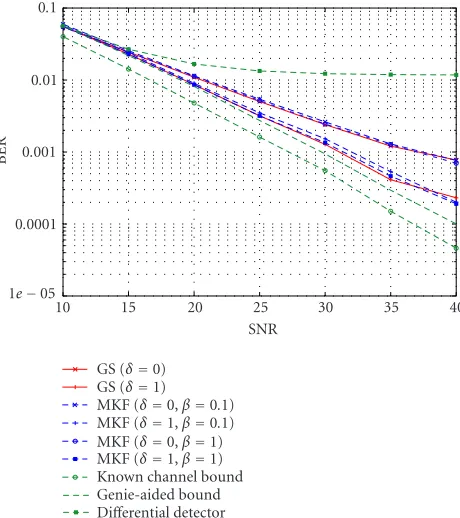
Figure 3shows the BER performance of each receiver ver-sus the SNR. The SNR is defined as var(αt)/var(Vt) and the BER is obtained by averaging the error rate over 106 sym-bols. The first 50 symbols were not taken into account in
1e−05 0.0001 0.001 0.01 0.1
BER
10 15 20 25 30 35 40
SNR GS (δ=0)
GS (δ=1)
MKF (δ=0,β=0.1) MKF (δ=1,β=0.1) MKF (δ=0,β=1) MKF (δ=1,β=1) Known channel bound Genie-aided bound Differential detector
Figure3: BER performance of the GS receiver versus the SNR. The BER corresponding to delaysδ = 0 andδ = 1 are shown. Also shown in this figure are the BER curves for the MKF detector (δ=0 andδ=1), the known channel lower bound, the genie-aided lower bound, and the differential detector. The number of particles for the GS receiver and the MKF detector is 50.
counting the BER. The BER performance of the GS receiver is shown for estimation delaysδ =0 (concurrent estimation) andδ = 1. Also shown are the BER curves for the known channel lower bound, the genie-aided lower bound, the dif-ferential detector, and the MKF detector with estimation de-lays δ = 0 andδ = 1 and resampling thresholdsβ = 0.1 andβ=1 (systematic resampling). The number of particles for both the GS receiver and the MKF detector is set to 50. From this figure, it can be seen that with 50 particles, there is no significant performance difference between the proposed receiver and the MKF detector with the same estimation de-lay and β = 0.1 orβ = 1. Note that, as observed in [16], the performance of the receiver is significantly improved by the delayed-weight method withδ =1 compared with con-current estimate; there is no substantial improvement when increasing further the delay; the GS receiver achieves essen-tially the genie-aided bound over the considered SNR.
0.001 0.01 0.1
BER
0 5 10 15 20 25 30 35 40 45 50
Number of particles GS, RMS :δ=1
SISR, RMS :δ=1,β=1 SISR, RMS :δ=1,β=0.1
Figure4: BER performance of the GS receiver versus the number of particles at SNR=20 dB andδ=1. Also shown in this figure are the BER curves for the MKF detector withβ=0.1 andβ=1.
the same number of particles and a resampling threshold set toβ=1 (systematic resampling). This suggests that, contrary to what is usually argued in the literature [5,16], systematic resampling of the particle seems to be, for reasons which re-main yet unclear from a theoretical standpoint, more robust when the number of particles is decreased to meet the con-straints of real-time implementation.
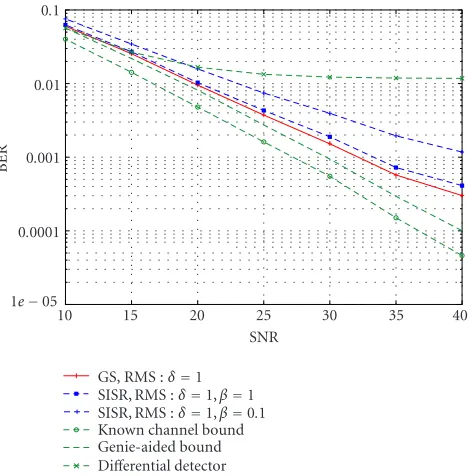
Figure 5shows the BER performance of each receiver ver-sus the SNR when the number of particles for both the GS receiver and the MKF detector is set to 5. For these simula-tions, the BER is obtained by averaging the error rate over 105symbols. From this figure, it can be seen that with 5 par-ticles, there is a significant performance difference between the proposed receiver and the MKF detector with the same estimation delay and a β = 0.1 resampling threshold. This difference remains significant even for SNR values close to 10 dB.Figure 5also shows that, for this particular example, the BER performance of the GS receiver is identical to the BER performance of an MKF with the same estimation delay and a resampling thresholdβset to 1.
5. CONCLUSION
In this paper, a sampling algorithm for conditionally linear Gaussian state-space models has been introduced. This algo-rithm exploits the particular structure of the flow of proba-bility measures and the fact that, at each time instant, a global exploration of all possible offsprings of a given trajectory of indicator variables can be considered. The number of trajec-tories is kept constant by sampling from this set (selection step).
The global sampling algorithm appears, in the example considered here, to be robust even when a very limited num-ber of particles is used, which is a basic requirement for
1e−05 0.0001
0.001 0.01 0.1
BER
10 15 20 25 30 35 40
SNR GS, RMS :δ=1
SISR, RMS :δ=1,β=1 SISR, RMS :δ=1,β=0.1 Known channel bound Genie-aided bound Differential detector
Figure5: BER performance of the GS receiver versus the SNR. The BER corresponding to delayδ = 1 is shown. Also shown in this figure are the BER curves for the MKF detector (δ =1,β=0.1), the known channel lower bound, the genie-aided lower bound, and the differential detector. The number of particles for the GS receiver and the MKF detector is 5.
the implementation of such a solution in real-world appli-cations: the global sampling algorithm is close to the optimal genie-aided bound with as few as 5 particles and thus pro-vides a realistic alternative to the joint channel equalization and symbol detection algorithms reported earlier in the lit-erature.
APPENDIX
MODIFIED STRATIFIED SAMPLING
In this appendix, we present the so-called modified stratified sampling strategy. LetMandNbe integers and (w1,. . .,wM) be nonnegative weights such that Mi=1wi = 1. A sam-pling procedure is said to be unbiased if the random vector (N1,. . .,NM) (whereNiis the number of times the indexiis drawn) satisfies
M
i=1
Ni=N, E[Ni]=Nwi, i∈ {1,. . .,M}. (A.1)
The modified stratified sampling is summarized as follows.
(1) Fori ∈ {1,. . .,M}, compute [Nwi], where [x] is the integer part ofx; then compute the residual number
˜
N=N−M
i=1[Nwi] and the residual weights
˜
wi=Nwi− Nwi
˜
(2) Draw ˜Ni.i.d. random variablesU1,. . .,UN˜ with a uni-form distribution on [0, 1/N] and compute, for˜ k ∈ {1,. . ., ˜N},
˜
Uk= k−˜1
N +Uk. (A.3)
(3) Fori ∈ {1,. . .,M}, set ˜Ni as the number of indices k∈ {1,. . ., ˜N}satisfying
i−1
j=1
wj<Uk˜ ≤
i
j=1
wj. (A.4)
REFERENCES
[1] T. Kailath, A. Sayed, and B. Hassibi,Linear Estimation, Pren-tice Hall, Englewood Cliffs, NJ, USA, 1st edition, 2000. [2] I. MacDonald and W. Zucchini, Hidden Markov and Other
Models for Discrete-Valued Time Series, vol. 70 ofMonographs on Statistics and Applied Probability, Chapman & Hall, Lon-don, UK, 1997.
[3] A. Doucet, N. de Freitas, and N. Gordon, “An introduction to sequential Monte Carlo methods,” inSequential Monte Carlo Methods in Practice, A. Doucet, N. de Freitas, and N. Gordon, Eds., pp. 3–13, Springer, New York, NY, USA, January 2001. [4] C. Carter and R. Kohn, “Markov chain Monte Carlo in
con-ditionally Gaussian state space models,” Biometrika, vol. 83, no. 3, pp. 589–601, 1996.
[5] A. Doucet, S. Godsill, and C. Andrieu, “On sequential Monte Carlo sampling methods for Bayesian filtering,”Statistics and Computing, vol. 10, no. 3, pp. 197–208, 2000.
[6] N. Shephard, “Partial non-Gaussian state space,”Biometrika, vol. 81, no. 1, pp. 115–131, 1994.
[7] J. Liu and R. Chen, “Sequential Monte Carlo methods for dy-namic systems,” Journal American Statistical Association, vol. 93, no. 444, pp. 1032–1044, 1998.
[8] R. Chen and J. Liu, “Mixture Kalman filter,” Journal Royal Statistical Society Series B, vol. 62, no. 3, pp. 493–508, 2000. [9] G. Rigal, Filtrage non-lin´eaire, r´esolution particulaire et
appli-cations au traitement du signal, Ph.D. dissertation, Universit´e Paul Sabatier, Toulouse, France, 1993.
[10] J. Liu and R. Chen, “Blind deconvolution via sequential im-putations,” Journal American Statistical Association, vol. 430, no. 90, pp. 567–576, 1995.
[11] E. Punskaya, C. Andrieu, A. Doucet, and W. Fitzgerald, “Par-ticle filtering for multiuser detection in fading CDMA chan-nels,” inProc. 11th IEEE Signal Processing Workshop on Statis-tical Signal Processing, pp. 38–41, Orchid Country Club, Sin-gapore, August 2001.
[12] V. Zaritskii, V. Svetnik, and L. Shimelevich, “Monte-Carlo technique in problems of optimal information processing,”
Automation and Remote Control, vol. 36, no. 12, pp. 95–103,
1975.
[13] H. Akashi and H. Kumamoto, “Random sampling approach to state estimation in switching environments,” Automatica, vol. 13, no. 4, pp. 429–434, 1977.
[14] J. Tugnait, “Adaptive estimation and identification for discrete systems with markov jump parameters,” IEEE Trans. Auto-matic Control, vol. 27, no. 5, pp. 1054–1065, 1982.
[15] A. Doucet, N. Gordon, and V. Krishnamurthy, “Particle filters for state estimation of jump Markov linear systems,” IEEE Trans. Signal Processing, vol. 49, no. 3, pp. 613–624, 2001. [16] R. Chen, X. Wang, and J. Liu, “Adaptive joint detection and
decoding in flat-fading channels via mixture kalman filter-ing,” IEEE Transactions on Information Theory, vol. 46, no. 6, pp. 2079–2094, 2000.
[17] X. Wang, R. Chen, and D. Guo, “Delayed-pilot sampling for mixture Kalman filter with application in fading channels,” IEEE Trans. Signal Processing, vol. 50, no. 2, pp. 241–254, 2002. [18] E. Punskaya, C. Andrieu, A. Doucet, and W. J. Fitzgerald, “Particle filtering for demodulation in fading channels with non-Gaussian additive noise,”IEEE Transactions on Commu-nications, vol. 49, no. 4, pp. 579–582, 2001.
[19] G. Kitagawa, “Monte Carlo filter and smoother for non-Gaussian non-linear state space models,”Journal of Computa-tional and Graphical Statistics, vol. 5, no. 1, pp. 1–25, 1996. [20] J. Liu, R. Chen, and T. Logvinenko, “A theoretical
frame-work for sequential importance sampling and resampling,”
in Sequential Monte Carlo Methods in Practice, A. Doucet,
N. de Freitas, and N. Gordon, Eds., Springer, New York, NY, USA, 2001.
[21] F. Ben Salem, “R´ecepteur particulaire pour canaux mobiles ´evanescents,” inJourn´ees Doctorales d’Automatique (JDA ’01), pp. 25–27, Toulouse, France, September 2001.
[22] F. Ben Salem,R´eception particulaire pour canaux multi-trajets ´evanescents en communication radiomobile, Ph.D. dissertation, Universit´e Paul Sabatier, Toulouse, France, 2002.
Pascal Cheung-Mon-Changraduated from the Ecole Normale Sup´erieure de Lyon in 1994 and received the Dipl ˆome d’Ing´enieur from the ´Ecole Nationale Sup´erieure des T´el´ecommunications (ENST) in Paris in the same year. After working for General Elec-tric Medical Systems as a Research and De-velopment Engineer, he received the Ph.D. degree from the ENST in Paris in 2003. He is currently a member of the research staff at France Telecom Research and Development.