R E S E A R C H
Open Access
Downlink compressive channel estimation
with support diagnosis in FDD massive
MIMO
Wei Lu
1*, Yongliang Wang
1, Qiqing Fang
1and Shixin Peng
2Abstract
Downlink channel state information (CSI) is critical in a frequency division duplexing (FDD) massive multiple-input multiple-output (MIMO) system. We exploit the reciprocity between uplink and downlink channels in angular domain and diagnose the supports of downlink channel from the estimated uplink channel. While the basis mismatch effects will damage the sparsity level and the path angle deviations between uplink and downlink transmission paths will induce differences in channel supports, a downlink support diagnosis algorithm based on the DBSCAN (density-based spatial clustering of applications with noise) which is widely used in machine learning is presented. With the diagnosed supports of downlink channel in angular domain, a weighted subspace pursuit (SP) channel estimation algorithm for FDD massive MIMO is proposed. The restricted isometry property (RIP)-based performance analysis for the weighted SP algorithm is given out. Both the analysis and the simulation results show that the proposed downlink channel estimation with diagnosed supports is superior to the standard iteratively reweighted least squares (IRLS) and SP without channel priori or with the assumption of the common supports for uplink and downlink channels in angular domain.
Keywords:FDD, Massive MIMO, Support diagnosis, Compressive channel estimation, Weighted subspace pursuit
1 Introduction
Spectrum and radio resources in the forthcoming new communication systems are valuable for efficient trans-mission. Cognitive radio technologies are used for spectrum sensing to reduce the spectrum idle rate, while compressed sensing technologies are applied to improve utilization efficiency of radio resource [1,2]. Compressed sensing (CS) can be applied into a massive multiple-input multiple-output (MIMO) system for efficient transmis-sion. It is crucial to have accurate channel state informa-tion (CSI) at transmitter for downlink beamforming in massive MIMO. In a time division duplexing (TDD) massive MIMO system, downlink CSI can be obtained by exploiting the channel reciprocity from the uplink chan-nel. In frequency division duplexing (FDD) massive MIMO system, downlink CSI feedback is challenging since the training and feedback overhead are proportional to the antenna number at the base station (BS) if the
feedback scheme in LTE is adopted [3]. Motivated by the framework of CS and the sparsity of massive MIMO chan-nel in angular domain also known as spatial domain, ap-plications of CS to massive MIMO channel estimation and feedback have been intensively studied.
In the compressive channel estimation, it can benefit from the CS technology to reduce the training and feed-back overhead and profit from the priori knowledge about the channel support to improve the estimation perform-ance further. The users feed the compressed training mea-surements back to the BS to reduce feedback overhead, and orthogonal matching pursuit (OMP) is used for down-link CSI recovery in [4]. In [5], the modified basis pursuit (MBP) is proposed by utilizing the partial priori signal sup-port information to improve the recovery performance. In [6], Bayesian estimation of sparse massive MIMO channel is developed in which neighboring antennas share among each other their information about the channel support. A weighted CS-based uplink channel estimation is consid-ered in TDD massive MIMO, and the previous estimated channel is used for generating weights for CS recovery in
* Correspondence:[email protected] 1Air Force Early Warning Academy, Wuhan, China
Full list of author information is available at the end of the article
[7]. In [8], the previous channel support is used for the initialization of the estimated support for subspace pursuit. In [9], the authors consider the incorrect indices in the previous support set and exclude them adaptively. From these researches, it can be seen that support priori can im-prove the recovery performance in massive MIMO, and compressive channel estimation can benefit from support priori by channel reciprocity in TDD system.
CS can also be used for channel estimation for FDD massive MIMO system in single-user (SU) scenario and multiple-user (MU) scenario. In single-user scenario, in [10], it makes use of the previous estimated support in-formation and the burst structured sparsity for massive MIMO channel estimation. In [11], it separates the channel vector into a dense vector and a sparse vector and makes use of the previous channel to predict the dense vector by least squares algorithm and applies CS to estimate the sparse vector. In [12], it examines the impacts on the training overhead in FDD downlink channel estimation when previous channel support in-formation is applied into a weighted l1 minimization framework. In multiuser scenario, in [13], it proposes a close-loop pilot and CSIT feedback resource adaptation framework for MU massive MIMO, and the joint spars-ity among users is used for compressive channel estima-tion. In [14], a two-stage weighted blockl1minimization algorithm is proposed for downlink CSI estimation in FDD massive MIMO system, and the priori knowledge that MU channels share common supports is used. In [15], it takes a variational Bayesian inference-based ap-proach for FDD channel estimation, and the partially joint sparsity shared by different users is captured. From the researches above, it can be seen that FDD massive MIMO channel estimation can benefit from the CS framework, and the support information from the previ-ous estimated channel or from the structured sparsity among multiusers can improve the estimation performance.
On the other hand, in the FDD system, the propaga-tion environment is almost the same for the uplink and downlink transmissions in short interval. The number of significant multipaths, path delays, and path angles are almost the same for uplink and downlink [16]. There ex-ists reciprocity for uplink and downlink in massive MIMO in angular domain which can also be used for ef-ficient compressive channel estimation. In [17], it ex-plores the reciprocal channel characteristics of the dominant propagation path in FDD for channel feed-back; however, the CS framework is not adopted. In [18], the joint overcomplete dictionary learning for uplink and downlink is proposed to get better channel estima-tion performance, and the dicestima-tionary learning is based on the assumption that the supports for uplink and downlink are common. It can be seen that reciprocity in
angular domain exists, and the reciprocity can also be used in compressive channel estimation.
From the researches above, it can be concluded that the priori information, such as channel supports among neighboring antennas, or in adjacent time frames, or be-tween uplink and downlink, can all improve the channel estimation performance. However, most of them rarely consider the basis mismatch effects which will deterior-ate the sparsity. In [19], a sparsity-enhancing algorithm is discussed for compressive estimation of doubly select-ive multicarrier channels, while the leakage effect is dis-cussed but not for massive MIMO. It is not practical to assume the common supports for uplink and downlink channels in the FDD system. On the other hand, the reciprocity for massive MIMO uplink and downlink channel in the angular domain is not discussed adequately.
In this paper, we present an efficient channel estima-tion algorithm in massive MIMO FDD system. Specially inspired by priori knowledge of channel reciprocity in angular domain for uplink and downlink channels, we propose a weighted SP channel estimation with the diag-nosed supports from the uplink channel. Moreover, the impacts on the sparsity caused by basis mismatch and angle deviation in massive MIMO are discussed. Ac-cording to [20], the radio paths are arriving in clusters with angle spread. By utilizing the cluster properties, we apply the DBSCAN algorithm (density-based spatial clustering of applications with noise) to extract the sup-port information of the uplink channel, and a DBSCAN-based support diagnosis algorithm is proposed to get the probable support of downlink channel, then a weighted subspace pursuit channel estimation is presented.
The contributions of the paper are listed as follows:
A channel support diagnosis algorithm based on DBSCAN is proposed, in which the reciprocity between uplink and downlink channels in angular domain is used.
A weighted SP algorithm is proposed for massive MIMO channel estimation, and the RIP-based performance analysis for weighted SP is proposed, which shows the superiority of the weighted SP compared with the standard SP.
Notation: ATis a matrix composed of the columns of
the matrix A of the set T. Tc symbolizes the complementary set of T. resid(·) is the residue vector after projection operation, for example,resid(y,A) =y−
AA†y, where A†is the pseudoinverse of the matrixA. δ
k
is the parameter fork-RIP condition.
2 System model
We consider a scenario of a single user in massive MIMO FDD and assume the BS is equipped withN an-tennas and the user terminal (UT) has a single antenna. For the uplink channel estimation, the uplink training received by the BS can be written as
yu¼pffiffiffiffiffiρuhuaþnu ð1Þ
where hu∈ℂN× 1 is the uplink channel, a∈ℂ1Tu
is the
uplink pilots, Tu is the pilot length, ρu is the uplink
received power, nu∈ℂNTu
is the received noise with each element to be i.i.d Gaussian with mean 0 and varianceσ2, andyu∈ℂNTu
is the received signal at BS.
For the downlink channel estimation in the FDD sys-tem, the BS transmits the pilots to UT. The UT receives the pilots and feeds the received signal back to the BS directly as in [21]. The received signalydat the UT can
the downlink pilots, Td is the pilot length, ρd is the
downlink received power,nd∈ℂTd1
is the received noise with each element to be i.i.d Gaussian with mean 0 and varianceσ2, andyd∈ℂTd1
is the received signal at UT.
Since the massive MIMO channel exhibits spatial sparsity in angular/spatial domain, CS can be applied to the compressive channel estimation with much less mea-surements which means thatTd<N. In the compressive channel estimation, the uplink channel estimation in (1) can be represented as
channel,hua is the sparse spatial representation withhu¼
Duhu
a, and ^h u
a is the estimated uplink channel in the
spatial domain. Similarly, the downlink channel
estimation in (2) can be represented as
^
downlink channel, hda is the sparse representation with
hd¼Ddhd a, and ^h
d
a is the estimated downlink channel in
the spatial domain.
In most existing literature problems, (3) and (4) are solved separately. A more effective method is to solve (3) and (4) jointly. Channel support refers in particu-lar to the set comprised by the locations of nonzero elements of channel representation in the angular/ spatial domain in this paper. In [18], it is assumed that hua and hda have the same supports and get the sparse solutions h^ua, ^hda and the dictionary matrices
Du,Dd iteratively. The uplink and downlink channel
estimation benefits from the joint dictionary learning. However, the assumption of common supports of hua and hda is not practical because of basis mismatch and angle deviation between uplink and downlink. In the following, we will discuss the partial common supports of hua and hda based on the reciprocity in angular domain in massive MIMO channel and then propose a support diagnosis algorithm which can provide support priori information for compressive channel estimation.
3 Channel supports in massive MIMO spatial channel
We discuss the basis mismatch and leakage effects on the support in massive MIMO spatial channel first and then take the angle deviation between up-link and downup-link into considerations for support analysis.
3.1 Mismatch of MIMO channel basis
In massive MIMO, the dominant physical paths between the transmitter and the receiver are relatively small com-pared to the number of antennas. For example, in the proposed channel model in the report 3GPP TS36.900 [12], the number of dominating physical path is six. So there is channel sparsity in angular domain. Similarly, as we did in [22], the massive MIMO channel can be given by
H¼Xpi¼1aierðΩriÞetðΩtiÞH ð5Þ
where H is the physical channel model of MIMO, ai is
the attenuation of the ith path, and θti and θri are the
angle of departure and the angle of arrival (Ωti:=cosθti,
Ωri:=cosθri), respectively; er and et are the steering vec-tors of the receiving and transmitting antenna arrays, re-spectively, and are given by
erð ÞΩ≔
wherediandβiare the distance and large scale fading of
theith path, respectively, andΔr andΔtare the
normal-ized separation at the receiving and transmitting antenna
arrays by the wavelength λc of the transmitted signal,
respectively.
We formulate the uplink and downlink channel basis matrices as in [22]: MIMO channel can represented as
H0¼UH
rHUt ð11Þ
where H′ is the MIMO channel in the angular/spatial
domain. Then, the (kth,lth) entry in channel matrix H′
there are leakage effects on the entries of H′; then, we have
where the second part of (15) is the leakage effects of
other paths. If the angle of departure (AOD) and angle of
arrival (AOA) of the paths are integer multiples of 1/Lr
and 1/Lt, most of the entries of channel matrix in angular/
spatial domain are 0. Otherwise, some entries of chan-nel matrix in angular/spatial domain are not 0 be-cause of the leakage effect even though there are no paths in the corresponding directions of the entries in channel matrix. It should be noticed that in the paper, the UT is equipped with single antenna; how-ever, the analysis is also valid.
3.2 Support difference between uplink and downlink massive MIMO channel
In [23], it is assumed that the propagation environment is static during uplink-downlink transmissions in FDD; hence, the same multipaths, UE positions, and DOA for uplink are also valid for downlink; however, the assump-tion is not always valid in practical scenarios. As shown in Fig. 1, the DOA and AOA for uplink and downlink channels are not exactly the same but with some devia-tions. Based on the analysis of channel basis mismatch, the supports of uplink and downlink spatial channels are not exactly the same as shown in Fig. 1. However, the probable support of downlink channel can be inferred from the uplink channel, which we call support diagno-sis in the paper.
In the practical scenario, the angle of transmission path for uplink and downlink will change slightly be-cause of UE movement and environment change. On the other hand, in the spatial channel model in 3GPP TS36.900 report, it assumes that there are six paths, but it demonstrates that the mean angle spread is 5° in sub-urban macrocell. Hence, it is practical to assume that the channel supports for uplink and downlink are par-tially common because of the angle deviation between uplink and downlink. Next, we will discuss the effects of angle deviation for uplink and downlink transmission on the channel supports.
Property 1: If the angle deviation for one path in up-link and downup-link isΔat BS as shown in Fig.1, the de-viation of the support center is bounded by Lrpffiffiffiffiffiffiffiffiffiffiffiffiffiffiffiffiffiffiffi2−2cosΔ.
Proof: If we consider the angle difference for one transmission path and the AOA in the uplink at the BS isΩti:=cosθti, the DOA in the downlink at the BS isΩri:
=cosθri. In a practical scenario,θtiand θri are not equal
and with the differenceΔ. Then, we have
position change of the support center will be ⌈|cosθri−
cosθti|/(1/Lr)⌉and can be bounded as
cosθri−cosθti
j j=ð1=LrÞ≤Lrpffiffiffiffiffiffiffiffiffiffiffiffiffiffiffiffiffiffiffi2−2cosΔ ð18Þ
■
From property 1, it can be seen that support position is related to the antenna array size Lr. The deviation of the support center is shown as Fig. 2b. In the following, we discuss the sparsity deterioration because of basis mismatch.
Property 2: The path angle arriving at the BS isθ, and
Ω= cosθ. The channel basis matrices are defined as (9) and (10). If path angle Ω¼i
.
Lr, i∈[1,⋯,N], then in the spatial channel, only the (i+ 1)th element is nonzero and there is not energy leakage; otherwise Ω¼k.
Lr
þΩ0,
k∈[1,⋯,N] andjΩ0j≤1
.
2Lr, then there is energy
leakage to the neighborhood elements in the spatial channel, and at most a percentage of 1
.
πðΔk−1Þ of the energy is outside a region comprised by [k−Δk,⋯,k,
⋯,k+Δk] in the spatial channel. Proof: ForΩ¼i.
Lr, there is no energy leakage which has been discussed in the previous section. Now, we considerΩ¼k
.
LrþΩ
0 and analyze the energy leakage
to the (k′+ 1)th atom in the channel basis. We define
ΔΩ=Ω−k′/Lr=Ω′+k/Lr−k′/Lr=Ω′+Δk/Lr, Δk=k−
k′, and we have
frð Þ ¼ΔΩ frðΩ−k0=LrÞ ¼erð ÞΩ Herðk0=LrÞ
¼ 1
Nr
expðjπΔrΔΩðNr−1ÞÞ sinðNrπΔrΔΩÞ
sinðπΔrΔΩÞ
ð19Þ
The absolute value offr(ΔΩ) is given by Fig. 1Angle deviation and sparsity in spatial channel
frð ÞΔΩ
j j ¼jfrðΩ0þΔk0=LrÞj
¼ 1
Nr
sinðπLrðΩ0þΔk0=LrÞÞ
sinðπLrðΩ0þΔk0=LrÞ=NrÞ
ð20Þ
LetΓ2k0þ1¼ jfrðΩ0þΔk0=LrÞj2, we have
Γ2 k0þ1¼
1
N2 r
sin2ðπLrðΩ0þΔk0=LrÞÞ
sin2ðπLrðΩ0þΔk0=LrÞ=NrÞ ð21Þ
By utilizing the cyclic symmetry of Γ2
k0þ1, the sum
leakage energy which is outside the region comprised by [k−Δk,⋯,k,⋯,k+Δk] in the spatial channel are given by
Γ2
Δkþ:::þΓ2Nr−Δk ¼
2
N2 r
X
Nr=2
i¼Δk
sin2ðπLrðΩ0þi=LrÞÞ
sin2 πLr Ω
0þ
i=Lr
ð Þ
Nr
≤ 2 N2r
X
Nr=2
i¼k
1
sin2 πLrðΩ0þi=LrÞ Nr
≤ 2 N2r
Z Nr=2
Δk−1
di
sin2 πLri
Nr
¼π2
Nr
cotðπðΔk−1Þ=NrÞ
ð Þ
≤π Δ1k−
1
ð Þ
ð22Þ
SincePNi¼1Γ2i ¼1 by the Parseval theory, property 2 is proofed.■
From property 2, it can be seen that although there ex-ists energy leakage because of basis mismatch, most of the energy is allocated around the support correspond-ing to the angle direction, and the leakage energy de-creases in the rate ofπðΔ1k−1Þ.
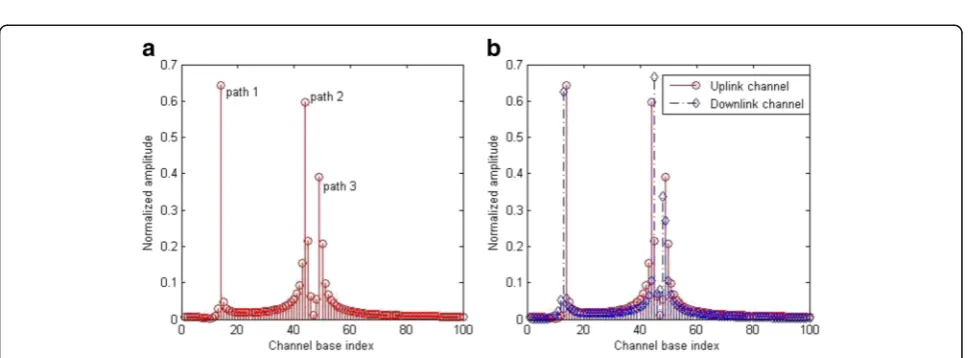
To illustrate these properties, we assume that the an-tenna number is 100; there are only three dominant paths. In Fig.2, it can be seen that the channel basis index or so-called the channel taps in the spatial domain are located in cluster. If the channel basis matches the channel angle perfectly, the sparsity is relatively good such as path 1 in Fig.2a; otherwise, the sparsity deteriorates such as path 2 and path 3. Meanwhile, if the angles of two paths are close, the amplitudes of the channel taps in spatial domain for them are superpositioned because of the leakage ef-fects. In the ideal assumption, the AOA and DOA for up-link channel and downup-link channel are common, but in the practical scenario, they are not the same. We assume the angle deviation for one path in uplink and downlink is within 5° randomly as [20,24]; then, as shown in Fig.2b, it can be seen that the channel taps or channel supports for uplink and downlink in the spatial domain change slightly and are partially common as property 1. In the
following, we will utilize these properties for downlink spatial channel support diagnosis.
4 Proposed methods
In this section, the support diagnosis algorithm is first proposed based on the reciprocity in angular domain for uplink and downlink channels; then, the downlink massive MIMO channel estimation algorithm based on the diagnosed support is proposed.
4.1 Channel support diagnosis algorithm
In this subsection, we propose the channel support diag-nosis algorithm based on the analysis of basis mismatch and support difference between the downlink channel and uplink channel. Although the AOA and DOA for uplink and downlink are not exactly the same, the multipath number is common for uplink and downlink. Inspired by the clustering property of channel support in spatial do-main, for example, there are three clusters in Fig. 2b, we apply the DBSCAN (density-based spatial clustering of ap-plications with noise) algorithm to extract the multipath information in the spatial domain. Then, we infer the probable channel supports of downlink channel. The de-tails of the support diagnosis algorithm are presented in Algorithm 1.
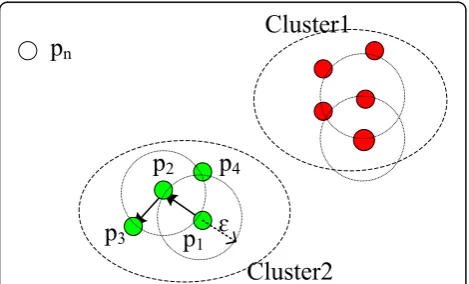
algorithm. The DBSCAN algorithm is a data clustering algorithm proposed by Martin Ester which is widely used in machine learning [25]. It is a density-based clus-tering algorithm in which it groups together points that are closely allocated and marks those as outlier points which lie in low-density regions. In DBSCAN algorithm, the points are classified as core points, density reachable points, and outliers. A pointpis a core point if at least minPts points are within distance ε, and ε is the max-imum radius of the neighborhood from p. A point q is reachable from pif there is a path p1, ..., pn with p1=p andpn=q, where eachpi+ 1is directly reachable frompi.
Ifpis a core point, then it forms a cluster together with all points that are reachable from it. For example, in Fig.
4, p3 is reachable from p1, and p1, p2, p3, and p4 are comprised as cluster 2. The detailed algorithm can be found in [26].
By step S1, we can capture the multipaths in most conditions by DBSCAN except if the channel basis matches the path angle well or the leakage channel taps are not selected, for example, only one channel tap alone for the path is selected such as path 1 in Fig.2a; then, by DBSCAN algorithm, this alone channel tap will be omit-ted because it is in the low-density region such as point pn in Fig. 3 which is the inherent characteristic of
DBSCAN. In order to avoid this situation, we add these channel supports manually in step S2. In this way, we can capture most of the channel supports and get the multipath information.
In the spatial channel, each path is corresponding to one cluster set. If the channel basis matches the path angle well, then there is no energy leakage, and the corresponding cluster set has only one element; otherwise, there are multiple elements in the cluster set. In step S3, we estimate the central support for each path by averaging the index value of each cluster set. For example, in Fig. 2a, the central support is 44 for path 2.
In step S4, we consider how to get the probable sup-port of the downlink channel from the uplink channel support. If we consider the angle deviation between up-link and downup-link, the change of channel tap index is within about Lrpffiffiffiffiffiffiffiffiffiffiffiffiffiffiffiffiffiffiffi2−2 cosΔ as property 1. If the an-tenna number is 100 and anan-tennas are half-wave allo-cated, thenLr= 50. If the angle deviation is about 5°, the
channel index deviation is about ± 4.36. From the leak-age effect analysis in the previous section, at most a per-centage of 1
.
πðΔm−1Þ of the energy is located outside a rectangular neighborhood of the central channel sup-port with interval of ±Δm. For example, if we consider about 90% energy, thenΔm= 4.
We can diagnose the downlink channel supports in step S4 based on the uplink channel support informa-tion. The diagnosis procedure is as follows: firstly, we find the multipath number and the center support index pi of each path in the spatial domain; then, taking the
angle deviations into account, it can be inferred that the center support index of each path change is within the range of½pi−Lr
ffiffiffiffiffiffiffiffiffiffiffiffiffiffiffiffiffiffiffi
2−2cosΔ
p
;piþLr
ffiffiffiffiffiffiffiffiffiffiffiffiffiffiffiffiffiffiffi
2−2cosΔ
p
; following, taking the basis mismatch effect and 90% energy criter-ion into consideratcriter-ion, the probable support index is within the range of ½pi−Lr
ffiffiffiffiffiffiffiffiffiffiffiffiffiffiffiffiffiffiffi
2−2 cosΔ
p
−Δm;⋯;piþLr
ffiffiffiffiffiffiffiffiffiffiffiffiffiffiffiffiffiffiffi
2−2cosΔ
p
þΔm; then, we can get the probable down-link channel support set.
4.2 Compressive downlink channel estimation with support priori
Firstly, the BS utilizes CS recovery algorithm for the uplink channel estimation, and UT feeds back the received pilot signal to the BS. At the BS, the chan-nel support diagnosis procedure is carried out as Al-gorithm 1. In order to integrate the support diagnosis information of downlink channel into the CS algorithm, we assign a weighting matrix W= diag([w1,⋯,wN]) based on the diagnosed support
in-formation. The weights are given by
w ið Þ ¼ fw1¼1;ifi∈Ωd
w2¼σ;ifi∉Ωd ð
23Þ
where 0 <σ< 1 is the penalty parameter and Ωd is the
estimated downlink spatial channel support set. In the paper, we merge the weighting matrix into the subspace pursuit (SP) algorithm, and the details for the modified SP with support priori are presented in Algorithm 2. Compared with the standard SP, the main difference is the candidate support selection in
step S1. In the standard SP, the n′ largest magnitude
entries are selected in the vector AHVk−1, while in
the proposed weighted SP algorithm, the weighting
matrix W takes into consideration which contains the
priori information from uplink channel. It should be noted that the diagnosed support information can be
merged into other CS recovery algorithms
equivalently.
5 RIP-based performance analyses
In this section, we study the RIP-based performance of the proposed algorithm. The basic idea for the analysis mainly stems from Dai and Milenkovic in [27] but is with the consideration of the weights in (23). Compared with the standard SP algorithm, the main difference in the proposed algorithm is the support updating step (S1) in Algorithm 2. In the following, for brevity yd is
de-noted asyandhda is denoted ash.
The following analysis uses several propositions from [27]. We bring these in this subsection first to keep the analysis complete. According to the definition of residue vector ofVk−1, we can get
is according to the definition of residual. The fifth line
in (24) is according to the definition of projection. One
can write estimated support during the (k −1)th iteration in step (S3) of Algorithm 2.
and Γk are the support sets during the kth iteration in steps S1 and S3 of Algorithm 2, respectively.
In step S4 of Algorithm 2, the residue vector is calcu-lated after the new support set is obtained in step S2. The residue vector is shown as (24). Proposition 1 and 2 give out the inequalities that hT−Γk−1 and hp;Γk−1 in (24)
will satisfy. Since in our proposed algorithm only step S1 is different from the standard SP, propositions 1 and 2 can be applied directly. Then, we will consider the im-pacts of step S1 only on the estimation error.
Theorem 3: By using the weighing matrixW in (23), the proposed SP solution at thelth iteration satisfies the inequality as
Proof: According to the definition of Ω in S1 in Algorithm 2, then
Removing the common columns betweenΩ and T on both sides of (25) and applying kresidðn;AΓk−1Þk2≤knk2
from the definition of residue operation, we arrive at
WΩ−TAHΩ−TVk−1
The second line of (26) is from the triangle inequality and the expression of Vk−1. The third line is from the
definition ofW in (23) and RIP property. On the other hand, by applying the triangle inequality, we have
WΩ−TAHΩ−TAT∪Γk−1hr;k−1
where T^ is the diagnosed support set and the weight is
given by (23). Similarly, we have
WT−ΩAHT−ΩAT∪Γk−1hr;k−1
where the second line in (30) is according to step S1 in
Algorithm 2 and the third line is according to Algo-rithm 1 and RIP properties.
Combining (29) and (30) into (28), we can get
where the second line in (32) is obtained by using
proposition 1. Note that Vk−1¼AT∪Γk−1hr;k−1þresid
Combining proposition 2 with (33), we complete the proof.■
In the standard SP algorithm as shown in [27], at the lth iteration it satisfies
hT−Γk
As in the weighting matrix (23),
ffiffiffiffiffiffiffiffiffiffiffi proposed algorithm can converge faster than the stand-ard SP and have better estimation accuracy. Whenδ3k=
0.083 as required in [27] and assuming w1=w2= 1 for the worst case, in our proposed algorithm, we have
khT−Γkk2≤0:164khT−Γk−1k
2þ5:152knk2 while in the
standard SP khT−Γkk2≤0:232khT−Γk−1k2þ5:152knk2 .
When σ= 0.1 in the proposed algorithm, we have
khT−Γkk2≤0:117khT−Γk−1k2þ5:152knk2. In this way, our
proposed algorithm converges faster than the standard SP and has better recovery performance. In other words, the restriction of δ3k is weakened in the proposed
algo-rithm. The performance improvement can be explained by that the SP algorithm can benefit from the priori sup-port information.
6 Simulation results
In this section, simulations are carried out to evaluate the performance of the proposed downlink channel estima-tions with priori information. The BS is equipped with 100 antennas, and the UT is equipped with a single an-tenna. The channel model is generated according to spatial MIMO channel in 3GPP TS36.900. The same SNR is assumed for both uplink and downlink. Since we focus on the impacts of the priori information on the perform-ance of downlink channel estimation, the gain of multiple pilots in uplink channel is not discussed, and the pilot length is set to 1. The estimation accuracy of uplink chan-nel can benefit from the increase of pilot number.
the leakage effect, and the slight deviation of AOA and DOA for uplink and downlink.
In Fig.5, the penalty valueσin the weighting matrix is 0.1. We compare the performance of the downlink chan-nel estimation with different pilot lengths. It can be seen that with the increase of the downlink pilot length, the MSE performance for the four algorithms ((1) SP algo-rithms with no priori information as done in [4,14], (2) weighted SP with the same supports as uplink in [18],
(3) weighted SP with the proposed diagnosed supports, and (4) standard iteratively reweighted least squares (IRLS) in [28]) are all improved which are in accordance with the results in the CS theory. The proposed recovery algorithm with diagnosed support has the best recovery performance and has higher MSE improvement gain by pilot increasing in the high-SNR region.
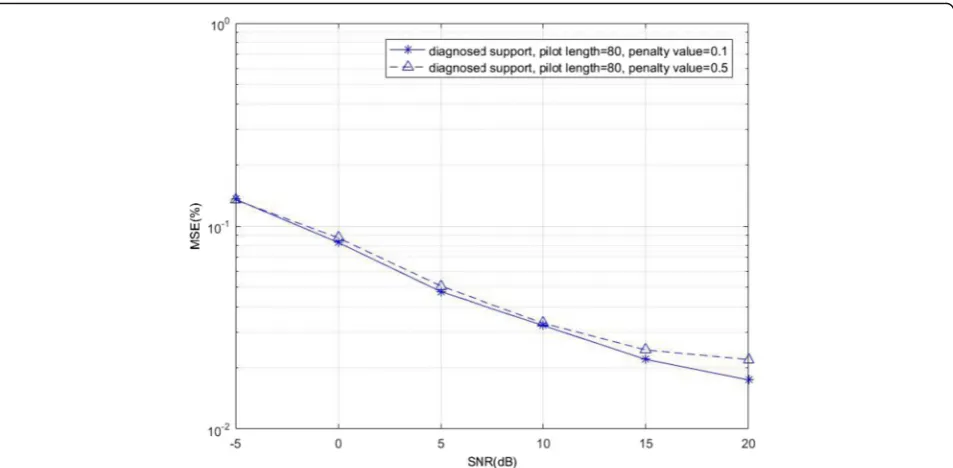
In Fig. 6, we compare the performance of downlink channel estimation with different penalty values in
Fig. 4MSE performance of the weighted SP recovery based on the diagnosed supports
weighting matrix in the proposed support diagnosis al-gorithm. It can be seen that weighting matrix with smaller penalty value in the proposed algorithm has bet-ter performance especially in the high-SNR region.
From the simulation results, above it can be con-cluded that (1) the uplink channel can offer support information for downlink channel estimation. The support information is useful for the downlink chan-nel recovery. (2) The assumption of common support for downlink and uplink channels is not practical. The estimation accuracy will deteriorate if the sup-port difference is ignored. The proposed supsup-port diag-nosis algorithm considers the basis mismatch and angle deviation for uplink and downlink which can improve the downlink channel estimation further. (3) The weighting matrix value is important for the pro-posed weighted SP algorithm; smaller penalty value in weighting matrix is preferred especially in the high-SNR region. In brief, the proposed support diagnosis algorithm is sufficient and beneficial for the downlink compressive channel estimation.
7 Conclusions
In this paper, we propose a downlink compressive chan-nel estimation based on weighted SP for FDD massive MIMO systems, and the weighted SP makes use of the priori support information to improve the estimation performance. The reciprocity between uplink and down-link channels in angular domain is used for diagnosing the support priori information of downlink channel. The proposed support diagnosis algorithm considers the
basis mismatch, leakage effect, and angle deviation for uplink and downlink channels and applies the DBSCAN algorithm used in machine learning to the channel sup-port diagnosis. RIP-based analysis shows a better conver-gence and error performance of the proposed algorithm compared with the standard SP. Simulation results verify that the proposed algorithm improves the downlink channel estimation accuracy compared to the IRLS, the SP algorithm which does not utilize the uplink priori in-formation, and the weighted SP which assumes that the downlink and uplink channels have common supports.
Abbreviations
AOA:Angle of arrival; AOD: Angle of departure; BS: Base station; CS: Compressed sensing; CSI: Channel state information; DBSCAN: Density-based spatial clustering of applications with noise; FDD: Frequency division duplexing; IRLS: Iteratively reweighted least squares; LTE: Long-term evolution; MBP: Modified basis pursuit; MIMO: Multiple-input multiple-output; MU: Multiple user; OMP: Orthogonal matching pursuit; RIP: Restricted isometry property; SP: Subspace pursuit; SU: Single user; TDD: Time division duplexing; UT: User terminal
Acknowledgements
This work is supported in part by the National Science Foundation of China (No.61601509) and the China Postdoctoral Science Foundation Grant (No.2016M603045). Thanks for the reviewers’comments.
Funding
The National Science Foundation of China (Grant No.61601509) and the China Postdoctoral Science Foundation (Grant No.2016M603045) are supporting the simulations and data analyses.
Authors’contributions
All authors discussed the experiments; WL performed the experiments and wrote the paper. YW, QF and SP have made some useful comments on the paper. All authors have read and approved the final manuscript.
Authors’information
Wei Lu received a Ph.D degree in communications and information system from Huazhong University of Science and Technology, China, in 2013. Now, he is a lecturer in the Air Force Early Warning Academy in China. His current research interests focus on compressed sensing and signal processing. Yongliang Wang received a Ph.D degree in signal processing from Xidian University, China, in 1994. Now, he is a professor in the Air Force Early Warning Academy in China. His current research interests focus on STAP. Qiqing Fang is an associate professor in the Air Force Early Warning Academy in China. His current research interests focus on operations research and management. Shixin Peng received a Ph.D degree in communications and information system from Huazhong University of Science and Technology, China, in 2015. Now, he is a postdoctor in Central China Normal University. His current research interests focus on wireless communications and signal processing.
Competing interests
The authors declare that they have no competing interests.
Publisher’s Note
Springer Nature remains neutral with regard to jurisdictional claims in published maps and institutional affiliations.
Author details
1Air Force Early Warning Academy, Wuhan, China.2National Engineering
Research Centre for E-Learning, Central China Normal University, Wuhan, China.
Received: 18 December 2017 Accepted: 26 April 2018
References
1. X Liu, F Li, ZY Na, Optimal resource allocation in simultaneous cooperative spectrum sensing and energy harvesting for multichannel cognitive radio. IEEE Access5, 3801–3812 (2017)
2. G Wunder, H Boche, T Strohme, P Jung, Sparse signal processing concepts for efficient 5G system design. IEEE Access3, 195–208 (2015)
3. L Lu, GY Li, AL Swindlehurst, A Ashikhmin, R Zhang, An overview of massive MIMO: benefits and challenges. IEEE J. Sel. Topics Signal Process.8(5), 742– 758 (2014)
4. X Rao, VKN Lau, Distributed compressive CSIT estimation and feedback for FDD multi-user massive MIMO systems. IEEE Trans. Signal Process.62(12), 3261–3271 (2014)
5. N Vaswani, W Lu, Modified-CS: modifying compressive sensing for problems with partially known support. IEEE Trans. Signal Process.58(9), 4595–4607 (2010)
6. M Masood, LH Afify, TY Al-Naffouri, Efficient coordinated recovery of sparse channels in massive MIMO. IEEE Trans. Signal Process.63(1), 104–118 (2015) 7. Y Nan, L Zhang, X Sun, Weighted compressive sensing based uplink
channel estimation for time division duplex massive input multi-output systems. IET Commun.11(3), 355–361 (2017)
8. Y Nan, L Zhang, X Sun, Efficient downlink channel estimation scheme based on block-structured compressive sensing for TDD massive MU-MIMO systems. IEEE Wireless Commun. Lett.4(4), 345–348 (2015)
9. X Rao, V Lau, Compressive sensing with priori support quality information and application to massive MIMO channel estimation with temporal correlation. IEEE Trans. Signal Process.63(18), 4914–4924 (2015) 10. A Liu, VKN Lau, W Dai, Exploiting burst-sparsity in massive MIMO with
partial channel support information. IEEE Trans. Wirel. Commun.15(11), 7820–7830 (2016)
11. YH Han, JW Lee, DJ Love, Compressed sensing-aided downlink channel training for FDD massive MIMO systems. IEEE Trans. Commun.65(7), 2852– 2862 (2017)
12. JC Shen, J Zhang, E Alsusa, KB Letaief, Compressed CSI acquisition in FDD massive MIMO: how much training is needed? IEEE Trans. Wirel. Commun.
15(6), 4145–4156 (2016)
13. A Liu, F Zhu, VKN Lau, Closed-loop autonomous pilot and compressive CSIT feedback resource adaptation in multi-user FDD massive MIMO systems. IEEE Trans. Signal Process.65(1), 173–183 (2017)
14. CC Tseng, J Y Wu, T S Lee, 2016 IEEE 27thAnnual IEEE International
Symposium on Personal, Indoor and Mobile Radio Communications.
Compressive downlink CSI estimation for FDD massive MIMO systems: a weighted block L1-minimization approach (2016)
15. X Cheng, J Sun, S Li, Channel estimation for FDD multi-user massive MIMO: a variational Bayesian inference-based approach. IEEE Trans. Wirel. Commun.
16(11), 7590–7602 (2017)
16. K Hugl, K Kalliola, J Laurila, inProc. COST 273 Technical Document TD. Spatial reciprocity of uplink and downlink radio channel in FDD systems, vol 66 (2002), p. 7
17. U Ugurlu, R Wichman, CB Ribeiro, C Wijting, A multipath extraction-based CSI acquisition method for FDD cellular networks with massive antenna arrays. IEEE Trans. Wirel. Commun.15(4), 2940–2953 (2016)
18. Y Ding, B D Rao, in IEEE Global Conference on Signal and Information Processing, Channel estimation using joint dictionary learning in FDD massive MIMO system(2015), 185-189
19. G TaubÖck, F Hlawatsch, D Eiwen, H Rauhut, Compressive estimation of doubly selective channels in multicarrier systems: Leakage effects and sparsity-enhancing processing. IEEE J. Sel. Topics Signal Process.4(2), 255– 271 (2010)
20. Universal Mobile Telecommunications System(UMTS): spatial channel model for Multiple Input Multiple Output(MIMO) simulations (3GPP, TS 36.900 Release 14) (2017),http://www.3gpp.org
21. A Liu, FB Zhu, VKN Lau, Close-loop autonomous pilot and compressive CSIT feedback resource adaption in multi-user FDD massive MIMO systems. IEEE Trans. Signal Process.65(1), 173–183 (2017)
22. W Lu, Y Z Liu, D S Wang, 2011 2nd International Conference on Wireless VITAE, Compressed sensing in spatial MIMO channels (2011)
23. G Xu and H Liu, Proc. Int. Conf. Acoust. Speech Signal Process., An effective transmission beamforming scheme for frequency-division-duplex digital wireless communication systems (1995), 1729–1732
24. AF Molisch, A Kuchar, J Laaurila, et al., Geometry-based directional model for mobile radio channels principles and implementation. Eur. Trans. Telecommun.14(4), 351–359 (2003)
25. M Ester, H P Kriegel, J Sander, X Xu, et al., Proceedings of the Second International Conference on Knowledge Discovery and Data Mining (KDD-96). A density-based algorithm for discovering clusters in large spatial data basis with noise (1996), 226–231
26. E Schubert, J Sander, M Ester, et al., DBSCAN revisited, revisited: why and how you should (still) use DBSCAN. ACM Trans. Database Syst.42(3), 1–21 (2017)
27. W Dai, O Milenkovic, Subspace pursuit for compressive sensing signal reconstruction. IEEE Trans. Inf. Theory55(5), 2230–2249 (2009)