Forward-Secure Signatures with Fast Key Update
Anton Kozlov
Leonid Reyzin
Boston University Computer Science111 Cummington St Boston MA 02215 USA {akozlov,reyzin}@cs.bu.edu
August 1, 2002
Abstract
In regular digital signatures, once the secret key is compromised, all signatures, even those that were issued by the honest signer before the compromise, will not be trustworthy any more. Forward-secure signatures have been proposed to address this major shortcoming.
We present a new forward-secure signature scheme, called KREUS, with several advantages. It has the most efficient Key Update of all known schemes, requiring just a single modular squar-ing. Our scheme thus enables more frequent Key Update and hence allows shorter time periods, enhancing security: fewer signatures might become invalid as a result of key compromise. In addition, the on-line component of Signing is also very efficient, consisting of a single multiplica-tion. We precisely analyze the total signer costs and show that they are lower when the number of signatures per time period is small; the advantage of our scheme increases considerably as the number of time periods grows.
Our scheme’s security relies on the Strong-RSA assumption and the random-oracle-based Fiat-Shamir transform.
1
Introduction
1.1
Prior work
The notion of forward-secure signatures was introduced in 1997 by Anderson [And97] to remove a serious limitation of regular digital signatures: once the secret key is lost (or stolen), all documents previously signed with that key become invalid. To reduce the damage, Anderson proposed to divide the validity time of a key pair into time periods. At the end of each time period, the signer derives the new secret key from the current one in a one-way fashion, and then securely erases the no-longer-needed current secret key. The public key, in contrast, remains unchanged during the life span of the key pair. This general approach ensures validity of all documents signed prior to the time period of compromise.
forward-secure signature schemes were developed. The development has followed two paths: one was based on modifying specific, Fiat-Shamir-like, signature schemes, while the other used any ordinary signature scheme as a black box. Our scheme belongs to the first category, in which two other schemes (in addition to the one of [BM99]) are known. Abdalla’s and Reyzin’s scheme [AR00] is based on modifying Ong-Schnorr signatures [OS90], and shortens the secret and public keys of the Fiat-Shamir-based scheme of [BM99] (at the expense of Signing and Verifying time). Itkis’ and Reyzin’s scheme [IR01] is based on modifying Guillou-Quisquater [GQ88] signatures, and results in both short keys and efficient Signing and Verifying. We summarize the relevant performance attributes of these schemes in Table 1.
We note that forward-secure signature schemes in the second category (the ones using any ordinary signature scheme as a black box) are competitive, as well. Krawczyk’s scheme [Kra00] is based on generating all of the certificates in advance in a pseudorandom manner. The most recent work by Malkin, Micciancio and Miner [MMM02] modifies the tree-based scheme of Bellare and Miner to achieve greater efficiency and remove the requirement (present in all prior schemes) that the number of time periods be fixed in advance, prior to Key Generation. These schemes are difficult to compare directly with schemes in the first category, because they depend heavily on how the ordinary signature scheme is instantiated. They can outperform schemes in the first category in some (but not all) parameters.
1.2
Our contribution
Our forward-secure digital signature scheme significantly improves the speed of Key Update algo-rithm: it becomes just a single modular squaring of the secret key, which is faster than in all previously known schemes. We therefore call our scheme KREUS for “Kozlov-Reyzin Efficient Update Signa-tures.” Our Signing and Verifying algorithms, although slower than those of some other previous schemes, are also reasonably efficient. In particular, the on-line component of Signing (i.e., the part of the signing algorithm that can be performed only once the message is known) is extremely efficient, requiring less than a single multiplication.
Our key and signature sizes are small, and no extra storage is required. Similarly in spirit (and in technique) to [IR01], at the cost of storing logT extra values and increasing the Update time to logT modular squarings (this still more efficient than all prior schemes), we can improve the speed of the off-line component of Signing, as further detailed in Section 4. This is a surprising and novel application of the techniques of Jakobsson [Jak02] and Coppersmith and Jakobsson [CJ02] for traversing hash sequences.
Our construction was inspired by the work of Song in the area of forward-secure Group Signa-ture schemes [Son01], that in turn is based on the ordinary Group SignaSigna-ture scheme by Ateniese, Camenisch, Joye, and Tsudik [ACJT00]. Since we do not need many features pertinent to group signatures (such as coalition resistance, anonymity, backward unlinkability, traceability, etc.), our scheme is more concise and simpler to implement. All we rely on is the proof of knowledge of Dis-crete Logarithm in a group of unknown size initially proposed by Fujisaki and Okamoto in [FO97].
2
Definitions
2.1
Forward-secure digital signature schemes
The definitions of forward security are taken almost verbatim from [AR00], which in turn follows very closely the definitions of [BM99].
A forward-secure digital signature scheme is, first of all, akey-evolvingdigital signature scheme. A key-evolving signature scheme is very similar to a standard one. Like a standard signature scheme, it has Key Generation, Signing and Verification algorithms. The public key is left unchanged throughout the lifetime of the scheme, making the Verification algorithm very similar to that of a standard signature scheme. Unlike a standard signature scheme, a key-evolving signature scheme has its operation divided into time periods, each of which uses a different (but related) secret key to sign messages. The way these keys are updated is given by a public Key Update algorithm, which computes the secret key for the new time period based on that for the previous time period. The forward security comes, in part, from the fact that this Key Update function is one-way and, given the secret key for the current period, it is hard to compute any of the previously used secret keys. Let us now define more formally what a key-evolving digital signature scheme is and then define what it means for it to be forward-secure.
Definition 1 (Key-evolving signature scheme). A key-evolving digital signature scheme is a quadruple of algorithms, F SIG= (FSIG.key,FSIG.update,FSIG.sign,FSIG.verify), where:
• FSIG.key, the Key Generation algorithm, is a probabilistic algorithm which takes as input a security parameterk ∈N (given in unary as 1k) and the total number of periodsT and returns a pair (SK1, P K), the initial secret key and the public key;
• FSIG.sign, the (possibly probabilistic) Signing algorithm, takes as input the secret keySKj for
the current time period j and the message M to be signed and returns a pair j, sign, the signature of M for time period j;
• FSIG.update, the (possibly probabilistic) Secret Key Update algorithm, takes as input the secret key for the current period SKj and returns the new secret keySKj+1 for the next period;
• FSIG.verify, the (deterministic) Verification algorithm, takes as input the public key P K, a message M, and a candidate signature j, sign, and returns 1 if j, sign is a valid signature of M or 0, otherwise. We require FSIG.verifyP K(M,FSIG.signSK
j(M)) = 1 for every message
M and time period j.
We also assume that the secret keySKj for time periodj ≤T always contains both the valuej itself
and the value T of the total number of periods. Finally, we adopt the convention that SKT+1 is the
empty string and that FSIG.updateSKT returns SKT+1. Since we are going to work in the random
oracle model [BR93], all the above-mentioned algorithms would additionally have oracle access to a public hash function H : {0,1}∗ → {0,1}l for some security parameter l that is known to all the algorithms. The function H is assumed to be random in the security analysis.
To define security, we need to specify the adversary. Besides knowing the user’s public key P K, the adversary also gets to know the total number of time periods T and the current time period j. The adversary runs in three phases (it is allowed to preserve state information between phases). In the first phase, the chosen message attack phase (cma), the adversary has access to a signing oracle, which it can query to obtain signatures of messages of its choice with respect to the current secret key; we designate by qsig the total number of signature queries. The adversary
can also make queries to the random oracle H at any time; we designate by qhash the total number
of H-queries. At the end of each time period, the adversary can choose whether to stay in the same phase or switch to the break-in phase (breakin). In the break-in phase, which models the possibility of a key exposure, we give the adversary the secret key SKj for the specific time periodj
it decided to break in. In the last phase, theforgery phase (forge), the adversary outputs a signature-message pair, that is, a forgery. The adversary is considered to be successful if it forges a signature of some new message (that is, not previously queried to the signing oracle) for some time period prior to j. In order to capture the notion of forward security of a key-evolving signature scheme
FSIG = (FSIG.key,FSIG.update,FSIG.sign,FSIG.verify) more formally, let F be an adversary for this scheme. To assess the success probability of F breaking the forward security of FSIG, consider the following experiment:
Experiment F-Forge-RO(FSIG, F) SelectH: {0,1}∗ → {0,1}l at random (P K, SK1) ←R FSIG.keyH(k, l, T) j ←1
Repeat
d←FH,FSIG.signHSKj(·)(cma, P K)
if (d=breakin)
SKj ←FSIG.updateH(SKj);j ←j + 1;
Until (d=breakin)or (j =T + 1) (M,b, sign)←FH(forge, SKj)
If FSIG.verifyHP K(M,b, sign) = 1 and1≤b < j
andM was not queried by FSIG.signHSKb(·) in period b
then return 1 else return 0
Finally, to define security, let FSIG= (FSIG.key,FSIG.update,FSIG.sign,FSIG.verify) be a key-evolving signature scheme, H be a random oracle and F be an adversary as described above. We now define
Succfwsig(FSIG[k, l, T], F) as the probability that the experimentF-Forge-RO(FSIG[k, l, T], F) returns 1. Then the insecurity of FSIG is the function
InSecfwsig(FSIG[k, l, T], t, qsig,qhash) = max F
Succfwsig(FSIG[k, l, T], F),
where the maximum is taken over all adversaries F making a total of at most qsig queries to the
signing oracle across all the stages and for which the running time of the above experiment is at most t and at most qhash queries are made to the random oracle H. The smaller the insecurity
2.2
Strong-RSA Assumption
We use essentially the same Strong-RSA assumption as [IR01], and hence quote it from there almost verbatim.
The assumption was first introduced independently in [BP97] and [FO97], and postulates that it is hard to compute any root of a fixed value modulo a composite integer. More precisely, the Strong-RSA assumption states that it is intractable, given n that is a product of two primes and a value α inZn∗, to find β ∈Zn∗ and r >1 such that βr≡α (mod n).
Just like [IR01], we modify the assumption in two ways. First, we restrict ourselves to the moduli that are products of so-called “safe” primes (a safe prime is one of the form 2q+ 1, where q itself is a prime). Note that, assuming safe primes are frequent, this restriction does not strengthen the assumption. Second, we upperbound the permissible values orrby 2l, wherelis a security parameter for our scheme (in an implementation,l will be significantly shorter than the lengthk of the modulus n; the sole difference between our assumption and the one in [IR01] is that [IR01] upperboundr by 2l+1 instead of 2l).
More formally, letA be an algorithm. Consider the following experiment.
Experiment Break-Strong-RSA(k, l, A)
Randomly choose two primes q1 and q2 of length k/2 −1 each such that 2q1+ 1 and 2q2+ 1 are both prime.
p1 ←2q1+ 1; p2 ←2q2+ 1; n ←p1p2 Randomly chooseα∈Zn∗.
(β, r)←A(n, α)
If 1< r≤2l and βr ≡α (mod n) then return1 else return0
Let Succ(k, l, A) = P r[Break-Strong-RSA(k, l, A) = 1]. Let InSecSRSA(k, l, t) be the maximum of Succ(k, l, A) over all the adversaries A who run in time at most t. Our assumption is that
InSecSRSA(k, l, t), for somet polynomial ink, is negligible ink. The smaller the value of l, of course, the weaker the assumption.
In fact, for a sufficiently smalll, our assumption follows from a variant of the fixed-exponent RSA assumption. Namely, assume that there exists a constant such that, for every r, the probability of computing, in time t, an r-th root of a random integer modulo ak-bit product of two safe primes, is at most 2−k. Then,InSecSRSA(k, l, t)<2l−k, which is negligible if l =o(k).
3
The New Scheme
3.1
Background
Our construction relies on proofs of knowledge of discrete logarithms in groups of hidden order [FO97], which are recalled in this section.
We first recall the well-known construction due to Schnorr [Sch91] for a group of known order. Let p be a safe prime (i.e. p = 2q+ 1, q - also prime) and let g be a generator of QRp, the group
of quadratic residues modulo p of size |QRp| = p−21 = q. Let the public key be P K = (y, g, p), and
Prover Verifier
t←R [0, q−1] d←gtmodp
d - commitment
−−−−−−−−−−−→
σ ← {R 0,1}l σ - challenge
←−−−−−−−−−−−
s←t−σxmodq
s - response
−−−−−−−−−−−→
d =? gsyσ modp
This protocol is both honest-verifier zero-knowledge and a proof of knowledge. Hence, it makes an identification scheme secure against passive attacks, and therefore can be transformed into a signature scheme secure against chosen-message attacks in the random oracle model using the Fiat-Shamir transform [FS86, PS96, AABN02]. In the resulting signature scheme, the signer acts just like the above prover, except that it computes σ as H(M, d), where H is a cryptographic hash function (modeled as a random oracle), and outputs (s, σ) as a signature. The verifier, who is now non-interactive, computes d ←gsyσ and checks if σ=? H(M, d).
Although the use of the order q of the group seems crucial in the above protocol, it turns out not to be needed, as shown in [FO97] (see section 4.1 of [CM98] for a more accessible write-up). Specifically, instead of working modulo a safe prime p, we will work modulo a composite n = p1p2, where bothp1 andp2 are safe primes (i.e. pi = 2qi+ 1, whereqi are also primes fori= 1,2). It is easy
to see that the groupQRnof quadratic residues modulonhas size|QRn|= (p1−1)(4p2−1) = 2q142q2 =q1q2
and is cyclic (by Chinese Remainder Theorem, because QRp1 and QRp2 are both cyclic). Let g be a
generator of QRn (Chinese Remainder theorem implies that a random element ofQRn is very likely
to be a generator, unless it is congruent to 1 modulo p1 orp2). We will now work inQRn, instead of
QRp, and will not require the prover or the verifier to know the factorization of n or, equivalently,
the order of QRn.
As in the previous case, y = gx modn, P K = (y, g, n) and SK = (x, g, n) . Let k = |n| be length of n in bits, and > 1 be another security parameter (the amount of information leaked by the signer, or, more formally, exact statistical zero-knowledgeness, will be roughly 2−(l+k)(−1)). The reasonable parameter values are k = 1024, l= 160, = 1.07 (see [CM98] for an analysis of statistical zero-knowledgeness of this protocol, from which the value for follows).
Prover Verifier
t ← {R 0,1}(l+k) d←gt modn
d - commitment
−−−−−−−−−−−→
σ ← {R 0,1}l σ - challenge
←−−−−−−−−−−−
s ←t−σx
s - response
−−−−−−−−−−−→
Note that the main difference from the previous protocol is that s is not computed modulo the group size, but rather as an integer. Note also that the set from which t is selected somewhat larger than before, to provide statistical zero-knowledgeness.
This protocol is a secure identification scheme under the Strong-RSA assumption; hence, like the previous protocol, it can be converted to a signature scheme using the Fiat-Shamir transform.
3.2
Our Forward-Secure Scheme
Our scheme relies essentially only on the above protocol, and on the fact that squaring in QRn is
a one-way permutation. Specifically, the public key contains a modulus n as above, and a value v ∈ QRn. The secret key for time period j contains the root cj ∈ QRn of 1/v of degree 2T−j+1.
Hence, Key Update is just squaring: cj+1 ←c2j modn.
To sign messages in time periodj, the signer applies the Fiat-Shamir transform to the interactive proof of knowledge of cj. So all that remains is to show how to construct a proof of knowledge of
2T−j+1-th root of 1/v modulo n.
Perhaps the first thing that comes to mind is to use something similar to the Ong-Schnorr [OS90] identification scheme that uses 2m-th roots. However, the [OS90] construction is not actually a proof of knowledge of 2m-th root, as pointed out in Shoup [Sho96]. Indeed, the forward-secure scheme of [AR00] based on [OS90] is quite inefficient for this very reason—because the signer needs to know a (2m+l)-th root, while the knowledge extractor can only obtain a 2m-th root (see [AR00] for further explanation).
Therefore, we use a different technique, inspired by [ACJT00] and [Son01]. Lety be a generator of QRn (included in both the public and the secret keys). The prover “blinds”cj by a random power
of y: A ← cjyw modn for a random w. Using the protocol from the previous section, the prover
then proves knowledge of the discrete logarithm of vA2T−j+1 to the base y2T−j+1.
Completeness follows from the fact that prover knowsw, which is the required discrete logarithm:
y2T−j+1
w
=A2T−j+1/c2jT−j+1 =vA2T−j+1.
Proof of knowledge property follows from the fact that knowledge of such A and w is equivalent to knowledge of a root of 1/v of degree 2T−j+1, which can simply be computed as A/yw from the previous equation. Note that the verifier has to check that A is not 0 modulo n, because the proof for discrete logarithms is not sound in that case.
There is a minor concern: namely, because the prover does not know the order of the groupQRn,
how can the prover select w so thatyw is a uniformly selected random element of QRn? We address
it by relaxing the requirement from perfect uniformity to “statistical uniformity.” Namely, we use (n−1)/4 as a good approximation to |QRn|=φ(n)/4, and simply select w as an integer between 0
and (n−1)/4. Note that the chances thatw >|QRn| are n−n1−−φ1(n) < pn1+−p12 ≈ 2k/22+2k k/2 ≈2−k/2, and
hence are negligible.
Prover Verifier
w←R (0,n−41] A←cjyw modn
A
−−−−−−−−−−−−−−−−→
r← {R 0,1}(l+k) d←(y2T−j+1)r modn
d - commitment
−−−−−−−−−−−−−−−−−→
σ← {R 0,1}l σ - challenge
←−−−−−−−−−−−−−−−−−
s←r−σw
s - response
−−−−−−−−−−−−−−−−−→
d= (y? 2T−j+1)s(A2T−j+1v)σ modn
and A≡? 0 (mod n)
In the above protocol, the prover needs to compute A only once to blind cj; using the same A
multiple times does not hurt security of this scheme. The value y2T−j+1 also need be computed only once, and can be saved and reused by the prover. In addition, the value d can be computed off-line, before the protocol starts. Only s has to be computed on-line.
If the verifier interacts with the same prover multiple times in time periodj, the verifier can also save and reuse y2T−j+1 and A2T−j+1.
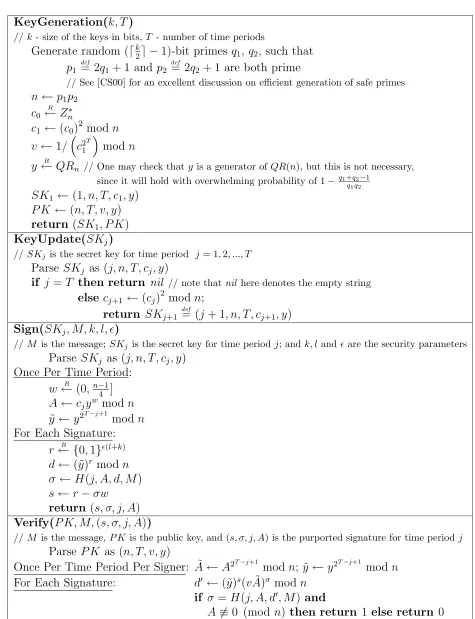
The conversion from this identification scheme to the signature scheme is straightforward [FS86, AABN02], using a hash function H : {0,1}∗ → {0,1}l, for a security parameter l. See Figure 1 for the resulting KREUS forward-secure signature scheme.
4
Performance
4.1
Improving Signer Costs via Pebbling
Note that the signer has to compute, in time period j, the value ˜y=y2T−j+1 modn. In other words, the signer needs to compute, in order, the values y1, y2, . . . ,yT, where yT =y and yj−1 =yj2 modn.
Note that this would be easy if the order of the values was reverse: the signer could just square the previous value each time. The direction we need is harder.
This is exactly the problem that Jakobsson [Jak02] and Coppersmith and Jakobsson [CJ02] ad-dress, except that they consider any one-way (hash) function, whereas we are interested specifically in modular squaring. They show that one can traverse a one-way chain by storing a few of its elements and performing a few computations per step. Specifically, the simple algorithm of [Jak02] requires log2T values stored and log2T steps in each time period; the much more complex one of [CJ02] requires about log2T + log2log2T values stored and further reduces the computation cost to about 0.5 log2T. Both algorithms use “pebbling” techniques, similar in spirit to those of [IR01].
KeyGeneration(k, T)
//k- size of the keys in bits,T - number of time periods
Generate random ( k2 −1)-bit primesq1, q2, such that p1 def= 2q1+ 1 andp2 def= 2q2+ 1 are both prime
// See [CS00] for an excellent discussion on efficient generation of safe primes
n ←p1p2 c0 ←R Zn∗
c1 ←(c0)2 modn
v ←1/
c21T
modn
y←R QRn // One may check thaty is a generator ofQR(n), but this is not necessary, since it will hold with overwhelming probability of 1−q1+q2−1
q1q2
SK1 ←(1, n, T, c1, y) P K ←(n, T, v, y)
return (SK1, P K)
KeyUpdate(SKj)
//SKj is the secret key for time period j = 1,2, ..., T
Parse SKj as (j, n, T, cj, y)
if j =T then return nil // note thatnil here denotes the empty string else cj+1 ←(cj)2 modn;
return SKj+1 def= (j+ 1, n, T, cj+1, y)
Sign(SKj, M, k, l, )
//M is the message;SKj is the secret key for time periodj; andk, l andare the security parameters
ParseSKj as (j, n, T, cj, y)
Once Per Time Period: w←R (0,n−41] A←cjyw modn
˜
y←y2T−j+1 modn For Each Signature:
r← {R 0,1}(l+k) d←(˜y)r modn σ←H(j, A, d, M) s←r−σw
return(s, σ, j, A)
Verify(P K, M,(s, σ, j, A))
//M is the message,P K is the public key, and (s, σ, j, A) is the purported signature for time periodj
ParseP K as (n, T, v, y)
Once Per Time Period Per Signer: ˜A←A2T−j+1 modn; ˜y ←y2T−j+1 modn For Each Signature: d ←(˜y)s(vA)˜ σ modn
if σ =H(j, A, d, M)and
A≡0 (mod n) then return 1else return 0
In KeyGenerationadd:
define data structure Pebble ={y,˜ pos,rb,re}
// y˜is the value to be used in time period pos (in each pebble y˜=y2T−pos+1);
// pos stands for position, “r” for “responsibility,” “b” for “begin” and “e” for “end”
TR ←1; while TR < T do TR ←2·TR // Let TR be the smallest power of 2 greater than T
let Pebble P ← {y2, T,1,TR}; L←a list of Pebbles (initially, just the single element P)
for i← −(T −4)/2 to 1 (inclusive) do // initialize by reaching position 1
PebbleRound(L, i)
remove the first element of L; its ˜y value is y2T and is to be used in the first time period
In KeyUpdate at the end of time periodj add:
PebbleRound(L, j+ 1)
remove the first element of L; its ˜y value is y2T−j to be used in time period j+ 1
ProcedurePebbleRound(L, i)
for eachPebble P inL, in order, do
Let d=P.pos −P.rb−2(P.rb −i) // Compute how much to move (it will be at most 2)
if d= 1 then MoveLeft(P) // Move once
if d= 2 then MoveLeft(P); MoveLeft(P) // Move twice
ProcedureMoveLeft(P)
while P.pos ≤P.re do // Can’t move until pos >re, or else won’t be able to reach re // Spawn a new pebble and delegate upper half of responsibility to it
mid ← (P.rb +P.re)/2+1
if mid ≤T then// The new pebble is needed only if it is for a “real” time period, T or before
let PebbleP1←(P.˜y, P.pos,mid, P.re);insert P1 into Limmediately following P P.re ←mid−1
P.˜y←P.˜y2 modn; P.pos ←P.pos−1 // this is the actual move left
Figure 2: Pebbling techniques to speed up computations ofy˜
Thus, in our scheme, much like in the scheme of [IR01], a time/memory tradeoff is possible: if the signer stores log2T values, then the cost per time period goes down from linear in T to logarithmic inT. Note, however, that both in our scheme and in [IR01], if the signer does not use pebbling, then the linear in T cost needs to be incurred only in those time periods in which signatures are issued; whereas if pebbling is used, then the logarithmic in T cost needs to be incurred inevery time period in order for the pebbling algorithm to work correctly.
4.2
Performance Comparison
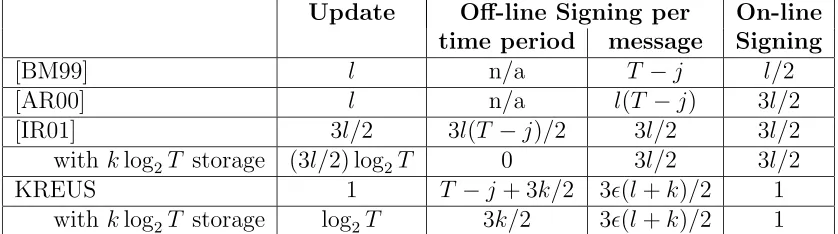
Update Off-line Signing per On-line
time period message Signing
[BM99] l n/a T −j l/2
[AR00] l n/a l(T −j) 3l/2
[IR01] 3l/2 3l(T −j)/2 3l/2 3l/2
with klog2T storage (3l/2) log2T 0 3l/2 3l/2
KREUS 1 T −j+ 3k/2 3(l+k)/2 1
with klog2T storage log2T 3k/2 3(l+k)/2 1
Table 1: Signer costs (in modular multiplications) of various forward-secure schemes
Once per signer
per time period For every signature
[BM99] n/a T −j+l/2
[AR00] n/a l(T −j) + 3l/2
[IR01] n/a 3l
KREUS 2(T −j) 3((l+k) +l)/2
Table 2: Verifier costs (in modular multiplications) of various forward-secure schemes
terms of the number of modular multiplications required, expressed as functions of the total number of time periodsT, the key sizek, the hash lengthl, security parameter, and a current time periodj. We assume that a modular exponentiation with an l-bit exponent is roughly equal to 3l/2 modular multiplications; to improve readability, we ignore small additive constants. The “generic” schemes of [BM99], [Kra00] and [MMM02] are not included in our comparison because of their fundamentally different design (their performance depends on the ordinary signature scheme with which they are instantiated).
Table 1 contains three metrics corresponding to Key Update, off-line Signing and on-line Signing parts of each scheme. Off-line Signing is additionally subdivided into two components: off-line Signing per time period and off-line Signing per message. By “off-line Signing per time period” we mean the computations that are needed only once per time period, and only in those time periods in which signatures are issued. This is different from Key Update, which needs to be performed in every time period, whether or not signatures are issued. This distinction—between off-line Signing per time period and Key Update—has not been made before. In particular, while the authors of [IR01] state that their scheme has a high update cost, in our terms it has a high off-line signing per time period cost. This distinction is important: if time periods are short for added security, then it is quite possible that no signatures will be issued in many of the time periods (and hence much of the computation will not be necessary).
Table 2 presents verifier’s costs, subdivided into the costs the verifier incurs only once per time period (for a given signer), and the costs for each signature.
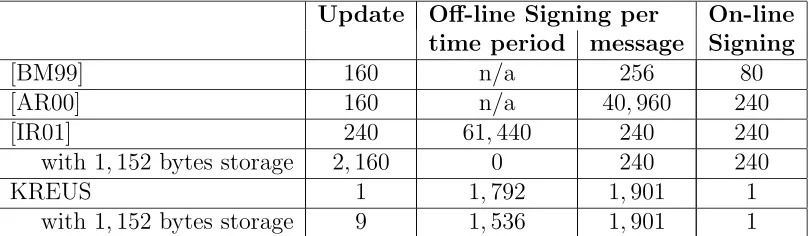
We evaluate the expressions in Table 1 for specific practical parameter values in Tables 3 and 4. Table 3 considers T = 512 (more than one update per day for a year), and Table 4 considersT = 225 (more than one update per second for a year).
Update Off-line Signing per On-line time period message Signing
[BM99] 160 n/a 256 80
[AR00] 160 n/a 40,960 240
[IR01] 240 61,440 240 240
with 1,152 bytes storage 2,160 0 240 240
KREUS 1 1,792 1,901 1
with 1,152 bytes storage 9 1,536 1,901 1
Table 3: Performance of different schemes (in modular multiplications) with T = 512, k = 1024, l = 160, j =T /2, = 1.07
Update Off-line Signing per On-line
time period message Signing
[BM99] 160 n/a 16×106 80
[AR00] 160 n/a 2.6×10⁹ 240
[IR01] 240 4×10⁹ 240 240
with 3,200 bytes storage 6,000 0 240 240
KREUS 1 16×106 1,901 1
with 3,200 bytes storage 25 1,536 1,901 1
Table 4: Performance of different schemes (in modular multiplications) with T = 225, k = 1024, l = 160, j =T /2, = 1.07
that 42 signatures per time period are issued for T = 512, and if no more that 2.8 million signatures per time period are issued for T = 225. With the extra storage, the relative performance of [IR01] improves, and our scheme’s total signer costs are lower if no more than 0.7 signatures per time period are issued for T = 512, and no more than 3 signatures per time period are issued for T = 225.
5
Security
The security proof is fairly standard: one can use the forking lemma technique of [PS96] and/or the reduction from identification to signatures of [AABN02]. We omit it here for lack of space; we do, however, point out its most salient features.
The security proof boils down to running the forger and simulating answers to the forger’s signa-ture queries. For this simulation, one relies on the statistical zero-knowledgeness of the identification scheme, using techniques similar to the ones of [CM98]. After a successful simulation, one obtains from the forger two signatures (s, σ, j, A) and (s, σ, j, A) for the same d. In other words,
y2T−j+1
s
vA2T−j+1
σ
≡y2T−j+1
s
vA2T−j+1
σ
(mod n).
Letting ˜s=s−s and ˜σ=σ−σ, we obtain the equation
y2T−j+1
˜s
≡vA2T−j+1
˜σ
We now consider two types of forgers. In the first type, ˜σ divides ˜s. To violate the Strong-RSA assumption using such forger, the reduction, on input a random α ∈ Zn∗, sets v =α2T−j+1 (this will enable the reduction to answer breakin query after time period j). Then the above equation becomes
y˜s/σ˜/A2T−j+1 ≡α2T−j+1. Because squaring is a permutation overQRn(becausenis a product of two
safe primes, and hence a Blum integer), this gives thatys/˜σ˜/A2 ≡α2. In other words, the reduction is able to compute a square root of α2; because α is a random element of Zn∗, this is equivalent to factoring n with probability 1/2, and hence, in particular, violates the Strong-RSA assumption.
In the second type of forger, ˜σ does not divide ˜s. To violate the Strong-RSA assumption using such forger, the reduction, on input a random α ∈Zn∗, sets y = α2, picks c0 ∈ Zn∗, lets c1 = c20 and v = 1/
c21T
, just like the true signer. Then the above equation becomes ys˜2T−j+1 ≡(A/cj)σ˜2
T−j+1
. By the so-called “Shamir’s trick” [Sha83], this equation enables us to obtain a root of y of degree r = ˜σ2T−j+1/gcdσ2˜ T−j+1,s2˜ T−j+1= ˜σ/gcd(σ, s)>1. Ifr is even, this gives us another square root of α2, thus again allowing us to factor n with probability 1/2. If r is odd, this gives us a root of α of degree r > 1, thus breaking the Strong-RSA assumption (note also thatr < 2l, because σ and σ are at most l bits long, because they are output byH).
Acknowledgments
We thank Jan Camenisch and Markus Jakobsson for explaining to us the history of building blocks of our scheme.
References
[AABN02] Jee Hea An, Michel Abdalla, Mihir Bellare, and Chanathip Namprempre. From identi-fication to signatures via the Fiat-Samir transform: Minimizing assumptions for security and forward-security. In Knudsen [Knu02].
[ACJT00] Giuseppe Ateniese, Jan Camenisch, Marc Joye, and Gene Tsudik. A practical and prov-ably secure coalition-resistant group signature scheme. In Mihir Bellare, editor, Advances in Cryptology—CRYPTO 2000, volume 1880 ofLecture Notes in Computer Science, pages 255–270. Springer-Verlag, 20–24 August 2000.
[And97] Ross Anderson. Invited lecture. In Fourth Annual Conference on Computer and Com-munications Security. ACM, 1997. Summary appears in [And01].
[And01] Ross Anderson. Two remarks on public key cryptology.
http://www.cl.cam.ac.uk/users/rja14/, 2001.
[BG92] Mihir Bellare and Oded Goldreich. On defining proofs of knowledge. In Ernest F. Brickell, editor,Advances in Cryptology—CRYPTO ’92, volume 740 ofLecture Notes in Computer Science, pages 390–420. Springer-Verlag, 1993, 16–20 August 1992.
[BM99] Mihir Bellare and Sara Miner. A forward-secure digital signature scheme. In Michael Wiener, editor, Advances in Cryptology—CRYPTO ’99, volume 1666 ofLecture Notes in Computer Science, pages 431–448. Springer-Verlag, 15–19 August 1999. Revised version is available from http://www.cs.ucsd.edu/~mihir/.
[BP97] Niko Bari´c and Birgit Pfitzmann. Collision-free accumulators and fail-stop signa-ture schemes without trees. In Walter Fumy, editor, Advances in Cryptology— EUROCRYPT 97, volume 1233 of Lecture Notes in Computer Science, pages 480–494. Springer-Verlag, 11–15 May 1997.
[BR93] Mihir Bellare and Phillip Rogaway. Random oracles are practical: A paradigm for de-signing efficient protocols. In Proceedings of the 1st ACM Conference on Computer and Communication Security, pages 62–73, November 1993. Revised version available from
http://www.cs.ucsd.edu/~mihir/.
[CJ02] Don Coppersmith and Markus Jakobsson. Almost optimal hash sequence traversal. In 6th International Financial Cryptography Conference, March 11–16 2002.
[CM98] Jan Camenisch and Markus Michels. A group signature scheme based on an RSA-variant. Technical Report RS-98-27, BRICS, University of Aarhus, November 1998.
[CS00] Ronald Cramer and Victor Shoup. Signature schemes based on the strong RSA assump-tion. ACM Transactions on Information and System Security, 3(3):161–185, 2000.
[FO97] Eiichiro Fujisaki and Tatsuaki Okamoto. Statistical zero knowledge protocols to prove modular polynomial relations. In Burton S. Kaliski Jr., editor, Advances in Cryptology— CRYPTO ’97, volume 1294 ofLecture Notes in Computer Science, pages 16–30. Springer-Verlag, 17–21 August 1997.
[FS86] Amos Fiat and Adi Shamir. How to prove yourself: Practical solutions to identifica-tion and signature problems. In Andrew M. Odlyzko, editor, Advances in Cryptology— CRYPTO ’86, volume 263 ofLecture Notes in Computer Science, pages 186–194. Springer-Verlag, 1987, 11–15 August 1986.
[GMR88] Shafi Goldwasser, Silvio Micali, and Ronald L. Rivest. A digital signature scheme secure against adaptive chosen-message attacks. SIAM Journal on Computing, 17(2):281–308, April 1988.
[GQ88] Louis Claude Guillou and Jean-Jacques Quisquater. A “paradoxical” indentity-based signature scheme resulting from zero-knowledge. In Shafi Goldwasser, editor, Advances in Cryptology—CRYPTO ’88, volume 403 of Lecture Notes in Computer Science, pages 216–231. Springer-Verlag, 1990, 21–25 August 1988.
[IR02] Gene Itkis and Leonid Reyzin. Forward-secure signatures with optimal signing and veri-fying. Cryptobytes, 5(2), 2002.
[Jak02] Markus Jakobsson. Fractal hash sequence representation and traversal. In 2002 IEEE International Symposium on Information Theory, June 30–July 5 2002.
[Knu02] Lars Knudsen, editor. Advances in Cryptology—EUROCRYPT 2002, volume 2332 of Lecture Notes in Computer Science. Springer-Verlag, 28 April–2 May 2002.
[Kra00] Hugo Krawczyk. Simple forward-secure signatures from any signature scheme. In Seventh ACM Conference on Computer and Communication Security. ACM, November 1–4 2000.
[Mau96] Ueli Maurer, editor. Advances in Cryptology—EUROCRYPT 96, volume 1070 of Lecture Notes in Computer Science. Springer-Verlag, 12–16 May 1996.
[MMM02] Tal Malkin, Daniele Micciancio, and Sara Miner. Efficient generic forward-secure signa-tures with an unbounded number of time periods. In Knudsen [Knu02].
[OS90] Heidroon Ong and Claus P. Schnorr. Fast signature generation with a Fiat Shamir-like scheme. In I. B. Damg˚ard, editor,Advances in Cryptology—EUROCRYPT 90, volume 473 of Lecture Notes in Computer Science, pages 432–440. Springer-Verlag, 1991, 21–24 May 1990.
[PS96] David Pointcheval and Jacques Stern. Security proofs for signature schemes. In Maurer [Mau96], pages 387–398.
[Sch91] Claus-Peter Schnorr. Efficient signature generation by smart cards. Journal of Cryptology, 4(3):161–174, 1991.
[Sha83] Adi Shamir. On the generation of cryptographically strong pseudorandom sequences. ACM Transactions on Computer Systems, 1(1):38–44, February 1983.
[Sho96] Victor Shoup. On the security of a practical identification scheme. In Maurer [Mau96], pages 344–353.