ISSN 2348 – 7968
An Advanced Crossbar Switching Technique for PCB Applications
Ankit Singh1, Khyati Choukse2 and Prof. Pankaj Golhane3
1
Electronics & Telecommunication Engineering, CSVTU/DIMAT Raipur Raipur, Chhattisgarh, India
2
Electronics & Telecommunication Engineering, CSVTU/DIMAT Raipur Raipur, Chhattisgarh, India
3
Electronics & Telecommunication Engineering, CSVTU/DIMAT Raipur Raipur, Chhattisgarh, India
Abstract
This paper represents a technique and method for developing a crossbar switch which is of reconfigurable architecture for network processors. The main objective of this paper is to enhance the performance of crossbar and reduce the excess power consumption. The method we proposed to reduce the power consumption at the runtime of crossbar switch is to enable only those link connection of crossbar which are necessary for the circuit or switch to perform and the unnecessary connection link turn off or disable by sending signal. We implemented a parameterized register transfer level design of reconfigurable crossbar switch. In this paper we have shown the result of 4×4 crossbar switch including the VHDL simulation of Reconfigurable Crossbar Switch on Xilinx ISE software tool.
Keywords: Interconnection network, on-chip communication , Reconfiguration, Crossbar Switch.
.
1. Introduction
Before the end of nineties, network equipment generally used as a general-purpose processors. But the need of quality-of-service (QoS) and the high speed data transmission asked for a quick evaluation of network equipments. Thus, the Network processor (NP) [1], [2] was created. Network processor takes the place of general-purpose Processors and Application specific Integrated circuits in network equipments. This are used to improve the two important issues flexibility and performance. These two features of processors are essential to process the packets, and the network processor is a best option to get them.
As industries build multi-core architecture involving number of cores in the future, on-chip interconnection network becomes a number one candidate for solving the problem facing on current multiprocessor chip. However one of the major challenges currently faced by on-chip interconnection is the power consumption [3]. NoC architecture classified by the links for packet data
transmission and router for storing, arbitration and switching functions performed by input buffer, arbiters and the crossbar respectively power is consumed from both communicating data packets across links as well as from switching and storage within the router [12].With the increased need of low power architectures, research has focused on optimizing buffer design [9],[10],[11] minimizing crass-power [8] and utilizing 3D interconnection [13]. The effective sharing of channel is achieved by implementing routing, crossbar switch within the router on a hop-by-hop basis.
The motivation is to increase the above two features cited before. With the help of reconfigurable crossbar switch in a network processor it could be achieved. Hence, using network processor with a reconfigurable crossbar switch as interconnection structure, it is possible to increase the throughput and reduce the power consumption of the network processor and also reduce the latency in communication packet transfer. The main objective of this paper is to reconfigure crossbar switch, a reconfigure crossbar switch architecture used to connect different inputs and outputs in interconnection and communication networks, and to implement dynamically topologies in two reconfiguration level.
ISSN 2348 – 7968
2.
RELATED WORKThere are number of commercial network processor of many companies available at the market. Some of this companies and their respective network processor are [1]: IBM (NP4GS3), Motorola/C-port (C-5 family), Lucent/Agere (FPP/RSP/ASI), Sitera/Vitesses (IQ2000), Chamelean (CS2000), EZChip (NP-1), Intel (IXPI1200) and many more. None of them gives reconfigurability except the CS2000 of Chamelean [6]. But it does not have
reconfigure crossbar switch. Network processor
architecture has blocks to execute
some function as a Network Processor System-on –Chip. Some of those blocks are PCI units, memory units, packet classifications, policy engines, metering engines, packet transform engines, queue engine, QoS engines and some other blocks. There are some papers about crossbar switch but they use reconfiguration crossbar in a network processor.
The related works [2],[5] presents result of previously implemented crossbar switch on FPGA. Our proposed platform for implementing crossbar switch with reduced energy consumption, flexibility but it did not change the core architecture. The work proposed is based on signal handling but the reconfiguration is depended on the FPGA. The Flexbar [7] work propos to modify schedules and network hardware level, but the crossbar architecture is similar to a traditional crossbar switch (TCS). This paper done not relate the FPGA and reconfigure switch as a feature of flexbar
Fig 1: FPGA – Reconfigurable Crossbar Switch .
The fig. 1 shows architecture of FPGA- Reconfigurable Crossbar Switch. Fig.1 shows some connection nodes of the reconfigurable crossbar switch, which if closed compose a circuit. This circuit represents a
topology in space. Differ from the traditional crossbar switch where it is possible to close only one node per line or per column regarding the implemented topology, the Reconfigurable Crossbar Switch permits that more than one node can be closed per line or column at the same time . The reconfigurable crossbar switch uses a reconfiguration bits to implement the topology in the space. This topology is used to create the connection as for the circuit. The reconfigurable bits set are capable of reconfiguring or implement a new topology in reconfigurable crossbar switch whenever it required.
Fig 2: Modified four-stage pipelined router architecture for proposed BiNoc router with VC flow-control technique
Fig .2 shows the architecture of a bidirectional channel network-on-chip (BiNoC) router model [14]. This part of network is used to enhance the performance of on-chip communication. In BiNoC, every communication channel allows itself to be dynamically reconfigured to transmit fits in one direction. This added flexibility, better bandwidth utilization, lower packet delivery latency and higher packet consumption rate. NoC router architecture is developed to support self configuration of the bidirectional traffic flow in the network processor. The flow direction at every channel-direction-control protocols (CDC) [14]. This channel-direction-control protocol provides high performance, free of deadlock and free of starvation. Fig.2 also illustrates reconfigurable crossbar switch components of a BiNoC router.
2.1 Crossbar Traversal
ISSN 2348 – 7968
2.2 Switch Allocation
Individual flits arbitrate for access to all physical characters via the crossbar on each cycle. Arbitration may be performed in two different stages [5]. The first stage reflects the sharing of a single crossbar port by V-input arbitrate between winning request from each input for each output channel. The request for a particular output port is routed from the VC which wins the second stage of arbitration. In order to improve fairness, the stage of the V-input the second stage of arbitration. We have to assume this organization wherever multiple stage of arbitration is presents.
2.3 Arbiter
Arbiter controls the arbitration of the ports and resolves connection problem. It keeps the update status of all the ports are free and which ports are communicating with each other. Fig.3 shows the arbiters used in the Reconfigurable Crossbar Switch. Packets with the same priority and destined for the same output port are scheduled with round-robin arbiter.
2.4 Crossbar
A crossbar switch is a switch connecting multiple inputs to multiple outputs in a matrix manner. The design of crossbar switch has 4 inputs and 4 outputs. In architecture illustration in fig.2 each input port is forced to share a single crossbar port even when multiple flits could be sent from different virtual-channel buffer. This restriction allows keeping crossbar size small and independent of the number of virtual-channel.
3.
Reconfigurable Crossbar Switch
Architecture
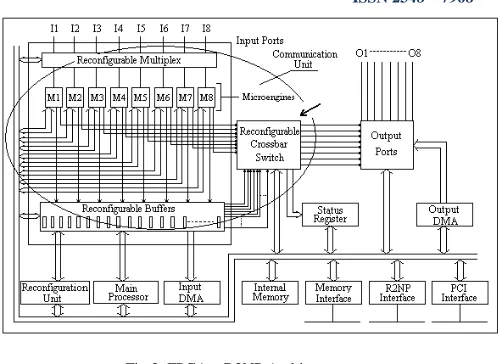
The figure 4 shows the Reconfigurable RISC Network processor (R2NP) architecture [3]. R2NP is generally used as a base for developing or design of our reconfigurable crossbar switch architecture. Thus, design of our reconfigurable crossbar switch was based on the R2NP in network processor. Reconfigurable crossbar switch shown in figure 1, has mainly three blocks: (1) connection matrix, where all the topologies are implemented; (2) decoder, that converts there configurable bits for a matrix bits set and (3) pre-header analyzer. Network processor can add this third block in the packet with the output destination. Reconfigurable crossbar switch (RCS) uses reconfiguration bits to implement the topology in the space
Fig 3: FPGA – R2NP Architecture
Only the Reconfiguration Unit and instruction set of the network processor are able to change those bits in order to implements new topologies. Although one instruction can modify the 01 and 10 formats the 00 format is restricted to reconfiguration unit.
4.
Work to be proposed
In this paper we proposed a method to develop reconfigurable crossbar switch architecture for network processor. In this paper we used 4×4 crossbar switch.
Input 1 Output 1
Input 2 Output 2
Input 3 Output 3
Input 4 Output 4
Fig 4: 4×4 Crossbar Switch
ISSN 2348 – 7968
5. Experimental Result
In our first result we have demonstrated the output of a normal packet from sources, 00,01,10 and 11 to 01,10,11,00 respectively. Our results show that the data goes properly from the given source towards the destination. The normal packets have MSBs as 0000
Fig: 5
In our next result, we demonstrate the reconfiguration, of sources. here we can observe that the connection matrix changes thereby the links which are turned off cannot communicate between each other in a better way.
Fig:6
6. Conclusion
In our design we have optimized the power of a normal cross bar switch by disabling the unwanted data connections thereby optimizing the data activity on the data lines. This leads to an optimum crossbar structure for network on chip devices.
References
[1] D. E. Comer, “Network Systems Design using Network Processors”,
Prentice Hall, 2003
[2] G. Lawton, “Will Network Processor Units Live up to Their
Promise?”, IEEE Computer, Volume 37, Number 4, April, 2004,
pp.13-15
[3] H. S. Wang, L. S. Peh, and S. Malik, “Power-drivendesign of router
microarchitectures in on-chipnetworks,” in Proceedings of the 36th
AnnualACM/IEEE International Symposium onMicroarchitecture,
Washington DC, USA, December03-05 2003, pp. 105– 116.
[4] H. C. Freitas and C. A. P. S. Martins, “Didactic Architectures and
Simulator for Network Processor Learning”, Workshop on Computer
Architecture Education, San Diego, CA, USA, 2003, pp.86-95
[5] K. Mai,” Smart Memories: A Modular Reconfigurable Architecture,”
Proc ISCA, June 2000, pp. 161-71.
[6] I. A. Troxel, A. D. George and S. Oral, “Design and Analysis of a
Dynamically Reconfigurable Network Processor”, IEEE Conference
on Local Computer Networks, November 6-8, 2002, pp.483-494
[7] J. D. Owens, W. J. Dally, R. Ho, D. N. Jayasimha, S.W. Keckler, and
L. S. Peh, “Research challenges foron-chip interconnection networks,” IEEE Micro, vol.27, no. 5, pp. 96–108, September-October
2007.
[8] H. S. Wang, L. S. Peh, and S. Malik, “Power-drivendesign of router
microarchitectures in on-chipnetworks,” in Proceedings of the 36th AnnualACM/IEEE International Symposium onMicroarchitecture,
Washington DC, USA, December03-05 2003, pp. 105–116. [9] J. Hu and R. Marculescu, “Application-specific bufferspace
allocation for network-on-chip router design,” inProceedings of the
IEEE/ACM InternationalConference on Computer Aided Design
(ICCAD), SanJose, CA, USA, November 7-11 2004, pp. 354–361.
[10] C. A. Nicopoulos, D. Park, J. Kim, N. Vijaykrishnan,M. S. Yousif,
and C. R. Das, “Vichar: A dynamicvirtual channel regulator for
network-on-chip routers,”in Proceedings of the 39th Annual
InternationalSymposium on Microarchitecture (MICRO), Orlando,FL,
USA, December 9-13 2006, pp. 333–344.
[11] W.Dally, “The J-Machine Network” Proc Intnl Conf on Computer
Design. IEEE VLSI in Computer & Processor, Oct 1992, pp 420-423.
[12] Y. Hoskote, S. Vangal, A. Singh, N. Borkar, and S.Borkar, “A 5-ghz
mesh interconnect for a teraflopsprocessor,” IEEE Micro, pp. 51–61,
Sept/Oct 2007.
[13] S. E. Dongkook Park, R. Das, A. K. Mishra, Y. Xie, N.Vijaykrishnan,
ISSN 2348 – 7968
architecture,” inProceedings of the International Symposium on
Computer Architecture (ISCA), June 2008, pp. 251–261. [14] Ying-Cherng Lan, Hsiao-An Lin, Shih-Hsin Lo, Yu Hen Hu, and Sao-
Jie Chen, “A bidirectional noc (binoc) architecture with dynamic
selfreconfigurable channel,” Computer-Aided Design of Integrated
Circuits and Systems, IEEE Transactions on, vol. 30, no. 3, pp. 427 –
![Fig .2 shows the architecture of a bidirectional channel network-on-chip (BiNoC) router model [14]](https://thumb-us.123doks.com/thumbv2/123dok_us/7817203.1295252/2.612.57.304.461.638/shows-architecture-bidirectional-channel-network-binoc-router-model.webp)