Modified DSR Protocol for Power Saving In
Mobile Ad Hoc Networks
Alphonsa Xavier
1, S Perumal Sankar
2PG Student [Wireless Technology], Dept. of ECE, Toc H Institute of Science and Technology, Kochi, India1 Professor, Dept. of ECE, Toc H Institute of Science and Technology, Kochi, India 2
ABSTRACT: Mobile ad hoc networks (MANETs) is a continuously self-configuring, infrastructure-less network of mobile devices. All the nodes involved in these type of networks are battery operated, and the main limitation in this type of networks is Energy optimization. Hence Energy Optimization plays a vital role in the successful operation of the networks. The Dynamic Source Routing protocol is an on demand routing protocol that is based on the concept of source routing. It finds the route from source to destination only when the source initiates the route discovery process. In this paper, we propose a modified dynamic source routing (mDSR) protocol which select energy efficient path. The performance of the proposed protocol has been examined and evaluated with NS-2.34 Simulator in terms of remaining energy, packet delivery fraction, and throughput.
KEYWORDS: Mobile Ad-hoc Networks, Dynamic Source Routing Protocol, Route discovery, Route maintenance
I.INTRODUCTION
A mobile ad hoc network [MANET] can be characterized by the mobile nodes which have ability to move at any direction and also have the ability of self-configuring, self-maintaining and self-organizing themselves within the network by means of radio links without any fixed infrastructure like base station, fixed link, routers, and centralized servers [7]. During the communication the individual node in the network plays the responsibility as a router since in the network there is no base station or central coordinator exists, so. Hence all the nodes are incorporated with a routing mechanism for transmit a data packet from source to destination
Routing protocol is used to discover routes between nodes, there by facilitate communication within the network. The primary goal of such an ad-hoc network routing protocol is efficient route establishment between a pair of nodes .In this way messages may be delivered in a timely manner. A large number of routing protocols are available for this purpose. The protocols mainly fall in three categories.
The Table Driven Routing Protocol, also known as Proactive Protocols which maintains extensive routing tables for the entire network. As a result, a route is found as soon as it is requested .Each node uses routing information to store the location information of other nodes in the network and by using this information the data is moves among different nodes in the network. On Demand Routing Protocol, also known as Reactive Protocols [5] establish routes between nodes only when they are required to route data packets. There is no updating of every possible route in the network instead it focuses on routes that are being used or being set up. Hybrid routing protocol combine Table Based Routing Protocols with On Demand Routing Protocols. They use distance vectors for more precise metrics to establish the best paths to destination networks and report routing information only when there is a change in the topology of the network.
II.DYNAMIC SOURCE ROUTING (DSR)
Dynamic Source Routing protocol (DSR) is a simple and efficient routing protocol designed specifically for use in multi-hop wireless ad hoc networks of mobile nodes. The two main mechanisms involved in this protocol are "Route Discovery" and "Route Maintenance", which work together to allow nodes to discover and maintain routes to arbitrary [6] destinations in the ad hoc network.
Route Discovery
Fig -1: Route Discovery Mechanism [3]
When node sender S is to send message to the destination node D,it first queries if there exists route from S to D in the routing buffer. If so, then source node sends message according to the route, otherwise route discovery program is launched, Fig-1 shows the Route discovery mechanism. Normally the sender looks the route cache and searches this route if there is no route it creates a route request packets containing its address and the address of the destination node then it broadcast this packet to all its neighbors using flooding.
Each neighbour when receiving this request consults its cache to find an eventual route to this destination to be returned back to the sender otherwise it rebroadcast the same route request to all its neighbours after adding its address to the header of the route request and learns from this request information to be added to its cache. If the node has already treated this route request it ignores the new received request by verifying its sequence number since each route request is identified by a unique sequence number[1]. The same procedure is executed by each neighbouring node until the route request arrives to destination which adds its address at the end of the header and sends a route reply
Route Reply
Fig -2: Route Reply Mechanism [3]
Fig-2 shows the Route reply mechanism. This procedure is executed by a node after receiving a route request destined to him thus this node executes the following actions:
Adds this new route from source to destination to its cache for future use.
Replies to this request using unicast along the path contained in the header.
Route Maintenance
When forwarding a packet each intermediate node is responsible for confirming that the packet is correctly received by the next node, however due to the dynamic topology and the constraints of the wireless medium it may occur some situation where a node doesn‟t receive the acknowledgement of reception from link layer of a given packet, therefore it resends the same packet it until reaches a predefined value of attempts[3]. Whenever this number of attempts was reached this node consider this link as broken than it deletes each route containing this link from its cache than it generates a route error packet to inform the source node and all intermediate nodes about this link failure in the same way each intermediate node deletes all routes containing this route until the route error packet arrives to its destination which chooses to launch a new route request or to find a new route in its route cache.
III. RELATED WORKS
Sabitha Ramakrishnan et. al presents a power aware routing protocol for a mobile ad hoc network of small to medium size (10 to 100 nodes). In that DSR protocol is enhanced with power awareness using the Location Aided Power Aware Routing (LAPAR) algorithm. The Location Aided Power Aware Routing (LAPAR) algorithm can be implemented over any existing routing protocol [2]. It identifies the optimum route between a source destination pair such that the total power required for the transmission of data packets is minimized. This saving of power is generally accompanied by an increase in the total number of hops. This algorithm states that for any node belonging to a set V, there exists a set of nodes to which direct transmission results in the least power. The set V in the previous statement consists of all the nodes in the region under consideration. The set of the line segments joining the considered node and the nodes to which direct transmission requires least power is known as the planar graph of that node. the distances between the nodes are calculated. Then each and every node calculates the shortest distance to reach other nodes by comparing distance of the direct path with distance of the various paths available to reach that node through other nodes.
Shipra Gautam proposed a Modified Energy Saving Dynamic Source Routing in MANETs (MESDSR) which will efficiently utilize the battery power of the mobile nodes in such a way that the network will get more life time If the Source node S wants to send data to the destination node D, it will first send REQ message to all its neighbor nodes [3]. When neighbour nodes receive REQ message they will check their Route_Cache, if this packet‟s ID is already in their Route_Cache then packet will be discarded.Otherwise, node will calculate its power and send this value as a reply to source node.Source node will calculate the mean value of all the values of Pnew of all the nodes and send a RREQ message to the node whose Pnew value is nearest to the mean value. When the node receives a RREQ message it will send REQ message to its own neighbours and this process will be continued till the destination node reaches.When destination node will receive the RREQ message it will send the RREP message back with the same route.RREP process is same as in traditional DSR.
IV. PROPOSED WORK
We have proposed an modified dynamic source routing protocol (mDSR) which aims to maximize the lifetime of the network and improve the performance obtained by the basic DSR routing protocol. In mDSR protocol, residual energy of wireless nodes is considered along with the hop count to avoid unbalanced energy consumption of wireless nodes.
The optimum route is determined by using the value of parameter a = E/NH
Where E is the remaining energy and NH is the number of hopes.
The destination node calculates the values of a for received routes and chooses a route that has the largest value of „a‟. That is, the mDSR protocol collects varius route sand find out the value of „a‟ for each available route .Finally the destination node select the route with largest value of „a‟
Operation ofmDSR:
The source node starts communicating as soon as it receives the first valid route reply. However, once the source S receives the next route reply, it runs an algorithm, which is described as follows:
1. Send a ROUTE REQUEST to neighbors. 2. Get various routes available to destination.
3. Compare parameters of routes with respect to remaining energy level and least count. 4. Then the appropriate route for destination is selected. .
V.PERFORMANCE EVALUATION
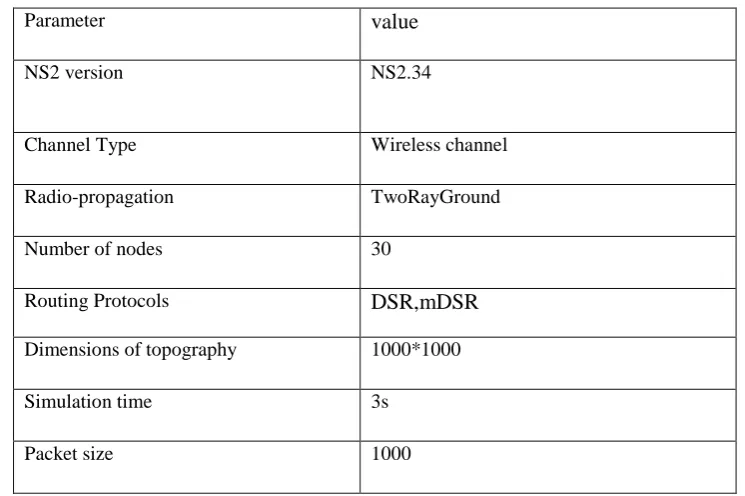
We have created a network of 30 nodes which are randomly distributed in a 1000(m) x1000 (m) rectangle area. The simulation tests have been performed on increasing number of nodes with DSR ,mDSR. Packet size has been set to 1000 bytes and simulated for 3s. Data rate
.
Table -1. Simulation Parameters used in NS2 Parameter
value
NS2 version NS2.34
Channel Type Wireless channel
Radio-propagation TwoRayGround
Number of nodes 30
Routing Protocols
DSR,mDSR
Dimensions of topography 1000*1000
Simulation time 3s
The simulation parameters used inNS2 are listed in Table I
Fig -3 Path Selection in Mdsr
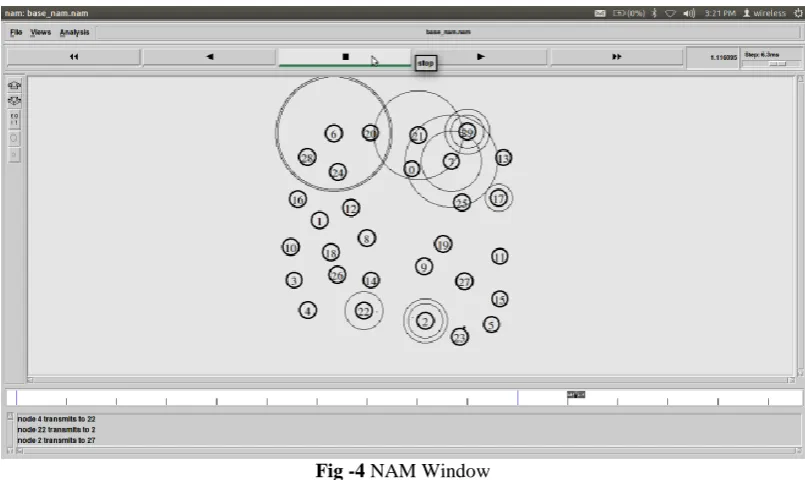
Fig. 3 shows the terminal window in which the entered source node is 4 and destination node is 27.There are 6 path are available .destination node calculate the value of “a” for for each path. Finally path with maximum value of ” a” is choose( path with id 4 in above example).Fig. 4 shows the NAM window of 30 nodes when the network was created using mDSR protocol for the above case.
Fig -4 NAM Window
Packet Delivery Ratio Vs
Number Of Nodes
Fig -5: Packet Delivery Ratio Vs Number Of Nodes
We measure the delivery ratio of data packets in the network of the two protocols as a function of the number of mobile nodes. . The number of mobile nodes in the network was varied from 10 to 60 MNs. The result is shown in Fig. 5. As the figure shows, for DSR, and mdSR the packet delivery ratio increases very slightly as the number of node increases from 10 to 30.As the node increases from 30 to 40. DSR shows a rapid change in packet delivery ratio from .4844 to .7344.
Remaining Energy Vs Number of Nodes
Fig -6: Remaining Energy Vs Number Of Nodes 0
0.1 0.2 0.3 0.4 0.5 0.6 0.7 0.8 0.9 1
10 20 30 40 650 60
Packet
Delivery
Ratio
Number Of Nodes
Packet Delivery Ratio v/s No. of nodes
DSR
The remaining energy available after the transmission is shown in fig 6. Here we are compare the existing DSR and mDSR protocol on the basis of remaining energy and increases the number of nodes from 10 to 60.Simulation result shows that mDSR protocol has better performance for every condition. In mDSR protocol, residual energy of wireless nodes is considered along with the hop count to avoid unbalanced energy consumption of wireless nodes
Throughput Vs Number Of Nodes
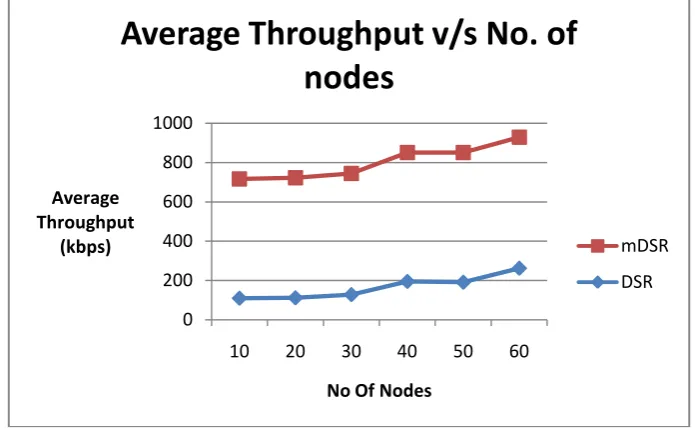
Throughput is the measure of how fast a node can actually sent the data through a network. So throughput is the average rate of successful message delivery over a communication channel. We measure the throughput in the network of the two protocols as a function of the number of mobile nodes. . The number of mobile nodes in the network was varied from 10 to 60 MNs. The result is shown in Fig. 7. As the figure shows, for DSR, and mDSR the throughput increases very slightly as the number of node increases from 10 to 30.As the node increases from 30 to 40 DSR shows a rapid change in throuhput from 127.39kbps to 194.57kbps.
Fig -7: Throughput Vs Number Of Nodes
Simulation result shows that mDSR has better performance in terms of throughput compared to the existing DSR protocol. As an explanation to the good throughput in mDSR is that the battery life of mobile nodes is longer, and hence routes are maintained for longer time and packets are transmitted easily,
VI. CONCLUSIONS
In order to facilitate communication within MANETs, an efficient routing protocol is required to discover route between mobile nodes. Energy efficiency is one of the main problems, especially in designing routing protocol. There are lot of protocol .It is difficult to compare them since each method has different goal with different assumption .we can combine or integrate the protocol for longer lifetime of network. Residual energy of wireless nodes is considered along with the hop count to avoid unbalanced energy consumption of wireless nodes.mDSR protocol collects routes that have the maximum residual energy of nodes and have the least hop-count, and then determines a proper route among them.
0 200 400 600 800 1000
10 20 30 40 50 60
Average Throughput
(kbps)
No Of Nodes
Average Throughput v/s No. of
nodes
mDSR
REFERENCES
[1] Surya Kant, Dr. Krishan Kumar,” Performance Analysis Of Dynamic Source Routing Protocol In Wireless Mobile Ad Hoc Network “, (IJERT) Vol. 1 Issue 10, December- 2012
[2] Sabitha Ramakrishnan, T. Thyagarajan, P. K. Ram and R.Vinodh,“ Design and Analysis of PADSR Protocol for Routing in MANETs” IEEE Indicon 2005 Conference
[3] ShipraGautam, Rakesh Kumar “Modified Energy Saving DSR Protocol for MANETs” ,IJECSE , 2013
[4] Baisakh,” A Review of Energy Efficient Dynamic Source Routing Protocol for Mobile Ad Hoc Networks “, International Journal of Computer Applications (0975 – 8887) Volume 68– No.20, April 2013
[5] Alphonsa Xavier, Prof R. N Gaur, “A Survey on Energy Efficient Dynamic Source Routing Protocol for MANETs”, (IJAREEIEVol.3, Issue 11,pp.13186-13192, Nov 2014, (IF 1.68).
[6] Savita Gandhi SMIEEE, NirbhayChaubey MIEEE, Pathik Shah, MadhviSadhwani,”Performance Evaluation of DSR, OLSR and ZRP Protocolsin MANETs”,ICCCI, Jan. 10 – 12, 2012
![Fig -1 : Route Discovery Mechanism [3]](https://thumb-us.123doks.com/thumbv2/123dok_us/7788444.1289478/2.595.188.410.269.383/fig-route-discovery-mechanism.webp)