Electronic Thesis and Dissertation Repository
12-16-2015 12:00 AM
Exercise Identity: Origins, Applications, and Future Utility
Exercise Identity: Origins, Applications, and Future Utility
Vincent L. Liardi
The University of Western Ontario Supervisor
Dr. Craig Hall
The University of Western Ontario Graduate Program in Kinesiology
A thesis submitted in partial fulfillment of the requirements for the degree in Doctor of Philosophy
© Vincent L. Liardi 2015
Follow this and additional works at: https://ir.lib.uwo.ca/etd
Part of the Sports Sciences Commons
Recommended Citation Recommended Citation
Liardi, Vincent L., "Exercise Identity: Origins, Applications, and Future Utility" (2015). Electronic Thesis and Dissertation Repository. 3451.
https://ir.lib.uwo.ca/etd/3451
by
Vincent L. Liardi
Graduate Program in
Kinesiology
A thesis submitted in partial fulfillment of the requirements for the degree of
Doctor of Philosophy
The School of Graduate and Postdoctoral Studies The University of Western Ontario
London, Ontario, Canada December 2015
strong determinant of exercise behaviours. The primary purpose of study 1 was to examine EI’s relationship with three key self-presentational variables: self-presentational efficacy (SPE), social physique anxiety (SPA), and impression motivation (IM). Specifically, we looked at how EI contributed uniquely to predicting exercise behaviour over and above these self-presentational concerns. The analyses demonstrated that EI is positively correlated with SPE and unrelated to SPA in both genders. Further analyses revealed that EI contributes a significant amount of
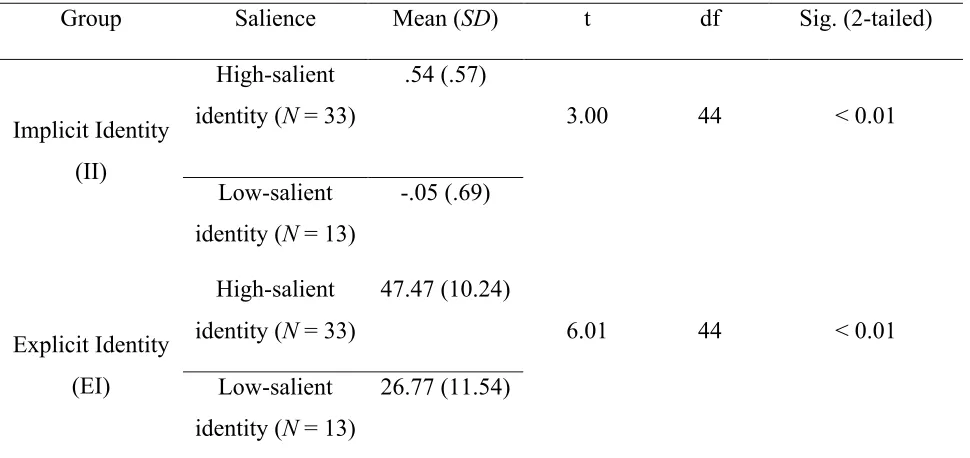
variance towards exercise behaviour over and above what is accounted for by SPE, SPA, and IM. Lastly, EI did not moderate the SPA-exercise relationship in either gender. In study 2 an implicit measure of exercise identity was developed and tested using the Implicit Association Test (IAT) procedure on 60 individuals (60% males, 40% females) ranging from 18 to 61 years of age. Findings showed that (explicit) exercise identity (EI) and implicit identity (II) were distinct concepts, yet each was moderately correlated with vigorous forms of exercise. Individuals who ranked EI among their top three identities (high-salient group) scored significantly higher in both EI and II measures than those who ranked exercise identity among their top bottom three
identities (low-salient group). Implications are discussed for the future utility of this objective measure of II. The aim of study 3 was to determine if two distinct imagery foci would
EII and SPEI. Follow-up exercise data indicated that both groups exercised at statistically similar rates post-intervention.
KEY WORDS: Identity theory, exercise identity, self-presentation, social physique anxiety,
“Cultivate the habit of being grateful for every good thing that comes to you, and to give thanks continuously. And because all things have contributed to your advancement, you should include all things in your gratitude.”
ABSTRACT ... ii
CO-AUTHORSHIP ... iv
ACKNOWLEDGEMENTS ... v
TABLE OF CONTENTS ... vi
LIST OF TABLES ... xi
LIST OF FIGURES ... xiii
LIST OF APPENDICES ... xv
INTRODUCTION ... 1
Identity Theory ... 1
Exercise Identity ... 2
Self-Presentation ... 3
Social Physique Anxiety ... 4
Implicit Cognitions ... 4
Imagery ... 6
Overview Of Present Research ... 7
References ... 10
STUDY 1: EXERCISE IDENTITY AND ITS RELATION TO SELF-PRESENTATION CONCERNS IN MALES AND FEMALES ... 15
Introduction ... 15
Exercise Identity ... 15
Self-Presentation ... 17
Male Participants ... 24
Measures ... 25
Exercise Identity ... 25
Self-Presentational Efficacy ... 25
Social Physique Anxiety ... 25
Impression Motivation ... 26
Demographic Questionnaire ... 26
Procedure ... 26
Results ... 27
Treatment of Data ... 27
Bivariate Correlations ... 27
Hierarchical Multiple Regression Analyses ... 28
Moderation Analyses ... 29
Discussion ... 30
References ... 41
STUDY 2: IMPLICIT AND EXPLICIT EXERCISE IDENTITY, IDENTITY SALIENCE, AND THE RELATIONSHIP TO EXERCISE BEHAVIOUR ... 46
Introduction ... 46
Exercise Identity ... 46
Identity Salience ... 48
Implicit Identity & Measurement ... 50
Measures ... 54
Exercise Identity ... 54
Identity Salience ... 54
Implicit Identity ... 55
Exercise Behaviour Follow-Up ... 56
Demographic Questionnaire ... 57
Procedure ... 57
Results ... 58
Bivariate Correlations ... 58
Identity Salience ... 58
Hierarchical Multiple Regression Analysis ... 59
Discussion ... 60
Implications, Limitations, and Future Directions ... 61
References ... 71
STUDY 3: EXERCISE IDENTITY AND SELF-PRESENTATIONAL RESPONSES TO A 6-WEEK PHYSICAL ACTIVITY PLUS IMAGERY INTERVENTION ... 78
Introduction ... 78
Imagery ... 78
Self-Presentation ... 83
Exercise Identity ... 85
Method ... 88
Exercise Identity (EI) ... 89
Self-Presentational Efficacy (SPE) ... 89
Social Physique Anxiety (SPA) ... 90
Cardiorespiratory Fitness ... 90
Upper-Body Strength ... 91
Core-Endurance ... 91
Exercise Behaviour Follow-Up ... 91
Demographic Questionnaire ... 92
Procedures ... 92
Recruitment ... 93
Randomization ... 93
Pre-test ... 94
Imagery ... 94
Exercise Program ... 96
Post-test and Follow-up ... 97
Results ... 97
Treatment of Data ... 97
Missing Data and Outliers ... 97
Preliminary Analyses ... 98
Group Differences in Psychosocial Outcomes ... 98
Group Differences in Physical Outcomes ... 99
References ... 116
GENERAL DISCUSSION ... 124
References ... 129
APPENDICES ... 131
Table(Study)
1(1) Descriptive statistics for demographic information of males and females ... 34 2(1) Correlations, means, and standard deviations of key variables in females
... 35 3(1) Correlations, means, and standard deviations of key variables in males
... 36 4(1) Hierarchical regression model of physical activity in females
... 37 5(1) Hierarchical regression model of physical activity in males
... 38 1(2) Descriptive statistics for demographic information
... 66 2(2) Bivariate correlations, means, and standard deviations of key variables
... 67 3(2) EI and II differences between high-salient and low-salient exercise identities
... 68 4(2) Summary of hierarchical regression analysis for variables predicting all-form
physical activity……….69 5(2) Summary of hierarchical regression analysis for variables predicting vigorous
at baselines……….107 2(3) Physical and psychological outcomes variables at baseline: Between
Figure(Study)
1(1) Plot of the interaction effect of social physique anxiety (SPA) and exercise identity (EI) on total weekly physical activity behaviour (METS) among female participants only ... 39 2(1) Plot of the interaction effect of social physique anxiety (SPA) and exercise identity (EI) on total weekly physical activity behaviour (METS) among male participants only ... 40 1(3) Comprehensive participant flow through the physical activity plus imagery
intervention ... 109 2(3) Plot of exercise identity scores (min = 9, max = 63) between two conditions (those
receiving the exercise identity imagery intervention (EI) and those receiving the self-presentational efficacy imagery intervention (SPE)) across three time points of the intervention (commencement of intervention, cessation of intervention, and follow-up) ... 110 3(3) Plot of self-presentational efficacy scores (min = 0, max = 100) between two
conditions (those receiving the exercise identity imagery intervention (EI) and those receiving the self-presentational efficacy imagery intervention (SPE)) across three time points of the intervention (commencement of intervention, cessation of
intervention, and follow-up) ... 111 4(3) Plot of social physique anxiety scores (min = 9, max = 45) between two conditions
follow-up) ... 112 5(3) Plot of aerobic capacity (estimated VO2max) scores between two conditions (those
receiving the exercise identity imagery intervention (EI) and those receiving the self-presentational efficacy imagery intervention (SPE)) across three time points of the intervention (commencement of intervention, cessation of intervention, and follow-up) ... 113 6(3) Plot of upper body strength (push-ups) between two conditions (those receiving the
exercise identity imagery intervention (EI) and those receiving the self-presentational efficacy imagery intervention (SPE)) across three time points of the intervention (commencement of intervention, cessation of intervention, and follow-up) ... 114 7(3) Plot of core strength (sit ups) between two conditions (those receiving the exercise
identity imagery intervention (EI) and those receiving the self-presentational efficacy imagery intervention (SPE)) across three time points of the intervention
APPENDIX A Research Ethics Approval Notices ……….131
APPENDIX B Exercise Identity Scale – Studies 1 to 3 ... 135
APPENDIX C Self-Presentational Efficacy Scale – Studies 1 & 3 ... 137
APPENDIX D Social Physique Anxiety Scale – Studies 1 & 3 ... 139
APPENDIX E Impression Motivation Subscale - Study 1 ………...141
APPENDIX F Letter(s) of Information – Study 1 ……….143
APPENDIX G Godin Leisure Time Exercise Questionnaire (GLTEQ) – Study 1 ... 147
APPENDIX H Identity Salience Hierarchy Measure – Study 2 ... 149
APPENDIX I International Physical Activity Questionnaire – Study 2 ... 151
APPENDIX J Letter of Information – Study 2 ………. 155
APPENDIX K Letter of Information – Study 3 ………. 158
APPENDIX L Follow-Up Exercise Email – Study 3 ... 162
APPENDIX M Physical Activity Readiness Questionnaire (PAR-Q) – Study 3 ... 164
APPENDIX N Sample EII script – Study 3 ... 166
INTRODUCTION
Identity Theory
likely it is that one’s internal mechanisms will resist variability in behaviour as it pertains to the identity standard. That is, the greater our perceived discrepancy to an identity standard, the deeper the internal drive will be to neutralize this disturbance and render the discrepancy void (Burke, 1991). It is in this way that identities are both changeable by the nature of a shifting society, but also staunchly resistant to change cross-situationally, thus acting as strong barometers for many forms of common behaviours.
Exercise Identity
In the realm of physical activity, the theoretical foundations of identity theory are surely applicable to the role of an exerciser. Hence, exercise identity would not only affect the
processing of exercise-related stimuli, but would also provide direction for future exercise
behaviour(s). Identity theory would hold that the likelihood of activating your exercise identity as a basis for performing behaviours in a related role (e.g., going for a hike on a sunny day) is a reflection of exercise identity’s standing within your identity salience hierarchy. Thus, the more you identify with exercise as an important part of who you are, particularly relative to other potential roles, the greater the probability it will occupy a superior position along your identity hierarchy. This enhances the odds you will engage in exercise behaviours which act to reaffirm this identity.
college students joined either a one-hour exercise class, twice a week for fourteen weeks (experimental group), or a non-exercise health education class (control group). This resulted in steady, significant increases in exercise identity throughout the study for only the exercise group. Furthermore, the experimental group’s mean exercise identity scores at week one and week seven significantly predicted persistent exercise involvement throughout the entire fourteen weeks. The control group, however, showed no change in exercise identity. The authors
contended that exercise behaviour alone could not account for the significant increase in exercise identity displayed by the experimental group (Markus, 1977). These studies point to the
importance that developing and upholding a salient exercise identity has on health and fitness practices.
Self-Presentation
sought after impression or perform a preferred behavior thus leading to a desired outcome (Maddux, Norton, & Leary, 1988). SPE is a compelling predictor of high-frequency exercise (Gammage et al.).
Social Physique Anxiety
In many social contexts, when people don’t believe they possess the requisite abilities to meet the situational demands they may experience social anxiety (Leary, 1992). This is
especially heightened when the desire to convey a particular impression is strong (e.g., talking to your grade nine crush). Social physique anxiety (SPA) is a variant of social anxiety about the body that stems from apprehensions one’s physique may be judged by others (Hart, Leary, & Rejeski, 1989). In physical activity contexts it has largely been recognized as a latent barrier to exercise participation and fulfilment (Carron & Prapavessis, 1997). However, in some instances SPA may actually spur exercise behaviour, as individuals attempt to alleviate their personal anxieties over body image concerns (Frederick & Morrison, 1996). Research has demonstrated that self-presentational reasons for exercise (appearing physically attractive, controlling weight, and toning the body) are positively connected with SPA even when controlling for body
composition effects (Eklund & Crawford, 1994). Women typically score higher on SPA, likely due to disparities in body image and body dissatisfaction between genders (Miller, Linke, & Linke, 1980). Gammage and colleagues claimed that SPA is the “most widely studied aspect of self-presentation in exercise psychology research” (Gammage, Hall, & Martin Ginis, 2004, p. 1639).
Implicit Cognitions
makes sense, since we meander through our days considering what to do and how to do it.
Sometimes we reflectively weigh the pros and cons of a decision, with a mindful consideration of what goals we wish to pursue and the actions necessary to accomplish them. Yet, a separate line of investigation questions these assumptions – instead advancing that many of our daily manners emerge without deliberate introspection, but rather through implicit, subconscious operative modes (Devos & Banaji, 2003). The term “implicit” explains mental processes that transpire outside of our conscious awareness and/or without conscious control.
As such, outcomes on the IAT are more liable to secure unfiltered, valid aspects of social cognition (Olson, Fazio, & Hermann, 2007).
Imagery
Imagery, also referred to as visualization or cognitive rehearsal, is akin to playing a movie in your mind. It is a mental skill that all individuals are capable of, and thus can be improved with training (Feltz & Landers, 1983; Hall, 2001). The way individuals typically acquire and process information is considered bottom-up processing; an environmental stimulus
is transduced to a cell of the nervous system and afterwards the signal is transmitted from the
nerve ending to the brain, via an axon. However, imagery is unique in that it is considered a
top-down cognitive process; the cerebrum generates images that can neurologically impact the rest of
the body’s senses (Kosslyn, 1996). This is analogous to executing perception backwards (Moran,
Guillot, MacIntyre, & Collet, 2012), and the generally agreed upon rationale is that imagery is
closely linked to perception, thus the images are largely congruent to the actual object being
formed mentally. This proposal that imagery relies on the same neural network employed in
actual perception and motor control has since been referred to as the functional equivalence
theory (Kosslyn, Ganis, & Thompson, 2001). Imagery tends to be most effective when the
visualization is both highly vivid and under great degrees of control (Corbin, 1972).
mental practice of strategies or routines; (3) visualizing specific outcome goals; (4) regulating affect (typically used for anxiety reduction); and (5) augmenting confidence and preserving focus.
Overview Of Present Research
In light of these previous concepts, this dissertation endeavoured to build out the current knowledge base relating to exercise identity and it’s utility within the research landscape. Phase 1 of this project was aimed at examining the relationship EI has with various aspects of
self-presentation. Given SPA’s equivocal relationship with exercise behaviour (Hausenblas & Symons Downs, 2002), it would be prudent to explore whether a strong, internalized exercise identity is meaningfully related in some way with SPA, or not. This may offer insight into the nature of SPA’s relationship with exercise – if it is caused by a fundamental belief that exercise is part of the self-concept, or not. Moreover, individuals tend to self-present in a manner that is congruent with their self-concept (Leary & Kowalski, 1990). The self-concept supplies a guide to the credibility and plausibility of trying to create these varied impressions. It would similarly be useful to better understand the relationship between SPE and EI. This may better inform our insight into SPE as, in part, a reflection of deep-rooted views of the self. It has been suggested that identity progression and self-efficacy advancement are affiliated, perhaps in a reciprocal manner, with intense forms of physical activity resulting in greater identification with exercise (Miller, Ogletree, & Welshimer, 2002). To this end, it’s of merit to explore this relationship deeper, while also testing if EI alone might significantly predict exercise behaviour over and above that already spoken for by self-presentational variables.
answering the question: does a more salient exercise identity actually translate to greater exercise behaviour? By gathering this information, practitioners may better design interventions aimed at bolstering identity salience. Adjacent to this goal, we also aimed to better understand exercise identity’s role in cognition processes; principally the role an exercise identity has in informing exercise behaviour. Do the devices of exercise identity operate at a more sub-attentive, implicit level? Does exercise identity operate more so at a level of explicit, conscious awareness? Or perhaps, do both cognitive tracks play an influential role? Again, a more refined grasp of how both types of cognition works may better inform intervention design and implementation strategy. If we are able to capture aspects of an exercise identity at both the explicit and implicit operative levels, this could potentially alter the way we approach the measurement of EI from a validity standpoint.
Phase 3 of this project ventured to introduce an exercise identity-based intervention in an applied setting. We chose imagery as the vehicle in which to package the underlying exercise identity properties. Further, since an abundance of research has established that imagery
interventions are effective (see Kossert & Munroe-Chandler, 2007 for a review) and that imagery combined with physical practice is better than physical practice alone (Munroe, Giacobbi, Hall, & Weinberg, 2000) we elected to devise a protocol that compared exercise identity imagery with self-presentational efficacy imagery (SPEI) rather than with a control group. This was done in such as a manner as to answer the primary question: can distinct forms of imagery content
(Glasgow, Bull, Gillette, Klesges & Dzewaltowski, 2002). This allowed our participants to maintain a proper level of autonomy within the confines of study framework.
Overall, a deeper examination of the self will allow us to better understand the deep-rooted mechanisms that inform our behaviours. With exercise rates trending downward and sedentary rates trending upward (Brownson, Boehmer & Luke, 2005) it is imperative that
References
Anderson, D. F., & Cychosz, C. M. (1994). Development of an exercise identity scale.
Perceptual and Motor Skills, 78(3), 747-751.
Anderson, D. F., Cychosz, C. M., & Franke, W. D. (1998). Association of exercise identity with measures of exercise commitment. Journal of Sport Behavior, 21(3), 233-241.
Anderson, D. F., Cychosz, C. M., & Franke, W. D. (2001). Preliminary exercise identity scale (EIS) norms for three adult samples. Journal of Sport Behavior, 24, 1431-9.
Baumeister, R. F. (1988). Masochism as escape from self. Journal of Sex Research, 25(1), 28-59.
Brownson, R. C., Boehmer, T. K., & Luke, D. A. (2005). Declining rates of physical activity in the United States: what are the contributors?. Annu. Rev. Public Health, 26, 421-443.
Buhrmester, M. D., Blanton, H., & Swann Jr, W. B. (2011). Implicit self-esteem: nature, measurement, and a new way forward. Journal of personality and social psychology,
100(2), 365.
Burke, P. J., & Tully, J. C. (1977). The measurement of role identity. Social Forces, 55(4), 881-897.
Burke, P. J. (1991). Identity processes and social stress. American Sociological Review, 836-849.
Cardinal, B. J., & Cardinal, M. K. (1997). Changes in exercise behavior and exercise identity associated with a 14-week aerobic exercise class. Journal of Sport Behavior, 20(4), 377.
Corbin, C. B. (1972). Mental practice. Ergogenic aids and muscular performance, 93-118.
Devos, T., & Banaji, M. R. (2003). Implicit self and identity. Annals of the New York Academy of Sciences, 1001(1), 177-211.
Eklund, R. C., & Crawford, S. (1994). Active women, social physique anxiety, and exercise.
Journal of Sport & Exercise Psychology, 16(4), 431-448.
Fazio, R. H., & Olson, M. A. (2003). Implicit measures in social cognition research: Their meaning and use. Annual review of psychology, 54(1), 297-327.
Feltz, D. L., & Landers, D. M. (1983). The effects of mental practice on motor skill learning and performance: A meta-analysis. Journal of sport psychology.
Frederick, C. M., & Morrison, C. S. (1996). Social physique anxiety: Personality constructs, motivations, exercise attitudes, and behaviors. Perceptual and motor skills, 82(3), 963-972.
Gammage, K. L., Hall, C. R., & Martin Ginis, K. A. (2004). Self‐presentation in exercise contexts: Differences between high and low frequency exercisers. Journal of Applied Social Psychology, 34(8), 1638-1651.
Glasgow, R. E., Bull, S. S., Gillette, C., Klesges, L. M., & Dzewaltowski, D. A. (2002). Behavior change intervention research in healthcare settings: a review of recent reports with
emphasis on external validity. American journal of preventive medicine, 23(1), 62-69.
Greenwald, A. G., McGhee, D. E., & Schwartz, J. L. (1998). Measuring individual differences in implicit cognition: the implicit association test. Journal of personality and social
psychology, 74(6), 1464.
Hall, C. R. (1995). The motivational function of mental imagery for participation in sport and exercise. Exercise addiction: Motivation for participation in sport and exercise, 15-21.
Hall, C. R. (2001). Imagery in sport and exercise. Handbook of sport psychology, 2, 529-549.
Hall, C. R., Mack, D. E., Paivio, A., & Hausenblas, H. A. (1998). Imagery use by athletes: development of the Sport Imagery Questionnaire. International Journal of Sport Psychology, 29(1), 73-89.
Hart, E. A., Leary, M. R., & Rejeski, W. J. (1989). The measurement of social physique anxiety.
Journal of Sport and exercise Psychology, 11(1), 94-104.
Hausenblas, H. A., & Fallon, E. A. (2002). Relationship among body image, exercise behavior, and exercise dependence symptoms. International Journal of Eating Disorders, 32(2), 179-185.
Kossert, A. L., & Munroe-Chandler, K. (2007). Exercise imagery: A systematic review of the empirical literature. Journal of Imagery Research in Sport and Physical Activity, 2(1).
Kosslyn, S. M. (1996). Image and brain: The resolution of the imagery debate. MIT press.
Leary, M. R. (1983). Social anxiousness: The construct and its measurement. Journal of personality assessment, 47(1), 66-75.
Leary, M. R. (1992). Self-presentational processes in exercise and sport. Journal of Sport and Exercise Psychology, 14, 339-339.
Leary, M. R., & Kowalski, R. M. (1990). Impression management: A literature review and two-component model. Psychological bulletin, 107(1), 34.
Maalouf, A. (2001). In the name of identity: Violence and the need to belong. Arcade Publishing.
Maddux, J. E., Norton, L. W., & Leary, M. R. (1988). Cognitive components of social anxiety: An investigation of the integration of self-presentation theory and self-efficacy theory.
Journal of Social and Clinical Psychology, 6(2), 180-190.
Markland, D., Hall, C. R., Duncan, L. R., & Simatovic, J. (2015). The effects of an imagery intervention on implicit and explicit exercise attitudes. Psychology of Sport and Exercise,
17, 24-31.
Markus, H. (1977). Self-schemata and processing information about the self. Journal of personality and social psychology, 35(2), 63.
Mead, G. H. (1934). Mind, self, and society: From the standpoint of a social behaviorist (Works of George Herbert Mead, Vol. 1).
Moran, A., Guillot, A., MacIntyre, T., & Collet, C. (2012). Re‐imagining motor imagery: Building bridges between cognitive neuroscience and sport psychology. British Journal of Psychology, 103(2), 224-247.
Munroe, K. J., Giacobbi Jr, P. R., Hall, C., & Weinberg, R. (2000). The four Ws of imagery use: where, when, why, and what. The Sport Psychologist.
Olson, M. A., Fazio, R. H., & Hermann, A. D. (2007). Reporting tendencies underlie discrepancies between implicit and explicit measures of self-esteem. Psychological Science, 18(4), 287-291.
Paivio, A. (1985). Cognitive and motivational functions of imagery in human performance.
Canadian journal of applied sport sciences. Journal canadien des sciences appliquées au
sport, 10(4), 22S-28S.
Serpe, R. T. (1987). Stability and change in self: A structural symbolic interactionist explanation.
Social Psychology Quarterly, 44-55.
Serpe, R. T., & Stryker, S. (2011). The symbolic interactionist perspective and identity theory. In
Handbook of identity theory and research (pp. 225-248). Springer New York.
STUDY 1
EXERCISE IDENTITY AND ITS RELATION TO SELF-PRESENTATION
CONCERNS IN MALES AND FEMALES
Physical inactivity is currently the fourth leading cause of death worldwide (WHO,
2009), causing an estimated 3.3 million premature deaths globally. Given the publically funded
nature of many health-care systems and the undesirable health consequences of a sedentary
lifestyle, steps must be taken to counteract this troubling trend. Recognizing why people engage
in exercise vs. sedentary behaviours contributes to evidence-based planning of public health
interventions, allowing programs to carefully target factors known to cause inactivity. Continued
research into the psychological bases of physical activity, health, and fitness are part of a robust
solution. Additional research into the roles played by variables such as self-presentational
concerns and exercise identity is warranted and consequently explored below.
Exercise identity
settings, our sense of identity is either reaffirmed or contradicted based on the actions we take. The multifaceted self reflects the wider social structure, and its identities exist insofar as they are role participants in social relationships. The strength of one particular identity has a direct (but not exclusive) effect on behaviour choice. Termed identity salience, it measures the probability of an identity being invoked in an interactional situation. Returning to our previous example, if one’s academic identity is highly salient (i.e., more important, relative to other identities, on the identity hierarchy) it would be likely that one would stay in and study the night before an exam, rather than go out to a social gathering.
Identity theory’s close theoretical tie with role-related behaviour justifies its promising foundation for examining physical activity. Exercise identity (EI; Anderson & Cychosz, 1994) measures the centrality and value of exercise within one’s self-concept. This concept has helped identify persons least likely to maintain an exercise program and has assisted in the development of effective intervention strategies. For instance, exercise behaviour indices have demonstrated a robust relationship to exercise identity. Measurements of frequency and duration of exercise account for approximately one-third of the variance in one’s identity (Anderson & Cychosz, 1995; Miller, Ogletree & Welshimer, 2002). This substantiates the mutually reinforcing relationship between the ‘role’ of exerciser and one’s behaviour. Moreover, EI and exercise behaviour have been measured together in a prospective design (Cardinal & Cardinal, 1997). Participants who enrolled in an aerobics class, when compared to a control group who received a basic health-education class, exhibited significantly greater increases in both exercise
decreases in body fat percentage, increases in muscular endurance, and heightenedmaximal oxygen uptake (Anderson, Cychosz, & Franke, 1998).
Qualitative research has explored the cognitions associated with EI. Hardcastle and Taylor (2005) conducted a series of semi-structured interviews to probe how a physical activity intervention for inactive, older individuals influences physical self-cognitions over time. It was apparent that the participants began to view exercise as central to their weekly routines and as an important part of who they are. They alluded to feelings of achievement, a greater sense of control, a sense of belonging, and social interaction as critical factors in fostering the identity of an exerciser. Over the course of ten weeks, many remarked how their priorities were changing and how they were now engaging in “guilt-free” exercise. The enhanced identity as an exerciser was coupled with feelings of empowerment and well-being.
EI’s established links with both fitness and psychological contentment render it notable in the effort to improve health and wellness. However, little research has been conducted examining how one’s EI might be related to the important psychological components associated with one’s self-presentational concerns.
Self-presentation
Naturally, as human beings we have an interest in how others view us; typically we
would prefer to be viewed in a positive light. Generally, making a “good” impression on others is
desirable, while making a “bad” impression is unwanted. People dedicate significant resources in
gauging how other people perceive them, and often operate in a manner that creates impressions
that lead others to treat them in desired ways (Leary & Allan, 2011). When individuals engage in
these self-presentational strategies (which are also similarly referred to as impression
in their surroundings (Schneider, 1981; Leary & Kowalski, 1990). By nature, self-presentation
has the capacity to impact one’s cognitions, attitudes, and behaviours (Schlenker, 1980). Social
psychologists have known for decades that, in reality, people are not interacting with a
counterpart but rather their own impression of that person (Leary & Allan).
Prudent efforts to manage social impressions require people to be self-aware and to
think about how they are being perceived through the eyes of others. Indeed, Humphrey (2003)
opined that humans may have evolved an innate capacity for self-awareness for the purpose of
reflecting on what others might be thinking about them. It has been theorized that there are two
components of impression management. The first process involves impression motivation, while
the second involves impression construction (Leary & Kowalski, 1990). Impression motivation is
the level of desire to form and control how one is seen by others, but may not always result in
observable impression-driven behaviours. In certain cases people may have a high desire to
create or maintain a desired image but not engage in behaviours that carry out this function.
Routinely, people are often motivated to cultivate a desired impression for the purposes of
maximizing their cost-benefit ratio during interactions (Schlenker, 1980), maintaining or
enhancing a personal sense of esteem (Schneider, 1969), and developing a particular
self-relevant identity (Mead, 1934). The apparent actions that result, in the form of impression
construction, are reasonably in line with one’s self-concept and identity (Leary & Allen, 2011),
but also heed various situational factors such as the values of the target audience and other
diverse role constraints (e.g., behavioural codes of conduct).
One’s self-confidence in their ability to form and maintain a favourable impression has
been conceptualized as self-presentational efficacy (SPE) -- classically defined as the subjective
1988). When people subjectively believe they will be unable to convey a desired impression
upon others, they may experience varying degrees of anxiety. Particularly, social anxiety can
manifest as a psychophysiological outcome due to a perceived failure in reaching the desired
impression. To that extent, social anxiety is thought to arise from people’s worries about how
they are being perceived by others (Leary & Atherton, 1986). More precisely, it has been argued
that anxiety arises when our IM is high but our SPE is low – that is, we want to make a specific
impression but are not sure we will be successful in doing so (Leary & Kowalski, 1990). Thus, self-presentational concerns lead directly to social anxiety partly due to a failure in believing we can create, manage, and maintain certain desirable impressions.
Since varying degrees of self-presentational concerns are ubiquitous in people’s daily
lives, it is not surprising that they play a key role in their willingness to undertake and adhere to
an exercise regime. Individuals have many reasons for engaging in exercise, but a consistent
determinant of exercise participation is perceived physical appearance (Furnham, Badmin, &
Sneade, 2002). Meta-analyses have established that people who are seen as attractive are more
persuasive, are treated better in social interactions, and achieve greater success across the
occupational spectrum (Langois et al., 2000). Exercise can generally enhance physical
attractiveness by reducing body fat and increasing muscle tone. Leary (1992) suggested that
one’s concerns over the impressions formulated by others might influence exercise behaviour in
two possible ways. First, it may provide an impetus to exercise more, as exercising can create a
more “ideal” appearance, bringing with it more positive impressions from those others.
Alternatively, self-presentational concerns can act as a deterrent to exercise, as individuals may
avoid settings in which others may evaluate them, especially as it pertains to physical appearance
concerns overall (Culos-Reed, Brawley, Martin, & Leary, 2002).
One form of social anxiety related to appearance that is relevant in exercise settings is
social physique anxiety (SPA), may manifest (Hart, Leary, & Rejeski, 1989). SPA has been
linked to a myriad of negative exercise outcomes (e.g., non-adherence, low motivation, decreased
enjoyment and satisfaction (see Hausenblas et al., 2004 for a review). However, these negative
effects of SPA can be mitigated by a durable self-presentational efficacy in exercise (SPE) --
defined as one’s confidence in his or her ability to be seen as an exerciser by others (e.g.,
coordinated, fit). SPE, it has an especially strong association with exercise participation
(Gammage, Martin & Hall, 2004).
Given that self-presentational concerns, particular SPA, have the potential to act as
either a catalyst or a deterrent in physical activity participation, it was previously hypothesized
that SPE could play a key role as a moderating variable in this relationship. In a study of older
women, analyses revealed that higher levels of SPA were inversely related to SPE (Woodgate,
Martin Ginis, & Sinden, 2003). The authors suggested that even with low social physique anxiety
that extrinsic and physical appearance-based motives (like SPA) often leads to poor exercise adherence rates (Ryan, Frederick, Lepes, Rubio, & Sheldon, 1997) it is important to promote self-presentational efficacy and other more intrinsic, internalized motives that more closely align exercise with a greater sense of the self and personal, internalized values.
More recently, Gammage, Lamarche, & Drouin (2014) examined the relationship
between SPA and physical activity. More specifically, the authors posed the question: does SPE
moderate the relationship between SPA and physical activity behaviour in a sample of male and
female university students? Hierarchical moderated regression analysis failed to indicate any
evidence of moderation in either gender. These results were not in line with previous findings
(Woodgate et al., 2003; Cumming & Thogersen-Ntoumani, 2011), however, taken together may
suggest that the relationship between SPE, SPA, and physical activity may shift over the lifespan. These findings suggest that investigation of other moderators of the SPA-physical activity
relationship in a college sample is warranted, to further clarify the exact nature of such relationships.
Given the importance held between self-presentational concerns and exercise, it would be advisable to explore how these variables relate to characteristics of one’s identity. Leary and Allen (2011) offer a compelling justification as to why self-presentation is associated with the concept of an identity (or self-concept). They argue that certainly there are various state-based circumstances that can influence the impressions one is attempting to make (e.g., the
characteristics of the target or the prevailing situational norms). However, regardless of situational idiosyncrasies, there are enduring intrapersonal or personality characteristics that influence self-presentation. One of these is the self-concept, and the authors maintain that
they tend to self-present. That is, how we think we are is generally congruent with how we try to convey ourselves to others. Further, people forgo presenting themselves in a manner inconsistent with their private self-view in order to avoid cognitive dissonance (Aronson, 1969). Humans are generally concerned that if they appear duplicitous by way of appearing inconsistent with their actual role-related behaviours, they will be judged harshly (Goffman, 1959). This line of thinking draws a direct parallel between self-presentation and identity: we self-present in a manner that harmonizes with our self-concept.
Schlenker and Leary (1982) rationalized that when individuals experience social anxiety they are acknowledging awareness that others’ reactions have an impact on their valued
identities. These concerns about the lack of reinforcement, or identity-threat, may be self-presentational in nature. Worry about real or imagined critiques to one’s identity can create an environment where the threat to one’s identity outweighs their perceived efficacy to portray an appealing self-identity. In this instance, arousal can exacerbate self-perceived deficiencies and feelings of low competence. This anxiety may surface in such a way that causes the individual to disengage, either psychologically or physically, from the situation. In a cyclical manner this can be detrimental by further restricting opportunities to cultivate self-efficacy.
The threat to one’s identity is more prominent when individuals direct conscious attention inward rather than away from the self (Fenigstein, Scheier, & Buss, 1975). Self-consciousness can be high enough that it induces a sort of social paralysis (Schlenker & Leary, 1985). Insofar as it can be ascertained, identities have a consistent and applicable influence on self-presentation and anxiety. Related to physical appearance, research merging identities with aspects of self-presentation has been scarce.
placed on exercising as a source of comprehensive health improvements, it is valuable to
understand how one’s EI is associated with issues of self-presentation. We must better recognize the nature of identity as it relates to self-presentation. In doing so, exercise identity can
potentially emerge as a valuable psychological structure in the mission to improve fitness and general health by successfully improving on exercise-related confidence and anxiety
characteristics.
Based on the tenets of the aforementioned theories, this study sought to examine the
intercorrelations between EI, SPE, SPA, and IM. It was expected that EI would display a positive
association with SPE and IM, and, based on past findings, and ambivalent relationship with SPA.
Further, we sought to test the unique contribution of EI towards exercise behaviours after
accounting for the SPE, SPA, and impression motivation variables. It was anticipated that EI
would still maintain a significant effect on physical activity over and above what is contributed
by those three variables. A secondary aim of this project was to test the moderating effect of EI
on the relationship between SPA and exercise. We hypothesized that in persons with low
exercise identities, the SPA-exercise relationship would be significantly stronger than in persons
with a low exercise identity.
The bulk of research to date on self-presentational concerns has concentrated on females.
The reason behind this focus is the reproducible finding that SPA tends to be significantly higher
among women, and thus has more of an impact in the deterrence of exercise behaviour in this
population (Hagger & Stevenson, 2010). However, exercising for appearance and/or weight
equivalency among research related to these concerns, we have chosen to analyze our male and
female samples separately.
Method
Female Participants
Participants in this cross-sectional design were 234 females who volunteered to complete
the survey package, recruited around the areas of London, Ontario, Canada and Bangor,
Gwynedd, Wales. Ages ranged from 18 to 68 years (M = 24.91, SD = 8.85). 76.1% of
respondents self-identified as students, and 89.7% self-identified as Caucasian. 80.3% of
participants indicated that they exercise three or more times per week for a minimum of 20
minutes per session, at a level that increases their breathing rate and causes sweating (see Table 1 for a more detailed demographic breakdown). Mean exercise behaviours were at a level of 26.47 METS per week. No significant differences on key variables were apparent between our
Canadian and Welsh female samples. Male Participants
Participants in this cross-sectional design were 140 males who volunteered to complete
the survey package, recruited around the areas of London, Ontario, Canada and Bangor,
Gwynedd, Wales. Ages ranged from 18 to 67 (M = 24.73, SD = 8.17). 77.9% of respondents
self-identified as students, and 79.3% self-identified as Caucasian. 85.7% of participants
indicated that they exercise three or more times per week for a minimum of 20 minutes per
Measures
Exercise Identity. The Exercise Identity Scale (Anderson & Cychosz, 1994) measures
how integral being an exerciser is to the self. Items were assessed on a 7-point Likert scale with
anchors ranging from 1 (strongly disagree) to 7 (strongly agree). There were a total of 9-items,
two of which were “if I were forced to give up exercise I would feel a real loss” and “physical
exercise is a central factor to my-self concept.” A score of 63 represents the maximum exercise
identity; that exercise is a deeply internalized behaviour and fundamentally important to one’s
being. This scale has demonstrated strong convergent validity, internal consistency, and
test-retest reliability in previous studies (Anderson & Cychosz, 1995). Internal reliability for this
measure in the present study was high (αmale = 0.95; αfemale = 0.94).
Self-Presentational Efficacy. SPE was assessed using a 5-item Self-Presentational
Efficacy Scale developed by Gammage, Hall, and Martin Ginis (2004). This scale was designed
to measure participants’ confidence in their ability to present themselves favourably in the
following five dimensions: physical coordination, tone & fitness, stamina, exercising habitually,
and being in good shape. Anchors ranged from 0% (not at all confident) to 100% (completely
confident). An example of one such item was, “these other people will think that (I) have good
stamina.” This scale has demonstrated sufficient validity and reliability (Strong & Martin Ginis, 2007). Internal reliability for this measure in the present study was high (αmale = 0.92; αfemale = 0.92).
Social Physique Anxiety. SPA was assessed using the 9-item Social Physique Anxiety
Scale developed by Martin, Rejeski, Leary, McAuley, and Bane (1997). This questionnaire
appraised the anxiety experienced by individuals when they perceive their physique to be
characteristic of me) to 5 (extremely characteristic of me). An example of one such item was, “It would make me uncomfortable to know others were evaluating my physique/figure.” In the present study, internal reliability was satisfactory (αmale = 0.87; αfemale = 0.91).
Impression Motivation (IM). IM was rated using the 4-item subscale developed by
Gammage et al. (2004; adapted from Conroy, Motl, & Hall, 2000). This measured the level of individual desire to be seen as toned and fit by others. Each item (e.g., “I value the attention and praise offered by others in regard to appearing physically fit”) was rated on a 6-point Likert scale anchored by 1 (strongly disagree) to 6 (strongly agree). In the present study, internal reliability for this measure was high (αmale = 0.92; αfemale = 0.90).
Demographic Questionnaire. Individual demographic information was also collected to
gain a better understanding of our sample. Age, profession, height, weight, ethnicity, and exercise status were all collected at the outset of the questionnaire. Participants completed a modified version of the Godin Leisure Time Exercise Questionnaire (GLTEQ) as an index of physical activity participation over the previous week (Godin & Shephard, 1985). The instrument assesses the frequency of mild, moderate, and strenuous exercise completed for a minimum of 20 minutes per session. A total exercise score (GLTEQ-METs) was calculated on a ratio-level scale by averaging the weighted responses to each question, Σ [(mild× 3) + (moderate × 5) +
(strenuous × 9)], that range, theoretically, from 0 to ∞. Procedure
After obtaining approval from the University Research Ethics Board, participants were
recruited though campus advertisements and email. An opportunity to be entered into a draw to
win a $100 Lululemon gift card for completion of the survey was offered. The questionnaires
20 minutes to complete. Informed consent was obtained and participant confidentiality was
assured. Participants were informed that the purpose of the current investigation is to determine
how exercise identity, exercise motivational factors, and physical activity anxiety variables are related among women and men. It was emphasized that participation was completely voluntary and participants could refuse to answer any questions or exit the survey at any time.
Results
Treatment of Data
All data were screened in order to ensure the assumptions of main analyses were met
(Tabachnick & Fidell, 2007). These assumptions included normality, linearity, multicollinearity,
homogeneity of variance, and homescedasticity. Missing data were replaced with the mean item
score from participants of the same gender. This occurred in less than 1% of cases. If a
participant failed to complete an entire measure, no values were entered and the participant was
excluded from the analyses, as this was deemed to be the most conservative method (Tabachnick
& Fidell, 2006). Accordingly, only two participants (one male, one female) were excluded from
the analyses completely. Univariate outliers were identified if the standardized score (z score) for
the reported value was in excess of ± 3.29. Using this method, 4 outliers were found, and these
cases were deleted prior to completing any further analyses. Multivariate outliers were screened
using the Mahalanbois distance statistic. No residual outliers were identified.
Bivariate Correlations
Pearson Bivariate correlations were conducted to examine relationships between six key
demographic and outcome variables for female participants (weekly physical activity (METS),
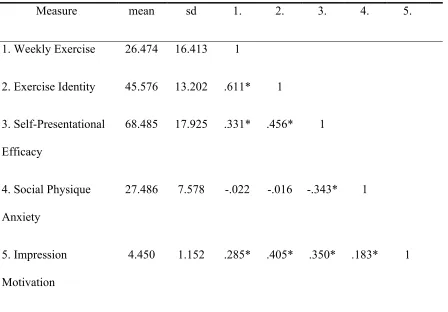
EI, SPE, SPA, IM). Pearson r values are presented in Table 2. Correlational analyses were
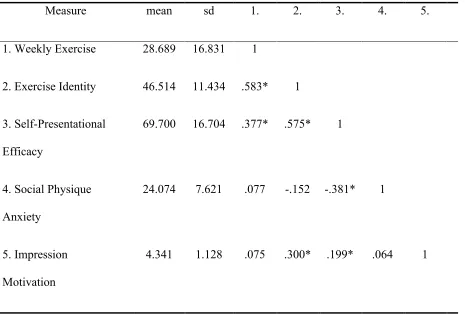
SPE, SPA, IM). Pearson r values are presented in Table 3.
For females, weekly physical activity behaviour (METS) was positively associated with
EI, SPE, and IM, but there were no relation to SPA. Notable among the psychosocial variables,
EI was positively associated with both SPE and IM, and unrelated to SPA. For males, weekly
physical activity behaviour (METS) was positively associated with EI and SPE. There was no
association with either SPA or IM variables. Notable among the psychosocial variables, EI was
positively associated with both SPE and IM. EI was unrelated SPA.
Hierarchical multiple regression analyses
Two separate hierarchical multiple regressions (one for each gender) were performed to
investigate the ability of exercise identity to predict physical activity behaviour (METS), after
controlling for SPE, SPA, and IM. Preliminary analyses were conducted to ensure no violation of
the assumptions of normality, linearity, and homoscedasticity. Additionally, tolerance and variance inflation statistics (VIF) were examined to rule out the possibility of multicollinearity. General sample size criteria were met, as the total N was greater than 50 + 8m, where m
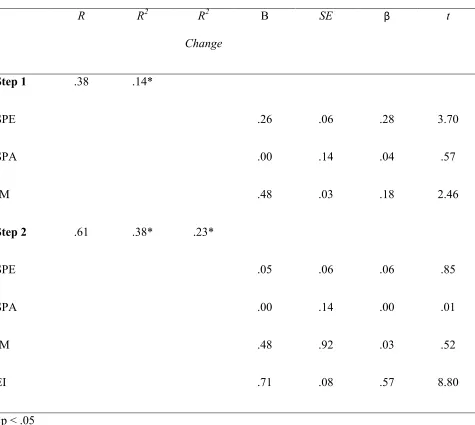
represents the number of independent variables used in the model (Tabachnick & Fidell, 2008). For females, in the first step of hierarchical multiple regression, three predictors were entered: SPE, SPA, and IM. This model was statistically significant F (3, 208) = 11.61, p < .001 and explained 14% of variance in METS. After entry of EI at Step 2 the total variance explained by the model as a whole was 37% (F (4, 207) = 31.33, p < .001). The introduction of EI
explained an additional 23% of variance in METS, after controlling SPE, SPA, and IM (R2 Change = .23, F (1, 207) = 77.67, p < .001). In the final adjusted model only EI contributed a significant Beta value (β = .57, p < .001). See Table 4 for detailed results.
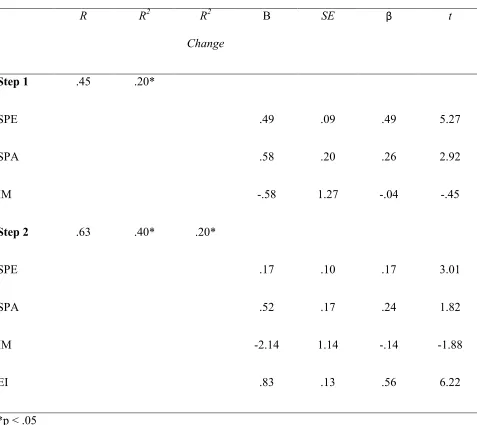
were entered: SPE, SPA, and IM. This model was statistically significant F (3, 117) = 9.77, p < .001 and explained 20% of variance in METS. After entry of EI at Step 2 the total variance explained by the model as a whole was 40% (F (4, 116) = 19.36, p < .001). The introduction of EI explained additional 20% of variance in METS, after controlling SPE, SPA, and IM (R2 Change = .20, F (1, 116) = 38.69, p < .001). In the final adjusted model only EI (β = .56, p < .001) and SPA (β = .24, p < .01) contributed a significant Beta value. See Table 5 for detailed results.
Moderation analyses
A hierarchical multiple regression analysis was used to test the hypothesis that EI may
moderate the relationship between SPA and physical activity. Prior to commencing the analysis,
the variables were zero-centered to help avoid the potentially problematic issue of high
multicollinearity. In the first step, both EI and SPA were entered into the regression to test for a
main effect (model 1). Next, an interaction term between SPA and EI was created (model 2) to
determine if it accounted for a significantly higher proportion of the variance then model 1 alone.
For females, hierarchical multiple regression results demonstrated a significant model 1
contribution towards physical activity, R2 = .344, F(2, 209) = 54.85, p < .001. However, the
model 2 SPA x EI interaction failed to account for a significant increase in the amount of
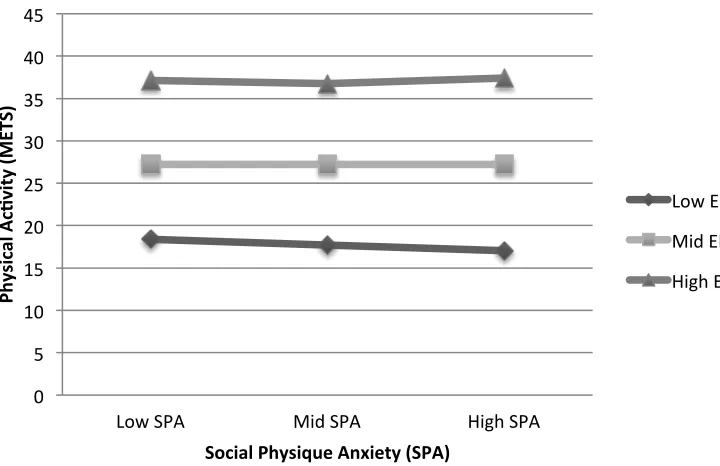
variance explained R2 Change = .002, F(1, 208) = .58, p > .05. In other words, EI did not
moderate the relationship between SPA and physical activity among females (Figure 1).
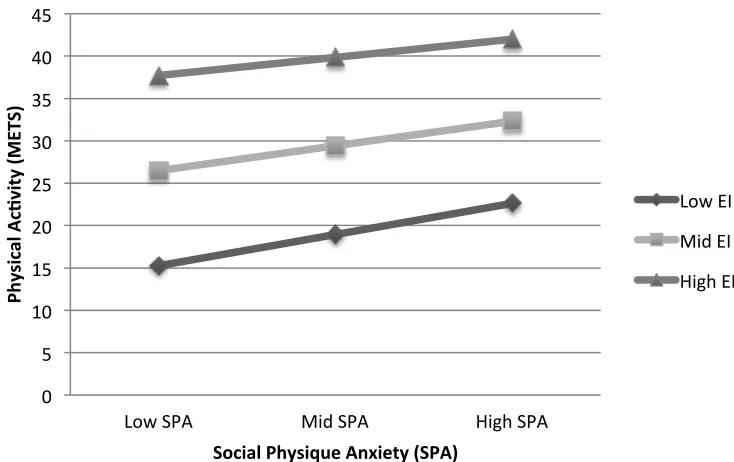
Similarly for males, the hierarchical multiple regression results demonstrated a significant model
1 contribution towards physical activity, R2 = .368, F(2, 118) = 34.43 p < .001. Again, the model
2 SPA x EI interaction failed to account for a significant increase in the amount of variance
relationship between SPA and physical activity among men (Figure 2).
Discussion
The purpose of this present study was to provide an in-depth consideration of EI’s
relationship to exercise and various body-related psychosocial variables. The findings provide
general support for most of the hypotheses forwarded. A discussion of the results with
corresponding implications follows.
Firstly, EI was significantly and positively related to SPE for both men and women. That
is, individuals with a stronger exercise identity were more confident that others would also see
them as an exerciser. This result was anticipated since self-presentation management strategies
have been previously thought of as founded, in part, in one’s public identity (Baumeister, 1982).
The concern over the public identity is a decisive factor in conformity and social inhibitions.
Further, levels of self-efficacy and self-esteem have been rooted in the level of clarity of one’s
self-concept (Campbell, 1990). It is for these reasons that fostering and reaffirming the exercise
identity ties in closely with the ability to present in a confident manner in an exercise setting. It is
likely, since identities are validated in a reciprocal manner, that further enhancements in SPE
serve to bolster the sense that exercising is a deep-rooted part of the self.
In addition, for both males and females there was no discernible relationship between EI
and SPA. This lack of a relationship was partly expected since SPA has often demonstrated an
inconsistent relationship with physical activity (Woodgate, et al., 2003; Gammage et al., 2014).
In certain instances, SPA may be negatively related to EI since those with strong identities are
often more self-assured and have a greater sense that exercise will remain an important part of
who they are despite whatever obstacles may face them. On the other hand, it is possible that
behaviours stem from anxieties over how he or she feels in a public setting. That is to say, the
internalized sense of anxiety over one’s body may regulate one’s exercise behaviours. In turn,
this may act as a driving mechanism for exercise commitments, which ultimately act in part to
cultivate the exercise identity. Therefore, it is quite possible that our lack of a significant finding
is the result of the two distinct manifestations of SPA simply cancelling one another out.
Secondly, we tested the hypothesis that exercise identity would be able to account for a
significant amount of the variation in exercise behaviour, even after controlling for various other
psychosocial variables (i.e., SPE, SPA, IM). This proved to be the case for both genders. This
finding is significant because many other studies - correlational (Anderson & Cychosz, 1995),
prospective (Cardinal & Cardinal, 1997) and qualitative (Hardcastle & Taylor, 2005) - have
clearly established that a strong EI is a key indicator of exercise behaviour. Yet, to demonstrate
that EI maintained critical leverage on behaviour over and above what was accounted for by
other key variables positions the identity as an evermore-vital construct in our field. Although it
has been demonstrated that identity has a discernable link with self-presentation (Leary & Allan,
2011), we see that even after accounting for these key self-presentation variable identity still is
able to account for exercise behaviour.
Efforts should be made to enhance the exerciser identity over time. One promising,
practical avenue is integrating positive self-affirmations into our daily routines (e.g., saying to
oneself (self-talk) or writing down: “Being an exerciser reflects my true self. It is who I am”).
This has been shown to foster a heightened sense of a global, intrinsic self and is effective in
dealing with threats to self-worth and self-integrity (Schimel, Arndt, Banko, & Cook, 2004).
Daily writing of these intrinsically self-reinforcing phrases could prove to be a straightforward
involves surrounding one’s environment with pro-exercise reminders. Some suggestions may
include: affixing a participation ribbon from an organized run to a commonly seen household
item (i.e., the refrigerator), setting up a picture of oneself in an exercise setting (e.g., hiking) as
the background image to a laptop or cell phone, or purchasing a new exercise item (e.g., running
shoes) on a semi-regular basis, and setting them near the front door. These serve as reminders
that exercise is a wholly integrated part of one’s day-to-day surroundings.
Next, we aimed to determine if EI had a moderating effect on the SPA-exercise
relationship. As previously mentioned, SPA maintains a somewhat inconsistent pattern of results
with respect to its relationship with exercise. Previous research has indicated that SPE, a
situation-specific social cognition, played a significant role as a moderator (Woodgate, et al.,
2003). It was thought that exercise identity, a more global construct, could potentially play a
similar moderating role, however this was not the case. The equivocal relationship between SPA
and exercise appears to operate independent of one’s internalized sense of self as an exerciser. It
should be noted that our sample comprised mainly university-aged participants, whereas
Woodgate and colleagues assessed a group of women whose mean age was above 70. Future
research would do well to explore the extent to which age differences affect the potential
moderating variables of the SPA and physical activity relationship.
The present study possesses several limitations that warrant discussion. As this sample
was relatively homogeneous in nature – chiefly Caucasian students who exercise on a regular
basis – the generalizability of these results should be approached with caution. Future research
should seek a more ethnically diverse sample with a broader range of ages and exercise habits.
Second, the present study was carried out as a cross-sectional design, thus limiting our ability to
strong exercise identity, scientists would do well to engage various populations in
intervention-based designs. Research of a longitudinal nature would add to our current state of knowledge. In
a similar vein, more research is required to discern what specific exercise identity intervention
strategies yield the most optimal improvements in health and wellness. Thirdly, a minor
drawback involves the acute reliance on self-report measures. Responses to questionnaires can
conceivably be regarded as self-presentations aimed at target (i.e., the researcher; Baumeister,
Tice, & Hutton, 1989). These self-presentations may reflect the true self, however, they may not.
In order to control for interpersonal motives that can with or without conscience bias affect
measurement accuracy, the development of an intrinsic, objective identity belief tool would be
prudent.
Collectively, these findings advance our knowledge of exercise identity and its
relationship with various important constructs examined throughout the contemporary literature.
Despite the aforementioned limitations, this study was benefited by its holistic scope by way of
including a variety of psychosocial variables, along with its large sample size. Indeed, exercise
identity offers a compelling reason for why many succeed (or fail) in the pursuit of a physically
Table 1
Descriptive Statistics for Demographic Information of Males and Females
Men Women
Variable n = 140 n = 234
Table 2.
Correlations, means, and standard deviations of key variables in females
Measure mean sd 1. 2. 3. 4. 5.
1. Weekly Exercise 26.474 16.413 1
2. Exercise Identity 45.576 13.202 .611* 1
3. Self-Presentational Efficacy
68.485 17.925 .331* .456* 1
4. Social Physique Anxiety
27.486 7.578 -.022 -.016 -.343* 1
5. Impression Motivation
4.450 1.152 .285* .405* .350* .183* 1
Table 3.
Correlations, means, and standard deviations of key variables in males
Measure mean sd 1. 2. 3. 4. 5.
1. Weekly Exercise 28.689 16.831 1
2. Exercise Identity 46.514 11.434 .583* 1
3. Self-Presentational Efficacy
69.700 16.704 .377* .575* 1
4. Social Physique Anxiety
24.074 7.621 .077 -.152 -.381* 1
5. Impression Motivation
4.341 1.128 .075 .300* .199* .064 1
Table 4.
Hierarchical Regression Model of Physical Activity in Females
R R2 R2
Change
B SE β t
Step 1 .38 .14*
SPE .26 .06 .28 3.70
SPA .00 .14 .04 .57
IM .48 .03 .18 2.46
Step 2 .61 .38* .23*
SPE .05 .06 .06 .85
SPA .00 .14 .00 .01
IM .48 .92 .03 .52
EI .71 .08 .57 8.80
*p < .05
Table 5.
Hierarchical Regression Model of Physical Activity in Males
R R2 R2
Change
B SE β t
Step 1 .45 .20*
SPE .49 .09 .49 5.27
SPA .58 .20 .26 2.92
IM -.58 1.27 -.04 -.45
Step 2 .63 .40* .20*
SPE .17 .10 .17 3.01
SPA .52 .17 .24 1.82
IM -2.14 1.14 -.14 -1.88
EI .83 .13 .56 6.22
*p < .05
Figure 1. Plot of the interaction effect of social physique anxiety (SPA) and exercise identity (EI) on total weekly physical activity behaviour (METS) among female participants only
0 5 10 15 20 25 30 35 40 45
Low SPA Mid SPA High SPA
Ph
ys
ic
al
Ac
+v
ity
(ME
TS
)
Social Physique Anxiety (SPA)
Low EI
Mid EI
Figure 2. Plot of the interaction effect of social physique anxiety (SPA) and exercise identity (EI) on total weekly physical activity behaviour (METS) among male participants only
0 5 10 15 20 25 30 35 40 45
Low SPA Mid SPA High SPA
Ph
ys
ic
al
Ac
+v
ity
(ME
TS
)
Social Physique Anxiety (SPA)
Low EI
Mid EI
References
Anderson, D. F., & Cychosz, C. M. (1994). Development of an exercise identity scale.
Perceptual and Motor Skills, 78, 747-751.
Anderson, D. F., & Cychosz, C. M. (1995). Exploration of the relationship between exercise behavior and exercise identity. Journal of Sport Behavior, 18(3), 159-166.
Anderson, D. F., Cychosz, C. M., & Franke, W. D. (1998). Association of exercise identity with measures of exercise commitment and physiological indicators of fitness in a law
enforcement cohort. Journal of Sport Behavior, 21, 233-241.
Aronson, E. (1969). The theory of cognitive dissonance: A current perspective. Advances in experimental social psychology, 4, 1-34.
Bandura, A. (1977). Self-efficacy: Toward a unifying theory of behavior change. Psychological Review, 84, 191-215.
Baumeister, R. F. (1982). A self-presentational view of social phenomena. Psychological Bulletin, 91, 3-26.
Baumeister, R. F., Tice, D. M., & Hutton, D. G. (1989). Self‐presentational motivations and personality differences in self‐esteem. Journal of Personality, 57(3), 547-579.Burke, P. J. (1980). The self: Measurement requirements from an interactionist perspective.
Social Psychology Quarterly, 43, 18-29.
Campbell, J. D. (1990). Self-esteem and clarity of the self-concept. Journal of Personality and Social Psychology, 59(3), 538-549.
associated with a 14-week aerobic exercise class. Journal of Sport Behaviour, 20, 377-386.
Cohen, J. (1988). Statistical power analysis for the behavioral sciences (2nd ed.). Hillsdale, NJ: Erlbaum.
Conroy, D. E., Motl, R. W., & Hall, E. G. (2000). Progress towards construct validation of the self-presentation in exercise questionnaire. Journal of Sport and Exercise Psychology, 22,
21-38.
Corcoran, K., & Fischer, J. (1987). Measures for clinical practice: a sourcebook. New York: The Free Press.
Culos-Reed, S. N., Brawley, L. R., Martin, K. A., & Leary, M. R. (2002). Self-presentation concerns and health behaviors among cosmetic surgery patients. Journal of Applied Social Psychology, 32, 560-569.
Cumming, J. & Thogersen-Ntoumani, C. (2011). Self-presentational cognitions for exercise in female adolescents. Journal of Applied Social Psychology, 41, 429-441.
Fenigstein, A., Scheier, M. F., & Buss, A. H. (1975). Public and private self- consciousness: Assessment and theory. Journal of Consulting and Clinical Psychology, 43, 522–527. Gammage, K., Hall, C., & Martin Ginis, K. (2004). Self-presentation in exercise contexts:
Differences between high and low frequency exercisers. Journal of Applied Social Psychology, 34, 1638-1651.
Gammage, K., Martin Ginis, K., & Hall, C. (2004). Self-presentational efficacy: It’s influence on social anxiety in an exercise context. Journal of Sport and Exercise Psychology, 26, 179-190.