Predicate Encryption for Circuits from LWE
Sergey Gorbunov
∗MIT
Vinod Vaikuntanathan
†MIT
Hoeteck Wee
‡ENS
Abstract
In predicate encryption, a ciphertext is associated with descriptive attribute valuesxin addition to a plaintextµ, and a secret key is associated with a predicatef. Decryption returns plaintext µif and only iff(x) = 1. Moreover, security of predicate encryption guarantees that an adversary learns nothing about the attributexor the plaintextµfrom a ciphertext, given arbitrary many secret keys that are not authorized to decrypt the ciphertext individually.
We construct a leveled predicate encryption scheme for all circuits, assuming the hardness of the subexponential learning with errors (LWE) problem. That is, for any polynomial functiond=d(λ), we construct a predicate encryption scheme for the class of all circuits with depth bounded byd(λ), where
λis the security parameter.
∗Email:
[email protected]. Supported in part by the Northrop Grumman Cybersecurity Research Consortium (CRC) and by a Microsoft PhD Fellowship.
†Email:
[email protected]. Research supported in part by DARPA Grant number FA8750- 11-2-0225, NSF Awards CNS-1350619 and CNS-1413920, an Alfred P. Sloan Research Fellowship, the Northrop Grumman Cybersecurity Research Consortium (CRC), Microsoft Faculty Fellowship, and a Steven and Renee Finn Career Development Chair from MIT.
‡E-mail:
1
Introduction
Predicate encryption [BW07, SBC+07,KSW08] is a new paradigm for public-key encryption that supports searching on encrypted data. In predicate encryption, ciphertexts are associated with descriptive attribute valuesxin addition to plaintextsµ, secret keys are associated with a predicatef, and a secret key decrypts the ciphertext to recover µ if and only if f(x) = 1. The security requirement for predicate encryption enforces privacy ofxand the plaintext even amidst multiple secret key queries: an adversary holding secret keys for different query predicates learns nothing about the attributexand the plaintext if none of them is individually authorized to decrypt the ciphertext.
Motivating applications. We begin with several motivating applications for predicate encryption [BW07,
SBC+07]:
• For inspecting recorded log files for network intrusions, we would encrypt network flows labeled with a set of attributes from the network header, such as the source and destination addresses, port numbers, time-stamp, and protocol numbers. We could then issue auditors with restricted secret keys that can only decrypt the network flows that fall within a particular range of IP addresses and some specific time period.
• For credit card fraud investigation, we would encrypt credit card transactions labeled with a set of attributes such as time, costs and zipcodes. We could then issue investigators with restricted secret keys that decrypt transactions over $1,000 which took place in the last month and originated from a particular range of zipcodes.
• For anti-terrorism investigation, we would encrypt travel records labeled with a set of attributes such as travel destination and basic traveller data. We could then issue investigators with restricted secret keys that match certain suspicious travel patterns.
• For online dating, we would encrypt personal profiles labeled with dating preferences pertaining to age, height, weight, salary and hobbies. Secret keys are associated with specific attributes and can only decrypt profiles for which the attributes match the dating preferences.
In all of these examples, it is important that unauthorized parties do not learn the contents of the ciphertexts, nor of the meta-data associated with the ciphertexts, such as the network header or dating preferences. On the other hand, it is often okay to leak the meta-data to authorized parties. We stress that privacy of the meta-data is an additional security requirement provided by predicate encryption but not by the related and weaker notion of attribute-based encryption (ABE) [SW05, GPSW06]; the latter only guarantees the privacy of the plaintextµand not the attributex.
Utility and expressiveness. The utility of predicate encryption is intimately related to the class of predicates for which we could create secret keys. Ideally, we would like to support the class of all circuits. Over the past decade, substantial advances were made for the weaker primitive of ABE, culminating most recently in schemes supporting any policy computable by general circuits [GVW13, BGG+14] under the standard LWE assumption [Reg09]. However, the state-of-the-art for predicate encryption is largely limited to very simple functionalities related to computing an inner product [BW07, SBC+07,KSW08,AFV11,GMW15].
1.1
Our Contributions
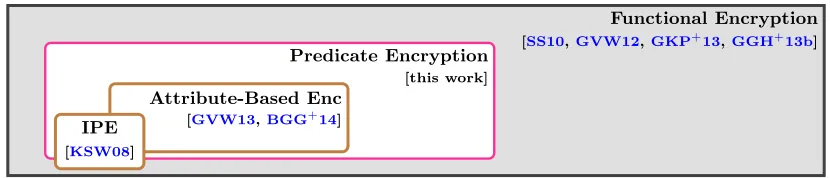
In this work, we substantially advance the state of the art to obtain predicate encryption for all circuits (c.f. Figure1):
Functional Encryption
[SS10,GVW12,GKP+13,GGH+13b]
Predicate Encryption
[this work]
Attribute-Based Enc
[GVW13,BGG+14]
IPE
[KSW08]
Figure 1: State of the art in functional encryption. The white region refers to functionalities for which we have constructions under standard cryptographic assumptions like LWE or decisional problems in bilinear groups: these functionalities include inner product encryption (IPE), attribute-based encryption for general circuits (ABE) and predicate encryption for general circuits. The grey region refers to functionalities beyond predicate encryption for which we only have constructions for weaker security notions like bounded collusions, or under non-standard cryptographic assumptions like obfuscation or multilinear maps.
As with prior LWE-based ABE for circuits [GVW13,BGG+14], to support circuits of depthd, the parameters of the scheme grow with poly(d), and we require sub-exponential nΩ(d) hardness of the LWE assumption. In addition, the security guarantee is selective, but can be extended to adaptive security via complexity leveraging [BB04].
Privacy guarantees. The privacy notion we achieve is a simulation-based variant of “attribute-hiding” from the literature [SBC+07, OT10, AFV11]. That is, we guarantee privacy of the attribute x and the plaintext µ against collusions holding secret keys for functions f such that f(x) = 0. An even stronger requirement would be to require privacy ofxeven against authorized keys corresponding to functionsf where f(x) = 1; in the literature, this stronger notion is referred to as “full attribute-hiding” [BW07, KSW08]. This stronger requirement is equivalent to “full-fledged” functional encryption [BSW11], for which we cannot hope to achieve simulation-based security for all circuits as achieved in this work [BSW11, AGVW13].
Relation to prior works. Our result subsumes all prior works on functional encryption under standard cryptographic assumptions, apart from a few exceptions pertaining to the inner product predicate [BW07,KSW08,OT12]. In a recent break-through work, Garg et al. [GGH+13b] gave a beautiful candidate construction of functional encryption for general circuits; however, the construction relies on “multi-linear maps” [GGH13a,CLT13], for which we have few candidates, along with complex intractability assumptions which are presently poorly understood and not extensively studied in cryptanalysis. In contrast, if we consider collusions of a prioribounded size, a weaker guarantee that is still meaningful for many applications, then it is possible to obtain functional encryption for general circuits under a large class of standard assumptions [SS10,GVW12,GKP+13]. See Figure1 for a pictorial summary.
1.2
Overview of Our Construction
Our starting point is the work of Goldwasser, Kalai, Popa, Vaikuntanathan and Zeldovich [GKP+13] who show how to convert an attribute-based encryption (ABE) scheme into a single key secure functional encryption (FE) scheme. Recall that in an attribute-based encryption scheme [GPSW06], a ciphertext is associated with a descriptive value (a public “attribute”)xand plaintextµ, and it hidesµ, but notx. The observation of Goldwasser et al. [GKP+13] is to hidexby encrypting it using a fully homomorphic encryption (FHE) scheme [Gen09,BV11b], and then using the resulting FHE ciphertext as the public “attribute” in an ABE scheme for general circuits [GVW13,BGG+14]. This has the dual benefit of guaranteeing privacy of x, while at the same time allowing homomorphic computation of predicatesf on the encryption ofx.
depends on whether theplaintextf(x) is 0 or 1.1 Clearly, resolving this conundrum requires obtainingf(x), which requires knowledge of the FHE secret key. Goldwasser et al. [GKP+13] solved this by employing a (single use) Yao garbling of the FHE decryption circuit, however this limited them to obtaining single key securepredicate/functional encryption schemes.2
Our first key idea is to embed the FHE secret key as part of the attributes in the ABE ciphertext. That is, in order to encrypt a plaintext µwith attributes xin the predicate encryption scheme, we first choose a symmetric key fhe.sk for the FHE scheme, encryptx into a FHE ciphertext ˆx, and encrypt µusing the ABE scheme with (fhe.sk,x) as the attributes to obtain an ABE ciphertextˆ ct. Our predicate encryption ciphertext is then given by
(ˆx,ct)
To generate the predicate secret key for a function f, one simply generates the ABE secret key for the functiongthat takes as input (fhe.sk,x) and computesˆ
g(fhe.sk,x) =ˆ FHE.Dec(fhe.sk;FHE.Eval(f,x))ˆ
That is,g first homomorphically computes a FHE encryption off(x), and then decrypts it using the FHE secret key to outputf(x).
At first glance, this idea evokes strong and conflicting emotions as it raises two problems. The first pertains to correctness: we can no longer decrypt the ciphertext since the ABE decryption algorithm needs to know all of the attributes (ˆxandfhe.sk), butfhe.skis missing. The second pertains to security: the ABE ciphertext ct is not guaranteed to protect the privacy of the attributes, and could leak all offhe.sk which together with ˆxwould leak all ofx. Solving both of these problems seems to require designing a predicate encryption scheme from scratch!
Our next key observation is that the bulk of the computation ing, namely the homomorphic evaluation of the function f, is performed on the public attribute ˆx. The only computation performed on the secret valuefhe.skis FHE decryption which is a fairly lightweight computation. In particular, with all known FHE schemes [Gen09, BV11b, BV11a,BGV12,GSW13,BV14, AP14], decryption corresponds to computing an inner product followed by a threshold function. Furthermore, we do know how to construct lattice-based predicate encryption schemes for threshold of inner product [AFV11,GMW15]. We stress that the latter do not correspond to FHE decryption since the inner product is computed over a vector in the ciphertext and one in the key, whereas FHE decryption requires computing an inner product over two vectors in the ciphertext; nonetheless, we will build upon the proof techniques in achieving attribute-hiding in [AFV11, GMW15] in the proof of security.
In other words, if we could enhance ABE with a modicum of secrecy so that it can perform a heavyweight computation on public attributes followed by a lightweight privacy-preserving computation onsecretattributes, we are back in business. Our first contribution is to define such an object, that we call partially hiding predicate encryption.
Partially Hiding Predicate Encryption. We introduce the notion of partially hiding predicate encryption (PHPE), an object that interpolates between attribute-based encryption and predicate encryption (analogously to partial garbling in [IW14]). In PHPE, the ciphertext, encrypting message µ, is associated with an attribute (x, y) wherexis private butyis always public. The secret key is associated with a function f, and decryption succeeds ifff(x, y) = 1. On the one extreme, considering a dummyxor functionsf that
1In fact, there is a syntactic mismatch since ˆf(·) is not a predicate, as it outputs an FHE ciphertext.
2A reader familiar with [GKP+13] might wonder whether replacing single-use garbled circuits in their construction with reusable garbled circuits (also from [GKP+13]) might remove this limitation. We remark that this does not seem possible, essentially because the construction in [GKP+13] relies crucially on the simplicity of computing garbled inputs from the “garbling key”. In particular, in Yao’s garbled circuit scheme, the garbling key is (many) pairs of “strings”L0 andL1, and a
garbling of an input bitbis simplyLb. This fits perfectly with the semantics of ABE (rather, a variant termed two-input ABE in [GKP+13]) that releases one of two possible “messages”L
0 orL1depending on the outcome of a computation. In contrast,
ignorexand compute ony, we recover attribute-based encryption. On the other end, considering a dummy y or functionsf that ignore y and compute onx, we recover predicate encryption.
We will be interested in realizing PHPE for functionsφof the formφ(x, y) =g(x, h(y)) for some functions gandhwherehmay perform arbitrary heavy-weight computation on the publicyandgonly performs light-weight computation on the privatex. Mapping back to our discussion, we would like to achieve PHPE for the “evaluate-then-decrypt” class of functions, namely wheregis the FHE decryption function,his the FHE evaluation function, xis the FHE secret key, and y is the FHE ciphertext. In general, we would like g to be simple and will allowhto be complex. It turns out that we can formalize the observation above, namely that PHPE for this class of functions gives us a predicate encryption scheme. The question now becomes: can we construct PHPE schemes for the “evaluate-then-decrypt” class of functions?
Assuming the subexponential hardness of learning with errors (LWE), we show how to construct a partially hiding predicate encryption for the class of functionsf :Zt
q× {0,1}`→ {0,1}of the form
fγ(x,y) =IPγ(x, h(y)),
whereh:{0,1}`→ {0,1}t,γ∈
Zq, andIPγ(x,z) = 1 iffhx,zi=
P
i∈[t]x[i]·z[i]
=γ modq.
This is almost what we want, but not quite. Recall that FHE decryption in many recent schemes [BV11b,
BGV12,GSW13,BV14,AP14] is a function that checks whether an inner product of two vectors inZt q (one
of which could be over{0,1}t) lies in a certain range. Indeed, ifz∈ {0,1}tis an encryption of 1 andx∈
Ztq
is the secret key, we know thathx,zi ∈[q/2−B, q/2 +B] (mod q), whereBis the noise range. Applying the so-called “modulus reduction” [BV11b] transformation to all these schemes, we can assume that this range is polynomial in size.
In other words, we will manage to construct a partially hiding PE scheme for the function
fγ(x,y) :hx, h(y)i
?
=γ (modq)
whereas we need a partially hiding PE scheme for the FHE decryption function which is
fR0(x,y) :hx, h(y)i∈? R (modq)
whereR is the polynomial size range [q/2−B, q/2 +B] from above. How do we reconcile this disparity?
The “Lazy OR” Trick. The solution, called the “lazy OR trick” [SBC+07,GMW15] is to publish secret keys for all functionsfγforγ∈R:= [q/2−B, q/2+B]. This will indeed allow us to test if the FHE decryption
of the evaluated ciphertext is 1 (and reveal the messageµif it is), but it is also worrying. Publishing these
predicate secret keys for the predicatesfγreveals more information than whetherhx, h(y)i
?
∈R. In particular, it reveals what hx, h(y)i is. This means that an authorized key would leak partial information about the attribute, which we do allow for predicate encryption. On the other hand, for an unauthorized key where the FHE decryption is 0, each of thesefγ, γ ∈R is also an unauthorized key in the PHPE and therefore leaks
no information about the attribute. This extends to the collection of keys in R since the PHPE is secure against collusions. For simplicity, we assume in the rest of this overview that FHE decryption corresponds to exactly to inner product.
Asymmetry to the Rescue: Constructing Partially Hiding PE. Our final contribution is the construction of a partially hiding PE for the function class fγ(x,y) above. We will crucially exploit the
fact that fγ computes an inner product on the private attribute x. There are two challenges here: first,
we need to design a decryption algorithm that knowsfγ andy but notx (this is different from decryption
hide them in exactly the way we want. In particular, the scheme allows us to carry out an inner product of a public attribute vector (corresponding to the evaluated FHE ciphertext) and a private attribute vector (corresponding to the FHE secret keyfhe.sk), thanks to an inherent asymmetry in homomorphic evaluation of a multiplication gate on ABE ciphertexts. More concretely, in the homomorphic evaluation of a ciphertext for a multiplication gate in [BGG+14], the decryption algorithm works even if one of the attribute remains private, and for addition gates, the decryption algorithms works even if both attributes remain private. This addresses the first challenge of a decryption algorithm that is oblivious to x. For the second challenge of security, we rely on techniques from inner product predicate encryption [AFV11] to prove the privacy ofx
Note that in the latter, the inner product is computed over a vector in the ciphertext and one in the key, whereas in our scheme, the inner product is computed over two vectors in the ciphertext. Interestingly, the proof still goes through since the ciphertext in the ABE [BGG+14] has the same structure as the ciphertext in [AFV11]. We refer the reader to Section 3.2.1for a detailed overview of the partial hiding PE, and to Section4 for an overview of how we combine the partial hiding PE with FHE to obtain our main result.
Finally, we remark that exploiting asymmetry in multiplication has been used in fairly different contexts in both FHE [GSW13, BV14] and in ABE [GVW13, GV14]. In [GSW13] and in this work, the use of asymmetry was crucial for realizing the underlying cryptographic primitive; whereas in [GVW13, BV14,
GV14], asymmetry was used to reduce the noise growth during homomorphic evaluation, thereby leading to quantitative improvements in the underlying assumptions and hence improved efficiency.
1.3
Discussion
Comparison with other approaches. The two main alternative approaches for realizing predicate and functional encryption both rely on multi-linear maps either implicitly, or explicitly. The first is to use indistinguishability obfuscation as in [GGH+13b], and the second is to extend the dual system encryption framework to multi-linear maps [Wat09, GGHZ14]. A crucial theoretical limitation of these approaches is that they all rely on non-standard assumptions; we have few candidates for multi-linear maps [GGH13a,
CLT13, GGH15] and the corresponding assumptions are presently poorly understood and not extensively studied in cryptanalysis, and in some cases, broken [CHL+14]. In particular, the latest attack in [CHL+14] highlight the importance of obtaining constructions and developing techniques that work under standard cryptographic assumptions, as is the focus of this work.
Barriers to functional encryption from LWE. We note the two main barriers to achieving full-fledged functional encryption from LWE using our framework. First, the lazy conjunction approach to handle threshold inner product for FHE decryption leaks the exact inner product and therefore cannot be used to achieve full attribute-hiding. Second, we do not currently know of a fully attribute-hiding inner product encryption scheme under the LWE assumption, although we do know how to obtain such schemes under standard assumptions in bilinear groups [OT12,KSW08].
2
Preliminaries
Notation. Let PPT denote probabilistic polynomial-time. For any integer q ≥ 2, we letZq denote the
ring of integers modulo q and we represent Zq as integers in (−q/2, q/2]. We let Znq×m denote the set of
n×mmatrices with entries in Zq. We use bold capital letters (e.g.A) to denote matrices, bold lowercase
letters (e.g.x) to denote vectors. We usex[i] to refer to i’th element of vectorx. The notation AT denotes the transpose of the matrixA.
If A1 is ann×mmatrix and A2 is ann×m0 matrix, then [A1kA2] denotes then×(m+m0) matrix formed by concatenating A1 and A2. A similar notation applies to vectors. When doing matrix-vector multiplication we always view vectors as column vectors.
For a vectorx, we let||x||denote its`2norm and||x||∞denote its infinity norm. For a matrixR∈Zm×m
We say a functionf(n) isnegligibleif it isO(n−c) for allc >0, and we use negl(n) to denote a negligible function of n. We say f(n) is polynomial if it is O(nc) for some c > 0, and we use poly(n) to denote
a polynomial function of n. We say an event occurs with overwhelming probability if its probability is 1−negl(n). The function lgxis the base 2 logarithm of x. The notationbxedenotes the nearest integer to x, rounding towards 0 for half-integers.
2.1
Lattice Preliminaries
2.1.1 Learning With Errors (LWE) Assumption
The LWE problem was introduced by Regev [Reg09], who showed that solving iton the averageis as hard as (quantumly) solving several standard lattice problemsin the worst case.
Definition 2.1(LWE). For an integerq=q(n)≥2and an error distributionχ=χ(n)overZq, the learning
with errors problem dLWEn,m,q,χ is to distinguish between the following pairs of distributions:
A,As+x
and A,u
whereA←$ Znq×m,s
$ ←Znq,x
$
←χm,u←$ Zmq .
Connection to lattices. LetB =B(n)∈N. A family of distributionsχ={χn}n∈Nis calledB-bounded if
Pr[χ∈ {−B, . . . , B−1, B}] = 1.
Regev and Peikert [Reg09, Pei09] showed that there is a B-bounded distribution χ such that solving
dLWEn,m,q,χ is as hard as (quantumly) approximating certain worst case lattice problems to a factor of
˜
O(n·q/B). These lattices problems are believed to be hard to approximate even whenq/B is 2n
for some fixed 0 < <1/2. Thus, the hardness of dLWE depends on the modulus-to-noise ratio q/B – the smaller the ratio, the harder the problem. Throughout this paper, the parameter m= poly(n), in which case we will shorten the notation slightly toLWEn,q,χ. We refer to [Pei09] for a detailed account of the worst-case to
average-case connection for LWE.
2.2
Lattice Algorithms
Gaussian distributions. Let DZm,σ be the truncated discrete Gaussian distribution over Zm with parameter σ, that is, we replace the output by 0 whenever the || · ||∞ norm exceeds
√
m·σ. Note that DZm,σ is
√
m·σ-bounded.
Lemma 2.1 (Lattice Trapdoors [Ajt99, GPV08, MP12]). There is an efficient randomized algorithm
TrapSamp(1n,1m, q) that, given any integers n≥ 1, q ≥ 2, and sufficiently large m = Ω(nlogq), outputs
a matrix A ∈ Znq×m and a trapdoor matrixT ∈Zm×m such that the distribution of A isnegl(n)-close to
uniform.
Moreover, there is an efficient algorithm SampleD that with overwhelming probability over all random choices, does the following: For any u∈Znq, and large enough s = Ω(
√
nlogq), the randomized algorithm
SampleD(A,T,u, s) outputs a vector r ∈ Zm with norm ||r||∞ ≤ ||r||2 ≤ s
√
n (with probability 1). Furthermore, the following distributions of the tuple (A,T,U,R) are within negl(n) statistical distance of each other for any polynomialk∈N:
• (A,T)←TrapSamp(1n,1m, q);U←
Znq×k;R←SampleD(A,T,U, s).
• (A,T)←TrapSamp(1n,1m, q);R←(D
Zm,s)k;U:=AR (mod q).
Lemma 2.2. Suppose thatm≥(n+ 1) logq+ω(logn)and that q≥2 is square free. LetR be an m×k matrix chosen uniformly from {−1,1}m×k modq where k = k(n) is polynomial in n. Let A and B be
matrices chosen uniformly in Zn×m andZn×k respectively. Then for all vectors w ∈ Zm, the distribution
We will use the following algorithms to sample short vectors from specific lattices. Looking ahead, the algorithmSampleLeft[ABB10,CHKP12] will be used to sample keys in the real system, while the algorithm
SampleRight[ABB10] will be used to sample keys in the simulation.
Algorithm SampleLeft(A,B,TA,u, α):
Inputs: a full rank matrixAin Znq×m, a “short” basisTAof Λ⊥q(A),
a matrixBin Zn×m1
q , a vectoru∈Znq, and a Gaussian parameterα. (1)
Output: LetF:= (AkB). The algorithm outputs a vectore∈Zm+m1
in the coset ΛF+u.
Theorem 2.3 ([ABB10, Theorem 17], [CHKP12, Lemma 3.2]). Let q > 2, m > n and α > kgTAk · ω(plog(m+m1)). Then SampleLeft(A,B,TA,u, α) taking inputs as in (1) outputs a vector e ∈ Zm+m1
distributed statistically close toDΛF+u,α, whereF:= (Ak B).
WherekTek refers to the norm of Gram-Schmidt orthogonalisation of T. We refer the readers to [ABB10]
for more details.
Algorithm SampleRight(A,B,R,TB,u, α):
Inputs: matricesAin Znq×k andR inZk×m, a full rank matrixBin
Znq×m, a “short” basisTBof Λq⊥(B), a vectoru∈Znq, and a Gaussian
parameterα.
(2)
Output: Let F := (A k AR+B). The algorithm outputs a vector
e∈Zm+k in the coset Λ
F+u.
Often the matrixRgiven to the algorithm as input will be a random matrix in{1,−1}m×m. LetSmbe the
m-sphere{x∈Rm+1 : kxk= 1}. We defines
R:=kRk:= supx∈Sm−1kR·xk.
Theorem 2.4 ([ABB10, Theorem 19]). Let q > 2, m > n and α > kTgBk · sR ·ω(
√
logm). Then
SampleRight(A,B,R,TB,u, α) taking inputs as in (2) outputs a vector e ∈ Zm+k distributed statistically
close to DΛF+u,α, whereF:= (Ak AR+B).
2.2.1 Primitive matrix
We use the primitive matrix G ∈ Znq×m defined in [MP12]. This matrix has a trapdoor TG such that
kTGk∞ = 2. We also define an algorithm G−1 : Zqn×m → Zmq×m which deterministically derives a short
pre-imageAe satisfyingG·Ae =A; the algorithm corresponds to bit decomposition.
2.3
Fully-Homomorphic Encryption
We present a fairly minimal definition of fully homomorphic encryption (FHE) which is sufficient for our constructions. A leveled homomorphic encryption scheme is a tuple of polynomial-time algorithms (HE.KeyGen,HE.Enc,HE.Eval,HE.Dec):
• Key generation. HE.KeyGen(1λ,1d,1k) is a probablistic algorithm that takes as input the security
parameterλ, a depth bounddand message lengthk and outputs a secret keysk.
• Encryption. HE.Enc(sk, µ) is a probabilistic algorithm that takes as inputskand a messageµ∈ {0,1}k
and outputs a ciphertext ct.
• Homomorphic evaluation. HE.Eval(f,ct) is a deterministic algorithm that takes as input a boolean circuitC:{0,1}k→ {0,1} of depth at mostdand a ciphertextctand outputs another ciphertextct0.
Correctness. We require perfect decryption correctness with respect to homomorphically evaluated ciphertexts: namely for all λ, d, k and all sk ← HE.KeyGen(1λ,1d,1k), all µ ∈ {0,1}k and for all boolean
circuitsC:{0,1}k → {0,1}of depth at most d:
PrhHE.Dec(sk, HE.Eval(C,HE.Enc(sk, µ))) =C(µ)i= 1
where the probablity is taken overHE.EncandHE.KeyGen.
Security. We require semantic security for a single ciphertext: namely for every stateful p.p.t. adversary
Aand for alld, k= poly(λ), the following quantity
Pr
b=b0:
sk←Setup(1λ,1d,1k); (µ0, µ1)← A(1λ,1d,1k); b← {$ 0,1};
ct←Enc(sk, µb);
b0← A(ct)
−1
2
is negligible inλ.
2.3.1 FHE from LWE
We will rely on an instantiation of FHE from the LWE assumption:
Theorem 2.5 (FHE from LWE [BV11b, BGV12, GSW13, BV14, AP14]). There is a FHE scheme
HE.KeyGen,HE.Enc,HE.Eval,HE.Decthat works for anyq withq≥O(λ2)with the following properties:
• HE.KeyGen outputs a secret keysk∈Ztq wheret= poly(λ);
• HE.Enc outputs a ciphertextct∈ {0,1}` where`= poly(k, d, λ,logq);
• HE.Evaloutputs a ciphertext ct0∈ {0,1}t;
• for any boolean circuit of depthd,HE.Eval(C,·)is computed by a boolean circuit of depthpoly(d, λ,logq).
• HE.Decon input sk,ct0 outputs a bitb∈ {0,1}. Ifct0 is an encryption of 1 then
t
X
i=1
sk[i]·ct0[i]∈[bq/2c −B,bq/2c+B]
for some fixed B= poly(λ). Otherwise, ifct0 is an encryption of0, then
t
X
i=1
sk[i]·ct0[i]∈/[bq/2c −B,bq/2c+B];
• security relies ondLWEΘ(t),q,χ.
We highlight several properties of the above scheme: (1) the ciphertext is a bit-string, (2) the bound B is a polynomial independent ofq(here, we crucially exploit the new results in [BV14] together with the use of leveled bootstrapping)3, (3) the size of normal ciphertexts is independent of the size of the circuit (this is the typical compactness requirement).
3
Partially Hiding Predicate Encryption
3.1
Definitions
We introduce the notation of partially hiding predicate encryption (PHPE), which interpolates attribute-based encryption and predicate encryption (analogously to partial garbling in [IW14]). In PHPE, the ciphertext, encrypting messageµ, is associated with an attribute (x, y) where xis private but y is always public. The secret key is associated with a predicate C, and decryption succeeds iff C(x, y) = 1. The requirement is that a collusion learns nothing about (x, µ) if none of them is individually authorized to decrypt the ciphertext. Attribute-based encryption corresponds to the setting wherexis empty, and predicate encryption corresponds to the setting where y is empty. We refer the reader to SectionAfor the standard notion of predicate encryption.
Looking ahead to our construction, we show how to:
• construct PHPE for a restricted class of circuits that is “low complexity” with respect toxand allows arbitrarily polynomial-time computation ony;
• bootstrap this PHPE using FHE to obtain PE for all circuits.
Syntax. A Partially-Hiding Predicate Encryption scheme PHPE for a pair of input-universes X,Y, a predicate universeC, a message spaceM, consists of four algorithms (PH.Setup,PH.Enc,PH.Keygen,PH.Dec):
PH.Setup(1λ,X,Y,C,M)→ (ph.mpk,ph.msk). The setup algorithm gets as input the security parameter
λ and a description of (X,Y,C,M) and outputs the public parameter ph.mpk, and the master key
ph.msk.
PH.Enc(ph.mpk,(x, y), µ)→cty. The encryption algorithm gets as inputph.mpk, an attribute (x, y)∈ X ×Y
and a messageµ∈ M. It outputs a ciphertextcty.
PH.Keygen(ph.msk, C)→skC. The key generation algorithm gets as input ph.mskand a predicateC∈ C.
It outputs a secret keyskC.
PH.Dec((skC, C),(cty, y))→µ. The decryption algorithm gets as input the secret key skC, a predicateC,
and a ciphertextcty and the public part of the attributey. It outputs a messageµ∈ Mor⊥.
Correctness. We require that for all PH.Setup(1λ,X,Y,C,M) → (ph.mpk,ph.msk), for all (x, y, C) ∈ X × Y × C, for allµ∈ M,
• ifC(x, y) = 1,
Pr
PH.Dec((skC, C),(cty, y)) =µ
≥1−negl(λ),
• ifC(x, y) = 0,
Pr
PH.Dec((skC, C),(cty, y)) =⊥
≥1−negl(λ),
where the probabilities are taken over skC ← PH.Keygen(ph.msk, C), cty ← PH.Enc(ph.mpk,(x, y), µ) and
coins ofPH.Setup.
expreal
PHPE,Adv(1
λ): expideal
PHPE,Sim(1λ):
1: (x, y)←Adv(1λ,X,Y,C,M)
2: (ph.mpk,ph.msk)←PH.Setup(1λ,X,Y,C,M)
3: µ←AdvPH.Keygen(msk,·)(ph.mpk)
4: cty←PH.Enc(ph.mpk,(x, y), µ)
5: α←AdvPH.Keygen(ph.msk,·)(cty)
6: Output(x, y, µ, α)
1: (x, y)←Adv(1λ,X,Y,C,M)
2: (ph.mpk,ph.msk)←PH.Setup(1λ,X,Y,C,M)
3: µ←AdvPH.Keygen(ph.msk,·)(ph.mpk)
4: cty←Sim(mpk, y,1|x|,1|µ|)
5: α←AdvPH.Keygen(msk,·)(cty)
6: Output(x, y, µ, α)
We say an adversary Adv is admissible if all oracle queries that it makes C ∈ C satisfy C(x, y) = 0. The Partially-Hiding Predicate Encryption scheme PHPE is then said to be attribute-hiding if there is a p.p.t. simulator Sim such that for every stateful p.p.t. adversary Adv, the following two distributions are computationally indistinguishable:
exprealPHPE,Adv(1λ)
λ∈N
c
≈
expidealPHPE,Sim(1λ)
λ∈N
Remarks. We point out some remarks of our definition (SIM-AH) when treated as a regular predicate encryption (i.e. the setting wherey is empty; see DefinitionA.1for completeness) and how it compares to other definitions in the literature.
• We note the simulator for the challenge ciphertext gets y but notx; this captures the fact thaty is public whereasxis private. In addition, the simulator is not allowed to program the public parameters or the secret keys. In the ideal experiment, the simulator does not explicitly learn any information about x (apart from its length); nonetheless, there is implicit leakage about xfrom the key queries made by an admissible adversary. Finally, we note that we can efficiently check whether an adversary is admissible.
• Our security notion is “selective”, in that the adversary “commits” to (x, y) before it sees ph.mpk. It is possible to bootstrap selectively-secure scheme to full security using standard complexity leveraging arguments [BB04, GVW13], at the price of a 2|x|loss in the security reduction.
• Our definition refers to a single challenge message, but the definition extends readily to a setting with multiple challenge messages. Moreover, our definition composes in that security for a single message implies security with multiple messages (see Section A.2). The following remarks refer to many messages setting.
• We distinguish between two notions of indistinguishability-based (IND) definitions used in the literature: attribute-hiding (IND-AH)4 and strong attribute-hiding (IND-SAH)5 [BW07, SBC+07,
KSW08,AFV11]. In the IND-AH, the adversary should not be able to distinguish between two pairs of attributes/messages given that it is restricted to queries which do not decrypt the challenge ciphertext (See SectionA.3). It is easy to see that our SIM-AH definition is stronger than IND-AH. Furthermore, IND-SAH also ensures that adversary cannot distinguish between the attributes even when it is allowed to ask for queries that decrypt the messages (in this case, it must output µ0 = µ1). Our SIM-AH definition is weaker than IND-SAH, since we explicitly restrict the adversary to queries that do not decrypt the challenge ciphertext.
• In the context of arbitrary predicates,strongvariants of definitions (that is, IND-SAH and SIM-SAH) are equivalent to security notions for functional encryption (the simulation definition must be adjusted
to give the simulated the outputs of the queries). However, the strong variant of notion (SIM-SAH) is impossible to realize for many messages [BSW11, AGVW13]. We refer the reader to Section A.2
for a sketch of the impossibility. Hence, SIM-AH is the best-possible simulation security for predicate encryption which we realize in this work. The only problem which we leave open is to realize IND-SAH from standard LWE.
3.2
Our Construction
3.2.1 Overview
We construct a partially hiding predicate encryption for the class of predicate circuitsC:Ztq×{0,1}`→ {0,1}
of the formCb ◦ IPγ whereCb:{0,1}`→ {0,1}tis a boolean circuit of depthd,γ∈Zq, and
(Cb ◦ IPγ)(x,y) =IPγ(x,C(b y)),
where IPγ(x,z) = 1 iffhx,zi=
P
i∈[t]x[i]·z[i]
=γ modq. We refer to circuit IPas the generic
inner-product circuit of two vectors.
Looking ahead, Cb corresponds to FHE evaluation of an arbitrary circuitC, whereasIPγ corresponds to
roughly to FHE decryption; in the language of the introduction in Section1,Cb corresponds to heavy-weight
computationh, whereasIPγ corresponds to light-weight computationg.
The scheme. The public parameters are matrices
A, A1, . . . ,A`, B1, . . . ,Bt
An encryption corresponding to the attribute (x,y)∈Zt
q× {0,1}` is a GPV ciphertext (an LWE sample)
corresponding to the matrix
A|A1+y[1]·G| · · · |A`+y[`]·G|B1+x[1]·G| · · · |Bt+x[t]·G
To decrypt the ciphertext given y and a key for Cb ◦ IPγ, we apply the BGGHNSVV algorithm to first
transform the first part of the ciphertext into a GPV ciphertext corresponding to the matrix
A|A
b
C1+z[1]·G| · · · |ACbt+z[t]·G
whereCbi is the circuit computing thei’th bit ofCb andz=C(b y)∈ {0,1}t. Next, observe that
−(A
b
Ci+z[i]·G)·G −1(B
i)
+z[i]·Bi+x[i]·G
=−A
b
CiG −1(B
i) +x[i]·z[i]·G.
Summing overi, we have
`
X
i=1
−(A
b
Ci+z[i]·G)·G −1(B
i)
+z[i]·Bi+x[i]·G
=A
b
C◦IP+hx,zi ·G
where
A
b
C◦IP:=−
A
b
C1G
−1
(B1) +· · ·+A
b
CtG −1
(Bt)
.
Therefore, given only the public matrices andy (but notx), we may transform the ciphertext into a GPV ciphertext corresponding to the matrix
A|A
b
C◦IP+hx,zi ·G
.
The secret key corresponding toCb ◦ IPγ is essentially a “short basis” for the matrix
A|A
b
C◦IP+γ·G
Proof strategy. There are two main components to the proof. Fix the selective challenge attributex,y. First, we will simulate the secret keys without knowing the trapdoor for the matrixA: here, we rely on the simulated key generation for the ABE [BGG+14]. Roughly speaking, we will need to generate a short basis for the matrix
A|AR
b
C◦IP+ (γ−Cb ◦ IP(x,y))·G
where R
b
C◦IP is a small-norm matrix known to the simulator. Now, whenever Cb ◦ IP(x,y)6= γ as is the case for admissible adversaries, we will be able to simultae secret keys using the puncturing techniques in [ABB10, AFV11,MP12]
Next, we will show that the attributexis hidden in the challenge ciphertext. Here, we adopt the proof strategy for attribute-hiding inner product encryption in [AFV11, GMW15]. In the proof, we simulate the matricesA,B1, . . . ,Btusing
A,AR01−x[1]G, . . . ,AR0t−x[t]G
whereR01, . . . ,R0t← {±$ 1}m×m. In addition, we simulate the corresponding terms in the challenge ciphertext
by:
c,cTR0 1, . . . ,c
TR0
t
where cis a uniformly random vector, which we switched fromATs+e using the LWE assumption. Here we crucially rely on the fact that switched to simulation of secret keys without knowing the trapdoor of
A. Going further, once c is random, we can switch back to simulating secret keys using the trapdoor T. Hence, the secret keys now do not leak any information about R01, . . . ,R0t. Therefore, we may then invoke
the left-over hash lemma to argue thatxis information-theoretically hidden.
3.2.2 Auxiliary evaluation algorithms
In order to formally describe our scheme, we first need to recall two algorithms (Evalpk,Evalct) from the BGGHNSVV14 ABE [BGG+14], which we may use as a “black box” and then extend to our setting. Given a boolean predicateC :{0,1}`→ {0,1} andy∈ {0,1}`, the algorithm Eval
cttransforms a GPV ciphertext for the matrix
A1+y[1]·G| · · · |A`+y[`]·G
into one for the matrix
AC+C(y)·G,
where the matrix AC is deterministically derived from (C,A1, . . . ,A`) via Evalpk. We then extend
Evalpk,Evalctto handle circuitsCb◦IPas outlined above, with the additional property thatEvalctis oblivious to x. We exploit the fact that for a multiplication gate, Evalct works even if one of the attribute remains private, and for addition gates, Evalct works even if both attributes remain private. Concretely, Evalct transforms a GPV ciphertext for the matrix
A1+y[1]·G| · · · |A`+y[`]·G|B1+x[1]·G| · · · |Bt+x[t]·G
into one for the matrix
A
b
C◦IP+ (Cb ◦ IP)(x,y)·G
,
where the matrixA
b
C◦IP is deterministically derived from (C,b A1, . . . ,A`,B1, . . . ,Bt) viaEvalpk, and where
Evalctgetsybut notx.
Two basic algorithms. The BGGHNSVV14 ABE provides two deterministic algorithms Evalpk,Evalct with the following properties:
• Evalpk takes as input` matrices A1, . . . ,A` ∈Zqn×m and a predicate C :{0,1}` → {0,1}, outputs a
• Evalcttakes as inputA1, . . . ,A`andCas before, along withy∈ {0,1}`and`vectorsu1, . . . ,u`∈Zmq ,
outputs a vector uC∈Zmq .
The algorithms satisfy the following properties:
• if (u1, . . . ,u`)≈ (A1+y[1]·G)Ts, . . . ,(A`+y[`]·G)Ts), thenuC ≈(AC+C(y)·G)Ts.
• if (A1, . . . ,A`) = (AR1−y[1]·G, . . . ,AR`−y[`]·G) whereR1, . . . ,R`are small-norm matrices, then
we have
AC=ARC−C(y)·G
where RC is also a small-norm matrix with a roughly n2d multiplicative blow-up.
These two properties are formalized quantitatively in the following lemma:
Lemma 3.1 (properties of Evalpk,Evalct [BGG+14]). The algorithms Evalpk,Evalct satisfy the following
properties. For all A1, . . . ,A` ∈ Znq×m, all y ∈ {0,1}`, all boolean predicate C of depth d, let AC :=
Evalpk(A1, . . . ,A`, C). Then,
• for all u1, . . . ,u`∈Zmq and all s∈Znq,
kuC−(AC+C(y)·G)Tsk∞≤O(`nlogq)O(d)·max i∈[`]
kui−(Ai+y[i]·G)Tsk∞
where uC:=Evalct(A1, . . . ,A`,u1, . . . ,u`,y, C).
• if (A1, . . . ,A`) = (AR1−y[1]·G, . . . ,AR`−y[`]·G) whereR1, . . . ,R`∈Zmq ×m, then we have
AC=ARC−C(y)·G
where RC is efficiently computable given(C,A,R1, . . . ,R`)and
kRCk∞≤O(`nlogq)
O(d)
·max{kR1k∞, . . . ,kR`k∞}
Extension to Cb ◦ IP. We extend the above algorithms to obtain the circuits of the form Cb ◦ IP. LetCbi
denote the circuit computing thei’th bit ofC.b
• Evalpktakes as input`+tmatricesA1, . . . ,A`,B1, . . . ,Bt∈Zqn×mand a circuitCb◦IP:{0,1}`×Ztq →
Zq, outputs a matrixACb◦IP ∈Znq×m computed as follows:
1. Fori= 1, . . . , t, computeA
b
Ci:=Evalpk(A1, . . . ,A`,Cbi); 2. OutputA
b
C◦IP:=−
A
b
C1G
−1(B
1) +· · ·+ACbtG−1(Bt)
.
• Evalct takes as inputA1, . . . ,A`,B1, . . . ,Bt and Cb ◦ IPas before, along with y ∈ {0,1}` and `+t
vectorsu1, . . . ,u`,v1, . . . ,vt∈Zmq , outputs a vector uCb◦IP∈Z
m
q computed as follows:
1. Fori= 1, . . . , t, computeu0
b
Ci
:=Evalct(A1, . . . ,A`,u1, . . . ,u`,y,Cbi);
2. OutputuT b
C◦IP:=
(z[1]·v1−G−1(B1)T·u01) +· · ·+ (z[t]·vt−G−1(Bt)T·u0
b
Ci
), wherez=C(b y).
We stress thatEvalctdoes not get x. We obtain the following extension of Lemma3.1:
Lemma 3.2 (properties of extended Evalpk,Evalct). The algorithms Evalpk,Evalct satisfy the following
properties. For all A1, . . . ,A`,B1, . . . ,Bt ∈ Zqn×m, all (x,y) ∈ Z t
q × {0,1}
`, all boolean circuits
b
C of
depthd, letA
b
• for all u1, . . . ,u`,v1, . . . ,vt∈Zmq and all s∈Znq,
uCb◦IP−(ACb◦IP+hx,C(b y)i ·G) Ts
∞≤O(`nlogq)
O(d)·max
i∈[`]
kui−(Ai+y[i]·G)Tsk∞, ....
where u
b
C◦IP:=Evalct(A1, . . . ,A`,B1, . . . ,Bt,u1, . . . ,u`,v1, . . . ,vt,y,Cb ◦ IP).
• if(A1, . . . ,A`) = (AR1−y[1]·G, . . . ,AR`−y[`]·G)and(B1, . . . ,Bt) = (BR10 −x[1]·G, . . . ,BR0`−
x[t]·G), whereR1, . . . ,R`,R01, . . . ,R0t∈Zmq×m, then we have
A
b
C◦IP =ARCb◦IP+hx,C(b y)iG
where R
b
C◦IP is efficiently computable and
R
b
C◦IP
∞≤O(`nlogq)
O(d)·max{kR
1k∞, . . . ,kR`k∞,kR01k∞, . . . ,kR0tk∞}
Proof. The proof follows readily from Lemma3.1, along with the calculation
R
b
C◦IP:=RCb1G
−1(B1) +· · ·+R b
CtG −1(B
t)− yˆ[1]R01+· · ·+ ˆy[t]R 0
t
.
3.3
Our PHPE scheme
For simplicity, we present our scheme for 1-bit message spaces.
• PH.Setup 1λ,1t,1`,1d: The setup algorithm takes the security parameterλ, the length of the secret attribute t, the length of the public attribute `, and the circuit depth bound d. Define the lattice parameters n=n(λ), m=m(n, d), q=q(n, d), χ=χ(n) as per Section3.6.
1. Choose random matricesAi∈Znq×mfori= 1, . . . , `,Bi∈Zqn×mfori= 1, . . . , tandP∈Znq×m.6
2. Sample a matrix with associated trapdoor:
A,T
←TrapGen(1m,1n, q)
3. LetG∈Znq×m be the powers-of-two matrix with a public trapdoor basisTG.
4. Output the master public key ph.mpk := {Ai},{Bi},A,P) and the master secret key as
ph.msk:= (mpk,T).
• PH.Keygen ph.msk,Cb ◦IPγ
: The key-generation algorithms takes as input the master secret keymsk,
a circuitCb ◦ IPγ. It outputs a secret keyskCb◦IPγ computed as follows.
1. Let
A
b
C◦IP←Evalpk {Ai},{Bi},Cb ◦ IP
be the homomorphically computed “public key” as per the evaluation algorithm in Section3.2.2.
2. Sample a matrix R∈Z2qm×msuch that [A|ACb◦IP+γ·G]·R=P modq, where
R←SampleLeft(A,A
b
C◦IP+γ·G,T,P, s)
3. Output the secret key sk
b
C◦IPγ := (R).
6To simplify notation, we always denote the collections{Ai}:={Ai}
• PH.Enc ph.mpk,(x,y), µ: The encryption algorithm takes as input the public key ph.mpk, attribute vectorsx∈Ztq,y∈ {0,1}` and a messageµ∈ {0,1}. It computes ciphertextcty as follows.
1. Choose a secret vectors←(χ)n and error termse,e0←(χ)m.
2. Letb=
0, . . . ,0,dq/2eµT
∈Zmq . Compute encodings
β0= (A)Ts+eandβ1=PTs+e0+b
3. For alli= 1, . . . , ` compute an encoding
ui= (Ai+y[i]·G)Ts+RTie
whereRi← {−1,1}m×m.
4. For alli= 1, . . . , tcompute an encoding
vi= Bi+x[i]·G
T
s+ (R0i)Te
i
whereR0i← {−1,1}m×m.
5. Output the ciphertext
cty:=
{ui}i∈[`],{vi}i∈[t], β0, β1
• PH.Dec((sk
b
C◦IPγ,Cb ◦ IPγ),(cty,y)) : The decryption algorithm takes as input the secret keyskCb◦IPγ for a circuitCb ◦ IPγ and the ciphertextcty along with the public attributey. It proceeds as follows.
1. Using {ui},{vi} andy, apply the encoding evaluation algorithm (See Section3.2.2) to obtain a
ciphertext
u
b
C◦IP←Evalct {Ai,ui},{Bi,vi},Cb ◦ IP,y
whereu
b
C◦IP≈(ACb◦IP+ρ·G)
Ts+efor someρ∈
Zq.
2. Now, compute
η=β1−RT·
β
0
u
b
C◦IP
∈Zmq
Outputµ=Round(η[m]) if
Round(η[1]), . . . ,Round(η[m−1])
=0, where
Round(c) =
0 if|c|< q/4 1 otherwise
Otherwise, output⊥.
3.4
Analysis and Correctness
Lemma 3.3. Let C be a family of circuits bounded by depth dand letPHPE be our scheme defined above. Assume that for LWE dimensionn=n(λ), the parameters are instantiated as follows:
χ=DZ,√
n
q= ˜O(tnd)O(d)
m=O(nlogq)
B=B(n)
s=O(tnlogq)O(d)
Proof. We proceed proving correctness of the scheme in two steps. First, we bound the error termein the final homomorphically computed encodingu
b
C◦IP. By Lemma3.2, the error inuCb◦IP satisfies
uCb◦IP−(ACb◦IP+hx,C(b y)i ·G) Ts
∞≤O(tB·O(nlogq)
O(d+1)).
Recall that [A|A
b
C◦IP+γ·G]·R=P modq andkR Tk
∞ ≤s
√
m. After multiplying by RT, we obtain the final error bound ofO(tB·O(nlogq)O(d+1)). We then consider two cases:
• ifhx,C(b y)i=γ modq, then
||η=β1−RT·
β0
u
b
C◦IP
||∞=O(tB·O(nlogq)O(d+1))≤q/4
in the first m−1 entries for sufficiently large q = ˜O(tnd)O(d). Hence, the message µ is recovered correctly.
• Otherwise, sayhx,C(b y)i=γ06=γ modq andγ0 =γ+γ∗. Then, then multiplying byRT= [R1,R2]
we obtain
η=β1−RT·
β0
u
b
C◦IP
=RT 2·γ
∗·G+e∗
for some error vectore∗. Hence, with all but negligible probability all firstm−1 coefficients ofη will be belowq/4.
This concludes the correctness proof.
3.5
Security
Theorem 3.4. Let PHPE be our partially-hiding predicate encryption scheme. Then, it is secure according to Definition3.1 assuming hardness of Learning With Errors problem.
Proof. We describe a p.p.t. simulator Sim algorithm and then claim that the output of the ideal experiment is indistinguishable from real via a series of hybrids.
• Sim(ph.mpk,y): samplesβ0, β1,ui,virandomly and independently fromZmq and outputs the ciphertext
ct:=
{ui}i∈[`],{vi}i∈[t],y, β0, β1
Hybrid Sequence. We now claim that security of our scheme scheme via a series of hybrids, where Hybrid 0 corresponds to the real experiment and Hybrid 6 corresponds to the simulated experiment using algorithms Sim.
• Hybrid 0: The real experiment.
• Hybrid 1: The real game algorithmsPH.Setup,PH.Encare replaced withPH.Setup∗1,PH.Enc∗1 defined below. Informally, these algorithms use the knowledge of x,y to setup the public parameters in a special form.
• Hybrid 2: The real gamePH.Keygenis replaced withPH.Keygen∗1, where instead of using the trapdoor
Tof the matrixA, the secret keys are sampled using the public trapdoorTGalong with the trapdoor information generated using PH.Setup∗1.
• Hybrid 3: Same as above, except thePH.Enc∗1 is replaced withPH.Enc∗2 defined below.
• Hybrid 5: Same as above, except PH.Enc∗2 is replaced with PH.Enc ∗
3 define below, which informally replaces all ciphertext components with random elements.
• Hybrid 6: The simulated experiment, that is, same as above, except PH.Setup∗1 is replaced with
PH.Setup.
Auxiliary Algorithms. We now define the auxiliary algorithms similar to those in [AFV11, GMW15] and then argue that the hybrids are either statistically or computationally indistinguishable.
• PH.Setup∗1 1λ,1d,x,y
: In addition to the system parameters, the setup algorithms use the knowledge of the challenge attribute vectors (x,y). Define the lattice parameters n = n(λ), m = m(n, d), q = q(n, d), χ=χ(n) (See Section3.6).
1. Sample a matrix with associated trapdoor:
A,T
←TrapGen(1m,1n, q)
LetGbe the powers-of-two matrix with a public trapdoorTG. 2. LetAi=A·Ri−y[i]·G∈Znq×mfori= 1, . . . , `whereRi
$
← {−1,1}m×m.
3. LetBi=A·R0i−x[i]·G∈Z n×m
q fori= 1, . . . , twhereR0i
$
← {−1,1}m×m.
4. Choose a random matrixP∈Znq×m.
5. Output the master public key ph.mpk := {Ai},{Bi},A,P) and the master secret key as
ph.msk:= (mpk,T,{Ri},{R0i}).
In Hybrids 1, 4, 5, we will generate secret keys usingPH.Keygen, which requires knowingT. In Hybrids 2 and 3, we will generate secret keys usingPH.Keygen∗1, which does not require knowingT.
• PH.Keygen∗1 ph.msk,Cb ◦ IPγ
: The key-generation algorithms takes as input the master secret key
ph.msk, a pair of circuitsC,IPγ. It outputs a secret keyskCb◦IPγ computed as follows.
1. Let
A
b
C◦IP←Evalpk {Ai},{Bi},Cb ◦ IP
be the homomorphically computed “public key” as per the evaluation algorithm in Section3.2.2.
2. By Lemma3.2,A
b
C◦IP=A·RCb◦IP− hx,C(b y)i ·G. Now, an admissible adversary is restricted to queries on circuitsCb◦ IPγ such thathx,C(b y)i 6=γ. Hence, we can sampleR∈Z2qm×msuch that
[A|A
b
C◦IP+γ·G]·R= [A|ARCb◦IP+ (γ− hx,C(b y)i)·G]·R=P modq, using
R←SampleRight(A,(γ− hx,C(b y)i)·G,R
b
C◦IP,TG,P, s) 3. Output the secret key sk
b
C◦IPγ := (R).
• PH.Enc∗1 ph.mpk,(x,y), µ
: The encryption algorithm takes as input the public keyph.mpk, challenge vectorsx∈Ztq,y∈Z
`
q and a messageµ. It computes ciphertextcty as follows.
1. Choose a vector s∈(χ)n and compute encodings
β0= (A)Ts+eandβ1=PTs+e0+b
whereb= [0, . . . ,0,dq/2eµ]T ∈
2. For alli= 1, . . . , ` compute an encoding
ui = RTi ·β0
= (A·Ri)Ts+RTi·e
= (Ai+y[i]·G)Ts+RTi ·e
3. For alli= 1, . . . , tcompute an encoding
vi = (R0i)
T·β0 = (A·R0i)Ts+ (R0
i)
T·e = (Bi+x[i]·G)Ts+ (R0i)
T
·e
4. Output the ciphertext
ct:=
{ui}i∈[`],{vi}i∈[t],y, β0, β1
• PH.Enc∗2 ph.mpk,(x,y), µ:
1. Choose random elementsβ0, β1 fromZmq .
2. For alli= 1, . . . , ` compute an encodingui=RTi ·β0. 3. For alli= 1, . . . , tcompute an encodingvi= (R0i)T·β0. 4. Output the ciphertext
ct:=
{ui}i∈[`],{vi}i∈[t],y, β0, β1
• PH.Enc∗3 ph.mpk,(x,y), µ
: The final auxiliary encryption algorithm computes ciphertext cty as a collection of random encodings. That is, β0, β1,ui,vi are all randomly and independently chosen from
Zmq . Output the ciphertext
ct:=
{ui}i∈[`],{vi}i∈[t],y, β0, β1
Lemma 3.5. The output of Hybrid 0 is statistically indistinguishable from the output of Hybrid 1.
Proof. The proof follows closely to [AFV11, Lemma 4.3]. For completeness, we first summarize the difference between the two hybrids:
1. In Hybrid 0, matricesAi,Biare uniformly chosen inZnq×m. However, in Hybrid 1,Ai=A·Ri−y[i]·G
andBi=A·R0i−x[i]·G.
2. In Hybrid 0, the ciphertext encodings are computed as
ui= (Ai+y[i]·G)Ts+RTie and vi= (Ai+x[i]·G)Ts+ (R0i)
Te
whereas in Hybrid 1 it is computed as
ui=RTiβ0 and vi= (R0i)
Tβ0
where β0= (A)Ts+e.
We now argue that the joint distribution of the public parameters, the ciphertext and the secret keys
A,{Ai},{Bi},{ui},{vi},{skCb◦IP}
is statistically indistinguishable between the two hybrids. Note that the secret keys are produced in both using trapdoorTand the public matrices. Now, observe that by Lemma 2.2,
A,A·Ri−y[i]·G,RTie,T
s
≈ A,Ai,RTie,T
.
This holds for matricesBias well. And since for alli,Ri (resp. R0i) is randomly and independently chosen,
it follows that
A,Ai ,
Bi ,
RT
ie ,
(R0i)Te ,T
s
≈
A,AiRi−y[i]·G ,
BiR0i−x[i]·G ,
RT
ie ,
(R0i)Te ,T
.
The ciphertext componentsui andvi are derived simply by adding (Ai+y[i]·G)Tsand (Bi+x[i]·G)Ts
to RT
ie and (R0i)Te, respectively. And the secret keys are generated from the matrices and the trapdoor
T. Since applying a function to two statistically indistinguishable distributions produces two statistically indistinguishable distributions, this shows that the public parameters, the ciphertext and the secret keys are statistically close in both hybrids.
Lemma 3.6. The output of Hybrid 1 is statistically indistinguishable from the output of Hybrid 2.
Proof. From Hybrid 1 to Hybrid 2, we switch between betweenKeygen and PH.Keygen∗. Fix a secret key queryCb ◦ IPγ made by an admissible adversary:
• In Hybrid 1, the secret key is sampled using SampleLeft with trapdoor T, and its distribution only depends on the public matrices in ph.mpk by Theorem 2.3 (provided the parameter s is sufficiently large);
• In Hybrid 2, the secret key is sampled using SampleRightwith trapdoor TG along withRi,R0i(which
we can do since the adversary is admissible) and its distribution only depends on the public matrices in ph.mpkby Theorem2.4(again, provided sis sufficiently large).
In particular, in both hybrids, the distribution of the secret key only depends on the matrices A,A
b
C◦IP+ γ·G,Pand are in turn completely determined by ph.mpk. Sinceph.mpkhas exactly the same distribution in Hybrids 1 and 2, it follows that the output of both hybrids are statistically indistinguishable.
Lemma 3.7. The output of Hybrid 2 is computationally indistinguishable from the output of Hybrid 3, under the LWE assumption.
Proof. We show how to break the security of LWE given an adversary that distinguishes between the two hybrids. We are given matrices (A,P)∈Znq×m×Zqn×mand samplesu,w∈Zmq ×Zmq which are either LWE
samples for some secret vectorsor randomly chosen. We simulate the experiments as follows.
• Runs PH.Setup∗1,PH.Keygen∗1 algorithms using the matricesA,Pfrom the challenge.
• To simulate the ciphertext encodings, letβ0=uandβ1=w+b, whereb=
0, . . . ,0,dq/2eµT
∈Zm q .
The ciphertext encodings ui,vi are computed usingRi,R0i as
ui =RTiβ0 andvi= (R0i)
Tβ0
Output
ct:=
{ui}i∈[`],{vi}i∈[t],y, β0, β1
Now clearly, if u=ATs+eand w=PTs+e0, then the simulation is identical to Hybrid 2. Otherwise, if
u,w are random elements then the experiment corresponds exactly to Hybrid 3. Hence, given an adversary that distinguishes between Hybrids 2 and 3, we can break the security of the standard LWE problem.
Proof. The proof follows similarly to that of Lemma3.6, where we switch betweenPH.Keygen∗andKeygen.
Lemma 3.9. The output of Hybrid 4 is statistically indistinguishable from the output of Hybrid 5.
Proof. In Hybrid 4, the ciphertext encodings are computed asui =RTi ·β0 andvi = (R0i)T·β0. However,
in Hybrid 5 these are randomly chosen from the encoding space. The indistinguishability of two hybrids follows from the standard leftover hash lemma, since:
• the secret keys are generated using PH.Keygen, which do not use any information aboutRi,R0i;
• the only additional leakage onRi,R0i comes from (ARi,BR0i) inph.mpk.
Therefore, for allA,B, β0 and for alli,
A,B, β0,{ARi,RTi·β0},{BR0i,(R0i)
T
·β0}
s
≈
A,B, β0,{ARi,ui},{BR0i,vi}
for randomly chosenRi,R0i,ui,vi and sufficiently largem=O(nlogq).
Lemma 3.10. The output of Hybrid 5 is statistically indistinguishable from the output of Hybrid 6.
Proof. The proof follows similarly to that of Lemma3.5, where we switch betweenPH.Setup∗1andPH.Setup.
This completes the security proof.
3.6
Parameters Selection
We must set the parameters to satisfy correctness and security of the scheme. For correctness, we must ensure that the magnitude of the final error e is below q/4. For security, we must ensure the statistical indistingushability of matrix A from uniform and indistinguishability of SampleLeft and SampleRight
algorithms by setting parameters large enough. We start by setting LWE dimension n=n(λ), the error distributionχ=χ(n) =DZ,√
n and the error boundB=B(n) =O(n). We set the modulusq= ˜O(tnd)O(d)
and lattice dimension m = O(nlogq) to apply Lemma 2.1. Finally, we set s = O(tnlogq)O(d) to apply Lemmas 2.3, 2.4. As shown in Section 3.4, these parameters also satisfy the correctness requirements of the scheme. That is, the master public key, ciphertext and secret keys all have size poly(λ, t, `, d) where (1λ,1t,1`,1d) is the input to PH.Setupand we achieve security underLWEn,q,χ where q= ˜O(tnd)O(d) and
the modulus-to-noise ratio is ˜O(tnd)O(d).
4
Predicate Encryption for Circuits
In this section, we present our main construction of predicate encryption for circuits by bootstrapping on top of the partially-hiding predicate encryption. That is,
• We construct a Predicate Encryption scheme PE = (Setup,Keygen,Enc,Dec) for boolean predicate familyC bounded by depthdoverkbit inputs.
starting from
• a partially-hiding predicate encryption scheme PHPE = (PH.Setup,PH.Keygen,PH.Enc,PH.Dec) for the classCPHPEof predicates bounded by some depth parameterd0= poly(d, λ,logq). Recall that
(Cb ◦ IPγ)(x∈Ztq,y∈ {0,1}
t) = 1 iff
X
i∈[t]
x[i]·C(b y)[i]
=γ modq
where Cb:{0,1}`→ {0,1}tis a circuit of depth at mostd0.
Overview. At a high level, the construction proceeds as follows:
• the PE ciphertext corresponding to an attribute a∈ {0,1}k is a PHPE ciphertext corresponding to
an attribute (fhe.sk,fhe.ct) wherefhe.sk←$ Ztq is private andfhe.ct:=HE.Enc(a)∈ {0,1}` is public;
• thePE secret key for a predicateC:{0,1}k → {0,1} ∈ C is a collection of 2B+ 1PHPE secret keys
for the predicates {Cb ◦ IPγ :Ztq× {0,1}` → {0,1}}γ=bq/2c−B,...,bq/2c+B whereCb :{0,1}`→ {0,1} is
the circuit:
b
C(fhe.ct) :=HE.Eval(fhe.ct, C),
so Cbis a circuit of depth at most d0 = poly(d, λ,logq);
• decryption works by trying all possible 2B+ 1 secret keys.
Note that the construction relies crucially on the fact thatB (the bound on the noise in the FHE evaluated ciphertexts) is polynomial. For correctness, observe that for allC,a:
C(a) = 1
⇔ HE.Dec(fhe.sk,HE.Eval(C,fhe.ct)) = 1
⇔ ∃γ∈[bq/2c −B,bq/2c+B] such that
X
i∈[t]
fhe.sk[i]·fhe.ct[i]
=γ modq
⇔ ∃γ∈[bq/2c −B,bq/2c+B] such that (Cb ◦ IPγ)(fhe.sk,fhe.ct) = 1
wherefhe.sk,fhe.ct,Cˆ are derived fromC,aas in our construction.
4.1
Our Predicate Encryption scheme
Our construction proceeds as follows:
• Setup(1λ,1k,1d): The setup algorithm takes the security parameterλ, the attribute length kand the
predicate depth bound d.
1. Run the partially-hiding PE scheme for familyCPHPEto obtain a pair of master public and secret keys:
(ph.mpk,ph.msk)←PH.Setup(1λ,1t,1`,1d0)
where fork-bit messages and depthdcircuits: tis the length of FHE secret key,`is the bit-length of the initial FHE ciphertext andd0 is the bound on FHE evaluation circuit (as described at the beginning of this section).
2. Output (mpk:=ph.mpk,msk:=ph.msk).
• Keygen(msk, C): The key-generation algorithms takes as input the master secret key msk and a predicateC. It outputs a secret keyskC computed as follows.
2. For allγ=bq/2c −B, . . . ,bq/2c+B, compute
sk
b
C◦IPγ←PH.Keygen ph.msk,Cb ◦ IPγ
3. Output the secret key asskC:= {skCb◦IP}γ=bq/2c−B,...,bq/2c+B
.
• Enc(mpk,a, µ): The encryption algorithm takes as input the public keympk, the input attribute vector
a∈ {0,1}k and messageµ∈ {0,1}. It proceeds as follow.
1. Samples a fresh FHE secret keyfhe.sk∈Ztq by runningHE.KeyGen(1 λ,1d0
,1k).
2. Encrypt the input to obtain
fhe.ct←HE.Enc(fhe.sk,a)∈ {0,1}`
3. Compute
ctfhe.ct←PH.Enc mpk,(fhe.sk,fhe.ct), µ
Note that the fhe.sk corresponds to the hidden attribute and fhe.ct corresponds to the public attribute.
4. Output the ciphertextct= (ctfhe.ct,fhe.ct).
• Dec((skC, C),ct) : The decryption algorithm takes as input the secret key skC with corresponding
predicateC and the ciphertextct. If there existsγ=bq/2c −B, . . . ,bq/2c+B such that
PH.Dec((sk
b
C◦IPγ,Cb ◦ IPγ),(ctfhe.ct,fhe.ct)) =µ6=⊥ then outputµ. Otherwise, output⊥.
4.2
Correctness
Lemma 4.1. Let C be a family of predicates bounded by depth d and let PHPE be the partially-hiding PE and F HE be a fully-homomorphic encryption as per scheme description. Then, our predicate encryption schemePE is correct according to Definition A. Moreover, the size of each secret key is poly(d, λ)and the size of each ciphertext ispoly(d, λ, k).
Proof. Fix an arbitrary attribute vectoraand a predicate C.
• IfC(a) = 1, we claim that decryption returnsµwith all but negligible probability. By the correctness of FHE decryption, we have
hfhe.sk,HE.Eval(fhe.ct, C)i=ρ modq
for some scalarρin range [bq/2c −B,bq/2c+B]. Hence,
PH.Dec((sk
b
C◦IPγ,Cb ◦ IPγ),(ctfhe.ct,fhe.ct)) =
(
µ ifγ=ρ
⊥ otherwise
by the correctness of partially-hiding scheme.
• IfC(a) = 0, then by the correctness of FHE decryption
hfhe.sk,HE.Eval(fhe.ct, C)i=ρ modq
for a scalarρoutside of range [bq/2c −B,bq/2c+B]. Hence, for allγ=bq/2c −B, . . . ,bq/2c+B,
PH.Dec((sk
b
C◦IPγ,Cb ◦ IPγ),(ctfhe.ct,fhe.ct)) =⊥
4.3
Security
Theorem 4.2. LetCbe a family of predicates bounded by depthdand letPHPEbe the secure partially-hiding PE and F HE be the secure fully-homomorphic encryption as per scheme description. Then, our predicate encryption schemePE is secure according to Definition A.1
Proof. We define p.p.t. simulator algorithms EncSim and argue that its output is indistinguishable from the output of the real experiment. Let PH.EncSim be the p.p.t. simulator for partially-hiding predicate encryption scheme.
• EncSim(mpk,1|a|,1|µ|): To compute the encryption, the simulator does the following. It samples FHE secret keyfhe.skby runningHE.KeyGen(1λ,1d0,1k). It encrypts a zero-stringfhe.ct←HE.Enc(fhe.sk,0).
It runsPH.EncSim(mpk,fhe.ct,1|fhe.sk|,1|µ|) to obtainct fhe.ct.
We now argue via a series of hybrids that the output of the ideal experiment.
• Hybrid 0: The real experiment.
• Hybrid 1: The real encryption algorithm is replaced withEnc∗, whereEnc∗is an auxiliary algorithm defined below. On the high level, Enc∗ computes the FHE ciphertext honestly by sampling a secret key and using the knowledge ofa. It then invokesPH.EncSim on the honestly generated ciphertext.
• Hybrid 2: The simulated experiment.
Auxiliary Algorithms. We define the auxiliary algorithmEnc∗ used in Hybrid 1.
• Enc∗(a,1|µ|): The auxiliary encryption algorithm takes as input the attribute vector a and message length.
1. Sample a fresh FHE secret keyfhe.skby runningHE.KeyGen(1λ,1d0,1k).
2. Encrypt the input attribute vector to obtain a ciphertext
fhe.ct←HE.Enc(fhe.sk,a)∈ {0,1}`
3. RunPH.EncSim on input (mpk,fhe.ct,1|fhe.sk|,1|µ|) to obtain the ciphertextctfhe.ct.
Lemma 4.3. The output of Hybrid 0 is computationally indistinguishable from the Hybrid 1, assuming security of Partially-Hiding Predicate Encryption.
Proof. Assume there is an adversary Adv and a distinguisher D that distinguishes the output (a, µ, α) produced in either of the two hybrids. We construct an adversary Adv0 and a distinguisherD0 that break the security of the Partially-Hiding Predicate Encryption. The adversary Adv0 does the following.
1. Invoke the adversary Adv to obtain an attribute vectora.
2. Sample a fresh FHE secret keyfhe.skusingHE.KeyGen(1λ,1d0,1k). Encrypt the attribute vector
fhe.ct←HE.Enc(fhe.sk,a)
and output the pair (fhe.sk,fhe.ct) as the “selective” challenge attribute.
3. Upon receivingmpk, it forwards it to Adv.
4. For each oracle query C that Adv makes, Adv0 uses its oracle to obtain secret keys sk
b
C◦IPγ for γ=bq/2c −B, . . . ,bq/2c+B. It outputsskC= {skCb◦IPγ}γ=bq/2c−B,...,bq/2c+B