Implementation of Expedite Message
Authentication Protocol in VANETs
Gopisetti Durga Rama Tulasi
1& P.V.Durga
21
M.Tech., Department: Computer Science Engineering, Jogiah Institute of Technology
& Science,Kalampudi, West Godavari, Andhra Pradesh,
Email: [email protected]
2Assistant Professor, M.Tech., Department: Computer Science Engineerng, Jogiah
Institute of Technology & Science, Kalampudi, West Godavari, Andhra Pradesh
ABSTRACT:Public key system assumes critical part in Vehicular Ad hoc Networks (VANETs). In this framework; affirmation of got message should be possible by checking the sender's declaration is incorporated into the Certificate Revocation Lists (CRLs), which implies checking its disavowal status, then, substantiating the sender's authentication, lastly approving the sender's mark. Since the CRL size is required to be substantial, the postponement of checking the repudiation status of a testament incorporate into a got message is relied upon to be extensive. So as to diminish the defer it utilizes Hasten verification handle for Vehicular Ad hoc Networks, which utilizes Hash Key procedure with upgraded and non advanced calculations which checks the repudiation status of the sender in a CRL. Moreover, it is impervious to normal assaults while performing confirmation strategy and utilizing secure correspondence by embracing computerized declaration for correspondence by trade the information just between non annul vehicles. Hurry can extensively lessen the time delay and give more secure correspondence in VANETs.
Keywords: Certificate Revocation Lists (CRLs), Public key infrastructure, Vehicular Ad hoc Networks (VANETs).
INTRODUCTION:
Vehicular ad-hoc networks Vehicular
specially appointed systems is a basic and promising innovation for building up a street movement framework and security applications, for example, occurrence cautioning, crash location, impact evasion, and so forth. It is
giving broadband correspondence
administrations to vehicles. VANET comprises of two principle elements which are On-Board
Units and Road-Side Units. On-board Unit is appended in every one of the vehicles. The street side unit is settled in street side in view of the uniform interim separations. There are two sorts of interchanges to give and share data: one is Vehicle to Vehicle (V2V) correspondences, the other one is Vehicle to Infrastructure (Road Side Unit) interchanges [1].
arrange assault (Ex: Sybil assault), application
assault (Ex: Message stifle, Message
manufacture, Message replay, Message adjust) can be effectively propelled. Security assaults can have stringent destructive for honest to goodness clients. Despite the fact that there are a ton of VANET wellbeing applications, it is
completely squandered without VANET
security. Guaranteeing the secured
correspondence in VANET is fundamental. With respect to security, a ton of cryptographic instruments have been connected. Open Key Infrastructure (PKI) technique is an all around perceived and very much characterized answer for secure VANET. In PKI, every element in the system holds a real testament, and each message
must be carefully marked before its
transmission. Confided in specialist (TA) appropriates substantial endorsement to all the enlisted and authentic clients and it issues Certificate Revocation List (CRL) to every one of the vehicles in the system. CRL contains the Id of all declarations issued by the Trusted Authority (TA) that have been repudiated and have not yet lapsed.
In a PKI framework, the confirmation of the message is done in three stages. To begin with, check the CRL whether the sender's testament is incorporated into the current CRL or not. By checking in the CRL, the sender's denial status can be resolved. It brings about a long postponement relying upon the CRL estimate and the looking instrument utilized as a part of CRL. Second, the sender's declaration is confirmed in light of a few conventions. Third, sender's mark on the got message is checked. In VANET, CRL size is relied upon to be
different mysterious endorsements to protect the security of the drivers. OBU can change its declaration in an intermittent way. Utilizing numerous unknown endorsement diminishes the spillage of the genuine personalities and area data from the spies. And in addition, VANET scale is additionally expansive contrasted with the different sorts of systems. Each OBU may get countless each 300 msec, and it ought to check in the current CRL for all the got testaments. Confirmation postponement might be longer relying upon the CRL estimate and the quantity of accepting endorsements. The capacity to check a CRL for tremendous number of declarations in an opportune way drives an unavoidable test to VANETs [2].
Vehicular Ad-hoc Networks (VANETs):
An Ad-hoc system is an accumulation of remote portable hubs powerfully shaping a transitory system without the utilization of existing system
foundation or incorporated organization.
Vehicular Ad-hoc Networks (VANETs) is a type of impromptu system which gives correspondence among the adjacent vehicles.
Vehicular specially appointed systems
(VANETs) have pulled in broad considerations as of late as a promising innovation for altering the transportation frameworks and giving broadband correspondence administrations to vehicles. The VANETs design comprises of a
spine organize including experts and
administration focuses, hardware introduced next to the streets, in particular Road Side Units and the comparing gadgets inside the vehicles, specifically the On-Board Units.
duty of the trusted expert is open key
administration. Open key administration
incorporates open key enlistment, open key distribution, and open key denial forms. It is additionally in charge of issuing the mystery keys to the vehicles.
In VANET, vehicles are furnished with gadgets called OBU, equipped for speaking with RSUs and other adjacent OBUs. OBU every now and again communicates messages including data about the vehicle position, speed, course, braking status and other related data related to the vehicle. OBUs in a joint effort with vehicle sensors can register and produce an assortment of messages upon various circumstances (e.g. crisis braking, automobile overloads, mishaps and change in climate condition) Each OBU is outfitted with a Hardware Security Module (HSM), which is an alter safe module used to store the security materials, e.g., mystery keys, declarations, and so on., of the OBU. Additionally, the HSM in each OBU is in charge of playing out all the cryptographic operations, for example, marking messages, checking testaments, keys overhauling, and so on.
The two main types of communication modes in
VANETs: Vehicle-to-Vehicle (V2V)
communication and Vehicle-to-Roadside
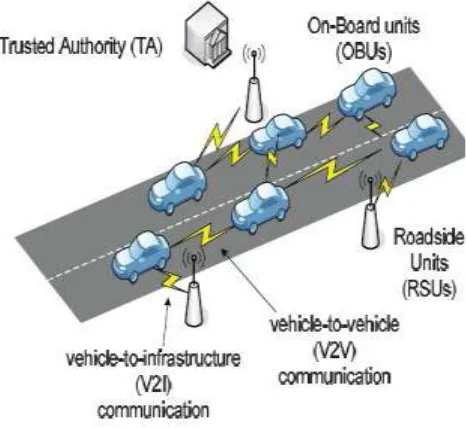
Infrastructure (V2I) communication. In V2V communication mode a vehicle communicates with other vehicles present in the network and all the vehicles engaged in the communication are mobile. V2I communication refers to a type of communication that involves Road Side Units (RSUs) communicating with the vehicles [3].
Figure 1: VANETs architecture
PROPOSED SYSTEM:
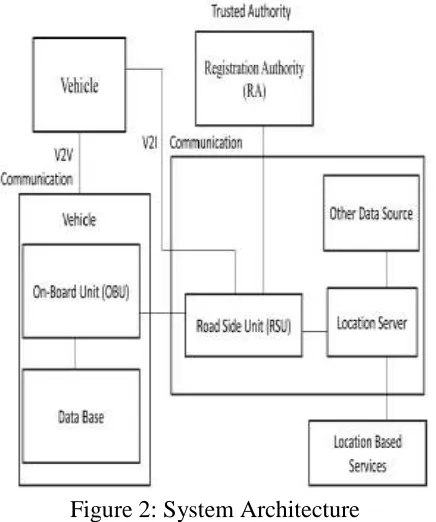
According to the WAVE standard, each OBU is furnished with a Hardware Security Module (HSM), which is an alter safe module used to store the security materials, e.g., mystery keys, authentications, and so on., of the OBU. Likewise, the HSM in each OBU is in charge of playing out all the cryptographic operations, for
example, marking messages, confirming
Figure 2: System Architecture
System Initialization:- The primary security
requirements are identified as entity
authentication, message integrity, no
repudiation, and privacy preservation. Message Authentication:- Here it proposes an efficient authentication and revocation scheme called TACK. TACK adopts a hierarchy system architecture consisting of a central trusted authority and regional authorities (RAs) distributed all over the network .Upon entering a new region, each vehicle must update its certificate from the RA dedicated for that region.
Revocation:- Message Authentication adopt a generic PKI system, the details of the TA signature on a certificate and an OBU signature on a message are not discussed in this paper for the sake of generality. It shows how to accelerate the revocation checking process, which is conventionally performed by checking the CRL for every received certificate.
Security Analysis:- A colluding attack, a legitimate OBU colludes with a revoked OBU by releasing the current secret key K~g such that the revoked vehicle can use this key to pass the revocation check process by calculating the correct HMAC values for the transmitted messages. All the security materials of an OBU are stored in its tamper resistant HSM. In addition, all the keys update processes in Algorithms 3-5 are executed in the HSM, which means that the new secret key K~g is stored in the HSM, and it cannot be transmitted in clear under any circumstances.
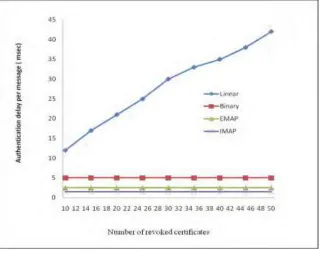
Substantiation Delay:- The performs
progressive search on a text file containing the unsorted identities of the revoked certificates, while the binary CRL checking program performs a binary search on a text file containing the sorted identities of the revoked
certificates. For the second and third
authentication phases, we employ Elliptic Curve Digital Signature Algorithm (ECDSA) to check the authenticity of the certificate and the signature of the sender.
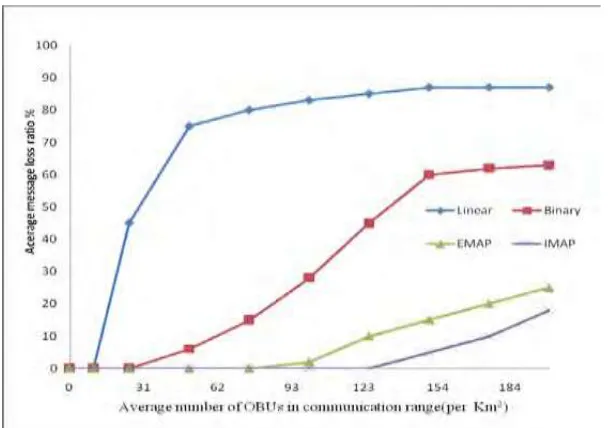
Message Loss Ratio:- The average message loss ratio is defined as the average ratio between the numbers of messages dropped every 300 msec, due to the message authentication delay, and the total number of messages received every 300 msec by an OBU. It should be noted that we are only interested in the message loss incurred by OBUs due to V2V communications [4].
ALGORITHM:
The TA initializes the system by executing Algorithm 1. In step (20), it should be noted that:
PKiu denotes the ith public key for OBUu , where
the corresponding secret key is SKiu; PIDiu
denotes the ith pseudo identity for OBUu, where
the TA is the only entity that can relate PIDiu to
the real identity of OBUu ; sigTA(PIDiu||PKiu)
denotes the TA signature on the concatenation
(||) of PIDiu and PKiu; and C is the number of
certificates loaded in each OBU. After the system is initialized, the TA has the followings:
• A secret key pool Us = {K−i = kiQ|1 ≤ i ≤ l}; • The corresponding public key set Up = {K+i = 1kiP|1 ≤ i ≤ l};
• A master secret key s and the corresponding public key Po;
• A set of hash chain values V = {vi|0 ≤ i ≤ j}, where j is large enough to accommodate with the number of revocation processes occur during the life-time of the network;
• The public parameters H, h, P, and Q. Also, each OBU will have the followings:
• A set of anonymous certificates (CERTu) used to achieve privacy-preserving authentication; • A set of secret keys RSu consisting of m keys randomly selected from Us, i.e., RSu ⊂ Us; • The set of the public keys RPu corresponding to the keys in RSu, i.e., RPu ⊂ Up;
• The secret key Kg, which is shared between all the legitimate OBUs; • The hash function H, h, P, Q, and the public key P◦.
Note that the system model under consideration is mainly a PKI system, where each OBUu has a set of anonymous certificates (CERTu) used to secure its communications with other entities in the network. In specific, the public key PKu , included in the certificate certu, and the secret key SKu are used for verifying and signing messages, respectively. Also, each OBUu is pre-loaded with a set of asymmetric keys (secret keys K−’s in RSu and the corresponding public keys K+’s in RPu). Those keys are necessary for generating and maintaining a shared secret key Kg between unrevoked OBUs [5].
SECURITY ANALYSIS:
In this section, we analyze the security of the proposed protocol against some common attacks.
2) Resistance to forging attacks: To forge the revocation check REVcheck = HMAC(Kg,
PIDu||Tstamp) of any OBUu , an attacker has to find the current Kg, which is equivalent to finding t in the following ECDLP problem: given Kim = tK+M = tkMP and K+M = 1 kMP, find t suchthat Kim =
tK+M. Similar analogy applies to finding the TA secret key s from the TA message signature sgnKmsg
= sH(Kmsg). Since ECDLP is a hard computational problem, i.e., it cannot be solved in a sub-exponential time, the revocation check and the TA message signature sgnKmsg are unforgeable. Similarly, finding the TA secret value s from P◦= sP is ECDLP problem, which makes it unforgeable. From the aforementioned discussion, it is concluded that EMAP is resistant to forging attacks [6].
3) Forward secrecy: Since the values of the hash chain included in the revocation messages are
released to non-revoked OBUs starting from the last value of the hash chain, and given the fact that a hash function is irreversible, a revoked OBU cannot use a hash chain value vj−ver+1 received in a
previous revocation process to get the current hash chain value vj−ver. Consequently, a revoked OBU
cannot update its secret key set (RS). Accordingly, a revoked OBU can neither get K−M necessary to independently calculate the new secret key K˜g nor get K˜g from the neighboring OBUs since the
certificates of the revoked OBUs are in the up-to-date CRL which prevents unrevoked OBUs from forwarding K˜g to the revoked OBUs. As a result, the proposed EMAP guarantees forward secrecy [7].
4) Resistance to replay attacks: Since in each message an OBU includes the current time stamp in the
revocation check value REVcheck = HMAC(Kg, PIDu||Tstamp), an attacker cannot record REVcheck at
time Ti and replay it at a later time Ti+1 to pass the revocation checking process as the receiving OBU
compares the current time Ti+1 with that included in the revocation check. Consequently, EMAP is
secure against replay attacks [8].
Computation Complexity
The computation complexity of revocation status checking process is defined as the number of comparison operation required to check the revocation status of an OBU. In the linear search method, the CRL checking process started from the first item in the list sequentially. In Binary search method, the certificate identities in the list are sorted. Then searching id is compared with the middle id in the list. If it is less than the middle one, right side id will be considered for checking. Only left side of the middle one will be the portion for searching. Until it finds the id, the same process is to be followed. This binary searching is better than linear searching method. Hash method is searching in the CRL using the Hash Function. In this study, one kind of hash method, Bloom Filter is used for checking the revocation status in CRL. As well as compared to EMAP protocol, the road or network is classified into regions. Each region has its own CRL which consist of the revoked certificate id in the region. Computation complexity is very much lesser than the other protocols [9].
Authentication Delay
We compare the message authentication delay employing the CRL with that employing this IMAP protocol to check the revocation status of an OBU. The authentication of any message is performed by three consecutive phases: the sender’s revocation status checking, the sender’s certificate verification, and the sender’s signature verification. In the first authentication phase, we can apply any searching method for checking the revocation status of the sender. In IMAP, bloom filter technique has been used to check the revocation status. Compare to linear, binary searching method, it takes very less authentication delay [10].
Communication Overhead
In IMAP and EMAP, each OBUu broadcast the message in the form (𝑀|𝑇𝑠𝑡𝑎𝑚𝑝)𝑒𝑟𝑡𝑢 (𝑃𝐼𝐷𝑢 ,𝑃𝐾𝑢
,𝑠𝑖𝑔𝑇𝐴(𝑃𝐼𝐷𝑢| 𝑃𝐾𝑢) )|𝑠𝑖𝑔𝑢|(𝑀 | 𝑇𝑠𝑡𝑎𝑚𝑝) |𝑅𝐸𝑉𝑐ℎ𝑒𝑐𝑘) . In the WAVE standard, a signed message has the certificate and signature of the sender with a time stamp on the transmitted message. The additional communication overhead incurred in IMAP and EMAP compared to that in the WAVE standard is mainly due to REVcheck.
Message Loss Ratio
The average message loss ratio is characterized as the normal proportion between the quantity of dropped messages each 300 milliseconds, because of the message validation delay, and the aggregate number of got messages each 300 milliseconds by an OBU. It increments with the quantity of OBUs inside the correspondence extend. In IMAP, just constrained OBUs might be included in correspondence inside the area and furthermore it brings about the base denial status checking. Thus, IMAP diminishes the message misfortune proportion contrasted with that utilizing either the direct or double or EMAP [11].
Figure 4: Message Loss ratio
CONCLUSION:
The review proposed Hasten Message
Authentication Protocol proposed here for
VANETs, which speeds up message
confirmation by supplanting the tedious CRL checking process with a quick disavowal checking process utilizing HMAC work. It utilizes a novel key sharing instrument which
way, Hasten can fundamentally diminish the message misfortune proportion because of message confirmation defer contrasted with the traditional verification strategies utilizing CRL checking.
REFERENCE:
[1] Raya. M and Hubaux. J.P (2007), “Securing
Vehicular Ad Hoc Networks,”J. Computer Security, vol. 15, no. 1, pp. 39-68.
[2] Studer. A, Shi. E, Bai. F and Perrig. A
(2009), “TACKing Together Efficient
Authentication, Revocation, and Privacy in VANETs,” Proc. IEEE CS Sixth Ann. Conf. Sensor, Mesh and Ad Hoc Comm. And Networks (SECON ’09), pp. 1-9.
[3] Sun. Y, Lu. R, Lin. X, Shen. X and Su. J
(2010), “An Efficient Pseudonymous
Authentication Scheme with Strong Privacy Preservation for Vehicular Communications,” IEEE Trans. Vehicular Technology, vol. 59, no. 7, pp. 3589-3603.
[4] Wasef. A and Shen. X (2008), “PPGCV:
Privacy Preserving Group Communications
Protocol for Vehicular Ad Hoc Networks,” Proc IEEE Int’l Conf. Comm. (ICC’08), pp. 1458-1463.
[5] Studer, E. Shi, F. Bai, and A. Perrig (2009),
“TACKing Together Efficient Authentication, Revocation, and Privacy in VANETs,” Proc. IEEE CS Sixth Ann. Conf. Sensor, Mesh and Ad Hoc Comm. And Networks (SECON ’09), pp. 1-9.
[6] M. Raya, P. Papadimitratos, I. Aad, D.
Jungels, and J.-P. Hubaux (2007), “Eviction of Misbehaving and Faulty Nodes in Vehicular Networks,” IEEE J. Selected Areas in Comm., vol. 25, no. 8, pp. 1557-1568.
[7] J.J. Haas, Y. Hu, and K.P. Laberteaux
(2009), “Design and Analysis of a Lightweight Certificate Revocation Mechanism for VANET,”
Proc.Sixth ACM International Workshop
Vehicular Inter NETworking, pp. 89-98.
[8] S. Zhu, S. Setia, S. Xu, and S. Jajodia
(2006), “GKMPAN: An Efficient Group Rekeying
Scheme for Secure Multicast in Ad-Hoc
Networks.”
[9] H. Hartenstein and K. P. Laberteaux (2010),
"VANET: Vehicular Applications and Inter-Networking Technologies," John Wiley & Sons, Ltd.
[10] M. Raya and J.-P. Hubaux (2005), "The
Security of Vehicular Ad Hoc Networks," in Proceedings of the 3rd ACM Workshop on Security of Ad Hoc and Sensor Networks Alexandria, VA, USA
[11] IEEE Trial-Use Standard for Wireless
Access in Vehicular Environments (WAVE) -
Security Services for Applications and