Becoming Competent, Confident and Critically Aware:
Tracing Academic Numeracy Development in Nursing
Linda Galligan
University of Southern Queensland <[email protected]>
Abstract
This paper describes the mathematical journey of a mature aged nursing student as she struggles to become more academically numerate. Within the paper, academic numeracy is defined around three features: competence, confidence and critical awareness of both the context of mathematics and students’ own relationship with mathematics. It then uses this definition to describe a course for 1st year nursing students to develop their mathematics skills needed for their degree. A conceptual framework, based on Valsiner’s Human Development Theory, is used to trace students’ developing understanding of academic numeracy. Finally the paper describes one student, Sally, as she struggles to become more numerate.
Introduction
This paper is based on research situated in a first year course in an Australian university, University of Southern Queensland (USQ), where about 200 students were learning/relearning mathematics in the context of a nursing degree. The aims of the research ( Galligan, 2011a) were to: (1) investigate nursing students' current knowledge of academic numeracy; (2) investigate how nursing students’ knowledge and skills in academic numeracy was enhanced using a developmental psychology framework; and (3) utilise data derived from these investigations to develop a theoretical model to embed academic numeracy in university programs. This paper will concentrate on the second of these aims.
Within this research, I defined academic numeracy as:
• mathematical competence in the particular context of the profession and the academic reflection of the profession at the time;
• critical awareness of the mathematics in the context and in students’ own mathematical knowledge and involves both cognitive and metacognitive skills; and
•
confidence highlighting its deeply affective nature (Galligan, 2011a)The paper first outlines the course. This is followed by a summary of the theoretical framework, then the journey of one student, Sally to exemplify the framework. The paper then
concludes with future directions.
The Course
Prior to 2006, a number of approaches had been taken to develop nursing students’ numeracy levels at the USQ (Galligan & Pigozzo, 2002). In 2006 USQ’s nursing program was reaccredited with the Australian Nursing and Midwifery Council (ANMC). This meant courses, especially those offered in first year, were revised. When planning the reaccreditation, it was decided by the Department of Nursing, that nursing students needed to develop some key academic skills in first semester of first year, as a separate course. Two new integrated first year nursing courses were developed (Lawrence, Loch, & Galligan, 2010) that included Information Technology and mathematics (one course) and literacies skills (second course). The aims of first course were to develop students’ numeracy and Information Technology skills directly linked to their degree. These skills were addressed by embedding aspects of the other courses taken in the students’ first semester and course content encountered later in the program.
The course briefly described in this paper, consisted of 10 × 2 hour tutorial style sessions, six of which were numeracy related. Table 1 highlights some of the mathematics needed and the context in which it is seen, and each tutorial session concentrated on one of these modules. While the concepts of decimals, fractions, percentage, proportion, measurement, and scale are all studied at the primary level at school, many adults have not mastered these concepts and this has implications in nursing (Hilton, 1999; Pirie, 1987).
Module Mathematics content Nursing examples
Arithmetic and Formulas basic operations, fractions, decimals, squares, and order of calculations and use formulas
Body Mass Index, Lean Body Weight and Ideal Body Weight
Graphs and Charts read single scale graphs;
read and construct patient charts; draw graphs with appropriate scale, title and labels and units; and interpret graphs
patient charts; drug profiles; graphs found in nursing articles
Rates and Percentage calculate percentages of given values; convert to & from decimal fractions to percentages;
express two quantities as a rate; determine quantities from given rates;
determine drip rates; pay rates; use of % burns calculations; % concentrations of drugs
Ratio and Proportion manipulate equivalent fractions and ratios;
read a percentile chart; drug calculations
Measurement identify the units used in the metric system; convert between units of measurement; convert from ordinary to scientific notation; multiply and divide by powers of 10 and
multiply and divide by decimals
read syringes
Drug Calculations problem solving read drug calculation problems correctly; recognise the different
types of drug calculations; recognise the solutions and units needed in drug calculation problems
Table 1. Mathematical content of course
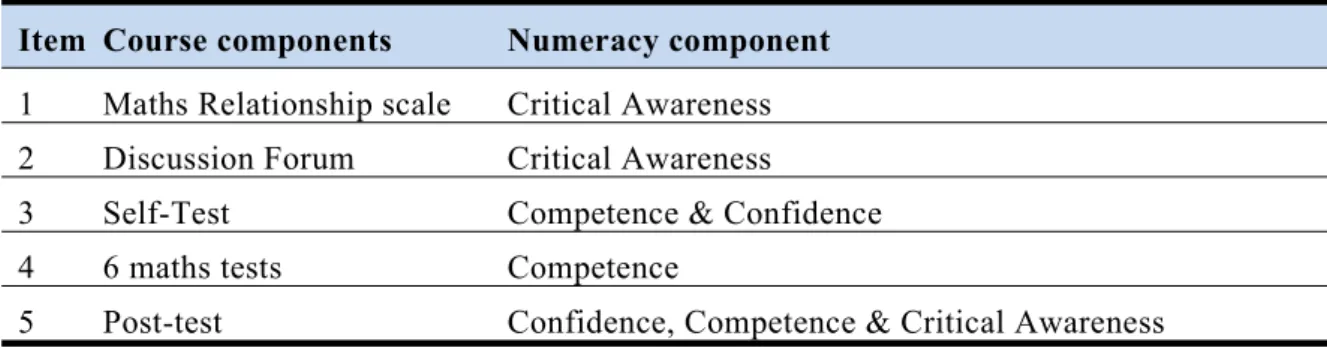
The course took the definition of academic numeracy, outlined in the introduction, and incorporated these features into teaching and assessment sections of the course (Galligan, 2011b) as summarised in Table 2
Item Course components Numeracy component
1 Maths Relationship scale Critical Awareness 2 Discussion Forum Critical Awareness
3 Self-Test Competence & Confidence 4 6 maths tests Competence
5 Post-test Confidence, Competence & Critical Awareness
Table 2. Course components and links to definition of numeracy
In class, students were asked to discuss and rate their past relationship with mathematics (item 1). They were also directed to read two articles on the relationship between mathematics and nursing. Using these two exercises as a basis they were asked to reply to the questions “Describe your previous experiences with mathematics in a couple of sentences” and “How do you think mathematics…will be important for you as a nursing student, and later as a professional” in an online forum (item 2).
As part of a first assignment ask, students were asked to complete a 30 item maths test (Galligan, 2011b) where the marks they received was on the completion of the test, not whether they got it right or wrong (item 3). For each question students’ were asked to rate their confidence, and reflect on their answers in relation to their competence, confidence, and critical awareness. They also completed six short competence tests through the semester (item 4) and one Post-test (item 5) where they were asked to reflect on their current numeracy status. For item 5, marks were also allocated to their competence.
The quantitative data give a static view of numeracy at a point in time. The reflective comments, while providing a deeper understanding of students’ numeracy, particularly in terms of critical awareness, still gave little insight into students’ development. In order to see how students progressed numerically (if they are), a qualitative approach was needed. The following section now describes the theoretical human development frame (Valsiner, 1997) used for this investigation.
Theoretical Framework
A person involved in mastering a skill is no longer lacking that skill, nor is the skill present in its fully-fledged form. The skill is coming into existence. The phenomenon here is quasi structured. Rudiments of the skill can be detected in the flow of conduct, yet nobody can say for sure that the skill as such already exists. (2000, p. 105)
For this paper, three aspects of Valsiner’s Human Development Theory are now highlighted: the Zone of Proximal Development; macrogenetic processes that influence development; and the Method of Double Stimulation (MeDoSt) to help capture any development. These will be briefly described (details in Galligan, 2011a, b) and then exemplified in one student’s journey which follows.
Vygotsky’s Zone of Proximal Development (ZPD) utilised in this study, is seen within a Valsinerian approach which defines ZPD more narrowly as the “set of possible next states of the developing system” (Valsiner, 1997, p. 200) which emerge from an interaction with both the environment and scaffolding provided by another (e.g. a teacher) or self-scaffolding. In this context, questions that need to be answered are: what do students do next when trying to understand some mathematical concept, or what could students do next? Why do they get “stuck?” What so teachers do? What scaffolding is used? The actual development emerges from the negotiation process within this set of possibilities. This negotiation process is researched in microgenetic contexts, i.e. short episodes where there is potential development. Over time, a string of these microgenetic episodes may lead to change and development and a stable pattern with a more ontogenetic flavour may emerge.
In addition to these microgenetic contexts, macrogenetic processes are also of crucial importance. That is, “cultural beliefs, personal beliefs, past experiences, memories and future anticipations” (Joerchel & Valsiner, 2003para. 10) may have an effect on the microgenetic episodes.
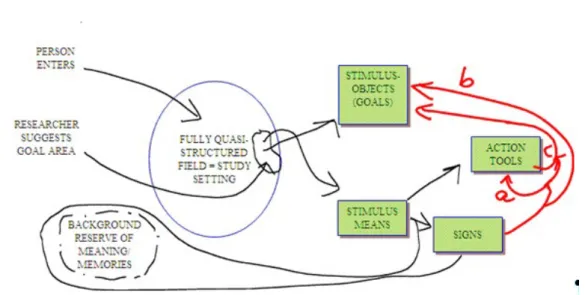
The process of uncovering the possible development utilizes MeDoSt (Figure 1). In this method, there are both stimulus means, and stimulus objects. In interviews conducted in this study, the researcher asked the nursing student to solve a drug, or a maths question (stimulus object). The student aimed to answer the question. In the room, there may be books, pens, formulas, calculator, other students, the tutor and, at times, even models, such as syringes or bottles of tablet (study setting). The student thinks about how to solve the problem (stimulus means), also drawing upon previous meaning memories such as fear, anxiety and self-efficacy be used for adult learning mathematics (the macrogenetic processes). In the study, the material was also designed to promote students to act in certain ways, e.g., doing exercises and looking at screen casts, reflecting on answers etc. The student may remember or see the formula (action tool). She thinks to use the formula to solve the problem. The three functions (a, b and c in Figure 1) are utilised: (a) the formula chosen has some relation to the drug problem, (b) If it is successful it may be used again (c).
Figure 1. Vygotsky’s Method of double stimulation (from Valsiner, 2007, p. 371)
Within this setting, the microgenetic episode of interest is at the point of any meaning blocks. Here, the data captured may be studied to see any possible trigger and the set of possible next states. For example, will students abandon the goal and start again; will they exit from the situation; will they get around the meaning block (and how)?
This theoretical frame can best be understood in the context of a student, whose journey is now described.
Sally’s Journey
Sally was a first year student in the over 45 age group who volunteered to be part of the study and came to five small group and individual sessions. Sally’s results in the Self Test and Post-test were the worst of those who completed the course (from 5/32 to 15/32). Her confidence levels were lower than the average as well (2.93/5 to 3.65/5). Her competence and confidence did vary depending on the mathematics context. For example, while she obtained almost 90% for the section on percentages and rates, her confidence levels were very low (Figure 2)
p re te st a ri th m e ti c g ra p h s % a n d r a te s F o rm u la & r a te s m e a su re m e n t R e a d in g d ru g s P o st -t e st 0% 20% 40% 60% 80% 100% Sally's Competence
Figure 2. Sally’s competence and confidence results.
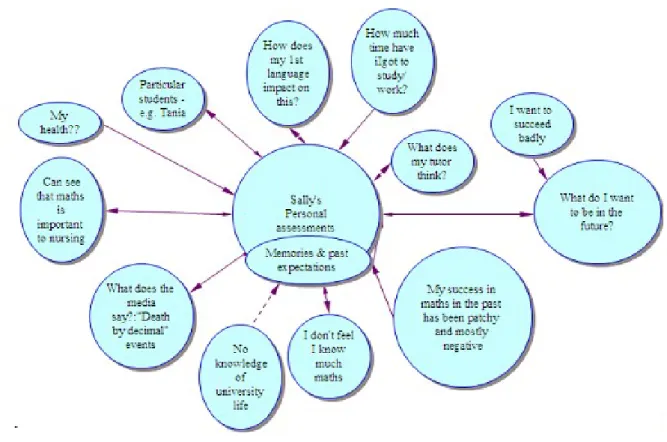
mathematics skills were good enough before the start of the course. In a web posting she said, “Maths was not my favourite subject at school so I can’t say that I was very interested in that at all.” She also strongly disagreed that she would pass the course (over 96 % of students surveyed strongly agreed or agreed they would pass the course). She passed with a “C” grade. Sally did not complete a reflective diary entry at the beginning of the course. However, comments during the course give some details. While she is fluent in English, her first language is Italian and she had completed some schooling in Italian. Working in a town about 1.5 hours from the university and working up to 10 shifts per fortnight in an allied industry, she could only come to the university two days. These pictures of Sally, gleaned from her comments and my subjective interpretations, create a macrogenetic story (Figure 3).
Figure 3. Sally’s macrogenetic model.
Her past mathematical experiences were typical of many mature aged students who struggle with mathematics, but she had the added pressures of time away from university and perhaps a second language issue. In addition, her inexperience with higher education expectations made university life bewildering, particularly at the beginning of semester. Sally’s numeracy issues and development, however, could be investigated from interviews which took place during the semester. A closer study of some short periods of time within those interviews, particularly where meaning blocks became apparent, assisted in understanding the issues.
The complete story of Sally (Galligan, 2011a), identified a number of mathematical issues and proposed possible learning development. The following are two examples: one on fractions and the other on squares and square roots.
Interview four focussed on multiplication of fractions. Sally often confused multiplication and division. Three issues emerged. One was evidence of an incomplete state of understanding what to do and why. There was also the importance of affect, and an issue of an approach to study (after a little prompting to reflect by the teacher).
After a few attempts with some examples, she tried to evaluate 27 / 3´26 / 4 . She was able to articulate that it would be, “Sorry, I think it should be, I don’t know. 27 times 26, divided by 12. Yeah”. Next we tried 27 /13´26 / 42 Even though it looks like she tried it three times before she got it right, (lines 148, 149) she was able to do it without any help, as the facilitator did not prompt her that it was wrong. Her excitement was good to see and she wanted to do more.
138. Sally Can I just do it without saying anything? 147. Facilitator Please.
148. Sally Oops do it again now the answer is 1 point 1 point 7. 149. Sally Multiplied the 13 by the 42 and then…That would be the
same answer. [Unclear] Yes I got it right, I’m so excited. Doesn’t happen! Can we have this every day. This is exciting…I got it right 1.285.
Why was she was persistent in multiplying instead of dividing? She did suggest her Italian background more than once, but it may also be her approach to tackling problems. In this interview she said to Tania (the other student), “I wish I could be like that, analyse everything ‘cause I go that is what it means and off I go like I don’t...”.
In interview 5, on talking about the formula for radiation intensity I =(1/d2) , she did not appear to have any knowledge of square or square root, but thought it was doubling (coming from the superscript “2”). After trying both a visual (line 25) and undoing approach (lines 17, 19 and 30) she got stuck between lines 31 and 35, she may have been OK at line 35. Even after some explanation, her last statement, “a kind of doubling” (line 59), suggested that she did not want to let go of this link to doubling (lines 16, 20 and 33):
13. Facilitator They wouldn’t ask it the other way round would they? If the intensity was 64, how far away would it be?
14. Sally 32.
15. Facilitator Square root do you know square root? 16. Sally No, thought it was double.
17. Facilitator No. Now they may not ask this, I think it would be too hard, but see how you’ve got, how I’ve said the distance was two, the intensity was a quarter. So you’ve got a quarter was the intensity, which is one over two squared. So if the intensity was a 64th , that’s one over what
squared? So it’s the square root of 64, the opposite operation to squaring.
18. Sally No, I don’t get it.
19. Facilitator That’s okay. Hopefully you won’t be asked this but if he did ask it, so if you’ve got, let’s just take the basics, if you’ve got five squared, that’s 25. So another way of saying that is, the square root of 25 is five. Square root means going back to the origin.
20. Sally So can I just do that, this is my own way of, 50? No 100. 21. Facilitator Don’t double it.
22. Sally So...10? 23. Facilitator 100
25. Facilitator Let me show you another one, maybe visually.
If I’ve got a square, and one side is two units, so I’ve got two units and the other side is two units, the area of that is four square units (OK). So if I’ve got a square and the area is four, then what’s the side? The side is the square root of four, which is two. It’s the opposite operation.
26. Sally It’s the opposite
27. Sally I should feel right at home with this it’s the other way around. (laughter)I’m serious
28. Facilitator You can use your calculator as well. There’s the square root and there’s the square. So if you press five, five squared equals 25. Now cancel that and press the square root sign. Square root 25 equals 5. Do square root of 64 equals eight. Now do eight squared.
29. Sally Equals 64. Okay.
30. Facilitator What we’re doing is the opposite operations all the time. 31. Sally Can I? Would that be 6?
32. Facilitator No What’s six squared?
33. Sally I’m trying, I’m working so hard. ...I’m thinking. No, I want to get one on my own. (long pause) It’s not 12, see I’m getting mixed up here.
34. Facilitator You are. It’s common. Use your calculator.
35. Sally I don’t want to, No, no, no I’m frustrated with myself. 36 OK Six by six is 36, basically that’s what it means. ... so if I do…(pause) maybe not... eight OH that one?
36. Tania So square root of 25 is 5 how do you do square on the calc so 2 and that equals so press the square… work out how to use the sc calculator (unclear)
37. Sally Is that right ? (yes) its an easy one but yeah OK.
38. Facilitator Yep. Did you learn your times tables when you were little? 39. Sally In Italian.
54. Facilitator ... Try seven. 55. Sally Seven squared? OK?
56. Facilitator Seven squared, seven sevens. 57. Sally Is that right?
58. Facilitator Yep. Squared means multiplied by itself. Keep that in your mind. 59. Sally So it’s kind of doubling.
In the pre- and post-test there were two questions, one finding the square root of a number and
the other was finding BMI =(w/h2) . In the pre-test, Sally did not answer either question. In the post-test, she got the square root correct, but in the BMI she divided h into w but did not square the h. Sally appears to be oscillating in this developing state and could easily revert without more reinforcement.
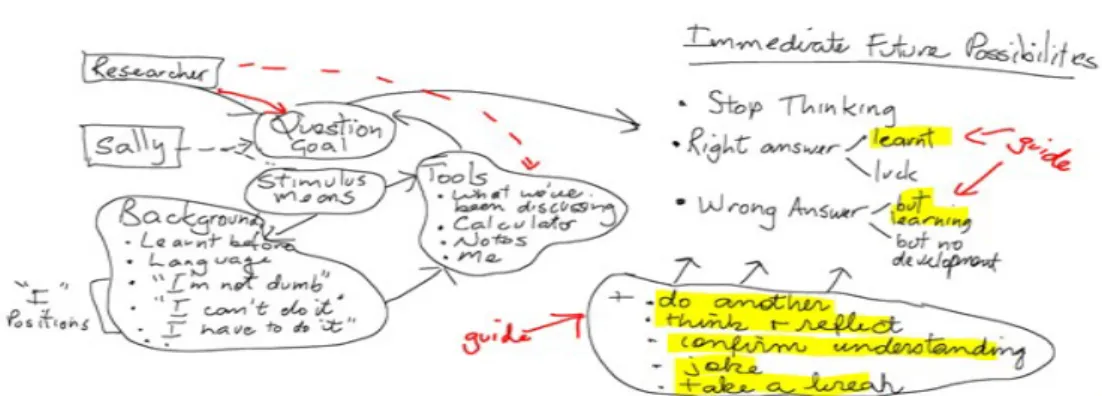
If these episodes are seen in terms of MoDoSt (see Figure 4 based on Figure 1) then Sally’s self-scaffolding “I-positions” at times influence her actions. She has at her disposal, tools to assist her in solving the question at hand and it appears these two forms of stimulus means, work both with and against her. When we look at the next possible future actions, while the researcher may promote certain next actions (guide), Sally may choose just to stop.
Figure 4. Sally’s microgenetic profile when discussing a concept
While Sally’s past mathematics story is not fully revealed, there appeared to be gaps in her mathematics understanding from a relatively young age. Sally’s constraints were outside factors, which hindered her progress in her mathematics journey. In addition, working and travelling that much in a week would have contributed to her lack of success. She just did not have time to reflect on how to be successful at university and she often did not do tasks that were asked of her. The university culture appeared to be alien to her. She may have been aware of the possible future actions in front of her, but just was not able to address many of these. A possible reason for her relatively poor numeracy performance is that she was not able to consolidate on the things discussed in class and in the small group sessions. She came to an assignment and just did it to move on to the next piece of work. From her actions, (Figure 5) trying to move forward to a new goal (B), in a typical setting, she does not appear to be able to access the new tools of checking and taking care (area to the right labelled ‘missing’); and when she gets something wrong she will often revert to past, inaccurate memories (area to the left).
Figure 5. Double stimulation scenario with Sally with development
At the end of semester Sally wrote:
It is imperative for me to get this mathematical side of things such as, measurements, percentages, multiplications, divisions, fractions, down pact [sic] as it is a huge responsibility to have as a future Registered Nurse, to administer the right dosages to other people in need, so that they can feel better, they rely on that, and my aim in life is to help others in need, and I cannot let anyone down or hurt anyone in the process.
Sally is now a registered nurse.
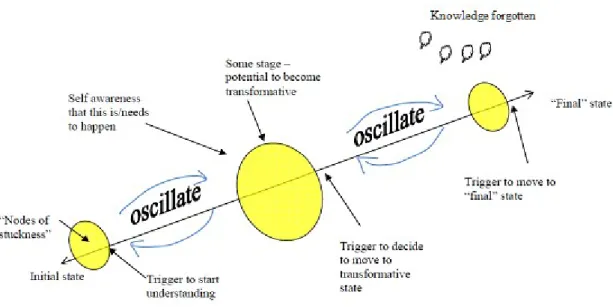
Upon reflection on Sally’s and other students’ numeracy journeys in this research, it is clear that the journeys are not direct. There are many points along the way where students stop. These ‘nodes of stuckness’ (Figure 6) may result in the staying at this point (or moving backwards) or staying until something (a trigger) helps them to move forward, either scaffolded from a tutor, themselves or another. It may be that there are no definitive observable triggers. The pathway may become more familiar each time a concept is revisited, as long as there is active recognition of parts of the concept that were unfamiliar, parts that are now more in focus and parts that are still to be made clear, and being comfortable with that uncertainty. While there may not be one particular AHA moment, there should be a realisation by students that they are more numerate (i.e., more competent, critical and confident) now than at the beginning of the semester.
Figure 6. Map of academic numeracy development (Galligan, 2011a, p. 339)
Along the journey they may move around, lose their way or go back to where they were before, oscillating between one point and another without really moving forward or moving forward as they are questioning their understanding. With the oscillation there are many potential paths to possible futures. A student’s final state may be anywhere along the oblique line. ‘Final’ is relative. In this state a student may still forget knowledge (e.g., how to find a percentage increase in a value), but retain thinking mathematically; think to check; think of consequences; think I could do this; etc. Some people’s way of thinking has been transformed and each may be different.
Conclusion
This paper proposed that Valsiner’s work be investigated more closely as an approach to understanding adult learners’ development. He advocates methodologies that centre on careful observation in micosettings, where development may be observed. His approach to the total environment; scaffolding and self-scaffolding; and the investigation of sets of possible future actions that result from the environment/scaffolding interaction (both successful and not), all fit in the methodology of double stimulation.
Broadly, this study outlined an example of support in academic numeracy aligned to students’ needs, as the student population demands more flexible relevant learning material in their busy complex worlds (Lawrence, Galligan, & Loch, 2008). More particularly, in the context of this
paper, it opened a lens to view a here and now setting and the next possible moments. This was also powerful lens for the teacher as it also suggests development: to learn when to speak and when to remain silent; to learn when to promote past experiences and when to leave them aside; when to move forward to push understanding and when to stop.
Finally, this research has promise to transfer this model of embedding academic numeracy to both new contexts (Galligan, 2012 (accepted 2011)). This approach to learning development is not restricted to academic numeracy. It can be used wherever a phenomenological view of learning development is needed and is particularly useful in adult learning where the study of student action, reflection on action and the environment around action and consequential development of the learner needs to be observed.
References
Galligan, L. (2011a). Developing a model of embedding academic numeracy in university programs: A case study from nursing. Unpublished doctoral thesis. Queensland University of Technology, Brisbane.
Galligan, L. (2011b). Measuring academic numeracy: Beyond competence testing. In Julie Clark, Barry Kissane, Judith Mousley, T. Spencer & S. T. (Eds.), Mathematics: Traditions and [New] Practices (Proceedings of the 34th annual conference of the Mathematics Education Research Group of Australasia).and the Australian Association of Mathematics Teachers) (pp. 288-296). Adelaide: AAMT and MERGA.
Galligan, L. (2012 (accepted 2011)). Systematic approach to embedding academic numeracy at university. Higher Education Research and Development
Galligan, L., & Pigozzo, R. (2002). Assisting Nursing Students Solve Drug Calculation Problems Using Metacognition and Error Analysis. Literacy & Numeracy Studies., 12(1), 45-62.
Hilton, D. (1999). Considering Academic Qualification in mathematics as an entry requirement for a diploma in nursing programme. Nurse Education Today, 19, 543-547.
Joerchel, A. C., & Valsiner, J. (2003). Making decisions about taking medications: A social coordination process [79 paragraphs]. Forum: Qualitative Research. Retrieved on January 5, 2012, from http://www.qualitative-research.net/fgs-texte/1-04/1-04joerchelvalsiner-e.htm Lawrence, J., Galligan, L., & Loch, B. (2008). Reframing e-assessment: building professional nursing
and academic attributes in a first year nursing course. CJEM: Learning, Media and Technology, 33(3).
Lawrence, J., Loch, B., & Galligan, L. (2010). Employing and evaluating inter-disciplinary collaborations to redefine academic practices in a nursing program Reshaping Higher Education: Proceedings of the Higher Education Research and Development Society of Australasia. Melbourne: HERDSA.
Pirie, S. (1987). Nurses and mathematics: Deficiencies in basic mathematical skills among nurses. London: Royal College of Nursing.
Valsiner, J. (1997). Culture and the development of children's actions: A theory of human development (2 ed.). Chichester: John Wiley & Sons.