A Study and Analysis of Different Simulators
in Computer Network
Sudha Rani S1, Akshay R2, Avinash Arunachalam A M3
Assistant Professor, Department of Computer Science, Sri Krishna College of Engineering and Technology , Coimbatore, Tamil Nadu, India1
UG Student, Department of Computer Science, Sri Krishna College of Engineering and Technology, Coimbatore, Tamil Nadu, India2
UG Student, Department of Computer Science, Sri Krishna College of Engineering and Technology, Coimbatore, Tamil Nadu, India3
ABSTRACT: Real world applications such as aircraft design, motor drive controller design and space robot integration simulation plays a prominent role. Simulation modelling aids to garner consensus and generate confidence for the design which was/is tried and tested. Simulation modelling acquires information about how something will behave without actually testing it in real life. One such type of simulation is network about how system behaves externally without actually testing it in real life. In this paper, we have examined one such type of simulation known as network simulation. In computer networking research, network simulation is a technique which models the behaviour of different network entities under different conditions. Our paper provides and overall analysis on divergent species of simulators used in networking models.
KEYWORDS: Computer networks; Network simulation; Network simulator
I. INTRODUCTION
At present, performing data communication in a network is one of the rapidly growing technologies. Sending the required information from one place to another place is extremely complex without networking. Can you imagine world without google, online newspapers, blogs, forums and other web services offered by the internet using network? Today, computer networks are the core of modern communication. Computer networking benefits the people to share the resources during data communication. Network manages all the program, data and hardware available to everyone in the network without any regard of physical location of users and their resources.
Computer networking is one of the very few profession in which top 25% workers make over $100,000. Computer network is fastest occupation for the need of system administrator who can help organizations to achieve increased firms.Networking has excellent research opportunities in the fields of military reconnaissance, Artificial Intelligence, Remote sensing and wireless sensor networks. Computer network finds its applications in various fields such as business, smart homes, mobile users, social networks, organization, education, telecommunication, media, industry, science, research and development etc. Advancement of technologies has proved itself that performing data communication is huge faster with expanded bandwidth capacity. Therefore, computer network guides people who live or work apart.
Advantages of networks are easy file sharing, sharing resources such as printers, Internet connections, and centralized data communication using file server for ease of access and back-up. Disadvantages of networks are vulnerable to hackers, if the network fails then other task becomes very difficult, easily attacked by unauthorized users. Similarly, when computer connected to Internet can find loopholes such as revealing personal information, suspecting websites that are malware, sometimes information in Internet is not always accurate or reliable. The use of network with respect to organization is cost reduction because it shares the hardware and software resources, high reliability because multiple sources of supply, greater flexibility because of possibility to connect devices from various vendors.
Data Communication is the movement of computer information from one device to another device forming a network. Client computers connected together to create a network which is termed to be servers and clients. Client computers or workstations are the normal computers where people sit at to get their work done. Servers are special, powerful computers that provide “services” to the client computers in the network. Servers provides a central, common file storage area, sharing hardware such as printers, controlling who can or can’t have access to the network and sharing Internet connections. Servers are built to be very reliable.
A. Benefits of Computer Network
● File Sharing: Networking of computers helps the users to share data files such as emails, instant messaging, video telephone, cat rooms etc.
● Hardware sharing: Users can share devices such as printers, scanners, CD-ROM, drivers, hard drives etc.
● Application sharing: Applications can be shared over the network, and this allows to implement client/server applications.
● User communication: Networks allow users to communicate using email, newsgroups and video conferencing etc.
● Network gaming: A lot of network games available allows multi-users to play from different locations.
II. LAYERING CONCEPT OF NETWORK SIMULATION
Simulation is meant to be a network entity (node, host, packets) flow process [3]. Simulation [2] “Process of designing a real system model and conducting experiments with this model to understand the behaviour of the system and evaluating various procedures for the operation of the system”.Network simulation is used to validate protocol, control experimental conditions, low cost in terms of $, time, collaboration and complexity. The main objective of simulation is to generate statistical results that represent the behaviour of certain network entities and their operations. Key elements used in simulation are as follows [1],
●Performance Modelling
●Failure Analysis
●Network Design
●Network resource planning
●Reusability
●Availability
●Scalability
●Graphical, debug and trace support
TABLE I shows the difference between testbed and simulator advantages and disadvantages [21].
Platform Advantages Disadvantages
Testbed Fast , Accurate, Ground truth Expensive
Shared resource????Hard to reconfigure, Hard to change, Hard to download
Simulator Inexpensive, Flexible, Easy to download virtual time (faster than reality”), performance of a real-life system (latency time, packet loss, etc.)
May require app changes might not run OS code accurately, May not be “believable”, May be slow/non-interactive
TABLE I Difference between Testbed and Simulator
III. NETWORK SIMULATORS
A. Cloonix
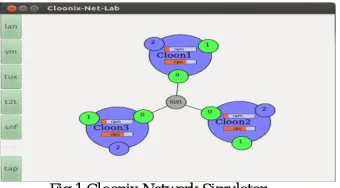
Cloonix is a network simulator which provides GUI to the user. It allows [7]KVM to create virtual machines and consists of inbuilt file systems which can be used as virtual machines for creating other virtual machine root file systems. It is widely used in virtualization of mobile networks [6]. It manages the virtual network topology providing WYSIWYG. It works under Linux Network Emulator tool known as netem [6]. It performs host simulation on Linux router encapsulating application, host and network L2 and L3 in the GUI form. Network characteristics such as delay and loss can be configured per network link using Cloonix simulator [7]. Fig.1. shows a simple GUI of Cloonix network simulator.
Fig.1.Cloonix Network Simulator
B.Cooja
Fig.2.Cooja Network Simulator
C. GNS3
GNS3 [10] stands for “Graphical Network Simulator” an open source software which simulates complex real networks. It is platform independent and implemented by CISCO and Juniper. A graphical network simulator which designs network topologies like IOS routers, ATM/Frame Relay/Ethernet switches and hubs by extending network with virtual topology. It performs emulation [13] using Cisco Internetwork Operating Systems. Graphical front end product of GNS3 is Dynagen Which is on the top of Dynamips used to create a text based environment [11] [12].
Fig.3. GNS3 Network Simulator
D. GloMoSim
GloMoSim stands for Global Mobile Information System Simulator [14] used for both wired and wireless networking environment especially used for ad hoc network. It is designed using parallel discrete-event called “Parsec”. It performs communication on heterogeneous, asymmetric, multihop wireless communication [15]. It uses rich protocol stack for the design and development of GloMoSim framework so as to achieve scalability and feasibility features. It supports both unicast and multicast wireless protocols [15].
E. IMUNES
IMUNES stands for Integrated Multiprotocol Network Emulator/Simulator which is a network emulation framework runs on FreeBSD operating system to partition virtualbox of virtual machine into multiple lightweight virtual machines. Lightweight virtual nodes will be interconnected via kernel level links to form complex network topologies. It provides each virtual node to run a private copy of any unmodified user-level application such as routing protocol daemons, traffic generators, analysers. Thus it provides high scalability, performance and fidelity [16] [17].
F. JavaSim
JavaSim or J-Sim is an object oriented simulator written in Java. It is a discrete event process based simulator consists of classes, methods, libraries. It is an open source simulator which can be modified according to the user. JavaSim package consists of JavaSim class which supports simulation using inbuilt classes of JavaSim class. Some of the methods available in JavaSim class are javaSimInit(), schedule(), schedule Plus(), report(), clearStats(). It used in commercial and academic organisations [18]. It provides,
● The SIMULA like simulation routines, random number generators, queueing algorithms and thread package interfaces.
● SIMSET similar to entity and set manipulation.
● Non causal events such as interrupts classes are allowed.
● Statistical routines such as histogram and variance classes.
● Debugging classes too.
G. Marionnet
A virtual network which allows user to define, configure and run complex computer networks without any need for physical setup. One non-networked Linux/GNU host machine is enough to simulate a whole Ethernet network consisting of computers, routers, hubs, switches, cables. It integrates the virtual network with the physical host network. It is termed as “virtual network laboratory” [19]. Marionnet[20] enables users to test computer network cabling, network protocols, services and applications. Then application allows to easily define and configure a virtual network complete with hubs, switches and routers. It is free software application. Network devices like hubs, switches, routers physical behaviour in the network can be simulated.
H. Mininet
Mininet creates a realistic virtual network running on real kernel, switch and application code on the same domain with a single command (e.g. >sudo mn) [21] [22]. Linux network namespace is used for virtualization technology to create virtual switches and virtual nodes supporting 1000’s of virtual nodes on a single OS [22]. It requires a knowledge of python scripting language to work with Mininet.
Features are [21],
● It provides ease of use, scalability, performance and accuracy [24]
● It shares experiment with OpenFlow and Software-Defined Networking systems [23]
I. NetKit
NetKit is a command line simulation tool. It uses user-mode Linux to create the virtual machines in which a full Linux OS can run on each machine [25][26]. NetKit works on Linux Host or machines. It does the running of routing daemon, configuring Ethernet Bridge and makes the virtual hub to make run on Linux host. It is primarily focused to work on virtual machine and virtual hub.
J. NetSim
Netsim is a network simulator used for modelling protocols, analyse networks in terms of depth, power and flexibility. It is mainly applicable in research and development and defence applications. Basically, most of the networks related to communication among data is complex to provide an accurate analysis of system behaviour. Hence, Netsim Analyses the parameters such as arrival time of the packet, queuing time of the data in buffer, payload of data, overhead, and error for every packet as it flows through the network. It also records the event traces logging every single event in the protocol and finite state machine transitions along with associated information like time-stamp, event id, and event type.
It provides the simulation visualization to animate the packet flow via wired and wireless links, the control packets, data packets, and error packets. Apart from animation, result analyses the output performance metrics such as network, sub network, link, queue, application, throughput, delay, loss, packet error, link utilization. Application [27] that simulates Cisco systems networking hardware and software using command structure.
K. ns2
Network simulator version 2, widely known as NS2, an event driven simulation tool used for communication in network. Simulation of wired as well as wireless network uses the routing algorithms, protocols such as TCP, UDP. It is written not only in OTcl (Object oriented Tool Command Language) but in C++ also. NS2 helps to create network topologies, trace the log events which takes place under any kind of load, analyses events to understand the network behaviour.
L. ns3
ns3 is an open source discrete event simulator used in networking for research and education [27]. It is written entirely in C++. The user code which includes the protocols and scenarios are written in C++ whereas python wraps the user code. Simulation programs are C++ executables or python scripts [27]. It does direct code execution (DCE).
M. OMNet++
OMNet++ is an object oriented modular discrete event network simulator which is used for traffic modelling, protocol modelling, modelling queuing networks, modelling multiprocessors and other distribute hardware systems. The main components are simulation kernel, library and user interfaces. The speciality of OMNet++ is portable. Some of the simulation models are INET framework, AdHoc Sim, Antnet, Mobility framework, IPV6, video interface, Ethernet, P2P swarming protocol simulation, Hiperlan/2 model, Sim SANs, Queues, SCSI bus, etc.
N. OPNET
form NETWARS programmed by department of US. It is an object oriented simulation approach supported by a series of GUI.
O. QualNet
QualNet is mainly used for mobile adhoc networks. It is used to create different network models and new protocols. It creates heterogeneous devices and networks with uniform platform. It supports WiFi, Wimax, and Sensors. It uses interfaces such as CLI and GUI. CLI uses MS DOS supporting 2000 to 3000 nodes with less memory storage.It supports cross layer communication using one protocol that runs in two different layers. It is a state-of-the-art simulator used specially for large, heterogeneous networks and distributed applications that execute on such networks.
IV. CONCLUSION AND FUTURE SCOPE
The other network simulators we left to explain are PSimulator, Gos IP, NetViz, NIST, REAL, NEST, PTOLEMY. The various network simulators are explained with some user interface diagrams. Various network simulators enable to simulate the network but only few simulators are used by researchers. Our work stated many simulators is useful in research and system networks. The future work may include explaining new simulators which we stated above.
REFERENCES
[1] E. E’gea-López, J. Vales-Alonso, A. S. Martínez-Sala, P. Pavón-Mariño, J. García-Haro_, “Simulation Tools for Wireless Sensor Networks”, Department of Information Technologies and Communications Polytechnic University of Cartagena, Spain, Summer Simulation Multiconference - SPECTS 2005.
[2] R. E. Shannon, “Introduction to the art and science of simulation,” in Proc. Of the 30th conference on winter simulation (WSC’98), 1989.
[3] T. Issariyakul, E. Hossain, Introduction to Network Simulator NS2, DOI: 10.1007/978-0-387 71760-9 1, c_ Springer Science+Business Media, LLC 2009. [4] 1. S. Keshav, REAL: A Network Simulator,tech. report 88/472, Univ. California,Berkeley, 1988.
[5] A. Dupuy et al., “NEST: A Network Simulation and Prototyping Testbed,” Comm. ACM, Oct. 1990, pp. 64-74.
[6] D. Rehunathan, S. Bhatti University of St Andrews , V. Perrier , P. Hui Deutsche Telekom Laboratories (Berlin) , “The Study of Mobile Network Protocols with Virtual Machines”, Barcelona, Spin, ICST 978-1-936968-00-8.
[7] V. Perrier. Cloonix. http://clownix.net/.
[8] Anuj Sehgal “Using the Contiki Cooja Simulator Computer Science”, Jacobs University Bremen Campus Ring 1, 28759 Bremen, Germany, [email protected], Elsevier, October 29, 2013.
[9] Joakim Eriksson, Fredrik Österlind, NiclasFinne, Nicolas Tsiftes, Adam Dunkels, Thiemo Voigt, “COOJA/MSPSim: Interoperability Testing for Wireless Sensor Networks “ Swedish Institute of Computer Science {joakime,fros,nfi,nvt,adam,thiemo}@sics.se Robert Sauter, Pedro José Marrón University of Bonn and Fraunhofer IAIS {sauter,pjmarron}@cs.uni-bonn.de,
[10] GNS3: http://www.gns3.net/
[11] http://www.ipflow.utc.fr/blog/ [12] http://dyna-gen-sourceforge.net/
[13] GNS3 Graphical Network Simulator,By Mike Fuszner – version 1.0
[14] Jorge Nuevo, “A Comprehensible GloMoSim Tutorial”, University of Quebee, March 26, 2003. [15] http://pcl.cs.ucla.edu/projects/glomosim/
[16] http://www.imunes.net
[17] Z. Puljiz and M. Mikuc,” IMUNES Based Distributed Network Emulator“, Faculty of Electrical Engineering and Computing/Department of Telecommunications, Zagreb, Croatia, 2004.
[18] https://github.com/nmcl/JavaSim [19] http://www.marionnet.org/EN/
[20] Jean-Vincent Loddo, Luca Saiu, “Marionnet: a virtual network laboratory and simulation tool”, Simulation Works March 4, 2008, Marseille, France.
[21] Te-Yuan Huang, Vimalkumar Jeyakumar Bob Lantz, Brian O'Connor Nick Feamster Keith Winstein, Anirudh Sivaraman, “Teaching Computer Networking with Mininet”, Wi-Fi: HHonors, SGC2014
[22] http://www.mininet.org
[23] Karamjeet Kaur, Japinder Singh and Navtej Singh Ghumman, “Mininet as Software Defined Networking Testing Platform”, International Conference on Communication, Computing & Systems (ICCCS–2014)
[24] Bob Lantz, Brian O’Connor work with Brandon Heller, Nikhil Handigol, Vimal Jeyakumar, and the Mininet Contributors, “Mininet: An instant Virtual Network on your Laptop”.
[25] http://wiki.netkit.org
[26] Maurizio Pizzonia, Massimo Rimondini, “Netkit: Easy Emulation of Complex Networkson Inexpensive Hardware”, Dept. of Computer Science and Automation, Roma Tre University
[27] http://nsnam.org/