Volume 8, No. 5, May-June 2017
International Journal of Advanced Research in Computer Science REVIEW ARTICLE
Available Online at www.ijarcs.info
ISSN No. 0976-5697
A Review on Swarm Intelligence Techniques
Pooja Thakur
1and Chaavi Rana
21Research Scholar and 2
UIET, MDU Rohtak, Haryana, India
Abstract: Modern communication networks
Asst. Prof.
are getting more and more numerous and heterogeneous. this can be the consequence of the addition of associate increasing array of devices and services, each wired and wireless. the requirement for seamless interaction of various heterogeneous network parts represents a formidable challenge, particularly for networks that have historically used centralized ways of network management. this can be true for each packet- switched and virtual circuit networks, and also the web, that is changing into associate ever additional assortment of a diversity of subnets. Swarm intelligence, as incontestable by natural biological swarms, has varied powerful properties fascinating in several engineering systems, like network routing. additionally, new paradigms for planning autonomous and ascendible systems could result from analytically understanding and increasing the look principles and operations exhibited by intelligent biological swarms. Artificial bee colony (ABC) algorithmic rule is associate improvement algorithmic rule supported a specific intelligent behavior of honey bees swarms. This work compares the ABC algorithmic rule therewith
INTRODUCTION
Swarm Intelligence
ACO, and Fuzzy system.
Keywords: Swarm Intelligence, ACO, ABC, Fuzzy System.
seems in biological swarms of sure insect species. It provides rise to advanced and
infrequently intelligent behaviour through advanced
interaction of thousands of autonomous swarm members. Interaction relies on primitive instincts with no supervising. the tip result is accomplishment of terribly advanced styles
of social behavior and fulfillment of variety of
optimisation and alternative tasks. the most principle behind these interactions is termed stigmergy, or communication through the setting. AN example is secretion contact trails followed by ants. secretion may be a potent sort of internal secretion which will be detected by ants as they follow trails. It attracts ants and thus ants tend to follow trails that have high secretion concentrations. This causes AN contact action reaction, i.e., one that's accelerated
by itself. Ants attracted by the secretion
can lay additional of identical on identical path, inflicting ev en additional ants to be attracted. Another sort of stigmergy alters the setting in such a way on promote additional similar action by the agents. This method is dubbed task-related stigmergy. AN example is sand grain giving birth by termites once constructing nests. within the initial stages of construction, termites lay sand grains haphazardly locations. This stimulates additional giving birth by alternative members of the swarm, till one heap of sand grains every which way reaches a essential mass that's larger than its neighboring plenty. At that purpose, most termites square measure drawn to that specific heap, thereby choosing that specific location
Swarm intelligence has become
for construction of their nest [1].
analysis interest to
several research scientists of connected fields in recent years. The swarm intelligence is outlined as ‘‘any decide
to style algorithms or distributed problem- resolution devices galvanized by the collective behaviour of social insect colonies and different animal societies...’’ by Bonabeau et al. Bonabeau et al. centered their viewpoint on social insects alone, such as termites, bees, wasps additionallyas completely different hymenopter species. However, the term swarm is employed in a general manner to ask any restrained assortment of interacting agents or people. The classical example of a swarm is bees swarming around their hive; all the same the image will simply be extended to different systems
with the same design. for example, associate
hymenopter colony are often thought of as a swarm whose individual agents area unit associatets; a flock of birds may be a swarm of birds; an immune systemis a swarm of cells additionally as a crowd may be a swarm of individuals [2]
A well-known SI is hymenopter colony improvement (ACO) (Dorigo&Stutzle, 2004). The ACO technique is galvanized by real hymenopter colony observations. it's a multi- agent approach that was originally planned toresolve tough distinct combinatorial improvement issues, like the sp okesperson downside (TSP) .In the original ACO meta-heuristic, .artificial hymenopter colonies work to seek out smart solutions
for tough distinctimprovement issues. completely different ACO models are applied to FS style issues .In the FS input area was partitioned off in grid sort with associatetecedent half parameters of an FS manually appointed prior to. within the FS input area was flexibly partitioned off employing a fuzzy clustering-like formula so as to cut back the fullvariety of rules [3].
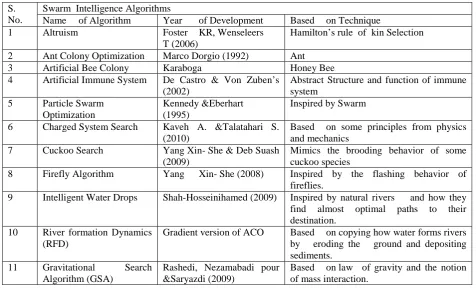
Swarm intelligence are often classified supported
Table 1: Different Swarm Intelligence Algorithms
S. No.
Swarm Intelligence Algorithms
Name of Algorithm Year of Development Based on Technique
1 Altruism Foster KR, Wenseleers
T (2006)
Hamilton’s rule of kin Selection
2 Ant Colony Optimization Marco Dorgio (1992) Ant
3 Artificial Bee Colony Karaboga Honey Bee
4 Artificial Immune System De Castro & Von Zuben’s
(2002)
Abstract Structure and function of immune system
5 Particle Swarm
Optimization
Kennedy &Eberhart (1995)
Inspired by Swarm
6 Charged System Search Kaveh A. &Talatahari S.
(2010)
Based on some principles from physics
and mechanics
7 Cuckoo Search Yang Xin- She & Deb Suash
(2009)
Mimics the brooding behavior of some cuckoo species
8 Firefly Algorithm Yang Xin- She (2008) Inspired by the flashing behavior of
fireflies.
9 Intelligent Water Drops Shah-Hosseinihamed (2009) Inspired by natural rivers and how they
find almost optimal paths to their destination.
10 River formation Dynamics
(RFD)
Gradient version of ACO Based on copying how water forms rivers
by eroding the ground and depositing sediments.
11 Gravitational Search
Algorithm (GSA)
Rashedi, Nezamabadi pour &Saryazdi (2009)
Based on law of gravity and the notion
of mass interaction.
ARTIFICIAL BEE COLONY(ABC) ALGORITHM
Artificial Bee Colony formula (ABC) was planned for optimisation, classification, and NNs drawback answersupported the
intelligent hunt behavior of honey bee swarm thus, rudiment is a lot of winning and most strong on multimodal functions enclosed within the set with reference
to Delaware, PSO, and GA [4], rudiment formula provides answer in organized type by
dividing the bee objects into completely different tasks such as employedbees, onlooker bees, and scout bees. These 3 bees/tasks confirm the objects of issues by sharing data to others bees. The common duties of those artificial bees area unit as follows: • employed bees: Employed bees use multidirectional search area for food supply with low-level formatting of the
world. They get data and every one potentialities to realize food supply and answer area.
Sharing of knowledge with onlooker bees is performed by worker bees. associate degree employed bee produces a modification on the supply position in her memory and discovers a brand new food supply position. Provided that the nectar quantity of the new supply is on top of that of the previous supply, the employed bee memorizes the new supply position and forgets the previous one.
• onlooker bees: Onlooker bees appraise the
nectar quantity obtained by employed bees and opt for a food supply relying on the likelihood values calculated victimization the fitness values. For this purpose, a fitness-based choice technique will be used. witness bees watch the dance of hive bees and choose the
simplest food supplyin keeping with the likelihood proportional to the standard of that
food supply.
• Scout bees: Scout bees choose the food supply willy-nilly while not expertise. If the nectar quantity of a food supply is on top of that of the previous supply in their memory, they learn the new position and forget the previous position. Whenever employed bees get a food supply and use the food supply all right once more, they become scout bees to realize new food supply by memorising the best path[5].
The main steps of the algorithm are given below:
Initialize REPEAT
Move the employee bees onto their food sources and determine the nectar amounts.
Move the onlooker bees onto the food source and determine the nectar amounts.
Each cycle of the search consists of 3 steps: moving the used and viewer bees onto the food sources and scheming their nectar amounts and determinant the scout bees then moving them randomly onto the attainable food sources. A food supply represents a attainable answer to the matter to be optimized. The nectar quantity of a food supply corresponds to the standard of the answer described by that food supply. Onlookers ar placed on the foods by mistreatment ‘‘roulette wheel selection’’ technique. each bee colony has scouts that ar the colony’s explorers. The explorers do not have any steering whereas craving
for food. they're primarily involved with finding any reasonably food supply. As a results of such behaviour,
the scouts ar characterised by low search prices and a coffee average in food supply quality. sometimes, the scouts will accidentally discover made, entirely unknown
food sources. within the case of artificial bees, the bogus scouts may have the quick discovery of the cluster of possible solutions as a task. In ABCs rule, one in every of the used bees is chosen and classified because the scout bee. The classification is controlled by an impression parameter referred to as ‘‘limit’’. If an answer representing a food supply isn't improved by a planned range of trials, then that food supply is abandoned by its used bee and also the used bee related to that food supply becomes a scout. the quantity of trials for cathartic a food supply is adequate the worth of ‘‘limit’’, that is a crucial management parameter of ABCs rule [6].
ANT COLONY OPTIMIZATION(ACO)
The basic plan of ant Colony optimisation (ACO)[7] is to model the matter to unravel because the search for a minimum price path in an exceedingly graph, and to use artificial ants to look permanently methods. The behavior of artificial ants is impressed from real ants: they lay secretion on elements (edges and/or vertices) of the graph and that they select their path with relevance possibilities that rely on secretion trails
that are previously set by the colony; these secretion trails more and more decrease by evaporation. Intuitively, this indirect stigmergetic
communication means that aims at giving info concerning the standard of path elements so as to
attract ants, within the following iterations, towards the corresponding areas of the search house. Artificial ants even have some extra-features that do not realize their counterpart in real ants. especially, they're sometimes related toinformation structures that contain the memory of their previous actions, and that they could apply some daemon procedures, like native search, to boost the standard of computed methods. In several cases, secretion is updated solely once having made a whole path and therefore the quantity of secretion deposited is
typically a operate of the standard of the entire path. Finally,
the chance for an artificial ant to decide on a elementtypically depends
not solely on secretion, however additionally on problem-specific native heuristics.
Ant Colony optimisation (ACO) is a metaheuristic for finding laborious combinatorial optimisation issues.
The ennobling supply of ACO is that the secretion path birthing and following behavior of real
ants, that use pheromones as a communication medium. In analogy to the biological example, ACO relies on indirect communication among a colony of easy agents, known as (artificial) ants, mediate by (artificial) secretion trails. The secretion trails in ACO function a distributed, numerical info, that the ants use to probabilistically construct solutions to the matter being resolved and that the ants adapt throughout the algorithm’s execution to replicate their search expertise. The (artificial) ants in
ACO implement a randomised construction
heuristic that makes probabilistic selections as a operate of artificial secretion trails
and presumably offered heuristic info supported the input file of the matter to be resolved. As such, ACO will be taken as associate degree extension
of ancient construction heuristics, that area unit without delay offered for several combinatorial optimisation issues. Yet, a crucial distinction with construction heuristics is the
adaptation of the secretion trails throughout formulaexecution to take into
account the cumulated search expertise [8].
ANT COLONY OPTIMIZATION (ACO) FOR FSDESIGN
ACO could be a meta-heuristic algorithmic program impressed by the behavior of[3] real ants, and especiallyhowever they forage for food it had been 1st applied to the interpreter downside (TSP). In ACO, a finite size colony of artificial ants is formed. every emmet then builds an answer to the
matter. whereas building its own resolution, every emmet collects info supported the
matter characteristics and on its own performance. The performance liveis predicated on a top quality operate F(•). ACO will be applied to issues that may be represented by a
graph, wherever the solutions to the improvement downside will be expressed in terms
of possible methods on the graph. Among the possible methods, ACO is employed to search out associate degree best one which can be a domestically or globally best resolution. the data collected by the ants throughout the search method is hold on within the secretion trails, r , associated to the association of all edges. These secretion trails play the role of a distributed remembering concerning the
complete emmet search method. The ants collaborate find a resolution by exchanging info via
the secretion trials. Edges will conjointly have associate degree associated heuristic price, , representing a priori info concerning the matter instance definition or run-time info provided by a supply totally different from the ants. Ants will act at the same time and severally, showing a cooperative behavior. Once all ants have computed their tours (i.e. at the top of the every iteration), ACO algorithms update the secretion pathvictimization all the solutions made by
the emmet colony. every edge happiness to at least one of
the computed resolutions is changed by the
number of secretion that's proportional to its solution price.
The secretion pathcould also be updated domestically whereas associate
degree emmet builds its path or globally once all ants
have designed their trails. Let τ_(ij ) (t) be
the secretion level on edge (i,j ) at iteration t , and ƞ_ijbe the
corresponding heuristic price. The chance that associate degree emmet chooses j because the next vertex onceit's
𝑃𝑃𝑖𝑖𝑖𝑖(𝑡𝑡) =��
𝜏𝜏𝑖𝑖𝑖𝑖(𝑡𝑡)ƞ𝑖𝑖𝑖𝑖𝛽𝛽(𝑡𝑡)
∑𝑖𝑖𝜖𝜖𝐽𝐽(𝑖𝑖)𝜏𝜏𝑖𝑖𝑖𝑖(𝑡𝑡)ƞ𝑖𝑖𝑖𝑖𝛽𝛽(𝑡𝑡), 𝑖𝑖𝑖𝑖𝑖𝑖𝜖𝜖𝐽𝐽(𝑖𝑖)
0 𝑜𝑜𝑡𝑡ℎ𝑒𝑒𝑒𝑒𝑒𝑒𝑖𝑖𝑒𝑒𝑒𝑒 (1.1)
at the vertex i at iteration t is given by
where J (i) is that the set of vertices that stay to be visited by the ant, β could be a parameter that determines the relative
influence of the secretion path and therefore
𝜏𝜏𝑖𝑖𝑖𝑖 (𝑡𝑡+ 1) =𝑝𝑝𝜏𝜏𝑖𝑖𝑖𝑖(𝑡𝑡) +∆𝜏𝜏𝑖𝑖𝑖𝑖(𝑡𝑡)s (1.2)
where p ρ ε (0,1) may be a parameter such 1-ρ represents the
evaporation constant. The update worth ∆ τ_(ij
)is associated with the
standard worth F. several change rules for ∆ τ_(ij
) are studied like ant system, ant colony system Georgia home boy MIN ant system, and hypercube framework ACO. the main variations between these ACO algorithms and AS square measure the likelihood choice techniques or secretion update. ACO is applied to style the consequent half parameters in AN FS. the final style approach is delineated as follows. take into account the FS whose structure and antecedent half parameters. Suppose the consequent half is chosen from a separate set U = . For every rule, there square measure m candidate actions to be chosen. every rule with competitive subsequent is also
That is, they have to decide one from a total of mc combinations of consequent parts. This combinatorial problem is solved by ACO [9].
written as
𝐼𝐼𝑖𝑖𝑥𝑥1𝑖𝑖𝑅𝑅𝑖𝑖𝑒𝑒𝐴𝐴𝑖𝑖1𝐴𝐴𝐴𝐴𝐴𝐴…𝐴𝐴𝐴𝐴𝐴𝐴𝑥𝑥𝐴𝐴𝑖𝑖𝑒𝑒𝐴𝐴𝑖𝑖𝐴𝐴
𝑇𝑇ℎ𝑒𝑒𝐴𝐴𝑢𝑢(𝐾𝐾)𝑖𝑖𝑒𝑒𝑢𝑢1𝑜𝑜𝑒𝑒𝑢𝑢2𝑂𝑂𝑒𝑒…𝑂𝑂𝑒𝑒𝑢𝑢𝑚𝑚
RELATED WORK
Chia-FengJuang et al. [3] (2010) delineated the style of FSs exploitation PSO, ACO, and their successive and parallel combination approaches. the utilization of on- line rule generation not solely helps to work out the amount of fuzzy rules, however additionally helps to find the initial antecedent parameters for ulterior parameter learning exploitation PSO. For PSO, the incorporation of ACO helps to find a decent initial fuzzy rule base for more PSO learning. For ACO, the incorporation of PSO
helps to search out the parameters in an
exceedingly continuous area. The cooperative search of ACO and PSO compensates for the looking out disadvantage of every improvementmethodology. Habib Shah of Iran et al. [5] (2011) investigated the utilization of basic principle algorithmic rule that simulates the intelligent forage behaviour of a honey bee swarm. Multilayer Perceptron (MLP) trained with the quality back propagation algorithmic rule usually utilises computationally intensive coaching algorithms. one in every of the crucial issues with the rear propagation (BP) algorithmic rule is that it will generally yield the networks with suboptimal weights as a result of the presence of the many native optima within the resolution area. To overcome basic principle algorithmic
rule employed in this search to coach MLP learning
the complicated behaviour of earthquake statistic knowledge trained by BP, the
performance of MLP-ABC is benchmarked against MLP coaching with the quality BP. Alok Sharma et al.[11] (2012) planned a feature choice algorithmic rule in factor expression knowledge analysis of sample classifications. The planned algorithmic rule 1st divides genes into subsets, the sizes
of that arcomparatively tiny (roughly of size ℎ), then selects
informative smaller sets of factors (of size r < ℎ ) from
a set and merges the chosen factors with another gene set (of size r) to update the gene subset. They repeat this method till all sets ar united into one informative subset.
They illustrate the effectiveness of the planned algorithmic rule by analyzing 3 distinct organic phenomenon datasets. Their methodology shows promising classification accuracy for all the check datasets. we have a tendency to additionally show the relevancy of the chosen
P.
genes in terms of their biological functions.
Hindu deity Kumar et al. [10] (2014) planned hymenopteron Bee algorithmic rule to handle the Accuracy-Interpretability trade-off within the style of fuzzy professional system for sample classification. In the planned ABA, Rule set
is represented exploitation number numbers and evolved exploitation ACO. The values of membership perform use floating purpose numbers and ar evolved exploitation basic principle at the same time along side the rule set. The effectiveness of the planned approach has been incontestible exploitation six microarray knowledge sets. From the results, it is known that the training ability of ABA is comparable and its classification error calculable for all the information sets exploitation MCCV
procedure throughout generalization is minimum than
the alternative approaches.
CONCLUSION
Swarm-based algorithms have recently emerged as a family of nature-inspired, population-based algorithms that area unit capable of manufacturing low value, fast, and strong solutions to many complicated issues. Swarm Intelligence(SI) will therefore be outlined as a
comparatively new branch of artificial intelligence that's used to model the collective behaviour of social swarms in nature, like hymenopterous insect colonies, honey bees, and bird flocks. though these agents (insects or swarm individuals) area unit comparatively unsophisticated
with restrictedcapabilities on their own, they're interacting along with bound activity patterns
to cooperatively reach tasks necessary for their survival.
This paper explains the abc algorithmic
rule with ant colony improvement, and fuzzy system. In
future, we propose to work on gravitative search algorithmic
rule.
REFERENCES
[1] I. Kassabalidis,M.A.El-Sharkawi, R.J.Marks Ii,
[2] P. Arabshahi,A.A.Gray, “Swarm Intelligence for Routing in Communication Networks”
[3] D. Karaboga, B. Basturk ,“On the performance of artificial bee colony (ABC) algorithm”, Applied Soft Computing 8 (2008) 687–697.
[4] Chia-FengJuang, “Combination of Particle Swarm and Ant Colony Optimization Algorithms for Fuzzy Systems Design”, ISBN 978-953-7619-92-3, pp. 216, February 2010, INTECH, Croatia, SCIYO.COM.
[5] A.E. Eiben, J.E. Smith, Introduction to Evolutionary Computing, Springer, 2003
[6] Shah, Habib, RozaidaGhazali, and NazriMohdNawi. "Using artificial bee colony algorithm for mlp training on earthquake time series data prediction." arXiv preprint arXiv:1112.4628 (2011).
[8] Alaya, I., Solnon, C., Gh´ edira, K.: Ant colony optimization for multi-objective optimization problems. In: 19th IEEE International Conference on Tools with Artificial Intelligence, vol. 1, pp. 450–457. IEEE Computer Society, Los Alamitos, CA (2007)
[9] M. Dorigo, T. Stuzle, Ant Colony Optimization, MIT Press,2004.
[10]Dorigo, M. & Gambardella, L.M. (1997). Ant colony system: A cooperative learning approach to traveling
salesman problem, IEEE Trans. on Evolutionary Computation, Vol. 1, No. 1, 53- 66.
[11]Ganesh Kumar, P., C. Rani, D. Devaraj, and T. Victoire. "Hybrid Ant Bee Algorithm for Fuzzy Exp System Based." (2014): 1-1.