R E S E A R C H
Open Access
Two types of permanence of a stochastic
mutualism model
Hong Qiu
1,2, Jingliang Lv
1*and Ke Wang
1,3*Correspondence:
1Department of Mathematics,
Harbin Institute of Technology, Weihai, 264209, P.R. China Full list of author information is available at the end of the article
Abstract
A stochastic mutualism model is proposed and investigated in this paper. We show that there is a unique solution to the model for any positive initial value. Moreover, we show that the solution is stochastically bounded, uniformly continuous and globally attractive. Under some conditions, we conclude that the stochastic model is stochastically permanent and persistent in mean. Finally, we introduce some figures to illustrate our main results.
Keywords: global attractivity; stochastic permanence; persistence in mean; extinction
1 Introduction
Population systems have long been an important theme in mathematical biology due to their universal existence and importance. As far as mutualism system is concerned, lots of proofs have been found in many types of communities. Mutualism occurs when one species provides some benefit in exchange for some benefit. One of the simplest models is the classical Lotka-Volterra two-species mutualism model, which reads
⎧ ⎨ ⎩
dN(t)
dt =N(t)[a–bN(t) +cN(t)], dN(t)
dt =N(t)[a–bN(t) +cN(t)].
()
There are many excellent results on the two-species mutualism model (). It is well known that in nature, with the restriction of resources, it is impossible for one species to survive if its density is too high. Thus the above model is not so good in describing the mutualism of two species (see []). Gopalsamy [] proposed the mutualism model as follows:
⎧ ⎨ ⎩
dN(t)
dt =r(t)N(t)[
K(t)+α(t)N(t)
+N(t) –N(t)],
dN(t)
dt =r(t)N(t)[
K(t)+α(t)N(t)
+N(t) –N(t)],
()
whereN(t) andN(t) denote population densities of each species at timet,ridenotes the intrinsic growth rate of speciesNiandαi>Ki,i= , . The carrying capacity of speciesNiis
Kiin the absence of other species, while with the help of the other species, the carrying ca-pacity becomes (Ki(t) +αi(t)N–i(t))/( +N–i(t)),i= , . It is assumed that the coefficients of the system are all continuous and bounded. Li and Xu [] obtained sufficient conditions for the existence of positive periodic solutions. Chen and You [] gave the sufficient con-ditions for the permanence of the model. Chenet al.[] considered the permanence of a
delayed discrete mutualism model with feedback controls. Here we transform the system () into the following form:
⎧ ⎨ ⎩
dx(t) dt =x(t)[
a(t)+a(t)y(t)
+y(t) –c(t)x(t)], dy(t)
dt =y(t)[
b(t)+b(t)x(t)
+x(t) –c(t)y(t)].
()
As a matter of fact, population systems are often subject to environmental noise,i.e., due to environmental fluctuations, parameters involved in population models are not absolute constants, and they may fluctuate around some average values. Based on these factors, more and more people began to be concerned about stochastic population systems (see [–]). Especially, Maoet al.[] obtained the interesting and surprising conclusion: even a sufficiently small noise can suppress explosions in population dynamics. Jianget al.[] considered the global stability and stochastic permanence of a stochastic logistic model. Ji
et al.[] discussed the persistence in mean of a predator-prey model with stochastic per-turbation. Now, taking into account the effect of randomly fluctuating environment, we in-corporate white noise in each equation of the system (). Therefore, the non-autonomous stochastic system can be described by the Itô equation
⎧ ⎨ ⎩
dx(t) =x(t)[a(t)+a(t)y(t)
+y(t) –c(t)x(t)]dt+σ(t)x(t)dB(t),
dy(t) =y(t)[b(t)+b(t)x(t)
+x(t) –c(t)y(t)]dt+σ(t)y(t)dB(t),
()
whereai(t),bi(t),ci(t), σi(t),i= , are all positive, continuous and bounded functions on [, +∞), andB(t),B(t) are independent Brownian motions,σandσrepresent the intensities of the white noises.
For convenience, iff(t) is a continuous bounded function on [, +∞), we define
ˆ
f = inf
t∈[,+∞)f(t), ˇ
f = sup
t∈[,+∞)
f(t).
For any sequence{fi(t)}(i= , ) define
ˆ
f = inf
t∈[,+∞)fi(t), ˇ
f = sup
t∈[,+∞)
fi(t).
To the best of our knowledge, a very little amount of work has been done on the stochas-tic system (). Therefore, we aim to consider dynamical properties of the stochasstochas-tic model () in this paper.
the system () in Section . We work out some figures to illustrate the various theorems obtained before in Section . Finally, we close the paper with conclusions in Section . The important contributions of this paper are therefore clear.
2 Basic properties of the solution
2.1 Positive and global solution
Throughout this paper, let (,F,{Ft}t≥,P) be a complete probability space with a filtration {Ft}t≥satisfying the usual conditions. We denote byR+the positive cone inR,X(t) = (x(t),y(t)) and|X(t)|= (x(t) +y(t)). And we useKto denote a positive constant whose
exact value may be different in different appearances.
Theorem For any given initial value X= (x,y)∈R+,there is a unique solution X(t) = (x(t),y(t))to stochastic differential equation()on t≥and the solution will remain in R +
with probability,that is,X(t) = (x(t),y(t))∈R
+for all t≥almost surely.
Proof The proof is similar to [, ]. Since the coefficients of equation () are locally Lips-chitz continuous, for any given initial valueX∈R+, there is a unique local solutionX(t) ont∈[,τe), whereτe is the explosion time. To show this solution is global, we need to show thatτe= +∞a.s. Letm> be sufficiently large forx(t) andy(t) lying within the interval [m
,m]. For each integerm≥m, define the stopping time
τm=inf
t∈[,τe) :x(t) ory(t) /∈
m,m
,
where, throughout this paper, we setinf∅=∞. Obviously,τmis increasing asm→ ∞. Let
τ∞=limm→∞τm, whenceτ∞≤τea.s. If we can show thatτ∞=∞a.s., thenτe=∞a.s. If not, there is∈(, ) andT> such thatP{τ∞≤T}>. Hence there is an integerm≥m such thatP{τm≤T} ≥for allm≥m. Define a functionV:R+→R+byV(x) = (x– –
lnx) + (y– –lny). The non-negativity of this function can be seen fromu– –lnu≥ onu> . IfX(t)∈R
+, we obtain that
LV = (x– ) a(t) +a(t)y(t)
+y(t) –c(t)x(t)
+ (y– ) b(t) +b(t)x(t)
+x(t) –c(t)y(t)
+σ +σ
≤(aˇi+cˇi)x(t) –cˆi(t)x(t) + (bˇi+cˇi)y(t) –ˆci(t)y(t) +
σ+σ≤K.
Therefore
EVX(τm∧T)
=V(X) +E
τm∧T
LVX(t)dt≤V(X) +KT. ()
On the other hand, we have
VX(τm)
≥[m– –lnm]∧ lnm– +
m
It follows from () that
V(X) +KT≥
[m– –lnm]∧ lnm– +
m
.
Lettingm→ ∞leads to the contradiction∞>V(X) +KT=∞. Hence, we haveτ∞=∞
a.s. The proof is complete.
2.2 Stochastic boundedness
Stochastic boundedness is one of most important topics because boundedness of a system guarantees its validity in a population system. We first present the definition of stochasti-cally ultimate boundedness.
Definition (see []) The solutionX(t) = (x(t),y(t)) of equation () is said to be stochasti-cally ultimately bounded if for any∈(, ), there is a positive constantδ=δ() such that for any initial valueX∈R+, the solutionX(t) to () has the property that
lim sup
t→∞
P|X(t)|>δ<.
Theorem The solution of the system()is stochastically ultimately bounded for any initial value X= (x,y)∈R+.
Proof By Theorem , the solutionX(t) will remain inR
+for allt≥ with probability . Define the functionV=etxpforp> . By the Itô formula, we obtain
LV =etxp(t) +p
a(t) +a(t)y(t)
+y(t) –c(t)x(t)
+p(p– ) σ
≤et +paˇ+p(p– ) σˇ
xp(t) –pˆcxp+(t)
≤(ˆ
c)p
+paˇ+p(p–) σˇ
p+
p+
et:=K(p)et.
Hence we have
detxp=LV dt+petxpσ
dB(t)≤K(p)etdt+petxpσ(t)dB(t).
ThusetExp–Exp
≤K(p)et. So, we havelim supt→∞Exp≤K(p) < +∞. On the other hand, define the functionV=etypforp> . We have
LV =etyp(t) +p
b(t) +b(t)x(t)
+x(t) –c(t)y(t)
+p(p– ) σ
≤et +pbˇ+p(p– ) σˇ
yp(t) –pcyˆ p+(t)
≤(ˆ
c)p
+pbˇ+p(p–) σˇ
p+
p+
This impliesd(etyp(t)) =K
(p)etdt+petypσ(t)dB(t). Thenlim supt→∞Eyp≤K(p) < +∞. ForX(t) = (x(t),y(t))∈R
+, note that|X(t)|p≤
p
(xp+yp), therefore
lim sup
t→∞ E
X(t)p≤K< +∞.
Applying the Chebyshev inequality yields the required assertion.
2.3 Uniform continuity
In this section, we show the positive solutionX(t) = (x(t),y(t)) is uniformly Hölder contin-uous. Main tools are to use appropriate Lyapunov functions and fundamental inequalities. Main methods are motivated by [, ].
Lemma ([, ]) Suppose that a stochastic process X(t)on t≥satisfies the condition E|X(t) –X(s)|α≤c|t–s|+β, ≤s,t< +∞,for some positive constantsα,β and c.Then there exists a continuous modificationX˜(t)of X(t),which has the property that for every γ ∈(,βα),there is a positive random variable h(w)such that
P
ω: sup
<|t–s|<h(ω),≤s,t<+∞
| ˜X(t,ω) –X˜(s,ω)|
|t–s|γ ≤
– –γ
= .
In other words,almost every sample path ofX˜(t)is locally but uniformly Hölder-continuous with exponentγ.
Theorem For any initial value (x,y)∈ R+, almost every sample path of X(t) = (x(t),y(t))to()is uniformly continuous on t≥.
Proof Let us consider the stochastic equation as follows:
x(t) =x+
t
f
s,x(s),y(s)ds+
t
g
s,x(s),y(s)dB(t),
where
f
s,x(s),y(s)=x(s) a(s) +a(s)y(s)
+y(s) –c(s)x(s)
,
g
s,x(s),y(s)=σ(s)x(s).
It follows from Theorem that
Ef
s,x(s),y(s)p =E
xp(s)a(s) +a(s)y(s)
+y(s) –c(s)x(s)
p
≤ Ex
p(s) + E
a(s) +a(s)y(s)
+y(s) –c(s)x(s)
p
≤ Ex
p(s) + p–aˇp+ p–ˇcExp(s)≤K (p)
and
Eg
By the moment inequality (cf.[, ]) then for ≤t<t<∞andp> ,
E
t
t
g(s)dB(s)
p≤ p(p– )
p
(t–t)
p–
t
t
Eg(s)pds,
where dropping (s,x(s),y(s)) fromg(s,x(s),y(s)).
Let ≤t<t<∞,t–t≤, /p+ /q= , we can compute
Ex(t) –x(t) p
≤p–E
t
t
|f|ds
p
+ p–E
t
t
gdB(s)
p
≤p–
t
t
qds
p q E
t
t
|f|pds
+ p– p(p– )
p
(t–t)
p–
t
t
E|g|pds
≤p–(t–t)
p
(t–t)
p
+ p(p– )
p
K
≤K(t–t)
p ,
where dropping (s,x(s),y(s)) fromf(s,x(s),y(s)) andg(s,x(s),y(s)). Consequently, it follows from Lemma that almost every sample path ofx(t) is locally but uniformly Hölder con-tinuous with an exponentγ ∈(,p–p), and therefore almost every sample path ofx(t) is uniformly continuous ont≥.
Similarly, by virtue of Lemma , almost every sample path ofy(t) is uniformly continuous ont≥. In a word, almost every sample path of (x(t),y(t)) to () is uniformly continuous
ont≥.
2.4 Global attractivity
Here we show that the solution of () is globally attractive.
Lemma (Barbalat []) Let f(t)be a non-negative function defined on[, +∞)such that f(t)is integrable on[, +∞)and is uniformly continuous on[, +∞).Thenlimt→∞f(t) = .
Definition LetX(t) = (x(t),y(t)) andX(t) = (x(t),y(t)) be two arbitrary solutions of the system () with initial values (x(),y())∈R+and (x(),y())∈R+respectively. If
lim
t→∞x(t) –x(t)+y(t) –y(t)= a.s.
then we say the system is globally attractive.
Theorem Let c(t) –|(b(t) –b(t))|> ,c(t) –|(a(t) –a(t))|> on[, +∞)hold.Then,
Proof The proof is motivated by the arguments of []. Define the Lyapunov function
V(t) =|x(t) –x(t)|+|y(t) –y(t)|. By virtue of the Itô formula, we obtain
d+V(t) =sgnx(t) –x(t)
dlnx(t) –lnx(t)
+sgny(t) –y(t)
dlny(t) –lny(t)
=sgnx(t) –x(t)
×
a(t) +a(t)y(t) +y(t)
–a(t) +a(t)y(t) +y(t)
–c(t)
x(t) –x(t)
dt
+sgny(t) –y(t)
×
b(t) +b(t)x(t) +x(t)
–b(t) +b(t)x(t) +x(t)
–c(t)
y(t) –y(t)
dt
= |(a(t) –a(t))(y(t) –y(t))| ( +y(t))( +y(t))
+|(b(t) –b(t))(x(t) –x(t))| ( +x(t))( +x(t))
–cx(t) –x(t)–cy(t) –y(t)
≤–c(t) –b(t) –b(t)x(t) –x(t)
–c(t) –a(t) –a(t)y(t) –y(t).
Integrating the above inequality from tot, there exists a positive constantKsuch that
V(t) +K
t
x(s) –x(s)+y(s) –y(s)ds≤V() < +∞.
Therefore, it follows from Theorem and Lemma that
lim
t→∞
x(t) –x(t)+y(t) –y(t)= a.s.
So, we complete the proof.
3 Stochastic permanence
The property of permanence is more desirable since it means the long time survival in a population dynamics. Now, the definition of stochastic permanence will be given below [, ].
Definition The solutionX(t) = (x(t),y(t)) of equation () is said to be stochastically permanent if for any∈(, ), there exists a pair of positive constantsδ=δ() andχ=χ() such that for any initial valueX= (x,y)∈R+, the solutionX(t) to () has the properties that
lim inf
t→∞ PX(t)≥δ
≥ –, lim inf
t→∞ PX(t)≤χ
≥ –.
Let us now impose a hypothesis.
Theorem Under Assumption, for any initial value X= (x,y)∈R+, the solution
whereθ is an arbitrary positive constant satisfying
min{ˆa,bˆ}>θ+ σˇ
, ()
and k is an arbitrary positive constant satisfying
θmin{ˆa,bˆ}–θ(θ+ ) positive constantθsuch that it obeys (). By the Itô formula again, we have
L( +U)θ=θ( +U)θ–LU+θ(θ– )
Now, choosek> sufficiently small such that it satisfies (). Thus by the Itô formula,
Lekt( +U)θ=kekt( +U)θ+ektL( +U)θ=ekt( +U)θ–k( +U)+F.
The following analysis mainly focuses on the upper boundedness of the function
We compute
droppingtfromx(t),y(t). Simplifying the inequalities above, we obtain
Lekt( +U)θ=ekt( +U)θ–k( +U)+F
Then () implies that there exists a positive constantKsuch that
Lekt( +U)θ≤Kekt.
Theorem Let Assumptionhold.Then the system()is stochastically permanent.
The proof is an application of the well-known Chebyshev inequality and Theorems and . Here it is omitted.
4 Persistence in mean
In view of ecology, a good situation occurs when all species co-exist. In this section, we will consider another stochastic persistence, that is, stochastic persistence in mean. Now, we present the definition of persistence in mean.
Definition (see [, ]) The system () is said to be persistent in mean if
lim
Firstly, we introduce a fundamental lemma which will be used.
Lemma Consider the one-dimensional stochastic equation
where a(t),b(t),σ(t)are positive,continuous and bounded functions,B(t)is a standard Brownian motion.Under the conditionaˆ>σˇ
,for any initial value x> ,the solution x(t)
to()has the property
lim
By virtue of the exponential martingale inequality, for any positive constantsT,δ,β, we have
Obviously, we know∞k=k–θ<∞. Applying the Borel-Cantalli lemma, we obtain that
For allt∈[,kγ] withk>k(ω), we derive
t ≥ a.s. The quadratic variation of the stochastic integraltσ(s)dB(s) istσ(s)ds≤Kt. So, the strong law of large numbers of
Hence, for any> , there exists some positiveT<∞such that
That is,x(t) ≤Ke(t+T)a.s. Thenln
x(t)
t ≤
t[lnK+ (t+T)] a.s. Thuslim inft→∞
lnx(t) t ≥– a.s. Sinceis arbitrary, we conclude that
lim inf
t→∞
lnx(t)
t ≥ a.s.
So, the proof is complete.
Remark Lemma generalizes the works of [] and [].
To continue our analysis, let us impose the following hypothesis.
Assumption aˆ–σˇ > ,bˆ–σˇ > .
Theorem tells us there is a unique global solution (which is positive for any initial value
X= (x,y)∈R+) to the stochastic system (). So, we conclude the following results by the comparison theorem. We can get
dx(t)≤x(t)aˇ–c(t)x(t)
dt+σ(t)x(t)dB(t)
and
dx(t)≥x(t)aˆ–c(t)x(t)
dt+σ(t)x(t)dB(t).
Denote thatXis the solution to the following stochastic equation:
dX(t) =X(t)
ˇ
a–c(t)X(t)
dt+σ(t)X(t)dB(t) ()
withX() =x. AndXis the solution to the equation
dX(t) =X(t)
ˆ
a–c(t)X(t)
dt+σ(t)X(t)dB(t) ()
withX() =x. It is obvious thatX(t)≤x(t)≤X(t),t∈[, +∞) a.s. Moreover, we can have
dy(t)≤y(t)bˇ–c(t)y(t)
dt+σ(t)y(t)dB(t)
and
dy(t)≥y(t)bˆ–c(t)y(t)
dt+σ(t)y(t)dB(t).
We denoteY(t) is the solution of the stochastic differential equation
dY(t) =Y(t)
ˆ
b–c(t)Y(t)
dt+σY(t)dB(t) ()
withY() =y. And the stochastic equation
dY(t) =Y(t)
(bˇ–c(t)Y(t)
has the solutionY(t) for initial valueY() =y. Consequently,Y(t)≤y(t)≤Y(t),t∈
Lemma , (), () and () can straightforward imply the assertion.
Lemma Under Assumption,for any initial value y> ,the solution y(t)to()satisfies
is persistent in mean.That is,the system()has the properties
lim inf
By virtue of the strong law of large numbers and Lemma , we get
Thus
Dividington both sides yields
ˇ
Lettingt→ ∞, by virtue of the strong law of large numbers and Lemma , we have
lim inf
The proof is complete.
5 Extinction
In Sections and , we showed that under certain conditions, the system was stochasti-cally permanent and persistent in mean respectively. In view of ecology, a bad thing hap-pens when a species disappears. Here, we will show that if the noise is sufficiently large, the solution to the associated stochastic model will become extinct with probability one.
Theorem Assumeaˇ–σˆ
Proof Define Lyapunov functionslnxandlnyrespectively. Then, by the Itô formula, we
and
lny(t)≤lny+
ˇ
b–σˆ
t+
t
σ(s)dB(s).
Dividington the both sides, lettingt→ ∞and applying the strong law of large numbers for local martingales, we have
lim sup
t→∞
lnx(t)
t ≤ ˇa–
ˆ
σ
< , lim supt→∞
lny(t)
t ≤ ˇb–
ˆ
σ
< a.s.
So, we complete the proof.
6 Numerical simulations
In this section we use the Milstein method mentioned in Higham [] to substantiate the analytical findings.
For the model (), we consider the discretization equation:
xk+=xk+xk
a(kt) +a(kt)yk
yk+
–c(kt)xk
t+σ(kt)xk √
tξk
+σ (kt)
xk
ξk– t,
yk+=yk+yk
b(kt) +b(kt)xk
xk+
–c(kt)yk
t+σ(kt)yk √
tηk
+σ (kt)
yk
ηk– t,
whereξkandηkare Gaussian random variables that followN(, ).
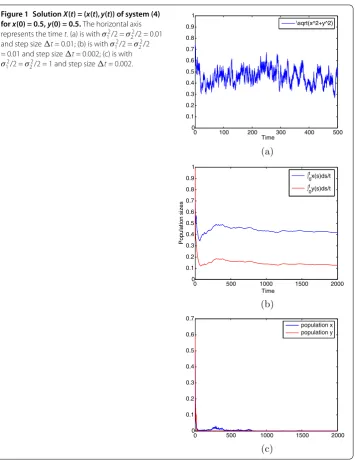
In Figure a,b, we choosea=b= .,a=b= .,c=c= .. In Figure a,b, we chooseσ(t)/ =σ(t)/ = .. By virtue of Theorem , the system will be stochastically permanent. It follows from Theorem that the system will be persistent in mean. What we mentioned above can be seen from Figure a,b. The difference between conditions of Figure a,b,c is that the values of σ andσ are different. In Figure a,b, we choose
σ/ =σ/ = .. In Figure c, we chooseσ/ =σ/ = . In view of Theorem , both speciesxandywill go to extinction. Figure c confirms this.
By comparing Figure a,b with Figure c, we can observe that small environmental noise can retain the stochastic system permanent; however, sufficiently large environmental noise makes the stochastic system extinct.
7 Conclusions
Figure 1 SolutionX(t) = (x(t),y(t)) of system (4) forx(0) = 0.5,y(0) = 0.5.The horizontal axis represents the timet. (a) is withσ2
1/2 =σ22/2 = 0.01
and step sizet= 0.01; (b) is withσ2 1/2 =σ22/2
= 0.01 and step sizet= 0.002; (c) is with
σ2
1/2 =σ22/2 = 1 and step sizet= 0.002.
desired. However, Theorem reveals that a large white noise will force the population to become extinct.
Competing interests
The authors declare that they have no competing interests.
Authors’ contributions
The authors carried out the proof of the main part of this article. All authors have read and approved the final manuscript.
Author details
1Department of Mathematics, Harbin Institute of Technology, Weihai, 264209, P.R. China.2Department of Mathematics,
Civil Aviation University of China, Tianjin, 300300, P.R. China.3School of Mathematics and Statistics, Northeast Normal
University, Changchun, 130024, P.R. China.
Acknowledgements
Innovation Foundation in Harbin Institute of Technology (No. HIT.NSRIF.2011094), the Scientific Research Foundation of Harbin Institute of Technology at Weihai (No. HIT(WH)ZB201103).
Received: 3 February 2012 Accepted: 30 January 2013 Published: 18 February 2013
References
1. Chen, LJ, Chen, LJ, Li, Z: Permanence of a delayed discrete mutualism model with feedback controls. Math. Comput. Model.50, 1083-1089 (2009)
2. Gapalsamy, K: Stability and Oscillations in Delay Equations of Population Dynamics. Kluwer Academic, London (1992) 3. Li, YK, Xu, GT: Positive periodic solutions for an integrodifferential model of mutualism. Appl. Math. Lett.14, 525-530
(2001)
4. Chen, FD, You, MS: Permanence for an integrodifferential model of mutualism. Appl. Math. Comput.186, 30-34 (2007) 5. Mao, XR, Marion, G, Renshaw, E: Environmental Brownian noise suppresses explosions in population dynamics. Stoch.
Process. Appl.97, 95-110 (2002)
6. Jiang, DQ, Shi, NZ, Li, XY: Global stability and stochastic permanence of a non-autonomous logistic equation with random perturbation. J. Math. Anal. Appl.340, 588-597 (2008)
7. Ji, CY, Jiang, DQ, Shi, NZ: Analysis of a predator-prey model with modified Leslie-Gower and Holling-type II schemes with stochastic perturbation. J. Math. Anal. Appl.359, 482-498 (2009)
8. Li, XY, Mao, XR: Population dynamical behavior of non-autonomous Lotka-Volterra competitive system with random perturbation. Discrete Contin. Dyn. Syst.24, 523-545 (2009)
9. Zhu, C, Yin, G: On hybrid competitive Lotka-Volterra ecosystems. Nonlinear Anal. TMA71, e1370-e1379 (2009) 10. Zhu, C, Yin, G: On competitive Lotka-Volterra model in random environments. J. Math. Anal. Appl.357, 154-170 (2009) 11. Ji, CY, Jiang, DQ, Li, XY: Qualitative analysis of a stochastic ratio-dependent predator-prey system. J. Comput. Appl.
Math.235, 1326-1341 (2011)
12. Chen, LS, Chen, J: Nonlinear Biological Dynamical System. Science Press, Beijing (1993) 13. Mao, XR: Stochastic versions of the Lassalle theorem. J. Differ. Equ.153, 175-195 (1999) 14. Karatzas, I, Shreve, S: Brownian Motion and Stochastic Calculus. Springer, Berlin (1991)
15. Friedman, A: Stochastic Differential Equations and Applications. Academic Press, New York (1976) 16. Mao, XR: Stochastic Differential Equations and Applications. Horwood, Chichester (1997)
17. Barbalat, I: Systems d’equations differential d’oscillations nonlineairies. Rev. Roum. Math. Pures Appl.4, 267-270 (1959) 18. Higham, DJ: An algorithmic introduction to numerical simulation of stochastic differential equations. SIAM Rev.43,
525-546 (2001)
doi:10.1186/1687-1847-2013-37