R E S E A R C H
Open Access
An efficient and secure anonymous
authentication scheme for mobile satellite
communication systems
Eun-Jun Yoon
1*, Kee-Young Yoo
2, Jeong-Woo Hong
3, Sang-Yoon Yoon
3, Dong-In Park
3and Myung-Jin Choi
4*Abstract
This paper proposes a new efficient and secure anonymous authentication scheme for mobile satellite
communication systems. Compared with the related schemes, the proposed scheme achieves the following three main advantages: (1) It is just based on a secure one-way hash function for avoiding complex computations for both mobile users and network control center (NCC), (2) it does not require sensitive verification table which may cause NCC to become an attractive target for numerous attacks (e.g., insertion attacks and stolen-verifier attacks), and (3) it provides higher security level (e.g., secure mutual authentication and key establishment, confidential communication, user’s privacy, simple key management, and session key independence). As a result, the proposed scheme is very suitable for lightweight-device environments because of very low computation overload on the part of both mobile user and NCC.
Keywords:mobile satellite communication system, user authentication, key establishment, public-key manage-ment, anonymity
1 Introduction
Recently, mobile satellite communication systems have captured much attention because these systems provide the opportunity to make personal communication as broad as possible [1-11]. Within mobile satellite com-munication systems, the problem arises how to mutually authenticate each other and whether confidentiality of communication is guaranteed. In 1996, Cruickshank [12] first proposed a security system for satellite net-works. In the Cruickshank’s scheme, public-key crypto-system (PKC) is used to provide authentication between a mobile user and the satellite network [13]. However, the scheme has the following three disadvantages: (1) It requires the complex computation overhead, (2) it requires the complexity of the public-key management in a PKI, and (3) user’s privacy is not kept confidential. In 2003, Hwang et al. [14] proposed another authentica-tion scheme for mobile satellite communicaauthentica-tion system
based on secret-key cryptosystems (SKC). The scheme reduced the complex computation overhead for mobile users by adopting only SKC instead of PKC. However, Hwang et al.’s scheme also has the following three dis-advantages: (1) It is insecure to the known key attack, (2) it is insecure to the stolen-verifier attack, and (3) the session key needs to be updated on the server side whenever the mobile user is authenticated.
In 2005, to overcome the weaknesses of Hwang et al.’s scheme, Chang et al. [15] proposed a hash-chain-based authentication scheme to improve efficiency and secur-ity. Due to the inverse direction when hashing the input value, a leaked hashed value of the chain is useful only for directly generating the valid value of the preceding, but not of the following session. This can preserve the authentication token used in the following session from leakage. However, Chang et al.’s scheme still has the fol-lowing three disadvantages: (1) An adversary can imper-sonate as either the mobile user or the network control center (NCC) using the compromised hash values from NCC, (2) user’s privacy is not kept confidential, and (3) it requires a great amount of communication bandwidth and computation resources.
* Correspondence: [email protected]; [email protected]
1
School of Computer Engineering, Kyungil University, 33 Buho-Ri, Hayang-Ub, Kyungsan-Si, Kyungsangpuk-Do 712-701, Republic of Korea
4
Satellite Information Research Institute, Korea Aerospace Research Institute, 45 Eoeun-Dong, Yuseong-Gu, Daejeon 305-333, Republic of Korea Full list of author information is available at the end of the article
’
PKC and SKC and achieves the following three advan-tages: (1) It does not require the public-key infrastruc-ture (PKI), (2) it reduces the complex computation for mobile users, and (3) it does not require sensitive verifi-cation table. Nevertheless, we found that Chen et al.’s scheme still requires high computations for both mobile users and NCC. For instance, it requires one pair of secret-key encryption/decryption computations during the authentication phase. In addition, for repelling an insertion attack in which an intruder inserts a verifica-tion item into the verificaverifica-tion table, NCC always must verify ifgs=yh(UID)·rr−1modpholds during the
authen-tication phase. We can see that the verification equation requires three exponential computations. Chen et al. claimed that these operations could be performed either off-line or by another authentication server in order to reduce complex computations. However, these solutions may cause increased communication delay.
Based on Chen at al.’s scheme, this paper proposes a new efficient and secure anonymous authentication scheme for mobile satellite communication systems. Compared with the above-related schemes, the proposed scheme achieves the following three main advantages: (1) It is just based on a secure one-way hash function for avoiding complex computations for both mobile users and NCC, (2) it does not require sensitive verifica-tion table which may cause NCC to become an attrac-tive target for numerous attacks (e.g., insertion attacks and stolen-verifier attacks), and (3) it provides higher security level (e.g., secure mutual authentication and key establishment, confidential communication, user’s priv-acy, simple key management, and session key indepen-dence) [16,17]. As a result, the proposed scheme is very suitable for lightweight-device environments because of very low computation overload on the part of both the mobile user and NCC.
The paper is organized as follows. Section 2 describes background concepts of mobile satellite com-munication systems and the required essential proper-ties to efficiently establish a secure mobile satellite communication link. Section 3 presents the proposed authentication scheme. Discussion and security analysis are described in Section 4. Finally, conclusions will be given in Section 5.
2 Preliminaries
This section introduces the basic concepts of mobile satellite communication systems and the required secur-ity properties to efficiently establish a secure mobile satellite communication link [1,12-16].
chronous equatorial orbit (GEO), circling the planet in full 24 h. However, the quite far distance, exactly 22,300 miles, between the geostationary satellite and the earth resulted in a signal delay problem. Over the past 10 years, considerable attention has been paid to low-earth-orbit (LEO) satellite communication systems for estab-lishing personal communication systems due to their large broadcasting range and communication area, small attenuation of the signals, and a shorter transmission delay [1].
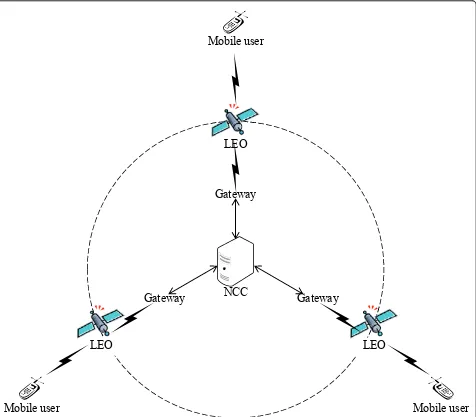
The LEO satellite communication system, as illu-strated in Figure 1, consists of the mobile users, the LEO satellites, the gateways, and a network control cen-ter (NCC) [2]. The responsibility of the LEO satellite is to forward communications among mobile users, other LEO satellites and the gateways in the system. A gate-way with a wired channel to NCC (the solid line in Figure 1) presides over communications between NCC and LEO satellites. In general, many different telecom-munication systems are connected together via the satel-lite communication model to provide diversified communication services, thus forming the so-called mobile satellite communication system (MSCS for short). For example, if a mobile user wants to communi-cate with a terrestrial mobile user such as a GSM user, the mobile user must contact and perform mutual authentication with NCC which will subsequently con-tact the GSM network. A communication link is then established between the mobile user and the other GSM user [16].
2.2 Required essential properties
As Figure 1 shows, communications among mobile users, LEOs, and gateways are open on the air (thunder-bolt line), while NCC is assumed to communicate with the gateway via a secure channel (solid line). Based on this assumption, the following several essential proper-ties [16,18-22] must be considered to efficiently establish a secure mobile satellite communication link and pre-vent various cryptographical attacks. We can find out that many researchers [16,18-22] claimed the following properties are absolutely required for efficient and secure mobile satellite communication environments.
authentication phase to send his/her sensitive infor-mation to an unidentified target or be fooled into establishing a connection to retrieve services which are not recognized by legitimate NCC.
(2) Confidential communication: Communication over wireless paths is susceptible to eavesdropping. Security protocols guarantee the confidentiality of communications between mobile users and NCC by encrypting them using the shared session key. (3) User’s privacy: There are two major privacy issues of concern for mobile networks: user’s identity and location. Since sometimes the user’s real identity is sensitive to adversaries [6] or the linkable identity of a user is useful in mining his/her behavior, the user’s identity and associated information must be
kept secret from outsiders as well as the mobile user’s current location.
(4)Low computation and update cost: A security protocol should result in low computation cost. Due to limited resources, on one hand, complex compu-tations will fail in the hand-held device of a mobile user and, on the other hand, frequent computations and updates might cause NCC to become a bottle-neck. This property is not only of concern for light-weight hand-held devices in PCS and MSCS, but also for NCC.
(5)Simple key management: As protecting the secret key from being compromised is a very critical issue in any environment concerning security, key man-agement should be simple as well as safeguard
NCC
Gateway
Gateway
Gateway
Mobile user
LEO
Mobile user
LEO
LEO
Mobile user
legal users) should be removed from the server side and, secondly, the heavy burden of maintaining a public-key infrastructure should be avoided in prac-tical applications such as GSM and UMTS.
(6) Minimum trust: It is well-accepted that NCC is trustworthy, since legal mobile users register their private information to obtain services at NCC, but the trust level of the other third parties involved should be as little as possible.
(7) Session independence: It is always possible that a session key can be compromised for some reasons. An adversary may derive the secret key from the last ses-sion as well as the next sesses-sion (so-called known key attacks) if these keys have correlation with the com-promised session key. To avoid that the revealed key may influence the security, the session key must be derived from a one-time-use parameter. This measure can prevent impersonation or replay attacks.
3 The proposed authentication scheme
This section presents the proposed anonymous authenti-cation scheme for a mobile satellite communiauthenti-cation sys-tem, which enables NCC and users to simultaneously negotiate the shared session key.
Initially, a cryptosystem based on secure one-way hash function, such as SHA-2 or SHA-256 [23,24], is estab-lished. Following the registration of a mobile user at NCC, the NCC generates an authentication token for this mobile user with its long-term private key and deduces the user’s master key. This master key can only be computed from the NCC’s long-term private key by NCC.
Before communicating with NCC, the mobile user computes a message authentication code (MAC) and sends it to NCC. Upon receiving the MAC code, NCC recovers the user master key to verify the received MAC. If it holds, NCC deduces the session key shared with the user from the user master key and the corre-sponding temporary identity. Then NCC generates a new temporary identity used in the next authentication phase by the user. The new temporary identity of the user is encrypted with the old one using the deduced session key. This encrypted message is sent to the user with its MAC as a response. Once the user has checked the validity of received MAC, the scheme ends. Clearly, the proposed scheme does not involve a PKC, a SKC, a PKI and certificate stored in the mobile user’s computer. The proposed scheme consists of two phases: registra-tion and authenticaregistra-tion. Notaregistra-tions used in this paper are defined as follows:
• ID ID ID
the temporary identity of a mobile user, and the identity of a LEO satellite, respectively;
•x: a long-term private key of NCC;
• X ® Y : M: a party X delivers a message M to
another partyY;
•h(·): a secure one-way hash function, such as SHA-2 or SHA-SHA-256 [SHA-23,SHA-24];
•MACk(·): a message authentication code (MAC)
involving a keyk;
•⊕: a bit-wise exclusive-or operation;
3.1 Registration phase
Figure 2 illustrates the proposed registration phase.
Assume that NCC owns its long-term private key x.
During the registration phase, a mobile user Urequests to be a legal user from the system and NCC does the following operations:
R1.U® NCC: UIDA mobile userUselects its
iden-tity UIDfreely and then submits it to NCC via a secure
channel.
R2.NCC ®U: Smart card(TID, key)
For each mobile userUwith an identityUIDin the
system, NCC decides an initialized temporary iden-tityTID, which is refreshed for the next
authentica-tion after each successful authenticaauthentica-tion. Afterward, NCC generates the user master key key =h(UID, x).
NCC stores {TID, key} onto the user’s smart card
and then releases it to the mobile user U via a
secure channel. Finally, NCC computesV=UID ⊕h
(TID, x) and then stores {V,TID} in the verification
table. This operation is used to repel against an insertion attack in which an intruder inserts a verifi-cation item into the verifiverifi-cation table.
3.2 Authentication phase
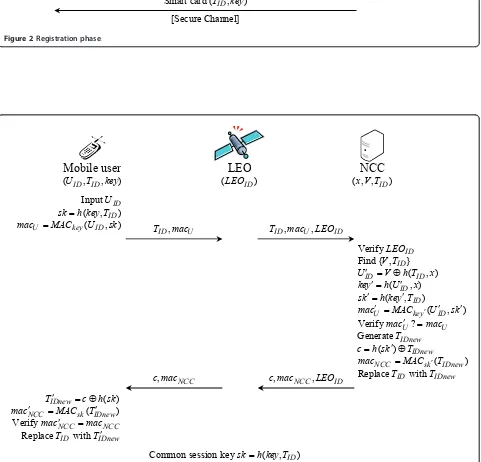
Figure 3 illustrates the proposed authentication phase. During the authentication phase, a mobile userUmust be authenticated before communicating with another mobile user or accessing the resources in the system. In addition, he/she has to ascertain the identity of the network with whom he/she communicates. In the proposed
authentica-tion phase, we assume thatLEOandNCCalready
estab-lished secure communication channel based on ordinal cryptographic techniques such as SSL protocol and TLS protocol [25]. The authentication phase goes as follows:
A1. U® LEO: TID, macU IfU wants to negotiate a
session key sk with LEO, he/she does the following
NCC
ReplaceTID withTIDnewCommon session keysk h key T( , ID)
Figure 3Authentication phase.
SelectUID
Store { , } in the verification table
ID
(b) Compute the session key sk=h(key,TID), where TIDis refreshed after one successful login.
(c) Compute a message authentication code macU=
MACkey(UID,sk) and send it withTIDto the LEO.
A2.LEO® NCC:TID, macU, LEOID Upon receiving
the authentication message fromU, theLEOforwards it to the NCC by appending its identityLEOID.
A3.NCC ® LEO: c, macNCC, LEOIDUpon receiving
the message fromLEO, the NCC checks the legitimacy
of theLEOand does the following operations:
(a) Find the corresponding information {V, TID}
associated with TIDby looking up the verification
table, whereV=UID ⊕h(TID, x).
(b) Compute h(TID,x) using its long-term secret key xand the received TID
(c) Extract U’s identityUIDby computingV⊕h(TID, x) as follows:
⊕h(TID,x) =UID⊕h(TID,x)⊕h(TID,x) =UIDV
(d) Compute the possible user master key key’ =h(UID,x)using the extractedUIDand the pos-sible session keysk’=h(key’,TID).
(e) Compute macU=MACkey’(UID,sk)and check if
macUto the receivedmacU. If this holds, the mobile
user U is authenticated and the session key is
con-firmed; otherwise, this authentication request is rejected.
(f) Generate a new temporary identity TIDnew and
update the old TID with TIDnew in the verification
table for next time to authentication.
(g) Computes c=h(sk)⊕TIDnew and a message
authentication codemacNCC=MACsk(TIDnew). Then
return {c,macNCC,LEOID} to theLEO.
A4. LEO ® U: c, macNCCThe LEO just forwards c
andmacNCCtoU.
A5. Once U receivesc and macNCC, he/she extracts
the new temporary identity TI D new using c and sk by computingc⊕skas follows:
c⊕sk=h(sk)⊕TIDnew⊕sk=T
IDnew
U then computes macNCC=MACsk(TIDnew) and
checks ifmacNCCis equal to the receivedmacNCC. If
this holds, the mobile user ascertains the identity of
is mutually confirmed.
Uand NCC uses the one-time session keysk =h(key,
TID) to protect (e.g., encrypt) further information
exchanged in the session.
4 Discussion and security analysis
This section discusses whether the above-required essential properties in a mobile satellite communication network can all be satisfied in the proposed authentica-tion scheme. In addiauthentica-tion, we analyze the security of the proposed scheme against diverse attacks.
4.1 Discussion of the required essential properties
(1)Mutual authentication: Mutual authentication
betweenU and NCC is achieved, because both are
able to deduceU’s master key key = h(UID, x) and
the identical session keysk=h(key,TID). In step A1
of the proposed scheme,U sends a MAC message
macU =MACkey(UID,sk) as a authentication request
to NCC, and then, NCC authenticatesUby verifying
ifU knows/possesses master secret keykey. If Uis legal, it can generateskto encrypt the new
tempor-ary identity TIDnew and another MAC message
macNCC=MACsk(TIDnew)as a response toU.
Accord-ingly,Ucan authenticate NCC by verifying the MAC
macNCC. Therefore, the proposed scheme provides
secure mutual authentication.
(2)Confidential communication: In the proposed
scheme, communication between U and NCC is
kept confidential by encrypting the messages (e.g., NCC’s response messagec=h(sk)⊕TIDnewwith the
shared session keysk=h(key,TID). Furthermore, the
shared session keyskis simultaneously confirmed by both participants before performing their subsequent communication. Therefore, the proposed scheme provides confidential communication.
(3)User’s privacy: In the proposed scheme,U’s iden-tityUID is never transmitted over the public network
for authentication purposes. In addition, a different
temporary identity TID is used in each session to
keep the privacy ofU. Since TIDis unlinkable, LEO
and gateway does not have any idea who is commu-nicating with NCC. Therefore, the proposed scheme provides user’s privacy.
the proposed scheme provides low computation and update cost.
(5) Simple key management: In the proposed scheme, the key management is very simple since
only the long-term private key x of NCC is
main-tained in the system. As the key is used only by NCC itself, there is no PKI required. Furthermore, no sensitive information is stored in NCC. This implies that even from a compromised NCC, no secret keys can be obtained. Therefore, the proposed scheme provides simple key management.
(6) Minimum trust: In the proposed scheme, no other trust parties are required except NCC. It is reasonable to assume that NCC is trustworthy since
U must register at NCC with their private
informa-tion to obtain services. Therefore, the proposed scheme provides minimum trust.
(7) Session independence: The fresh session keyskis not deduced from the last session key, and there is no relationship among the session keys. Once the past session key is compromised for some reasons, an adversary trying to mount a known key attack can derive the newer session keys only in case that he/she knows the master key key =h(UID,x).
There-fore, the proposed scheme provides session independence.
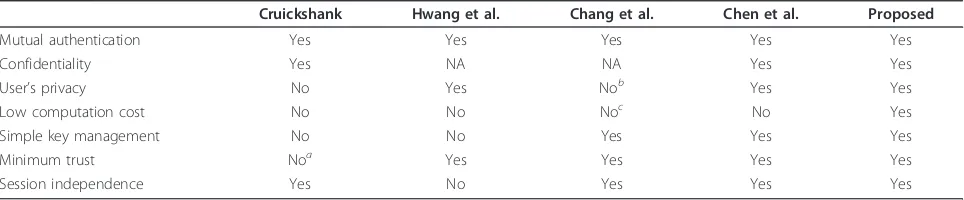
The required essential properties of the proposed scheme is compared with the schemes in [12,14,15], and [16] in Table 1. It can be seen that only the proposed scheme can fulfill the seven criteria for designing an authentication scheme for mobile satellite communica-tion systems.
4.2 Security analysis
(1)Insertion attacks: Assume that an attacker is able
to intrude NCC and then inserts a fake (V =UID⊕
h(TID,x), TID) into the verification table. If he/she
wants to impersonate a legal userU, he/she must be able to deduce the same master key key = h(UID, x)
which would be deduced by NCC from the fake (V,
TID). However, he/she has no idea about the
long-term private keyx to solve UID from V = UID⊕h
(TID,x) like NCC does. He/she fails to impersonate
a legal user without knowing U’s identity UID.
Therefore, the proposed scheme is secure to inser-tion attacks.
(2)Stolen-verifier attacks: In the proposed scheme, the verification table does not contain any sensitive information. If an attacker steals the verification table, he/she has no efficient way to solveU’s iden-tityUIDor the long-term private keyxfromV=UID ⊕ h(TID, x) and TID without knowing x or UID.
Therefore, the proposed scheme is secure to stolen-verifier attacks.
(3)Secret key guessing attacks: The only secret on the user side is the user master key key =h(UID, x).
The key is a strong secret key with long enough bits and protected in a tamper-resistant mechanism such as a smart card. There is no efficient way to obtain it, but brute-force guessing. Therefore, the proposed scheme is secure to secret key guessing attacks. (4)Replay attacks: NCC generates a new temporary identityTIDnewafter a successful authentication. Since
the temporary identity TID is used only once, the
derived session keysk =h(key, TID) is changed in
each session. Therefore, the authentication message
macU =MACkey(UID) and NCC’s response messages
(c,macNCC=MACsk(TIDnew))are renewed each time.
Therefore, the proposed scheme is secure to replay attacks.
(5)Impersonation attacks: An attacker may imperso-nate a legal user by forging an authentication request {TID, macU = MACkey(UID, sk)}. As NCC should
check the validity of the MAC message by comput-ing the user master key key =h(UID,x) and the
ses-sion keysk=h(key,TID) to generate the same MAC,
the attacker must know how to computekey andsk;
otherwise, he/she cannot pass the authentication. However, he/she has no feasible way to know these
Table 1 Comparisons of essential properties for mobile satellite communication systems
Cruickshank Hwang et al. Chang et al. Chen et al. Proposed
Mutual authentication Yes Yes Yes Yes Yes
Confidentiality Yes NA NA Yes Yes
User’s privacy No Yes Nob Yes Yes
Low computation cost No No Noc No Yes
Simple key management No No Yes Yes Yes
Minimum trust Noa Yes Yes Yes Yes
Session independence Yes No Yes Yes Yes
NA: not addressed
4.3 Performance analysis
This subsection provides the performance analysis in terms of communication costs. Since there is no expo-nential computation required on both sides during the authentication phase in the proposed scheme, but only a few hashing operations, the proposed scheme is efficient and easy to implement on mobile devices. A comparison of the computation complexity among related works is
shown in Table 2. On the side of the mobile user U,
there are one hash function operations and two MAC operations. On the other hand, there are four hash func-tion operafunc-tions and two MAC operafunc-tions employed on the side of NCC. Clearly, the proposed scheme is more
computationally efficient compared to Cruickshank’s
scheme [12] involving four asymmetric cryptographic operations, Hwang et al.’s scheme [14] involving four
symmetric cryptographic operations, Chang et al.’s
scheme [15] involving (N-(j-1))+3 times of hash function operations in thejth authentication, where the system
parameter N is the number of times of contact with
NCC, and NCC has 3 hash function operations, and Chen et al.’s scheme [16] involving two symmetric cryp-tographic operations. In Chen et al.’s scheme, for repel-ling an insertion attack in which an intruder inserts a verification item into the verification table, NCC always must verify if gs=yh(UID)·rr−1modp holds during the
authentication phase. We can see that the equation requires three exponential computations. Chen et al. claimed that these operations could be performed either off-line or by another authentication server in order to reduce complex computations. However, these solutions may cause increased communication delay. Moreover, Chen et al. did not explained the computation costs in their performance analysis to solvek from s =h(UID)x
+ kr-1 mod q by NCC. We can see that it requires
much time to find a random number x which satisfies
the equation s = h(UID)x + kr-1 mod q because of the
random number k, 1 ≤k < q, where q is a large prime
efficient compared with previous related schemes [12,14-16].
4.4 Formal proofs
This subsection proves the security of the proposed authentication scheme based on random oracle model [26-28].
4.4.1 Security model
CommunicationCommunication betweenNCCandU
is provided via a wireless network, upon which third parties can easily eavesdrop and which is easily cut or disturbed. Therefore, we describe the communications in an RFID system using two players–client and server.
Client In the proposed scheme, we suppose small
mobile devices as clients. The clients only have poor electronic power provided by servers and can only per-form light calculations.
Server In the proposed scheme, we imagine NCC and
LEOas servers. Generally, a mobile user communicates
with LEOs through wireless channels, and then the
LEOs communicate with NCC servers through secure
channels. We assume that the communication between
NCC andLEO is secure using ordinal cryptographic
techniques such as SSL and TLS. Therefore, we describe the communications in a mobile satellite communica-tion system using two players–client (Mobile user) and server (NCC).
FunctionsLet functions (FR(),SR(),CheckC(),CheckS()) be indexes of the client UID and secret keykey.
Intui-tively, each function means the following. FR() is
responses from server to client (i.e., mobile user).SR() is the returning responses from client (i.e., mobile user) to server.CheckC() means the verification check of the cli-ent’s output by the server.CheckS() is the result of veri-fication check of the server’s output by the client. SK() is the key updating processes.
Oracles Security notions for robust mutual
authentica-tion protocols are defined by the success probability of the adversary, which is allowed to access the oracles.
Table 2 Comparisons of computation complexity in the authentication phase
Cruickshank Hwang et al. Chang et al. Chen et al. Proposed
Hash operations - - *N-(j-1)+3/3 1/3 1/4
MAC operations - - - 1/1 2/2
Symmetric operations 1/1 2/2 - 1/1
-Asymmetric operations 1/1 - - (0/3)
-Equation solving operations - - - k
-*jth authentication request
kmeans computation time to solvekfroms=h(UID)x+kr-1modq
We first show oracles that the adversary can access.SO
andCOare oracles as server’output and client’output.
FRO,SRO, andSKOare oracles as functions used in ser-ver or client.
4.4.2 Security proofs
The goal of our authentication scheme is to achieve mutual authentication that preserves privacy. We prove that the proposed scheme satisfies the above security notions using a game style proof technique. The security proof based on Ohkubo et al.’s model [28] is adopted to proof the mutual authentication and security of the ses-sion key in the proposed scheme. The construction of the proofs is as followings. The proofs are constructed following game-based techniques. We make four steps as games as follows.
(1)Game 0:Simulator SIMexecutes simulations fol-lowing protocols.
(2)Game 1:SimulatorSIMexecutes simulations set-ting the outputs of oracles random values, instead of the results of functions.
(3) Game 2: Excluding the case in which adversary accesses to oracles with the information of the secret key directly from the adversary’s win.
(4) Game 3:Replying changed from challenge oracle
COto adversary and set the replying random values
set regardless of coin-flipping results.
Through these games, we show that the adversary in the protocol (i.e., Game 0) is in the same situations in that it is given no information related to the secret key, and there are no means other than random guessing.
Definition 1Secure two-party authentication protocol: A two-party authentication (TPA) protocol is secure in our model if the following requirements are satisfied:
Validity: When the protocol is run among two oracles (a client and a server) in the absence of an active adver-sary, the oracles accept the same key.
Indistinguishability: For all probabilistic, polynomial-time adversaries AD,AdvAD
TPA(k)is negligible.
As a result, the following theorems are shown.
Theorem 1The proposed authentication scheme TPA is secure, if hash functions h(·)and MAC(·)are random oracles.
ProofAdversaryATPAis allowed to access the oracles, SO, CO, FRO, SRO, SKO. Let the maximum number of
queries be q times and the size of secret key key ben
bits. In addition, the adversaryATPAcan use the
simula-tor SIMto perform the Games 0, 1, 2, 3. From Games
0, 1, 2, and 3, we can conclude the following AAD
From the Equation (1), we can obtain the following
AADTPA’s advantages.
From the Equation (2), we can say that
εTPA≤
q
2n (3)
As a result, it can be shown that the proposed TPA
scheme is secure two-party authentication protocol, if q
≪ 2n and h(·), MAC(·) are random oracles. Due to
space limitations, we omit the detailed proof, as it is almost similar to the Ohkubo et al.’s proof method (see Proofs 1 ~ 4 of Appendix) [28]. Readers are referred to [28] for more complete references.
5 Conclusion
Based on Chen et al.’s scheme, this paper proposed a
through the National Research Foundation of Korea(NRF) funded by the Ministry of Education, Science and Technology(no. 2010-0010106) and partially supported by the MKE(The Ministry of Knowledge Economy), Korea, under the ITRC(Information Technology Research Center) support program supervised by the NIPA(National IT Industry Promotion Agency(NIPA-2011-(C1090-1121-0002)). The authors declare that they have no competing interests.
Author details
1School of Computer Engineering, Kyungil University, 33 Buho-Ri,
Hayang-Ub, Kyungsan-Si, Kyungsangpuk-Do 712-701, Republic of Korea2School of
Computer Science and Engineering, Kyungpook National University, 1370 Sankyuk-Dong, Buk-Gu, Daegu 702-701, Republic of Korea3Korea Institute of
Science and Technology Information, 335 Gwahangno, Yuseong-Gu, Daejeon 305-806, Republic of Korea4Satellite Information Research Institute, Korea
Aerospace Research Institute, 45 Eoeun-Dong, Yuseong-Gu, Daejeon 305-333, Republic of Korea
Competing interests
The authors declare that they have no competing interests.
Received: 6 January 2011 Accepted: 1 September 2011 Published: 1 September 2011
References
1. G Comparetto, R Ramirez, Trends in mobile satellite technology. IEEE Comput.30(2), 44–52 (1999)
2. SS Jeng, HP Lin, Smart antenna system and its application in low-earth-orbit satellite communication systems, in Proceedings of the Microwaves. Antennas and Propagation146(2), 125–130 (1999)
3. KY Lam, SL Chung, M Gu, JG Sun, Lightweight security for mobile commerce transactions. Comput Commun.26(18), 2052–2060 (2003). doi:10.1016/S0140-3664(03)00188-9
4. HY Lin, Security and authentication in PCS. Comput Electr Eng.25(4), 225–248 (1999). doi:10.1016/S0045-7906(99)00010-5
5. HY Lin, L Harn, Authentication protocols for personal communication systems. ACM SIGCOMM Comput Commun Rev.25(4), 256–261 (1995). doi:10.1145/217391.217456
6. M Spreitzer, M Theimer, Secure mobile computing with location information. Commun ACM.36(7), 27 (1993). doi:10.1145/159544.159558 7. WAP forum, wireless application protocol, wireless transport layer security
specification; version (12-Feb-1999) http://www.wapforum.org
8. RC Ayan, SB John, Energy-efficient source authentication for secure group communication with low-powered smart devices in hybrid wireless/satellite networks. EURASIP J Wirel Commun Netw, 1–18 (2011). Article ID392529
9. B Francesco, B Cecilia, AC Enzo, C Stefano, EC Giovanni, N Massimo, P Claudio, P Marco, R Stefano, VC Alessandro, LTE adaptation for mobile broadband satellite networks. EURASIP J Wirel Commun Netw, 1–13 (2009). Article ID989062
10. ES Ray, D Anton, VC Alessandro, Satellite communications. EURASIP J Wirel Commun Netw, 1–2 (2007). Article ID058964
11. G Thierry, B Pascal, A QoS architecture for DVB-RCS next generation satellite networks. EURASIP J Wirel Commun Netw, 1–9 (2007). Article ID58484
12. HS Cruickshank, A security system for satellite networks. inProceedings of the IEEE Satellite Systems for Mobile Communications and Navigation, 187–190 (1996)
13. C Ellison, B Schneier, Ten risks of PKI: what you’re not being told about public-key infrastructure. Comput Secur J.16(1), 1–7 (2000)
14. MS Hwang, CC Yang, CY Shiu, An authentication scheme for mobile satellite communication systems. ACM SIGOPS Oper Syst Rev.145(2-3), 42–47 (2003)
15. YF Chang, CC Chang, An efficient authentication protocol for mobile satellite communication systems. ACM SIGOPS Oper Syst Rev.39(1), 70–84 (2005). doi:10.1145/1044552.1044560
16. TH Chen, WB Lee, HB Chen, A self-verification authentication mechanism for mobile satellite communication systems. Comput Electr Eng.35(1), 41–48 (2009). doi:10.1016/j.compeleceng.2008.05.003
Commun Netw, 1–11 (2009). Article ID243956
19. R Jian, L Yun, L Tongtong, SPM: source privacy for mobile ad hoc networks. EURASIP J Wirel Commun Netw, 1–10 (2010). Article ID534712
20. V Vijay, O Diethelm, S Jaleel, JH Antoni, J Sanjay, Broadcast secrecy via key-chain-based encryption in single-hop wireless sensor networks. EURASIP J Wirel Commun Netw, 1–12 (2011). Article ID695171
21. JM Li, YH Park, X Li, A USIM-based uniform access authentication framework in mobile communication. EURASIP J Wirel Commun Netw, 1–12 (2011). Article ID867315
22. JY Huang, IE Liao, HW Tang, A forward authentication key management scheme for heterogeneous sensor networks. EURASIP J Wirel Commun Netw, 1–10 (2011). Article ID296704
23. B Schneier,Applied Cryptography, 2nd edn. (Wiley, New York, 1996) 24. N Sklavos, O Koufopavlou, Implementation of the SHA-2 hash family
standard using FPGAs. J Supercomput.31(3), 227–248 (2005). doi:10.1007/ s11227-005-0086-5
25. R Oppliger, R Hauser, D Basin, SSL/TLS session-aware user authentication. IEEE Comput.41(3), 59–65 (March 2008)
26. M Bellare, P Rogaway, Provably secure session key distribution: The three party case, inProceedings of 27th ACM Symposium on the Theory of Computing, 57–66 (1995)
27. M Bellare, D Pointcheval, P Rogaway, Authenticated key exchange secure against dictionary attacks, inProceedings of Eurocrypt 2000, LNCS.1807, 139–155 (2000)
28. M Ohkubo, S Matsuo, Y Hanatani, K Sakiyama, K Ohta, Robust RFID authentication protocol with formal proof and its feasibility, Cryptology ePrint Archive Report 2010/393, 1–23
doi:10.1186/1687-1499-2011-86
Cite this article as:Yoonet al.:An efficient and secure anonymous authentication scheme for mobile satellite communication systems. EURASIP Journal on Wireless Communications and Networking20112011:86.
Submit your manuscript to a
journal and benefi t from:
7Convenient online submission 7Rigorous peer review
7Immediate publication on acceptance 7Open access: articles freely available online 7High visibility within the fi eld
7Retaining the copyright to your article