O R I G I N A L R E S E A R C H
Risk Factors And Epigenetic Markers Of Left
Ventricular Diastolic Dysfunction With Preserved
Ejection Fraction In A Community-Based Elderly
Chinese Population
This article was published in the following Dove Press journal: Clinical Interventions in Aging
Wei Wang1,2 Yi Zhang3 Runzi Wang 1,2 Yeshaswi Shrestha1,2 Yawei Xu3
Luying Peng1,4,5 Jie Zhang1,2 Jue Li1,2
Lijuan Zhang1,2
1Key Laboratory of Arrhythmias of the
Ministry of Education, Tongji University School of Medicine, Shanghai 200092, People’s Republic of China;2Institute of Clinical Epidemiology and Evidence-Based Medicine, Tongji University School of Medicine, Shanghai 200092, People’s Republic of China;3Department of Cardiology, Shanghai Tenth People’s Hospital, Tongji University School of Medicine, Shanghai 200072, People’s Republic of China;4Department of Pathology and Pathophysiology, Tongji University School of Medicine, Shanghai 200092, People’s Republic of China; 5Research Center for Translational
Medicine, Shanghai East Hospital, Tongji University School of Medicine, Shanghai 200120, People’s Republic of China
Purpose:Left ventricular diastolic dysfunction with preserved ejection fraction (LVDD-PEF) is an early-stage manifestation but poorly understood in the process of heart failure. This study was designed to investigate risk factors and epigenetic markers for predicting LVDD-PEF. Patients and methods: A community-based study in 1568 residents over 65 years was conducted in Shanghai, People’s Republic of China, from June 2014 to August 2015. Echocardiography was performed to diagnose LVDD-PEF. DNA methylation by whole-genome bisulfite sequencing was used to determine those potential epigenetic markers contributing to LVDD-PEF.
Results:A total of 177 participants (11.3%) were diagnosed with LVDD-PEF, and higher prevalence in females than in males (15.0% vs 6.5%,P<0.001). Multivariate logistic regres-sion analysis indicated that female sex (OR 2.46, 95% CI 1.47–4.13), body mass index (BMI) (OR 1.09, 95% CI 1.04–1.14), pulse pressure (PP) (OR 1.03, 95% CI 1.01–1.05) and carotid intima-media thickness (CIMT) (OR 4.20, 95% CI 1.40–12.55) showed a significant association with LVDD-PEF. Overall, 638 CpG sites were differentially methylated in LVDD-PEF group compared to non-LVDD-PEF group (P<0.001); 242 sites were signifi -cantly hypermethylated (covering 238 genes) and 396 sites were significantly hypomethy-lated (covering 265 genes).
Conclusion: Ourfindings found female, BMI, PP, and CIMT were independent predictors for LVDD-PEF in the community-dwelling elderly population. Regulation of DNA methyla-tion might play a crucial role for LVDD-PEF.
Keywords:left ventricular diastolic dysfunction, DNA methylation, risk factor
Introduction
Heart failure (HF) is a complex pathophysiological syndrome with severe morbidity and mortality. Its prevalence varies from 6% to 10% in those aged over 65 years and increases substantially with aging. Heart failure leads to a lethal condition, with
an annual mortality of about 17% in women and 21% in men.1 Up to 50% of
patients diagnosed with end-stage HF will die within 1 year. Evidence indicates that early diagnosis and effective intervention might be effective measures to slow the
progression of HF and reduce those adverse cardiovascular (CV) events.2European
Society of Cardiology guidelines (2016) on HF indicate that among people over 65 years presenting to primary care with breathlessness on exertion, one in six will
Correspondence: Jue Li; Lijuan Zhang Key Laboratory of Arrhythmias of the Ministry of Education, Tongji University School of Medicine, Shanghai 200092, People’s Republic of China
Tel/fax +86 21 65985195 Email [email protected]; [email protected]
Clinical Interventions in Aging
Dove
press
open access to scientific and medical research
Open Access Full Text Article
Clinical Interventions in Aging downloaded from https://www.dovepress.com/ by 118.70.13.36 on 20-Aug-2020
have unrecognized HF with preserved ejection fraction
(HFpEF).3Left ventricular diastolic dysfunction with
pre-served ejection fraction (LVDD-PEF) is recognized
fre-quently as the earlier alteration of HF, classified in those
asymptomatic individuals with a left ventricular ejection fraction (LVEF) over 50%. This syndrome regularly
results in impairedfilling function with or without reduced
restoring forces, which increase cardiac filling pressures.4
LVDD-PEF was very common in the community-based elderly population, with a median prevalence of 36.0%
(15.8–52.8%), and it could rise steeply with age.5Recent
studies demonstrated that patients with worsened diastolic dysfunction had substantial risk for HF, even risk of early
death.6,7Defined by the American College of Cardiology/
American Heart Association, LVDD-PEF almost stays in
stage B of HF.8Currently, LVDD-PEF patients have less
predictive biomarkers to better stratify individuals at risk.9
Clinical HF guidelines emphasis the importance of early
identification for the cardiac dysfunction to prevent the
cardiac pathological conditions.8 The last decades have
witnessed the huge amount of studies linking cardiac dis-orders to epigenetic regulation that governing potential pathogenesis. Application of human genetic technologies has accelerated the advancement in our comprehension of the role of epigenetics and risk factors involved in the pathogenesis of cardiovascular disease (CVD). Epigenetic
modifications can lead to exacerbate the stage of HF with
consequences on cardiac remodeling and preceding
car-diac dysfunction.10 Previous studies suggested that DNA
methylation was associated with hypertrophy and can
reduce cardiac contractility.9,11 Therefore, current
evi-dence supports the importance of DNA methylation altera-tion in the process of HF. In the present community-based cross-sectional study, we aimed to detect potential risk factors and epigenetic markers for LVDD-PEF in order to explore the independent predictive factors for this early-stage of HF which could act as a target for future therapeutic strategies.
Materials And Methods
An ongoing community-based investigation named the Northern Shanghai Study was performed from June 2014 to August 2015 in the northern urban area of Shanghai,
People’s Republic of China (Clinical trial registration:
NCT02368938). Details of the “Northern Shanghai
Study” methodology have been described elsewhere.12
Briefly, elderly participants were recruited to build a CV
risk score. Eligibility criteria included in the following: 1)
the individual should be a long-term resident in northern
Shanghai; 2) age≥65 years old; 3) telephone in the home
or easy access to one; 4) signed the informed consent voluntarily and can be followed up for a long period.
Exclusion criteria included: 1) had severe CVD (achieve IV grade of New York Heart Association); 2) previously diagnosed with end-stage of renal disease
(chronic kidney disease ≥4); 3) suffered from cancer or
less than 5 years of life expectancy; 4) experienced stroke within 3 months; 5) could not return for the follow-up visits and declined to participate in the study. Finally, a total of 1599 participants were enrolled in this investiga-tion and 1568 subjects who completed both
echocardio-graphy and carotid ultrasonography detection were
included in thefinal analysis. The study was approved by
the medical ethical review committee of Tongji University and informed consent was obtained for all participants. This study was conducted in accordance with the Declaration of Helsinki.
A structured questionnaire was used to obtain basic information and medical data, including age, gender, height, weight, drinking and smoking habits, and history of hypertension, diabetes mellitus, coronary heart disease, and stroke. Venous blood samples and urine samples were
obtained from fasting individuals in the morning.
Biological markers, including plasma low-density lipopro-tein cholesterol, high-density lipoprolipopro-tein cholesterol, plasma creatinine (PCr), urinary microalbumin and creati-nine, were measured by uniformed methods in the Department of Laboratory Medicine of Shanghai Tenth
People’s Hospital. Fasting plasma glucose was measured
by the glucose oxidase method. Body weight (in kilo-grams) and body height (in meters) were measured by a well-trained clinician. Participants wore light clothes and removed shoes for weight measurements. Body mass index (BMI) was calculated as weight (kg) divided by
height squared (m2). Blood pressure (BP) was measured
three times every 5 mins in the morning at the room temperature in the sitting position, after resting for 10 mins using a mercury sphygmomanometer. Hypertension
was defined as brachial SBP ≥140mmHg or DBP ≥90
mmHg or the use of antihypertensive agents or a previous
history of hypertension.13 The average of the three
read-ings was regarded as participants’ BP and was used for
further analysis. Pulse pressure (PP) was calculated as the difference between SBP and DBP. Echocardiography and carotid ultrasonography were measured by a single skill-ful, experienced and well-trained cardiologist in the
Clinical Interventions in Aging downloaded from https://www.dovepress.com/ by 118.70.13.36 on 20-Aug-2020
Department of Cardiology, Shanghai Tenth People’s
Hospital who was blinded to participants’ clinical data
using the MyLab30 Gold CV system (Esaote SpA, Genoa, Italy) followed by the American Society of
Echocardiography recommendations.14 Carotid
intima-media thickness (CIMT) was measured in the left common carotid artery by using carotid ultrasonography, which is
on plaque-free segments –nearly 2 cm from the
bifurca-tion. The measurement of CIMT was taken three times, and the average result was used for analysis. Left ventri-cular dimensions and mass were measured through trans-thoracic echocardiography. Left ventricular mass (LVM) was calculated from two-dimensionally guided M-mode echocardiograms. The LVEF was obtained according to
Teichholz’s formula.15 Left atrium (LA) size was
mea-sured in the parasternal long-axis and apical four chamber views. Left ventricular end-diastolic diameter (LVEDd), interventricular septal (IVSd), and posterior wall thickness at end-diastole (PWTd) were measured directly which
were used to calculate LVM.14The formula is:
LVMðgÞ ¼0:8 f1:04 ½ðLVEDdþPWTdþIVSdÞ3
ðLVEDdÞ3g þ0:6
Left ventricular mass index (LVMI) was obtained by dividing the raw LVM by body surface area (BSA). In addition, left atrial volume was calculated using the ellipse model formula:
LAVðmLÞ ¼π ðSA1SA2LAÞ=6
In this formula, left atrial parameters were measured including SA1, SA2 and LA. SA1 is the M-mode left atrial dimension in the parasternal short-axis view and SA2 and LA are measurements of short and long axes in the apical four chamber view at ventricular end-systole. Left atrial
volume index (LAVI) was also standardized by BSA.16
Peak early diastolic transmitral flow velocity (E) and early
diastolic lateral mitral annular velocity (E’) were performed
by pulse-wave Doppler imaging and tissue Doppler signals
in lateral septum, respectively. The ratio of E/E’was present
to evaluate LV diastolic function. Left ventricular diastolic
dysfunction (LVDD) was assessed by E/E’ according to
following criteria: E/E’ ≥15; or 8 < E/E’<15 with any of
the conditions 1) LAVI >40 mL/m2; 2) LVMI >149 g/m2
(male); 3) LVMI >122 g/m2(female).17,18
Confirmed LVDD-PEF patients and healthy controls
were recruited for the detection of DNA methylation changes, as a part of the Northern Shanghai Study.
Whole-genome bisulfite sequencing (WGBS) was performed in 15
randomized subjects (age 76.767.00 years, meanSE)
for the present study. After screening 177 patients with LVDD-PEF, 10 LVDD-PEF subjects were a random sample of those who were in the absence of relevant heart diseases. A total of 5 controls were randomly selected from the non-LVDD-PEF group with normal diastolic function and no evidence for other CV disorders as determined by
echocar-diography, matched by age and gender. No significant
differ-ence was observed for baseline characteristics between two groups using a Wilcoxon rank test.
For each participant enrolled in the DNA methylation exploration, whole blood was obtained after an overnight
fast and immediately frozen and stored at−80°C. WGBS
for DNA methylation analysis was extracted from pre-viously frozen peripheral blood using phenol-chloroform protocol. The DNA was fragmented by sonication (Covaris) using a Bioruptor (Diagenode, Belgium) to a mean size of 250 bp, followed by blunt-ending, dA
addi-tion to 3ʹ-end and,finally, adaptor ligation (in this case of
methylated adaptors to protect from bisulfite conversion),
essentially according to the manufacturer’s instructions.
Bisulfite conversion of genomic DNA was carried out
with EZ DNA Methylation-Gold Kit (ZYMO) following
the manufacturer’s protocol. Different insert size
frag-ments were excised from the same lane of a 2% TAE agarose gel. At last, sequencing was performed using HighSeq4000 or other Illumina platforms (pipeline). The reads generated by Illumina sequencing were aligned to the reference genome using SOAP aligner. The alignment and methylation estimation was performed as described previously. Averagely 0.8 GB clean reads of each sample
were generated afterfiltering low quality reads, N reads
and adaptor sequences. After filtering, clean reads were
aligned to the human reference genome (hg19) using
BSMAP.19 Methylation level was determined by dividing the number of reads covering each mC by the total reads covering that cytosine. In general, CG methylation is found in both genes and repeats, and is involved in gene expression regulation.
Differentially methylated regions (DMRs) are stretches
of DNA in a sample’s genome that have different patterns
compared with other samples. Putative DMRs were
iden-tified by comparison of the sample1 and sample2
methy-lomes using windows that contained at least 5 CpG(CHG or CHH) sites with a twofold change in methylation level
and Fisher test P-value ≤0.05. Two nearby DMRs would
be considered interdependent and joined into one contin-uous DMR if the genomic region from the start of an
Clinical Interventions in Aging downloaded from https://www.dovepress.com/ by 118.70.13.36 on 20-Aug-2020
upstream DMR to the end of a downstream DMR also had twofold methylation level differences between sample1
and sample2 with a P-value ≤0.05. Otherwise, the two
DMRs were viewed as independent. After iteratively
mer-ging interdependent DMRs, thefinal dataset of DMRs was
made up of those that were independent of each other. Categorical and continuous variables were expressed as numbers with percentage or means±SD. Differences between LVDD-PEF and non-LVDD-PEF were analyzed
by independentt-test for continuous variables or byχ2 test
for categorical variables. Multiple stepwise linear regres-sion was applied for the association of diastolic function
(E/E’). Multiple stepwise logistic regression analyses were
performed to investigate the associations between indepen-dent variables and LVDD-PEF both under a full model and an adjusted model with age and gender were adjusted. Statistical analysis was performed using SPSS software,
version 20.0 (SPSS Inc., Chicago, IL). P-value<0.05 was
considered to be statistically significant.
Gene ontology (GO), which is a major bioinformatics initiative to unify the representation of gene and gene product attributes in any organism, provides an ontology
of defined terms representing gene product properties. To
investigate pathways and processes that may be subject to epigenetic variation in association with DMRs, DMRs-related genes both obtained from all samples were ana-lyzed using GO and pathway analysis. All DMR-related
genes were mapped to GO terms in the database (http://
www.geneontology.org/), calculating gene numbers for
every term and using the hypergeometric test to find
sig-nificantly enriched GO terms in the input list of
DMR-related genes, based on “GO: TermFinder” (http://www.
yeastgenome.org/help/analyze/go-term-finder). The
calcu-latedP-value goes through bonferroni correction,20taking
correctedP-value≤0.05 as a threshold. GO terms fulfilling
this condition are defined as significantly enriched GO
terms in DMR-related genes.
Pathway-based analysis helps to further understand genes
biological functions. KEGG21(Kyoto Encyclopedia of Genes
and Genomes) is used to better perform pathway enrichment
analysis of DMR-related genes which can identify signifi
-cantly enriched metabolic pathways or signal transduction pathways in DMR-related genes comparing the whole-gen-ome background. The formula used for the calculation is the
same as that in GO analysis. Significantly higher DNA
methylation levels between the cases and controls were
identified using a Wilcoxon rank test. P-values were
corrected for multiple testing according to the Bonferroni
method.P≤0.001 was considered significant.
Results
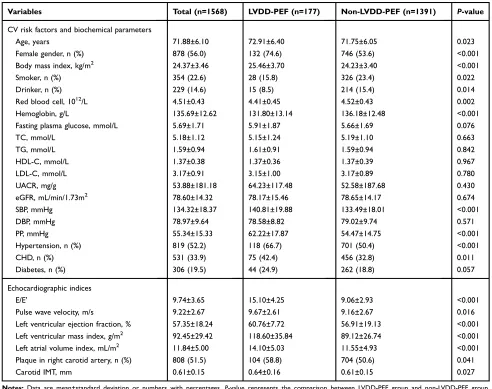
Baseline characteristics of subjects are presented inTable 1.
Of the whole study population, the average age was
71.96.1 years; 878 (56.0%) participants were women;
average BMI was 24.233.46 kg/m2. Of 1568 participants,
177 (11.3%) subjects were diagnosed with LVDD-PEF. About half of the population (819, 52.2%) had hypertension; 33.9% of participants (531) had CVD history; 19.5% of participants (306) had diabetes mellitus. The comparison between LVDD-PEF and non-LVDD-PEF indicated that female sex, BMI, SBP, PP, history of hypertension and CVD, and echocardiographic parameters in participants
with LVDD-PEF were significantly higher than those
with-out LVDD-PEF (allP<0.05).
Considering the risk factors related to LVDD, stepwise multiple linear regression was performed to analyze the
independent issues of E/E’and the results indicated that E/
E’ was significantly associated with BMI (0.067±0.028,
P=0.016), PP (0.053±0.012, P<0.001) and CIMT (1.385
±0.615,P=0.027) (Table 2).
Age and gender were highly predictive of LVDD-PEF.
Significant association with LVDD-PEF included BMI
(OR 1.10; 95% CI 1.05–1.15), SBP (OR 1.02; 95% CI
1.01–1.03), PP (OR 1.03; 95% CI 1.02–1.04), CIMT (OR
4.64; 95% CI 1.67–12.93), plaque in right carotid artery
(OR 0.71; 95% CI 0.52–0.99) and history of hypertension
(OR 1.98; 95% CI 1.42–2.76) after adjustment by age and
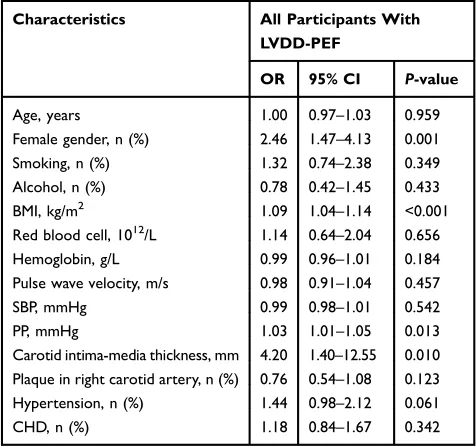
gender (Table 3). In a multivariate logistic analysis model
(Table 4), BMI (OR 1.09; 95% CI 1.04–1.14), PP (OR
1.03; 95% CI 1.01–1.05) and CIMT (OR 4.20; 95% CI
1.40–12.55) still the independent predictors of
LVDD-PEF, and effects of SBP, plaque in right carotid artery
and history of hypertension were attenuated (allP>0.05).
Ten participants with LVDD-PEF and 5 participants without LVDD-PEF were further included in the DNA methylation analysis. A total of 639 sites (covering 580
genes) were significantly differentially methylated between
two groups (Wilcoxon rank test, P<0.001). The extent of
DNA methylation was significantly increased at 242 sites in
238 genes, while 396 sites were significantly
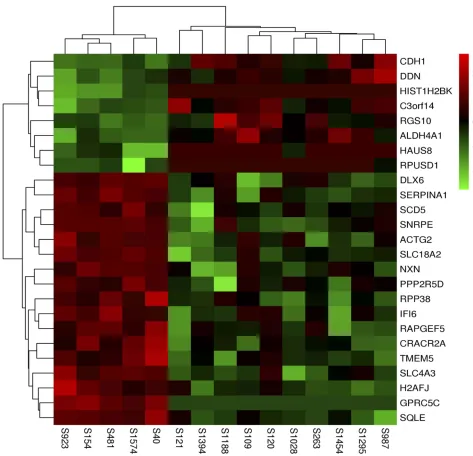
hypo-methy-lated in 265 genes in LVDD-PEF group compared with controls. We focused on the differentially methylated genes in the upstream region since hyper-methylation in promoters might cause alteration of gene expression. The
heatmap showed the graphical representation of
Clinical Interventions in Aging downloaded from https://www.dovepress.com/ by 118.70.13.36 on 20-Aug-2020
differentially hyper and hypomethylated genes in
LVDD-PEF subjects and controls (Figure 1). By performing
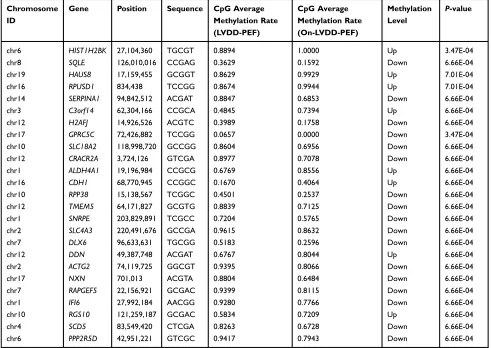
heat-map cluster analysis, 8 hypermethylated (HIST1H2BK,
HAUS8, RPUSD1, C3orf14, ALDH4A1, CDH1, CCN
and RGS10) and 17 hypomethylated (SQLE, SERPINA1, H2AFJ, GPRC5C, SLC18A2, CRACR2A, RPP38, TMEM5, SNRPE, SLC4A3, DLX6, ACTG2, NXN, RAPGEF5, IFI6, SCD5andPPP2R5D) genes were identified as significantly differentially methylated genes in the group of LVDD-PEF (Table 5). Three of these candidate genes, RGS10, CRACR2AandACTG2were further identified by searching the PubMed (NCBI) and GENECARDS database
compre-hensively (Table 6) which might be involved in the cardiac
physiological process.
Discussion
It is critical to investigate the clinical variables and mechanisms of LVDD-PEF since the outcome and
prog-nosis of HFpEF have been poorly understood.22,23 Both
the modifiable and nonmodifiable elements contributed to
the progression of LVDD-PEF. This community-based study was designed to clarify risk factors and potential epigenetic markers for predicting LVDD-PEF in Chinese
elderly population. We identified 11.3% of the participants
were displayed LVDD-PEF, which was less than 15.8–
52.8% reported by previous studies.24–27 We also
con-firmed that female gender, BMI, PP and CIMT were
clo-sely correlated with the risk of LVDD-PEF. To be precise, increase in BMI, PP and CIMT would be predictive
Table 1Baseline Characteristics Of Participants
Variables Total (n=1568) LVDD-PEF (n=177) Non-LVDD-PEF (n=1391) P-value
CV risk factors and biochemical parameters
Age, years 71.88±6.10 72.91±6.40 71.75±6.05 0.023
Female gender, n (%) 878 (56.0) 132 (74.6) 746 (53.6) <0.001
Body mass index, kg/m2 24.37±3.46 25.46±3.70 24.23±3.40 <0.001
Smoker, n (%) 354 (22.6) 28 (15.8) 326 (23.4) 0.022
Drinker, n (%) 229 (14.6) 15 (8.5) 214 (15.4) 0.014
Red blood cell, 1012/L 4.51±0.43 4.41±0.45 4.52±0.43 0.002
Hemoglobin, g/L 135.69±12.62 131.80±13.14 136.18±12.48 <0.001
Fasting plasma glucose, mmol/L 5.69±1.71 5.91±1.87 5.66±1.69 0.076
TC, mmol/L 5.18±1.12 5.15±1.24 5.19±1.10 0.663
TG, mmol/L 1.59±0.94 1.61±0.91 1.59±0.94 0.842
HDL-C, mmol/L 1.37±0.38 1.37±0.36 1.37±0.39 0.967
LDL-C, mmol/L 3.17±0.91 3.15±1.00 3.17±0.89 0.780
UACR, mg/g 53.88±181.18 64.23±117.48 52.58±187.68 0.430
eGFR, mL/min/1.73m2 78.60±14.32 78.17±15.46 78.65±14.17 0.674
SBP, mmHg 134.32±18.37 140.81±19.88 133.49±18.01 <0.001
DBP, mmHg 78.97±9.64 78.58±8.82 79.02±9.74 0.571
PP, mmHg 55.34±15.33 62.22±17.87 54.47±14.75 <0.001
Hypertension, n (%) 819 (52.2) 118 (66.7) 701 (50.4) <0.001
CHD, n (%) 531 (33.9) 75 (42.4) 456 (32.8) 0.011
Diabetes, n (%) 306 (19.5) 44 (24.9) 262 (18.8) 0.057
Echocardiographic indices
E/E’ 9.74±3.65 15.10±4.25 9.06±2.93 <0.001
Pulse wave velocity, m/s 9.22±2.67 9.67±2.61 9.16±2.67 0.016
Left ventricular ejection fraction, % 57.35±18.24 60.76±7.72 56.91±19.13 <0.001 Left ventricular mass index, g/m2 92.45±29.42 118.60±35.84 89.12±26.74 <0.001
Left atrial volume index, mL/m2 11.84±5.00 14.10±5.03 11.55±4.93 <0.001
Plaque in right carotid artery, n (%) 808 (51.5) 104 (58.8) 704 (50.6) 0.041
Carotid IMT, mm 0.61±0.15 0.64±0.16 0.61±0.15 0.027
Notes: Data are mean±standard deviation or numbers with percentages.P-value represents the comparison between LVDD-PEF group and non-LVDD-PEF group. Estimated GFR was calculated with Chronic Kidney Disease Epidemiology Collaboration equation.40
Abbreviations:BMI, body mass index; CV, cardiovascular; CHD, coronary heart disease; eGFR, estimated glomerularfiltration rate; E, peak early diastolic transmitralflow velocity; E’, early diastolic lateral mitral annular velocity; HDL-C, high-density lipoprotein; LDL-C, low-density lipoprotein; LVDD-PEF, left ventricular diastolic dysfunction with preserved ejection fraction; PP, pulse pressure; TC, total cholesterol; TG, triglyceride; UACR, urinary albumin-creatinine ratio.
Clinical Interventions in Aging downloaded from https://www.dovepress.com/ by 118.70.13.36 on 20-Aug-2020
markers for the value of E/Eˊ, and they then predicted LVDD-PEF even after adjustment of those potential
con-founders. Similarly, Perkiömäki et al28 discovered that
female gender was associated with diastolic dysfunction in the middle-aged population. BMI was also reported to be an independent predictor of LVDD (OR 1.06, 95% CI 1.04–1.08).29
As one of the early stages of HF progression, LVDD-PEF was responsible for clinical and symptomatic dete-rioration. Diastolic dysfunction can be induced through increased LV stiffness caused by hypertrophy and
inter-stitialfibrosis, as well as from abnormal LV relaxation due
to abnormal calcium cycling.30In our present analysis, PP
was considerably associated with LVDD-PEF. Elevated PP in elderly population could lead to increase the arterial stiffness and thicken the left ventricular walls, as the result
of an increase in LVM.31CIMT, also regarded as an early
biomarker for the development of atherosclerosis, even for vascular remodelling and ageing. Arterial stiffness is accepted as an important determinant of increased PP,
thus providing predictive value for CV outcomes.32
In order to clarify the potential mechanisms of
LVDD-PEF in view of epigenetic modifications, DNA methylation
analysis was further performed. To our knowledge, it is the
first study to simultaneously compare the DNA methylation
difference in the early-stage of HF. Emerging evidence of epigenetic mechanisms is considered to be involved in the progression of HF, resulting in cardiac remodelling and
accelerating cardiac dysfunction.33Movassagh et al
discov-ered the changes of gene expression by genome-wide maps of DNA methylation and histone-3 lysine-36 trimethylation
in human end-stage hearts.34Differential DNA methylation
in the region of promoters of upregulated genes was shown. Xiao et al suggested that increased DNA methylation
Table 3Age- And Gender-Adjusted Multivariate Logistic Analyses
Characteristics All Participants With
LVDD-PEF
OR 95% CI P-value
Smoking, n (%) 1.40 0.81–2.43 0.228 Alcohol, n (%) 0.84 0.47–1.51 0.555 BMI, kg/m2 1.10 1.05–1.15 <0.001 Red blood cell, 1012/L 0.86 0.56–1.30 0.460 Hemoglobin, g/L 0.99 0.97–1.00 0.148 Pulse wave velocity, m/s 1.05 0.99–1.12 0.094
SBP, mmHg 1.02 1.01–1.03 <0.001
PP, mmHg 1.03 1.02–1.04 <0.001
Carotid intima-media thickness, mm 4.64 1.67–12.93 0.003 Plaque in right carotid artery, n (%) 0.71 0.52–0.99 0.042 Hypertension, n (%) 1.98 1.42–2.76 <0.001 CVD history, n (%) 1.40 1.01–1.93 0.045
Note:The multiple logistic regression was performed to identify the independent risk factors of LVDD-PEF after adjustment for age and gender.
Abbreviations:BMI, body mass index; CHD, coronary heart disease; LVDD-PEF, left ventricular diastolic dysfunction with preserved ejection fraction; PP, pulse pressure. Table 2 Determinants Of E/E’ By Multiple Linear Regression Analysis
Determinant E/E’
β±SE P-value
Age 0.000±0.016 0.999
Female gender 1.001±0.252 <0.001
Smoking 0.392±0.269 0.146
Drinking 0.145±0.282 0.608
BMI, kg/m2 0.067±0.028 0.016
Hypertension 0.325±0.202 0.107
CHD –0.014±0.196 0.941
Red blood cell, 1012/L –0.196±0.339 0.562
Hemoglobin, g/L 0.003±0.013 0.798
SBP, mmHg –0.003±0.010 0.728
PP, mmHg 0.053±0.012 <0.001
Pulse wave velocity, m/s –0.052±0.038 0.168 Plaque in right carotid artery –0.218±0.185 0.239 Carotid intima-media thickness, mm 1.385±0.625 0.027
Note:The multivariate linear regression was conducted to investigate the associa-tions of E/E’with the significant variables in the baseline.
Abbreviations:β, the regression coefficient of variables; BMI, body mass index; CHD, coronary heart disease; E, peak early diastolic transmitralflow velocity; E’, early diastolic lateral mitral annular velocity; PP, pulse pressure; SE, standard error.
Table 4Independent Risk Factors Of LVDD-PEF According To Multivariate Logistic Analysis
Characteristics All Participants With
LVDD-PEF
OR 95% CI P-value
Age, years 1.00 0.97–1.03 0.959
Female gender, n (%) 2.46 1.47–4.13 0.001 Smoking, n (%) 1.32 0.74–2.38 0.349 Alcohol, n (%) 0.78 0.42–1.45 0.433 BMI, kg/m2 1.09 1.04–1.14 <0.001 Red blood cell, 1012/L 1.14 0.64–2.04 0.656 Hemoglobin, g/L 0.99 0.96–1.01 0.184 Pulse wave velocity, m/s 0.98 0.91–1.04 0.457
SBP, mmHg 0.99 0.98–1.01 0.542
PP, mmHg 1.03 1.01–1.05 0.013
Carotid intima-media thickness, mm 4.20 1.40–12.55 0.010 Plaque in right carotid artery, n (%) 0.76 0.54–1.08 0.123 Hypertension, n (%) 1.44 0.98–2.12 0.061
CHD, n (%) 1.18 0.84–1.67 0.342
Abbreviations:BMI, body mass index; CHD, coronary heart disease; LVDD-PEF, left ventricular diastolic dysfunction with preserved ejection fraction; PP, pulse pressure.
Clinical Interventions in Aging downloaded from https://www.dovepress.com/ by 118.70.13.36 on 20-Aug-2020
played a causative role in reducing cardiac contractility.11 Three differential DNA methylation genes including
RGS10, CRACR2AandACTG2were identified as potential epigenetic markers for predicting LVDD-PEF in this study. The regulator of G-protein signaling (RGS) proteins had been found to be engaged in diverse pathophysiological
progress in CVDs, such as arrhythmias35 and ischemic
injury.36 Recently, RGS10 was identified as a negative
regulator of cardiac remodelling and its overexpression reversed the hypertrophy induced by aortic banding both
in murine and human hearts;37 whereas hypomethylated
alteration of RGS10 was observed in the region of the
promoter for those presented end-stage HF.34How RGS10
acts during the progress of the early-stage of HF still
remains unclear. Accordingly, our observed finding in
alteration of DNA methylation of RGS10 might be a result of enhanced expression of RGS10 protein, which needs further interpretation in subsequent studies. Besides, left ventricular abnormalities of in HFpEF might be
com-pounded by microvascular dysfunction.30 Calcium release
activated channel regulator 2A (CRACR2A) protein coded
by CRACR2A is a modulator of calcium-release-activated
Figure 1Cluster analysis of genes with significantly altered methylation for upstream (n=25). Each column represents a sample, and each row represents the methylation level of a gene. The color code for the heatmap is displayed in the upper right corner, values range from−2 (sample with the lowest methylation for the considered genes) to 2 (sample with the highest methylation for the considered genes).
Clinical Interventions in Aging downloaded from https://www.dovepress.com/ by 118.70.13.36 on 20-Aug-2020
calciumchannels which plays a role in endothelial cells. Previous evidence found that it was a large Rab GTPase and acted in intracellular signaling pathways. One of the
important features of CRACR2A is GDP binding.38
Expression of mRNA was detected in cardiac
microvascu-lature endothelial cell as well. A significant contribution to
endothelial remodelling was observed throughCRACR2A.38
The function ofCRACR2Ain CV system was still unclear
since there were few studies focused in this field. Actin
gamma smooth muscle 2 (ACTG2) was enriched the
path-way of vascular smooth muscle contraction provided according to KEGG. Normally, actin proteins took part in the intracellular process, incorporating maintenance of cytoskeleton. ACTG2 was generally discovered in enteric
tissue and abnormally expressed in different cancer types.39
However, the mechanisms underlying HF regulated by ACTG2 still remained unclear.
The strengths of our study were: firstly, our survey
derived from large community-based samples, the results were therefore representative when extrapolating to the whole population; secondly, we evaluated potential risk factors, as well as epigenetic markers for predicting
LVDD-PEF;finally, reliable echocardiographic parameters
were available at baseline in our study to assess the dia-stolic function accurately.
Several limitations have to be interpreted in the present
study:first, this is a cross-sectional study limited the actual
relationship evaluation. Nevertheless, we will be able to
provide more data at the 5 years’follow-up visit since the
Table 5Details Of Differentially Methylated Regions Between Two Groups
Chromosome ID
Gene Position Sequence CpG Average
Methylation Rate (LVDD-PEF)
CpG Average Methylation Rate (On-LVDD-PEF)
Methylation Level
P-value
chr6 HIST1H2BK 27,104,360 TGCGT 0.8894 1.0000 Up 3.47E-04
chr8 SQLE 126,010,016 CCGAG 0.3629 0.1592 Down 6.66E-04
chr19 HAUS8 17,159,455 GCGGT 0.8629 0.9929 Up 7.01E-04
chr16 RPUSD1 834,438 TCCGG 0.8674 0.9944 Up 7.01E-04
chr14 SERPINA1 94,842,512 ACGAT 0.8847 0.6853 Down 6.66E-04
chr3 C3orf14 62,304,166 CCGCA 0.4845 0.7394 Up 6.66E-04
chr12 H2AFJ 14,926,526 ACGTC 0.3989 0.1758 Down 6.66E-04
chr17 GPRC5C 72,426,882 TCCGG 0.0657 0.0000 Down 3.47E-04
chr10 SLC18A2 118,998,720 GCCGG 0.8604 0.6956 Down 6.66E-04
chr12 CRACR2A 3,724,126 GTCGA 0.8977 0.7078 Down 6.66E-04
chr1 ALDH4A1 19,196,984 CCGCG 0.6769 0.8556 Up 6.66E-04
chr16 CDH1 68,770,945 CCGGC 0.1670 0.4064 Up 6.66E-04
chr10 RPP38 15,138,567 TCGGC 0.4501 0.2537 Down 6.66E-04
chr12 TMEM5 64,171,827 GCGTG 0.8839 0.7125 Down 6.66E-04
chr1 SNRPE 203,829,891 TCGCC 0.7204 0.5765 Down 6.66E-04
chr2 SLC4A3 220,491,676 GCCGA 0.9615 0.8632 Down 6.66E-04
chr7 DLX6 96,633,631 TGCGG 0.5183 0.2596 Down 6.66E-04
chr12 DDN 49,387,748 ACGAT 0.6767 0.8044 Up 6.66E-04
chr2 ACTG2 74,119,725 GGCGT 0.9395 0.8066 Down 6.66E-04
chr17 NXN 701,013 ACGTA 0.8804 0.6484 Down 6.66E-04
chr7 RAPGEF5 22,156,921 GCGAC 0.9399 0.8115 Down 6.66E-04
chr1 IFI6 27,992,184 AACGG 0.9280 0.7766 Down 6.66E-04
chr10 RGS10 121,259,187 GCGAC 0.5834 0.7209 Up 6.66E-04
chr4 SCD5 83,549,420 CTCGA 0.8263 0.6728 Down 6.66E-04
chr6 PPP2R5D 42,951,221 GTCGC 0.9417 0.7943 Down 6.66E-04
Table 6Candidate Genes Selected For Validation
Gene Symbol
Gene ID
Summary
RGS10 6001 GTPase activating proteins (GAPs) for G alpha subunits of heterotrimeric G proteins
CRACR2A 84,766 A protein coding gene related to calcium ion binding and GTPase activity
ACTG2 72 Cardiac vascular smooth muscle contraction
Abbreviations:ACTG2, actin gamma smooth muscle 2;CRACR2A, calcium release activated channel regulator 2A;RGS10, regulator of G-protein signaling 10.
Clinical Interventions in Aging downloaded from https://www.dovepress.com/ by 118.70.13.36 on 20-Aug-2020
Northern Shanghai Study is an on-going prospective study; additionally, mechanisms of these differentially methylated genes associated with effects of DNA methy-lation have not been validated on the development of LVDD-PEF.
This community-based study of senior residents revealed
that female gender, BMI, greater PP and CIMT were signifi
-cantly associated with LVDD-PEF. Differentially methylated
genes such as RGS10, CRACR2A and ACTG2 were
sug-gested to be further identified for predicting LVDD-PEF
using in vitro and in vivo assays.
Data Sharing Statement
Individual deidentified participant data underlying the
results reported in this study and other study-related documents will not be accessible since the Northern Shanghai Study is an on-going prospective community-based study. The follow-up study is still in the process and new enrolment is also conducted at the same time.
Acknowledgments
This work was supported by the National Natural Science Foundation of China (grant no. 81872720) and Shanghai Municipal Commission of Health and Family Planning (grant no. 201840066) to Dr Lijuan Zhang. The National Natural Science Foundation of China (grant no. 81471402) to Jue Li and the National
Natural Science Foundation of China (grant no.
81501203) to Jie Zhang. The abstract of this paper was presented at the Pulse of Asia 2019 Shanghai
Conference name “Risk factors and epigenetic markers
of left ventricular diastolic dysfunction with preserved ejection fraction in a community-based elderly Chinese
population” as a poster presentation with interim fi
nd-ings. The poster’s abstract was published in “Poster
Abstracts” in Pulse: DOI: 10.1159/000499586.
Author Contributions
All authors contributed to the conception and design, data analysis, drafting and critically revising the article, gave
final approval of the version to be published, and agreed to
be accountable for all aspects of the work.
Disclosure
The authors declare no conflicts of interest in this work.
References
1. Roger VL, Weston SA, Redfield MM, et al. Trends in Heart Failure Incidence and Survival in a Community-Based Population. JAMA.
2004;292(3):344–350. doi:10.1001/jama.292.3.344
2. Schocken DD, Benjamin EJ, Fonarow GC, et al. Prevention of heart failure: a scientific statement from the American Heart Association Councils on Epidemiology and Prevention, Clinical Cardiology, Cardiovascular Nursing, and High Blood Pressure Research; Quality of Care and Outcomes Research Interdisciplinary Working Group; and Functional Genomics and Translational Biology Interdisciplinary Working Group.Circulation.2008;117:2544–2565. doi:10.1161/CIRCULATIONAHA.107.188965
3. Ponikowski P, Voors AA, Anker SD, et al. 2016 ESC Guidelines for the diagnosis and treatment of acute and chronic heart failure: the Task Force for the diagnosis and treatment of acute and chronic heart failure of the European Society of Cardiology (ESC). Developed with the special contribution of the Heart Failure Association (HFA) of the ESC.Eur J Heart Fail.2016;18:891–975. doi:10.1002/ejhf.592 4. Nagueh SF, Smiseth OA, Appleton CP, et al. Recommendations for
the evaluation of left ventricular diastolic function by echocardiogra-phy: an update from the American Society of Echocardiography and the European Association of Cardiovascular Imaging.Eur Heart J Cardiovasc Imaging.2016;17:1321–1360. doi:10.1093/ehjci/jew082 5. van Riet EE, Hoes AW, Wagenaar KP, Limburg A, Landman
MA, Rutten FH. Epidemiology of heart failure: the prevalence of heart failure and ventricular dysfunction in older adults over time. A systematic review.Eur J Heart Fail.2016;18:242–252. doi:10.1002/ejhf.483
6. Aljaroudi W, Alraies MC, Halley C, et al. Impact of progression of diastolic dysfunction on mortality in patients with normal ejection fraction. Circulation. 2012;125:782–788. doi:10.1161/ CIRCULATIONAHA.111.066423
7. Kane GC, Karon BL, Mahoney DW, et al. Progression of left ven-tricular diastolic dysfunction and risk of heart failure. JAMA.
2011;306:856–863. doi:10.1001/jama.2011.1201
8. Yancy CW, Jessup M, Bozkurt B, et al. 2013 ACCF/AHA guideline for the management of heart failure: a report of the American College of Cardiology Foundation/American Heart Association Task Force on Practice Guidelines. J Am Coll Cardiol. 2013;62:e147–e239. doi:10.1016/j.jacc.2013.05.019
9. Berezin A. Epigenetics in heart failure phenotypes. BBA Clin.
2016;6:31–37. doi:10.1016/j.bbacli.2016.05.005
10. Napoli C, Grimaldi V, De Pascale MR, Sommese L, Infante T, Soricelli A. Novel epigenetic-based therapies useful in cardiovascular medicine. World J Cardiol. 2016;8:211–219. doi:10.4330/wjc.v8. i2.211
11. Xiao D, Dasgupta C, Chen M, et al. Inhibition of DNA methylation reverses norepinephrine-induced cardiac hypertrophy in rats.
Cardiovasc Res.2014;101:373–382. doi:10.1093/cvr/cvt264 12. Ji H, Xiong J, Yu S, et al. Northern Shanghai Study: cardiovascular
risk and its associated factors in the Chinese elderly-a study protocol of a prospective study design. BMJ Open. 2017;7:e013880. doi:10.1136/bmjopen-2016-013880
13. Chobanian AV, Bakris GL, Black HR, et al. The seventh report of the joint national committee on prevention, detection, evaluation, and treatment of high blood pressure: the JNC 7 report. JAMA.
2003;289:2560–2572. doi:10.1001/jama.289.19.2560
14. Lang RM, Bierig M, Devereux RB, et al. Recommendations for chamber quantification: a report from the American Society of Echocardiography’s Guidelines and Standards Committee and the Chamber Quantification Writing Group, developed in conjunction with the European Association of Echocardiography, a branch of the European Society of Cardiology. J Am Soc Echocardiogr.
2005;18:1440–1463. doi:10.1016/j.echo.2005.10.005
Clinical Interventions in Aging downloaded from https://www.dovepress.com/ by 118.70.13.36 on 20-Aug-2020
15. Teichholz LE, Kreulen T, Herman MV, Gorlin R. Problems in echo-cardiographic volume determinations: echocardiographic-angio-graphic correlations in the presence of absence of asynergy.Am J Cardiol.1976;37:7–11. doi:10.1016/0002-9149(76)90491-4 16. Zhang Y, Li Y, Liu M, Sheng CS, Huang QF, Wang JG. Cardiac structure
and function in relation to cardiovascular risk factors in Chinese.BMC Cardiovasc Disord.2012;12:86. doi:10.1186/1471-2261-12-86 17. Nagueh SF, Appleton CP, Gillebert TC, et al. Recommendations for the
evaluation of left ventricular diastolic function by echocardiography.
Eur J Echocardiogr.2009;10:165–193. doi:10.1093/ejechocard/jep007 18. Paulus WJ, Tschope C, Sanderson JE, et al. How to diagnose diastolic heart failure: a consensus statement on the diagnosis of heart failure with normal left ventricular ejection fraction by the Heart Failure and Echocardiography Associations of the European Society of Cardiology.
Eur Heart J.2007;28:2539–2550. doi:10.1093/eurheartj/ehm037 19. Xi Y, Li W. BSMAP: whole genome bisulfite sequence MAPping
pro-gram.BMC Bioinformatics.2009;10:232. doi:10.1186/1471-2105-10-232 20. Abdi H. Bonferroni and Sidak corrections for multiple comparisons. In: Salkind NJ, editor.Encyclopedia of Measurement and Statistics. Thousand Oaks: Sage;2007:103–107.
21. Kanehisa M, Araki M, Goto S, et al. KEGG for linking genomes to life and the environment.Nucleic Acids Res.2008;36:D480–D484. doi:10.1093/nar/gkm882
22. Borlaug BA, Paulus WJ. Heart failure with preserved ejection frac-tion: pathophysiology, diagnosis, and treatment. Eur Heart J.
2011;32:670–679. doi:10.1093/eurheartj/ehq426
23. Sharma K, Kass DA. Heart failure with preserved ejection fraction: mechanisms, clinical features, and therapies.Circ Res.2014;115:79– 96. doi:10.1161/CIRCRESAHA.115.302922
24. Fischer M, Baessler A, Hense HW, et al. Prevalence of left ventri-cular diastolic dysfunction in the community. Results from a Doppler echocardiographic-based survey of a population sample.Eur Heart J.
2003;24:320–328. doi:10.1016/s0195-668x(02)00428-1
25. Goncalves A, Almeida PB, Lourenco P, Alvelos M, Betrencourt P, Azevedo A. Clinical significance of impaired relaxation pattern in middle-aged and elderly adults in the general population.Rev Port Cardiol.2010;29:1799–1806.
26. Abhayaratna WP, Smith WT, Becker NG, Marwick TH, Jeffery IM, McGill DA. Prevalence of heart failure and systolic ventricular dysfunction in older Australians: the Canberra Heart Study.Med J Aust.2006;184:151–154.
27. Mosterd A, Hoes AW, de Bruyne MC, et al. Prevalence of heart failure and left ventricular dysfunction in the general population; The Rotterdam Study.Eur Heart J.1999;20:447–455.
28. Perkiomaki JS, Mottonen M, Lumme J, Kesaniemi YA, Ukkola O, Huikuri HV. Predictors of Development of Echocardiographic Left Ventricular Diastolic Dysfunction in the Subjects Aged 40 to 59 Years (from the Oulu Project Elucidating Risk of Atherosclerosis Study).Am J Cardiol.2015;116:1374–1378. doi:10.1016/j.amjcard.2015.07.054
29. Cil H, Bulur S, Turker Y, et al. Impact of body mass index on left ventricular diastolic dysfunction. Echocardiography. 2012;29:647– 651. doi:10.1111/j.1540-8175.2012.01688.x
30. Butler J, Fonarow GC, Zile MR, et al. Developing therapies for heart failure with preserved ejection fraction: current state and future directions. JACC Heart Fail. 2014;2:97–112. doi:10.1016/ j.jchf.2013.10.006
31. Payne JR, James LE, Eleftheriou KI, et al. The association of left ventricular mass with blood pressure, cigarette smoking and alcohol consumption; data from the LARGE Heart study. Int J Cardiol.
2007;120:52–58. doi:10.1016/j.ijcard.2006.08.043
32. Laurent S, Alivon M, Beaussier H, Boutouyrie P. Aortic stiffness as a tissue biomarker for predicting future cardiovascular events in asymptomatic hypertensive subjects. Ann Med. 2012;44 Suppl 1: S93–S97. doi:10.3109/07853890.2011.653398
33. Di Salvo TG, Haldar SM. Epigenetic mechanisms in heart failure pathogenesis. Circ Heart Fail. 2014;7:850–863. doi:10.1161/ CIRCHEARTFAILURE.114.001193
34. Movassagh M, Choy MK, Knowles DA, et al. Distinct epigenomic features in end-stage failing human hearts. Circulation.
2011;124:2411–2422. doi:10.1161/CIRCULATIONAHA.111.040071 35. Qin M, Huang H, Wang T, et al. Absence of Rgs5 prolongs cardiac repolarization and predisposes to ventricular tachyarrhythmia in mice. J Mol Cell Cardiol. 2012;53:880–890. doi:10.1016/j. yjmcc.2012.10.003
36. Parra S, Huang X, Charbeneau RA, et al. Conditional disruption of interactions between Galphai2 and regulator of G protein signaling (RGS) proteins protects the heart from ischemic injury. BMC Pharmacol Toxicol. 2014;15:29. doi:10.1186/2050-6511-15-29
37. Miao R, Lu Y, Xing X, et al. Regulator of G-protein signaling 10 negatively regulates cardiac remodeling by blocking mitogen-activated protein kinase-extracellular signal-regulated protein kinase 1/2 signaling. Hypertension. 2016;67:86–98. doi:10.1161/ HYPERTENSIONAHA.115.05957
38. Wilson LA, McKeown L, Tumova S, Li J, Beech DJ. Expression of a long variant of CRACR2A that belongs to the Rab GTPase protein family in endothelial cells. Biochem Biophys Res Commun.
2015;456:398–402. doi:10.1016/j.bbrc.2014.11.095
39. Edfeldt K, Hellman P, Westin G, Stalberg P. A plausible role for actin gamma smooth muscle 2 (ACTG2) in small intestinal neuroendocrine tumorigenesis. BMC Endocr Disord. 2016;16:19. doi:10.1186/ s12902-016-0100-3
40. Levey AS, Stevens LA, Schmid CH, et al. A new equation to estimate glomerularfiltration rate.Ann Intern Med.2009;150:604– 612. doi:10.7326/0003-4819-150-9-200905050-00006
Clinical Interventions in Aging
Dove
press
Publish your work in this journal
Clinical Interventions in Aging is an international, peer-reviewed journal focusing on evidence-based reports on the value or lack thereof of treatments intended to prevent or delay the onset of maladaptive correlates of aging in human beings. This journal is indexed on PubMed Central, MedLine, CAS, Scopus and the Elsevier
Bibliographic databases. The manuscript management system is completely online and includes a very quick and fair peer-review system, which is all easy to use. Visit http://www.dovepress.com/ testimonials.php to read real quotes from published authors.
Submit your manuscript here:https://www.dovepress.com/clinical-interventions-in-aging-journal
Clinical Interventions in Aging downloaded from https://www.dovepress.com/ by 118.70.13.36 on 20-Aug-2020