Spectrum-Availability Based Routing for Cognitive
Sensor Networks†
Lichen Zhang1,2, Zhipeng Cai3,∗, Peng Li2,3and Xiaoming Wang1,2
1 Key Laboratory Modern Teaching Technology, Ministry of Education, Xi’an 710062, China;
[email protected]; [email protected]
2 School of Computer Science, Shaanxi Normal University, Xi’an 710119, China; [email protected]
3 Department of Computer Science, Georgia State University, Atlanta, GA 30303, USA
* Correspondence: [email protected]
† This paper is an extended version of our paper published in the 11th International Conference on Wireless Algorithms, Systems, and Applications (WASA 2016).
Abstract: With the occurrence of Internet of Things (IoT) era, the proliferation of sensors coupled with increasing usage of wireless spectrums especially the ISM band makes it difficult to deploy real-life IoT. Currently, the cognitive radio technology enables sensors transmit data packets among them through the licensed spectrum bands as well as the free ISM bands. Cognitive radio technology has been believed as a promising solution to the congestion problem of spectrum utilization. The dynamic spectrum access technology enables secondary users (SUs) access wireless channel bands that is originally licensed to primary users (PUs). Due to the high dynamic of spectrum availability, it is a challenge to design an efficient routing approach for SUs in Cognitive Sensor Networks (CSNs). We estimate the spectrum availability and spectrum quality from the view of both the global statistical spectrum usage and local instant spectrum status, and then introduce novel routing metrics to consider the estimation. In our novel routing metrics, one retransmission is allowed to restrict the number of rerouting and then increase the routing performance. Then, the related two routing algorithms according to the proposed routing metrics are designed. Finally, our routing algorithms in extensive simulations are implemented to estimate the routing performance, and we find that the proposed algorithms achieve a significant performance improvement compared with the reference algorithm.
Keywords: internet of thing; IoT; cognitive sensor networks; forwarding; spectrum-availability; retransmission
0. Introduction
Currently, more and more objects with capacity of computing and wireless communication are being designed and deployed to construct pervasive computing environments, which leads to the era of the Internet of Things (IoT) [1]. With the wide deployment of wireless objects and mobile applications, the unlicensed portions of wireless spectrums especially the ISM band have become increasingly crowded. The Federal Communications Commission (FCC) stated current spectrum resources are static allocated and utilized in some limited geographical regions, and that the expectation of utilization is largely under-utilized [2]. To efficiently increase the ratio of the spectrum usage, cognitive radio emerged as a promising solution to the problem of low ratio of spectrum utilization [3,4]. In cognitive radio environments, primary users (PUs) coexist with secondary users (SUs), in which SUs usually carry cognitive radio devices, which enable them scan and sense the surrounding spectrum utilization; when finding spectral holes, in which no PUs access the related spectrum bands, Sus can opportunistically access these spectrums by adjusting their spectrum bands dynamically; in the process of spectrum usage, an SU should abandon its spectrum band at once and then switch to other available spectrum band when a PU arrives.
signal with equipped cognitive radio devices and communicate with each other over the available licensed spectrum bands of PUs in a multi-hop manner [10]. In a multi-hop CRSN, an SU senses the surrounding spectrum bands, chooses the most appropriate available channel once identifying the idle channel to transmit data in a multi-hop manner and abandons the channel immediately when detecting the arrival of a PU on the channel. By applying the cognitive radio technique, multi-hop CSNs could increase spectrum utilization, enhance network efficiency and prolong the network lifetime [10,11].
Among various research topics in networking, routing is an agelong one and has attracted attentions of the research community. The objective of routing is to deliver data packets from sources to destinations. Although plenty of routing schemes [12–16] for traditional cognitive radio networks and wireless sensor networks have been designed, these routing schemes would fail if they are directly used in multi-hop CSNs. Routing in multi-hop CSNs becomes a challenge because of the high dynamic of spectrum availability and quality. [17–20]. First, in a multi-hop CRSN for any path from a source SU to a destination SU, a common available channel band that could be used by all SUs in the path usually does not exist. In fact, the goal of traditional routing schemes for wireless multi-hop networks is to identify a path with one common available channel band which can be accessed by all the SUs along the path. Thus, they would fail in multi-hop CSNs due to the absence of any common available channel band. On the other hand, there may exist a path in which each neighboring SUs share a common available channel band even if there does not exist one global common channel along the path. Second, the spectrum availability for SUs changes randomly, so it would be better to estimate the availability from both local and global view. As we know that an SU has to abandon the data transmission because of the reclaim of spectrum by PUs, and then applies rerouting. In multi-hop CSNs,the dynamic availability of spectrum bands usually causes frequent spectrum handoffs and reroutings, which in turn would lead to a great decrease of routing performance. So it is important to look for a routing path that causes the least number of rerouting. This requires that the availability of temporarily unavailable spectrum along the path should also be considered. Last but not least, the spectrum quality (e.g., spectrum bandwidths and spectrum average idle time) has a great impacts on the path selection in routing. A candidate path may involve multiple channel bands, each of which may have its own spectrum quality and availability. During data transmission, current chosen channel band may becomes invalid due to the arrival of PUs and new channel band may become available due to the leaving of PUs. This requires that the quality of both current available and unavailable spectrum should be considered in a good routing scheme. Thus, in routing for CSNs, it is important yet difficult to utilize efficiently and sufficiently the above mentioned issues.
To sufficiently consider the dynamic spectrum availability and spectrum quality, we define two routing metrics. In the routing metrics, all candidate paths are evaluated by the defined routing metric. For each path, the spectrum quality is computed for each current available channel band, and the availability and quality of temporarily unavailable channel bands are also considered in the routing metric. The purpose of the paper is to propose novel routing approaches that can increase routing performance and reduce the number of rerouting with the consideration of the above issues. In the following, we summarize the main contributions of this work:
• To fully utilize the global and instant spectrum usage information especially the temporarily unavailable spectrum resources, we define two novel routing metrics with the restriction of one retransmission permitted. One is delivery success probability and the other is average transmission delay. The two routing metrics estimate the spectrum availability and dynamics from the global statistical spectrum usage and local instant spectrum resources.
• To validate the routing performance of our algorithms, extensive simulations are conducted compared with the state of the art for CSNs.
We organize the rest of the paper as follows. We first introduce the related works in Section 1, and present the network model, routing metrics and problem formulation in Section 2. We then provide the related routing algorithms in section 3, and evaluate route performance in Section 4. Finally, the paper is concluded in Section 5.
1. Related works
Since the dynamic spectrum access paradigm has been introduced, researchers have taken numerous efforts on using cognitive radio technology in different issues in CSNs. Dedicated survey on CSNs can be found in references [10,21]. As for routing issues in CSNs, numerous approaches have been proposed [20,22–28] by using various of routing metrics. Technically, opportunistic routing and on-demand routing are the two routing categories in CSNs. In the following, we briefly summarize the existing routing categories in CSNs.
1.1. On-demand routing in CSNs
The main focus of on-demand routing is how to select a path among multiple candidate paths from a global view. AODV [29] is the typical on-demand routing scheme, which usually includes on-demand path discovery that tries to find end-to-end paths and path maintenance which is caused by PUs’ reclaim of the spectrum. Chowdhury et al. [20] designed the spectrum-aware routing protocol (SEARCH), in which a greedy geographic strategy is used to broadcast route requests on each spectrum channel, and finally the destination SU chooses the path with the minimal hop count to the Source SU and the minimal interference with PUs through the receiving routing requests. In fact, without the estimation of future spectrum availability the route selection in SEARCH is very correlated with spectrum dynamics in applications. Fenget al. [30] proposed a shortest path routing scheme with the consideration of spectrum handoff scheduling and also an active-rerouting mechanism which is applied upon the arrival of PUs. Badarnehet al. [22] introduced the maximum success probability (MaxPoS) for multi-hop CSNs, which estimates the quality of available spectrums between any two neighboring SUs. In MaxPoS, the delivery success probability between any two neighboring SU nodes can be estimated by the probability that the current available band will be accessible from the current time to the required minimal transmission time for a given data packet; in fact, for any two neighboring SUs with several common bands, the delivery success probability is determined as the maximal one for all the available spectrums without consideration of the number of available common bands; for a multi-hop path, the delivery success probability is determined as the minimal value for all neighboring SUs in the path. In MaxPoS, the source SU determined the optimal path that has the maximal delivery success probability. However, for any two neighboring SUs only one band is finally selected without the consideration of all the available and currently unavailable channels. As we know that due to the dynamic availability of each spectrum channel and the absence of the above consideration, in MaxPos the number of rerouting is large, thus causing decreased route performance. Jin et al. [23] designed the geographic routing protocol (TIGHT), where the source SU chooses the optimal path with the shortest distance to the destination along the boundary of PU regions to avoid the interference with PUs. In sparse applications with less PUs’ activities, TIGHT performs well, but achieves poorly in the high dynamic spectrum-availability applications.
1.2. Opportunistic routing in CSNs
cognitive routing (OCR) protocol is proposed, where the priority of a relay node is determined by its spectrum quality and position, such as the channel throughput, the channel reliability, and the distance advancement to destination. Caiet al.[25] constructed a cross-layer distributed opportunistic routing protocol, in which the spectrum sensing and the relay selection are jointly considered with the purpose of decreasing the delivery delay from source to destination. Jiet al. [31] analyzed the optimization problem of spectrum dynamics and spectrum utilization efficiency, and proposed a semi-structure spectrum-aware routing (SSR) scheme with energy efficiency. They introduced the forwarding zone for each SU, and allowed a single SU select its next relay node from possible relay neighbors, thus decreasing the delivery latency and energy consumption. Although the probability of retransmission can be decreased by using the broadcast mechanism in opportunistic routing schemes, they sometimes enter the local optimization in CSNs because the spectrum availability from both the local and global point of view is not considered.
In this work, we aim to design spectrum-aware routing scheme for CSNs, which takes account for both dynamics of spectrum availability and quality from the view of local and global spectrum information. We also provide novel routing metrics which evaluate the statistical spectrum availability and the minimal delivery delay, which attempt to minimize the number of reroutings due to the PUs’ arrivals.
2. Network model and problem formulation
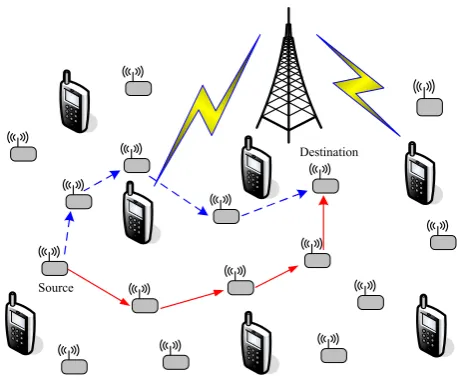
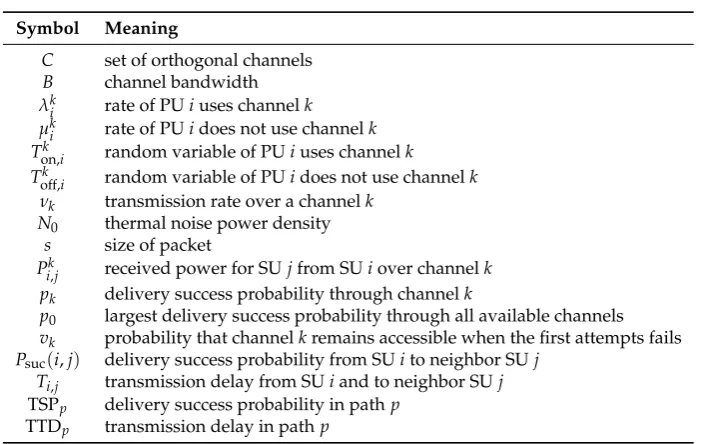
We first provide CRSN network model, and then analyze our routing metrics followed by the problem definition of routing in CSNs. For ease of illustration, Table1lists the notations used in this work.
Figure 1.The network model of CSNs.
2.1. Network model
A multi-hop CRSN consists a number of static PUs and SUs, illustrated in Figure 1. In a multi-hop CRSN, the data transmission adopts a multi-hop manner if the distance from the sender to the receiver is beyond the transmission range of the sender. To make routing easier, the network is assumed to be connected, which means at least one route path exists for any pair of SUs.
In a CRSN, each PU is allowed to access only one channel band from an orthogonal channel setC = {c1,c2, . . . ,cm}. There exists a common control channel (CCC), over which SUs exchange
!"#$%
Table 1.System notations.
Symbol Meaning
C set of orthogonal channels
B channel bandwidth
λki rate of PUiuses channelk µki rate of PUidoes not use channelk
Ton,k i random variable of PUiuses channelk Toff,k i random variable of PUidoes not use channelk
νk transmission rate over a channelk
N0 thermal noise power density
s size of packet
Pik,j received power for SUjfrom SUiover channelk
pk delivery success probability through channelk
p0 largest delivery success probability through all available channels vk probability that channelkremains accessible when the first attempts fails
Psuc(i,j) delivery success probability from SUito neighbor SUj Ti,j transmission delay from SUiand to neighbor SUj
TSPp delivery success probability in pathp
TTDp transmission delay in pathp
the controlling messages. Besides the common channel, each SU can switch to and access any of the available licensed channels with the equipped half-duplex cognitive radio [32]. As aforementioned, when using a channel, each SU must abandon it and switch to an available licensed channel at once if a PU arrives and reclaims of the channel. To make routing easier, over a given channel, each SU is assumed to transmit data with the fixed power.
As in other references (e.g.[33]), the PUs’ activities are formulated by an alternating renewal process, named ON-OFF model, over a channel. In the ON-OFF model, the process of PUiaccessing channelk∈ Cobeys a Poisson process, whereTon,k irepresents the ON period with rateλki, andToff,k i represents the OFF period with rate µki. So, the availability and unavailability that a PU accesses channelkcan be denoted byTonk andToffk , respectively. By using cognitive radio technology, each SU
could sense the channel usage of PUs. We assume the channel usage pattern change slowly with time, and an SU could obtain the patten of surrounding PUs’ spectrum usage by conducting cooperative channel sensing with surrounding SUs. In this paper, we do not discuss the parameter estimation of the spectrum usage patten, which can be found in reference [34].
2.2. Routing metrics
In this sub-section, we first introduce the initial routing metrics from a statistical point of view only, in which no instant information (e.g., the current spectrum availability) is considered, and then introduce our novel routing metrics considering both the instant information and the global statistical data.
2.2.1. Routing metrics without instant information considered
Based on the alternating renewal process, we could obtain the limiting probability that a PUi does not access a given channelkat any given time. We denote the above probability by Poff,k i), which can be computed by
Pkoff,i = µi,k
µi,k+λi,k,
about PUion channelk. Similarly, we can infer the probability a given PU being in active state over a given channel, denoted by Pkon,i.
By using the Shannon capacity theory, we can obtain the achievable transmission rate through channelkfrom an SUito its neighbor SUjwith only the statistical spectrum usage data as follows
νk=B+log2 1+
Pik,j B×N0
!
,
where N0, B, νk, and Pik,j represent the thermal noise power density, the channel bandwidth, the transmission rate, and the power received by SU j, respectively. Generally, Pik,j is inversely proportional to some degree of distance from SU i to SU j, and directly proportional to SU i’s transmission power. Under the assumption that the power of transmission for each SU is fixed, the transmission rate is sensitive to the two SUs’ distance only. For a data packet, an SU takes at least s/νkto transmit over channelk, in which the size of the packet iss, and over channelkthe achievable data transmission rate isνk.
As aforementioned, the transmission of SUs over a channel can break upon PUs’ arrival and reclaim of the channel, and then extends the total transmission delay. So, the probability of successful transmission is related with both the spectrum availability time on the channel and the required time of transmission. Like reference [22], through channelk, the delivery success probability from SUito its neighbor SUjcan be defined by
Psuck (i,j) =P
Tk ≥ s
νk
=e−s/(νk·µk) (1) in whichµk represents the rate of channelkbeing unavailable,srepresents the packet size, andνk represents the rate of transmission through channelk.
From Equation 1, the metric of the delivery success probability includes the influence of the spectrum available time and the influence of the transmission time, so it was applied in previous papers (e.g., [22]). But we observe that the above metric only consider the statistical spectrum usage information, and does not include the instant spectrum usage information, such as whether the channels are used by PUs or not. Moreover, the existing routing metric (e.g., [22]) only consider the maximum probability of successful transmission over all possible spectrums, and thus achieves suboptimal due to the absence of consideration of all potential channels especially temporarily unavailable channels. For example, assuming there is only one available channel over which an SU is transmitting data, rerouting will occur upon a PU’s arrival and reclaim of the channel. In fact, rerouting and retransmitting will increase transmission delay and reduce the routing performance greatly. Due to the dynamic availability of PU’s arrival, rerouting and retransmitting will inevitably occur when PU reclaims the channel and there exists no available channels. A good routing metric should consider the above case and decrease the number of rerouting and retransmitting. Thus, it would be better to consider both instant spectrum usage information and the global spectrum information especially the current unavailable spectrums in routing in multi-hop CSNs to decrease the number of rerouting and retransmission. In the following, we propose our routing metrics with the consideration of the above factors.
2.2.2. Our routing metrics
there usually exist a limited time-to-live (TTL) for any packet that should be abandoned when its TTL decreases to zero. Thus, it is necessary to consider the limited number of retransmission in routing in a multi-hop CRSN.
As aforementioned, a good routing metric should consider the number of all the available channels. In fact, the existing routing metric does not consider the dynamics of spectrum availability. Under the condition that the number of transmission over one channel is 1 over any two neighboring SUs, the traditional transmission probability of success over all the available channels is defined as 1−(1−p1)(1−p2)· · ·(1−pm), where mrepresents the number of current available channels,
and pk = Psuck (i,j) represents the delivery success probability through channel k. It is evident
that the delivery success probability goes up with the number of available channels. In fact, the aforementioned formula is not accurate since the availability of the channels changes dynamically during data transmission.
To estimate more accurately the transmission probability of success between two neighboring SUs,one retransmissionis allowed for an SU when transiting a packet to its neighboring SU if the first transmission is interrupted by the arrival of a PU. We should mention that, although the delivery success probability becomes larger if more times of retransmissions are allowed, the difficulty of estimating the routing metric increases largely, thus leads to less feasible. So, in this work, with the restriction of only one retransmission permitted, we at the first time define a novel delivery success probability with the consideration of availability and quality of all spectrum channels.
Definition 1. With the restriction of one retransmission permitted, we denote the delivery success probability from an SU i to its neighbor SU j through all channels by Psuc(i,j), that is,
Psuc(i,j) =p0+ (1−p0)
n−1
∑
k=1
vk k−1
∏
m=1
(1−vm)pk
!
(2)
in which n represents the number of all channels between SUs i and j, p0 = Pk
0
suc(i,j)is the biggest delivery
success probability though all the current accessible channels, pk = Psuck (i,j)represents the delivery success
probability through channel k, and vkrepresents the probability that channel k remains accessible upon the fail of first attempt of transmission.
When there are various available channels, it is easy to observe that we could obtain a higher delivery success probability if the SU first transmits packet with the channel that has the largest delivery success probability. So, in this work, an SU first uses the accessible channel that has the biggest delivery success probability to increase the transmission probability of success. When the first transmission fails, another transmission occurs if there exists other available channel to its neighboring SU. In the second attempt of retransmission, the SU also tries the channel with the largest delivery success probability at that time to transmit data. If unfortunately the second attempts fails again, a rerouting occurs to find an optimal path from current SUi.
In Definition. 1, we have to compute the probabilityvk. When an SU fails to transmit data over channelkat the first time, the availability of the channel falls in two cases: available and unavailable. So, considering the two possible states of the channelk,vkcan be obtained by,
vk=max
e−s/(2νkµk), µk µk+λk
(3)
where the first parte−s/(2νkµk)represents the probability of channelkstill remaining accessible upon the fail of transmission, andµk/(µk+λk)represents the limiting probability of channelkremaining accessible.
this case, the first packet transmission was not interrupted. On the other hand, if the first transmission fails and there exist available channels, SUiwill try another transmission over the channel with the highest transmission probability of success at that time; otherwise, if there exist no available channels, it applies rerouting at SUi.
In the following, the first routing metric is introduced, that represents the delivery success probability for a path with the constraint of one retransmission permitted.
Definition 2. We define the delivery success probability in path p,TSPpin the following TSPp= min
(i,j)∈pPsuc(i,j) (4)
in which the tuple(i,j)represents the pair of SU i and its neighboring SU j in path p.
From Definition2, we see that it does not include the transmission time between two neighboring SUs. In fact, under the assumption that an SU sends packet successfully to its neighboring SU, we can obtain the transmission time.
Definition 3. Supposing that a packet will be transmitted successfully in at most two attempts, we define the transmission delay from an SU i to its neighbor SU j using all channels, Ti,j, as follows
Ti,j= s
ν0
·p0+ (1−p0)·
n−1
∑
k=1
s
2νo + s
νk
·vk·
k−1
∏
m=1
(1−vm)pk
!
(5)
In Definition3,s/ν0is the required average time over the channel with the highest transmission
probability. So, the value of s/(2ν0) is the required average time at which the first transmission
fails. In the following, our second novel routing metric in a path that estimates the total average transmission delay over a path can also be obtained.
Definition 4. Supposing that a packet will be transmitted successfully in at most two attempts, we define the transmission time delay over path p,TTDp, that is
TTDp=
∑
(i,j)∈pTi,j (6)
From Equation6, TTDpis the sum of the transmission delays over all pairs of neighboring SUs in the path p. Thus, both the statistical spectrum usage data and the instant spectrum available information are considered in the above two routing metrics, especially the quality of all common channels in a path.
2.3. Problem formulation
Under the above two routing metrics, the routing problem in CSNs can be formulated with the goal of optimizing the related routing metric. Thus, for the two routing metrics, the routing problems in CSNs are respectively formulated as follows.
Definition 5. The routing problem under the delivery success probability metric under the constraint that only one retransmission allowed is resolved as follows
max
Definition 6. The routing problem under the transmission delay metric under the constraint that only one retransmission allowed is resolved as follows
min
p TTDp (8)
3. Our novel routing algorithms
Taking into accounts both the statistical spectrum usage data and the instant spectrum available information, two novel routing algorithms are designed respectively, named by Maximum Transmission Probability of Success (MaxTSP) and Minimum Average Transmission Delay (MinATD) according to the above two routing metrics.
3.1. Maximum Transmission Probability of Success routing
In the MaxTSP algorithm, the objective is to determine the best route path in terms of the probability of maximum delivery success under the constraint that only one retransmission is permitted.
Algorithm 1:MaxTSP routing algorithm
Input: parameters in multi-hop CRSN, destination SUD, source SUS Output: route path with the largest delivery probability of success
1 Source SUSconstructs RREQ messagesm;
2 Source SUSbroadcastsmthrough CCC channel to the neighboring SUs; 3 foreach SU x which receives mdo
4 ifSU x is the destination SU Dthen 5 SUxobtainsTSPpby Equation (4);
6 else
7 SUxobtainsPsuc(i,j)by Equation (1); 8 SUxforwardsmon over CCC channel;
9 SUDwaists for a predefined time upon receiving the first replica of messagem; 10 SUDdetermines the best route path which has the largest TSPpby using Definition5;
11 SUDsends back toSalong the chosen path.
The details of the MaxTSP algorithm is illustrated in Algorithm1, which describes the process that the desired path is constructed by using the first routing metric. When having data packet destined to SUD, SUSfirst broadcasts the Route Request message (RREQ) through the CCC channel in an AODV manner, which is forwarded on and finally reaches to the destination D. During the broadcasting, the delivery success probability of each SU obtained by (4) is accumulated in the RREQ message along the path. After collecting a number of the RREQ messages, destinationDselects one route path by computing the optimal path which has the largest delivery success probabilities. Then, the destination constructs a route reply message and reply back along the chosen path.
We should note that Algorithm1 only determines the best path through which the maximum delivery success probability could be achieved, and it does not determines the actual channels in that path. In fact, due to the dynamic availability of spectrum resources, each relay SU carrying packets could choose the channel with the highest value of the delivery success probability from all the available channels at that time under the condition of adopting the path determined by Algorithm 1. Only if there exists no available channels, the relay SU applies rerouting.
3.2. Minimum Average Transmission Delay routing
the CCC channel in an AODV manner, which is forwarded on and finally reaches to the destination D. During the broadcasting, the spectrum information about the transmission delays by using (5) are accumulated in the RREQ message along the path. After collecting a number of the RREQ messages, destinationDselects one route path by computing the optimal path which has the smallest average transmission delays. Then, the destination constructs a route reply message and reply back along the chosen path.
Algorithm 2:MinATD routing algorithm
Input: parameters in multi-hop CRSN, destination SUD, source SUS Output: path with the minimum expected transmission delay
1 Source SUSconstructs RREQ messagesm; 2 Source SUSbroadcastsmthrough CCC channel; 3 foreach SU x which receives mdo
4 ifSU x is the destination SU Dthen 5 SUxobtains TTDpby Equation (6);
6 else
7 SUxobtainsTi,jby Equation (5); 8 SUxforwardsmon over CCC channel;
9 SUDwaists for a predefined time upon receiving the first replica of messagem;
10 SUDdetermines the best route path which has the minimum TTDpby using Definition6; 11 SUDsends back toSalong the chosen path.
3.3. Route update
Data transmission may be interrupted due to PUs’ arrival, thus leading to retransmission or rerouting. As we know that rerouting requires greater resources and time than retransmission. Thus, in this work, retransmission is first tried under the constraint that the next relay node remains the same with the predetermined through the original routing. Suppose SU i is sending data to its neighboring SU j over channel kand then is interrupted upon PU’s arrival. If this is the second interrupt for SUiduring transmission, SUiattempts rerouting using Algorithms1or2. IF this is the first interrupt for SUiduring transmission, SUiattempts retransmission. First, SUirequests SUjall accessible channels forjover CCC channel. Then, SUjreturns to SUithe set of all available channels over CCC channel. On the reception from SUj, SUicomputes the common available channels, and for each channelk0 computes the related delivery success probability Pk0
i,j. If there exists a number of common channels, SUichooses the channel with the delivery success probability, and sends data over that channel. Otherwise, there exists no common channels between any two neighbor SUs at that time, and then a new route needs to be discovered using Algorithms1or2.
4. Simulations
4.1. Parameter settings
To evaluate the routing performance, our routing algorithms are implemented and simulated in the CRSN network using the NS-2 simulator. The same simulation scenarios are used as in reference [22]. For the settings of the parameters, the simulation region is square with 1000×1000m2, in which 50 SUs and 10 PUs are randomly static deployed, respectively. For each SU and PU, the interference range is 550m and the transmission range is 250m, respectively. The average spectrum usage time for PUs varies from 0.5ms to 25ms. Furthermore, we set that the bandwidth for each channelB = 0.5MHz, the number of channels 4, the size of data packet is 2 KB, and thermal noise power density N0=0.5×10¹²W/Hz. The repeated number of the simulations is 100, and each simulation lasts for
4.2. Simulation results
4.2.1. PUs availability vs. Throughput
(a)Ptr=0.1W (b)Ptr=0.5W
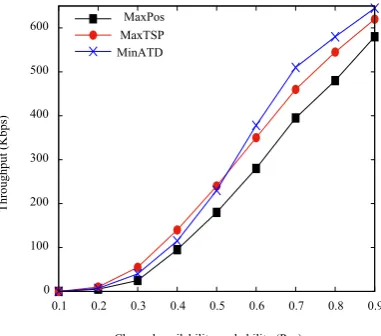
Figure 2.PUs availability vs. Throughput.
First, we evaluate the throughput of routing algorithms under different PUs’ availabilities. Figure2illustrates the different route throughput for the three routing algorithms under the different PUs’s availability Poff. Poffvaries from 0.1 to 0.9. As aforementioned, Poffmeans the channel usability
by SUs. We set the values of the data transmission power for each node to respectively 0.1W and 0.5W in the two simulation scenarios. From Figure2, we observe that with the increasing PUs’ availability, the route throughput of all the three algorithms increases also from 0 to 600Kpbs. The reason lies in that the number of accessible channels by SUs arises with the decrease of PUs’ activities, leading to a higher throughput. Moreover, with increasing the transmission power from 0.1W to 0.5W, an SU achieves a higher the transmission rate over each channel, thus increasing the throughput for each routing algorithm. From Figure2in the two simulation scenarios, we also observe that our two algorithms perform best under different values of Poff. The reason lies in that the number and quality
of spectrum channels impact the route throughput. Specifically, our algorithms take into accounts the quality of all the channels as well as the temporarily unavailable channels, whilst the MaxPos considers only one available channel, leaving the state of other channels unconsidered. So in MaxPos, rerouting occurs often if there exists only one available channel in some pairs of SUs in one path, thus decreases the throughput. In fact, our routing metrics consider and estimate both the number and quality of all channels especially those temporarily unavailable ones, which decreases the number of rerouting, and thus increasing the throughput.
4.2.2. Throughput vs. Transmission power
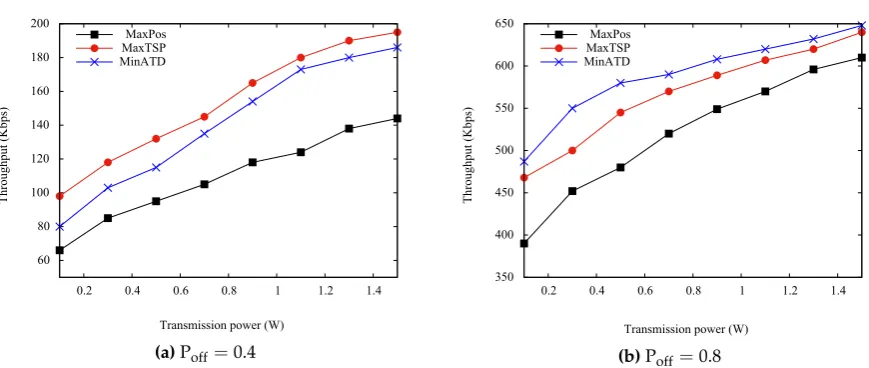
We then evaluate routing performance under different transmission power. Figure3illustrates the different route throughput for the three routing algorithms under the different transmission power that changes in[0.1, 1.5]W. As aforementioned, a large transmission power means a farther radio range. We set the values of the PUs availability to respectively 0.4 and 0.8 in the two simulation scenarios. From Figure 3, we observe that with increasing transmission power, the throughput increases also. The reason lies in the fact that with increasing transmission power, the transmission
0 100 200 300 400 500
0.1 0.2 0.3 0.4 0.5 0.6 0.7 0.8 0.9
Throughput (Kbps)
Channel availability probability (Poff) MaxPos
MaxTSP MinATD
0 100 200 300 400 500 600
0.1 0.2 0.3 0.4 0.5 0.6 0.7 0.8 0.9
Throughput (Kbps)
Channel availability probability (Poff) MaxPos
Figure 3. Transmission power vs. Throughput.
range of the packet and the power of received arises also, thus increasing the data transmission rate. Moreover, Figure3(a) indicates that MaxTSP outperforms MinATD in a low availability of PUs, while Figure3(b) indicates MinATD performs better in a high availability of PUs. In the environment with a high availability of PUs, more available channels will exist, in which all the available channels of PUs seldom changes to be unavailable simultaneously during data transmission. which then leads to no or less chances of rerouting. Thus, in the scenario with low availability of PUs, the number of rerouting is less and the main focus of routing is finding a path with minimal the transmission delay. Further, the second routing metric considers mainly the transmission delay. So, MinATD outperforms MaxTSP due to the first one uses our second routing metric. Similar analysis can be conducted in a low channel availability.
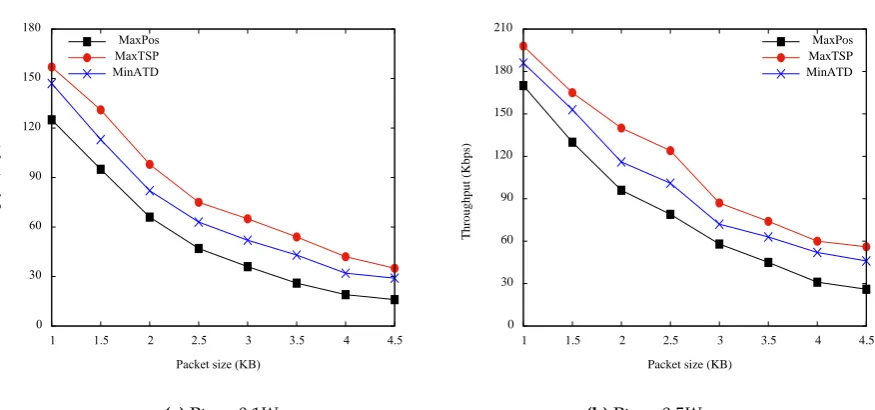
4.2.3. Throughput vs. Packet size
Figure 4 depicts the influence of different packet size on throughput, in which the PUs’ availability probability Poffis 0.4, and the size of data packet varies from 1 to 4 KB. From the figure,
we can see that the throughput goes down with the arise of the data packet size. The is because that as the size of data packet increases, the required transmission time increases also, leading to larger probability of PU’s arrival and more number of retransmission. As aforementioned, since our proposed routing metrics consider the impacts of the number and quality of all channels, our algorithms outperform the best.
5. Conclusions
Routing is an difficult issue in CSNs due to the complex dynamic availability of spectrum channels. In this work, taking accounts of the number and quality of spectrum channels from the global and instant point of view, we propose two CRSN routing metrics. In the first routing metric, the delivery success probability through all possible channels is defined in the constraint that only one retransmission is permitted to reduce rerouting. Similarly, the second routing metric considers the average transmission delay over all possible channels is presented. Based on the two routing metrics, the related routing algorithms are then designed, in which the optimal route is determined in an ON-demand route style. To increase the practicability, the channel assignments are not permanent and any relay nodes carrying packets could choose the channel with the largest routing metric at that
60 80 100 120 140 160 180 200
0.2 0.4 0.6 0.8 1 1.2 1.4
Throughput (Kbps)
MaxPos MaxTSP MinATD
Transmission power (W)
(a)Poff=0.4
350 400 450 500 550 600 650
0.2 0.4 0.6 0.8 1 1.2 1.4
Throughput (Kbps)
MaxPos MaxTSP MinATD
Transmission power (W)
(a)Ptr=0.1W (b)Ptr=0.5W
Figure 4.Throughput vs. packet size.
time. We conduct extensive simulations, which validates the the route performance of our routing schemes compared with other CRSN routing protocol. To increase the practicability and usability in real applications, further research needs to be conducted. Examples of research focuses on the power control strategy and joint opportunistic routing to decrease energy consumption in routing. Moreover, the mobility of both PUs and SUs could also be analyzed to make routing more practical.
Acknowledgments:This work is partly sponsored by the NSF of USA under Grant No.1252292, the NSF of China under Grant Nos.61370217, 61402273, 61373083, 61502116, and 61370084, the Fundamental Research Funds for the Central Universities of China under Grant Nos. GK201603115 and GK201401002.
Author Contributions: Lichen Zhang and Zhipeng Cai proposed the approaches. Peng Li and Lichen Zhang designed and performed experiments. Zhipeng Cai and Xiaoming Wang did modelling work. Lichen Zhang wrote the manuscript.
Conflicts of Interest:The authors declare no conflict of interest.
References
1. Rawat, P.; Singh, K.D.; Bonnin, J.M. Cognitive radio for M2M and Internet of Things: a Survey. Computer Communications2016.
2. Salameh, H.B.; Krunz, M. Channel access protocols for multi-hop opportunistic networks: Challenges
and recent developments. IEEE Network-Special Issue on Networking over Multi-hop Cognitive Networks 2009,23, 14–19.
3. Haykin, S. Cognitive radio: brain-empowered wireless communications.IEEE Journal on Selected Areas in
Communications2005,23, 201–220.
4. Wang, B.; Liu, K. Advances in cognitive radio networks: a survey. IEEE Journal of Selected Topics in Signal Processing2011,5, 5–23.
5. Akan, O.B.; Karli, O.B.; Ergul, O. Cognitive radio sensor networks.IEEE Network2009,23, 34–40. 6. Yan, M.; Ji, S.; Han, M.; Li, Y.; Cai, Z. Data aggregation scheduling in wireless networks with Cognitive
Radio capability. the 11th Annual IEEE International Conference on Sensing, Communication, and
Networking (SECON’2014); IEEE, , 2014; pp. 513–521.
7. Yang, Z.; Shi, Z.; Jin, C. SACRB-MAC: a high-capacity MAC protocol for cognitive radio sensor networks
in smart grid.Sensors2016,16, 464:1–14. 0
30 60 90 120 150 180
1 1.5 2 2.5 3 3.5 4 4.5
Throughput (Kbps)
Packet size (KB) MaxPos
MaxTSP MinATD
0 30 60 90 120 150 180 210
1 1.5 2 2.5 3 3.5 4 4.5
Throughput (Kbps)
Packet size (KB)
8. Zubair, S.; Yusoff, S.K.S.; Fisal, N. Mobility-enhanced reliable geographical forwarding in cognitive radio sensor networks.Sensors2016,16, 172:1–30.
9. Joshi, G.P.; Kim, S.W. A survey on node clustering in cognitive radio wireless sensor networks. Sensors 2016,16, 1465:1–19.
10. Joshi, G.P.; Nam, S.Y.; Kim, S.W. Cognitive radio wireless sensor networks: applications, challenges and research trends.Sensors2013,13, 11196–11228.
11. Zhang, L.; Cai, Z.; Li, P.; Wang, X. Exploiting spectrum availability and quality in routing for multi-hop
cognitive radio networks. the 11th International Conference on Wireless Algorithms, Systems, and
Applications (WASA’2016); Springer International Publishing, , 2016; pp. 283–294.
12. Wei, K.; Liang, X.; Xu, K. A survey of social-aware routing protocols in delay tolerant networks:
applications, taxonomy and design-related issues. IEEE Communications Surveys and Tutorials 2014,
16, 556–578.
13. Zhang, L.; Wang, X.; Lu, J.; Ren, M.; Duan, Z.; Cai, Z. A novel contact prediction based routing scheme for DTNs. Transactions on Emerging Telecommunications Technologies2014.
14. Zhang, L.; Cai, Z.; Lu, J.; Wang, X. Mobility aware routing in delay tolerant networks. Personal and
Ubiquitous Computing2015,19, 1111–1123.
15. Lu, J.; Wang, X.; Zhang, L. Signal power random fading based interference-aware routing for wireless
sensor networks.Wireless Networks2014,20, 1715–1727.
16. Zhang, L.; Cai, Z.; Lu, J.; Wang, X. Spacial mobility prediction based routing scheme in
delay/disruption-tolerant networks. Proceedings of International Conference on Identification,
Information and Knowledge in the Internet of Things (IIKI 2014); , 2014; pp. 274–279.
17. Sengupta, S.; Subbalakshmi, K.P. Open research issues in multi-hop cognitive radio networks. IEEE
Communications Magazine2013,51, 168–176.
18. Youssef, M.; Ibrahim, M.; Abdelatif, M.; Chen, L.; Vasikakos, A.V. Open research issues in multi-hop
cognitive radio networks. IEEE Communications Magazine2013,51, 168–176.
19. Cesana, M.; Cuomo, F.; Ekici, E. Routing in cognitive radio networks: challenges and solutions. Ad Hoc Networks2011,9, 228–248.
20. Chowdhury, K.; Felice, M. SEARCH: a routing protocol for mobile cognitive radio ad-hoc networks.
Computer Communications2009,32, 1983–1997.
21. Saleem, Y.; Salim, F.; Rehmani, M.H. Routing and channel selection from cognitive radio network’s
perspective: a survey.Computers and Electrical Engineering2015,42, 117–134.
22. Badarneh, O.S.; Salameth, H.B. Opportunistic routing in cognitive radio networks: exploiting spectrum
availability and rich channel diversity. Proceedings of the IEEE Global Telecommunications Conference (Globecom 2011); , 2011; pp. 1–5.
23. Jin, X.; Zhang, R.; Sun, J.; Zhang, Y. TIGHT: A geographic routing protocol for cognitive radio mobile ad hoc networks.IEEE Transactions on Wireless Communications2014,13, 4670–4681.
24. Liu, Y.; Cai, L.X.; Shen, X.S. Spectrum-aware opportunistic routing in multi-hop cognitive radio networks.
IEEE Journal on Selected Areas in Communications2012,30, 1958–1968.
25. Cai, Z.; Duan, Y.; Bourgeois, A.G. Delay efficient opportunistic routing in asynchronous multi-channel cognitive radio networks. Journal of Combinatorial Optimization2015,29, 815–835.
26. Guan, X.; Li, A.; Cai, Z.; Ohtsuki, T. Coalition graph game for robust routing in cooperative cognitive radio networks. Mobile Networks and Applications2015,20, 147–156.
27. Cai, Z.; Ji, S.; He, J.; Bourgeois, A.G. Optimal distributed data collection for asynchronous cognitive radio networks. IEEE 32nd International Conference on Distributed Computing Systems (ICDCS 2012); IEEE Computer Society: Macau, China, 2012; pp. 245–254.
28. Ji, S.; Cai, Z.; He, J.; Beyah, R. Primary social behavior aware routing and scheduling for Cognitive Radio Networks. IEEE 12th Annual International Conference on Sensing, Communication, and Networking (SECON 2015); IEEE Computer Society: Seattle, WA, USA, 2015; pp. 417–425.
29. Perkins, C.; Belding-Royer, E.; Das, S. Ad hoc on-demand distance vector (AODV) routing. RFC Editor; , 2003; pp. 1–5.
30. Feng, W.; Cao, J.; Zhang, C.; Liu, C. Joint optimization of spectrum handoff scheduling and routing
on Distributed Computing Systems (ICDCS’09 ); IEEE Computer Society: Montreal, Canada, 2009; pp. 85–92.
31. Ji, S.; Yan, M.; Beyah, R.; Cai, Z. Semi-structure routing and analytical frameworks for cognitive radio networks. IEEE Transactions on Mobile Computing2016,15, 996–1008.
32. Salameh, H.B.; Krunz, M.; Younis, O. Cooperative adaptive spectrum sharing in cognitive radio networks.
IEEE/ACM Transactions on Networking2010,18, 1181–1194.
33. Bayhan, S.; Alagöz, F. A Markovian approach for best-fit channel selection in cognitive radio networks.
Ad Hoc Networks2014,12, 165–177.
34. Kim, H.; Shin, K.G. Efficient discovery of spectrum opportunities with MAC-layer sensing in cognitive
radio networks. IEEE Transactions on Mobile Computing2008,7, 533–545.
c