Aus dem Institut für Gesundheits- und Rehabilitationswissenschaften der Universität München
Kommissarischer Direktor: Prof. Dr. Dennis Nowak
The Essence of Functioning in Sleep Disorders -
Development of a Core Set of Categories of the International
Classification of Functioning, Disability and Health (ICF)
Dissertation
Zum Erwerb des Doktorgrades der Humanbiologie An der Medizinischen Fakultät der
Ludwig-Maximilians-Universität München
Vorgelegt von
Felix Gradinger
aus
Villingen-Schwenningen
Mit Genehmigung der Medizinischen Fakultät der Universität München
Die Dissertation ist vom Promotionsausschuss gemäß Promotionsordnung angenommen worden
Berichterstatter: PD Dr. Alarcos Cieza
Mitberichterstatter: Prof. Dr. Axel Steiger
Prof. Dr. Christoph Lauer
Dekan: Prof. Dr.med. Dr.h.c. Maximilian Reiser, FACR,
FRCR
This doctoral project seeks to answer the question about the essence of functioning, disability and health in the lived experience of persons with any kind of primary sleep disorder. Its overall objective is the development of a first version of Core Sets of categories of the International Classification of Functioning, Disability and Health (ICF) in an evidence- and consensus-based process. To this end, four separate studies exploring different perspectives (researcher, clinical, patient, health professional) have been conducted and their results provided the evidence basis for selecting the relevant categories for the ICF Core Sets for Sleep Disorders during an international consensus conference. The doctoral thesis first-authored by the doctoral candidate therefore consists of five separate publications (1 Systematic Review, 2 Patient Studies, 1 Expert Survey, 1 Conference Results) that describe the different steps in the development process.
Zusammenfassung
1. Introduction p. 1
2. Researcher perspective:
Systematic review and content comparison p. 13
3. Clinical perspective:
Empirical, cross-sectional study p. 51
4. Patient perspective:
Qualitative Study p. 73
5. Health professional perspective:
Expert Survey p. 104
6. ICF Core Sets for Sleep Disorders:
Background
Sleep is a universal human need, about a third of our lives we spent asleep. Sleep and sleep related disorders therefore play an important role in relation to health. The International Classification of Sleep Disorders ICSD-2 (1) identifies six distinct fields of sleep disorders with over eighty different diagnoses. The six distinct fields comprise insomnia, sleep related breathing disorders, hypersomnias, sleep related movement disorders, circadian rhythm sleep disorders, and parasomnias, whereas the first four are the most frequent.
Involuntary naps, sleep attacks and drowsiness are hallmarks of excessive daytime sleepiness (EDS), a consequence common to the vast majority of patients with a sleep disorder (2-4).
However, not only the prevalence rates, diagnoses and symptoms are relevant when sleep disorders are described but also how they manifest in the lived experience of persons with sleep disorders. We know that sleep disorders also extend to health-related aspects of this lived experience. Especially, poor performance at work or school, disruption of family life, and frequent accidents (5) and the impact of these consequences on quality of life (6), the work environment, economy and health care expenditure are considerable (7-9).
The recognition of the importance of systematically assessing symptoms, problems in functioning and quality of life to optimize the management of patients with sleep disorders is increasingly influencing the clinical practice and research in the field of sleep medicine (10-17). Irrespective of the clinical context and the health-care situation in which sleep disorders manifest, an in-depth understanding, systematic consideration and solid description of the whole range of functional problems associated with sleep disorders are necessary.
The classification systems relevant to sleep medicine like the Diagnostic and Statistical Manual of Mental Disorders (DSM-IV)(18) and the ICSD-2 seek to give credit to the important impact on a person’s daytime functioning.
It is therefore important to specifically define those problems in functioning and moreover to do so for all sleep disorders. The International Classification of Functioning, Disability and Health (ICF)(19) offers a globally agreed-on framework for a more detailed and comprehensive understanding of the components of health and health-related states. It thereby complements classification systems like the International Classification of Diseases (ICD-10th revision)(20) or DSM-V and ICSD-2. It therefore seems an adequate tool to systematically and comprehensively explore the essence of the lived experience of sleep disorders. The ICF framework is based on a bio-psycho-social model of health and provides added value to the conceptualization of quality of life by including codes for the component environmental factors (21).
ICF was approved and unanimously endorsed by all member states at the 54th World Health Assembly in May 2001. The ICF and its model achieve a synthesis and provide a coherent view of the different perspectives of functioning and disability from the biological, individual, and social perspectives. Thus, based on the ICF, the management of functioning and disability requires a comprehensive approach that not only targets aspects intrinsic to the person but also aspects of the environment, and requires actions be taken across sectors that include health, labor, education and social-affairs.
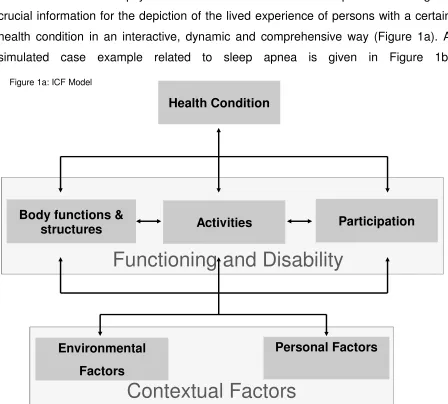
The model identifies three components of the dimension functioning, namely body functions and structures, activities, and participation. Problems or difficulties in these components that represent disability are called impairments, activity limitations, and participation restrictions. Functioning and disability are both affected by interactions between health conditions and contextual factors (environmental and personal). The ICF consist of more than 1400 categories to describe patient’s functioning, disability, and health. This project seeks to answer the question of what are the categories of functioning in ICF that essentially address sleep disorders.
These will be used in combination with other diagnostic classifications such as ICD-10, DSM-V or ICSD-2 to describe problems in functioning as an addition to the diagnostic criteria. These sets of categories relevant to persons with sleep disorders are called ICF Core Sets. The overall objective of this doctoral project is therefore the development of a first version of ICF Core Sets for Sleep Disorders in an evidence- and consensus-based process.
been performed. The results of the four studies and the results of the consensus conference have been published separately in international, peer-reviewed sleep journals and are summarized in the following paragraphs.
Specific Studies
The systematic review and content comparison representing the perspective of the researcher was published as:
• Gradinger F, Glässel A, Bentley A, Stucki A. Content Comparison of 115
Health-Status Measures in Sleep Medicine using the International Classification of Functioning, Disability and Health (ICF) as a reference. submitted to Sleep Medicine Reviews (IF: 6.143) on 30.03.10
Accepted: 02.07.10
The ICF has been proven to be a useful reference system to compare the content of outcome measures of health-related quality of life in general (22) and for sleep related breathing disorders in particular (23). However, a global estimation of the different questionnaires used in sleep medicine has not been done so far. The objective of this review and content comparison was therefore to systematically identify and quantify the concepts contained in health status measures in sleep medicine practice and research using the ICF as a reference.
A systematic literature review was conducted in order to identify and select generic and condition-specific patient-administered measures/questionnaires used in sleep medicine practice and research. A comprehensive search strategy for reviews, national/international guidelines and standard references to ensure that all areas of functioning, disability and health are captured, was employed. In a further step the contents of the selected measures were identified and linked to the ICF using established linking rules. The frequencies of ICF categories covering the concepts contained in the measures were used for the descriptive analysis and content comparison.
Overall, 115 patient-administered measures were analyzed. Of these, 35 were of generic nature and 17 were symptom-related (eight sleepiness/six fatigue/two alertness/one tiredness). There were 63 condition-specific measures including 38 for Insomnia, 11 for Sleep Apnea, 10 for Restless Legs Syndrome, and 4 Narcolepsy questionnaires.
(61.4%), followed by 15.3% of concepts linked to 49 different categories of the component activities & participation, and 9.8% of concepts linked to 22 categories of the component environmental factors. The component body structures was the least frequent (0.5%). Table 1 shows the top five of most frequently mentioned ICF categories for each ICF component.
The study is both comprehensive in the range of questionnaires covered and also in the application of a reference system that seeks to capture all aspects of health. The measures vary greatly with regard to the number and specificity of the ICF categories covered, as indicated by the proportional indices of content density and content diversity that are displayed in the league table in the publication. The ICF provides a useful reference to identify and quantify the concepts contained in health status measures used in sleep medicine practice and research.
All work related to identifying, retrieving and analyzing the data and the writing of the related paper were undertaken by the doctoral candidate.
The empirical, cross-sectional study representing persons with any kind of (primary) sleep disorders in a clinical setting was published as:
• Gradinger F, Glässel A, Gugger M, Cieza A, Braun N, Khatami R, Schmitt W,
Mathis J. Identification of problems in functioning of persons with sleep disorders in a clinical setting using the International Classification of Functioning Disability and Health (ICF)-Checklist.
Submitted to Journal of Sleep Research (IF: 3.255) on 02.03.10 Accepted: 20.08.2010
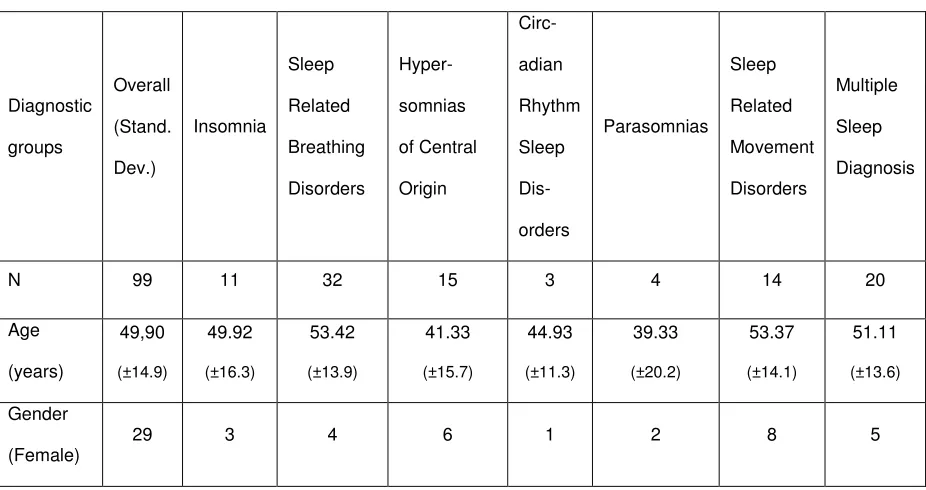
clinical setting using the International Classification of Functioning, Disability and Health (ICF) as a frame of reference. A convenience sample of patients of any etiopathology of a primary sleep disorder was consecutively recruited in the sleep centers of the University clinics of Berne and Zurich and the Clinic Barmelweid (all Switzerland), each in different Swiss cantons (provinces). Data was collected through a structured face-to-face Interview with patients of 45-60 minutes. A case record form which was coded by health professionals contained the extended ICF Checklist (24), socio-demographic variables, and disease specific variables was used. The study centers collected data of 99 individuals with any kind of primary sleep disorder. The identified categories include 48 (32%) for body functions, 13 (9%) body structures, 55 (37%) activities and participation and 32 (22%) for environmental factors. Table 2 shows the top five of most frequently mentioned ICF categories for each ICF component.
This study shows that sleep disorders are associated not only with a large number of impairments in body functions and body structures but also with activity limitations and participation restrictions, and that the environment can play an essential role in the life of persons with sleep disorders. The ICF has potential to provide a comprehensive framework for the description of functional health in individuals with sleep disorders in a clinical setting.
All the work related to the logistics within the three study centers (including ethics committee approval) as well as the data collection and analysis and its reporting in written form were performed by the doctoral candidate.
• Gradinger F, Köhler B, Khatami R, Mathis J, Cieza A, Bassetti C. Problems in
functioning from the patient perspective using the International Classification of Functioning, Disability and Health (ICF) as a reference.
Submitted to Journal of Sleep Research (IF: 3.255) on 02.03.10, Accepted: 08.05.10
This is a qualitative, multicenter study using a focus group design to explore the lived experiences of persons with any kind of primary sleep disorder with regard to functioning and contextual factors. Six open-ended questions related to the ICF components were used to classify the results using the International Classification of Functioning, Disability and Health (ICF) as a frame of reference.
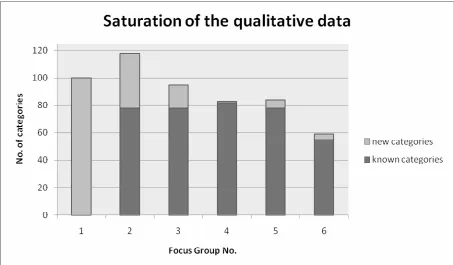
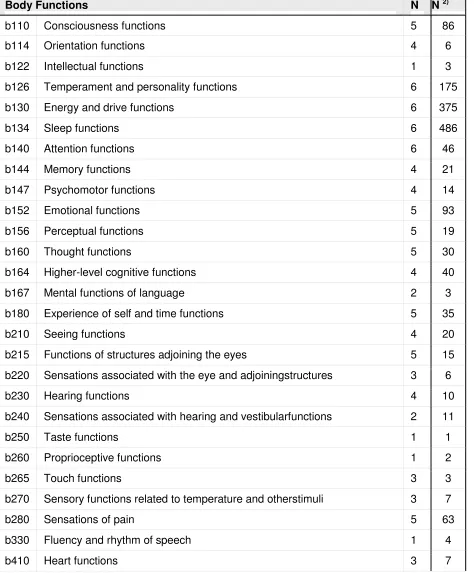
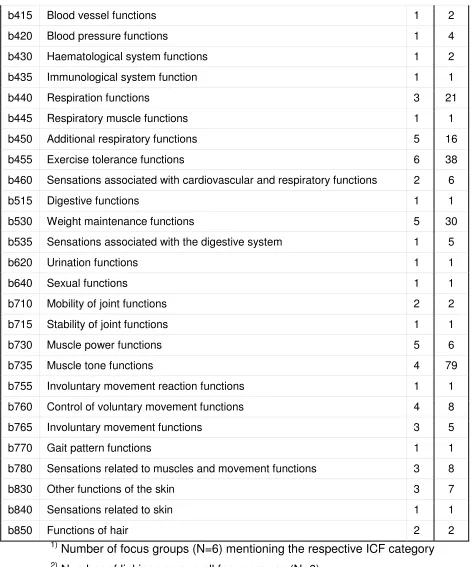
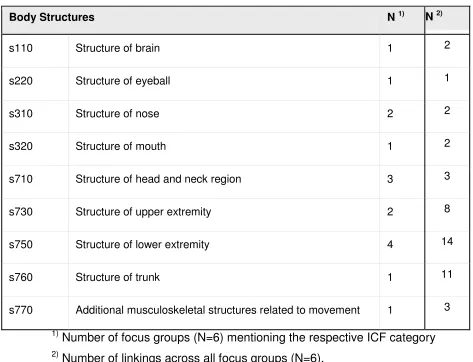
The units of analysis were the meaningful concepts within the transcribed data and which was linked to ICF categories according to established linking rules (25-26). The six focus groups with 27 participants yielded a total of 6986 relevant concepts which were linked to a total of 168 different 2nd-level ICF categories.
Out of these 168 categories, 53 (31.5%) categories belong to Body Functions, 57 (33.9%) categories to Activities and Participation, and 48 (28.6%) categories belong Environmental Factors. Ten (6%) categories referred to Body Structures.
All the work related to the logistics within the three study centers (including ethics committee approval) as well as the data collection and analysis and its reporting in written form were performed by the doctoral candidate.
The expert survey with health professionals from different professions worldwide was published as:
• Gradinger F, Boldt C, Högl B, Cieza A. Identification of problems in
functioning of persons with sleep disorders from the health professional perspective using the International Classification of Functioning, Disability and Health (ICF) as a reference.
Submitted to Sleep Medicine (IF: 3.163) on 18.02.10 Accepted: 31.08.2010
This is an international expert survey which looked to identify relevant aspects of functioning as well as related environmental factors of patient with sleep disorders from the perspective of health professionals that treat them. A structured email survey was sent to 174 selected international experts experienced in the treatment of sleep disorders including physicians, nurses, therapists, technicians, biologists and psychologists. The same 6 open-ended questions that were used in the qualitative study were applied in the survey. All answers were translated (‘linked’) to the ICF based on established coding rules.
This is the first survey that explores the functional problems of individuals with sleep disorders from a worldwide perspective and that is involving most of the different health professions related to the treatment of these disorders. Health professionals addressed a large variety of functional problems reflecting the complexity of sleep disorders. The ICF provided a comprehensive framework in order to integrate answers from different professional backgrounds and different world regions.
All the steps of the survey including the compilation and recruitment of participants, data analysis and reporting were done by the doctoral candidate.
ICF Core Sets for Sleep Disorders
The results of the international consensus conference were published as:
• Gradinger F, Cieza A, Stucki A, Michel F, Bentley A, Oksenberg A, Rogers
AE, Stucki G, Partinen M. International Classification of Functioning, Disability and Health (ICF) - ICF Core Sets for Persons with Sleep Disorders: Results of the Consensus Process integrating Evidence from Preparatory Studies.
Submitted to Sleep Medicine (IF: 3.163) on 18.02.10 Accepted: 31.08.2010
A formal decision-making and consensus process which integrated evidence gathered from preparatory studies was performed. The resulting proposal for the Comprehensive and Brief 1st Versions of the ICF Core Set for Sleep Disorders are reported. The relevant ICF categories were selected by a sample of international experts from different professional backgrounds in a formal consensus process using the nominal group technique.
Twenty-six experts from 22 countries and different professional backgrounds attended the consensus conference. Altogether 120 second- or third-level ICF categories were included in the Comprehensive ICF Core Set with the following ICF components: 49 categories from body functions, 8 from body structures, 31 from activities and participation and 32 from environmental factors. The Brief ICF Core Set is depicted in table 5 below.
All of the varying aspect of project-managing the international consensus conference were supervised and performed by the doctoral candidate.
Outlook
This dissertation set the ground for furnishing a bio-psycho-social outlook on all health and health-related aspects of the lived experience of any kind of sleep disorder based on the ICF model and classification system.
Besides having come up with an evidence- and consensus-based core data set of categories of the ICF relevant to sleep disorders, the dissertation generated additional methodological, practical and meaningful value for the field of sleep medicine as a whole.
Especially the league tables of existing sleep questionnaires published in the most widely read international sleep journal could be used as global resources for sleep clinicians and researchers working on any continent or in any language. It will help clinicians and researchers make more informed choices about which patient-reported questionnaires to use in their work.
Both patient studies present new methodologies as well as results that incite a more profound understanding of the individual patient living with a sleep disorder. The patient studies deliver ample and pivotal evidence for the inclusion of contextual factors in the interactive treatment of these patients. These are evidently critical for the enabling and disabling factors in the disease process. Advocating for including the anamnestic question: How is it going at home/work? in any clinical proceeding would be a starting point.
References
1. AASM. International classification of sleep disorders: Diagnostic and coding manual. 2 ed. Westchester, Illinois: American Academy of Sleep Medicine; 2005. 2. Engleman HM, Douglas NJ. Sleep. 4: Sleepiness, cognitive function, and quality of life in obstructive sleep apnoea/hypopnoea syndrome. Thorax. 2004 Jul;59(7):618-22.
3. Thorpy MJ. Which clinical conditions are responsible for impaired alertness? Sleep Med. 2005 Jun;6 Suppl 1:S13-20.
4. Guilleminault C, Brooks SN. Excessive daytime sleepiness: a challenge for the practising neurologist. Brain. 2001 Aug;124(Pt 8):1482-91.
5. Colten HR, Altevogt BM, editors. Sleep Disorders and Sleep Deprivation: An Unmet Public Health Problem. Washington: Institute of Medicine (IOM); 2006.
6. Verster JC, Pandi-Perumal SR, Streiner DL, editors. Sleep and Quality of Life in Clinical Medicine. Totowa, NJ: Humana Press; 2008.
7. Hillman DR, Murphy AS, Pezzullo L. The economic cost of sleep disorders. Sleep. 2006 Mar 1;29(3):299-305.
8. Wittmann V, Rodenstein DO. Health care costs and the sleep apnea syndrome. Sleep Med Rev. 2004 Aug;8(4):269-79.
9. Reinhold T, Muller-Riemenschneider F, Willich SN, Bruggenjurgen B. Economic and human costs of restless legs syndrome. Pharmacoeconomics. 2009;27(4):267-79.
10. ATS/ASA. American Thoracic Society/American Sleep Disorders Association. Statement on health outcomes research in sleep apnea. Am J Respir Crit Care Med. 1998 Jan;157(1):335-41.
11. Morgenthaler TI, Kapur VK, Brown T, Swick TJ, Alessi C, Aurora RN, et al. Practice parameters for the treatment of narcolepsy and other hypersomnias of central origin. Sleep. 2007 Dec 1;30(12):1705-11.
12. Morgenthaler TI, Lee-Chiong T, Alessi C, Friedman L, Aurora RN, Boehlecke B, et al. Practice parameters for the clinical evaluation and treatment of circadian rhythm sleep disorders. An American Academy of Sleep Medicine report. Sleep. 2007 Nov 1;30(11):1445-59.
13. AASM. Sleep-related breathing disorders in adults: recommendations for syndrome definition and measurement techniques in clinical research. The Report of an American Academy of Sleep Medicine Task Force. Sleep. 1999 Aug 1;22(5):667-89.
14. Chesson AL, Jr., Anderson WM, Littner M, Davila D, Hartse K, Johnson S, et al. Practice parameters for the nonpharmacologic treatment of chronic insomnia. An American Academy of Sleep Medicine report. Standards of Practice Committee of the AASM. Sleep. 1999 Dec 15;22(8):1128-33.
15. Chesson AL, Jr., Wise M, Davila D, Johnson S, Littner M, Anderson WM, et al. Practice parameters for the treatment of restless legs syndrome and periodic limb movement disorder. An American Academy of Sleep Medicine Report. Standards of Practice Committee of the AASM. Sleep. 1999 Nov 1;22(7):961-8.
16. Morin CM, Hauri PJ, Espie CA, Spielman AJ, Buysse DJ, Bootzin RR. Nonpharmacologic treatment of chronic insomnia. An American Academy of Sleep Medicine review. Sleep. 1999 Dec 15;22(8):1134-56.
19. WHO. International Classification of Functioning, Disability and Health (ICF). Geneva: World Health Organization; 2001.
20. WHO. International Statistical Classification of Diseases and Related Health Problems 10th Revision Geneva: World Health Organization; 2007.
21. Cieza A, Bickenbach J, Chatterji S. The ICF as a conceptual platform to specify and discuss health and health-related concepts. Gesundheitswesen. 2008 Oct;70(10):e47-56.
22. Cieza A, Stucki G. Content comparison of health-related quality of life (HRQOL) instruments based on the international classification of functioning, disability and health (ICF). Qual Life Res. 2005 Jun;14(5):1225-37.
23. Stucki A, Cieza A, Schuurmans MM, Ustun B, Stucki G, Gradinger F, et al. Content comparison of health-related quality of life instruments for obstructive sleep apnea. Sleep Med. 2008 Jan;9(2):199-206.
24. WHO. ICF Application and Training Tools. Geneva: World Health
Organization; 2010 [06.01.2010]; Available from:
http://www.who.int/classifications/icf/icfapptraining/en/index.html.
25. Cieza A, Brockow T, Ewert T, Amman E, Kollerits B, Chatterji S, et al. Linking health-status measurements to the international classification of functioning, disability and health. J Rehabil Med. 2002 Sep;34(5):205-10.
Content Comparison of 115 Health-Status Measures in Sleep
Medicine using the International Classification of Functioning,
Disability and Health (ICF) as a reference
Felix Gradinger1, Andrea Glässel1, Alison Bentley2, Armin Stucki3,4
1
ICF Research Branch of the WHO Collaborating Center for the Family of International Classifications in German
at Swiss Paraplegic Research, Nottwil, Switzerland and Institute for Health and Rehabilitation Sciences,
Ludwig-Maximilian University, Munich, Germany
2Wits Dial.A.Bed Sleep Laboratory, Faculty of Health Sciences, University of the Witwatersrand, Johannesburg,
South Africa.
3
Department of Pneumology, University Hospital ‘Insel’, Berne, Switzerland
4Berne Rehab Centre Heiligenschwendi, Switzerland
Address for correspondence:
Felix Gradinger
ICF Research Branch at Swiss Paraplegic Research CH-6207 Nottwil
Tel.: +41 (0)41 939 6593 Fax: +41 (0)41 939 6577 Mob.: +41 (0)762006510
Mail: [email protected] www.paranet.ch/sw39430.asp
www.icf-research-branch.org/research/sleep.htm
Short title: ICF Content Comparison of 115 Health-Status Measures
Keywords
Sleep Disorders; Systematic Review; Measurement, Assessment; Functioning; Questionnaires; ICF; WHO
Abbreviations:
ICF: International Classification of Functioning, Disability and Health ICD-10: International Classification of Diseases, 10th revision ICSD-2: International Classification of Sleep Disorders, 2nd edition *asterisked key references
Abstract
The objective of this systematic review and content analysis was to identify and quantify the concepts contained in patient-administered health status measures in sleep medicine practice and research using the International Classification of Functioning, Disability and Health (ICF) as a reference.
Both generic and condition-specific patient-administered measures/questionnaires used in sleep medicine practice and research were identified and selected. A comprehensive search strategy for reviews, national/international guidelines and standard references to ensure that all areas of functioning, disability and health were captured was used. The contents of the selected measures were examined and linked to the ICF using established linking rules. The frequencies of ICF categories covering the concepts contained in the 115 patient-administered measures were used for the descriptive analysis and content comparison.
INTRODUCTION:
Sleep deprivation and sleep disorders are important public health issues (1) presenting with a wide spectrum of complaints including fatigue, lethargy, drowsiness, reduced attention and concentration, headaches, memory deficits, irritability, anxiety, depressive symptoms, poor performance at work or school, disruption of family life, and frequent accidents (2). The impact of these consequences on quality of life (3), the work environment, economy and health care expenditure are considerable (4-6).
The sheer number of 88 different diagnoses, as classified in the second edition of the International Classification of Sleep Disorders (ICSD-2) (7), makes the field of sleep medicine a uniquely complex, inter-disciplinary and challenging clinical and research environment. Simply arriving at the correct diagnosis does not explain what individuals living with a sleep disorder are actually able to do, what their needs are, how their environment comes into play, what their trajectory and prognosis are and what the cost of treatment will be.
Various organisations have published statements which have highlighted the importance of the systematic assessment of symptoms, functional limitations and quality of life in order to optimize the management of patients with sleep disorders (8-14).
In order to provide a common framework for functional health outcome measurement that seeks to answer the above questions, the International Classification of Functioning, Disability and Health (ICF) (15) was developed. The ICF answers the needs for common definitions, anchor points and a consensus on the conceptual framework capturing the functional problems associated with health conditions and diseases that appear on a continuum between functioning and disability and that are conceptualized in interaction with contextual factors. In accordance with the World Health Organization’s policy, it thereby complements and completes the manifestation properties (signs & symptoms) of diseases as specified in the International Classification of Diseases, 10th revision (ICD-10) (16, 17).
Contextual factors. The letters representing each component are followed by a numeric code that defines the chapter number (first digit) and category levels up to the fourth level (suffix of two, three, or four digits), apart from personal factors where no categories exist as of yet.
As an example, mental functions (from chapter 1 under body functions) would be represented by the following:
‘b1 Mental functions’ (first/chapter level) ‘b134 Sleep functions’ (second level)
‘b1340 Amount of sleep’ (third level) ‘b1341 Onset of sleep’ (third level)
‘b1342 Maintenance of sleep’ (third level) ‘b1343 Quality of sleep’ (third level)
‘b1344 Functions involving the sleep cycle’ (third level)
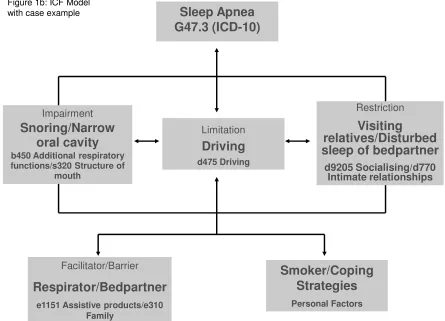
With the use of the bio-psycho-social model of ICF it becomes possible to integrate crucial information for the depiction of the lived experience of persons with a certain health condition in an interactive, dynamic and comprehensive way (Figure 1a). A simulated case example related to sleep apnea is given in Figure 1b.
Contextual Factors
Functioning and Disability
Environmental
Factors
Personal Factors Body functions &
structures Activities Participation
Figure 1a: ICF Model
Impairment
Snoring/Narrow oral cavity
b450 Additional respiratory functions/s320 Structure of
mouth
Limitation
Driving
d475 Driving
Facilitator/Barrier
Respirator/Bedpartner
e1151 Assistive products/e310 Family
Restriction
Visiting
relatives/Disturbed sleep of bedpartner
d9205 Socialising/d770 Intimate relationships
Smoker/Coping Strategies
Personal Factors Figure 1b: ICF Model
with case example Sleep Apnea
G47.3 (ICD-10)
The classification systems relevant to sleep medicine like the Diagnostic and Statistical Manual of Mental Disorders, 4th edition text revised (DSM-IV-TR)(18) and the ICSD-2 can benefit from the bio-psycho-social grid provided by ICF. Both classifications use some operational and broad definitions of functional manifestations in the diagnostic criteria of the health conditions they seek to define. For insomnia, the DSM-IV-TR uses the expression of ‘causing significant distress or daytime impairments in social, occupational or other sectors of daily life’ without further specification, whereas ICSD-2 captures the functioning properties and essential criteria of insomnia in nine different ‘forms of daytime impairment’. The ICF offers a more detailed and comprehensive framework to specify functioning in its component activities and participation as well as adding value to the conceptualisation of quality of life by including environmental factors (19).
and standardized reference system, that allows for a comprehensive exploration and comparison of all contents of the existing and currently used measures would be valuable. However, a global estimation of the different questionnaires used in sleep medicine has not been done so far.
The objective of the following study is therefore to systematically identify and quantify the concepts contained in health status measures in sleep medicine practice and research using the ICF as a reference. Specific aims are: (a) to compare measures used for different purposes in sleep medicine practice and research, (b) to examine the contents for items in the ICF; and (c) to deliver an evidence base for the international consensus process when developing a list of the most relevant ICF categories to describe any kind of primary sleep disorder.
METHODS:
ICF Core Sets process
This study is a preparatory study in the development of the ICF Core Sets for Sleep Disorders (33). The ICF Core Sets are lists of ICF categories selected for specific conditions, such as depression (34), obesity (35), and obstructive pulmonary disease (36) or for certain clinical settings, e.g. in vocational rehabilitation (37).
The ICF Core Sets for Sleep Disorders seek to capture the essential ICF functioning properties of any kind of primary sleep disorder as defined in the eight major diagnostic groups of the ICSD-2.
The process starts with evidence gathered through four preparatory studies followed by an international expert conference where consensus on a brief and a comprehensive version of the ICF Core Set is reached (38). One of these preparatory studies was to find out what researchers consider to be relevant, a systematic review of outcome measures in sleep medicine practice and research was conducted.
Design
A systematic literature review was conducted to identify and select questionnaires applied in sleep medicine practice and research.
three-way search strategy was employed using various degrees of quantitative and qualitative reach:
1. Review of Reviews: the literature databases MEDLINE, EMBASE, and PSYCINFO were systematically searched limiting the search to human adult studies, and reviews. The comprehensive search strategy employed which was targeting sleep-specific questionnaires used the following terms and their variants:
(Sleep*) or (Sleep in title or abstract) and
(instrument*) or (measure) or (questionnaire) or (index) or (measurement) or (scale) or (inventory) or (classification) or (outcome) or (assessment).
An eligibility check was conducted screening the abstracts identified through the literature search. Reviews referring to aspects of sleep disorders and/or quality of life were included.
2. internet-based sources and standard references in sleep medicine practice and research for international guidelines, standard procedures and standard references describing the state-of-the-art of outcome measurement were screened.
3. We consulted expert opinion, used conference visits, and conducted reference-chaining to identify more measures.
All the full text articles that were identified from the above sources containing concrete measures related to sleep were retrieved. Other questionnaires were obtained by contacting the original authors.
Linking procedure
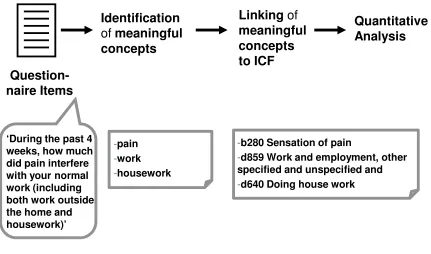
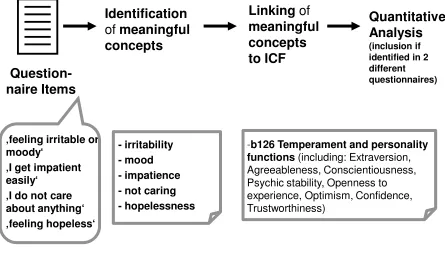
From the questions and items of the selected questionnaires, so-called “meaningful concepts” were identified and linked, by researchers trained in the taxonomy of the ICF, to the ICF components using established linking rules (39, 40). The ICF categories which had been linked to the concepts contained in the questionnaires provided the basis of the descriptive and content analysis.
to b280 sensation of pain, d859 work and employment, other specified and unspecified and d640 doing house work, respectively (42).
Identificationof meaningful
concepts
Linkingof
meaningful concepts to ICF
Question-naire Items
Quantitative Analysis
-pain
-work
-housework ‘During the past 4
weeks, how much did pain interfere with your normal work (including both work outside the home and housework)’
-b280 Sensation of pain
-d859 Work and employment, other specified and unspecified and
-d640 Doing house work
Figure 2: Linking procedure and example
The linking procedure was performed separately by two health professionals experienced with the ICF. If an item or meaningful concept was too general to allow a decision on the linking to a specific ICF component, chapter, or category, the statement was considered as ‘nd-not defined’ (such concepts that are captured in ICF but not specific enough to be attributable to certain components or categories e.g. “limited daytime functioning”). If a statement described an aspect which is not covered by the ICF, the code ‘nc-not covered’ was attributed (e.g. “risk of accidents”). Items asking for information related to health conditions (e.g. comorbidities) were coded as ‘hc-health condition’. The component ‘personal factors’ is not yet classified in the current version of ICF. Identified aspects of this component were therefore coded as ‘pf’.
between ‘How sleepy are you?’ and ‘Do you fall asleep during the day?’), or aspects of dimensionality. Thus, all concepts in items including additional information in itemizations or brackets were linked: e.g. ‘interference with normal social activities with family, friends, neighbors, or groups?’.
Data analysis
For sake of a comprehensible display of the results the measures were broadly grouped and reported according to generalized purpose. The most common denominator that might help distinguishing the questionnaires is whether they are developed for or validated with persons with a certain health condition. Hence, we used the distinction between the different condition-specific instruments in order to report our results. The second broad discriminator might be that instruments seek to distinguish between health conditions or that they screen for the different manifestation properties (signs & symptoms). Hence, we used the distinction between generic type of questionnaires and symptom-related ones to further group our measures.
The frequencies of the outcome measures and the linked ICF categories were reported along with percentages, relative to the total number of concepts or the total number of measures. For the individual measures the number of ICF categories covered on the component level was calculated. In addition, the most frequently identified ICF categories in each ICF-component using the respective cut-offs of more than 20% for body functions, 15% for activities & participation, and 10% for environmental factors of measures were reported. If a concept was linked to a third- or fourth-level category, the corresponding second-level category was reported unless the third-level category was one of those included in b134 – sleep functions.
Content analysis
The SF-36, for example, was found to have 54 concepts reflected in the 36 items giving us a content density ratio of 1.5 (43).
Content diversity is a measure of reach or bandwidth of a measure with regard to ICF categories or health-related aspects covered. It is calculated as a ratio using the number of 2nd level ICF categories divided by the number of linked meaningful concepts found during the linking process. Values close to one indicate that each meaningful concept of the measure corresponds to a different ICF category. Values closer to zero record lower content diversity, meaning that several concepts in the measure relate to one ICF category. In the SF-36, 23 different ICF categories were required in order to map the 54 concepts giving us a content diversity ratio of 0.43 (43).
The reliability of the linking process was evaluated by calculating unweighted kappa coefficients (44) and nonparametric bootstrapped confidence intervals based on the two independent linking versions of 50% of the overall number of measures. Kappa coefficients were calculated at the 2nd level of hierarchical ICF level to indicate the degree of agreement between the two health professionals conducting the linking procedure. The kappa analysis was performed with SAS (45).
RESULTS
In addition, 175 (3.7%) concepts were linked to the ICF component, personal factors. Included under ‘other’, 227 concepts (4.8%) were linked as ‘nc’ [not classifiable, e.g. questions related to time], 108 (2.3%) of concepts as ‘hc’ [health condition, e.g. questions related to comorbidities], and 100 (2.1%) as ‘nd’ [not definable,].
All the questionnaires, their references, the groups according to general purpose and the range of ICF components covered by each measure and their purpose groups respectively are listed in the annex in Table 1. The table depicts the respective and overall content measures of density and diversity. Overall, one questionnaire item represented 1.8 meaningful concepts (density). On average, 2.5 concepts in the questionnaires represent one and the same ICF category (diversity).
The Brock Sleep and Insomnia Questionnaire BSQI (46) contains the highest (n=371) and the Nocturnal Sleep Onset Scale NSOS (47, 48) the lowest (n=2) number of meaningful concepts. The highest value (9.8) for content density was found in the Augmentation Severity Rating Scale ASRS (49), which has 4 items containing 39 concepts. It is lowest (1.0) for the Multidimensional Fatigue Symptom Inventory MFSI (50, 51), which has 83 items containing 84 concepts.
The content diversity ratio is highest (0.9) in the Tiredness Symptoms Scale TSS (52), where 12 different ICF categories have been used to map the 14 concepts. The content diversity ratio is lowest (0.33) for the Sleep Timing Questionnaire (53), where 2 different ICF categories were used to represent 21 concepts.
ICF
Functioning and Disability
Contextual Factors
Body Functions and Body Structures
Activities and
Participation Environmental Factors Personal Factors
Component+
Body Functions (codes b1-b8)
61.4
Chapter 1 Mental functions (b1)
b110 Consciousness functions 29.6*
b126 Temperament and
personality functions 40.9 b130 Energy and drive
functions 57.4 b134 Sleep functions 87.8 3rd
Level b1340 Amount of sleep 40 3rd
Level b1341 Onset of sleep 64.3 3rd
Level
b1342 Maintenance of
sleep 53.9
3rd
Level b1343 Quality of sleep 66.1 3rd
level
b1344 Functions involving the sleep cycle 21.7 b140 Attention functions 20 b147 Psychomotor functions 24.3 b152 Emotional functions 48.7 b160 Thought functions 28.7 Chapter 2 Sensory functions and pain (b2)
b280 Sensations of pain 22.6 Chapter 4 Functions of the cardiovascular, haematological, Immunological and respiratory system (b4)
b450 Additional
respiratory functions 22.6
b460 Sensations associated with cardiovascular and respiratory functions 22.6
Chapter 7 Neuromusculoskeletal and movement-related functions (b7)
b765 Involuntarymovement functions 21.7
Component+
Body Structures (code s s1-s8)
0.5
Chapter 3 Structures involved in voice and speech (s3) s320 Structure of mouth 1* s330 Structure of pharynx 1 Chapter 4 Structures of the
cardiovascular, immunological and respiratory system (s4)
s410 Structure of cardiovascular system 1 Chapter 7 Structures related to movement (s7)
s710 Structure of headand neck region 2
s720 Structure of shoulder region 1
s730 Structure ofupper extremity 2
s740 Structure ofpelvic region 1
s750 Structure of lower extremity 4
Component+
Activities & Participation (codes d1-d9)
15.3
Chapter 2 General tasks and demands (d2)
d230 Carrying out daily routine 22* Chapter 4 Mobility (d4)
d415 Maintaining a body
position 19.1 d475 Driving 16.5 Chapter 5 Self-care (d5)
d570 Looking after one‘s health 20 Chapter 7 Interpersonal interactions and relationships (d7)
d770 Intimate relationships 16.5
Chapter 8 Major life areas (d8)
d850 Remunerative
employment 28.7
d855 Non-remunerativeemployment 15.7 Chapter 9 Community,
social and civic life (d9)
d920 Recreation and leisure 32.2
Component+
Environmental Factors (codes e1-e5)
9.8
Chapter 1 Products and technology (e1)
e110 Products or substancesfor personal consumption 33*
e115
Products and technology for personal use in daily living
9.6
Chapter 2 Natural environment and human-made changes to environment
(e2)
e240 Light 7.8
e245 Time-related changes 20
e250 Sound 21.7
Chapter 3 Support and relationships (e3)
e310 Immediate family 11.3 Chapter 5 Services, systems and
policies (e5)
e580 Health services, systems and policies 8.7
e590
Labour and employment services, systems and policies
5.2
Component+
Personal Factors (not classified in ICF)
3.7
Figure 3: Most frequently identified ICF Categories
*2ndand 3rdlevel categories in Body Functions
(Percentage of measures mentioning the
*All 2ndlevel ICF Categories in
Body Structures (Percentage of all measures (N=115) mentioning
the respective ICF category) *2Participation (Percentage of measures ndlevel categories in Activities & (N=115) mentioning the respective ICF category; ≥15%)
*2ndlevel categories in Environmental
Factors (Percentage of measures (N=115) mentioning the respective ICF category; ≥5%)
+Percentage of overall number of
The percentage of agreement between the independent linking of 58 out of the 115 (50.4%) questionnaires on the 2nd level hierarchy of the classification is 73.78%. After eliminating the amount of agreement expected by chance, the Kappa value is a substantial 0.71 (bootstrapped confidence interval: 0.69, 0.73).
Tables with the detailed linking results at all levels of the ICF’s hierarchical system including the frequency of the ICF categories identified through the linking of each individual measure are available from the corresponding author.
DISCUSSION
This paper provides a comprehensive overview of currently used health status measures in sleep medicine research and practice using the ICF as an independent, external frame of reference. The resulting snapshot picture of the state-of-the-art in patient-administered outcome assessment related to sleep allows clear and precise access to central comparative information related to the measures assessed. The study is both comprehensive in the range of purpose groups covered and also in the application of a reference system that seeks to capture all aspects of health. In supplying both these perspectives, the results provide valuable information for the appropriate selection of measures for specific purposes and for the bio-psycho-social outlook of the field of sleep medicine as a whole.
It is evident by the predominance of body function category choices, that current measures mainly capture the biomedical manifestation properties of sleep disorders (signs & symptoms). Very few measures address body structures in the context of sleep disorders. When extending and combining this outlook towards functioning as defined by ICF these measures mainly look at the impact of the disorder on categories of activities and participation while some integrate the interaction of the above with person and environment.
that no one sleep-related questionnaire covers all the functioning concepts contained in the ICF.
Many of the outcome measures included in this analysis target specific sleep disorders and the factors most useful in diagnosing and managing that particular disorder. This is demonstrated by the large quantity of measures identified for RLS, where measurement development and use is often driven by the need of precisely declaring benefits and side-effects (e.g. in severity ratings, augmentation). This phenomenon would also explain why ‘structure of lower limbs’ was the most commonly seen body structure. Questionnaires for sleep apnea increase the number of ‘respiratory functions’ observed. The large number of measures within the insomnia group mainly represents categories of behavioral and mental functions (e.g. cognitions, arousal, sleep hygiene). Since activity limitations are furthermore often part of diagnostic procedures (63), the insomnia field offered the most comprehensive measures we reviewed.
Major new findings of this content analysis are related to content density and content diversity of the measures which partly answers the question of how we are currently measuring in the field of sleep medicine with respect to content. While it is evident that the measures might differ with respect to length and number of concepts contained, the indices of content density and diversity might still be helpful for the selection of the most efficient measures. Measures with lower levels of content density have less complex items which might be more applicable in clinical settings. Such measures were especially identified in the shorter formats of visual analog scales or diaries, or those questionnaires that assess symptoms. The higher the content density, the more complex the item, and the more difficulty patients are to have in understanding and answering those items. Items that measure more than one concept may also provide results which are more difficult to analyze correctly and the concept of content density may be used to assist in the analysis. Possibly the more dense questionnaires should be combined with less dense questionnaires in order to provide a broader spread of assessment.
The measure of content diversity might become useful when deliberating and balancing the number of items with the reach and bandwidth of content covered in relation to the ICF components and their health domains.
cognitions or sleep hygiene are examples of measures with lower levels of content diversity. These measures might be more finely tuned and selective towards the topic they seek to explore. Those measures with a higher level of content diversity were encountered in such measures that look at the various consequences of disordered sleep on quality of life or activities and participation, and those intended for diagnostic or screening purposes, e.g. questionnaires looking at severity or symptoms.
It is important to note that the figures of content density and diversity are neutral and subsidiary indicators of the ICF-based contents included in the item structure of the respective measure. Low content density or diversity of a measure does not necessarily imply being a better or worse measure than another measure with higher content density or diversity. The purpose to which the measure is applied and how it behaves psychometrically determine the usefulness of the measure. The indices do however make the measures comparable with regard to ICF-based content covered. Many of the questionnaires derive worth from the personal perspective of the patient and this focus seems especially important. This is further supported by our finding of 3.7% of concepts being linked to personal factors. It might be worth considering that these softer aspects of the subjective health experience might extend to other sleep-disordered patient groups, where other medical disorders which show insomnia or mental disorders as a frequent comorbidity are encountered (64-70). Treatment adherence to continuous positive airway pressures (CPAP) might be cited as a case in point with increasing evidence indicating the variability and complexity of this problem (71). The enhancement of multidisciplinary models with psychosocial interpretations may provide increased explanatory and interventional potential in models of CPAP use (72-75).
since we did not encounter any questionnaires that explicitly assess the less prominent diagnostic groups (e.g. parasomnias like sleep-related eating disorders). The resulting ‘ICF Core Sets for Sleep Disorders’ seeks to broaden what can be measured when looking to address patient’s needs, resources and trajectories in a holistic and comprehensive way. Together with the evidence base and the item pool provided by this content analysis a first step to identify suitable existing measures or developing new measures has been taken (76).
Taking stock of what we are currently measuring and what must be considered the ‘canon’ was the aim of this study. To this end the application of a broad and open search strategy aimed to establish this through the unusual method of reviewing reviews. This means that the sample we identified necessarily contained some older measures that may not be in use any more and newer and more comprehensive measures already exist that we have not included as they have not reached the threshold of being reproduced through reviews and validation studies. Some recently published reviews were also not included for this analysis (77-79).
A further limitation alludes to the way this data was presented. In order to be concise, we were not able to represent the concrete analysis of each measure or purpose group in greater detail. We further had to represent the data on the component level or the 2nd level of hierarchy, omitting more detailed information that might have been of interest. Furthermore, it is debatable whether the ICF classification system, with its given categories and given levels of hierarchy, in itself can be considered as a suitable reference system since it must withstand the same criteria for content validity that we apply to other measures (80). A major limitation of ICF with regard to sleep medicine is the fact that ‘the descriptions of health and health-related domains refer to their use at a given moment (i.e. as a snapshot)’ ((15), p. 22). Accordingly, we were not able to code aspects of time-extensional measures that affect diagnosis, treatment, and functional assessment. ICF delivers a taxonomy or vocabulary but it lacks the grammar.
This whole exercise may be seen as an isolated strategy from WHO but this would be untrue. International expert groups of the Lancet Mental Health Group and the Child Health and Nutrition Research Initiative recently conducted an expert survey to identify research priorities for health in people with disabilities (81) and those affected by mental health problems (82).
Such endeavors give further impetus to discussion about and application of the ICF adding to the predominant linearization from the disease perspective an integrative and comprehensive perspective that looks at impact, functional problems and needs of people living with sleep disorders.
In conclusion, this analysis of 115 sleep-related questionnaires has extended the current knowledge regarding the relationship of concepts contained within these questionnaires to the ICF system of classification. Two new measures, content density and diversity, used in this analysis may be helpful in the future when clinicians decide on the specific questionnaire to be used.
Practice Points:
• ICF is a suitable internationally accepted, independent framework to
analyze content of health status measures.
• ICF-based content metrics add an additional content estimate:
1. Content density: measure of multidimensionality within the item
structure of a questionnaire (number of concepts/number of items)
2. Content diversity: measure of reach or bandwidth of an instrument
(number of different 2nd level ICF categories/number of linked meaningful concepts)
• Overview table may help sleep clinicians/researchers to choose the
ACKNOWLEDGEMENTS:
This study was funded by Swiss Paraplegic Research and forms part of the doctoral thesis of the first author at the Faculty of Medicine, University of Munich.
We want to thank Cristina Bostan, of the ICF Research Branch at the University of Munich for conducting the statistical analyses. Alarcos Cieza and Gerold Stucki many thanks for supervising and supporting this work. Thanks also to Jan Reinhardt for reviewing the final manuscript.
Many thanks to all the colleagues that provided their measures through direct contact: Ian Chen, Frances Chung, Kimberly Cote, Christian Guilleminault, Ian Hindmarch, Birgit Hoegl, Peter Liao, Henry Moller, Thomas Roth, Dan Teculescu, J. Catesby Ware.
Research Agenda:
• Extend prevailing biomedical focus to psychosocial, comprehensive and
multi-directional approaches based on ICF.
• Establish the epidemiology of functioning in sleep disorders and using
functioning as a common denominator in the field of sleep medicine.
• Systematically identify and use changes in functioning in patients with
sleep disorders to sustainably address the patients’ lived experiences.
• Develop tools and measures based on ICF that are comprehensive and
feasible (international validation of ICF Core Sets for Sleep Disorders).
• Interrogate categories not currently covered as to their worth in
REFERENCES [*asterisked key references]
1. Vgontzas AN, Kales A. Sleep and its disorders. Annu Rev Med. 1999;50:387-400.
2. Colten HR, Altevogt BM, editors. Sleep Disorders and Sleep Deprivation: An Unmet Public Health Problem. Washington: Institute of Medicine (IOM); 2006.
3. Verster JC, Pandi-Perumal SR, Streiner DL, editors. Sleep and Quality of Life in Clinical Medicine. Totowa, NJ: Humana Press; 2008.
4. Hillman DR, Murphy AS, Pezzullo L. The economic cost of sleep disorders. Sleep. 2006 Mar 1;29(3):299-305.
5. Wittmann V, Rodenstein DO. Health care costs and the sleep apnea syndrome. Sleep Med Rev. 2004 Aug;8(4):269-79.
6. Reinhold T, Muller-Riemenschneider F, Willich SN, Bruggenjurgen B. Economic and human costs of restless legs syndrome. Pharmacoeconomics. 2009;27(4):267-79.
7. AASM. International classification of sleep disorders: Diagnostic and coding manual. 2 ed. Westchester, Illinois: American Academy of Sleep Medicine; 2005. 8. ATS/ASA. American Thoracic Society/American Sleep Disorders Association. Statement on health outcomes research in sleep apnea. Am J Respir Crit Care Med. 1998 Jan;157(1):335-41.
9. AASM. Sleep-related breathing disorders in adults: recommendations for syndrome definition and measurement techniques in clinical research. The Report of an American Academy of Sleep Medicine Task Force. Sleep. 1999 Aug 1;22(5):667-89.
10. Morgenthaler TI, Lee-Chiong T, Alessi C, Friedman L, Aurora RN, Boehlecke B, et al. Practice parameters for the clinical evaluation and treatment of circadian rhythm sleep disorders. An American Academy of Sleep Medicine report. Sleep. 2007 Nov 1;30(11):1445-59.
11. Chesson AL, Jr., Anderson WM, Littner M, Davila D, Hartse K, Johnson S, et al. Practice parameters for the nonpharmacologic treatment of chronic insomnia. An American Academy of Sleep Medicine report. Standards of Practice Committee of the AASM. Sleep. 1999 Dec 15;22(8):1128-33.
12. Morin CM, Hauri PJ, Espie CA, Spielman AJ, Buysse DJ, Bootzin RR. Nonpharmacologic treatment of chronic insomnia. An American Academy of Sleep Medicine review. Sleep. 1999 Dec 15;22(8):1134-56.
13. Chesson AL, Jr., Wise M, Davila D, Johnson S, Littner M, Anderson WM, et al. Practice parameters for the treatment of restless legs syndrome and periodic limb movement disorder. An American Academy of Sleep Medicine Report. Standards of Practice Committee of the AASM. Sleep. 1999 Nov 1;22(7):961-8.
14. NHLBI (National Heart Lung, and Blood Institute). National Sleep Disorders Research Plan. Bethesda, MD: National Institutes of Health; 2003 [cited 15.12.09]. Available from: http://www.nhlbi.nih.gov/health/prof/sleep/res_plan/sleep-rplan.pdf. 15. WHO. International Classification of Functioning, Disability and Health (ICF). Geneva: World Health Organization; 2001.
16. Ustun B, Kennedy C. What is "functional impairment"? Disentangling disability from clinical significance. World Psychiatry. 2009;8:82-5.
17. Madden R, Sykes C, Ustun TB. World Health Organization Family of
International Classifications: definition, scope and purpose. Geneva: World Health Organization; 2007 [cited 25.01.10]; Available from:
18. APA. Diagnostic and Statistical Manual of Mental Disorders (DSM-IV-TR). Washington: The American Psychiatric Association (APA); 2000.
19. Cieza A, Bickenbach J, Chatterji S. The ICF as a conceptual platform to specify and discuss health and health-related concepts. Gesundheitswesen. 2008 Oct;70(10):e47-56.
*20. Morin C. Insomnia: psychological assessment and management. New York: Guilford Press; 1993.
*21. Spielman AJ, Yang C-M, Glovinsky PB. Assessment Techniques for Insomnia. In: Kryger MH, Roth T, Dement WC, editors. Principles and Practice of Sleep
Medicine. 3 ed. Philadelphia: W.B. Saunders; 2000. p. 1239-50.
*22. Weaver TE. Outcome measurement in sleep medicine practice and research. Part 1: assessment of symptoms, subjective and objective daytime sleepiness, health-related quality of life and functional status. Sleep Med Rev. 2001;5(2):103-28. *23. Morin CM. Measuring outcomes in randomized clinical trials of insomnia treatments. Sleep Med Rev. 2003;7(3):263-79.
*24. Reimer MA, Flemons WW, Reimer MA, Flemons WW. Quality of life in sleep disorders. Sleep Med Rev. 2003 Aug;7(4):335-49.
*25. Moul DE, Hall M, Pilkonis PA, Buysse DJ. Self-report measures of insomnia in adults: rationales, choices, and needs. Sleep Med Rev. 2004 Jun;8(3):177-98.
*26. Devine EB, Hakim Z, Green J, Devine EB, Hakim Z, Green J. A systematic review of patient-reported outcome instruments measuring sleep dysfunction in adults. Pharmacoeconomics. 2005;23(9):889-912.
*27. Buysse DJ, Ancoli-Israel S, Edinger JD, Lichstein KL, Morin CM, Buysse DJ, et al. Recommendations for a standard research assessment of insomnia. Sleep. 2006 Sep 1;29(9):1155-73.
*28. Hogl B, Gschliesser V. RLS assessment and sleep questionnaires in practice--lessons learned from Parkinson's disease. Sleep Med. 2007 Aug;8 Suppl 2:S7-12. *29. Martoni M, Biagi M. [Sleep self-report measures: a literature review]. Epidemiol Psichiatr Soc. 2007 Oct-Dec;16(4):316-29.
*30. Lomeli HA, Perez-Olmos I, Talero-Gutierrez C, Moreno CB, Gonzalez-Reyes R, Palacios L, et al. Sleep evaluation scales and questionaries: a review. Actas Esp Psiquiatr. 2008 Jan-Feb;36(1):50-9.
*31. Zhang L, Zhao Z-X. Objective and subjective measures for sleep disorders. Neurosci Bull. 2007 Jul;23(4):236-40.
32. McHorney CA. Health status assessment methods for adults: Past
accomplishments and future challenges. Ann Rev Pub Health. 1999;20:309-35. 33. Cieza A, Ewert T, Ustun TB, Chatterji S, Kostanjsek N, Stucki G. Development of ICF Core Sets for patients with chronic conditions. J Rehabil Med. 2004 Jul(44 Suppl):9-11.
34. Cieza A, Chatterji S, Andersen C, Cantista P, Herceg M, Melvin J, et al. ICF Core Sets for depression. J Rehabil Med. 2004 Jul(44 Suppl):128-34.
35. Stucki A, Daansen P, Fuessl M, Cieza A, Huber E, Atkinson R, et al. ICF Core Sets for obesity. J Rehabil Med. 2004 Jul(44 Suppl):107-13.
36. Stucki A, Stoll T, Cieza A, Weigl M, Giardini A, Wever D, et al. ICF Core Sets for obstructive pulmonary diseases. J Rehabil Med. 2004 Jul(44 Suppl):114-20. 37. Ekholm J, Escorpizo R, Gmϋnder H-P, Kostanjsek N, Cieza A, Stucki G.
38. Stucki A, Cieza A, Michel F, Stucki G, Bentley A, Culebras A, et al. Developing ICF Core Sets for persons with sleep disorders based on the International
Classification of Functioning, Disability and Health. Sleep Med. 2008 Jan;9(2):191-8. 39. Cieza A, Brockow T, Ewert T, Amman E, Kollerits B, Chatterji S, et al. Linking health-status measurements to the international classification of functioning, disability and health. J Rehabil Med. 2002 Sep;34(5):205-10.
40. Cieza A, Geyh S, Chatterji S, Kostanjsek N, Ustun B, Stucki G. ICF linking rules: an update based on lessons learned. J Rehabil Med. 2005 Jul;37(4):212-8. 41. Ware J, Sherbourne C. The MOS 36-item short-form health survey (SF-36). A. Conceptual framework and item selection. Medical Care. 1992;30:473-83.
42. Cieza A, Stucki G. Content comparison of health-related quality of life (HRQOL) instruments based on the international classification of functioning, disability and health (ICF). Qual Life Res. 2005 Jun;14(5):1225-37.
43. Geyh S, Cieza A, Kollerits B, Grimby G, Stucki G. Content comparison of health-related quality of life measures used in stroke based on the international classification of functioning, disability and health (ICF): a systematic review. Qual Life Res. 2007 Jun;16(5):833-51.
44. Cohen J. Weighted kappa: nominal scale agreement with provision for scaled disagreement or partial credit. Psychol Bull. 1968 Oct;70(4):213-20.
45. Vierkant RA. A SAS® Macro for Calculating Bootstrapped Confidence Intervals About a Kappa Coefficient. Cary, NC: SAS Institute Inc.; 1996 [cited 11.02.10]; Available from:
http://www2.sas.com/proceedings/sugi22/STATS/PAPER295.PDF.
46. Cote KA, Ogilvie RD. The Brock Sleep and Insomnia Questionnaire: phase I. Sleep Res. 1992;22:356.
47. Johnson EO, Breslau N, Roth T, Roehrs T, Rosenthal L. Psychometric evaluation of daytime sleepiness and nocturnal sleep onset scales in a
representative community sample. Biol Psychiatry. 1999 Mar 15;45(6):764-70. 48. Johnson EO, Roehrs T, Roth T, Breslau N. Epidemiology of alcohol and medication as aids to sleep in early adulthood. Sleep. 1998 Mar 15;21(2):178-86. 49. Garcia-Borreguero D, Allen RP, Kohnen R, Hogl B, Trenkwalder C, Oertel W, et al. Diagnostic standards for dopaminergic augmentation of restless legs syndrome: report from a World Association of Sleep Medicine-International Restless Legs
Syndrome Study Group consensus conference at the Max Planck Institute. Sleep Med. 2007 Aug;8(5):520-30.
50. Stein KD, Jacobsen PB, Blanchard CM, Thors C. Further validation of the multidimensional fatigue symptom inventory-short form. J Pain Symptom Manage. 2004 Jan;27(1):14-23.
51. Stein KD, Martin SC, Hann DM, Jacobsen PB. A multidimensional measure of fatigue for use with cancer patients. Cancer Pract. 1998 May-Jun;6(3):143-52.
52. Wilde-Frenz J, Bes F, Schulz H. The application of the Tiredness Symptoms Scale (TSS) during sleep deprivation. J Sleep Res. 1992;1(Suppl. 1):255.
53. Monk TH, Buysse DJ, Kennedy KS, Pods JM, DeGrazia JM, Miewald JM. Measuring sleep habits without using a diary: the sleep timing questionnaire. Sleep. 2003 Mar 15;26(2):208-12.
54. Brostrom A, Johansson P, Stromberg A, Albers J, Martensson J, Svanborg E. Obstructive sleep apnoea syndrome--patients' perceptions of their sleep and its effects on their life situation. J Adv Nurs. 2007 Feb;57(3):318-27.
56. Reishtein JL, Pack AI, Maislin G, Dinges DF, Bloxham TJ, George CFP, et al. Sleepiness and relationships in obstructive sleep apnea. Issues Ment Health Nurs. 2006 Apr;27(3):319-30.
57. Cartwright R. Sleeping together: a pilot study of the effects of shared sleeping on adherence to CPAP treatment in obstructive sleep apnea. J Clin Sleep Med. 2008 Apr 15;4(2):123-7.
58. Troxel WM, Robles TF, Hall M, Buysse DJ. Marital quality and the marital bed: Examining the covariation between relationship quality and sleep. Sleep Med Rev 2007;11(5):389-404.
59. Chandola T, Marmot M, Siegrist J. Failed reciprocity in close social
relationships and health: findings from the Whitehall II study. J Psychosom Res. 2007 Oct;63(4):403-11.
60. Doherty LS, Kiely JL, Lawless G, McNicholas WT. Impact of nasal continuous positive airway pressure therapy on the quality of life of bed partners of patients with obstructive sleep apnea syndrome. Chest. 2003 Dec;124(6):2209-14.
61. McArdle N, Kingshott R, Engleman HM, Mackay TW, Douglas NJ. Partners of patients with sleep apnoea/hypopnoea syndrome: effect of CPAP treatment on sleep quality and quality of life. Thorax. 2001 Jul;56(7):513-8.
62. Parish JM, Lyng PJ. Quality of life in bed partners of patients with obstructive sleep apnea or hypopnea after treatment with continuous positive airway pressure. Chest. 2003 Sep;124(3):942-7.
63. Ohayon M, Reynolds C. Epidemiological and clinical relevance of insomnia diagnosis algorithms according to the DSM-IV and the International Calssification of Sleep Disorders (ICSD). Sleep Med. 2009;10:952-60.
64. Andrews JG, Oei TPS. The roles of depression and anxiety in the
understanding and treatment of Obstructive Sleep Apnea Syndrome. Clin Psychol Rev. 2004 Dec;24(8):1031-49.
65. Smith S, Sullivan K, Hopkins W, Douglas J. Frequency of insomnia report in patients with obstructive sleep apnoea hypopnea syndrome (OSAHS). Sleep Med. 2004 Sep;5(5):449-56.
66. Dagan Y, Borodkin K. Behavioral and psychiatric consequences of sleep-wake schedule disorders. Dialogues Clin Neurosci. 2005;7(4):357-65.
67. Haba-Rubio J. Psychiatric aspects of organic sleep disorders. Dialogues Clin Neurosci. 2005;7(4):335-46.
68. Reutens S, Sachdev PS. Periodic limb movements and other movement disorders in sleep: neuropsychiatric dimensions. Int Rev Psychiatry. 2005 Aug;17(4):283-92.
69. Dauvilliers Y, Paquereau J, Bastuji H, Drouot X, Weil JS, Viot-Blanc V. Psychological health in central hypersomnias: the French Harmony study. J Neurol Neurosurg Psychiatry. 2009 Jun;80(6):636-41.
70. Sateia MJ. Update on sleep and psychiatric disorders. Chest. 2009 May;135(5):1370-9.
71. Aloia MS, Goodwin MS, Velicer WF, Arnedt JT, Zimmerman M, Skrekas J, et al. Time series analysis of treatment adherence patterns in individuals with
obstructive sleep apnea. Ann Behav Med. 2008 Aug;36(1):44-53.