159 |
P a g e
www.ijarse.com
IMPLEMENTATION AND IMPROVEMENT OF
QUALITY CONTROL SYSTEMS IN INDIAN SMEs
Supriya Naha Biswas
1, Sweta Sarkar
2, Dr. Abhijit Chakraborty
31,2
B.Tech. ,
3Associate Prof. &HOD, Department of Mechanical Engineering,
Global Institute of Management and Technology, Nadia, West Bengal, (India)
ABSTRACT
Quality control is a process which aims to prevent the defects and errors rather than finding out and then removing those defects. Proper emphasis is to be given on quality planning, quality design, quality implementation, quality gaps identification and quality improvement. This would result in the reduction of labour and material cost, minimum generation of scrap and waste, optimum utilisation of resources, better customer satisfaction, improved employee morale, better quality consciousness among employees and enhancement in productivity and efficiency of the SMEs. This paper is studying quality control conditions for different SMEs in India. Several quality tools are proposed to implement for improving quality control systems. Strategies are suggested to sustain quality in order to achieve organisational goals. Though different quality tools are being applied in a bare way in SMEs, but they are not in a well organised fashion. Therefore, it may be said that for sustaining their competitiveness and surviving in the market, the SMEs have to implement efficiently quality control systems since the large organisations expect assurance of high quality products and services from the SMEs.
Keywords:
Cost, Customer, Quality, Tools, Waste
I INTRODUCTION
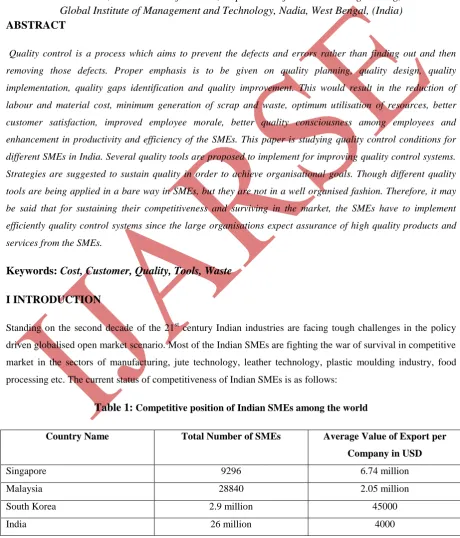
Standing on the second decade of the 21st century Indian industries are facing tough challenges in the policy
driven globalised open market scenario. Most of the Indian SMEs are fighting the war of survival in competitive
market in the sectors of manufacturing, jute technology, leather technology, plastic moulding industry, food
processing etc. The current status of competitiveness of Indian SMEs is as follows:
Table 1:
Competitive position of Indian SMEs among the worldCountry Name Total Number of SMEs Average Value of Export per
Company in USD
Singapore 9296 6.74 million
Malaysia 28840 2.05 million
South Korea 2.9 million 45000
160 |
P a g e
www.ijarse.com
Indian SMEs enjoy some potential assets as highly capable entrepreneurs and managers (we have world class
Engineers and Managers who are leading some international companies worldwide), extensive industrial
infrastructure (Indian SMEs are using same type of plant, machinery and technology as used anywhere else in
the world), availability of skilled technical manpower in a large scale, low cost labour (
1
4
th or1
5
th of thelabour cost compared to South-East Asia, Europe or USA is paid in India) and above all abundance of natural
resources (we have advantage of indigenous sources of raw materials at much cheaper rates than any other part
of the world). In spite of enjoying these assets Indian SMEs are performing too poor, as shown in the above
table, in global competitive market. The question is “why”?
This paper is finding the solution of the question by implementing and improving quality control systems in
Indian SMEs. Quality is a concept to achieve perfection by eliminating wastes. „Quality‟ is the success mantra
of any industry. This paper first indentifies the problems, then analyzes them by different models and finally
prescribes the possible solution depending upon the results of implementing quality tools.
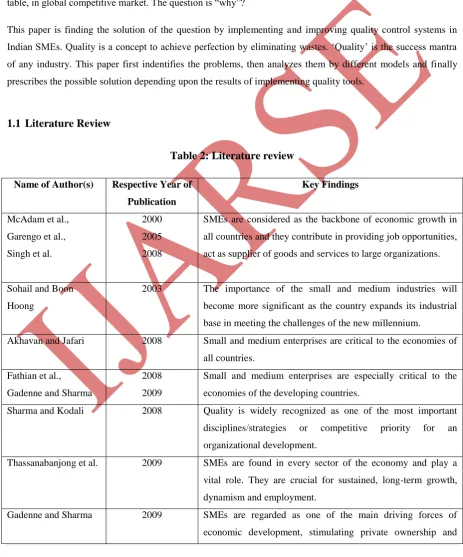
1.1
Literature Review
Table 2: Literature review
Name of Author(s) Respective Year of
Publication
Key Findings
McAdam et al.,
Garengo et al.,
Singh et al.
2000
2005
2008
SMEs are considered as the backbone of economic growth in
all countries and they contribute in providing job opportunities,
act as supplier of goods and services to large organizations.
Sohail and Boon
Hoong
2003 The importance of the small and medium industries will
become more significant as the country expands its industrial
base in meeting the challenges of the new millennium.
Akhavan and Jafari 2008 Small and medium enterprises are critical to the economies of
all countries.
Fathian et al.,
Gadenne and Sharma
2008
2009
Small and medium enterprises are especially critical to the
economies of the developing countries.
Sharma and Kodali 2008 Quality is widely recognized as one of the most important
disciplines/strategies or competitive priority for an
organizational development.
Thassanabanjong et al. 2009 SMEs are found in every sector of the economy and play a
vital role. They are crucial for sustained, long-term growth,
dynamism and employment.
Gadenne and Sharma 2009 SMEs are regarded as one of the main driving forces of
161 |
P a g e
www.ijarse.com
entrepreneurial skills. Application of quality management
(QM) practices in small and medium enterprises has improved
their overall performance by a combination of “hard” QM
factors such as benchmarking and quality measurement,
continuous improvement, and efficiency improvement; and the
“soft” QM factors consisting of top management philosophy
and supplier support, employee training and increased
interaction with employees and customers.
Mirbatrgkar 2009 For developing economies SMEs often offer the only realistic
prospects for increases in employment and value added
services or products.
Singh 2010 SMEs generally employ the largest percentage of the
workforce and are responsible for income generation
opportunities.
Abdullah 2010 There is logic and structure to high performance businesses
and the application of TQM, as the award-winning companies
perform better over their closest rivals.
1.2
Reasons For Poor Quality And Competitiveness
After making a contribution of more than 45% in our country‟s GDP our SMEs are lacking considerable
efficiency, good quality of products and better response to competitiveness. Some observed reasons for this
lagging performance by our SMEs are enlisted below:
Lack of interest by the Owner/CEOs in quality improvement.
Flat organisational structure.
Departmental focus of the company.
Paucity of innovation.
Inefficient system of maintenance of Plant and Machinery.
Absence of long-term strategy.
Poor technical discipline.
Lack of organized system for quality improvement.
Poor house-keeping and non-attention to various kinds of waste in the company.
Lack of involvement of CEOs in quality control is the beigest single cause for comparatively poor quality and
cost competitiveness. Most CEOs consider Quality Control department as a minor functional group, and leave it
to a junior manager/engineer. There is a misconception among managers particularly in small scale units that
quality improvement effort affects productivity and adds extra costs, making the products non-competitive. But,
a number of studies abroad and recently carried out even in India, has broken this myth and shown the opposite
effect. These studies have shown that planned quality improvements not only enhances the product quality, but
162 |
P a g e
www.ijarse.com
II METHODOLOGY
Following are the quality improvement methods followed in the study for a Medium Scale Enterprise:
Present plant information and previous records were collected.
An awareness seminar was arranged for the Management and senior staff of the company on strategy
for quality improvement and cost reduction.
A diagnostic study was arranged to identify the weaknesses of the company and major areas of waste.
The diagnosis also assessed rough estimate of cost of the waste due to poor quality management.
After diagnostic study, a pilot project was taken for quality improvement and cost reduction. The scope
of the project which included training of staff and working hands holding during implementation of the
project was also defined.
Actual implementation of the project was carried out by a selected team from the company.
Results were evaluated after completion of the pilot project and the future actions were planned.III ANALYSIS OF PLANT STUDIES
The plant was plotted into three parts for studies according to the contribution of employees: the upper
management, the floor management and the general workers. All the employees were interviewed personally
according to their group standard, before the implementation of pilot project. The previous performance of the
enterprise was studied from past records to find out the actual quality gap in the system. From that study it was
clear that the enterprise was facing survival threats from the competitive market. After the completion of the
pilot project following result came out:
Name of the company: XYZ (cannot be mentioned for permission issues).
Location of the company: Howrah industrial belt, West Bengal, India.
Products: Automotive cold formed components.
Reduction in set up time: 19.43% (10 minutes 41 seconds)
Total number of die changes per year: 320 x 12 = 3840 (in 8 presses)
Increased availability of power presses: 745 hrs. / year
Estimated increase in production due to reduced set up time: 357500 pcs / yr.
Estimated increase in profitability @ Rs. 5 / pc. : Rs. 17,87,500 / year
This study was completed within 6 months.
IV APPLICATION OF QUALITY TOOLS
Depending on the detected problem it was facing, following quality tools were applied in three phases during
163 |
P a g e
www.ijarse.com
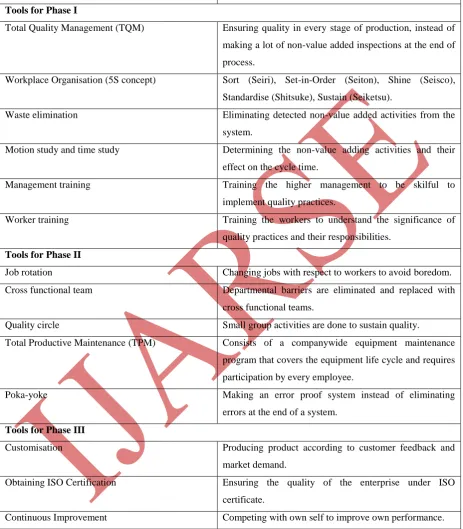
Table 3: Applied quality tools according to phase
Tools Remarks
Tools for Phase I
Total Quality Management (TQM) Ensuring quality in every stage of production, instead of
making a lot of non-value added inspections at the end of
process.
Workplace Organisation (5S concept) Sort (Seiri), Set-in-Order (Seiton), Shine (Seisco),
Standardise (Shitsuke), Sustain (Seiketsu).
Waste elimination Eliminating detected non-value added activities from the
system.
Motion study and time study Determining the non-value adding activities and their
effect on the cycle time.
Management training Training the higher management to be skilful to
implement quality practices.
Worker training Training the workers to understand the significance of
quality practices and their responsibilities.
Tools for Phase II
Job rotation Changing jobs with respect to workers to avoid boredom.
Cross functional team Departmental barriers are eliminated and replaced with
cross functional teams.
Quality circle Small group activities are done to sustain quality.
Total Productive Maintenance (TPM) Consists of a companywide equipment maintenance
program that covers the equipment life cycle and requires
participation by every employee.
Poka-yoke Making an error proof system instead of eliminating
errors at the end of a system.
Tools for Phase III
Customisation Producing product according to customer feedback and
market demand.
Obtaining ISO Certification Ensuring the quality of the enterprise under ISO
certificate.
Continuous Improvement Competing with own self to improve own performance.
Implementations of the recommended tools in different phases are important to achieve and sustain quality in
the enterprise. Tools of Phase I are the basic tools and techniques to establish quality practice in an enterprise as
well as to understand its importance. Tools of Phase II are targeting to achieve quality standards and its regular
practices. Tools of Phase III are the advanced techniques to sustain quality in the organisation and progress with
164 |
P a g e
www.ijarse.com
toward advancement and this is the most efficient way of quality implementation as the system experiences very
slow change in this method.
V KEY FINDINGS AND RECOMMENDATIONS
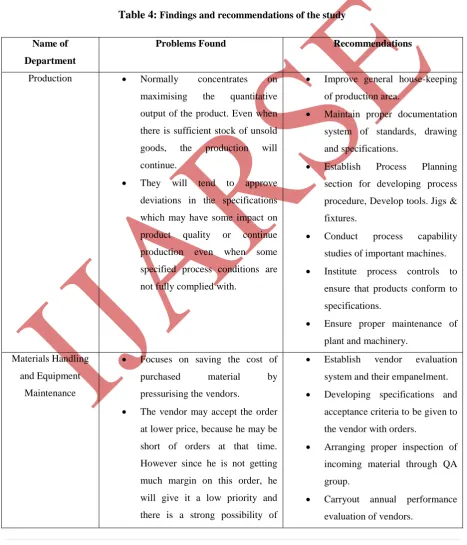
Most companies are managed by through various functional departments. The departments mainly focus on the
criteria, based on which their performance will be judged.
Table 4:
Findings and recommendations of the studyName of
Department
Problems Found Recommendations
Production Normally concentrates on
maximising the quantitative
output of the product. Even when
there is sufficient stock of unsold
goods, the production will
continue.
They will tend to approve
deviations in the specifications
which may have some impact on
product quality or continue
production even when some
specified process conditions are
not fully complied with.
Improve general house-keeping
of production area.
Maintain proper documentation
system of standards, drawing
and specifications.
Establish Process Planning
section for developing process
procedure, Develop tools. Jigs &
fixtures.
Conduct process capability
studies of important machines.
Institute process controls to
ensure that products conform to
specifications.
Ensure proper maintenance of
plant and machinery.
Materials Handling
and Equipment
Maintenance
Focuses on saving the cost of
purchased material by
pressurising the vendors.
The vendor may accept the order
at lower price, because he may be
short of orders at that time.
However since he is not getting
much margin on this order, he
will give it a low priority and
there is a strong possibility of
Establish vendor evaluation
system and their empanelment.
Developing specifications and
acceptance criteria to be given to
the vendor with orders.
Arranging proper inspection of
incoming material through QA
group.
Carryout annual performance
165 |
P a g e
www.ijarse.com
delayed supplies, which may
result in stoppage of production
or buying the part on emergency
basis by paying a higher price.
Both eventualities may cost more
than the anticipated savings due
to lower purchase price, thus
eating into profitability.
Normally Equipment of
Maintenance department is not
given its due importance.
Generally there is a tendency that
if a manager is not dynamic
enough to get higher production,
he is shunted to maintenance.
Because of his low profile, he
may not be able to arrange
resources or money to ensure
planned preventive maintenance,
which may need to shut down of
some machines affecting overall
production schedule and waste
due to idle machines.
Planning optimum inventory
level by shortening the
procurement cycle.
Proper storage and maintenance
of procured martial.
Quality Control This department is mainly responsible for:
Carrying out inward goods
inspections, stage inspection and
final inspection.
Monitoring process control in
production processes.
Carrying out various tests
required in their laboratory.
Very rarely it takes up quality
improvement project or analyzing
the causes of defects occurring in
the production.
Inspection of incoming martial,
in-process inspection and final
inspection and then generating
data on trend of rejections for the
information of the management.
Checking effectiveness of
process control.
Assisting production in analyses
of processing defects to find the
root causes and taking corrective
actions.
Determining the cost of poor
quality in the company in
financial terms and submission
166 |
P a g e
www.ijarse.com
Marketing Normally concentrates on
fulfilling or even exceeding their
allotted targets by giving all kinds
of incentives and concessions
within the power of the marketing
executives.
Sometimes, they may even
promise tight delivery schedule to
get a large order. This may
necessitate the Production to put
personnel on overtime or resort to
emergency purchase of material
at higher cost.
Such orders may cause loss to the
company rather than profit.
Focus on marketisation.
Keep balance between order
time and delivery time to control
inventories.
Maintain regular communication
with other departments.
VI QUALITY MANAGEMENT MAPPING FOR SMEs
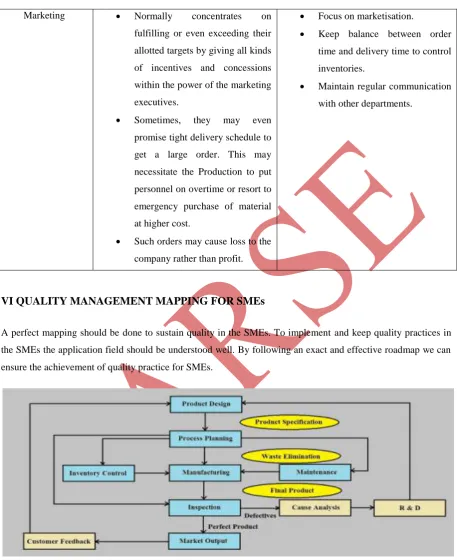
A perfect mapping should be done to sustain quality in the SMEs. To implement and keep quality practices in
the SMEs the application field should be understood well. By following an exact and effective roadmap we can
ensure the achievement of quality practice for SMEs.
In general, the production systems for SMEs are a simple straight line method to be followed and some
traditional steps are taken sometimes to detect defects at the end of the process. But in fact these methods are
insufficient to produce quality products and services. Fig. 1 describes a diagram, which can be treated as a
mapping plan for Indian SMEs to sustain quality. In a production system, design, process planning,
manufacturing and inspection are the most significant steps to be considered to control quality of the entire
system. We divided the entire system in three major operational parts in our diagram, i.e. product specification,
167 |
P a g e
www.ijarse.com
waste elimination and final product output. Planning and application of different quality tools should be done in
these particular areas of a production system to achieve better quality control and optimum output.
VII CONCLUSIONS
To stimulate processes of qualitative growth in SMEs, this study investigated the application and effectiveness
of basic and advanced quality management tools in Indian firms. The results highlighted that most managers still
are experiencing low levels of quality management implementation and they do not recognize the need to
compete in the pursuit of modern technologies. This could be due to major problems to SMEs such as
knowledge deficiency, human and financial resource limitation, product design and development capability,
training infrastructure and networking. There is a growing need for advanced and codified quality managerial
practices. SMEs in India are expected to transcend from their present state through training and skill
development, in order to undertake a more important role in supporting the requirements of India's
industrialization process.
REFERENCES
Journal Papers
[1]. McAdam R. & Kelly M. 2002, “A business excellence approach to generic benchmarking in SMEs”,
Benchmarking: An International Journal, vol. 9, no.1, pp. 7-27.
[2]. McAdam, R., Stevenson, P. & Armstrong, G. 2000, “Innovative change management in SMEs: beyond
continuous improvement”, Logistic Information Management, vol. 13, no. 3, pp. 138-149.
[3]. Singh, R.K., Garg, S.K. & Deshmukh, S.G. 2008, “Strategy development by SMEs for
competitiveness: a review”, Benchmarking; An International Journal, vol. 15, no. 5, pp. 525-547.
[4]. Singh, R.K., Garg, S.K. & Deshmukh, S.G. 2010, “The competitiveness of SMEs in a globalized
economy Observations from China and India”, Management Research Review, vol. 33, no.1, pp. 54-65.
[5]. Sohail, M.S. & Boon Hoong, T. 2003, “TQM practices and organizational performances of SMEs in
Malaysia”, Benchmarking: An International Journal, vol. 10, no.1, pp. 37-53.
[6]. Akhavan, P. & Jafari, M. 2008, “Towards learning in SMEs: an empirical study in Iran”, Development and Learning in Organizations, vol. 22, no. 1, pp. 17-19.
[7]. Fathian, M., Akhavan, P. & Hoorali, M. 2008, “E-readiness assessment of non-profit ICT SMEs in a
developing country: The case of Iran”, Technovation, vol. 28, no. 9, pp. 578-590.
[8]. Gadenne, D. & Sharma, B. 2009, “An investigation of the hard and soft quality management factors of
Australian SMEs and their association with firm performance”, International Journal of Quality &
Reliability Management, vol. 26, no. 9, pp. 865-880.
168 |
P a g e
www.ijarse.com
[10]. Mirbargkar, S.M. 2009, “Global Competitiveness: Iranian SME”, SCMS Journal of Indian
Management, October - December, 2009.
[11]. Abdullah, A. 2010, “Measuring TQM implementation: a case study of Malaysian SMEs”,
MEASURING BUSINESS EXCELLENCE, vol. 14, no. 3, pp. 3-15.
[12]. Fawcett, S.E., Allred, c., Magnan, G.M. & Ogden, J. 2009, "Benchmarking the viability of SCM for
entrepreneurial business model design", Benchmarking: An International Journal, vol. 16, no. 1, pp. 5-29.
[13]. Fotopoulos, C. & Psomas, E. 2009, “The use of quality management tools and techniques in ISO
9001:2000 certified companies: the Greek case”, International Journal of Productivity and
Performance Management, vol. 58, no. 6. Pp. 564-580.
[14]. Grando, A. & Belvedere, V. 2006, “District‟s manufacturing performances: A comparison among
large, small-to-medium-sized and district enterprises”, International Journal of Production Economics, vol. 104, pp. 85-99.
[15]. Jafari, M., Fathian, M., Akhavan, P. & Hosnavi, R. 2007, “Exploring KM features and learning in
Iranian SMEs”, VINE: The journal of information and knowledge management systems, vol. 37, no.
2, pp. 207-218.
[16]. Khan, Z., Bali, R.K. & Wickramasinghe, N. 2007, “Developing a BPI framework and PAM for
SMEs”, Industrial Management & Data System, vol. 107, no. 3, pp. 345-360.
[17]. Okpara J.O. 2009, “Strategic choices, export orientation and export performance of SMEs in
Nigeria”, Management Decision, vol. 47, no. 8, pp. 1281-1299.
Books
[18]. Garengo, P., biazzo, S., Simonetti, A. & Bernardi, G. 2005, “Benchmarking on managerial
practices: a tool for SMEs”, The TQM Magazine, vol. 17, no. 5, pp.440-455.
[19]. Sharma, M. & Kodali, R. 2008. “TQM implementation elements for manufacturing excellence”,
The TQM Magazine, vol. 20, no. 6, pp. 599-621.
Theses
[20]. Ghanatabadi, F. 2005, “Internationalization of small and medium-sized enterprises in Iran”, Luleå
University of Technology, Department of Business Administration and Social Sciences, Division
of Industrial Marketing and e-Commerce an unpublished PhD Thesis.
Proceeding Paper
[21]. Jain, A. 2007, “Significance of SMEs in emerging markets”, uploaded November 17, available at: