Upgraded LHC experiments as a check of non-perturbative
ef-fects of the Electro-Weak Interaction
Boris A. Arbuzov1,and Ivan V. Zaitsev1,
1M.V. Lomonosov Moscow State University
Abstract.Recently reported diphoton excesse at LHC is interpreted to be connected with heavyWWzero spin resonances. The resonances appears due to the wouldbe anomalous triple interaction of the weak bosons, which is defined by coupling constant λ. The γγ750GeV anomaly is considered to correspond to weak isotopic spin 0 pseudoscalar state. We obtain estimates for the effect, which qualitatively agree with ATLAS data. Effects are predicted in a production ofW+W−,(Z, γ)(Z, γ) via resonanceXPSwithMPS
750GeV, which could be reliably checked at the upgraded LHC at √s = 13T eV. In coupling constant of the triple anomalous interaction is estimated to beλ =−0.010± 0.005 in an agreement with existing restrictions. Specific predictions of the hypothesis are significant effects in decay channelsXPS→γl+l−,XPS →l+l−l+l−(l=e, μ).
1 Introduction
In experiments [1] indications for excesses in the production of boson pairs WW, WZ, ZZ were observed at invariant massMR 2T eV. Data for these processes are also present in works [2, 3]. Despite the fact that the wouldbe effect is not finally established yet, the publication causes numerous proposals for an interpretation mostly in terms of theories beyond the Standard Model (see,e.g.[4]).
In work [5] we have considered interpretation of the effect in terms of a weak isotopic spin 2 scalar
W Wstate. Indeed, pair of tripletsWacould form a resonance state, the so-calledW-ball. Of course the well known gauge interaction of these bosons with couplingg(MW)=0.65 can not bind them in the resonance state with mass being of aT eVscale. However, there might exist also an additional effective interaction,e.g.the anomalous triple boson interaction [7, 8], which increases with increasing energy scale. In case the interaction becomes sufficiently strong at aT eVscale, it might lead to a formation of a resonance under discussion. Note, that the most recent data at √s=13T eV[6] do not contradict estimates of [5].
There are recent data onγ γanomaly atM(γ γ)750GeV[11, 12], which also caused numerous proposals for an interpretation [13]. Could this anomaly also be prescribed to analogous states? We would consider this problem in the present talk.
2 A model for the
WW
resonance
Now let us consider a possibility of a heavy resonance in case of an existence of the anomalous three-boson interaction, which in conventional notations [7, 8] looks like
−G
3!FabcW a
μνWνρb Wρμc ; G = − g λ
M2
W
(1)
Wμνa = ∂μWνa−∂νWμa +g abcWμbWνc;
whereg0.65 is the electro-weak coupling. The best limitations for parameterλread [14]
λγ=−0.022±0.019 ; λZ=−0.09±0.06 ; (2)
where a subscript denote a neutral boson being involved in the experimental definition ofλ. Let us emphasize thatF ≡ F(pi) in definition (1) denotes a form-factor, which is either postulated as in original works [7, 8] or it is just uniquely defined as in works on a spontaneous generation of effective interaction (1) [9, 10]. In any case the form-factor guarantees the effective interaction to act in a limited region of the momentum space. That is it vanishes for momenta exceeding scaleΛ. FormfactorFis explicitly presentede.g.in work [5]. Calculations were done in the framework of an approximate scheme, which accuracy was estimated to be(10−15)% [15]. Would-be existence of effective interaction (1) leads to important non-perturbative effects in the electro-weak interaction.
In particular, one might expect resonances to appear in the system of twoWa-bosons. A possibility of an appearance of such states (W-balls) was already discussed,e.g.in works [10, 16]. In the previous work [5] we studied the 2000GeVanomaly and appeared to the conclusion, that data can be described in terms of weak isospin 2 scalar resonance. The effect is due to anomalous interaction (1) and we come to a conclusion [5], that there is a possibility to describe data [1] with
λ = −0.015±0.005. (3)
There are recent indications for existence of the other effect: theγγ enhancement at invariant massMγγ750GeV. Let us consider this effect being explained by existence of zero weak isotopic spin pseudoscalar stateXPS, which interaction with electroweak bosons is described by the following expression
Le f f = GPS
4 δab μνρσWa
μνWρσb XPS; (4)
Let us consider a Bethe-Salpeter equation for a pseudoscalar resonance consisting of twoW. We consider such state corresponding to value of the weak isospin:I =0. With interaction (1) we have the following Bethe-Salpeter equation for stateXPS in correspondence to diagrams presented in Fig 1 under assumption of existence of interaction (4).
ΨPS =GPS+ G2
8π2
1
6x
x
0
ΨPS(y)y2dy− 1 2
x
0
ΨPS(y)ydy−
x
2
∞
x
ΨPS(y)dy+ x2
6
∞
x
ΨPS(y) y dy
; (5)
where coupling constantGPS is defined by (4). Here in view of large valueMX 0.75T eV of the wouldbe resonance we neglectWmass.
z= G 2x2
128π2; t= G2y2
Figure 1.Diagram form of equation (5). Simple lines representW-s, a double line corresponds to the resonance, black circles correspond to interaction (1), squares correspond to BS wave function. The triangle corresponds to vertex (4).
Figure 2. Diagram representation of normalization condition for couplingGPS. Simple lines representW-s, a
double line corresponds to the resonance, squares correspond to BS wave function.
we come to the following equation
ΨPS(z)=GPS+ 4 3√z
z
0 ΨR(t)
√
tdt−4
z
0
ΨPS(t)dt−
4√z
∞
z
ΨPS(t) √
t dt+
4z
3
∞
z
ΨPS(t)
t dt. (7)
Equation (7) satisfies condition
ΨPS(0) =GPS. (8)
By successive differentiations of equation (7) we obtain a Meijer differential equation for function
ΨPS(z)
zd dz+
1 2
zd dz
zd dz−
1 2
zd dz−1
+z
ΨPS(z) = 0. (9)
Then the solution, which fulfill boundary condition both at zero and at the infinity (seee.g.[18]) is the following
ΨPS(z) = GPS
2 G
30 04
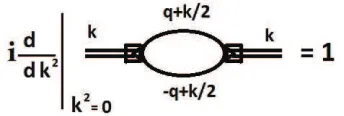
The normalization condition for Bethe-Salpeter wave function (10) give according to diagram Fig. 2 with account of definition (6) the following relation
9 64π2
∞
0
dyΨPS(y)2 =
9√2G2
PS
16πG I = 1; (11)
I =
∞
0 G30
04
t|0,1/2,1,−1/2
2
2√t dt =
π 8.
With valuesI(11),g=0.65 and with account of (1) we obtain couplingGPS
GPS = 8 3MW
g|λ|√2 = 0.00318 1
GeV; (12)
where numerical value corresponds to λ = λ0 = −0.01, that is safely inside restrictions (2) and
estimates (3).Value (12) corresponds to scaleΛ 0. We take value (12) for estimates of effects, bearing in mind, that for other values of scaleΛcouplingGPS is defined by solution (10), namely
GPS(Λ)= GPS
2 G
30 04
zΛ|0,1/2,1,−1/2; zΛ= G
2Λ4
128π2. (13)
We evaluate the pseudoscalar resonance decay probabilities withΛD = MPS = 750GeV. For es-timations of cross sections we takeΛin correspondence to maxima of structure functions. That is
Λ(√s) √s/7. Then for the decay and for two values √s=8T eV and √s=13T eVwe have the following values for effective couplingGPS
GPS(ΛD)=GPS(0.75T eV)=0.00303; (14) GPS(8T eV/7)=0.00285; GPS(13T eV/7)=0.00242.
Thus we have interaction (4) with parametersGPS(12,14) andMPS =750GeV. We use well-known relation
W0=cosθWZ + sinθWA; (15)
and obtain for partial decay widths of the pseudoscalarXPS
Γ(W+W−) = 31.06GeV(43.5%); Γ(Z Z) = 9.01GeV(12.6%);
Γ(Zγ) = 4.72GeV(6.6%); Γ(γ γ) = 0.91GeV(1.2%); (16)
Γ(W+W−Z) = 21.34GeV 29.9%); Γ(W+W−γ) = 4.45GeV(6.2%) (17)
Γt(XPS) = 71.49GeV.
We would present also probabilities for the following specific channels, wherelmeans light lepton (μ,e)
Γ(l+l−γ)=0.404GeV(0.64%); Γ(l+l−l+l−)=0.0411GeV(0.065%). (18)
Then we calculate cross sections forXPS production in p pcollisions for √
s=8T eVand for √s=
13T eV. In doing this we use CompHEP package [19].
Thus we consider possible pseudoscalar neutral resonance with mass≈ 750T eV, which decay into
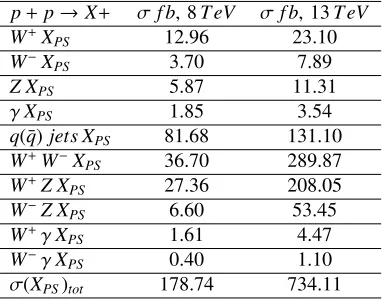
Table 1.Results for cross-sections ofXPS production inp+pcollisions at
√
s=8T eVand √s=13T eVwith λ=−0.01 (GPS =0.00318GeV−1).
p+p→X+ σf b,8T eV σf b,13T eV
W+XPS 12.96 23.10
W−XPS 3.70 7.89
Z XPS 5.87 11.31
γXPS 1.85 3.54
q( ¯q)jets XPS 81.68 131.10 W+W−XPS 36.70 289.87 W+Z XPS 27.36 208.05
W−Z XPS 6.60 53.45
W+γXPS 1.61 4.47
W−γXPS 0.40 1.10
σ(XPS)tot 178.74 734.11
According to Table 1 the cross-section of the resonance production at √s=8T eVis four times less than at √s =13T eV. Available √s =8T eV data [20–22] do not contradict to our estimates with account of branching ratios (16). Namely, for √s=8T eVwe have
σ(p p→XPS)·BR(XPS →γ γ)=178.8·0.012 = 2.15f b; (20)
that do not contradict the most recent limitations [23]. Limitations forW WandZ Zdecay modes [24, 25] also do not contradict the present results. For example, CMS data [22] give for 750GeVresonance with width100GeVlimitationσBR(XPS →γγ)<40f bwith prediction 5.2f bfrom Table 1. Let us note, that our result for effect in channelXPS → ZZ gives forl+l−(l =e, μ) decays ofZ-bosons with integral luminosityL=5.3 f b−1[20] the following estimate for an event number
σ(XPS,8T eV)·BR(XPS →l+l−l+l−)·L=
178.74·0.00065·5.3=0.62. (21)
It is worth mentioning, that in experimental results at √s = 8T eV [20] there is one event just at
M(l+l−l+l−)=750GeVand no other events for M(l+l−l+l−)>600GeV. Of course this coincidence proves nothing due to the poor statistics, we may only state, that results [20] do not contradict our estimates.
Now what for √s = 13T eV? First of all let us estimate an effect in channelγ γ. We have for possible number of events with (16) and data from Table 1
Nγγ = σ(p p→XPS)·BR(XPS →γ γ)·L=8.81·L(f b−1). (22)
Thus we have forL3 f b−1few tens events, that agrees observations [11, 12].
It may be advisable to study effect not only in channel XPS → γ γ but also in channelXPS → γl+l−. According to (16) we have
BR(XPS →γl+l−) BR(XPS →γ γ)
= 0.445
that is actually only two times smaller than already observed effect in 2γ.
Let us also calculate the effect forl+l−l+l−at √s=13GeVin the resonance region750GeV
N(l+l−l+l−) = σ(XPS,13T eV)·BR(XPS →l+l−l+l−)=0.48L(f b−1). (24)
So forL ∼20f b−1the effect in four leptons channel may become noticeable. The more so as for
this channel background conditions are favorable [20]. Effects XPS → γl+l−; XPS → l+l−l+l− with intensities (23,24) would confirm definitely the interpretation of the 750GeVstate being W-ball. Note, that existing limitations on a possible extra contribution of decayXPS → γZ with invisible decayZ→νν¯ [26] do not contradict our estimates.
There is one more suspicious point in data by ATLAS [27], where process
p+p→ jets+Z(→l+l−)+missingET; (25)
was studied at √s = 8T eV. SM calculations for the number of events for integrated luminosity
L=20.3f b−1giveN=9.8±2.9±1.4. Experiment [27] givesN=29 events.
However with our premises we have for processp+p → XPS +everythingwith decayXPS → Z(→l+l−)+Z(→νν¯ ) also missingET due to the invisibleZ-decay. Thus we have for the additional contribution
ΔN=σ(pp→XPS)·L·BR(XPS →ZZ)·2·BR(Z→l+l−)BR(Z→νν¯ )=12.3; (26)
for results in tables. Contribution (26) corresponds to the discrepancy within error bars. In any case the data do not contradict theW-ball interpretation ofX(750).
Let us remind, that all the estimates were made withλ=−0.01. Calculations for another value of λare straightforward with the prescriptions presented above.
3 Conclusion
Existence of W-balls would testify for anomalous gauge interaction (1), which would be due to non-perturbative effects in the electroweak interaction. Thus we could come to important conclusion, that non-perturbative contributions are appropriate not only to QCD, but to the electroweak interaction as well. In this case the anomalies in the electroweak boson pair production do not contradict the Standard Model and do not need extra efforts for a choice of a theory beyond the SM.
Data on effects under discussion might give information on a value of parameterλ. According to our considerations it could be expected in rangeλ=−0.010±0.005. Of course experiments on direct measurement ofλ,e.g.in processes ofW+W−,W±Z(γ) production are also quite desirable.
Acknowledgments
The work is supported in part by grant NSh-7989.2016.2 of the President of Russian Federation.
References
[5] B. A. Arbuzov and I. V. Zaitsev, Int. J. Mod. Phys. A30(2015) Article 1550221. [6] G. Aadet.al.(ATLAS Collaboration), arXiv: 1606.04833 [hep-ex] (2016).
[7] K. Hagiwara, R.D. Peccei, D. Zeppenfeld and K. Hikasa, Nucl. Phys. B282, 253 (1987). [8] K. Hagiwara, S. Ishihara, R. Szalapski and D. Zeppenfeld, Phys. Rev. D48, 2182 (1993). [9] B. A. Arbuzov, Eur. Phys. J. C61, 51 (2009).
[10] B. A. Arbuzov and I. V. Zaitsev, Phys. Rev. D85(2012) Article 093001. [11] G. Aadet.al.(ATLAS Collaboration), arXiv: 1606.03833 [hep-ex] (2016). [12] V. Khachatryanet al.(CMS Collaboration), arXiv: 1606.04093 [hep-ex] (2016). [13] J. Elliset al., arXiv: 1512.05327 [hep-ph].
[14] K. A. Oliveet al.(Particle Data Group), Review of particle physics, Chin. Phys. C 38(2014) Article 090001.
[15] B. A. Arbuzov, Theor. Math. Phys.140, 1205 (2004).
[16] B. A. Arbuzov and I. V. Zaitsev, Int. J. Mod. Phys. A27(2012) Article 1250012.
[17] H. Bateman and A. Erdélyi,Higher Transcendental Functions V.1, McGraw-Hill, New-York, Toronto, London, 1953.
[18] B. A. Arbuzov, Non-perturbative Effective Interactions in the Standard Model, De Gruyter, Berlin, 2014.