Long-range rapidity correlations between mean transverse
momenta in the model with string fusion
VladimirVechernin1,
1Saint Petersburg State University
Abstract. The long-range correlation between mean-event transverse momenta, being robust against the volume fluctuations and the details of the centrality determination, enables to obtain the signatures of string fusion at the initial stage of hadronic interaction in relativistic heavy ion collisions. The dependence of the correlation strength between mean-event transverse momenta on the collision centrality and initial energy is analyzed in a simple model with quark-gluon string fusion on the transverse lattice. It is shown that above RHIC energy the dependence reveals the decline of the correlation coefficient for most central collisions, reflecting the attenuation of color field fluctuations due to the string fusion at large string density. It is also found that contrary to the correlation between transverse momenta of single particles the strength of the correlation between mean-event transverse momenta of particles in two separated rapidity intervals is not decreasing with the total number of produced strings, remaining significant even in the case of Pb-Pb collisions, in which the total number of strings can reach several thousand.
1 Introduction
The study of the correlations between observables in two separated rapidity windows (the so called long-range forward-backward correlations) has been proposed [1] as a signature of the string fusion and percolation phenomenon [2–5], which is one of the collectivity effects in ultrarelativistic heavy ion collisions. Later it was realized [6–11] that the investigations of the forward-backward correlations between intensive observables, such e.g. as mean-event transverse momenta, enable to obtain more clear signal about the initial stage of hadronic interaction, including the process of string fusion, compared to usual forward-backward multiplicity correlations.
In the present work, as an example, we consider the correlation between mean-event transverse momenta of charged particles in separated rapidity intervals [8, 10, 11]:
ptF= 1 nF
nF
i=1
|pitF| ptB= 1 nB
nB
i=1
|pitB| (1)
The calculations are fulfilled in a simple model with string fusion by introducing a lattice in transverse plane [7, 12]. Previously, in the framework of the model we found the analytical asymptotics of the correlation coefficient,bptpt, between mean transverse momenta in separated rapidity intervals at large
string density and fulfilled, using MC simulations, the calculation of the correlation coefficient as a function of string density [10, 11]. In present paper we discuss the impact of the obtained results on thebptptcorrelation coefficient centrality dependence at RHIC and LHC energies.
2 Forward-Backward Rapidity Correlations
Usually the forward-backward (FB) rapidity correlation are studied as the correlation between two observables,FandB, measured event-by-event in some rapidity intervals,δηFandδηB, separated by some rapidity gap,ηgap. Numerically it can be described by the correlation function:
BF = f(F), (2)
giving the dependence of the mean value of the variableBon the variableF. Usually this dependence is approximated by a linear function
BF =a+bFBF, (3)
the so-called linear regression. In this case the strength of the correlation can be characterized by one number - the correlation coefficientbFB, for which one can find the following expression:
bFB= FB − FB F2 − F2 =
cov(F,B) DF
, (4)
To reduce the influence of different widths of the rapidity windows,δηFandδηB, on the correlation coefficient the analysis sometimes performs using the relative variables,F/FandB/B. Clear that the correlation coefficient in this variables,brel
FB, is simply connected with thebFB:brelFB=bFBF/B. In our analysis we will use only symmetric observation windows,δηF =δηB, in this casebrelFB=bFB for a symmetric collision. Nevertheless note, that this does not eliminates the dependence of the correlation coefficient on the rapidity width of observation window (see e.g. [13]) what is important when one compares the results of different experiments.
Due to the locality of strong interaction in rapidity the FB correlation naturally divides into two parts: the short- and the long-range ones. The Short-Range Correlation (SRC) takes place only be-tween particles produced from a same source (string). It goes to zero for large enough rapidity gaps,
ηgap 2. The origin of the Long-Range Correlations (LRC) at largeηgapis event-by-event variance in the number and properties of particle sources (cut pomerons [14], strings [13] and so on), formed in high energy hadronic interaction. In present paper we will consider only these LRC, as we are interested in the study of changing of source properties (the string properties due to their fusion).
Traditionally in the FB correlation analysis the multiplicities of charged particles with rapidities belonging to these FB windows were used as the observables,F = nF andB = nB. Unfortunately then-n LRC is dominated mainly by the fluctuation in the number of initial sources (strings) - the so-called “volume” fluctuation, originating, for example, due to the fluctuation of the collision impact parameter. The influence of the other interesting effects, connected with fluctuation of source proper-ties (e.g. due to possible string fusion processes), on this type of correlation is rather small [15]. The reason is the extensive nature of these observables.
3 The model
The discrete version of string fusion model [4, 5] with a lattice in transverse plane was introduced in [12] and then was successfully exploited for a description of various phenomena in ultra relativistic nuclear collisions [7–11, 16–18]. In this approach one splits the impact parameter plane intoMcells with the area equal to the transverse area of single string,σstr, and supposes the fusion of all strings with the centers in a given cell. Then each string configuration is characterized by the set of integers:
Cη={η1, ..., ηM} , (5)
whereηiis a number of initial strings fused in a giveni-th cell . This leads to the splitting of the transverse area into domains with different, fluctuating values of color field within them. What is similar to the attempts to take into account the density variation in transverse plane in models based on the BFKL evolution [19] and on the CGC approach [20].
In present calculations we supposed that the ηi in each cell fluctuates around the same mean valueηwith a scaled varianceωη. Then in accordance with the string fusion prescription [4, 5] the
mean number of charged particles in forward and backward observation windows, produced from the fragmentation of fused strings in thei-th cell, is given by the expression
niF =μF√ηi, (6)
and the same fornBi, whereμF is a mean number of particles produced from decay of a single string in the forward window. Because we study only LRC, we also suppose the independent fragmentation of thei-th fused string in forward and backward windows. So the corresponding numbers of charge particlesnF
i andnBi fluctuates independently event-by-event around the above mean values with some scaled varianceωμ.
Finally, in accordance with the string fusion ideas [4, 5] we suppose that the transverse momentum distribution of particles, produced from theηifused strings, has enlarged mean transverse momentum:
p(ηi)=p0√4ηi, (7)
where p0 is a mean transverse momentum for particles produced from a decay of a single string.
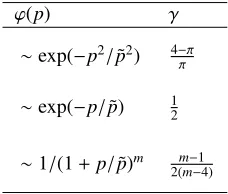
For popular transverse momentum distributionsϕ(p) with one dimensional parameter ˜p(see table 1), due to dimensional reasons, we have ˜p ∼ √4η
i. We have also the following connection between the variance and the mean transverse momentum for particles produced from a decay of the fused string in thei-th cell:
dpi(ηi)=γp 2
(ηi), (8)
where the dimensionless parameterγdepends only on the shape of the distribution (see table 1). So each event in the model is characterized by the following configuration
C=Cη,CnF,CBn,CFp,CBp
, (9)
where
CnF=
nF1, ...,nFM
, CB n =
nB1, ...,nBM
, (10)
CFp =
p1F
1 , ...,p
nF
1F 1 ;...;p
1F M, ...,p
nF MF
M
(11)
Table 1.The values of the dimensionless parameterγ, see formula (8), for the popular transverse momentum distributionsϕ(p), normalized asϕ(p)d2p=1 (m>4).
ϕ(p) γ
∼exp(−p2/p˜2) 4−π
π
∼exp(−p/p˜) 12
∼1/(1+p/p˜)m m−1 2(m−4)
transverse momenta. Then, for the physical observables, defined in Sect. 1, we have
ptF= 1 nF
M
i=1
nF i
j=1
pijF, nF = M
i=1
nFi (12)
and the same for theptBandnB. To calculate the correlation function (2) and the correlation coefficient (4) we have to average over these configurations with a proper weights (see [11, 21] for details).
4 The asymptotic of the correlation coefficient
In the framework of the model one can find the explicit analytical asymptotic of the LR correlation coefficient between mean-event transverse momenta [11] at large uniform mean string densityη/σstr withη1:
bptpt =
ωημF
ωημF+16γ
η . (13)
The dimensionless parameterηcharacterizes the mean degree of overlap of strings. In the derivation of the asymptotic the existence of two small parameters: 1/M and 1/ηin the model was used. One can estimate the typical value ofM, as ratio of the total transverse interaction areaS to the area of a single stringσstr =πr2str:
M∼S/σstr∼R2A/r2str.
For Pb-Pb collisionsRA =7÷8 fm,rstr =0.2÷0.3 fm, so in this case we haveM ∼103. The value ofη ∼10 at LHC andη∼3 at RHIC energies [10, 22] (as we’ll see below the asymptotic (13) is a good approximation only atη7÷8).
The most interesting feature of the asymptotic is the decrease of the correlation coefficientbptpt
with growth of the string density. The physical reason of such behavior is the attenuation of color field fluctuations due to the string fusion processes at large string density.
Another important property of the asymptotic is theM-scaling. The expression (13) for thebptpt
depends only on the string densityηand does not depend on the total number of cells,M, and hence on the total number of strings. Note that this nontrivial property takes place only for the correlation betweenmeanevent transverse momenta, defined above, (1), in contrast with the behavior of thept-pt correlation coefficient,βptpt, between transverse momenta of two single particles, defined as
βptpt ≡ I2(pt1,pt2) I(pt1)I(pt2)−
whereI(pt1) andI2(pt1,pt2) are single and double inclusive cross sections. In [7] it was shown that
this correlation coefficient decreases with the total number of sources (strings), and hence withM:
βptpt ∼1/Nsources∼1/M
So, its value becomes very small, e.g. for Pb-Pb interactions at LHC energy, in which the number the strings is of order of few thousand [10, 22]. The reason of the difference between these two types ofpt -ptcorrelation, characterized bybptpt andβptpt, is that the meanptFandptB, being intensive variables,
stronger correlates with the value of string tension and better reflects the specific event transverse energy in observation rapidity windowsδηFandδηB, than the transverse momenta of single particles. We see also that the asymptotic (13) depends only on the one combination of all model param-eters, ωημF
γ√η, what we’ll refer on as ωημF
γ√η - scaling. Note also, that in contrast with the correlations
between multiplicitiesnF andnB and between mean transverse momentum ptBand multiplicitynF, considered in [12], there is no dependence of thebptpt asymptotic on the parameterωμ. Recall thatωμ
characterizes the fluctuations in the number of particles produced from a string.
Instead of theωμwe have the dependence of thebptpt asymptotic on the dimensionless parameter γ, which characterizes the transverse momentum distribution from one initial string (see table 1). Since for a distribution with one dimensional parameter it does not depends on a string fusion, then in this condition it can be evaluated from data, asγ = p2
t/pt2 −1, where the...means averaging over tracks from all events.
5 Results of the MC simulations
Figure 1.Thebptptcorrelation coefficient (points), obtained by MC simulations in the model with string fusion
on a transverse lattice withM=45 cells forμF =1 () andμF =2 (), as a function of mean string densityη.
The filled points are calculated in the version with preliminary averaging of string density within lattice clusters (see [10, 23] for details). The curves - corresponding asymptotics calculated by the formula (13) at the parameter values:ωη=ωμ=1 andγ=0.6. The dotted lines illustrate theμF/√η-scaling for asymptotics (see text).
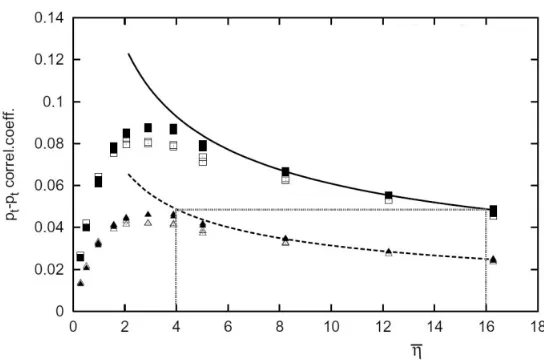
Figure 2.The same as in figure 1, but for a lattice withM=450 cells. The arrows show the string densities, R and L, available correspondingly at RHIC and LHC [10, 22].
distribution of mean string density [10]. We restrict to the uniform string distribution over lattice with the mean densityηand the poissonian fluctuations around this value (ωη=1) in each cell. The results
for thebptpt correlation coefficient calculated on the base the MC simulation forμF =1 andμF =2
in the casesM =45 andM =450 are presented in figures 1 and 2 together with the corresponding asymptotics calculated by the formula (13).
First of all we see in these figures that the asymptotics well approximate the correlation coefficient bptpt at values ofηgreater than 7÷8. Comparing figures 1 and 2 we see also a good fulfillment of
theM-scaling at any value of string densityη, and not only in the asymptotic region. (More thorough analysis [12] shows that theM-scaling is broken only in narrow regionη 1/M, when the total number of strings is small,N =Mη∼1, so that the condition of formation at least one string in any inelastic collision starts to influence the results.)
In contrast to theM-scaling theμF/√η-scaling is valid only in the asymptotic regionη1. One can see this from the dotted lines in figure 1. The lines illustrate that in this region the increase of the
μFfrom 1 to 2 can be compensated by fourfold increase of theη.
6 Energy and centrality dependencies
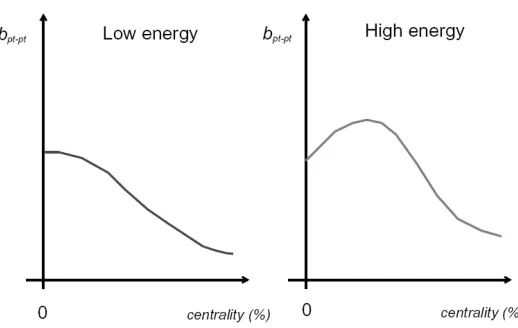
The general behavior of the pt-pt correlation coefficient, bptpt, as a function of heavy ion collision
centrality for RHIC and LHC energies is presented in figure 3. Qualitatively, it can be understood based on the dependency, shown in figure 2, as follows.
Figure 3.The general form of the dependence ofbptpt on the collision centrality at RHIC (left panel) and LHC
(right panel), following from the existence of thebptptmaximum atη=3÷4 in figures 1 and 2 (see text).
At LHC energies, depending on the centrality, the string densityηvaries in the interval (0, L). In figure 2 we see that in this case the pt-ptcorrelation coefficient,bptpt, reaches the highest value
at some intermediate value of centrality, which corresponds to the string densityη 3. The further increase ofηwith centrality from 3 to L leads to the decrease of the correlation coefficient, in contrast with the situation at RHIC energies. So at LHC energies thept-ptcorrelation coefficient reaches the highest value in semicentral collisions at some intermediate value of centrality, see the right panel in figure 3,
This decrease of the correlation coefficient for the most central collisions at LHC energies corre-sponds to the decrease of the asymptotic (13) with the growth ofη, discussed in Sect. 4. It is clear from the figure 2 that the RHIC data, corresponding to theηregion (0, R), can not be described by the asymptotic formula (13), which starts to work atη 7÷8. This asymptotic, decreasing with string density, behavior is reached only for central heavy ion collisions at LHC energies. The model calculations show that the physical reason of this decrease is the attenuation of color field fluctuations due to the string fusion at large string density.
So the results show that the non-monotonic behaviour ofbptpt with centrality is achieved in heavy
ion collisions at LHC, while at RHIC the string density is not enough to provide a decline of the cor-relation coefficient for most central collisions (see figure 3). This qualitative conclusion is confirmed by the results [24], obtained in more realistic dipole-based Monte Carlo string fusion model [25, 26].
7 Summary and conclusions
The pt-ptcorrelations between mean-event transverse momenta are studied in a simple model with quark-gluon string fusion on the transverse lattice. The dependence of the correlation coefficient, bptpt, characterizing the correlation strength, on the collision centrality is analyzed for different initial
string fusion at large string density, while at RHIC energy the string density is not yet enough to provide a decline of the correlation coefficient for most central collisions.
It is also found that contrary to the correlation between transverse momenta of single particles the strength of the correlation between mean-event transverse momenta of particles in two separated rapidity intervals is not decreasing with the total number of produced strings, remaining significant even in the case of Pb-Pb collisions, in which the total number of strings can reach several thousand.
So the long-range correlation between mean-event transverse momenta, being robust against the volume fluctuations and the details of the centrality determination, enables to obtain the signatures of string fusion at the initial stage of hadronic interaction in relativistic heavy ion collisions at LHC energy.
Acknowledgements
The work was supported by the Saint-Petersburg State University grant 11.38.242.2015 and by the RFBR grant 15-02-02097-a.
References
[1] N.S. Amelin et al., Phys. Rev. Lett.73, 2813 (1994)
[2] T.S. Biro, H.B. Nielsen, J. Knoll, Nucl. Phys. B245, 449 (1984) [3] A. Bialas, W. Czyz, Nucl. Phys. B267, 242 (1986)
[4] M.A. Braun, C. Pajares, Phys. Lett. B287, 154 (1992) [5] M.A. Braun, C. Pajares, Nucl. Phys. B390, 542 (1993) [6] M.A. Braun, C. Pajares, Phys. Rev. Lett.85, 4864 (2000)
[7] M.A. Braun, R.S. Kolevatov, C. Pajares, V.V. Vechernin, Eur. Phys. J. C32, 535 (2004). [8] ALICE collaboration et al., J. Phys. G32, 1295 (2006), [Sect. 6.5.15]
[9] V.V. Vechernin, R.S. Kolevatov, Phys. Atom. Nucl.70, 1797 (2007) [10] V.V. Vechernin, R.S. Kolevatov, Phys. Atom. Nucl.70, 1809 (2007) [11] V.V. Vechernin, Theor. Math. Phys.,184, 1271 (2015)
[12] V.V. Vechernin, R.S. Kolevatov, Vestn. Peterb. Univ., Ser.4: Fiz. Khim., No.4, 11 (2004), arXiv: hep-ph/0305136
[13] V. Vechernin, Nucl. Phys. A939, 21 (2015)
[14] A. Capella, A. Krzywicki, Phys. Rev. D18, 4120 (1978) [15] M.A. Braun, C. Pajares, Eur. Phys. J. C16, 349 (2000) [16] M.A. Braun, C. Pajares, Eur. Phys. J. C71, 1558 (2011)
[17] M.A. Braun, C. Pajares, V.V. Vechernin, Nucl. Phys. A906, 14 (2013) [18] M.A. Braun, C. Pajares, V.V. Vechernin, Eur. Phys. J. A51, 44 (2015) [19] E. Levin, A.H. Rezaeian, Phys.Rev. D84, 034031 (2011)
[20] A.Kovner., M. Lublinsky, Phys.Rev. D83, 034017 (2011) [21] V.V. Vechernin, Theor. Math. Phys. (2016) [in press] [22] J. Dias de Deuset al., Eur. Phys. J. C72, 2123 (2012)
[23] V. Vechernin, I. Lakomov, Proceedings of ScienceBaldin-ISHEPP-XXI, 072 (2012) [24] V. Kovalenko, V. Vechernin, EPJ Web of Conferences66, 04015 (2014)
[25] V.N. Kovalenko, Phys. Atom. Nucl.76, 1189 (2013)
![Figure 2. The same as in figure 1, but for a lattice with M = 450 cells. The arrows show the string densities, Rand L, available correspondingly at RHIC and LHC [10, 22].](https://thumb-us.123doks.com/thumbv2/123dok_us/8156366.1360514/6.482.109.376.81.256/figure-gure-lattice-arrows-string-densities-available-correspondingly.webp)