O R I G I N A L R E S E A R C H
Development And Early Feasibility Testing Of A
Mind-Body Physical Activity Program For Patients
With Heterogeneous Chronic Pain; The
GetActive Study
This article was published in the following Dove Press journal: Journal of Pain Research
Jonathan Greenberg1,2
Ann Lin1
Emily L Zale1
Ronald J Kulich 2,3
Peter James2,4
Rachel A Millstein 1,2
Hannah Shapiro 5
Michael E Schatman 6,7
Robert R Edwards2,8
Ana-Maria Vranceanu1,2
1Integrated Brain Health Clinical and
Research Program, Massachusetts General Hospital, Boston, MA, USA;
2Harvard Medical School, Boston, MA,
USA;3Center For Pain Medicine,
Massachusetts General Hospital, Boston, MA, USA;4Department of Population
Medicine, Harvard T. H. Chan School of Public Health, Boston, MA, USA;
5Department of Biology, Tufts University,
Medford, MA, USA;6Research and
Network Development, Boston Pain Care, Waltham, MA, USA;7Department
of Public Health and Community Medicine, Tufts University School of Medicine, Boston, MA, USA;8Pain
Management Center, Brigham and Women’s Hospital, Boston, MA, USA
Background: Increasing physical function is a challenging, yet imperative goal of pain management programs. Physical activity can improve physical function, but uptake is low due to chronic pain misconceptions, poor pain management skills, and doing too much too soon.
Purpose:To increase physical function by 1) adapting an evidence-based, group, mind-body program to address the needs of patients with heterogeneous chronic pain and to facilitate individually tailored quota-based pacing with a Fitbit (GetActive with Fitbit) or without it (GetActive) (phase 1), and 2) assessing preliminary feasibility benchmarks (phase 2).
Methods: We followed evidence based frameworks for developing interventions and for early feasibility testing. In phase 1 we conducted 4 focus groups with 22 patients with heterogeneous chronic pain and adapted the mind-body program. In phase 2 we conducted a nonrandomized pilot trial of the 2 programs (N=7 and 6) with qualitative exit interviews.
Results:Focus groups showed high interest in increasing activity, a preference for walking linked to pleasurable activities, using a Fitbit to track number of steps, and learning skills to manage pain and aid with increased activity. Both programs had good to excellent feasibility markers. Participation in both programs was associated with signal of improvements in
physical and emotional function, as well as intervention targets. Exit interviews confirmed
high satisfaction and suggested modification.
Conclusion: Results informed subsequent adaptations of the 2 programs and methodology for an ongoing pilot randomized controlled trial (RCT) of the 2 programs, necessary before
an efficacy RCT of the 2 programs against an education control.
Keywords: mind-body, chronic pain, fitbit, physical activity, focus groups, feasibility, physical function
Introduction
Chronic pain, defined as persistent pain that lasts more than 3–6 months,1 is
prevalent,2costly,2and associated with decreased physical and emotional function.3 Over the last decade, mind-body (e.g. meditation and mindful-movement based) programs have been increasingly popular among patients with chronic pain, and have been shown to lead to improvements in anxiety, depression, and acceptance of
symptoms.4However, effect sizes for improvements in self-reported emotional4–6
and physical functioning6–8have been small to moderate, and tended to dissipate
Correspondence: Ana-Maria Vranceanu Integrated Brain Health Clinical and Research Program, Department of Psychiatry, Massachusetts General Hospital/Harvard Medical School, One Bowdoin Square, 1stFloor, Suite 100,
Boston, MA, USA Tel +1 6177244977 Fax +1 617-643-8777
Email [email protected]
Journal of Pain Research
Dove
press
open access to scientific and medical research
Open Access Full Text Article
Journal of Pain Research downloaded from https://www.dovepress.com/ by 118.70.13.36 on 24-Aug-2020
over time.4–6,8 Existent mind-body interventions do not incorporate systematic gains in physical activity despite its positive effects on emotional and physical function. Thus, there is a need for novel interventions that incorpo-rate mind-body and physical activity skills in order to sustainably and substantially improve emotional and phy-sical function among patients with chronic pain. The importance of comprehensive assessment of physical
func-tion has recently been specifically emphasized. The
Recent Initiative on Methods, Measurement, and Pain
Assessment in Clinical Trials (IMMPACT)9 and
International Classification of Functioning, Disability and
Health (ICF)10 guidelines, as well as a recent review of
mind-body interventions for chronic pain11clearly specify
that physical function should be comprehensively assessed by combining self-report, performance-based (e.g., walk test), and objective (e.g., accelerometer) measures in order to better understand effects of interventions and also
improve overall efficacy and effect sizes. However, no
chronic pain clinical trials to date comply.11There is there-fore a need for comprehensive assessments of physical function among patients with chronic pain.
Physical activity is an important target for patients with chronic pain, who tend to be sedentary, deconditioned, and
thus at risk for further pain conditions and disability.12
Moreover, such sedentariness negatively impacts patients’
mood, motivation, emotional function, and mental health.13,14 Walking–the preferred physical activity modality in chronic pain patients15–is efficacious in improving self-reported func-tion, particularly when quota-based (i.e. when activity is depen-dent on a given quota rather than dependepen-dent on pain levels16–18), although uptake and adherence are problematic.12,19Activity monitoring devices such as Fitbit provide the user with feedback about their level activity and progress, and present an opportu-nity to actively reinforce the patient in incremental quota-based gains tailored to each patient’s ability, thereby facilitating phy-sical activity.20 Such devices are showing promising use in patients with chronic illness,21,22 including initial reports of effectiveness among patients with chronic pain.23,24Our guiding hypothesis is that the most effective and efficient way to sustain-ably increase emotional and physical function among chronic pain patients is by 1) gradual and quota contingent increases in activity (walking) paired with re-engagement in activities of daily living; 2) monitoring and reinforcing quota contingent activity goals (number of steps) with a digital activity monitoring device (Fitbit)), and 3) teaching mind-body skills to manage pain, and target barriers to engaging in physical activity.
The goal of this paper is to set the stage for a future
fully powered efficacy RCT to test our guiding hypothesis.
Here, we report on a 2-phased study informed by the National Institute of Health (NIH) stage model for
beha-vioral intervention development,25 National Institute of
Complementary and Integrative Health (NCCIH) model
for developing and testing mind-body intervention,26and
recent recommendations for early feasibility testing.27,28In phase 1, we conducted focus groups to with the aim of
informing adaptation of the 8-session mind-body
Relaxation Response Resiliency Program (3RP)29 and
developing the GetActive and GetActive with Fitbit pro-grams, including treatment manuals and study procedures.
The 3RP program was chosen specifically due to its
demonstrated efficacy30and its multimodal structure (e.g. including relaxation response, coping, CBT, and positive
psychology skills), which has significant benefits over
unimodal programs.31 In phase 2, we conducted a
non-randomized pilot trial with exit interviews of the GetActive and GetActive with Fitbit programs with the aim of exploring feasibility markers and within group improvements on physical function and other relevant
out-comes, to inform additional modifications before future
phases of the study - phase 3 (RCT of GetActive versus
GetActive with Fitbit) and phase 4 (efficacy RCT of
GetActive versus GetActive with Fitbit versus health edu-cation control).
Phase 1: Development Of The
GetActive And GetActive With
Fitbit Programs
Methods
First, our multidisciplinary team with expertise in chronic
pain, mind-body medicine, and physical activity modified
the 3RP manual29 to target the needs of patients with
chronic pain.32,33 The 3RP teaches relaxation response
(e.g., diaphragmatic breathing, mindfulness), stress aware-ness and coping (e.g., adaptive thinking, acceptance), and positive psychology (e.g., humor, optimism) skills. We
also proposed new pain specific skills including a
discus-sion on the rationale and practice of quota-based, non pain
contingent increases in activity using time goals
(GetActive) and step counts (GetActive with Fitbit). Further we added behavioral activation techniques (e.g. identifying and scheduling physical activities that are
achievable for the patient; targeting motivation34) and
paired increased activity with reengagement in activities
Journal of Pain Research downloaded from https://www.dovepress.com/ by 118.70.13.36 on 24-Aug-2020
of daily living (e.g. increasing step count via activities such as walking to the grocery store or commuting home). Next, we developed a semi-structured qualitative
interview script to gauge participants’ views on the
chal-lenges of living with chronic pain, perception of the
pro-posed modifications of the 3RP skills, perception of the
additional proposed skills targeting pain, physical activity, emotional and physical functioning, and barriers and facil-itators for Fitbit use and program participation.
Participants And Recruitment
Twenty-two adults with chronic pain participated in four focus groups (N=2-9 each). Participants were recruited between September 2017 and January 2018, primarily via the Pain Clinic at the Massachusetts General Hospital, through direct referrals from study staff, and throughflyers distributed through a hospital-wide email advertising clinical research. Interested participants were screened over the phone by a trained research assistant. Inclusion criteria
were: 1) age ≥ 18; 2) nonmalignant musculoskeletal pain
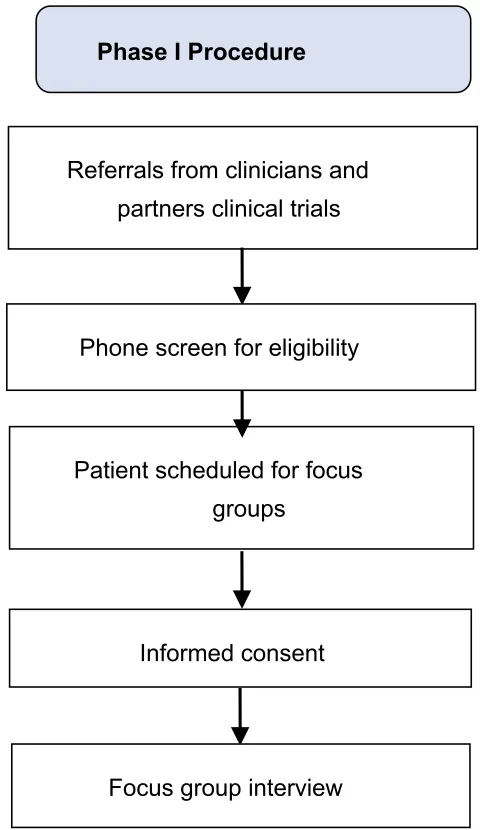
for more than 3 months; 3) able to perform a 6 min walk test;354) own a smartphone with Bluetooth 4.0 or computer; 5) on a stable dose of psychotropic or pain medication and willing to maintain a stable dose. Exclusion criteria were: 1) medical illness expected to worsen in the next 6 months; 2) serious psychiatric illness (untreated schizophrenia, active suicidality); 3) current substance use disorder; 4) practice of yoga/meditation once per week for 45 mins or more within the last 3 months; and 5) regular physical exercise for >30 min daily. The latter two exclusion criteria were chosen to ensure that participants interviewed would be similar to those who will participate in the intervention, thus eliminating confounds. All screenings were reviewed by a clinical psy-chologist. Of the 86 participants screened, 39 did not meet study criteria, 16 had scheduling difficulties, and 9 dropped prior to enrollment. All participants provided written informed consent prior to the focus groups. All study proce-dures were approved by the Institutional Review Board of Massachusetts General Hospital, and all procedures were in compliance with the Declaration of Helsinki. Study proce-dures are further detailed inFigure1.
Focus Groups
The interview focused on 4 major areas: 1) challenges of
living with chronic pain, 2) perception of modified 3RP
specific skills to address needs of patients with chronic
pain, 3) perception of additional skills targeting activity, emotional and physical functioning, and 4) barriers/
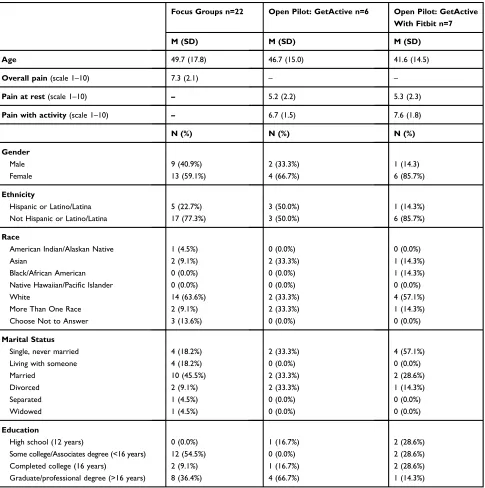
facilitators for Fitbit use and program participation. Interviews lasted 40–60 mins depending on the size of each group and were audio-recorded. Groups were led by clinical health psychologists with expertise in treating individuals with chronic pain. At the end of each group participants completed a demographic questionnaire (Table 1). Each par-ticipant was reimbursed $20 for participation.
Analysis Plan
We used guidelines for qualitative data analyses that focused on a framework approach with the goal of
mini-mizing bias.36,37 The framework approach is a method of
qualitative data analysis which involves the indexing of thematic content into categories, which are then used to compare and contrast the content and draw descriptive
Phase I Procedure
Referrals from clinicians and
partners clinical trials
Patient scheduled for focus
groups
Informed consent
Focus group interview
Phone screen for eligibility
Figure 1Phase 1 procedure.
Journal of Pain Research downloaded from https://www.dovepress.com/ by 118.70.13.36 on 24-Aug-2020
conclusions.38Study staff transcribed all recordings which were subsequently independently checked by an additional
staff member. Next, we identified themes and developed a
coding structure. Two additional staff members not involve in the development of the coding structure
inde-pendently coded the data using NVivo 11.39Whenever the
data did not fit an existing code, new ones were added.
Discrepancies were resolved through consensus between the coders and feedback from study staff with expertise in
qualitative methods. A kappa coefficient was calculated to
determine coding precision.
Results
The Kappa index for coding was high (0.76), indicating high consensus between raters. Coding yielded 4 major
themes (bolded) and 9 subthemes (italicized).Table 2
pro-vides further details about the themes and subsequent adaptations to the program manual.
Table 1Demographic And Clinical Patient Characteristics Of Participants In Focus Groups And Open Pilot Groups
Focus Groups n=22 Open Pilot: GetActive n=6 Open Pilot: GetActive
With Fitbit n=7
M (SD) M (SD) M (SD)
Age 49.7 (17.8) 46.7 (15.0) 41.6 (14.5)
Overall pain(scale 1–10) 7.3 (2.1) – –
Pain at rest(scale 1–10) – 5.2 (2.2) 5.3 (2.3)
Pain with activity(scale 1–10) – 6.7 (1.5) 7.6 (1.8)
N (%) N (%) N (%)
Gender
Male 9 (40.9%) 2 (33.3%) 1 (14.3)
Female 13 (59.1%) 4 (66.7%) 6 (85.7%)
Ethnicity
Hispanic or Latino/Latina 5 (22.7%) 3 (50.0%) 1 (14.3%)
Not Hispanic or Latino/Latina 17 (77.3%) 3 (50.0%) 6 (85.7%)
Race
American Indian/Alaskan Native 1 (4.5%) 0 (0.0%) 0 (0.0%)
Asian 2 (9.1%) 2 (33.3%) 1 (14.3%)
Black/African American 0 (0.0%) 0 (0.0%) 1 (14.3%)
Native Hawaiian/Pacific Islander 0 (0.0%) 0 (0.0%) 0 (0.0%)
White 14 (63.6%) 2 (33.3%) 4 (57.1%)
More Than One Race 2 (9.1%) 2 (33.3%) 1 (14.3%)
Choose Not to Answer 3 (13.6%) 0 (0.0%) 0 (0.0%)
Marital Status
Single, never married 4 (18.2%) 2 (33.3%) 4 (57.1%)
Living with someone 4 (18.2%) 0 (0.0%) 0 (0.0%)
Married 10 (45.5%) 2 (33.3%) 2 (28.6%)
Divorced 2 (9.1%) 2 (33.3%) 1 (14.3%)
Separated 1 (4.5%) 0 (0.0%) 0 (0.0%)
Widowed 1 (4.5%) 0 (0.0%) 0 (0.0%)
Education
High school (12 years) 0 (0.0%) 1 (16.7%) 2 (28.6%)
Some college/Associates degree (<16 years) 12 (54.5%) 0 (0.0%) 2 (28.6%) Completed college (16 years) 2 (9.1%) 1 (16.7%) 2 (28.6%) Graduate/professional degree (>16 years) 8 (36.4%) 4 (66.7%) 1 (14.3%)
Journal of Pain Research downloaded from https://www.dovepress.com/ by 118.70.13.36 on 24-Aug-2020
T able 2 Themes Fr om F ocus Gr oups Theme Sub-Theme Quotes Example Of Subsequent Chang es T o Manual Based On Quote Challenges of Living with Chr onic Pain Ph ysical functioning “ I feel lik e a lot of fatigue comes with it … on good da ys wher e I feel lik e I don ’ t ha ve a lot of pain, I ’ m still tir ed fr om compensating for when I had to do things with pain. Or ma ybe I ’ ll be functional but I ’ ll be afraid to ov er ex ert m yself because then I might ha ve to pa y for it the next w eek. ” Include a speci fi c emphasis on incr easing activities and minding activity pacing while performing e ver yda y function tasks (session 2) Social functioning “ It ’ s not only me that ’ s dealing with the chr onic pain, it ’ s also m y children, m y wife, m y cow ork ers, m y friends. ” “ The pr oblem is that chr onic pain is not visual. ” “ P eople that don ’ t see something hurting don ’ t understand it. The y don ’ t compr ehend it. ” An incr eased focus de vo ted to social support and relationships in chr onic pain (session 3) Emotional functioning “ I ’ m still w orking thr ough the panic attack that I had fr om the pain. ” T argeting emotional reactions to pain (sessions 3, 6, 7) P e rc e p ti on of M in d -B o dy 3 R P Sp eci fi c Sk ill s to A dd res s N e ed s of P ati e n ts w it h Ch ro n ic Pa in P ositiv ely per ceiv ed mind-body skills “ I think as chr onic pain suffere rs, if w e set a re war d at the end of the goal … it mak es you want to driv e to get it. ” “ Ther e ar e de fi nitely times when I feel lik e I can powe r thr ough some of m y back pain and neck pain with mindfulness activities. ” “ W e ha ve pain, it ’ s har d enough. Put your effor ts towar ds someone else. And your own self re war d will come back to you and build you up higher , knowing that, ‘ Y eah, I ’ m in pain, but I ’ m able to do something to help somebody else. ’” None Negativ ely per ceiv ed mind-body skills “ [Deep br eathing] is ver y dif fi cult when you ’ re out in public. I ’ m able to use it at home, in private . But when I ’ m out in public … sometimes I forget because the pain just strik es so har d. ” “ F or me, I don ’ t think [meditation/mindful awar eness] w ould help because I associated mindfulness re laxation with relaxing, not moving … lying down on the fl oor , sitting on a chair with m y e yes closed is not going to help me feel better . ” Emphasis on “ Minis ” and opportunities for short bouts of practice thr oughout the da y (eg when waiting at a doctor ’ so f fi ce; session 2); cultivating mindfulness while being activ e or (session 4) ( Continued )
Journal of Pain Research downloaded from https://www.dovepress.com/ by 118.70.13.36 on 24-Aug-2020
T able 2 (Continued). Theme Sub-Theme Quotes Example Of Subsequent Chang es T o Manual Based On Quote P er ception of Additional Skills T argeting Emotional and Ph ysical Functioning Pain-speci fi c skills “ I don ’ t ha ve gr eat body awar eness … I had injuries fi rst that I didn ’ t tak e care of right awa y because I wasn ’ t ver y good at fi guring out body awar eness. So , it was sort of things lik e … is this a good sort of pain? Did I ov er ex ert m yself? And that ’ s something I still ha ve tr ouble with … m y own activity has sort of slow ed down because I can ’ t re ally tell if I ’ m ha ving lik e bene fi cial sort of sensations fr om it. ” “ I ju st w an t to ge t b ac k to b e ing som e w h at n o rm al , p h ys ic al ly . ” “ It m ig h t n o t ma ke th e p ai n go aw ay at al l, b u t I fee ll ik e b e ing ab le to w o rk th ro u gh it o r w al k th ro ug h it an d st ill b e ac tiv e w it h ou t fe e lin g lik e it ’ sg o in g to co me b ac k an d b it e you , I fe e l lik e th at ’ s w hat I w o uld lo ok for or ex pect . ” Emphasis on body awar eness (session 2) and cultivating mindfulness of pain (session 3) Ph ysical activity skills “ The past year I ’ ve re stricted m yself so bad that I ’ m too scared to do any thing, so … I just basically don ’ t. ” “ Ma yb e I ’ ll wa lk fast e r to th e p arki n g garage , and th en I ’ ll h av e th e w or st jo in t p ai n w he n I ge t h o me . I d on ’ t know how to ev en manage th at . ” Pr oviding mor e detail on activity pacing (session 2) and activity limitation due to misconceptions such as “ hur t alwa ys means harm ” (session 1) Barriers and Facilitators Using a Fitbit “ I ha ve enough tr ouble charging e ver ything else that has to be charged. ” “ E ve ry ti m e it rem in d s m e, ‘ O h ,y o u ha ve n ’ t got e n ough st e p s, yo u h av e to do th is , ’ it ’ s al w ay s o n th e lis t o f yo u r e ve ry d ay sc h e du le … and you al wa ys se t it le ss p rio ri ty . A nd it sta ys th e re fo r a lon g tim e, an d yo u get re all y fr u st ra te d . ”“ T h e Fit b it is a re m in d er ,it ’ s som e th in g in you r fa ce. W e ’ re … cr e at u res o f h ab it , w e n e e d to se e som e th ing th at m ak e s u s go . ” Added detail of Fitbit, emphasis on making a speci fi c plan to remember to w ear , sync, and change Fitbits (Session 1) Pr ogram participation “ I ’ m limited because I don ’ t driv e now … and it ’ s dif fi cult to get a ride. ” “ I w ould be inter ested in in-person … because it give s me an excuse to get out of the house. ” “ So to ha ve to come her e to attend a session — that w ould be tough … just ‘ cause of the tra vel issues … wher eas online you can just do it any wher e. ” Emphasis on motivation factors, link betw een attendance and potential bene fi t fr om pr ogram (session 1)
Journal of Pain Research downloaded from https://www.dovepress.com/ by 118.70.13.36 on 24-Aug-2020
Theme #1: Challenges Of Living With Chronic Pain
Social functioning. Most participants reported that their chronic pain affects their loved ones and impairs their own social functioning. They felt disconnected and misunder-stood by others, who may not be aware of their pain. Participants expressed a wish to re-strengthen and restore their relationships.
Physical functioning. Participants noted inactivity/sig-nificant reduction in activities due to pain and associated physical symptoms such as exhaustion. They reported that their chronic pain significantly interferes with their ability to keep a job, engage with family or friends, and impacts their performance at work due to impaired concentration or frequent absenteeism.
Emotional functioning. Many participants reported feeling overwhelmed, anxious, and depressed due to pain. They also felt frustrated about the medical system and noted that their pain management needs are unmet (e.g., insurance companies not covering their preferred treatments, medical providers unable or unwilling to
offer useful treatment, being told to “get over it,” and
being dismissed from care). Some participants reported feeling that their doctors invalidate their experiences, are unable to understand them, or set unrealistic expectations.
Theme #2: Perception Of The Modified 3RP Specific Skills To Address Needs Of Patients With Chronic Pain
The majority of participants liked the modified 3RP
skills. Participants appreciated the provided rationale for using these skills to improve pain management and reported their interest in learning these skills themselves. Several participants noted that they had been or were currently intermittently using some of the 3RP strategies, such as gratitude, humor, and optimism, as well as prac-tices such as deep breathing and meditation. They noted these skills as being helpful and associated with improve-ment in pain, relaxation, and motivation. However, many
noted challenges adhering to these skills (e.g. finding
time to practice) and reported their belief that the group setting would help with motivation. They were receptive
to pain specific meditations and learning to use these
skills consistently to manage pain. Other skills, such as goal setting, were also perceived as helpful means to increase motivation and adherence over time. A minority of participants, however, expressed some reluctance, as they associated mind-body skills with inactivity or
laziness. Other participants shared concerns about the logistics of practicing these skills in public.
Theme #3: Perception Of Additional Skills Targeting Emotional And Physical Functioning
Pain specific skills. Participants indicated that understanding the disability spiral, myths about pain (e.g., harm versus hurt), learning quota-based (non-pain contingent) pacing, the use of metaphors such as“the true pain alarm”(i.e. when pain sig-nifies damage) vs the“false pain alarm”(i.e. when it does not) and setting specific goals toward increasing activity can all be useful tools to help manage their pain and become more physically active regardless of pain. Participants reported that they expected these new skills to better enable them to tend to their day-to-day activities despite the pain, rather than eliminate their pain altogether.
Physical activity skills. Generally, participants reported being sedentary, and indicated fear of exacerbating pain as a primary motive for avoiding activity. They reported continuously restricting their activities and the heavy toll associated with these restrictions. Several participants attempted to be active, primarily through walking, but noted immediate discouragement due to increased pain.
All participants noted increased activity during the“good
days,” and then needing to rest the following day(s)
because of activity-related pain. Despite these challenges, most participants preferred walking as a primary mode of physical activity, although a minority of participants reported interest in other activities, such as aquatic exer-cise. The provided rationale for using pacing and quota-based, non-pain contingent increases in walking paired with re-engagement in daily activities made sense to participants.
Theme # 4: Barriers And Facilitators
Using a Fitbit. Participants noted an understanding of the rationale behind using a Fitbit to help them gradually increase their daily steps while learning to pace themselves. They described their desire to meet a predetermined step goal, and to develop a habit of wearing the Fitbit and incor-porate it into their normal routines. Participants noted two barriers to engaging with the Fitbit: forgetting to charge it and forgetting to wear it. They noted that having a concrete plan for when to charge their Fitbit (e.g., while taking a shower) as well as reminders to wear it would help adherence. They also agreed that receiving reminder phone calls from study staff and checking their progress on their phones would help increase both adherence and motivation.
Journal of Pain Research downloaded from https://www.dovepress.com/ by 118.70.13.36 on 24-Aug-2020
Program participation. Participants identified several barriers to participation, including burden of travel to the clinic, challengesfinding parking, cost of parking, distance of clinic to the closest train station, and scheduling
con-flicts. Several participants noted an increased challenge
with both attendance and activity during the winter months in New England. Participants also identified several facil-itators to program participation, such as the interactive nature of the group setting, the opportunity to leave their
houses, and optimism regarding the program’s potential to
help them better manage their pain and increase their ability to engage in activities that they enjoyed prior to the onset of their chronic pain.
Phase 2: Open Pilot Studies
Methods
Participants And Recruitment
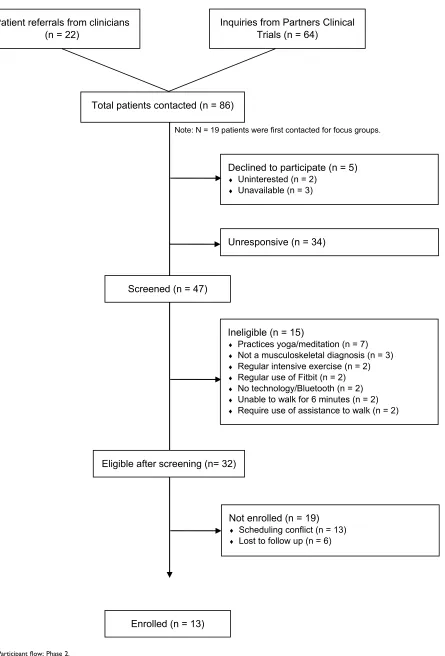
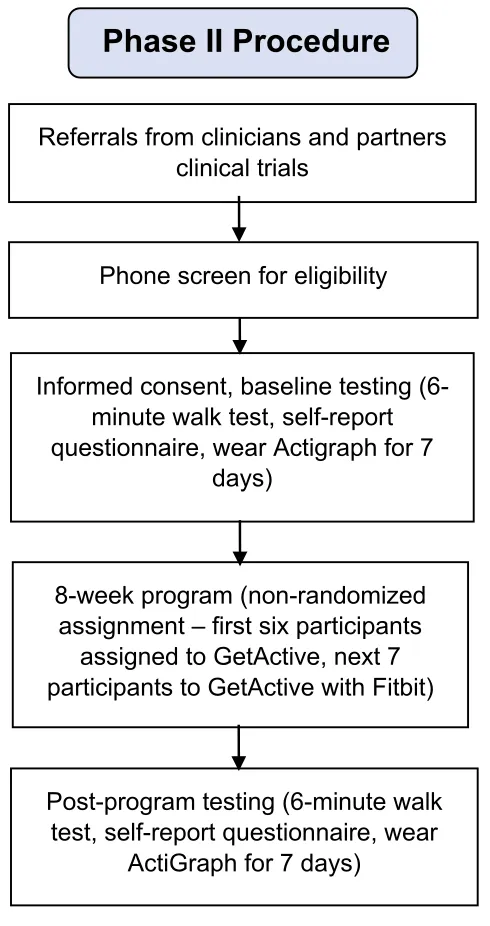
Recruitment took place between January and April 2018 via the same methods described in Phase 1. Inclusion criteria were identical to those of phase 1, with an additional criterion requiring the ability to participate in 8 in-person group treatment sessions. We also excluded participants who used a Fitbit tracker in the past 3 months. A total of 13 participants enrolled (Figure2 andTable 1). Thefirst six participated in the GetActive program and the next seven in the GetActive with Fitbit program. All participants provided written informed consent prior to participation. All study procedures were approved by the Institutional Review Board of Massachusetts General Hospital, and all proce-dures were in compliance with the Declaration of Helsinki. Study procedures are further detailed inFigure 3.
Procedure For GetActive And GetActive With Fitbit
A research assistant scheduled the consent and assessments for all participants. A clinician described the study in detail and performed consent procedures. After consent was pro-vided, participants completed study questionnaires in per-son, as a group. A research assistant was available to answer questions and check that all questions were answered. The research assistant also performed the 6 min walk test.35At the end of the 2 hr assessment session, participants received a wGT3X-BT ActiGraph accelerometer (Pensacola, FL, USA) to wear daily for 1 week, wear instructions (including no changes in routine activities), and were asked to keep a wear time log. The research assistant called participants daily with reminders to wear the ActiGraphs and help problem solve issues in real time. Participants returned the ActiGraphs and the logs the following week, which
coincided with Session 1 of the group program. At the end of the program (week 8), participants were asked to wear the ActiGraphs again for one week, following the same guidelines previously described. They returned for the
final assessment session a week later, during which they
completed the post intervention questionnaires, the 6 min walk test, and exit interviews.
Additional Procedural Steps For GetActive With Fitbit
The research assistant downloaded the ActiGraph data while
the study clinician delivered the first group session, and
prepared individual Fitbit accounts with individual steps counts. Step goals for each participant were determined
based on predefined criteria (see GetActive and GetActive
with Fitbit programs section below). At the end of the GetActive with Fitbit group session, the research assistant paired each participant’s phone with the Fitbit. During each of the subsequent group visits, the research assistant manu-ally programed steps goals directly into each participant’s Fitbit using the same criteria.
GetActive And GetActive With Fitbit Programs
The two 8-session weekly programs retained the core com-ponents of the 3RP,29modified for pain: 1) elicitation of the relaxation response (RR) through general, pain and activity-specific meditations; 2) reducing overall reactivity to stress and pain through adaptive thinking and acceptance-based techniques, and 3) increasing connectedness to self and others generally and when in pain through social support and positive psychology skills, as well as the emphasis on
home practice (adaptive goal setting: “SMART goals”;
defined as goals that are specific, measurable, attainable,
relevant, and time-based”),29 daily RR practice and
appreciations.
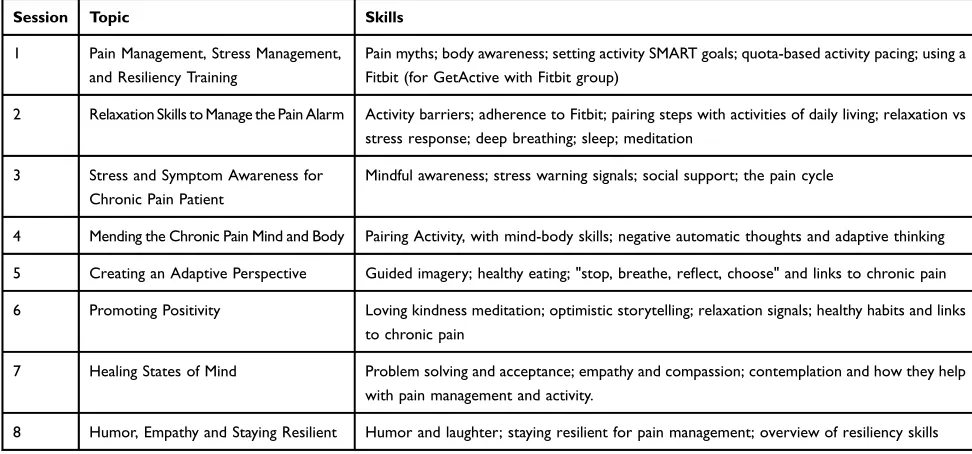
We also added 5 components: 1) education regarding myths about chronic pain and activity to help participants challenge their ingrained misconceptions regarding pain and activity 2) the “true versus false pain alarm skill,” to help participants understand the difference between harmful pain (e.g., acute pain, new injury), and non-harmful pain (e.g., chronic pain which is not indicative of current physical damage); 3) quota-based, non-pain contingent activity pacing, to help them gradually increase activity; 4) beha-vioral activation (e.g., reengagement in meaningful activities of daily living) paired with quota based pacing based increases in activity; 5) challenging misconceptions around mindfulness meditation (Table 3).
Journal of Pain Research downloaded from https://www.dovepress.com/ by 118.70.13.36 on 24-Aug-2020
Figure 2Participantflow; Phase 2.
Journal of Pain Research downloaded from https://www.dovepress.com/ by 118.70.13.36 on 24-Aug-2020
For the GetActive with Fitbit group, we used the
Fitbit’s step-count to assess weekly physical activity,
determine participants’pacing plans, and set weekly activ-ity SMART goals. Each week, steps were assessed over 5-day blocks. After the ActiGraph-monitored baseline step-count was determined, participants set this step-count as their initial step goal, which was uploaded onto the Fitbit. Participants had to reach their goal, on average, by the day of the session. We excluded the highest and lowest
step-count days. Patients were allowed 2 “rest days” per
week. Missed samples or days on which patients forgot to charge or wear their devices were counted as rest days. If participants met the 5-day goal criterion, they were given
the option of repeating their step goal the following week or increasing their step goal by 10%. Participants paired their Fitbits with their smartphones, which automatically downloaded data on a daily basis. A staff member
calcu-lated patients’upcoming step goals and provided the study
clinician with individual adherence data for each partici-pant, used when discussing homework adherence and to set homework including new step goals. In the GetActive
program, participants’ physical activity levels were
assessed via activity logs. We calculated their correspond-ing paccorrespond-ing plans and SMART goals based on time spent being physically active or distance walked, based on indi-vidual patient preference.
Phase II Procedure
Figure 3Phase 2 procedure.
Journal of Pain Research downloaded from https://www.dovepress.com/ by 118.70.13.36 on 24-Aug-2020
Feasibility And Acceptability Assessments
Assessment milestones were set a priori and were based on guidelines for feasibility studies.40,41Feasibility of recruit-ment was assessed by determining the proportion of con-tacted patients who agreed to participate. A feasibility rate of 80% was considered excellent and 70% was considered good. Program acceptability was calculated by reporting the proportion of participants who attended 6 out of 8 treatment sessions. Feasibility was considered excellent when at least 70% participants attended at least 6 of the 8 planned treat-ment sessions (75%). Therapist adherence to the manual was determined via checklists. An adherence rate of 100% was considered excellent and 75% good. Feasibility of quantitative measures was deemed acceptable if no ques-tionnaires were fully missing in more than 25% partici-pants, and if reliability was higher than 0.70. Adherence to homework and activity were assessed via number of logs turned in by participants over the course of the study, and via reaching SMART goals and frequency of reported RR practice and appreciations. Adherence was deemed excel-lent if participants had at least 3 to 4 out of 7 days of completed homework (RR practice, SMART goal activity, and appreciations) OR at least 5 out of 7 days for one of the 3 components, by at least 80% of participants. Adherence was deemed good if at least 3 to 4 out of 7 days of com-pleted homework (RR practice, SMART goal activity and appreciations) OR at least 5 out of 7 days for one of the 3 components, by at least 70% participants. ActiGraph
adher-ence was assessed via daily wear of ActiGraph
accelerometer (minimum 7 hrs/day) at baseline and post intervention assessments. Adherence was deemed excellent if data were successfully collected at least 5 out of 6 days a week (>7 wear hours a day; excluding the days participants received and returned the ActiGraphs), from at least 80% of
participants during the pre- and post-assessments.
Adherence was deemed good if data were collected from at least 70% of participants. Fitbit adherence was assessed via daily wear of a charged device for the GetActive with Fitbit group. Adherence to Fitbit was deemed excellent if data were collected from at least 5 of 7 days from at least 80% of participants and good if collected from 70% of participants. Satisfaction with the program was assessed
via the Client Satisfaction Questionnaire (CSQ-3)42 and
was determined by the percentage of participants scoring
above the scale midpoint (≥75% excellent;≥70% good).
Physical Function Assessments
Objective Physical Function/Physical Activity
During baseline and post-program testing, all participants wore a wGT3X-BT ActiGraph accelerometer (Pensacola, FL, USA) for 7 days to determine baseline average num-ber of daily steps. An increase of 1000 steps is considered
a minimally clinical important difference (MCID).43
Performance-Based Physical Function
We used the 6 min walk test,44 which measures the
dis-tance participants walk for 6 mins. The MCID in walking distance is 54 m.44
Table 3GetActive With Fitbit Session Topics And Skills
Session Topic Skills
1 Pain Management, Stress Management, and Resiliency Training
Pain myths; body awareness; setting activity SMART goals; quota-based activity pacing; using a Fitbit (for GetActive with Fitbit group)
2 Relaxation Skills to Manage the Pain Alarm Activity barriers; adherence to Fitbit; pairing steps with activities of daily living; relaxation vs stress response; deep breathing; sleep; meditation
3 Stress and Symptom Awareness for Chronic Pain Patient
Mindful awareness; stress warning signals; social support; the pain cycle
4 Mending the Chronic Pain Mind and Body Pairing Activity, with mind-body skills; negative automatic thoughts and adaptive thinking
5 Creating an Adaptive Perspective Guided imagery; healthy eating; "stop, breathe, reflect, choose" and links to chronic pain
6 Promoting Positivity Loving kindness meditation; optimistic storytelling; relaxation signals; healthy habits and links to chronic pain
7 Healing States of Mind Problem solving and acceptance; empathy and compassion; contemplation and how they help with pain management and activity.
8 Humor, Empathy and Staying Resilient Humor and laughter; staying resilient for pain management; overview of resiliency skills
Journal of Pain Research downloaded from https://www.dovepress.com/ by 118.70.13.36 on 24-Aug-2020
Patient-Reported Physical Function
We measured self-reported physical function with the Patient-Reported Outcomes Measurement Information
System (PROMIS) Physical Function, v.1.2.8b45 which
assesses one’s ability to perform activities ranging from
self-care (activities of daily living) to more complex activities requiring a combination of skills, often within
a social context. The MCID for this measure is 8.46 We
additionally used the World Health Organization
Disability Assessment Schedule (WHODAS) 2.0,47 a
36-item questionnaire assessing functional difficulties in
various domains (e.g., understanding and communicat-ing, getting around, self-care, getting along with people, life activities, and participation in society). Internal
relia-bility in the current sample was good (Cronbach’s
alpha=0.81–0.87) for the PROMIS and excellent (0.95–
0.96) for the WHODAS. There is no MCID available for WHODAS. We used both measures in order to be able to compare their respective sensitivity in preparation for a future RCT.
Self-Reported Physical Activity Scale For Individuals With Physical Disabilities (PASIPD)48
A 13-item questionnaire which assesses engagement in leisure, household, and work activities of varying intensi-ties for the past 7 days. This measure has established
validity, with low-to-moderate Cronbach’s alpha values
(0.37-0.65) within each of its five factors due to the
small number of items in each factor.48 There is no
MCID available for this measure.
Emotional Function
We assessed emotional function with the PROMIS depres-sion v1.0.8b49as well as the PROMIS anxiety, v1.08a.50The MCID for PROMIS depression is 5.19 and for PROMIS anxiety is 4.28.51 Internal reliability for both measures in
the current sample was excellent (Cronbach’s alpha=0.87–
0.96 for depression, 0.93–0.96 for anxiety).
Other Patient-Reported Assessments
While our main quantitative outcomes, which we will test
in the future efficacy RCT are emotional and physical
function, at this stage it is important to test other variables that assess constructs that are directly targeted by the program, which may be mediators in a future RCT and will inform about the mechanisms of improvement. We used the following additional measures (MCID indicated when available):
Pain. We used the Numerical Rating Scale (NRS);52,53
11-point Likert scale, with “0” representing no pain and
“10”representing the worst pain possible, during rest and activity. A 1-point change is considered the MCID for patients with musculoskeletal pain.54
Social isolation was assessed via the PROMIS Social
Isolation short form (4a),55 a 4-item questionnaire
asses-sing perceptions of being avoided, excluded, detached, disconnected from, or unknown by, others. Internal relia-bility (Cronbach’s alpha) for this measure was 0.60–0.82. Mindfulness was assessed by the Cognitive and
Affective Mindfulness Scale- Revised (CAMS-R),56 a
12-item self-report measure of the frequency with which patients use mindfulness behaviors (e.g., noticing thoughts without judgement) in their daily lives. Items are scored on a 4-point Likert scale, with“0”representing“rarely/not at all”and “3”representing “almost always”. Internal relia-bility (Cronbach’s alpha) for this measure was 0.63–0.77. Emotional support was assessed via the PROMIS
emo-tional support (4a),57 a 4-item questionnaire measuring
perceived feelings of being cared for and valued as a person and having close relationships. This measure had
excellent internal reliability in the current sample
(Cronbach’s alpha=0.94–0.97).
Coping. Coping was assessed using (1) the Pain
Catastrophizing Scale (PCS),58 which assesses
hopeless-ness, helplessness and rumination about pain; (2) the
Tampa Kinesiophobia Scale (TSK),59which assesses fear
of pain and activities that cause pain, and the Measure of
Current Status (MOCS),60which assesses ability to engage
in a series of healthy coping skills (e.g., relaxation, social support, adaptive thinking). Internal reliability was found to be excellent (Cronbach’s alpha=0.93–0.94) for the PCS, good (0.77–0.87) for the TSK, and acceptable (0.71–0.77) for the MOCS.
Perceived Improvement was assessed with the
Modified Patient Global Impression of Change
(MPGIC),61 in which participants assessed on a 7-point
Likert scale (with 1 representing “very much improved”)
and “7” representing “very much worse” the extent to
which they perceived that the intervention improved their pain, physical activity, physical function, emotional func-tion, pain resiliency, and the degree to which the Fitbit helped to increase their activity (for the GetActive with Fitbit group). The rationale for using all of these measures concurrently is to help determine which the assessments best capture the effects of the program, and should be included in the future feasibility and efficacy RCTs.
Journal of Pain Research downloaded from https://www.dovepress.com/ by 118.70.13.36 on 24-Aug-2020
Exit Interviews
Following program completion, participants participated in semi-structured group-based exit interviews to assess their views on program components feasibility. All
parti-cipants agreed to maintain confidentiality. Interviews
lasted ~60 mins and were audio-recorded, with an emphasis on the importance of honest feedback to enable program optimization.
Analysis Plan
Consistent with common guidelines for feasibility studies,27 we did not test efficacy or perform between-group analyses. Rather, we limited our quantitative analyses to descriptive statistics for each quantitative measure, as well as within-group pre-post comparisons using paired t-tests and Cohen’s D effect sizes (ES) to broadly gauge for potential signals of improvement. To verify results of these comparisons due to the low sample size, we additionally conducted the
non-parametric related-samples Wilcoxon signed rank test compar-ing pre and post values. Qualitative data analysis for the exit interviews followed the methods outlined above in Phase 1.
Results
Feasibility And Acceptability Markers
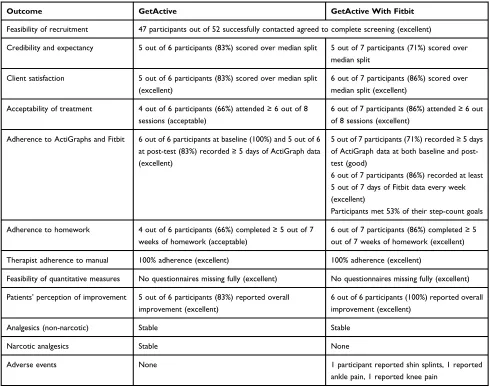
Feasibility of recruitment, credibility and expectancy, cli-ent satisfaction, acceptability of treatmcli-ent, adherence to ActiGraphs and Fitbit, adherence to homework, therapist adherence to manual, and perception of improvement were good to excellent and similar for both groups (Table 4).
Physical Function (Table 5)
Objective physical function. Overall, both groups, when
considered together, showed a significant increase in
ActiGraph-measured number of steps from baseline to
posttest (Figure 4). Participants in the GetActive with
Fitbit group had a relatively high baseline step-count
Table 4Feasibility And Acceptability Of The Open Pilot Studies
Outcome GetActive GetActive With Fitbit
Feasibility of recruitment 47 participants out of 52 successfully contacted agreed to complete screening (excellent)
Credibility and expectancy 5 out of 6 participants (83%) scored over median split 5 out of 7 participants (71%) scored over median split
Client satisfaction 5 out of 6 participants (83%) scored over median split (excellent)
6 out of 7 participants (86%) scored over median split (excellent)
Acceptability of treatment 4 out of 6 participants (66%) attended≥6 out of 8 sessions (acceptable)
6 out of 7 participants (86%) attended≥6 out of 8 sessions (excellent)
Adherence to ActiGraphs and Fitbit 6 out of 6 participants at baseline (100%) and 5 out of 6 at post-test (83%) recorded≥5 days of ActiGraph data (excellent)
5 out of 7 participants (71%) recorded≥5 days of ActiGraph data at both baseline and post-test (good)
6 out of 7 participants (86%) recorded at least 5 out of 7 days of Fitbit data every week (excellent)
Participants met 53% of their step-count goals
Adherence to homework 4 out of 6 participants (66%) completed≥5 out of 7 weeks of homework (acceptable)
6 out of 7 participants (86%) completed≥5 out of 7 weeks of homework (excellent)
Therapist adherence to manual 100% adherence (excellent) 100% adherence (excellent)
Feasibility of quantitative measures No questionnaires missing fully (excellent) No questionnaires missing fully (excellent)
Patients’perception of improvement 5 out of 6 participants (83%) reported overall improvement (excellent)
6 out of 6 participants (100%) reported overall improvement (excellent)
Analgesics (non-narcotic) Stable Stable
Narcotic analgesics Stable None
Adverse events None 1 participant reported shin splints, 1 reported ankle pain, 1 reported knee pain
Journal of Pain Research downloaded from https://www.dovepress.com/ by 118.70.13.36 on 24-Aug-2020
(>7300 steps, with most (5 out of 7) participants walking more than 5,000 steps a day). Improvements in number of steps in both groups were clinically meaningful, over the
MCID of 1000 steps43(medium effect size). Four out of 7
participants within the GetActive with Fitbit group and 4 out of 6 within the GetActive group showed increases in step-count over the MCID (medium effect size).
Performance-based physical function. As a group, par-ticipants in the GetActive group generally increased their distance walked in the 6 min walk test (4 out of 6
partici-pants; 1 above the MCID; medium effect size).
Participants in the GetActive with Fitbit showed no change in the 6 min walk test (4 out of 7 participants increased distance but did not reach the MCID).
Self-report physical function. Both the GetActive and GetActive with Fitbit groups showed some improvement in physical function (medium effect size;Table 5).
Emotional Function
Both groups exhibited non-significant improvement in
anxiety (small effect size) and depression (small to med-ium effect size;Table 6).
Other Measures
The GetActive group exhibited clinically meaningful reductions in levels of pain during rest and activity (med-ium effect size;Table 6), pain resilience (large effect size),
and non-significant improvements in kinesiophobia (large
effect size), and coping (medium-large effect size;
Table 6). Participants in the GetActive with Fitbit group
similarly exhibited a significant and clinically meaningful decrease in levels of pain during rest and activity (large effect sizes), as well as improvements in coping (large
effect size), and a non-significant improvement in pain
resilience (medium-large effect size). These comparisons were repeated using the non-parametric related-samples Wilcoxon signed rank test (see Analysis Plan) and yielded similar results in terms of direction and significance.
Exit Interviews
Participants reported high satisfaction with the learned relaxation, mind-body, and coping skills, and reported an improved ability to manage stress, pain, and an increased quality of life. They indicated that the pacing
of the program, particularly in the first sessions, could
be more relaxed and spread out over more sessions. Three participants indicated that healthy behaviors topics (e.g., healthy eating, sleep) detracted from the rest of the intervention. Participants in the GetActive
T
able
5
Objectiv
e,
P
erformance-Based
And
Self-Report
Activity/Function
Outcomes
Ph
ysical
Activity
Assessments
GetActiv
e
GetActive
With
Fitbit
Baseline
M
(SD)
P
ost-T
est
M
(SD)
Pr
e-P
ost
Change
M
(95%
CI)
t value
p value
Cohen
’
s
D
Baseline
M
(SD)
P
ost-T
est
M
(SD)
Pr
e-P
ost
Change
M
(95%
CI)
t value
p value
Cohen
’
s
D
ActiGraph
A
verage
Steps
5341.33 (2470.81) 6514.83 (3728.13)
1173.5
(
−
1136.30,
3483.30)
1.31
0.248
0.53
7341.43 (2022.17) 9066.00 (2500.08)
1724.57
(
−
558.59,
4007.74)
1.85
0.114
0.70
6
min
W
alk
T
est
Distance
(m)
405.88
(109.58)
436.95
(41.05)
31.07
(
−
29.26,
91.39)
1.32
0.243
0.54
406.31 (60.77) 400.33 (50.40)
−
5.99
(
−
35.01,
23.04)
0.505
0.632
0.19
Ph
ysical
function
(PR
OMIS)
37.58
(5.76)
40.28
(4.77)
2.70
(
−
1.65,
7.05)
1.60
0.171
0.65
38.70
(4.07)
39.67
(3.56)
0.97
(
−
0.90,
2.84)
1.27
0.251
0.48
Ph
ysical
Function
(WHOD
AS)
82.67
(25.20)
70.83
(25.86)
11.83
(0.88,
22.79)
2.78
0.039
1.13
67.71
(14.30)
63.71
(17.11)
4.00
(
−
4.13,
12.13)
1.20
0.274
0.45
Self-re
porte
d
ph
ysical
activity
8.60
(8.02)
13.72
(16.35)
5.12
(
−
5.44,
15.68)
1.25
0.268
0.51
11.40
(11.94)
13.71
(15.64)
2.31
(
−
5.53,
10.15)
0.72
0.498
0.27
Journal of Pain Research downloaded from https://www.dovepress.com/ by 118.70.13.36 on 24-Aug-2020
with Fitbit group reported that the Fitbit was helpful in improving sleep and body awareness. However, they also reported feeling guilty and discouraged whenever they did not meet their step-goal or when receiving reminders about lack of activity.
Discussion
Despite decades of research, improvements in emo-tional and physical function following mind-body treat-ments among chronic pain patients are modest and generally fade over time. Further, no clinical trials to date assess physical function using IMMPACT and ICF criteria. Although there is evidence that physical activ-ity helps patients with chronic pain, uptake and adher-ence remain problematic. The current study used the
NIH stage model25 and NCCIH model for intervention
development26 and adapted an evidence-based, group,
mind-body program for the specific needs of patients
with chronic pain. The study targeted comprehensive
improvement in emotional and physical function9,10
(self-report, performance based and objective) with a Fitbit device (GetActive with Fitbit) or without it
(GetActive; phase 1). We also assessed preliminary feasibility markers for the two programs via 2 nonran-domized open pilot studies (phase 2).
Focus groups confirmed the physical, emotional, and
social challenges associated with chronic pain. Fear of exacerbating pain, difficulties with pacing, and frustration with current functioning were common complaints from participants. They held largely favorable views of the
modified 3RP and the additional pain management skills
described, the use of a Fitbit device to increase activity, and the value of learning skills in a supportive group
setting. The rationale of combining pain-specific
mind-body skills with increased in walking linked to re-engage-ment in activities of daily living resonated with focus
group participants. They identified the group setting and
the Fitbit as particularly motivating in regards to meeting
their goals. These results confirmed prior reports in this
population.3,32Results are also in line with evidence sug-gesting that this population is in need of extra support to
engage in physical activity,62 and the essential roles of
quota-based pacing and mind-body skills63 as aids in this
endeavor.
0 1000 2000 3000 4000 5000 6000 7000 8000 9000 10000
Baseline Post-test
ActiGraphSteps
GetActive (Accelerometer Steps)
d = 0.53
0 2000 4000 6000 8000 10000
Baseline Post-test
ActiGraphSteps
GetActive with Fitbit (Accelerometer
Steps)
d = 0.70
0 50 100 150 200 250 300 350 400 450 500
Baseline Post-test
6-Minute Walk Test (meters)
GetActive (6-Minute Walk Test)
d = 0.54
0 100 200 300 400 500
Baseline Post-test
6-Minute Walk Test (meters)
GetActive with Fitbit (6-Minute Walk
Test)
d = 0.19
Figure 4Pre-post changes in performance-based measures in the 2 programs.
Journal of Pain Research downloaded from https://www.dovepress.com/ by 118.70.13.36 on 24-Aug-2020
T able 6 Quantitativ e Self-Report Outcomes Of Pain, Emotional Function And Coping Measur es GetActive GetActiv e With Fitbit Baseline M (SD) P ost-T est M (SD) Pre -P ost Chang e M (95% CI) t value p value Cohen ’ s D Baseline M (SD) P ost-T est M (SD) Pr e-P ost Chang e M (95% CI) t value p value Cohen ’ s D Pain at re st 5.17 (2.23) 3.83 (2.64) 1.33 (0.25, 2.42) 3.16 0.025 1.30 5.29 (2.29) 3.57 (2.64) 1.71(0.05, 3.38) 2.52 0.045 0.95 P ai n w it h ac ti vi ty 6.67 (1.51) 4.67 (3.56) 2.00 ( − 0.89, 4.89) 1.78 0.136 0.73 7.57 (1.81) 6.00 (2.24) 1.57 (0.28, 2.86) 2.98 0.025 1.12 Pain re silience 28.83 (6.62) 39.17 (6.85) − 10.33 ( − 20.10, − 0.56) 2.72 0.042 1.11 29.57 (11.52) 33.71 (7.50) − 4.14 ( − 9.28, 0.99) 1.97 0.096 0.75 Depre ssion 59.02 (6.65) 54.70 (10.10) 4.32 ( − 4.42, 13.05) 1.27 0.260 0.52 55.11 (10.86) 53.66 (4.42) 1.46 ( − 5.56, 8.47) 0.51 0.629 0.19 Anxiety 59.38 (5.55) 56.78 (11.61) 2.60 ( − 7.19, 12.39) 0.68 0.525 0.28 55.00 (12.02) 51.74 (9.21) 3.26 ( − 5.98, 12.49) 0.86 0.421 0.33 Social isolation 48.63 (8.16) 46.53 (9.33) 2.10 ( − 9.70, 13.90) 0.46 0.667 0.19 51.94 (6.46) 50.54 (5.24) 1.40 ( − 2.80, 5.60) 0.82 0.446 0.31 Emotional support 45.48 (9.73) 45.68 (9.90) − 0.20 ( − 4.72, 4.32) 0.11 0.914 0.05 49.80 (7.76) 50.64 (10.26) − 0.84 ( − 10.37, 8.68) 0.22 0.836 0.08 Mindfulness 29.83 (4.58) 33.33 (5.35) − 3.50 ( − 9.89, 2.89) 1.41 0.218 0.58 27.29 (4.54) 29.00 (4.76) − 1.71 ( − 6.08, 2.65) 0.96 0.373 0.36 P ai n ca ta st ro p h iz in g 44.00 (12.51) 33.17 (14.32) 10.83 ( − 7.63, 29.29) 1.51 0.192 0.62 34.14 (11.05) 29.86 (8.55) 4.29 ( − 5.60, 14.17) 1.06 0.330 0.40 Kinesiophobia 43.17 (8.91) 34.83 (8.61) 8.33 ( − 2.09, 18.76) 2.05 0.095 0.84 40.43 (1.90) 37.14 (7.01) 3.29 ( − 2.56, 9.13) 1.38 0.218 0.52 Coping 25.67 (8.12) 32.83 (3.87) − 7.17 ( − 17.22, 2.89) 1.83 0.126 0.75 22.00 (6.76) 30.29 (7.48) − 8.29 ( − 15.50, − 1.07) 2.81 0.031 1.06
Journal of Pain Research downloaded from https://www.dovepress.com/ by 118.70.13.36 on 24-Aug-2020
The open pilot studies showed excellent therapist adherence, client satisfaction, perceptions of improvement, feasibility of quantitative measures, and feasibility of recruitment for both programs. One hundred percent of participants with baseline data completed post-testing in both groups, and attrition was lower compared to other
studies of chronic pain.4 Credibility and adherence to
ActiGraph and Fitbit were high, and minimal adverse events were reported. Results indicate that the interven-tions and procedures are feasible and accepted by study participants.
In line with common guidelines for feasibility studies27
this study did not test efficacy or perform any
between-group analyses. Nevertheless, preliminary exploration of effect sizes of within group pre-post changes suggests that both programs show promise for improvements in most outcome measures. Critically, both groups exhibited step-count increases that are clinically meaningful.43Moreover,
we found large effect sizes and clinically meaningful54
decreases in pain following the programs, as well as
large and significant effects for improvements in physical
function and medium-large effect sizes for improvements in coping, pain resilience, and kinesiophobia.
Qualitative exit interviews indicated high satisfaction
with both programs and the mind-body, pain-specific and
physical activity skills learned, and suggested additional
modifications including: 1) increasing the total number of
sessions in both programs from 8 to 10 to allow for a more relaxed pace of teaching the skills; 2) including 3RP specific information on healthy eating and sleep in an appendix to
avoid deterring from theflow of the program; 3) debunking
the myths regarding mindfulness, meditation, and other mind-body practices which had associations with“laziness” for some participants; 4) incorporating a more thorough discussion on challenges associated with forming new habits, as well as introducing the skill of self-compassion to help patients remain motivated even when not meeting step-count goals; 5) developing a comprehensive assessment of activity
(e.g., job activity, seating time, Physical Activity
Questionnaire-Short Form IPAQ-SF64scores) during
screen-ing to ensure that participants are sedentary (e.g., less than 5,000 steps) so that they can fully benefit from the programs.
Conclusions
This study is thefirst to integrate physical activity with mind-body skills to increase comprehensive physical and emotional functioning in a heterogeneous group of patients with chronic pain, thefirst to use a comprehensive assessment of physical
function consistent with IMMPACT and ICF criteria, and the first to compare increase in activity with and without a Fitbit. Focus groups, open pilot, and exit interview data provided preliminary evidence for feasibility and acceptability of the novel interventions as well as a signal of improvement in physical activity, pain, physical function, and other measures. Consistent with the aims of pilot feasibility studies,27our aim was not to examine the efficacy of the programs or generalize findings to the larger pain population. Rather, we collected meaningful information which allowed us to further modify the GetActive with Fitbit and GetActive programs and study procedures which are currently being tested within a definitive
feasibility pilot RCT, following the NIH stage model25 and
NCCIH framework.26If feasibility benchmarks are met within this feasibility RCT of GetActive versus GetActive with Fitbit, we will next conduct a fully powered RCT of the GetActive with Fitbit versus Get Active versus a health education control in order to determine comparatively their efficacy and sus-tained improvement in emotional and physical function, as well as elucidate whether the Fitbit is a necessary ingredient. Results of the future efficacy RCT will have important impli-cations for the treatment of chronic pain and may lead to a paradigm shift in the manner in which pain is assessed and treated, support implementation of ICF and IMMPACT cri-teria across all settings, and potentially provide evidence for the use of digital activity trackers as activity reinforcers within chronic pain treatments.
Acknowledgement
We thank Stephanie Moffat and Christopher Funes for transcribing the interviews.
Funding
This study was funded by an R34 grant from the National Center for Complementary and Integrative Health (1R34AT009356-01A1) to the senior author.
Disclosure
Dr. Schatman serves as a consultant to Kaleo Pharma and Quest Diagnostics and received ad board honorarium from Salix Pharmaceuticals. All other authors declare that they have no conflicts of interest in this work.
References
1. IASP Taxonomy Working Group. Pain terms a current list with defi
ni-tions and notes on usage.Pain.1986;4:S215–S221.
doi:10.1016/0304-3959(86)90113-2
Journal of Pain Research downloaded from https://www.dovepress.com/ by 118.70.13.36 on 24-Aug-2020
2. Schappert SM. Ambulatory care visits to physician offices, hospital outpatient departments, and emergency departments: United States, 2001–02.Vital Health Stat.2006;13.
3. Vranceanu AM, Bachoura A, Weening A, Vrahas M, Smith RM, Ring D. Psychological factors predict disability and pain intensity after
ske-letal trauma.J Bone Jt Surg - Ser A.2014;96(3). doi:10.2106/JBJS.
L.00479
4. Veehof MM, Oskam MJ, Schreurs KMG, Bohlmeijer ET.
Acceptance-based interventions for the treatment of chronic pain: a
systematic review and meta-analysis. Pain. 2011;152(3):533–542.
doi:10.1016/j.pain.2010.11.002
5. Gotink RA, Chu P, Busschbach JJV, Benson H, Fricchione GL, Hunink MGM. Standardised mindfulness-based interventions in healthcare: an overview of systematic reviews and meta-analyses of
RCTs.PLoS One.2015;10(4). doi:10.1371/journal.pone.0124344
6. Hilton L, Hempel S, Ewing BA, et al. Mindfulness meditation for
chronic pain: systematic review and meta-analysis.Ann Behav Med.
2017;51(2):199–213. doi:10.1007/s12160-016-9844-2
7. Jackson W, Kulich R, Malacarne A, Lapidow A, Vranceanu A. Physical functioning and mindfulness based interventions in chronic pain: a
systematic review. J Pain. 2016;17:S99. doi:10.1016/j.
jpain.2016.01.304
8. Marikar Bawa FL, Mercer SW, Atherton RJ, et al. Does mindfulness improve outcomes in patients with chronic pain? Systematic review
and meta-analysis. Br J Gen Pract. 2015;65(635):e387–e400.
doi:10.3399/bjgp15X685297
9. Taylor AM, Phillips K, Patel KV, et al. Assessment of physical function and participation in chronic pain clinical trials: IMMPACT/OMERACT
recommendations. Pain. 2016;157(9):1836–1850. doi:10.1097/j.pain.
0000000000000577
10. World Health Organization. International Classification of
Functioning, Disability and Health (ICF). Geneva;2001.
11. Jackson W, Zale EL, Berman SJ, et al. Physical functioning and
mindfulness skills training in chronic pain: a systematic review. J
Pain Res.2019;12:179–189. doi:10.2147/JPR
12. Geneen LJ, Moore RA, Clarke C, Martin D, Colvin LA, Smith BH. Physical activity and exercise for chronic pain in adults: an overview
of cochrane reviews. Cochrane Database Syst Rev. 2017;1:
CD011279. doi:10.1002/14651858.CD011279.pub2
13. Endrighi R, Steptoe A, Hamer M. The effect of experimentally induced sedentariness on mood and psychobiological responses to
mental stress. Br J Psychiatry. 2016;208(3):245–251. doi:10.1192/
bjp.bp.114.150755
14. Suchert V, Hanewinkel R, Isensee B. Sedentary behavior and indica-tors of mental health in school-aged children and adolescents: a
systematic review.Prev Med (Baltim).2015;76:48–57. doi:10.1016/
j.ypmed.2015.03.026
15. O’Connor SR, Tully MA, Ryan B, et al. Walking exercise for chronic
musculoskeletal pain: systematic review and meta-analysis. Arch
Phys Med Rehabil. 2015;96(4):724–734.E3. doi:10.1016/j. apmr.2014.12.003
16. Kent P, Kjaer P. The efficacy of targeted interventions for modifiable
psychosocial risk factors of persistent nonspecific low back pain - a
systematic review. Man Ther. 2012;17(5):385–401. doi:10.1016/j.
math.2012.02.008
17. Rainville J, Hartigan C, Martinez E, Limke J, Jouve C, Finno M.
Exercise as a treatment for chronic low back pain.Spine J.2004;4
(1):106–115. doi:10.1016/S1529-9430(03)00174-8
18. Vranceanu A-M, Stone M, Wallace T, Kulich R. Cognitive behavioral therapy for chronic pain. In: Vranceanu A-M, Greer J, Safren S
editors. The Massachusetts General Hospital Handbook of
Behavioral Medicine. Humana Press; 2017:93–114. doi:10.1007/ 978-3-319-29294-6_5
19. Nijs J, Kosek E, Van Oosterwijck J, Meeus M. Dysfunctional endo-genous analgesia during exercise in patients with chronic pain: to
exercise or not to exercise?Pain Physician.2012;15:ES205–ES213.
20. Patel MS, Asch DA, Volpp KG. Wearable devices as facilitators, not
drivers, of health behavior change. JAMA. 2015;313(5):459–460.
doi:10.1001/jama.2014.14781
21. Chandrasekar A, Hensor EMA, Mackie SL, Backhouse MR, Harris
E. Preliminary concurrent validity of the fitbit-zip and actigraph
activity monitors for measuring steps in people with polymyalgia
rheumatica. Gait Posture. 2018;61:339–345. doi:10.1016/j.
gaitpost.2018.01.035
22. Alharbi M, Bauman A, Neubeck L, Gallagher R. Measuring overall physical activity for cardiac rehabilitation participants: a review of
the literature.Hear Lung Circ.2017;26(10):1008–1025. doi:10.1016/
j.hlc.2017.01.005
23. Gordon R, Bloxham S. Influence of the Fitbit Charge HR on physical
activity, aerobicfitness and disability in non-specific back pain
parti-cipants.J Sport Med Phys Fit.2017. 57(12):1669–1675.
24. Jamison RN, Jurcik DC, Edwards RR, Huang CC, Ross EL, Pilot A. Comparison of a smartphone app with or without 2-way messaging
among chronic pain patients: who benefits from a pain app?Clin J
Pain.2017;33(8):676–686. doi:10.1097/AJP.0000000000000455 25. Onken LS, Carroll KM, Shoham V, Cuthbert BN, Riddle M.
Reenvisioning clinical science: unifying the discipline to improve
the public health. Clin Psychol Sci.2013;2(1):22–34. doi:10.1177/
2167702613497932
26. National Center for Complementary and Integrative Health.
Framework for developing and testing mind and body interventions.
Available from: https://nccih.nih.gov/grants/mindbody/framework.
Published2017. Accessed June 27, 2019.
27. Leon AC, Davis LL, Kraemer HC. The role and interpretation of pilot
studies in clinical research. J Psychiatr Res. 2011;45(5):626–629.
doi:10.1016/j.jpsychires.2010.10.008
28. Lancaster GA, Dodd S, Williamson PR. Design and analysis of pilot
studies: recommendations for good practice. J Eval Clin Pract.
2004;10(2):307–312. doi:10.1111/j.2002.384.doc.x
29. Park ER, Traeger L, Vranceanu AM, et al. The development of a patient-centered program based on the relaxation response: the
relaxation response Resiliency Program (3RP). Psychosomatics.
2013;54(2):165–174. doi:10.1016/j.psym.2012.09.001
30. Gonzalez A, Shim M, Mahaffey B, Vranceanu A-M, ReffiA, Park ER.
The Relaxation Response Resiliency Program (3RP) in patients with headache and musculoskeletal pain: a retrospective analysis of clinical
data.Pain Manag Nurs.2018. doi:10.1016/j.pmn.2018.04.003
31. Eisenberg DM, Buring JE, Hrbek AL, et al. A model of integrative
care for low-back pain.J Altern Complement Med.2012;18(4):354–
362. doi:10.1089/acm.2011.0408
32. Crombez G, Eccleston C, Van Damme S, Vlaeyen JWS, Karoly P.
Fear-avoidance model of chronic pain: the next generation. Clin J
Pain.2012;28(6):475–483. doi:10.1097/AJP.0b013e3182385392 33. Breivik H, Collett B, Ventafridda V, Cohen R, Gallacher D. Survey of
chronic pain in Europe: prevalence, impact on daily life, and treatment. Eur J Pain.2006;10(4):287–333. doi:10.1016/j.ejpain.2005.06.009
34. Dahl J. Behavioral activation for depression: a clinician’s guide.Cogn
Behav Ther.2011;40(1):77. doi:10.1080/16506073.2010.514119 35. American Thoractic Society. ATS statement: the six-minute walk test.
Am J Respir Crit Care Med. 2002;166(1):111–117. doi:10.1164/ rccm.166/1/111
36. Ritchie J, Lewis J, McNaughton Nicholls C, Ormston R.Qualitative
Research Practice: A Giode for Social Science Students and Researchers. 2nd ed ed. Sage Publications, Inc;2013.
37. Tong A, Sainsbury P, Craig J. Consolidated criteria for reporting qualitative research (COREQ): A 32-item checklist for interviews
and focus groups. Int J Qual Heal Care. 2007;19(6):349–357.
doi:10.1093/intqhc/mzm042
38. Smith J, Firth J. Qualitative data analysis: the framework approach. Nurse Res.2011. doi:10.7748/nr2011.01.18.2.52.c8284
39. Bazeley PK. Qualitative Data Analysis with NVivo. Los Angeles:
Sage;2013.
Journal of Pain Research downloaded from https://www.dovepress.com/ by 118.70.13.36 on 24-Aug-2020