ISSN(Online): 2320-9801
ISSN (Print): 2320-9798
I
nternational
J
ournal of
I
nnovative
R
esearch in
C
omputer
and
C
ommunication
E
ngineering
(An ISO 3297: 2007 Certified Organization) Vol. 4, Issue 1, January 2016
Effective Video Inpainting Based on
Super-Resolution Algorithm
Sonali Gadge, Gokul Kadnar, Sonali Satpute
B.E. Student, Dept. of Computer, Jai Hind College of Engineering, Kuran, Maharastra, India
ABSTRACT: Image Inpainting is recover missing part of image as Image is save memories of life’s important moments. A Novel framework is one of the model of inpainting in which image inpainting work on scratchy version of image inpainting. Inpainting of the low resolution image is simple than high quality image. It will display high and complex image. Using different image inpainting techniques create high quality of image from low resolution image and collect the high level images. For this purpose our system uses the super resolution algorithm which is responsible for inpainting of single image.
KEYWORDS: Examplar based inpainting, single image super Resolution.
I. INTRODUCTION
Fig.1.Image Inpainting
II. LITERATURE REVIEW
A. Overview Of The Algorithm
There are many techniques exists which can be used for inpainting of the image. These techniques can be the diffusion based or the examplar based techniques. To develop the hierarchical approach of high level image inpainting having some limitations in above approches.
B. Traditional Image Inpainting
Image inpainting is only work for the make high quality image and clear the image. But this approach is not suitable for high quality images. It uses patch based inpainting. Here this area is marked as the sigma notation. The sigma means masking done on the image and it is removed by using Efros and leungs algorithm. In the selected area apply inpainting algorithms by manualy.
C. Examplar-Based Inpainting
In [4] author presented a technique which introduce a novel examplar based Image Inpainting Algorithm with an improved priority term which defines the filling order of patches in the image. This algorithm is based on propagation of patch by propagating the image patches from the source region into the interior of the target region patch by patch.The block effects are removed by the PDE. Examplar-based technique not used for complex geometrics structure completion because the novel method used for restore original image with large target region and complex geometrics structure. There are two types of exemplar-based method is as follows:
1) The Filling Order and 2) Texture Synthesis
1) Filling Order by Patch Priority: To define the structures from textures the filling order computation defines a measure of priority for each patch in order.
2) Texture Synthesis: The filling process starts with the patch having the highest priority.The similarity metric is used for this purpose.
D. Image Regularization Using PDE’s
In [2] author gave an overview of a method uses vector valued algorithm for elaborate the diffusion. It is mainly based on the following approaches.
1. Functional minimization. 2. Divergence expression. 3. Oriented laplaciouns [2].
E. Fragment Based Inpainting
ISSN(Online): 2320-9801
ISSN (Print): 2320-9798
I
nternational
J
ournal of
I
nnovative
R
esearch in
C
omputer
and
C
ommunication
E
ngineering
(An ISO 3297: 2007 Certified Organization) Vol. 4, Issue 1, January 2016
III. IMPLEMENTATION DETAILS
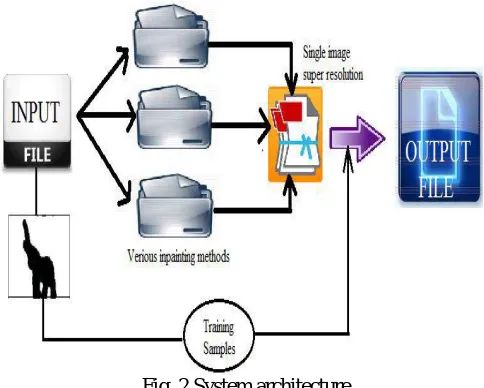
The System architecture of project is shown in Fig 2. It works in following steps: 1. From the original image first extract low resolution area;
2. An in-painting algorithm is applied to fill-in the holes of the low-resolution picture; 3. The quality of the in-painted regions is improved by using a single-image SR method.
Fig. 2.System architecture
A. Image Inpainting
In painting is the process of reconstructing lost or deteriorated parts of images and videos. For example, in the museum world, in case of a valuable painting, this work would be carried out by a skilled art conservator or art restorer. In digital world, in painting refers to the application of sophisticated algorithms to replace lost or corrupted parts of the image data.
B. Image Restoration
Image restoration is the operation of taking a corrupted/noisy image and estimating the clean original image. Corruption can come in many forms such as motion blur, noise, camera miss focus’ etc.
C. Super Resolution
Super resolution (SR) is a class of techniques that enhance the resolution of an imaging system. In some SR techniques—termed as optical SR—the diffraction limit of systems is transcended, while in others termed as— geometrical SR—the resolution of digital imaging sensors is enhanced.
1) Super Resolution Algorithm:
Fig.3. Flowchart of super resolution algorithm
1. Dictionary building:
It consists of the correspondences between low and high resolution image patches. The unique constraint is that the resolution patches have to be valid which is entirely composed of known pixels. In the proposed approach, high-resolution and valid patches are evenly extracted from the known part of the image. The size of dictionary is a user-parameter. An array is used to store the spatial coordinates of HR patches (DHR). Those of LR patches are simply deduced by using the decimation factor.
2. Filling order of the HR picture:
The computation of the filling order is defines a measure of priority for each patch.It is computed on the HR picture with the sparsity-based method. This improves the quality of the in painted picture compared to a raster-scan filling order.
3. For the LR patch corresponding to the HR patch :
Which patch having the highest priority, according to its K-NN in the in painted images of lower resolution are sought.Only best candidate is kept.
IV. EXPECTED RESULT
For comparing results we are tested on variety of natural images and compared to five state-of-art inpainting methods.
a) Parameter Analysis:
Suppose two versions of the proposed method are evaluated. One uses down sampling factor of 4 in both directions (the patch size is equal to 5 × 5) whereas this factor is set to 2 for the second version (the patch size is equal to 7 × 7). For both versions, the size of the dictionary is the same and can contain at most 6000 patches evenly distributed over the picture. The LR patch size is 3 × 3 and the HR patch size is 15 × 15.
b) Comparison with the state of the art method:
ISSN(Online): 2320-9801
ISSN (Print): 2320-9798
I
nternational
J
ournal of
I
nnovative
R
esearch in
C
omputer
and
C
ommunication
E
ngineering
(An ISO 3297: 2007 Certified Organization) Vol. 4, Issue 1, January 2016
Table 1. Running time for low resolution in painting and super resolution
From results it is found that running time results with low resolution inpainting and super resolution gives better result. Also here we are using state-of-the-art method for filling missing areas so it gives better result.
V. EXPERIMENTALRESULT
Fig.4. Registration
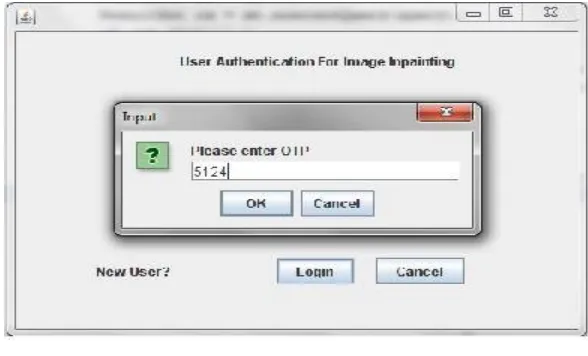
User should be completed Registration process before using this software, to get OTP password for secure login.
Fig.5. OTP Password
Fig.6 Select Image
Further successfully login user have to selected Video for the
On which Apply Inpainting method. In the left corner yellow mark has been reflected.
Fig.7.Apply Inpainting Method
ISSN(Online): 2320-9801
ISSN (Print): 2320-9798
I
nternational
J
ournal of
I
nnovative
R
esearch in
C
omputer
and
C
ommunication
E
ngineering
(An ISO 3297: 2007 Certified Organization) Vol. 4, Issue 1, January 2016
Fig.8. Inpainting completed successfully
VI. ACKNOWLEDGMENT
I express my sincere thanks to my project guide (Write your Guide name) who always being with presence & constant, constructive criticism to made project successful. I would also like to thank all the staff of COMPUTER DEPARTMENT for their valuable guidance, suggestion and support through the project work, who has given co-operation for the project with personal attention. I again take it as great privilege to express our heartfelt thanks to our principal and Head of Department for their valuable suggestion for developing project at every state. Above all I express my deepest gratitude to all of them for their kind-hearted support which helped me a lot during project development.At the last I am thankful to my friends, colleagues for the inspirational help provided to me through a project work.
VII.CONCLUSION
REFERENCES
1. M. Bertalmio, G. Sapiro, V. Caselles, and C. Ballester, “Image inpainting,” in Proc. 27th Annu. Conf. Comput. Graph. Interact. Tech, Jul. 2000, pp. 417–424.
2. D. Tschumperlé and R. Deriche, “Vector valued image regularization with PDEs: A common framework for different applications,” IEEE Trans. Pattern Anal. Mach. Intell, vol. 27, no. 4, pp. 506–517,Apr. 2005.
3. T. Chan and J. Shen, “Variational restoration of non-flat image features: Models and algorithms,” SIAM J. Appl. Math, vol. 61, no. 4, pp. 1338– 1361,2001.
4. A. Criminisi, P. Pérez, and K. Toyama, “Region filling and object removal by examplar-based image inpainting,” IEEE Trans. Image Process.,vol. 13, no. 9, pp. 1200–1212, Sep 2004.
5. I. Drori, D. Cohen-Or, and H. Yeshurun, “Fragment-based image completion,” ACM Trans. Graph, vol. 22, no. 2003, pp. 303–312, 2003. 6. P. Harrison, “A non-hierarchical procedure for re-synthesis of complex texture,” in Proc. Int. Conf. Central Eur. Comput. Graph., Vis. Comput.
Vis, 2001, pp. 1–8.
7. C. Barnes, E. Shechtman, A. Finkelstein, and D. B. Goldman, “Patch- Match: A randomized correspondence algorithm for structural image editing,” ACM Trans. Graph., vol. 28, no.3, p. 24, Aug 2009.
8. A. A. Efros and T. K. Leung, “Texture synthesis by non-parametric sampling, ” in Proc. 7th IEEE Comput. Vis. Pattern Recognit., Sep. 1999, pp. 1033–1038.
9. O. Le Meur, J. Gautier, and C. Guillemot, “Examplar based inpainting based on local geometry,” in Proc. 18th IEEE Int. Conf. Image Process, Sep. 2011, pp.3401–3404.
10. O. Le Meur and C. Guillemot, “Super resolution-based inpainting,” in Proc. 12th Eur. Conf. Comput. Vis, 2012, pp. 554–567.
11. Chang, H., Yeung, D.Y., Xiong, Y.: Super resolution through neighbor embedding. In: Computer Vision and Pattern Recognition. Volume I. (2004) 275–282.
BIOGRAPHY
Gokul Kadnar is BE, Student at Computer Department., Jai Hind College of Engineering, Kuran, Maharashtra, India
Sonali Gadge is BE, Student at Computer Department., Jai Hind College of Engineering, Kuran, Maharashtra, India
Sonali Satpute is BE, Student at Computer Department., Jai Hind College of Engineering, Kuran, Maharashtra, India