ISSN(Online): 2319-8753 ISSN (Print) : 2347-6710
I
nternational
J
ournal of
I
nnovative
R
esearch in
S
cience,
E
ngineering and
T
echnology
(A High Impact Factor, Monthly, Peer Reviewed Journal)
Visit: www.ijirset.com
Vol. 8, Issue 3, March 2019
Solving Conflicts in the Construction Industry
by Using Game Theory
N. Padma Priya
M.E Construction Engineering and Management, Arunachala College of Engineering for Women, Nagercoil,
Tamilnadu, India
ABSTRACT: A Typical Construction projects are distributedby several categories such as geographically and professionally. The members are working together to improve the design of construction in short period of time. Since the construction are becoming geographically wide the conflicts may arises in the industries. To solve the conflicts in the construction project the negotiation claims can be used. The negotiation can be used for resolving claims, preventing disputes and keeping aharmonious relationship between project members. The role of the project manager is to recognize the conflicts,find the source and manage it.to solve complex,technical and human issues the negotiation theories can be used. The theories are game theory, economic theory, and behavior theory. Since game theory contains appropriate tools for analyzing the conflicts and give eventual solution, it can be used.
I. INTRODUCTION
Often, the construction industry suffers from several problems such as high fragmentation, complexity and resource discrepancies, cost overruns, conflicts and disputes, etc.Since projects are becoming large and complex, involving multiple participants located at different places, the resources and operations of a project are distributed by nature. The wide range of stakeholders and multiple objectives in large scale construction projects inevitable causes conflicts. Construction problems also include complexity and dynamicity. The construction sector represents one of the most dynamic and complex industrial environments requiring the application of different technologies or technical approaches.
He possible reasons for conflict in the construction industry are the following: (i) during the lifecycle of construction, especially in the planning phase, the participants are confronted with enormous issues and a multitude of implicit and explicit interests; (ii) there are obvious differences in mental behavior, culture, temperament, etc., among different negotiators. Thus, their abilities, knowledge and preferences for the same issue differ too; (iii) a huge amount of information is required for decision-making in the construction industry. Therefore, it is difficult for decision-makers to grasp all the information required, the information used by every participant is unilateral and deficient.
ISSN(Online): 2319-8753 ISSN (Print) : 2347-6710
I
nternational
J
ournal of
I
nnovative
R
esearch in
S
cience,
E
ngineering and
T
echnology
(A High Impact Factor, Monthly, Peer Reviewed Journal)
Visit: www.ijirset.com
Vol. 8, Issue 3, March 2019
II. LITERATURE REVIEW
Game Theory as a Tool of Project Management,KaterinaBockova, Gabriela Slavikova, JurajGabrhel (2015)
This paper describes about the project management that has a tool as game theory. Game theory is one of the creative methods of successful managing of communication risks at educational projects with respect to economic and management.The principles of game theory and the games that emerge as a result of the principles are very interesting and can help us think of different ways of interacting with the people around us, especially those in professional settings. As project managers we thrive on working as parts of cross-functional and diverse teams, undertaking planning and management responsibilities towards and stated set of success criteria. Besides, a well-defined communication strategy built on the principles of game theory may reduce or eliminate the probability of risk (problem) creation. The game theory is one of less known areas of exact mathematics, mingling with humanist sciences, with focus on the psychological aspect of the individual. Therefore, it is not only a useful tool in the hands of scientists, but also on fields that are more attractive to the lay public. Project managers manage many different areas including the links between related projects,and we decide on resource priorities and report progress of the project to the appropriate people. This authority, responsibility and accountability is an important and demanding role. As we know the activities we perform mostly involves dealing with people; negotiating with them and arriving at a solution that keeps the project moving forward. It is in these negotiationsthat game theory can be an essential tool for project management.
ISSN(Online): 2319-8753 ISSN (Print) : 2347-6710
I
nternational
J
ournal of
I
nnovative
R
esearch in
S
cience,
E
ngineering and
T
echnology
(A High Impact Factor, Monthly, Peer Reviewed Journal)
Visit: www.ijirset.com
Vol. 8, Issue 3, March 2019
3.1 LITERATURE REVIEW
For the support of the project of this research several journals have been collected. Each literature explains different aspects that are relevant to the main aim of the project.
3.2. DATA COLLECTION
In data collection, the construction project with all the task associated with the project such as planned time, real time, expedition and delays are collected.
3.3. IDENTIFY THE DELAY AND EXPEDITION OF THE ACTIVITIES
In order to calculate the delay and expedition of the activities and real duration of the project, the following calculation are used.
d(i) = max[r(i)-p(i), 0] e(i) = max[p(i)-r(i), 0]
where, p(i) represent the delay functions of activity i respectively r(i) represent the expedition functions of activity I respectively
3.4 DETERMINE SLACK OF THE PATHS
Planned, real duration and float of the path are calculated as follows, D(Nα, p) = iNαp(i)
D(Nα, r) = iNαr(i)
Float (Nα, p) = D(1)-D(Nα, p)
Where, D (Nα, p) represent the planned duration of a path
D(Nα, r) represent the real duration of a path
Nα, D(1) is the planned duration of the project
3.5 ALLOCATION OF PENALTY
Allocate the total penalty among the delayed condition and activities using linear programming model.
3.6 SHARE THE COST
Share the cost allocated to a coalition among the activities. This amount will be shared proportionally according to the delay of activities to the total delay of coalition.
3.7 PRIMAVERA SOFTWARE
ISSN(Online): 2319-8753 ISSN (Print) : 2347-6710
I
nternational
J
ournal of
I
nnovative
R
esearch in
S
cience,
E
ngineering and
T
echnology
(A High Impact Factor, Monthly, Peer Reviewed Journal)
Visit: www.ijirset.com
Vol. 8, Issue 3, March 2019
IV. ANALITICAL METHOD
4.1 CRITICAL PATH
4.1.1 RESIDENTIAL BUILDING 1
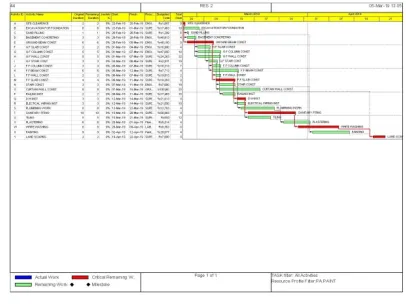
Fig 2: critical path for res building 1
ISSN(Online): 2319-8753 ISSN (Print) : 2347-6710
I
nternational
J
ournal of
I
nnovative
R
esearch in
S
cience,
E
ngineering and
T
echnology
(A High Impact Factor, Monthly, Peer Reviewed Journal)
Visit: www.ijirset.com
Vol. 8, Issue 3, March 2019
4.1.3 RESIDENTIAL BUILDING 3
Fig 4: critical path for res building 3
4.2 THEORITICAL METHOD
4.2.1 RESIDENTIAL DUILDING 1
ISSN(Online): 2319-8753 ISSN (Print) : 2347-6710
I
nternational
J
ournal of
I
nnovative
R
esearch in
S
cience,
E
ngineering and
T
echnology
(A High Impact Factor, Monthly, Peer Reviewed Journal)
Visit: www.ijirset.com
Vol. 8, Issue 3, March 2019
4.2.2RESIDENTIAL BUILDING 2
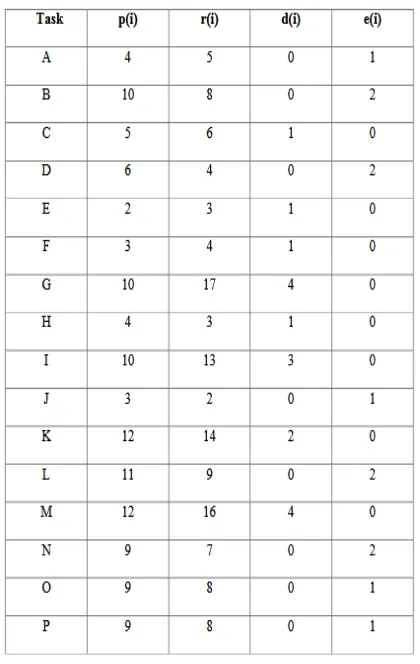
Fig 6: table for res building 2
ISSN(Online): 2319-8753 ISSN (Print) : 2347-6710
I
nternational
J
ournal of
I
nnovative
R
esearch in
S
cience,
E
ngineering and
T
echnology
(A High Impact Factor, Monthly, Peer Reviewed Journal)
Visit: www.ijirset.com
Vol. 8, Issue 3, March 2019
Fig 7 : table for res building 3
V. RESULT
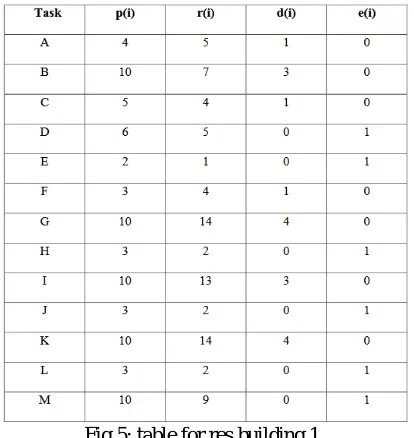
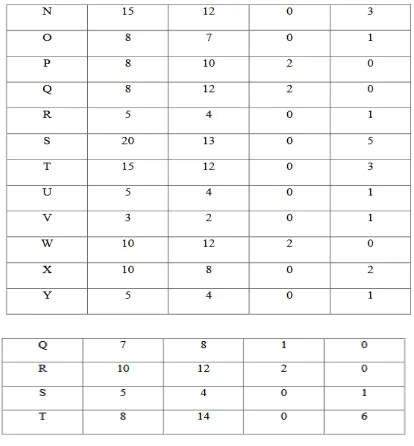
In this project, the delay occurs in the residential building 1 real time is 54 ,and the planned time is 36 so the total delay is 10 days.For residential building 2, the planned time is 48 and the real time is 60 so the total delay is 12 days. Then for residential building 3, the planned time is 56 and the real time is 64 so the total delay time is 14 days.
VI. CONCLUSION
ISSN(Online): 2319-8753 ISSN (Print) : 2347-6710
I
nternational
J
ournal of
I
nnovative
R
esearch in
S
cience,
E
ngineering and
T
echnology
(A High Impact Factor, Monthly, Peer Reviewed Journal)
Visit: www.ijirset.com
Vol. 8, Issue 3, March 2019
REFERENCES
1. Game Theory as a Tool of Project Management ,KaterinaBockova, Gabriela Slavikova, JurajGabrhel (2015)
2. Application of Game Theory Approach in Solving the Construction Project Conflicts ,AzinShakibaBarough, MojtabaValinejadShoubi, MoohammadJavadEmamiSkardi (2012)
3. Factors of Conflict in Construction Industry: A Literature Review ,N. Jaffar, A. H. Abdul Tharim, M. N. Shuib (2011) 4. Analysis on Causes of Delay in Construction Industry In Pune City ,Leena Mali, AbhijitWarudkar (2016)
5. Causes of Delay in Nigeria Construction Industry , KasimuAlhaji Mohammed, AbubakarDanladiIsah (2012) 6. Causes of conflicts in a construction industry: a communicational approach
SigitasMitkus, Tomas Mitkus (2013)
7. Investigating Causes of Construction Delay in Ethiopian Construction Industries WerkuKoshe, K. N. Jha (2016)
8. Causes and effects of delays in Malaysian construction industry, MuraliSambasivan, Yau Wen Soon (2006) 9. Game Analysis in the Construction Claim Negotiations
Hongchuan YUAN, Hui MA (2012)