Pursuance of Average Delay and Throughput
Analysis on Ad Hoc Network Protocols
K. Vijayalakshmi1, Dr. R. Manicka Chezian2
Research Scholar, Department of Computer Science, NGM College, Pollachi, India1
Associate Professor, Department of Computer Science, NGM College, Pollachi, India2
ABSTRACT: A Mobile Ad-hoc Network (MANET) is a collection of wireless mobile nodes that communicates with each other without using any existing infrastructure or centralized supervision. There are several familiar routing protocols like AODV, DSR, DSDV.Network throughput and packet delay are the two most important parameters to evaluate the performance of wireless ad hoc networks. Generally it is difficult to achieve both high throughput and low packet delay by Dynamic Source Routing Protocol for Mobile Ad Hoc Networks (DSR) and Ad-Hoc On-demand Distance Vector (AODV) routing protocol. Based on the routing load (delay, throughput) and the connectivity, this paper systematically discusses the performance and comparison of three typical routing protocols of ad hoc networks with the different simulation model and metrics.
KEYWORDS: MANET, AODV, DSR, DSDV, Throughput and Delay
I. INTRODUCTION
An ad-hoc network is a collection of wireless mobile hosts forming a temporary network without the assistance of any
centralized administration or any stand-alone infrastructure. If two wireless hosts are out of their transmission ranges in
the ad hoc networks, other mobile hosts located between them can forward their messages, which effectively builds connected networks among the mobile hosts in the deployed area administration.[1] The former simulation modeled a network of 60 mobile hosts and varying pause times, the latter modelled sceneries with 50 nodes and pause time of 0, 30, 60, 120, 300, 600 and 900 s, respectively. Das et al. carried out the simulation analysis to AODV and DSR. Their simulation has a model of 50 (the first group of experiment) and 100 (the second group of experiment) nodes at varying pause times. The above mentioned works consider the simulation model with a constant network size and a varying pause times or mobility speeds. This paper considers the simulation model with a dynamic network size and an invariable pause time which should be zero under weakest case. So we investigate performances of the routing protocols from different categories under various network scenarios (e.g., different network size, mobility speeds, etc.). This paper systematically discuses the performance evaluation and comparison of three typical routing protocols, AODV, DSDV, DSR and in ad hoc networks, which take the QoS (delay, throughput), routing load and connectivity as evaluation metrics.
II. RELATED WORK
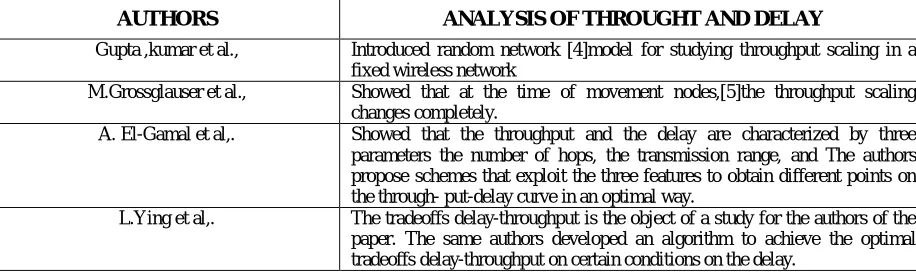
Table 1: Analysis of Throughput and Delay
AUTHORS ANALYSIS OF THROUGHT AND DELAY
Gupta ,kumar et al., Introduced random network [4]model for studying throughput scaling in a fixed wireless network
M.Grossglauser et al., Showed that at the time of movement nodes,[5]the throughput scaling changes completely.
A. El-Gamal et al,. Showed that the throughput and the delay are characterized by three parameters the number of hops, the transmission range, and The authors propose schemes that exploit the three features to obtain different points on the through- put-delay curve in an optimal way.
L.Ying et al,. The tradeoffs delay-throughput is the object of a study for the authors of the paper. The same authors developed an algorithm to achieve the optimal tradeoffs delay-throughput on certain conditions on the delay.
III. ROUTING PROTOCOLS IN MANET
Ad-hoc routing protocol setup the path, exchange information and take decision of runtime path.In this paper we work on reactive routing(AODV,DSR) and Hybrid Routing (ADV) Proactive Routing Proactive routing protocols are based on shortest path algorithms. It maintains and update information on routing among all nodes of a given network at all times even if the paths are not currently being used. [5]Thus, even if some paths are never used but updates regarding such paths are constantly broadcasted among nodes. Route updates are periodically performed regardless of network load, bandwidth constraints In this paper we work on reactive routing(AODV,DSR) and Hybrid Routing (ADV) There is three types of topology based routing
1. Proactive (table-driven) routing protocols 2. Reactive (on-demand) routing protocols 3. Hybrid routing protocols .
Reactive Routing On demand or reactive routing protocols were designed to overcome the overhead problem, that was created by proactive routing protocols, by maintaining only those routes that are currently active . These protocols implement route determination on a demand or need basis and maintain only the routes that are currently in use, thereby reducing the burden on the network when only a subset of available routes is in use at any timeAODV maintains and uses an efficient method of routing that reduces network load by broadcasting route [3,6]discovery mechanism and by dynamically updating routing information at each intermediate node. Route discovery in AODV can be done by sending RREQ (Route Request) from a node when it requires a route to send the data to a particular destination.
A.DYNAMIC SOURCE ROUTING PROTOCOL (DSR)
The Dynamic Source Routing (DSR) protocol is an on- demand reactive unicast routing protocol based on source routing. DSR protocol is composed by two “on-demand” mechanisms, which are requested only when two nodes want to communicate with each other. In DSR, each node uses buffer technology to keep route information of all the nodes. There are two major phases in DSR such as:
1. Route discovery 2. Route maintenance
In DSR, every mobile node in the network needs to maintain a route cache where it caches source routes that it has learned. When a host wants to send a packet to some other host, it first checks its route cache for a source route to the destination. In the case a route is found, the sender uses this route to propagate the packet. [8,9]Otherwise the source node initiates the route discovery process. Route discovery and route maintenance are the two major parts of the DSR protocol.
B..AODV
one of the goals is scalability, I have strived to make the code as efficient as possible. For example, I implemented an expanding ring search algorithm to limit the flood of RREQ messages Throughout the development process, I have used simulation programs which I have written to test and harden the code. Each AODV router is essentially a state machine that processes incoming requests from the SWANS network entity. [11]
Each routing table entry consists of the following fields: 1. Destination address
2. Next hop address
3. Destination sequence number
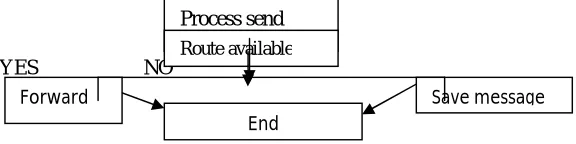
If a route exists, the router simply forwards the message to the next hop.Otherwise, it saves the message in a message queue, and then it initiates a route request to determine a route.
YES NO
FIG 1: sends the queued messages for AODV
AODV nodes use four types of messages to communicate among each other. Route Request (RREQ) and Route Reply (RREP) messages are used for route discovery. Route Error (RERR) messages and HELLO messages are used for route maintenance. [12] The following sections describe route determination and route maintenance in greater detail.
Table2: Comparison between AODV, DSR
Parameters AODV DSR
Source routing No Yes
Topology Full Full
Broad cast Full Full
Update Information
Route Error Route Error
Update Destination
Source Source
Method Unicast Unicast
Storage Capacity
O(E) O(E)
C.DESTINATION-SEQUENCED DISTANCE-VECTOR (DSDV)
The Table-driven DSDV protocol is a modified version of the Distributed Bellman-Ford (DBF) Algorithm that was used successfully in many dynamic packet switched networks [14]. The Bellman-Ford method provided a means of calculating the shortest paths from source to destination nodes, if the metrics (distance-vectors) to each link are known. DSDV uses this idea, but overcomes DBF’s tendency to create routing loops by including a parameter called destination-sequence number. On reception of these update messages, the neighbouring nodes use the following algorithm to decide whether to ignore the update or to make the necessary changes to its routing table
Step 1: Receive the update message
Step 2: Update the routing table if any one of the following condition satisfies: i) Sn > Sp
ii) Sn=Sp , Hop count is less
Otherwise, ignore the update message. Here, Sn and Spare the Sequence numbers of new message and existing message respectively. When a path becomes invalid, due to movement of nodes, the node that detected the broken link
Process send request
Route available
Forward message
is required to inform the source, which simply erases the old path and searches for a new one for sending data. The advantages are latency for route discovery is low and loop-free path is guaranteed. The disadvantage is the huge volume of control messages.
IV. THROUGHPUT AND DELAY
Throughput: Suppose packets arrive at node j as a Bernoulli process of rate j packets/slot, i.e., a packet arrives during the current slot with probability j, and otherwise no packet arrives. Other stochastic arrival flows with the same average rate can be treated similarly, and the arrival model does not affect the region of rates the network can support.[13]Thus, the per-node capacity of the network is the maximum rate that the network can stably support. Throughput is the average number of successfully delivered data packets on a communication network or network node. In other words throughput describes as the total number of received packets at the destination out of total transmitted packets. Throughput is calculated in bytes/sec or data packets per second. Mathematically,throughput is shown as Equation1
Throughput (bytes/sec) = Total number of received packets at destination* packet size
--- kb/s eq(1) Total simulation time
Delay: The delay of a packet is the time it takes from the source to reach its destination. The total network delay is the
expectation of the average delay over all packets, all S-D pairs, and all random network configurations in the long term.
The average End-to-End Delay AVG T is calculated as showing in Equation 2
TAVG = ∑NtNii=1(Hti-Hit) eq(2)
Nt= the total number of packets received Ht= emission instant of package
V. AVERAGE DELAY AND THROUGHPUT ANALYSIS
DSDV exhibits a shorter delay because it is a kind of table-driven routing protocol; each node maintains a routing table in which all of the possible destinations with the network and the number of hops to each destination are recorded, only packets belonging to valid routes at the ending instant get through. A lot of packets are lost until new (valid) route table entries have been propagated through the network by the route update messages in DSDV. The literature [15] has drawn a conclusion that DSR has a lower delay than AODV with a longer pause time.In our simulation experiments environment of high-speed movement and an increasing network size, DSR has always a longer delay than AODV. This is mainly in that the different simulation models are applied in table 3.
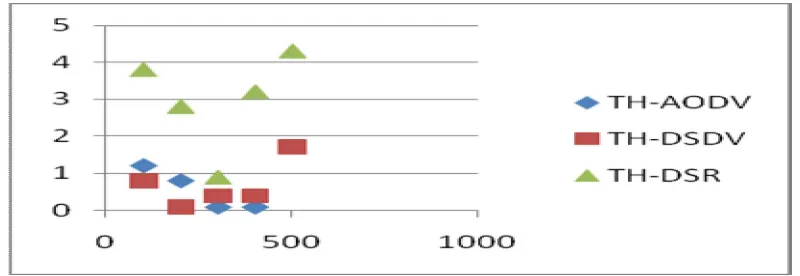
Table 3: Average Delay in Different Protocols
AODV DSDV DSR
1.2 0.8 3.8
0.8 0.1 2.8
0.1 0.4 0.9
0.1 0.4 3.2
FIG 2: Average Delay versus Number of Nodes
A. AVERAGE THROUGHPUT ANALYSIS
The average end to end throughput for the network is shown in Figs. 2 and 3, which reflects the usage degree of the network resources for the typical routing protocols. For the convenience to comparison, Fig. 2 only demonstrates the
throughput-changing curve with the number smaller than 50, and Fig. 3 presents the complete simulation‟s throughput-
changing curve. With an offered load of 1 packets/s the maximum throughput is approximately 4500 kbps. Throughput increases quickly for AODV, DSR and DSDV with increased number of nodes. TORA on the other hand has difficulties in finding routes when number increases, [16]which is clear from Fig. 3, where the throughput drops slightly with the number smaller than 50. [16]AODV is still the highest with the number exceeding 50, but this time DSDV has a better throughput. Throughput is the total of all bits (or packets) successfully delivered to individual
destinations over total-time / total- time (or over bits-total / total time) and result is found as per KB/Sec.In AODV, the
throughput increases with respect to number of nodes increases except network size 100, but very slowly because delay is very high. In DSDV, the throughput increases with respect to number of nodes increases except network size 100,
similar to AODV.Sometimes in data packets per second or data packets per time slot. From graph we can analyze as
number of node increase in network throughput gets better.
FIG 3: Average Throughput versus Number of Nodes
B.PARAMETER VALUES BY VARYING SPEED OF THE MOBILE NODES
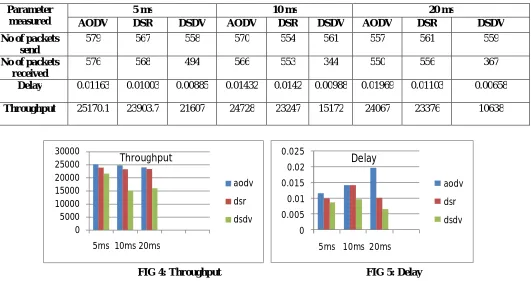
three routing protocols AODV is better than other two routing protocols and DSR have slightly lower throughput than AODV.The following table represent parameter values in different routing protocol shown in table 4.
Table 4: PARAMETER VALUES BY VARYING SPEED OF THE MOBILE NODES
Parameter measured
5 ms 10 ms 20 ms
AODV DSR DSDV AODV DSR DSDV AODV DSR DSDV
No of packets send
579 567 558 570 554 561 557 561 559
No of packets received
576 568 494 566 553 344 550 556 367
Delay 0.01163 0.01003 0.00885 0.01432 0.0142 0.00988 0.01969 0.01103 0.00658
Throughput 25170.1 23903.7 21607 24728 23247 15172 24067 23376 10638
0 5000 10000 15000 20000 25000 30000
5ms 10ms 20ms
aodv
dsr
dsdv
Throughput
0 0.005 0.01 0.015 0.02 0.025
5ms 10ms 20ms
aodv
dsr
dsdv
Delay
FIG 4: Throughput FIG 5: Delay
As it can be seen from the above simulation, end to end delay is higher in AODV followed by DSR and DSDV having the lowest and most stable End to End Delay in mobility. By increasing number of nodes in small area then reduce the end to end delay in AODV and increasing speed of the node then increase the delay in AODV. In DSR and DSDV slightly lower delay compared to AODV.
VI. CONCLUSION
Each mobile node in a MANET acts as a router by forwarding the packets in the network. Hence, one of the challenges in the design of routing protocols is that it must be tailored to suit the dynamic nature of the nodes.Throughput and Delay performance is discussed from various authors. From the analysis AODV performance is the best considering its ability to maintain connection by periodic exchange of data’s. As far as Throughput and Delay is concerned,
AODV and DSR perform better than DSDV even when the network has large number of nodes. The related
work uses the simulation model with a constant network size and varying pause time. It is concluded that in End-to-End delay and throughput of DSR and AODV showed better results than DSDV.In Future we discuss the impacts of
location popularity on scaling laws of MANETs. To analyze the Delay and Throughput, and find the performance is
worse than that of uniform scenarios.
REFERENCES
[2] Karthika.M, Dr. R. Manicka Chezian ,Survey On Ad-hocInWirelesss networks,International JournalComputerEngineering&Technology (IJARCET)Volume1,issue 5,july 2012 pp270-273.
[3] Akanksha Saint, Harish Kumar “Effect Of Black Hole Attack On AODV Routing Protocol In MANET”, IJCST Vol. 1, Issue 2, December 2010 [4] K.Vijayalakshmi, Dr. R. Manicka Chezian “A Study On Security Consideration In MANET”. National Conference on Emerging Trends In Big Data Analytics, FEB, 2015, ISBN 97893 80800417.
[5] P. Gupta and P. R. Kumar, “The Capacity of Wireless Networks,” IEEE Transactions on Information Theory, Vol. 46, No. 2, 2000, pp. 388-404. [6] A. S. Bedekar and M. Azizoglu. On the information-theoretic capacity of discrete-time queues. IEEE Trans. on Info. Theory, 44:446–461, 1998. [7] S. Narasimhan and S. Kunniyur, “Effect of Network Parameters on Delay in Wireless Ad Hoc Networks,” 2nd Annual IEEE Communications Society Conference on Sensor and Ad Hoc Communications and Networks (SECON), Santa Clara, 26-29 September 2005.
[8] R. Barr, Z. Haas, and R. van Renesse. JiST: An efficient approach to simulation using virtual machines. Software Practice & Experience, 35(6):539–576, 2005.
[9]Haas Z.J,”A new routing protocol for the reconfigurable wireless network”. In Proceedings of the 1997 IEEE 6th International Conference on Universal Personal Communications, ICUPC '97, San Diego, CA, October 1997; pp. 562 - 566.
[10]A. E. Gamal, J. Mammen, B. Prabhakar, and D. Shah, “Throughput-delay trade-off in wireless networks,” in Proc. IEEE Conf. Compute. Comm. Hong Kong, Mar. 2004, pp. 464–475.
[11] N. Banal and Z. Liu, “Capacity, delay and mobility in wireless ad-hoc networks,” in Proc. IEEE Conf. Compute. Commun. San Fran- Cisco, CA, USA, Apr. 2003, vol. 2, pp. 1553–1563.
[12]M. U. Chowdhury, D. Perera and T. Pham, “Performance Comparison of three Wireless Multi-Hop Ah-Hoc Net- work Routing Protocols When Streaming MPEG-4 Traffic,” Proceeding of the 8th International Multi-Topic Conference, 24-26 December 2004, Lahore, pp. 516-521.
[13] Nitin H. Vaidya,”Mobile Ad Hoc Networks: Routing, MAC and Transport Issues”, University of Illinois at Urbana-Champaign,(IEEE International Conference on Computer Communication). INFOCOM 2004, july pp81-94.
[14] A. S. Bedekar and M. Azizoglu. On the information-theoretic capacity of discrete-time queues. IEEE Trans. on Info. Theory, 44:446–461, 1998. [15]Vincent D. Park, M. Scott Corson, Temporally-Ordered Routing Algorithm (TORA) version 1: functional specification, Internet- Draft, draft-it-manet-tora-spec- 00.txt, November 1997, Work in progress.
[16] Qi Biao, He Jian-hua, Yang Zong-kai, Simulation of wireless Ad hoc routing protocols and its evaluation, Huazhong University of Science and Technology (Nature Science Edition) 32 (8) (2004) 66–69.
BIOGRAPHY
K.Vijayalakshmi is a Research Scholar in Department of Computer Science, Nallamuthu Gounder Mahalingam College, and Pollchi. She received her Master of Computer Science (M.Sc) in 2014 from Nallamuthu Gounder Mahalingam College, Pollachi under Bharathiar University, Coimbatore. She has presented papers in National conferences and attended Workshop, Seminars. Her research focuses on advanced networking.